
A company buying a $2 million commercial property from a GST-registered seller could face a further $180,000 in GST. Where the purchasing company is GST-registered and the acquisition qualifies for input tax recovery, that GST can be claimed through its GST return. For an investor buying an office, shop or industrial unit, the difference can materially change the acquisition budget.
The structure is straightforward in principle: establish the purchasing private limited company, arrange its GST registration and financing, and buy the property in that company’s name. The company must have a genuine business purpose and meet the input tax conditions. Incorporation by itself does not create a right to a refund. A company is not the only structure that can qualify for GST recovery; the relevant business and registration conditions determine entitlement.
The decision also extends beyond completion. A GST-registered landlord generally charges GST on commercial rent and on a subsequent taxable property sale. The right structure should work for the purchase, the rental business and the eventual exit.
How buying commercial property through a company works
The private limited company becomes the purchaser and owner. Investors hold shares in the company rather than owning the property directly. This can provide a clear structure for several investors, with agreed contributions, voting rights and arrangements for selling their interests.
Before incorporation, decide whether the property belongs in an existing operating company or a separate property-holding company. A separate vehicle keeps its accounts, rental receipts and financing easier to distinguish from an operating business. It also creates another set of annual administration costs. Bank guarantees and security arrangements can affect how much practical protection the structure provides.
Singapore companies need at least one locally resident director and must appoint a company secretary within six months of incorporation. ACRA’s requirements for company officers explain these obligations. The shareholders should also agree how the deposit, completion funds and ongoing expenses will be funded.
When the purchase attracts GST
The standard GST rate is 9%. An ordinary taxable sale of non-residential property by a GST-registered seller attracts GST. If the seller is not GST-registered and is not required to charge it, there is no purchase GST to recover. Check the actual selling entity through the IRAS GST-registered business search.
The contract should make clear whether the agreed price includes GST or whether GST is payable on top. That distinction changes the cash needed to complete. For a property containing residential and commercial portions, the GST treatment also needs to reflect the different portions. A shophouse’s marketing description is not enough to establish its tax classification.
A sale with an existing tenancy can require a further assessment of whether it qualifies as a transfer of a going concern. A qualifying business transfer can have different GST treatment; the presence of a tenant alone does not settle it. The IRAS rules on transferring businesses explain when a qualifying transfer is excluded from GST.
Can the company claim back the purchase GST?
Yes, when the purchase meets the applicable conditions. Under section 19 of the Goods and Services Tax Act 1993, allowable input tax is credited against output tax. Subject to the Act’s conditions, an excess credit can be refunded. This is the mechanism behind recovering purchase GST through the company’s GST return.
The IRAS input tax conditions require, among other things, that the company is GST-registered, the property is supplied to it for its business, and the claim is supported by a valid tax invoice addressed to it. The GST must be attributable to qualifying taxable supplies. Private use, exempt activities and disallowed claims can restrict recovery.
For a property-holding company, commercial letting is a familiar taxable activity. The tenant does not have to be GST-registered for the landlord’s commercial rent to be taxable. The tenant’s status instead matters to the tenant’s own ability to recover the GST charged on rent.
If the company buys premises for its own operations, the relevant question is what those operations do. Premises supporting a taxable trading business and premises supporting exempt activities can produce different recovery outcomes. A company carrying out both needs to consider apportionment rather than assuming a full claim.
Worked example: a $2 million commercial unit
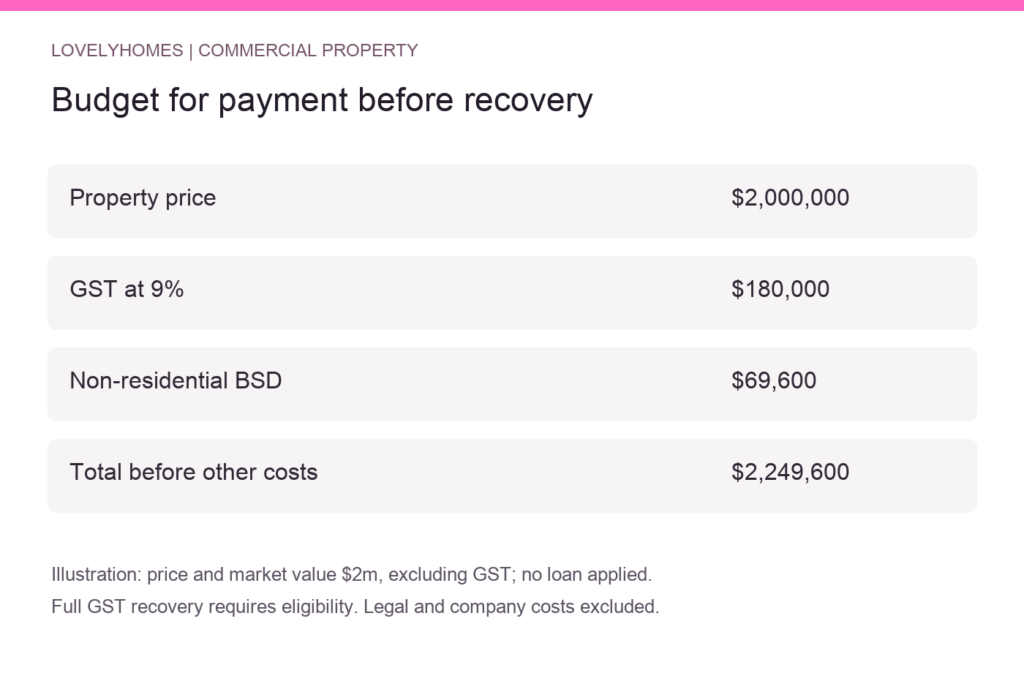
Assume an ordinary taxable purchase at $2 million excluding GST, a GST-registered seller, a market value equal to the purchase price, and full input tax eligibility for the purchasing company. Legal fees, valuation, financing and company administration are excluded from the illustration.
| Item | Amount | Treatment |
|---|---|---|
| Property price excluding GST | $2,000,000 | Purchase consideration |
| GST at 9% | $180,000 | Payable under the purchase terms; potentially recoverable |
| Non-residential Buyer’s Stamp Duty | $69,600 | Separate stamp duty cost |
| Total before other costs | $2,249,600 | Funding requirement before any GST recovery or loan |
| Cost after full purchase-GST recovery | $2,069,600 | Price plus BSD, before other costs |
The $180,000 is a recoverable tax amount in this scenario, not a reduction in the seller’s price. The company still needs to fund the GST when the contract requires payment. A later refund should not be treated as money already available for completion.
If the company were entitled to recover only 60% of that purchase GST, the claim would be $108,000 and the unrecovered amount would be $72,000. This is a mathematical illustration of partial recovery, not an entitlement to use a 60% allocation.
Registering a new company for GST
A newly incorporated company does not need to wait until its turnover reaches $1 million to explore registration. It can apply voluntarily if it qualifies. For a new property business, IRAS needs to be satisfied that it is carrying on a business and has firm intentions to make qualifying supplies. A genuine commercial-letting plan should be supported by the transaction and business documents.
The voluntary-registration rules also make the wider financial decision important: consider both recoverable purchase GST and the effect of charging GST to customers. Registering the property company does not register its shareholders or a separate trading company.
Under the conditions for voluntary GST registration, the business must generally remain registered for at least two years. Conditions include GIRO arrangements, the relevant GST learning requirement unless exempt, and a guarantee if required. A business that has not begun making taxable supplies must do so within two years or an approved longer period.
New voluntary applications made on or after 1 April 2026 also fall within the GST InvoiceNow requirement. Include suitable accounting software and invoice-data submission arrangements in the company’s setup, alongside the bank account and bookkeeping process.
Arrange the buyer and registration before signing
The cleanest purchasing sequence is to decide the ownership structure first, establish the company, assess GST registration and agree the funding before entering the transaction. The company name, purchase documents, invoices and payment records should tell a consistent story.
- Confirm the property and seller. Establish the approved use, tax classification, selling entity and whether the price includes GST.
- Set up the purchaser. Agree shareholders, directors, funding and the company’s intended business.
- Prepare GST registration. Coordinate the application, supporting documents, GIRO and InvoiceNow setup with the purchase timetable.
- Secure financing and transaction advice. Review the bank’s terms, any guarantees and the contract’s GST provisions.
- Complete and account for the purchase. Retain the company’s tax invoice, completion statement and supporting records for the claim.
Do not assume a pending GST application is an effective registration. IRAS’s registration process states that voluntary registration is not backdated for the purpose of claiming input tax. The effective date in the approval matters.
There is also an option-fee issue. Where an individual takes an Option to Purchase with a nominee clause and a company later exercises it, the recipient of the original option can affect the input tax claim on that fee. IRAS’s real-estate GST guidance addresses this point. Establishing the intended buyer early is preferable to relying on a later nomination to solve the paperwork.
What if the purchase happens before GST registration?
A purchase before the effective registration date does not necessarily mean all GST is lost. There are specific pre-registration input tax rules, including conditions concerning timing, whether assets remain held and their use before registration. Apportionment may apply.
Expenses incurred before incorporation are a separate question. IRAS imposes additional conditions and requires written approval for a company to claim qualifying pre-incorporation GST. Neither route should be treated as an automatic correction for buying personally and incorporating afterwards.
If the deal is already under way, gather the option, exercise documents, invoices, payment dates, occupation history and rental commencement date. Those details allow the company’s tax adviser to determine the claim under the actual timeline. If you need an introduction to property lawyers to review the contract or purchasing entity, Lin Xuan and Ade can help arrange one.
Rent, resale and deregistration: the ongoing GST cost
Once registered, an ordinary commercial landlord charges GST on taxable rent. For example, rent of $8,000 a month excluding GST becomes $8,720 at a 9% rate, with $720 of output GST. The company accounts for output tax and eligible input tax through its returns. Its eventual taxable sale also generally attracts GST while it remains registered.
The lease wording affects the commercial result. If a tenant can recover input GST, the tax may be less significant to its final occupancy cost. A tenant without recovery rights sees the GST as an additional cost. Compare competing units on the tenant’s total payment, as well as your net rental receipts.
Registration is not something to cancel immediately after receiving a property refund. Apart from the minimum voluntary-registration period, deregistration rules can require output GST on business assets still held where input tax was claimed and the relevant assets’ total open-market value exceeds $10,000. Non-residential property is included.
For illustration, a retained property worth $2.2 million would produce $198,000 of output GST at 9% if it falls within that deregistration charge. The calculation uses its value at deregistration, rather than simply reversing the original $180,000 claim. The exit plan belongs in the investment assessment from the beginning.
Stamp duty, company costs and borrowing still matter
GST recovery does not remove Buyer’s Stamp Duty. For non-residential property, BSD is charged on the higher of price and market value: 1% on the first $180,000, 2% on the next $180,000, 3% on the next $640,000, 4% on the next $500,000 and 5% above $1.5 million. That produces the $69,600 in the example.
Purely non-residential property is outside residential ABSD, whether bought personally or through a company. Mixed-use assets need a separate classification assessment under the ABSD rules. Incorporation should not be presented as the reason a commercial purchase avoids residential ABSD.
Budget for bookkeeping, GST returns, company-secretarial work, annual filings and corporate tax compliance. Rental income and deductible expenses also need their own income-tax assessment under the rules for investment-holding companies. Purchase GST recovery is only one part of the ownership cost.
Ask bankers to price the transaction for the actual purchasing company and property. Compare the loan amount, tenure, rate, fees, lock-in, guarantees and treatment of the purchase GST. A larger tax recovery can still sit alongside a less favourable loan or a higher annual compliance bill.
Company incorporation and GST support
Raffles Corporate Services is a corporate service provider offering company incorporation, corporate-secretarial services, accounting, GST registration and GST filing support. Buyers considering a property-holding company can contact its team to coordinate the company setup and GST application with their proposed purchase.
Bring the property details, expected purchase price, seller’s GST status, ownership plans and intended use. That gives the team a practical basis to scope the work and identify the documents required. GST registration and recovery remain subject to IRAS’s rules and the company’s circumstances.
Is this structure right for your purchase?
A private limited company can be a useful vehicle for a genuine commercial-property business, particularly where ownership, accounting and funding are organised before the purchase. The strongest decision combines a qualifying GST claim with workable rental economics, manageable compliance and a sensible exit.
Before committing, put four figures beside one another: the cash needed at completion, the GST actually recoverable, the annual net income after ownership costs, and the tax and financing consequences of selling. That comparison is more useful than judging the purchase by the refund alone.
For wider context, read our commercial-property investment guide and our guide to buying property through a company or SPV.
Need help with a commercial-property purchase?
Contact Lin Xuan at 82222556 or Ade at 81888871 to discuss available properties, arrange a viewing or request introductions to bankers who can help compare commercial-property loan rates and packages for your needs. If you need legal advice on the purchase, lease or ownership structure, we can also introduce you to property lawyers.
WhatsApp Lin Xuan | WhatsApp Ade. For a new commercial launch, you can also request its full brochure and latest available price list. Loan terms and approval are determined by the bank; prices and availability are subject to seller or developer confirmation.
Lin Xuan: ONG LIN XUAN, CEA registration R069812H. Ade: CHUA MUAY MUAY (ADE CHUA), CEA registration R014252F. ERA REALTY NETWORK PTE LTD, estate agent licence L3002382K.