
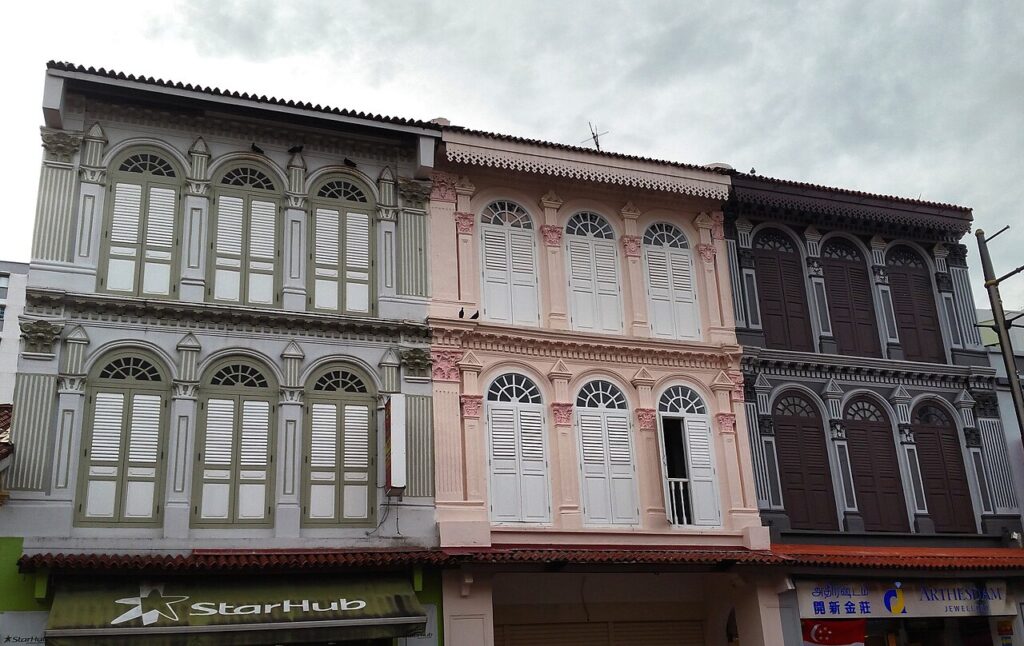
- On 7 August 2026, URA formally awarded the Chitty Road and Veerasamy Road conservation cluster in Little India to YK Land (a subsidiary of the Soon Hock Group) at S$35.3 million.
- The top bid of S$962 psf was approximately 48% above the second-highest offer among seven bidders , an unusually wide spread that reflects strong conviction from YK Land in the site’s conservation premium.
- The site comprises 18 conserved pre-war Art Deco terrace houses built in 1927, originally constructed as municipal quarters for government employees, now heritage-listed under the URA Conservation Guidelines.
- Permitted uses are either long-stay serviced apartments (SA2 use, minimum 3-month stay) or strata landed housing , both low-density uses compatible with the heritage streetscape.
- This is a rare conservation GLS: fewer than five comparable conservation clusters have been offered at public tender since 2010.
The Site: Little India’s Art Deco Municipal Quarters
The Chitty Road and Veerasamy Road site sits within the Little India Historic District, one of Singapore’s four designated conservation precincts under URA’s overarching Urban Conservation Programme. The 18 two-storey terrace houses , constructed in 1927 as quarters for municipal government employees , form two parallel rows linked by a back lane, a building typology characteristic of colonial-era government housing in the region.
The buildings are constructed in the Art Deco style, with characteristic geometric facades, moulded plaster cornices and timber louvred shutters. The URA’s conservation guidelines require owners to retain the external facade, fenestration pattern, roof form and architectural elements while permitting internal reconfiguration. This means any developer will work within a fixed exterior envelope , which both increases construction complexity and substantially enhances the finished product’s distinctiveness compared with a conventional development site.
The total site area is approximately 0.34 hectares , small by GLS standards , and the 18 units have a combined floor area of around 3,600 square metres (about 38,750 sq ft). The site is located in District 8, within walking distance of the Little India MRT station on the North East Line (NEL) and the future Rochor station on the Thomson-East Coast Line (TEL), with completion expected in 2027.
The Tender Result: Seven Bidders, One Clear Winner
The tender for the site closed on 28 July 2026. URA received seven bids , a competitive result that underscores genuine developer appetite for conservation sites despite their complexity. The top bid of S$35.3 million, submitted by YK Land (a vehicle of the Soon Hock Group), was approximately 48% above the second-highest bid. This spread is remarkable: in most GLS tenders, the gap between first and second bid is 5–15%. A 48% differential indicates either highly divergent views on value among bidders, or an unusually aggressive and well-researched conviction from the winning bidder.
| Site Details | Value |
|---|---|
| Location | Chitty Road and Veerasamy Road, Little India (District 8) |
| Site Area | ~0.34 hectares |
| Number of Buildings | 18 conserved pre-war terrace houses (1927) |
| Tenure | 99-year leasehold |
| Permitted Use | Long-stay serviced apartments (SA2) or strata landed housing |
| Winning Bidder | YK Land (Soon Hock Group) |
| Winning Bid | S$35,300,000 (approximately S$962 psf of land area) |
| Number of Bids | 7 |
| Gap to 2nd Bid | ~48% |
| URA Press Release | pr26-60, 7 August 2026 |
Who Is YK Land?
YK Land Pte Ltd is a development vehicle of the Soon Hock Group, a Singapore-based privately held property developer with an established track record in conservation shophouse redevelopment, boutique hospitality and specialist residential projects. The Soon Hock Group has previously been involved in conservation property projects in Chinatown and Kampong Glam, both of which are located in URA-designated conservation precincts. Its focus on heritage properties suggests YK Land will likely pursue the serviced apartment route , leveraging Little India’s growing standing as a lifestyle and heritage tourism destination , rather than strata landed housing, though both uses remain permitted subject to URA’s prior written approval.
What Will It Become?
The two permitted uses are structurally different in their economics and market positioning:
Option A , Long-stay serviced apartments (SA2): SA2 use means minimum 3-month leases , targeting expatriates, relocated professionals and digital nomads rather than short-stay tourists. With 18 terrace units across a conserved block, a well-executed SA2 scheme could produce 18–36 serviced residences (depending on internal subdivision), positioned at the boutique end of the market. Given Little India’s MRT access and proximity to the Farrer Park medical cluster and Tekka Centre, demand from medical tourism and long-term expatriate tenants would be a natural fit. Comparable SA2 serviced residences in the area achieve gross yields of 4.5–6% at current rental levels.
Option B , Strata landed housing: This is the rarer option for a conservation cluster, but not unprecedented. Strata landed units within a conservation terrace row would be highly differentiated , freehold-quality character, limited supply, and a central location. Comparable conservation shophouses in Tanjong Pagar or Duxton Hill have achieved S$4,000–S$6,500 psf in recent transactions. At 3,600 sqm total floor area, a strata landed scheme could command total GDV well above S$150 million , implying very substantial development margins over the S$35.3M land cost, subject to construction, conservation-compliance and financing costs.
What This Means for Singapore’s Conservation Property Market
Conservation sites are a structurally constrained sub-segment of Singapore’s property market. URA’s conservation policy, administered under the Planning Act, protects approximately 7,000 pre-war buildings across six conservation areas (Chinatown, Little India, Kampong Glam, Singapore River, Cairnhill and Beach Road/Bugis). New conservation GLS sites are released rarely and on a project-specific basis , they do not follow the standard Government Land Sales Programme cycle.
The strong seven-bidder response and the winning bid’s 48% premium above second place signal that well-located conservation sites remain highly sought after by developers, even in a year where general residential GLS demand has been more measured. For buyers and investors tracking the conservation shophouse market, this result reinforces the view that authentic heritage stock in established precincts , particularly those with modern MRT connectivity , continues to attract a premium that is structural rather than cyclical.
For the Little India precinct specifically, the award adds momentum to a broader revival narrative. The upcoming completion of the TEL Rochor station, the continued development of the Farrer Park medical precinct, and the heritage-tourism investments along Serangoon Road all support the area’s transition from a neighbourhood with purely ethnic retail character to one that is actively sought by lifestyle and boutique hospitality operators.
Related Articles
- Berlayar Drive GLS 2026: Single S$576M Bid Sets RCR Land Price Record
- Singapore En Bloc Sale Guide 2026: Complete Collective Sale Guide
- En Bloc Reform 2026: New Consent Thresholds Explained
- ABSD Singapore 2026: Complete Guide to Additional Buyer’s Stamp Duty
Frequently Asked Questions
Can the public buy units from the Chitty Road conservation development?
That depends on the development use chosen by YK Land. If the site is developed as strata landed housing, the individual units may be offered for public sale as strata-titled properties , in which case buyers would be subject to the normal rules for strata landed housing (Singapore Citizens and PRs can purchase freely; foreigners require LDAU approval). If developed as long-stay serviced apartments (SA2), the units would likely be marketed on a rental basis rather than sold en strata, as SA2 serviced residences are commonly held by a single operator or investment entity. URA must approve the final use before development can proceed.
What is the difference between SA1 and SA2 serviced apartments?
Singapore’s planning framework distinguishes two categories of serviced apartments. SA1 (short-stay) applies a minimum tenancy period of 7 consecutive days and is used for hotel-style accommodation. SA2 (long-stay) requires a minimum tenancy of 3 consecutive months, targeting longer-term residents rather than tourists. SA2 use is URA-approved and common in conservation buildings where the boutique scale and heritage setting suits professional long-stay tenants rather than high-turnover hotel guests. The Chitty Road site’s permitted use is SA2 , meaning it cannot be operated as a short-stay hotel or home-sharing platform.
Why did the top bid come in 48% above the next bidder?
Wide bid spreads on conservation GLS sites are not unusual but a 48% gap is towards the extreme end. Possible explanations include: YK Land’s specific expertise and lower-risk construction assumptions for conservation work (which other bidders may have priced more conservatively); a unique business plan (such as a pre-arranged anchor tenant or joint venture partner) that justified a materially higher land cost; or a portfolio-level strategic value (e.g. completing a conservation precinct holding) that translated into a higher subjective valuation. The competitive result (seven bids) confirms that the site attracted genuine interest , the spread simply reflects divergent views on what the site is worth when fully realised.
What are URA’s conservation guidelines for redeveloping conservation buildings?
URA’s Conservation Guidelines require owners of gazetted conservation buildings to retain and restore the original external character: facades, fenestration, roof form, boundary walls, five-foot way (covered walkway) and any distinctive architectural features. Internal reconfiguration , combining units, inserting new floors within the existing envelope, upgrading services and finishes , is permitted with URA’s prior approval. Owners are also required to maintain the buildings in good repair. Demolition of conservation buildings is not permitted without URA’s express consent, which is granted only in exceptional circumstances such as structural irreparability. Developers who win conservation GLS sites typically engage URA’s Conservation team early in the planning phase to align on what works are permissible.
How does this compare with other recent conservation GLS awards?
Conservation GLS sites are released infrequently. Comparable recent conservation tenders include the Beach Road conservation cluster (awarded in 2019) and various individual shophouse sites in Chinatown and Kampong Glam offered since 2015. At S$962 psf of land, the Chitty Road result is at the higher end of conservation site pricing, reflecting the quality and completeness of the cluster (18 buildings in a coherent row), the improving connectivity from the TEL Rochor station, and the growing market depth for boutique hospitality and conservation residential assets in Singapore. The nearest comparison , individual conservation shophouses in the same precinct , have been changing hands at S$3,500–S$5,000 psf in recent private treaty transactions, suggesting a very wide development margin at the land cost achieved.
Disclaimer
This article is based on the URA press release pr26-60 (7 August 2026) and publicly available information as at 7 August 2026. It is for informational purposes only and does not constitute investment, property, legal or financial advice. Readers should conduct independent due diligence and consult qualified professionals before making any property-related decision. Source: URA pr26-60, URA Conservation Guidelines.
Supporting graphics
Original article illustrations are available below.
