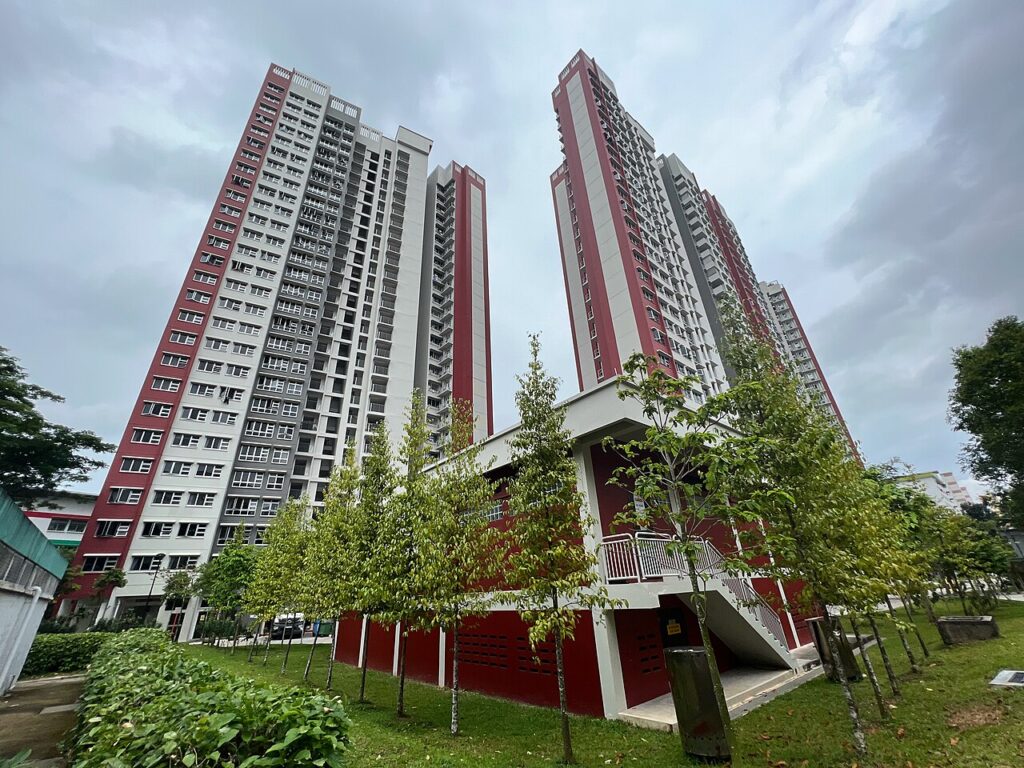
Quick Answer: The HDB Public Rental Scheme
- The Public Rental Scheme (PRS) is HDB’s social safety net for households with no other housing option, letting eligible Singapore Citizens rent a 1-room or 2-room flat directly from HDB at a heavily subsidised rent, rather than buying a flat outright.
- There is no fixed income ceiling. HDB commonly cites a household income guideline of around S$1,500 a month, but assesses each application holistically, considering family size, housing budget, family support and individual circumstances, so households above the guideline with genuine housing difficulty may still qualify.
- Applicants must be at least 21 years old, and generally form a family nucleus with a Singapore Citizen or Permanent Resident, or apply as a single person under the Joint Singles Scheme (JSS).
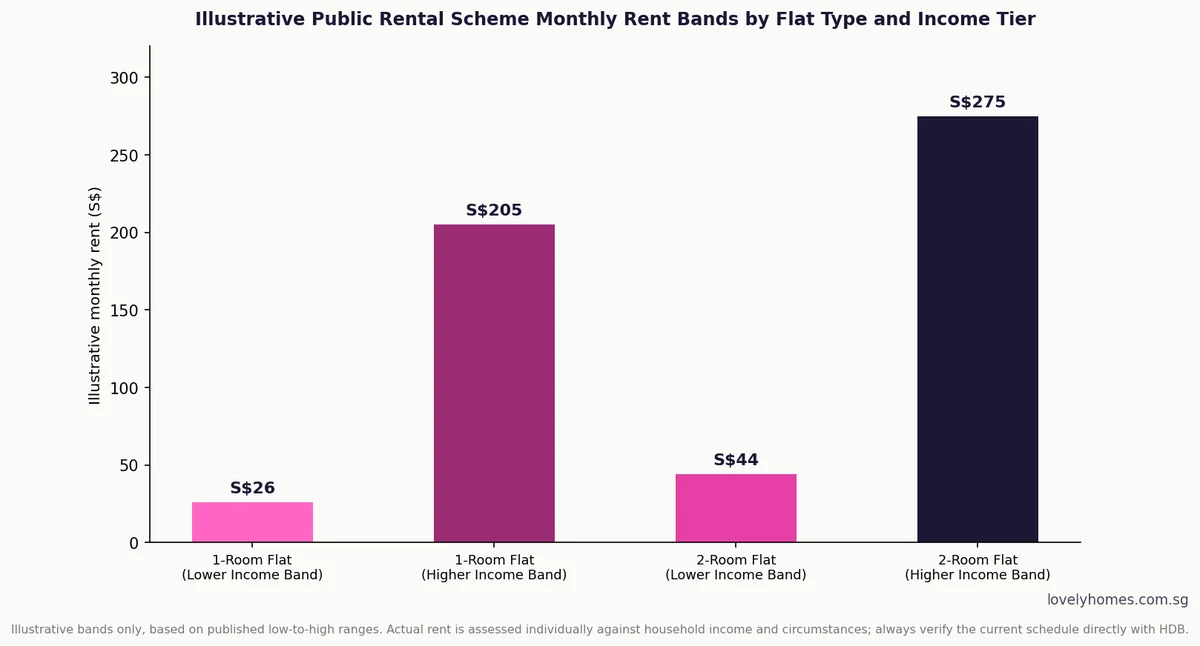
- Illustrative monthly rents range from around S$26 to S$205 for a 1-room flat and S$44 to S$275 for a 2-room flat, assessed individually against household income.
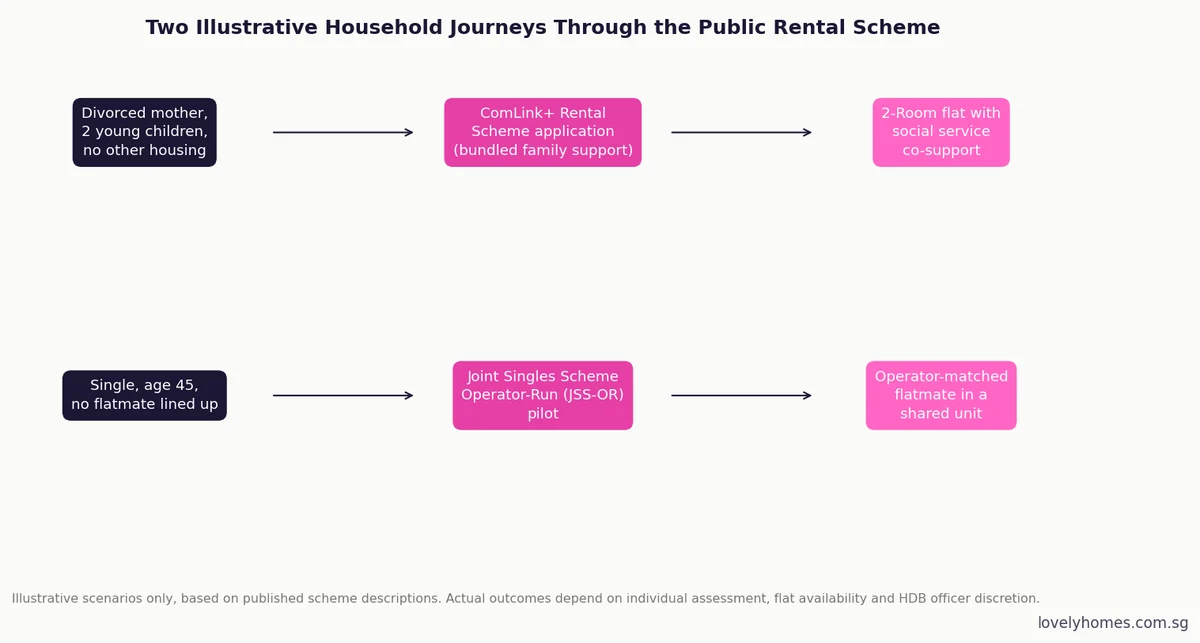
- Newer access routes include the Joint Singles Scheme Operator-Run (JSS-OR) pilot, which matches singles with a flatmate rather than requiring them to find one themselves, the Single Room Shared Facilities (SRSF) pilot, and the ComLink+ Rental Scheme, which bundles a rental flat with social support for families with children under 21.
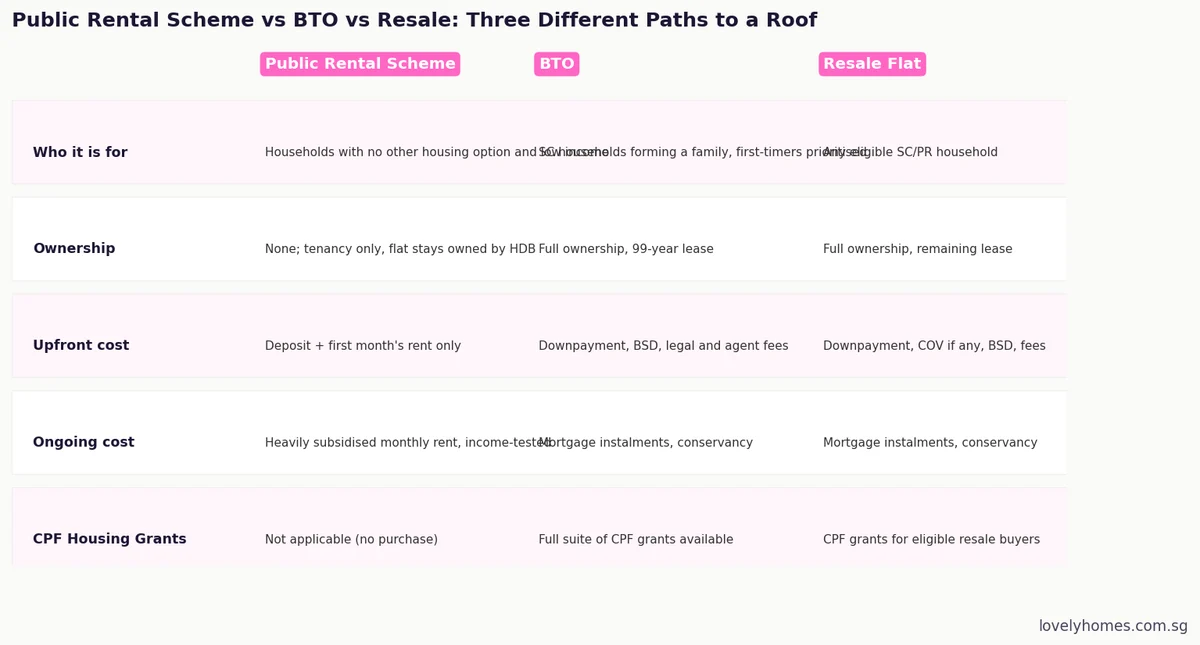
- PRS is a tenancy, not ownership: the flat remains owned by HDB, tenants do not accrue equity, and CPF Housing Grants (which apply to BTO and resale purchases) are not relevant since no purchase takes place.
- Tenancies are reviewed periodically, and continued eligibility (income, family circumstances, conduct) is reassessed at each renewal; always check the current criteria, rents and available flats directly with HDB before applying.
Home ownership dominates the conversation about HDB, but it is not the only path HDB offers. For households with genuinely no other housing option, whether through very low income, family breakdown, destitution or a run of bad luck, the Public Rental Scheme exists as a direct safety net: a flat rented straight from HDB, at a rent that is deliberately kept far below market and scaled to what the household can actually afford. It sits apart from BTO, resale and even the Lease Buyback Scheme, all of which assume the household already owns or is buying a flat. This guide sets out who qualifies for PRS, what it actually costs, the newer access routes HDB has piloted for singles and families, and how it compares with Singapore’s home-ownership schemes.
What the Public Rental Scheme Actually Is
The Public Rental Scheme is administered directly by HDB and functions as Singapore’s principal public housing safety net for households that cannot access, or are not ready for, home ownership. Unlike BTO or resale, where the household eventually owns the flat and a 99-year lease, PRS tenants rent a 1-room or 2-room flat directly from HDB on a tenancy basis. The flat remains HDB property throughout, rent is reassessed periodically against the household’s circumstances, and the scheme is explicitly designed as transitional or long-term support rather than a stepping stone that automatically leads to ownership, although some tenants do eventually move on to a BTO or resale purchase once their circumstances improve.
Who Can Apply
To apply, at least one applicant must be a Singapore Citizen aged 21 or above, and the household must generally form a family nucleus, typically with a spouse, children, parents or siblings, at least one of whom is a Singapore Citizen or Permanent Resident. Singles without a family nucleus can apply under the Joint Singles Scheme (JSS), which requires finding a co-applicant to share a flat, or under the newer JSS-OR pilot described below. Applicants must not own, and must not have recently disposed of, any residential property locally or overseas, and households that sold a property may face a debarment period before PRS eligibility, similar in spirit to the rules that apply to BTO and resale purchases. HDB does not apply a single hard income ceiling; instead it commonly refers to a guideline of around S$1,500 a month household income, while stressing that applications are assessed holistically, taking into account family size, existing support, and the genuineness of the housing need.
Flat Types and Where They Are Located
PRS flats are drawn from HDB’s rental flat stock, mostly 1-room and 2-room units spread across various towns rather than concentrated in a single estate. Some flats are offered as Partitioned Flats, where a larger unit is divided to house more than one household, which HDB uses to make more efficient use of its rental stock. Available flat types and locations change over time depending on stock and demand, so applicants are matched to what is currently available rather than being able to choose freely across all towns, and priority is generally given to applicants with the most urgent housing need.
Rent and Deposits
Rent under PRS is heavily subsidised and scaled to household income, rather than fixed at a single flat rate. Illustrative published ranges run from around S$26 to S$205 a month for a 1-room flat, and S$44 to S$275 a month for a 2-room flat, with the exact figure assessed individually against the household’s income and circumstances at the point of application, and reviewed again at each tenancy renewal. Tenants also pay a deposit at the start of the tenancy, generally equivalent to a modest number of months’ rent, which is refundable subject to the flat being returned in good condition and rent being kept current. Because rent is reassessed periodically rather than fixed for the life of the tenancy, a household’s rent can rise or fall as its income changes, which is a meaningful difference from a fixed mortgage instalment under a BTO or resale purchase.
Newer Access Routes: JSS-OR, SRSF and ComLink+
HDB has piloted several newer entry points into PRS aimed at groups the standard scheme served less well. The Joint Singles Scheme Operator-Run (JSS-OR) pilot removes the traditional requirement that a single applicant first find their own flatmate; instead, an appointed operator matches tenants based on profile, preferences and living habits, and the pilot has expanded from three to six sites since its 2021 launch. The Single Room Shared Facilities (SRSF) pilot introduces a new flat typology for singles, using the same eligibility criteria as JSS, with shared common facilities to make more efficient use of limited rental stock. The ComLink+ Rental Scheme is aimed specifically at families with children under 21 living in public rental housing, bundling the flat with coordinated social support intended to help the household build toward greater stability, rather than treating the rental flat as support in isolation.
Tenancy Renewal and Ongoing Obligations
PRS tenancies are not indefinite grants; they are reviewed and renewed periodically, with HDB reassessing income, family circumstances and conduct at each renewal. Rent can be adjusted at renewal to reflect a change in household income, and tenants who breach tenancy conditions, including unauthorised subletting of a PRS flat (which is not permitted) or falling significantly behind on rent without engaging HDB, risk having their tenancy terminated. HDB also offers assistance channels for tenants facing genuine payment difficulty, and encourages early engagement rather than allowing arrears to accumulate silently.
Public Rental Scheme at a Glance
| Feature | Public Rental Scheme |
|---|---|
| Minimum age | 21, with at least one Singapore Citizen applicant |
| Household type | Family nucleus, or Joint Singles Scheme (JSS/JSS-OR) for singles |
| Income guideline | Around S$1,500/month household income, assessed holistically, not a hard ceiling |
| Flat types | 1-room and 2-room flats, including Partitioned Flats and SRSF units |
| Rent | Illustrative S$26 to S$205 (1-room), S$44 to S$275 (2-room), income-assessed |
| Ownership | None; flat remains owned by HDB throughout the tenancy |
| Review | Periodic tenancy renewal, income and circumstances reassessed |
Worked Example: Two Household Journeys
Consider a divorced mother with two young children who has no other housing option after her matrimonial flat was sold and divided as part of a divorce settlement. Rather than the standard PRS route alone, her household may be directed toward the ComLink+ Rental Scheme, which pairs a 2-room rental flat with coordinated social support, recognising that housing instability for young children often accompanies other needs that a flat alone will not resolve. Separately, consider a single 45-year-old without a ready-made flatmate, who previously would have struggled to complete a joint application under the standard Joint Singles Scheme. Under the JSS-OR pilot, this applicant can apply alone and be matched by an appointed operator to a compatible flatmate in a shared unit, removing what has historically been one of the biggest practical obstacles for single PRS applicants.
Why This Matters
Singapore’s public housing policy is often discussed purely in terms of home ownership, BTO ballots, resale prices and CPF grants, which can obscure the fact that a meaningful share of households are not ready to buy a flat at all, whether due to income, family breakdown or a temporary crisis. The Public Rental Scheme, and the newer pilots layered onto it, represent a deliberate widening of HDB’s remit beyond ownership, treating stable housing as a foundation that some households need before ownership becomes realistic, rather than assuming every household’s end goal is a purchased flat. A parliamentary adjournment motion in 2026 explicitly framed this as “supporting diverse aspirations through rental housing,” signalling that policymakers see rental as a legitimate long-term outcome for some households, not merely a waiting room before ownership.
What Might Come Next
The JSS-OR and SRSF pilots remain pilots for now, and their continuation or expansion will likely depend on take-up and outcomes at the current sites. Given HDB’s broader 2026 policy direction, including scrapping the 15-month wait-out period for private owners buying HDB resale flats in response to affordability pressures, further adjustments to rental housing access are plausible, though nothing has been confirmed. Applicants should always check HDB’s official Public Rental Scheme pages directly for the current eligibility criteria, rent bands and flat availability before making any decision, since figures and criteria in this guide are illustrative and subject to change.
Frequently Asked Questions
Is there a fixed income ceiling for the Public Rental Scheme?
No. HDB commonly refers to a guideline of around S$1,500 a month household income, but applications are assessed holistically, and households above this guideline with genuine housing difficulty may still be considered.
Can Permanent Residents apply for PRS on their own?
At least one applicant in the household must be a Singapore Citizen. Permanent Residents can be included as part of a family nucleus alongside a Citizen applicant, but cannot apply as the sole applicant.
Do PRS tenants build up any ownership stake in the flat?
No. PRS is a tenancy, not a purchase. The flat remains owned by HDB throughout, and tenants do not accrue equity or lease value in the way a BTO or resale buyer does.
What is the difference between JSS and JSS-OR?
Under the standard Joint Singles Scheme (JSS), applicants must find their own flatmate before applying. Under the JSS-OR pilot, an appointed operator matches applicants to a compatible flatmate, removing the need to find one independently.
Can a PRS tenant sublet their flat?
No. Subletting a Public Rental Scheme flat is not permitted, since the flat is already a heavily subsidised tenancy intended for the applicant household’s own occupation.
Does rent stay the same for the whole tenancy?
No. Rent is reassessed at each periodic tenancy renewal based on the household’s current income and circumstances, so it can rise or fall over time.
Can a PRS household later apply for a BTO or resale flat?
Yes, in principle, if the household’s circumstances improve and it meets the eligibility criteria for a BTO or resale purchase at that time. PRS is not a barrier to eventually pursuing home ownership.
Related Articles
- Singapore HDB BTO Guide 2026
- Singapore HDB Flat Eligibility Guide 2026
- Singapore HDB Grant Guide 2026
- HDB Income Ceiling Raised to S$16,000: BTO Moves to November 2026
- Singapore Divorce Property Division Guide 2026
- Singapore HDB Room Rental Guide 2026
Supporting graphics
Original article illustrations are available below.