
A shared lane that is convenient today may not provide every access right a buyer needs. The route, benefiting land, permitted use and conditions must be established together. If the proposed purchase relies on a future agreement or court-created easement, keep that uncertainty separate from the rights already documented.
Match the route to both pieces of land
Section 94(1) of the Land Titles Act 1993 distinguishes the dominant land benefiting from an easement from the servient land bearing its burden. Identify the lots and the part of the route crossing another property, rather than relying only on an address or a neighbour’s description.
For the purchase file, gather the title information, plans and instrument or order said to support access. Mark what the household needs: walking, a family car, deliveries or a particular accessible route. Drawing those requirements does not establish a legal entitlement; it makes the questions precise.
Read conditions before treating access as unlimited
Section 97(3) requires the creating instrument to identify the nature of the easement, burdened land, dominant land and relevant conditions, limitations and restrictions. Sections 97(5) and (6) require a memorial on the burdened title and notification on the benefiting title. The proprietor of the benefiting land can agree to dispense with that notification.
A right described casually as access should therefore be checked against its wording and route. It does not by that description alone answer whether a larger vehicle, a delivery, parking or a different entrance is covered. Public-road status, contractual licences and strata common-property arrangements can raise different questions from an express easement over registered land.
A court-created easement has its own threshold
Section 97A(1) and (2) allows an interested person to seek a court-created easement over registered land where it is reasonably necessary for effective use or development of benefiting land. The court must also be satisfied about consistency with the public interest, adequate compensation for the burdened proprietor, and all reasonable attempts to obtain the easement directly.
Sections 97A(3) to (6) address the order’s terms, costs, registration and who qualifies as interested. The default is that the applicant pays the proceedings’ costs unless the court orders otherwise. This is a conditional court process, not an automatic right to a preferred shortcut or a promise that a buyer can repair missing access after completion.
Why the negotiation record matters
In Management Corporation Strata Title Plan No 561 v Kosma Holdings Pte Ltd [2025] SGHC 185, Philip Jeyaretnam J gave judgment in the General Division of the High Court on 17 September 2025. At paragraph 53, the court allowed time for proposals because the reasonable-attempts requirement had not yet been fulfilled. The dispute concerned access to Parklane Shopping Mall’s loading bay.
In the same case’s supplemental judgment, [2026] SGHC 25, dated 30 January 2026, paragraphs 4 to 5 record the proposals exchanged and the court’s conclusion that the requirement was met. Paragraphs 14 to 25 distinguish the access arrangements for different vehicles, registration and pedestrian access. In that setting, the court did not treat every possible form of access as necessary.
These are decisions on a commercial service road and particular evidence, not a ready-made order for a residential driveway. A complete later appeal outcome has not been established as at 29 October 2026. The judgments illustrate why the proposal, route and intended use matter; they do not promise a purchaser the same result.
Keep a proposed solution outside the existing-rights column
If a seller says the neighbour will agree, ask what has actually been offered, accepted and documented. Preserve correspondence, plans and conditions, including any compensation or upkeep proposal. Distinguish an owner’s willingness to talk from an executed and properly completed arrangement.
For a hypothetical household whose only workable car route crosses another lot, a proposal permitting pedestrian use would not answer the vehicle requirement. Equally, an agreement in principle about vehicles may leave the width, users or charges unresolved. Resolve the material point before treating the home as suitable or committing to a moving date.
For advice on the particular title and scope, contact Lin Xuan or Ade for introductions to property lawyers. Use our buyer checklist to keep the access documents beside the funding and completion calendar. This is general legal information; the cited current provisions were checked on 29 October 2026.
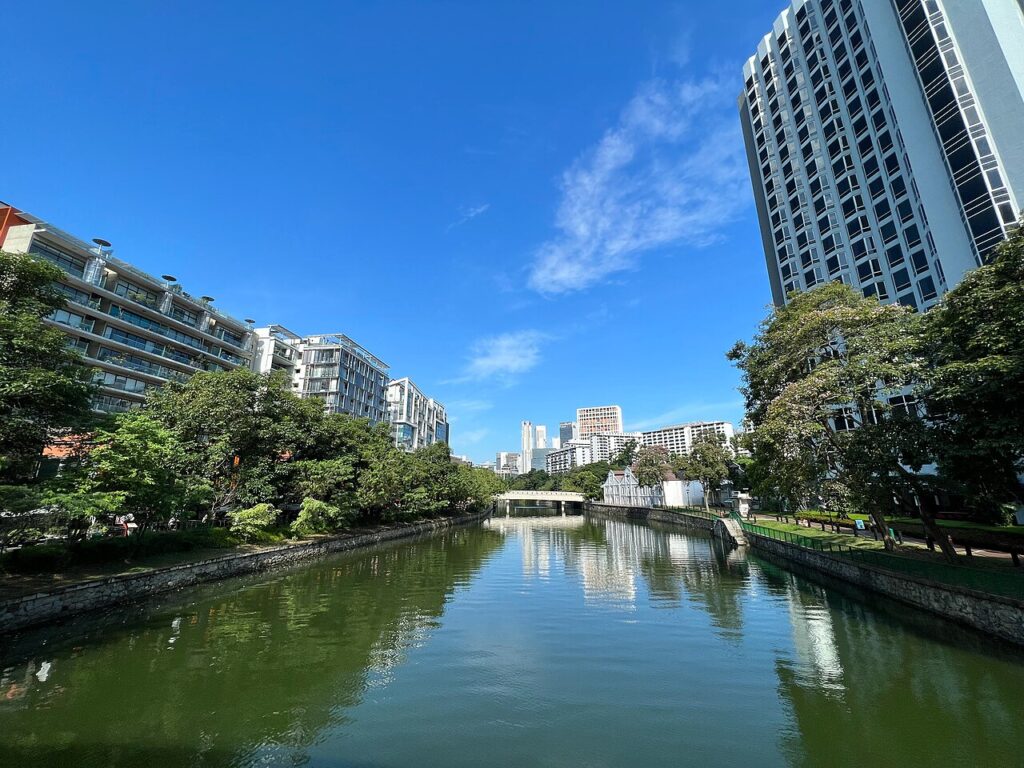
Photograph: Singapore River at Robertson Quay, 14 August 2022, Wzhkevin, CC BY-SA 4.0. Source: commons.wikimedia.org/wiki/File:Singapore_River_at_Robertson_Quay_-_2022-08-14.jpg. Licence: creativecommons.org/licenses/by-sa/4.0/. Resized for web and displayed cropped. Neighbourhood context, not either hypothetical home or the case location.
Need a brochure, price list or professional introduction?
Contact Lin Xuan at 82222556 or Ade at 81888871 or Benn at 83218774 for the full project brochure, latest available price list, a viewing, or introductions to bankers who can help you compare home-loan rates and packages to find the best available option for your needs. If you need legal advice on a property purchase, sale or tenancy, we can also put you in touch with property lawyers.
WhatsApp Lin Xuan | WhatsApp Ade. Let us know the project or property question you would like help with. Prices and availability are subject to developer confirmation, while loan terms and approval are determined by the bank.
Lin Xuan: ONG LIN XUAN, CEA registration R069812H. Ade: CHUA MUAY MUAY (ADE CHUA), CEA registration R014252F. ERA REALTY NETWORK PTE LTD, estate agent licence L3002382K.
Benn: TAN JUN FENG, BENNEDICT (BENNEDICT TAN), CEA registration R058941E. PROPNEX REALTY PTE. LTD., estate agent licence L3008022J.