
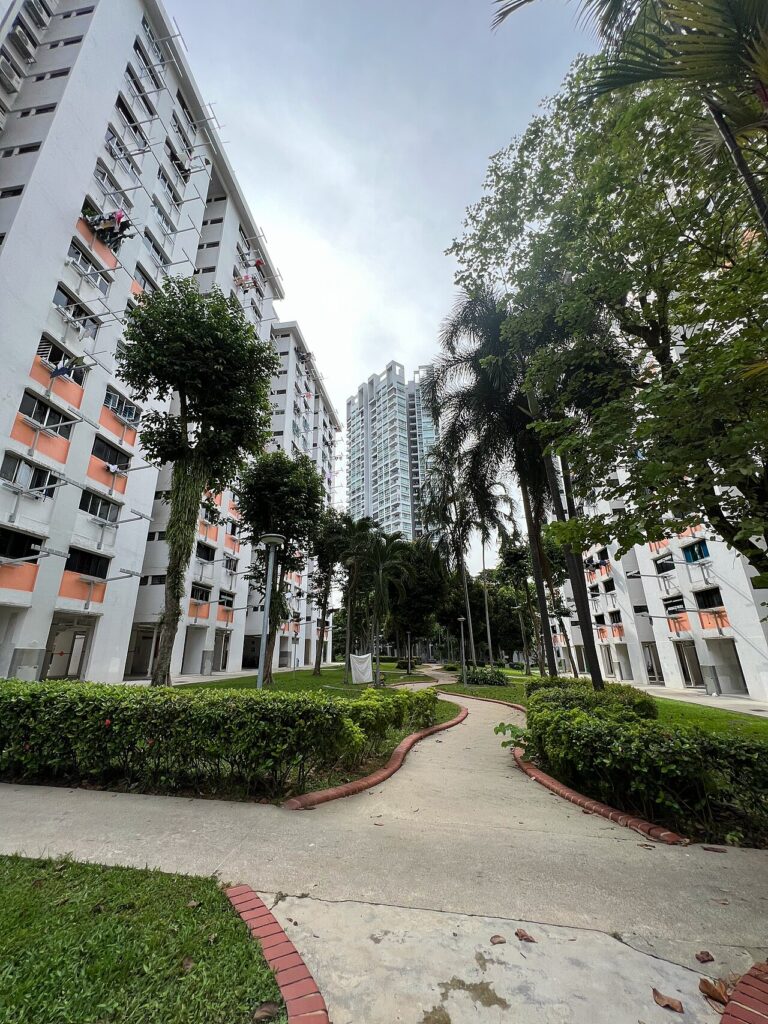
- BTO stands for Build-To-Order , HDB’s primary flat sales programme where flats are built only when sufficient demand is confirmed by a ballot exercise.
- You must obtain a valid HDB Flat Eligibility (HFE) letter before applying for any BTO flat. The HFE letter is valid for six months and confirms your eligibility, CPF housing grant entitlement, and HDB loan eligibility.
- BTO exercises are launched quarterly by HDB, typically in January, April, July, and October, though additional sales exercises may be introduced.
- From 2024, all BTO flats are classified under one of three categories , Standard, Plus, or Prime , each with different locational attributes, subsidy levels, and resale restrictions.
- Family applicants may earn up to S$14,000 per month (household income ceiling) for all BTO categories. Singles aged 35 and above may apply under the Single Singapore Citizen (SSC) scheme with an income ceiling of S$7,000.
- First-timer applicants receive priority ballot allocation , typically 85–95% of units are reserved for first-timers in each exercise. Additional ballot chances (one extra per unsuccessful application) are given to applicants who have unsuccessfully balloted two or more times.
- Priority schemes , such as the Married Child Priority Scheme (MCPS) and Multi-Generation Priority Scheme (MGPS) , allocate a portion of units to applicants buying near their parents or applying together with parents.
- From application to key collection typically takes four to six years , about three to four years of construction plus any waiting time before flat selection.
What Is an HDB BTO Flat?
Build-To-Order, or BTO, is the Housing and Development Board’s primary mechanism for selling new public housing flats in Singapore. Unlike traditional public housing systems where government bodies build flats speculatively, BTO ensures demand is confirmed before construction begins: HDB releases a site with a planned number of units, Singaporeans apply during a fixed sales exercise window, and construction proceeds only once sufficient applications are received.
This demand-driven model has two practical consequences. First, BTO buyers must wait , typically three to four years , for their flat to be built after they select a unit. Second, and more importantly, the BTO programme allows HDB to calibrate pricing and subsidy levels to keep new flats affordable relative to resale market prices, achieved through direct subsidies and various housing grants administered by HDB and the CPF Board.
BTO flats are sold only to Singapore citizens and permanent residents meeting eligibility criteria set by HDB under the Housing and Development Act (Cap. 129). The eligibility assessment is now centralised through the HDB Flat Eligibility (HFE) letter application on the MyHDBPage portal.
BTO Categories: Standard, Plus, and Prime (2024 Onwards)
In October 2024, HDB introduced a revamped classification for new BTO flats to replace the legacy classification that grouped all BTO flats together regardless of location. The new three-tier system aims to reflect the locational premium of better-connected or more centrally located sites, while maintaining affordability through differentiated subsidy and restriction structures.
Standard BTO flats are offered in towns outside the central region and are not subject to any resale restrictions beyond the standard five-year Minimum Occupation Period (MOP). Buyers may purchase resale HDB flats or private property after MOP without restriction. Standard flats receive the baseline level of subsidy from HDB.
Plus BTO flats are located in more attractive locations , often near MRT stations, town centres, or amenities , that would otherwise command significantly higher resale prices. Plus flats carry a ten-year MOP, an income ceiling restriction on resale buyers for the first resale transaction (buyer must earn S$14,000 or less), and a subsidy clawback mechanism if sold within the first resale transaction. Despite these additional conditions, Plus flats are priced at subsidised rates relative to the open market.
Prime BTO flats are the most restricted category, covering flats in central locations that are most proximate to the CBD, Orchard Road, or other premium districts. Prime flats apply all the Plus restrictions plus additional ones: buyers must be Singapore citizens, and resale buyers must also be Singapore citizens. The ten-year MOP applies, subsidy clawback applies, and income ceiling on resale applies. In return, Prime flats are the most heavily subsidised relative to their open market equivalents.
HDB BTO Eligibility: Who Can Apply?
All BTO applicants must meet HDB’s eligibility conditions at the time of application. The core requirements are:
Citizenship: At least one applicant in the family nucleus must be a Singapore citizen. Under the Joint Singles Scheme, all applicants must be Singapore citizens aged 35 or above. Permanent Residents may be included as occupiers but do not count as the eligible citizenship anchor for most schemes.
Age: Applicants must be at least 21 years old (35 for singles applying under the SSC scheme).
Income ceiling: Household income must not exceed S$14,000 per month for families, S$7,000 for singles, or S$16,000 for Executive Condominiums (ECs) , the only privatised segment within the HDB framework. Income is assessed at the time of flat selection, not application.
Property ownership: Applicants must not own private residential property locally or overseas, and must not have disposed of private property within 30 months before the BTO application date. Existing HDB flat owners generally may not apply for a new BTO flat unless certain conditions are met (e.g., applying under the Second-Timer scheme).
Previous housing subsidy: First-timers who have not previously received a housing grant or purchased an HDB flat at a subsidised price receive preferential ballot allocation. Second-timers who have previously benefited from subsidised housing may still apply but receive a smaller allocation of units.
How the HDB BTO Ballot Works
The BTO ballot process is a computer-generated random draw that assigns queue numbers to all eligible applicants for each town or project. HDB does not reveal the algorithm or the random seed, though the process is audited. The ballot determines the order in which applicants are invited to select a flat , a lower queue number means an earlier appointment and therefore access to a wider range of units.
Critically, the ballot is conducted separately for different applicant groups. First-timers and second-timers are balloted separately, and priority scheme applicants (MCPS, MGPS, etc.) are balloted within their reserved pools before the remaining units are allocated to the general ballot. This means that even a high-numbered queue position within the first-timer pool usually results in a flat selection appointment, since first-timers as a group receive 85–95% of units.
If you receive a queue number and do not select a flat , either because your preferred flat type runs out or you choose not to select , you count as a non-selection. Two or more non-selections may affect your eligibility for certain priority schemes in future exercises. However, not receiving a queue number (i.e., being balloted out) does not constitute a non-selection and entitles you to an additional ballot chance in the next application.
Priority Schemes and Additional Ballot Chances
HDB administers several priority schemes that allocate a proportion of BTO units to specific family structures and circumstances. These schemes operate as separate pools within each exercise , applicants who qualify are balloted within the priority pool first, before remaining units go to the general first-timer and second-timer pools.
The Married Child Priority Scheme (MCPS) reserves 30% of 2-room Flexi to 4-room flats in non-mature estates and 15% in mature estates for applicants who are buying a flat within 4 kilometres of their parents’ or married child’s current HDB flat. This is the most commonly used priority scheme in Singapore, particularly among families with multi-generational ties to specific towns.
The Multi-Generation Priority Scheme (MGPS) reserves 5% of 4-room and larger flats for families applying together with parents, with both the parents and the married child submitting simultaneous applications for separate flats in the same BTO exercise.
The Third Child Priority Scheme (TCPS) reserves 5% of units for families with three or more children who are Singapore citizens aged 18 or below.
The Additional Ballot Chance is not a priority scheme per se but an important mechanism: first-timer applicants who have applied for a BTO flat but did not receive a queue number receive one additional ballot chance for each unsuccessful application in the same town category (mature or non-mature). After two or more unsuccessful applications, this can materially improve the odds of receiving a queue number in subsequent exercises.
Step-by-Step: HDB BTO Application to Key Collection
Step 1 , Obtain the HFE letter. Before applying for any BTO flat, you must submit an HFE application on the MyHDBPage portal. The HFE letter confirms your eligibility, your CPF housing grant quantum (Enhanced CPF Housing Grant, Family Grant, or Proximity Housing Grant), and whether you qualify for an HDB housing loan. Processing takes approximately three weeks. The letter is valid for six months , if it expires before you apply, you must renew it.
Step 2 , Apply during the BTO sales exercise. Applications are submitted online through the MyHDBPage portal during the sales exercise window, typically one month. There is no application fee. You select a project and flat type (but not a specific unit). Couples and families submit one joint application; singles applying under the SSC scheme submit individually and then form a group if both receive queue numbers.
Step 3 , Receive the ballot result. HDB publishes ballot results approximately 8–12 weeks after the close of application. Results are accessed via MyHDBPage. You will receive either a queue number (proceeded to flat selection) or a notification that you were unsuccessful (entitling you to an additional ballot chance in future).
Step 4 , Flat selection appointment. If you receive a queue number, HDB will schedule a flat selection appointment in queue number order. At this appointment (conducted via the MyHDBPage portal or in person at an HDB Hub), you select your preferred unit from those remaining. You pay a booking fee of S$2,000 (for 4-room and larger; less for smaller flat types) at this stage.
Step 5 , Sign the Agreement for Lease. Typically about four months after flat selection, HDB will schedule you to sign the Agreement for Lease (the binding sales agreement). You pay a down payment at this point: 10% of the flat price minus the booking fee (via CPF OA and/or cash), and legal fees. If using an HDB housing loan, HDB issues the loan at this stage.
Step 6 , Construction period. HDB construction typically takes three to four years from the start of construction to the issuance of Temporary Occupation Permit (TOP). During this period, HDB collects progress payments from you , a series of staged payments tied to construction milestones (foundation, structure, roof, etc.) , disbursed from your CPF OA and/or bank loan. You are not required to make cash payments during construction unless your CPF OA is insufficient.
Step 7 , Key collection. Upon TOP, HDB invites you to collect your keys and inspect your flat. The Minimum Occupation Period (MOP) begins from the date of key collection. Standard flats: 5-year MOP. Plus and Prime flats: 10-year MOP. EC: 5-year partial MOP (for selling to SC/PR), 10-year for full privatisation.
HDB Housing Grants: What You Can Receive
| Grant | Who Qualifies | Maximum Amount |
|---|---|---|
| Enhanced CPF Housing Grant (EHG) | First-timer families earning ≤S$9,000/mth | S$80,000 (at income ≤S$1,500) |
| EHG (Singles) | Single SC ≥35 earning ≤S$4,500/mth | S$40,000 |
| Family Grant (FG) | SC+SC or SC+PR couple buying resale | S$50,000 (SC+SC) / S$40,000 (SC+PR) |
| Proximity Housing Grant (PHG) | Buying within 4km of parents (resale) | S$30,000 (living together); S$20,000 (nearby) |
| Step-Up CPF Housing Grant | Second-timer SC families from 2-room rental | S$15,000 |
| Silver Housing Bonus | Seniors 55+ rightsizing to smaller flat | S$30,000 |
Note: EHG is automatically assessed during the HFE application. PHG and Family Grant apply to resale flat purchases and are disbursed from your CPF OA. All grants are disbursed to CPF OA, not as cash.
Worked Example: Mr and Mrs Lim Apply for a BTO Flat in Tengah
Mr and Mrs Lim (both Singapore citizens, married, combined income S$10,200 per month) apply for a 4-room BTO flat in Tengah during the October 2026 sales exercise. Tengah is classified as a Standard estate.
Eligibility check: First-timers, no private property ownership, income S$10,200 < S$14,000 ceiling. HFE letter confirms EHG eligibility (income S$10,200: EHG = S$25,000 based on the income bracket). They also apply under MCPS as Mrs Lim’s parents live in Jurong West (within 4km of Tengah).
Flat price: 4-room BTO Standard Tengah , indicative price S$430,000. After EHG of S$25,000: effective price S$405,000.
Financing: HDB loan (2.6% p.a., up to 90% LTV): loan quantum S$364,500 (90% of S$405,000). Monthly instalment over 25 years: approximately S$1,648 per month.
TDSR / MSR check: Mortgage Servicing Ratio (MSR) for HDB flats is capped at 30% of gross income. MSR = S$1,648 / S$10,200 = 16.2% , well within the 30% cap.
Cash outlay at key collection: Down payment = 10% × S$405,000 − S$2,000 booking fee = S$38,500 (via CPF OA). Booking fee S$2,000 (cash). Legal fees approximately S$2,000 (cash). Total cash needed at signing: approximately S$4,000. Total CPF OA needed at signing: S$38,500. Construction progress payments thereafter are funded from CPF OA monthly deductions throughout the 3–4 year build period.
Timeline: Flat selection in Q1 2027 (3 months after ballot result). Agreement for Lease signing Q2 2027. Estimated TOP Q2 2030. Key collection Q3 2030. MOP ends Q3 2035 (Standard 5-year MOP). Earliest resale of flat: after 7 August 2035.
What Might Come Next for HDB BTO
The BTO programme is HDB’s primary demand-management and affordability-control tool, and it evolves in response to demographic trends, construction costs, land availability, and political priorities. Looking ahead to 2027 and beyond, several analytical observations are worth noting , though readers should treat these as informed speculation rather than confirmed policy:
The Standard/Plus/Prime framework is still bedding in following the 2024 launch. Resale restrictions on Plus and Prime flats will not begin to expire until 2034–2035, meaning the secondary market impact of these restrictions is yet to be observed. HDB may calibrate the relative pricing and restriction balance based on early application demand patterns.
Waiting times remain a key policy focus. HDB has targeted shorter BTO waiting times of under three years for a portion of supply, through the use of shorter-lead-time construction methods and pre-built flat types. Any reduction in waiting time would significantly alter the financial planning calculus for young couples choosing between BTO and the HDB resale market.
The single-applicant pathway via the SSC scheme may see further evolution. Currently, singles aged 35 may apply for 2-room Flexi flats or, in some exercises, larger flat types , but the income ceiling of S$7,000 and the age restriction remain constraints relative to the couple/family pathway.
Summary: HDB BTO Key Facts at a Glance
| Factor | Key Point |
|---|---|
| Application frequency | Quarterly exercises (Jan/Apr/Jul/Oct); additional exercises possible |
| Income ceiling (family) | S$14,000 per month (assessed at time of flat selection) |
| Income ceiling (single ≥35) | S$7,000 per month |
| HFE letter validity | 6 months , must be valid at time of application |
| Ballot allocation (first-timers) | 85–95% of units; additional ballot chance for unsuccessful applicants |
| MOP (Standard BTO) | 5 years from key collection date |
| MOP (Plus and Prime BTO) | 10 years, plus resale income ceiling, subsidy clawback |
| Typical waiting time | 3–4 years from flat selection to key collection; 4–6 years total |
| Maximum EHG | S$80,000 for families earning ≤S$1,500/mth; S$25,000 at ≤S$10,200/mth |
| HDB loan LTV | Up to 90%; rate 2.6% p.a. (August 2026); MSR cap 30% |
Frequently Asked Questions
How do I know if I am a first-timer or second-timer?
You are a first-timer if you have never purchased a subsidised HDB flat (BTO or resale with CPF housing grant), never received a CPF housing grant, and have not previously owned an HDB flat as an owner. If you have previously received a grant, purchased an HDB flat directly from HDB, or received the Step-Up CPF Housing Grant, you are generally classified as a second-timer for BTO purposes. The HFE letter application process automatically assesses and confirms your first-timer or second-timer status based on your NRIC and CPF records.
Can I apply for a BTO flat if I currently own private property?
No. You must not own any private residential property , locally or overseas , at the time of application, and must not have disposed of any private property within 30 months before the BTO application. This 30-month restriction was introduced as part of Singapore’s broader property market cooling framework administered by MAS, specifically to reduce demand pressure from private property owners using the BTO system as an exit strategy. If you disposed of your private property more than 30 months ago and meet all other conditions, you may apply , though your second-timer status may affect your ballot allocation.
What happens if I receive a queue number but my preferred flat type runs out?
If you attend your flat selection appointment and none of the units in your preferred flat type are available, you may choose to select an available unit of a different flat type (if your HFE permits) or to walk away. If you walk away without selecting any unit, it counts as a non-selection. Two or more non-selections in an exercise count towards your “non-selection” record, which may affect eligibility for the Multi-Generation Priority Scheme and could influence your classification as a first-timer in subsequent exercises. It does not, however, remove your additional ballot chances from prior unsuccessful ballots , those accumulate independently.
Can a Singapore citizen apply for a BTO flat with a foreigner spouse?
Yes, under the Non-Citizen Spouse Scheme. If you (as a Singapore citizen) are legally married to a non-citizen who is not a Singapore Permanent Resident, you may apply for a BTO flat as the anchor citizen with your non-citizen spouse as an occupier. However, the flat must be registered in your sole name (not jointly with the non-citizen spouse), and you will be treated as a first-timer only if you meet all other first-timer conditions. The income ceiling applies to the combined household income of all persons listed in the flat. Your non-citizen spouse does not count as the eligible citizen anchor but their income is included in the TDSR and MSR calculation.
How do Plus and Prime flat resale restrictions actually work in practice?
For Plus and Prime flats, after the 10-year MOP, you may sell your flat on the open resale market , but only to buyers who meet the income ceiling of S$14,000 per month (for the first resale transaction). This restriction is tied to the flat, not just the buyer’s status at any given time: every subsequent resale transaction of that specific flat carries this income ceiling restriction for one resale cycle. The subsidy clawback on Plus and Prime flats means HDB recovers a portion of the price discount it provided at the time of BTO sale , expressed as a percentage of the resale price. The exact clawback percentage is announced by HDB at the time of the original sale and remains tied to the flat. Buyers of Plus/Prime flats on the resale market do not face the same clawback , it is a one-time deduction from the original owner’s resale proceeds on their first sale after MOP.
What is the difference between the Enhanced CPF Housing Grant (EHG) and the Family Grant?
The Enhanced CPF Housing Grant (EHG) is an income-linked grant for new BTO flat purchases (and some resale purchases) , the lower your household income, the higher the EHG, up to S$80,000 for the lowest income bracket. It is automatically assessed during the HFE application. The Family Grant is a separate flat quantum grant for resale HDB flat purchases (not BTO) by SC+SC or SC+PR couples , it provides S$50,000 or S$40,000 respectively. You cannot receive the Family Grant when buying a new BTO flat. For BTO flat purchases, only the EHG (plus the Proximity Housing Grant, if applicable for certain resale purchases) is relevant. These are all disbursed via CPF OA and reduce the purchase price effectively , they are not cash in hand.
Related Articles
- Singapore HDB Eligibility Guide 2026: Who Can Buy an HDB Flat?
- CPF Property Guide 2026: How to Use Your CPF OA to Buy Property
- Singapore MOP Guide 2026: Minimum Occupation Period Rules Explained
- HDB Resale Procedure Guide 2026: Step-by-Step for Buyers and Sellers
- Singapore HDB Downsizing Guide 2026: How to Rightsize and Unlock Cash
- ABSD Singapore 2026: Complete Guide to Additional Buyer’s Stamp Duty
Disclaimer: This article is for general informational purposes only and does not constitute legal, financial, or housing advice. HDB policies, grant quantum, income ceilings, and BTO categories change regularly. Readers should verify all details with the Housing and Development Board (hdb.gov.sg), CPF Board (cpf.gov.sg), and consult a licensed financial adviser or HDB-registered salesperson before making any housing decision. LovelyHomes does not endorse any bank, service provider, or individual mentioned in this article.
Supporting graphics
Original article illustrations are available below.


