
Updated 25 Sep 2026. A condo AGM is where owners can test the budget, elect the council and decide properly notified motions. To use it well, check the notice and your voting entitlement before the meeting, put your proposal into a written motion early, and understand how that particular vote will be counted.
This guide covers a Singapore management corporation after its first AGM. The first AGM and the period before it have separate rules. “Owner” below means a subsidiary proprietor; arrangements for joint owners, corporate owners and mortgagees can affect who exercises a vote. A buyer who has not yet become the owner should not assume ownership voting rights.
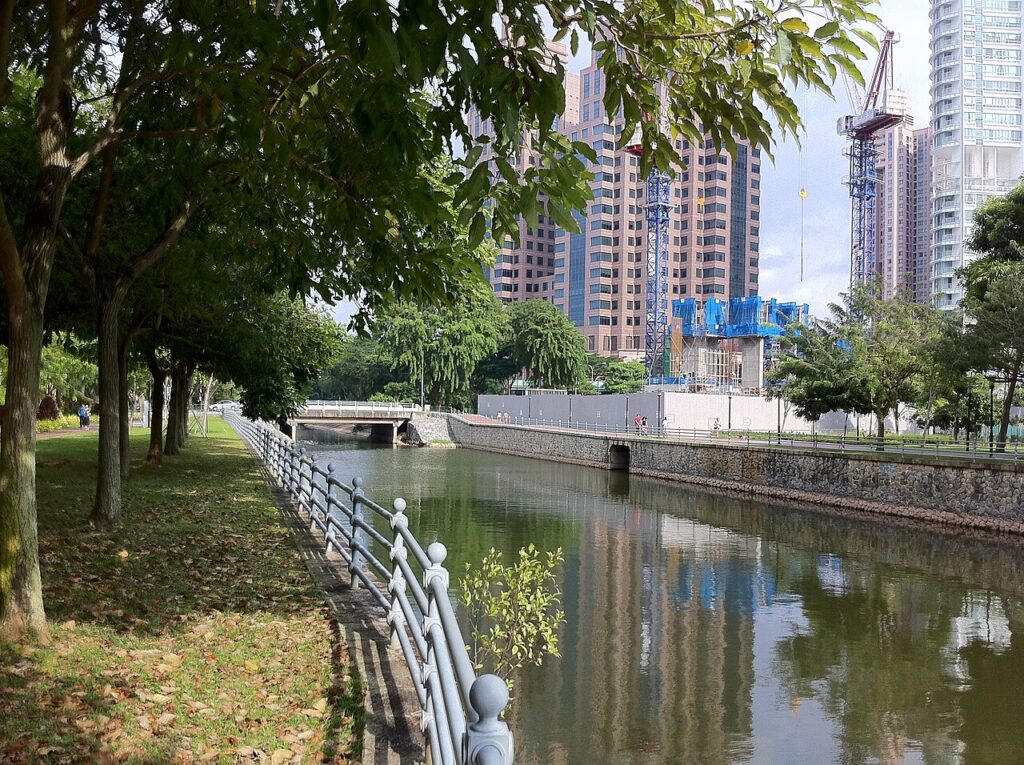
Featured photograph: Robertson Quay, 31 July 2011, by Bryanmackinnon. Original photograph, CC BY-SA 3.0, resized for this site. Archive neighbourhood image; no assessment of a pictured development’s management is implied.

Check the meeting date and what the notice actually proposes
Under section 27 of the Building (Strata Management) Act 2004, subsequent AGMs must be held in each calendar year, with no more than 15 months between them. These are two requirements, not permission to skip a calendar year whenever the 15-month limit has not expired.
The First Schedule, paragraph 1A sets out the meeting notice requirements and exceptions. Do not treat “14 days’ notice” as sufficient for every motion. Under section 2, an ordinary-resolution meeting must be held on the 15th day or later after notice specifying the motion; a special-resolution meeting must be on the 22nd day or later.
Read the exact proposed resolutions, the accounts and auditor’s report, and the proposed fund budgets. The AGM notice must include the relevant financial material or the specified online access arrangements. Where online access is used, paragraph 1A(3A) provides for a free printed copy on a request made at least 48 hours before the meeting. Obtain the papers early enough to compare this year’s spending and planned works with the proposed contributions.
Submit a motion before notices go out
Under First Schedule paragraph 12, an owner can give written notice to the council secretary requiring a motion to be included on the agenda of the next general meeting. If notices for that meeting have already been given, it goes to the next meeting after that. Keep the submission and delivery evidence.
Make the decision you want clear. For example, if you want better information about a proposed repainting budget, specify the information sought and when it should be provided. Do not assume that asking a question under “any other business” allows the meeting to approve an unrelated new spending proposal.
Paragraph 1A(4) generally requires a motion to be properly notified. An amendment can be moved if it does not change the subject matter of that motion. Paragraph 4 also allows the chairperson to rule a motion out of order if it would conflict with the Act or by-laws, or would otherwise be unlawful or unenforceable. For a consequential proposal, check the required resolution type and lawful scope before submitting the wording.
Resolve voting entitlement and proxy arrangements early
Check that your particulars are correctly recorded in the strata roll. For ordinary and special resolutions, contributions and other moneys due and payable in respect of the lot as at the notice date must be duly paid at least three days before the meeting. The statutory notice explains the exception for unanimous resolutions and resolutions by consensus. Paragraph 2 contains the detailed voting-entitlement rules; joint ownership and mortgagee priority can also matter.
Ask the managing agent to confirm receipt and allocation of payments before the deadline, rather than relying on a transfer made during the meeting. Paragraph 7 requires the list of persons entitled to vote to be displayed on the notice board at least 48 hours beforehand. Raise discrepancies promptly and retain the supporting records.
If using a proxy, follow First Schedule paragraphs 17 to 19. The appointment must be in writing and signed by the appointing person or authorised attorney. A proxy need not be an owner. Deliver it to the permitted address or specified email: normally at least 48 hours before the meeting or adjourned meeting, or at least 48 hours before the poll where it is for a poll. A late instrument is not valid for that meeting or poll.
One person cannot act as proxy for more than the higher of two lots or 2% of all lots, with that percentage rounded down to a whole number. Check the intended proxy’s capacity before appointing them. The instrument is void if the appointing owner is present at the meeting. These rules are not an invitation to collect unlimited proxy forms or assume a tenant has an owner’s vote without appointment.
Ask which voting method applies
The main rules below come from section 2(2), (3) and (8) and First Schedule paragraphs 8 and 9. They describe ordinary completed lots and do not replace the separate rules for proposed lots or other resolution types.
| Decision | How the vote is counted |
|---|---|
| Ordinary resolution | Without a poll, more valid votes for than against, normally one vote per lot. If a valid poll is demanded before the vote, share value is used. |
| Special resolution | A share-value poll. At least 75% of the share value represented by all valid votes cast must support the motion. This is not 75% of every lot in the estate. |
| Council election | One vote for each lot for which the voter is entitled to vote. A poll cannot be demanded for this election. |
As a hypothetical special-resolution example, if the valid votes cast represent 100 shares, 75 shares in favour meet the threshold and 74 do not. The total share value of the whole development is not the denominator for this particular resolution. Quorum and the other procedural conditions must still be satisfied; abstentions are not automatically votes against.
Test the sinking-fund budget against the work
Section 38(4) requires a sinking fund. It does not prescribe a universal minimum contribution of 10% of annual contributions. Section 39(1) to (3) provides for the management corporation to determine the relevant funding amounts by ordinary resolution, including reasonable and necessary sums for anticipated liabilities and specified major works.
Ask which works are expected, the basis and date of each estimate, what cash is already available and how the proposed contributions address the gap. A healthy-looking balance does not answer those questions on its own. Compare the proposed budget with maintenance plans, commitments and available estimates rather than a universal “adequate reserve per unit” figure.
If there is a proposed additional collection, ask for the exact resolution, amount, allocation and payment dates. Do not assume the council can impose any levy it regards as urgent and obtain approval later. Our separate by-laws and council-powers guide explains why owners’ reserved decisions must be distinguished from council administration.
If the issue cannot wait until the AGM
After the first AGM, First Schedule paragraph 14 provides a requisition route for an extraordinary general meeting. The qualifying owners must together hold at least 20% of the aggregate share value, or comprise at least 25% of the total number of owners, and be entitled to vote on the proposed matter. These are alternative thresholds, not a blanket “25% of share value” rule.
The signed written requisition must state the objects of the meeting and be deposited at the registered address. The council must convene the meeting as soon as practicable and within six weeks after deposit. Further provisions address a council’s failure to act. Obtain advice before relying on those provisions to organise a meeting yourself; an informal residents’ chat is not the statutory requisition.
Read the minutes against the decision
First Schedule paragraph 10A requires minutes to record, among other matters, the meeting details, owners present, proxy appointments, the result of every motion and the exact text of every resolution passed. Compare the record with the wording and count announced at the meeting. If a material discrepancy appears, identify it precisely in writing and retain the notice, proxy, payment and voting evidence that bears on it.
For a prospective buyer, the useful question is what these decisions mean for the home: upcoming payments, major works, access disruptions and rules affecting the intended use. Ask your conveyancing solicitor which records to obtain and what unresolved decisions mean for your purchase. Attendance by an owner does not itself prove that every resolution was valid.
Sources and scope: current Singapore Statutes Online provisions opened and checked on 25 September 2026, with exact sections and First Schedule paragraphs identified above. The 75-out-of-100 illustration is invented arithmetic. This is editorial legal information, not advice on a specific dispute or lawyer-approved work. No case is relied upon because the procedural points are addressed directly by the statute.
Correction, 25 September 2026: this article replaces earlier incorrect statements about a mandatory 10% sinking-fund minimum, voting methods, the special-resolution denominator and EGM requisition thresholds. Unsupported fee benchmarks, dispute-procedure claims and legacy diagrams have been removed.