
Quick Answer
HDB flats are sold on 99-year leases. As the remaining lease shortens, CPF withdrawal limits decrease, bank financing becomes more restricted, and resale prices face steeper discounts. The key threshold for CPF is whether remaining lease covers the youngest buyer to age 95. Below 20 years remaining, CPF and HDB loans are not available at all. Understanding these thresholds before buying a resale flat can save you from a financing shortfall.
Every HDB flat in Singapore comes with a 99-year lease. On the day a flat is built, it has 99 years remaining. Each passing year reduces that number by one. This slow reduction is what property professionals call lease decay, and it has real, measurable effects on what you can borrow, how much CPF you can use, and what your flat will eventually sell for.
Most first-time HDB buyers focus on location, floor level, and facing. Lease decay is an afterthought. But for resale flat buyers, where flats may already be 20, 30, or 40 years old, understanding the financing thresholds and price trajectory tied to remaining lease can be the difference between a sound purchase and an expensive mistake.
This guide explains the mechanics, the numbers, and the decisions.
1. What Is HDB Lease Decay?
HDB flats are not freehold. When you buy a flat from HDB or on the resale market, you are purchasing the right to occupy that unit for the remaining duration of its 99-year lease. Once the lease expires, the flat reverts to HDB and the owner receives no compensation.
Lease decay is simply the passage of time reducing that remaining term. A flat built in 1985 began with 99 years from 1985. In 2026, it has approximately 58 years remaining. By 2050, it will have 34 years remaining. This trajectory is fixed, predictable, and unlike market value fluctuations, it cannot be reversed.
The effects of lease decay fall into three broad categories:
- CPF withdrawal limits: CPF Board rules restrict how much OA savings you can use based on the flat’s remaining lease at the point of purchase.
- Financing limits: Both HDB concessionary loans and bank mortgages have maximum loan tenures tied to remaining lease, and loans are unavailable below certain thresholds.
- Resale price: Buyers who cannot use CPF or obtain standard financing will pay less, reducing market demand and price relative to newer flats.
2. How Remaining Lease Affects CPF Usage
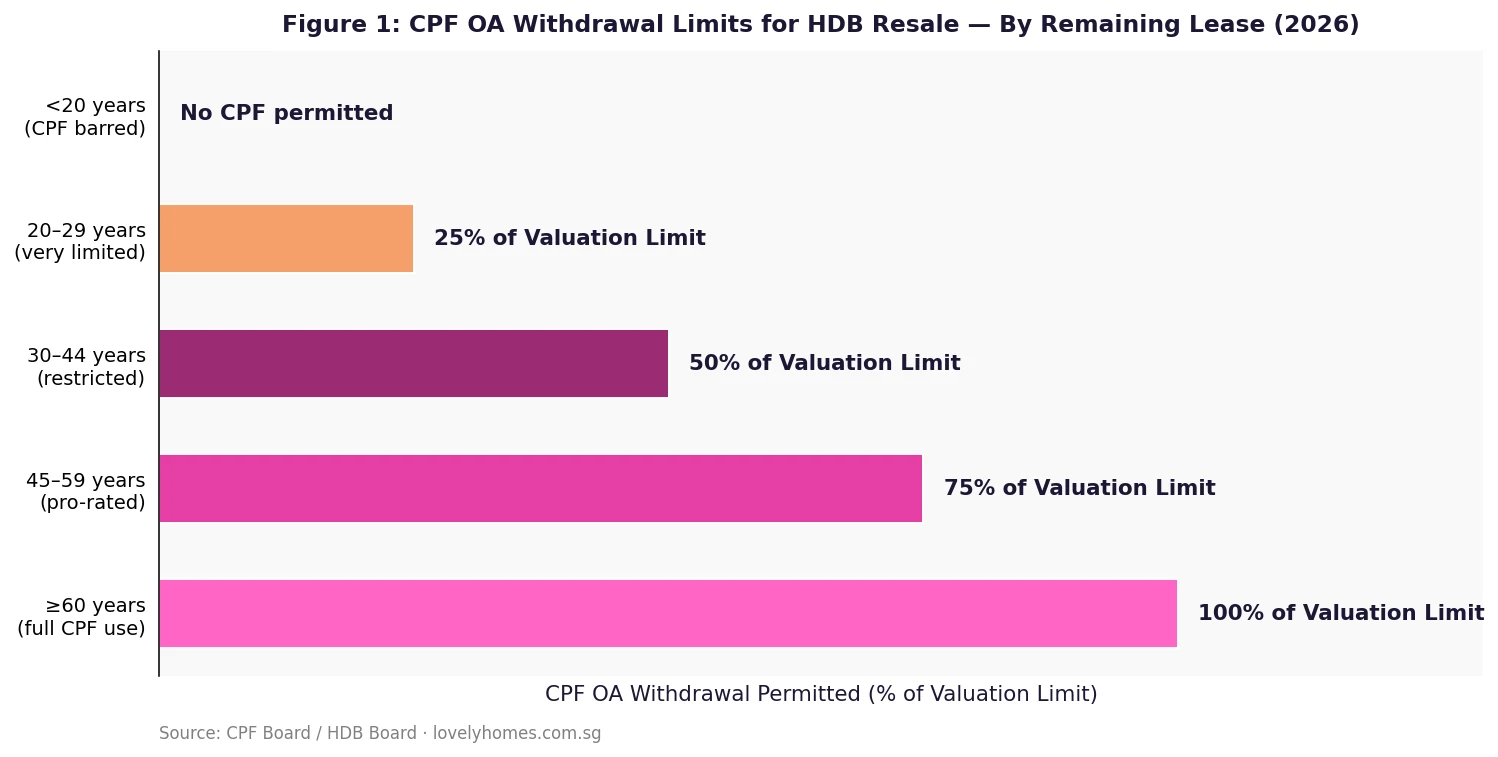
CPF Board applies a straightforward test: can the flat’s remaining lease cover the youngest buyer in the transaction to at least age 95? The answer determines how much OA savings can be used.
The 95-Year Coverage Test
Add the youngest buyer’s current age to the flat’s remaining lease at the point of purchase. If this sum is 95 or more, the buyer can use their full CPF OA savings (up to the Valuation Limit, which is the lower of purchase price and valuation).
If the sum is below 95 but the remaining lease is at least 20 years, CPF usage is allowed but capped. The cap is calculated as:
CPF Limit = Purchase Price x (Remaining Lease) / (95 minus Youngest Buyer’s Age)
If the remaining lease is below 20 years, CPF cannot be used for the purchase at all.
| Condition | CPF OA Usage |
|---|---|
| Buyer age + remaining lease ≥ 95 | Full CPF OA usable (up to Valuation Limit) |
| Buyer age + remaining lease < 95, but remaining lease ≥ 20 years | Prorated CPF: Purchase Price × Remaining Lease ÷ (95 − Buyer Age) |
| Remaining lease < 20 years | No CPF withdrawal allowed |
Why This Matters in Practice
Most Singaporean homebuyers rely heavily on CPF for the downpayment and mortgage servicing. If CPF is prorated or unavailable, you must substitute cash. For a $500,000 flat where CPF is capped at 70% of the purchase price, you would need an extra $150,000 in cash compared to buying a flat where full CPF applies.
3. HDB Loan and Bank Financing Limits
HDB Concessionary Loan
HDB’s concessionary loan (currently at 2.6% per annum as of 2026, pegged to CPF OA rate plus 0.1%) is available only if the flat’s remaining lease is at least 20 years. The maximum loan tenure under an HDB loan is 25 years, subject to the following conditions:
- Remaining lease must cover at least 20 years.
- Loan tenure cannot exceed the remaining lease minus 5 years.
- Buyer’s age plus loan tenure cannot exceed 65 years (for HDB loans).
Bank Mortgages
Banks generally follow similar rules but may apply stricter criteria. For a flat with fewer than 30 years remaining lease, many banks will decline to extend a mortgage at all. For flats with 30 to 60 years remaining, the maximum loan tenure is typically the remaining lease minus 5 years or 30 years, whichever is lower. The shorter tenure means higher monthly instalments for the same loan amount.
| Remaining Lease | HDB Loan | Bank Loan |
|---|---|---|
| 75 years and above | Up to 25 years | Up to 30 years (standard) |
| 50 to 74 years | Up to 25 years (if age permits) | Up to 25 to 30 years (lender-dependent) |
| 30 to 49 years | Up to 25 years (if age permits) | Restricted; many banks decline |
| 20 to 29 years | Tenure = lease minus 5 years (max 25) | Very limited; most banks decline |
| Below 20 years | Not available | Not available |
4. How Remaining Lease Affects Resale Price
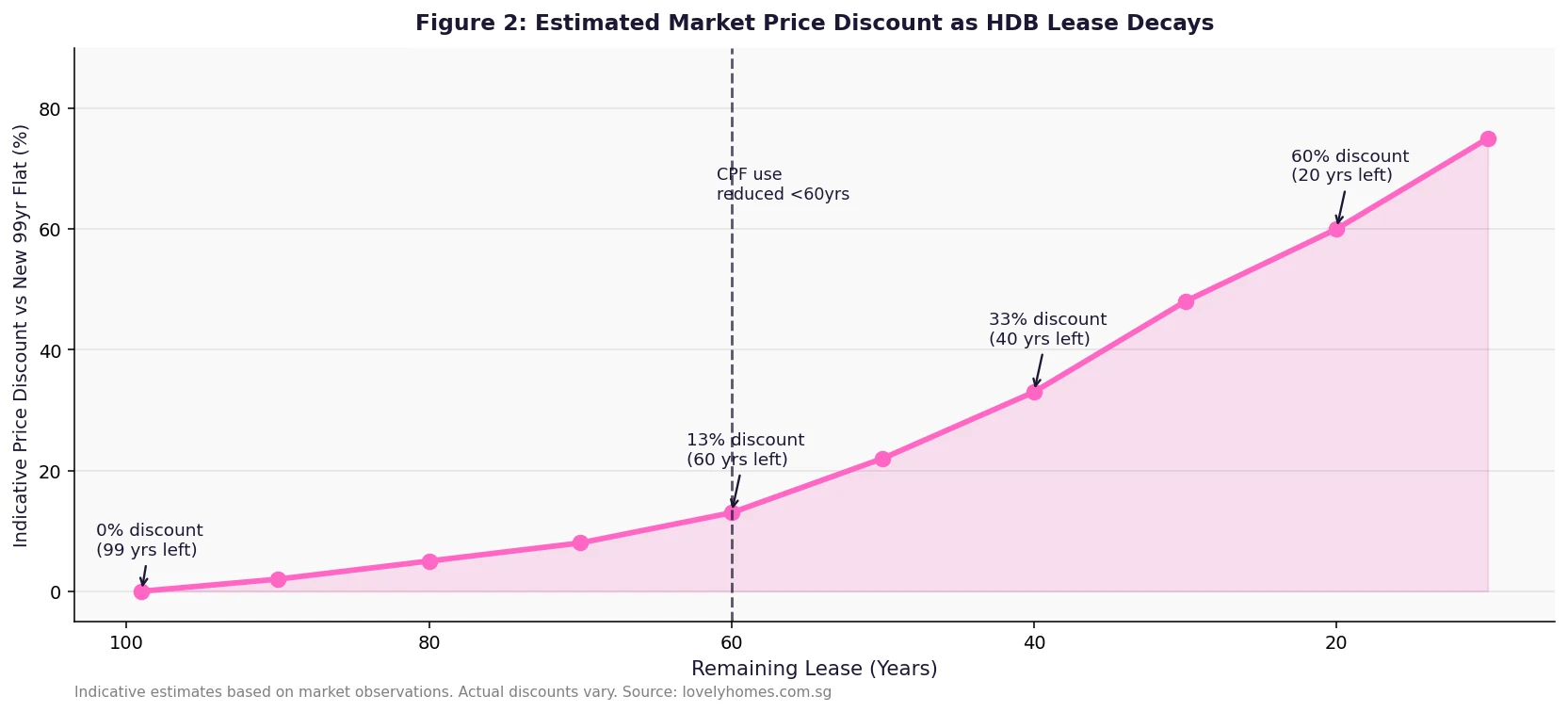
The financing constraints described above directly translate into price pressure. When fewer buyers can use CPF or access a standard loan, effective demand for the flat shrinks. Sellers must price at levels accessible to cash-heavy buyers, who expect a discount for taking on more risk and using more of their own capital.
Academic research and market experience suggest the following broad discount pattern relative to comparable newer flats in the same estate:
| Remaining Lease | Typical Price Discount vs Newer Flats | Key Financing Issue |
|---|---|---|
| 75 to 99 years | Minimal (<5%) | None; full CPF and financing available |
| 60 to 74 years | 5 to 15% | CPF prorated for younger buyers; bank tenure starting to shorten |
| 40 to 59 years | 15 to 30% | CPF significantly prorated for most buyers; bank loan tenure shortened |
| 20 to 39 years | 30 to 50% | CPF severely limited; most buyers need substantial cash |
| Below 20 years | 50% or more | No CPF; no HDB or bank loan; cash purchase only |
These are broad market observations, not guarantees. Individual flats can trade above or below these ranges depending on specific location, renovation quality, floor level, and the general property cycle.
5. Key Milestones on a 99-Year Lease
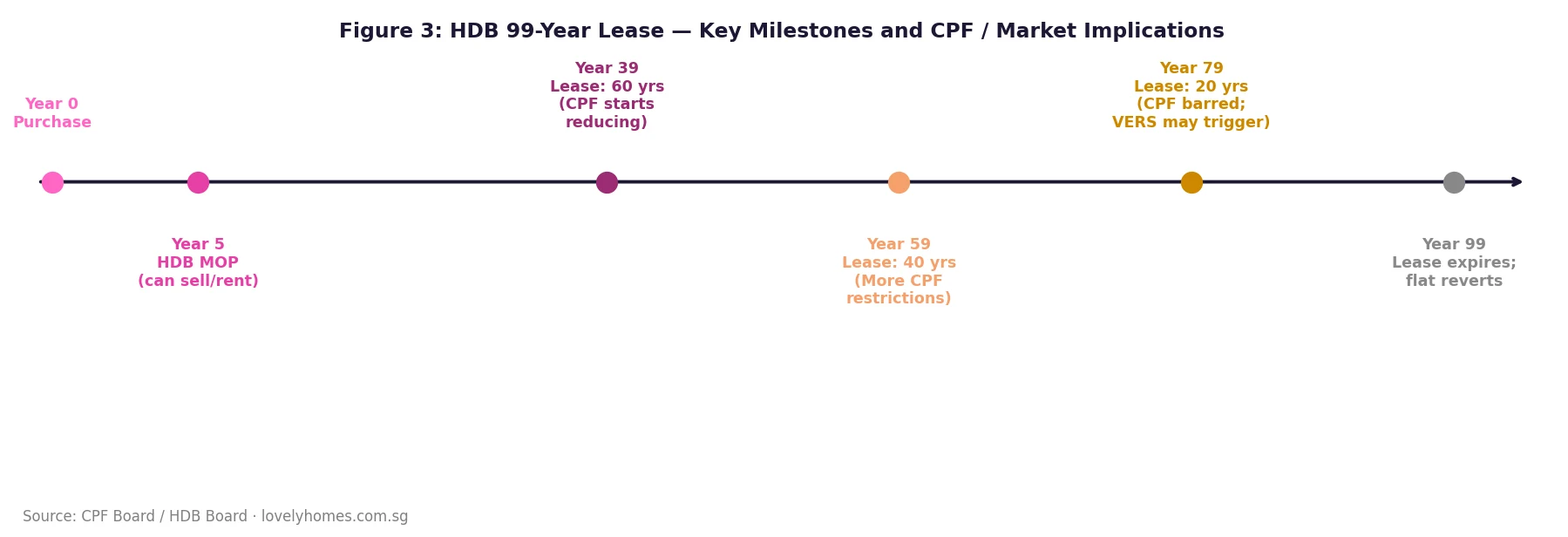
Understanding where a flat sits on its lease timeline helps buyers and sellers set realistic expectations.
| Flat Age | Remaining Lease | Key Event or Implication |
|---|---|---|
| 0 to 10 years | 89 to 99 years | New or near-new; full financing and CPF; MOP may still be running |
| 10 to 30 years | 69 to 89 years | Peak resale years; prime window for SERS consideration by HDB |
| 30 to 40 years | 59 to 69 years | SERS window closing; CPF starting to be prorated for buyers aged 30+ |
| 40 to 55 years | 44 to 59 years | CPF prorated for most buyers; bank tenure shortening; price discount emerging |
| 55 to 75 years | 24 to 44 years | Significant CPF proration; bank financing very restricted; steeper price discount |
| 79 to 80 years | 19 to 20 years | Critical threshold: CPF and HDB loan limits hit; below 20 years means cash only |
| Above 80 years | Below 19 years | No CPF; no loans; very limited buyer pool; deep price discount |
6. Worked Example
Scenario: Sarah, aged 38, buying a resale 4-room flat with 52 years remaining lease, priced at S$560,000
Step 1: CPF eligibility test
Buyer age + remaining lease = 38 + 52 = 90
90 < 95, so CPF is prorated. Remaining lease (52 years) is above the 20-year floor, so some CPF is available.
Step 2: Calculate CPF cap
CPF Limit = S$560,000 × 52 ÷ (95 − 38)
= S$560,000 × 52 ÷ 57
= S$560,000 × 0.912
= S$510,700 maximum CPF (as a cap, not the amount in her account)
Step 3: HDB loan eligibility
Maximum loan tenure = min(52 − 5, 25) = min(47, 25) = 25 years
Age check: 38 + 25 = 63 ≤ 65. HDB loan is available.
Sarah can take an HDB loan for up to 25 years, making her monthly repayments manageable.
Step 4: Practical takeaway
Sarah can still buy this flat with CPF and an HDB loan. However, her CPF is capped at S$510,700 rather than the full S$560,000. The S$49,300 shortfall must come from cash savings, on top of the standard 10% minimum cash downpayment required by HDB. This is manageable but illustrates why lease decay matters even for flats with 50+ years remaining.
Contrast: Michael, aged 50, eyeing a S$350,000 flat with 18 years remaining lease
CPF test: 18 years < 20 years. No CPF allowed.
HDB loan: Remaining lease below 20 years. No HDB loan available.
Bank loan: Most banks will not lend. Very unlikely to get a mortgage.
Michael would need S$350,000 in cash plus stamp duty and legal costs. While the flat appears cheap, the full cash requirement means this is only viable for buyers with substantial liquid savings and an investment horizon that does not depend on resale proceeds in their retirement years.
7. Should You Buy a Short-Lease Flat?
There is no universal answer, but the following framework helps most buyers:
When a short-lease flat can work
- You have substantial cash savings and do not need CPF or a mortgage loan.
- You plan to use it for rental income and your yield calculation accounts for the cash outlay.
- You intend to live in it yourself for 10 to 15 years and are not counting on significant resale proceeds.
- The price discount is large enough that even a further decline in value still represents value for your purpose.
When to be cautious
- You are relying on CPF OA savings for the downpayment and mortgage servicing.
- You intend to sell and upgrade later: a short-lease flat may not fetch enough to fund an upgrade.
- You are close to retirement and plan to use the flat’s value as part of your retirement funding.
- You have limited cash savings beyond what you are putting into the purchase.
Note on SERS: The Selective En bloc Redevelopment Scheme (SERS) can dramatically change the calculus for older flats. However, SERS is selective and not guaranteed. Do not purchase a short-lease flat purely on the expectation of SERS selection. HDB has progressively noted that SERS will become less common as land constraints increase.
8. Frequently Asked Questions
What happens to a HDB flat when the 99-year lease expires?
When the lease expires, the flat reverts to HDB and owners receive no compensation. This is why remaining lease matters so much, particularly for buyers who plan to hold the flat into their older years or use it as a retirement asset.
Can I use CPF to buy a HDB flat with 50 years remaining lease?
Yes, but CPF will likely be prorated. For a 40-year-old buyer, 40 + 50 = 90, which is below 95. The CPF cap = Purchase Price × 50 ÷ (95 − 40) = 50/55 = about 91% of purchase price. The remaining 9% must come from cash.
Can I get a HDB loan for a flat with 25 years remaining lease?
Yes, if the remaining lease is at least 20 years. The maximum tenure is the lesser of 25 years or (remaining lease minus 5 years). For 25 years remaining, max tenure is 20 years. Your age plus loan tenure cannot exceed 65 years under an HDB loan.
Do older HDB flats sell for less?
Generally yes, especially once remaining lease falls below 60 years. The main driver is that financing and CPF become restricted for most buyers, reducing demand. Flats with 40 to 59 years remaining may trade at a 15 to 30% discount versus comparable newer flats in the same estate. Below 20 years, the buyer pool shrinks to cash purchasers only.
What is SERS and how does it affect lease decay?
The Selective En bloc Redevelopment Scheme (SERS) allows HDB to redevelop certain older estates, giving affected owners generous compensation and priority to buy a new replacement flat. SERS effectively resets the lease for affected owners. However, SERS is selective and applies to a small minority of estates; it should not be assumed when buying an older flat.
How do I find out how many years are left on a HDB flat’s lease?
The remaining lease for any HDB flat is shown on the HDB Resale Portal listing. You can also check via the Singapore Land Authority’s INLIS portal. The lease commencement date is stated in the flat’s title, and remaining lease is calculated from that date to today.
Related Articles