Quick Answer , HDB PLH Model Singapore 2026
- What it is: The Prime Location Public Housing (PLH) model applies to HDB flats built in prime central areas. It imposes stricter resale rules to prevent windfall gains from heavily subsidised public housing.
- 10-year MOP: PLH flats have a minimum occupation period of 10 years, double the standard 5 years for regular HDB flats.
- Subsidy clawback: When you sell your PLH flat for the first time, you must return 6% of the resale price or current market value (whichever is higher) to HDB.
- Buyer restrictions: PLH flats on first resale can only be sold to Singapore Citizens (not Permanent Residents). The buyer’s household income must not exceed S$14,000/month.
- Launched: The PLH model was introduced by HDB in November 2021. Nine PLH projects have been launched through July 2026.
- Rationale: The model ensures that HDB can continue to provide affordable housing in prime areas without enabling excessive speculative gains by early buyers.
- Does not apply to standard BTO: Regular HDB BTO flats in non-prime areas follow the standard 5-year MOP and have no clawback.
What Is the HDB PLH Model? An Introduction
The Prime Location Public Housing (PLH) model is a set of enhanced rules applied by the Housing and Development Board (HDB) to new flats launched in prime central locations , areas where land costs, amenity access, and MRT connectivity make property significantly more valuable than in suburban HDB towns.
HDB first announced the PLH model on 26 October 2021 and applied it to two BTO projects launched in November 2021: King George’s Heights in Kallang/Whampoa and Rochor in the Rochor planning area. Since then, every BTO launch in prime central Singapore has been designated as a PLH project.
The model was created in response to a policy tension that HDB had long grappled with: how to keep public housing affordable for Singaporeans who need it in prime locations, while preventing taxpayer-subsidised flats from becoming speculative assets for buyers who resell at a significant profit years later. The PLH model does not cap resale prices, but it does impose a clawback mechanism and elongated MOP to reduce the speculative appeal of prime-location BTO flats.
The Four Key PLH Model Rules Explained
1. Ten-Year Minimum Occupation Period (MOP)
Under the standard HDB framework, flat owners must live in their flat for a minimum occupation period of five years before they may sell on the open market, rent out the entire flat, or invest in private property. The PLH model doubles this to ten years. This means a household that purchases a PLH BTO flat in 2022 and collects keys in 2026 cannot sell until 2036 at the earliest.
The extended MOP has two effects. First, it limits the liquidity of PLH flats, which reduces their appeal to buyers who are not committed long-term occupiers. Second, it ensures the public housing stock in prime areas is occupied by genuine owner-occupiers for a meaningful period before it enters the resale market. The standard MOP rules apply in all other respects: PLH owners can still rent out individual rooms (not the whole flat) and may not own private residential property during the MOP.
2. Subsidy Clawback on First Resale
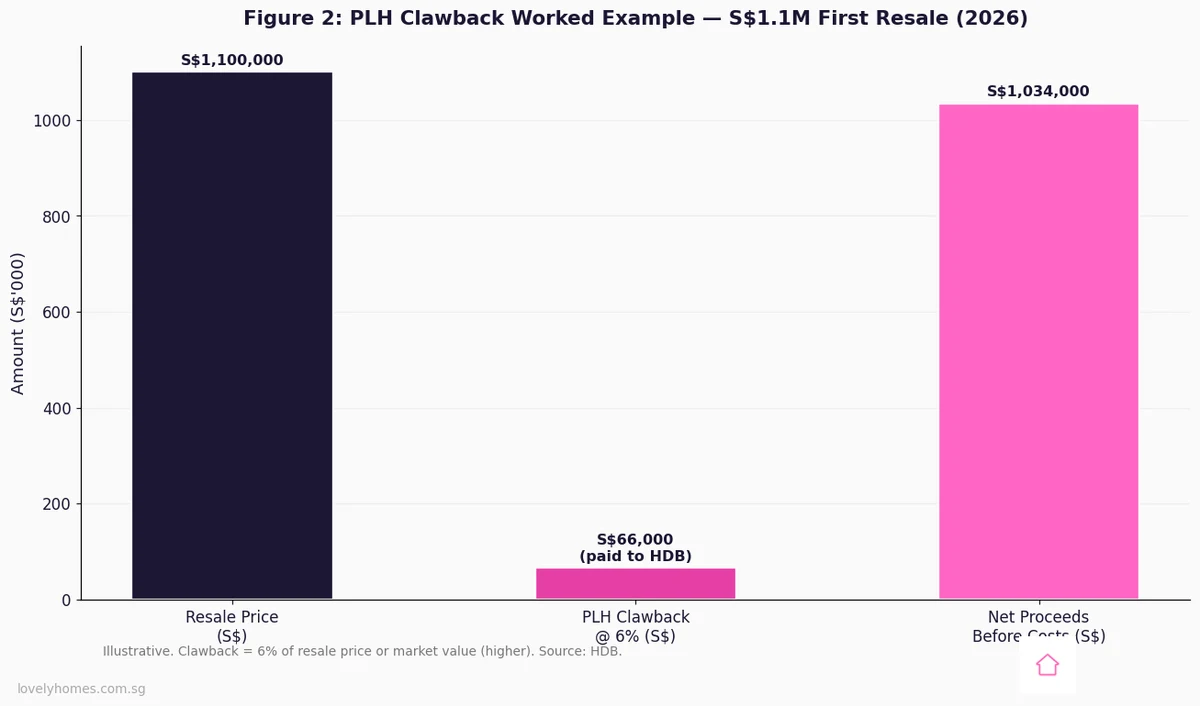
The single most financially material rule of the PLH model is the subsidy clawback. When a PLH flat owner sells their flat for the very first time after completing the MOP, they must pay HDB a sum equal to 6% of the resale price or 6% of the current market value , whichever is higher. This clawback represents a partial return of the enhanced subsidy that HDB provides for prime-location flats, which are priced below the true cost of building and the prevailing market value of the location.
The clawback applies only once , on the first resale. Subsequent buyers of a PLH flat (i.e., buyers who purchase on the open resale market after the first resale) are not subject to any clawback when they eventually sell. However, the standard 5-year MOP and normal HDB resale rules apply to subsequent buyers.
3. Resale Buyer Restrictions
When a PLH flat owner completes the MOP and lists their flat for sale, the pool of eligible buyers is restricted compared to standard HDB resale. Specifically:
- The first resale of a PLH flat can only be sold to Singapore Citizens. Permanent Residents (PRs) are not eligible to purchase a PLH flat on its first resale.
- The purchasing household’s monthly income must not exceed S$14,000. This is the same income ceiling applied at the point of BTO purchase, and it is intended to ensure that prime-location public housing remains accessible to Singaporeans of moderate means, not only high earners.
These restrictions dissolve after the first resale. From the second resale onwards, PLH flats are treated similarly to standard HDB resale flats , PRs may purchase them, and there is no income ceiling for buyers.
4. No Concurrent Private Property Ownership During MOP
Like all HDB flat owners, PLH flat owners are prohibited from owning private residential property in Singapore or overseas during the MOP. Given the 10-year MOP, this is a longer constraint. Owners who receive private property by way of inheritance during the MOP must dispose of it within 6 months.
PLH Projects Launched to Date (as at July 2026)
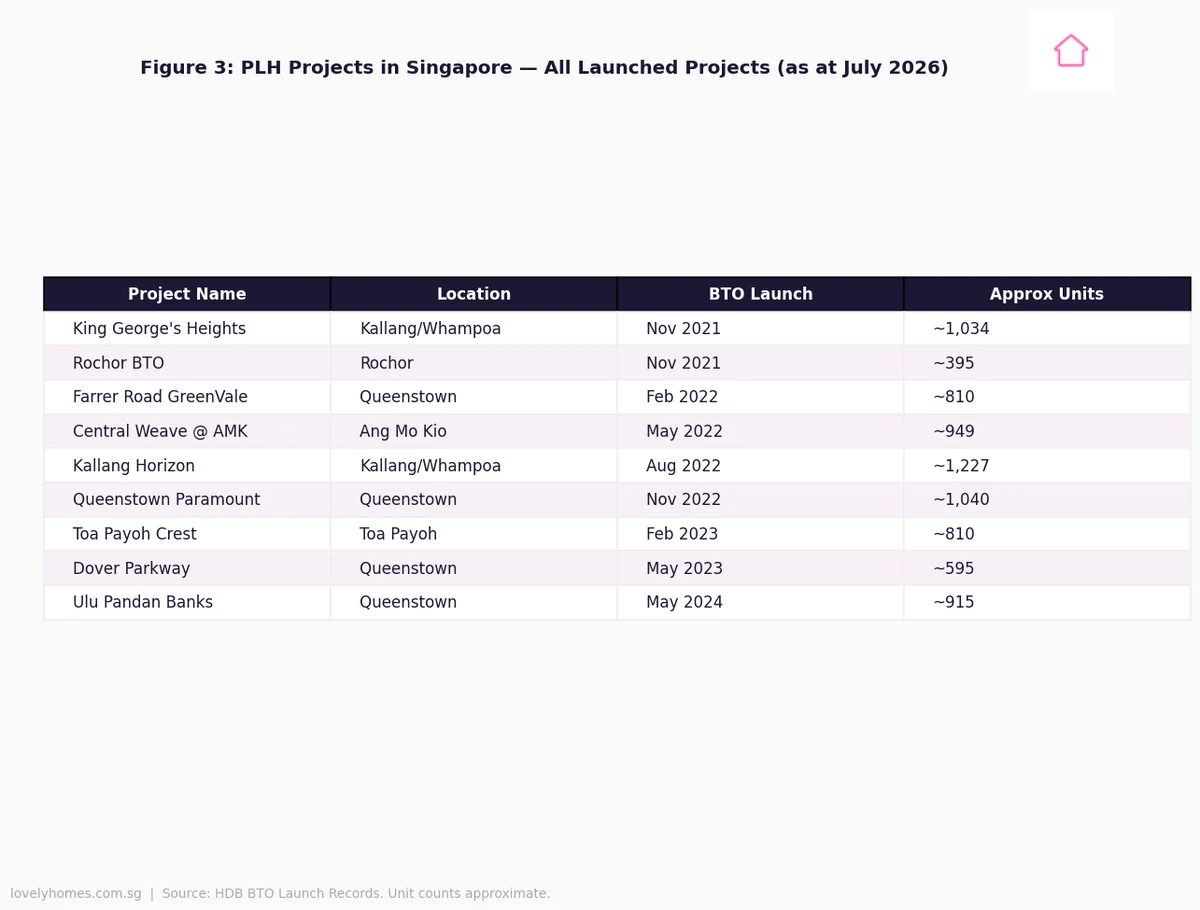
Nine PLH projects have been launched since the model’s introduction in November 2021. All are located in prime central areas that would otherwise have been too expensive for the majority of Singaporean households. Projects are distributed across several planning areas including Kallang/Whampoa, Rochor, Queenstown, Toa Payoh, and Ang Mo Kio Central , areas that were historically served only by ageing HDB estates and expensive private housing. The PLH model has enabled HDB to continue selling new flats in these desirable locations without surrendering the affordability mandate of public housing.
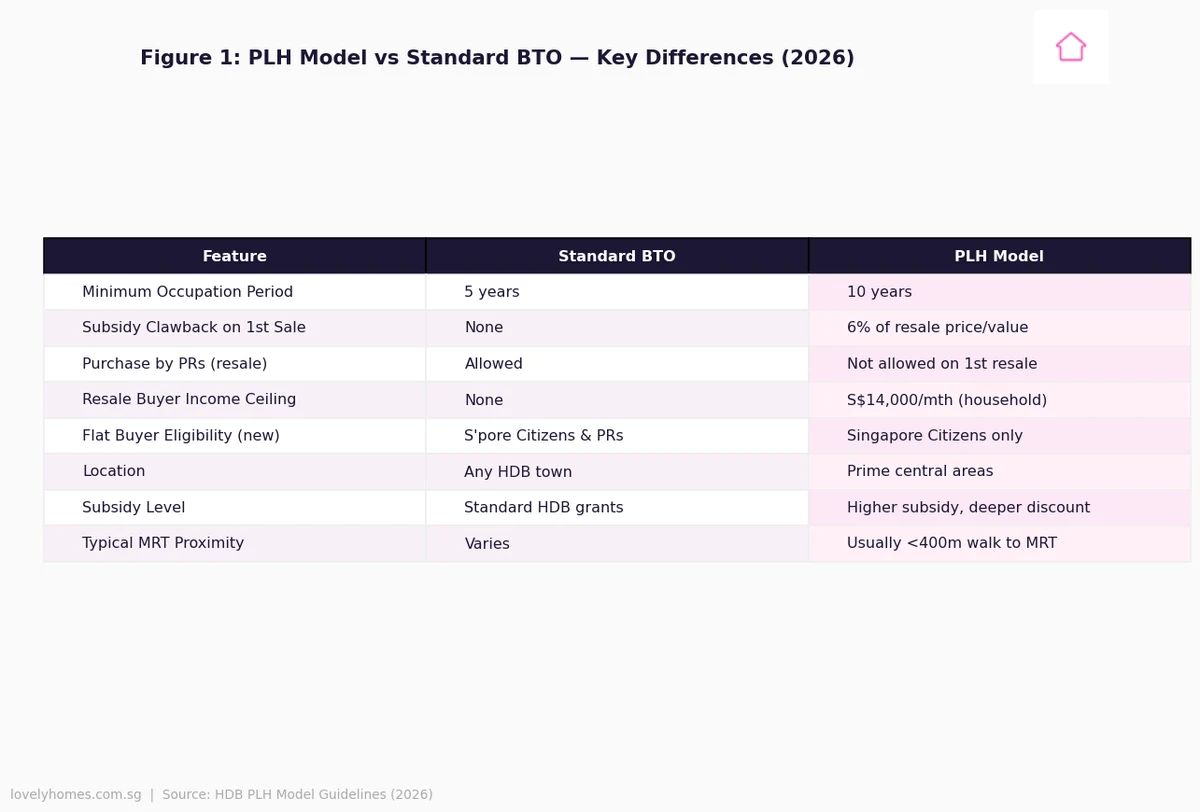
Summary Table , PLH Model at a Glance
| Feature | Standard BTO | PLH Model BTO |
|---|---|---|
| Minimum Occupation Period | 5 years | 10 years |
| Subsidy Clawback (1st Resale) | None | 6% of resale price or current market value (higher) |
| 1st Resale , Eligible Buyers | SC and PRs | Singapore Citizens only |
| 1st Resale , Income Ceiling | None | S$14,000/month household income |
| Subsequent Resales | Standard HDB resale rules | Standard HDB resale rules (clawback does not apply again) |
| Location | Any HDB town | Prime central areas designated by HDB |
| Private Property During MOP | Not allowed (5 yrs) | Not allowed (10 yrs) |
Worked Example , Buying and Selling a PLH Flat
Scenario: PLH Flat in Toa Payoh Crest , Purchase, MOP, and First Resale
BTO purchase (2023): A Singapore Citizen couple buys a 4-room PLH flat at Toa Payoh Crest for S$498,000 (after HDB grant). They collect keys in 2027 (typical BTO lead time of 4 years).
MOP expiry: 10-year MOP from key collection = MOP fulfilled in 2037.
First resale (2037 , illustrative): Market value assessed at S$980,000. Resale price agreed at S$1,020,000.
| Item | Amount |
|---|---|
| Agreed Resale Price | S$1,020,000 |
| Current Market Value (assessed by HDB) | S$980,000 |
| PLH Clawback Base (higher of the two) | S$1,020,000 |
| PLH Clawback Amount (6%) | S$61,200 |
| Proceeds After Clawback (before agent fees, legal, CPF refund) | S$958,800 |
| CPF Ordinary Account Refund (principal + accrued interest) | Deducted separately per CPF rules |
This is an illustrative scenario. Actual clawback is calculated at the time of resale. Market values in 2037 are entirely speculative. Consult HDB and a licensed financial adviser before relying on any projection.
Why the PLH Model Matters for Singapore Homebuyers
The PLH model represents a significant policy shift in how Singapore manages the tension between public housing accessibility and market efficiency in prime locations. Prior to its introduction, BTO launches in prime areas (like Pinnacle@Duxton in Tanjong Pagar, completed 2009) produced cases where buyers who paid subsidised BTO prices resold after 5 years at more than double what they paid, capturing gains that critics argued were underwritten by taxpayers via HDB’s development subsidies.
For prospective buyers weighing a PLH flat against other housing options, the key trade-offs are:
- Pros: Genuine location premium , you get a flat in a central area at below-market pricing; well-designed, modern HDB blocks typically with excellent MRT access; strong community facilities.
- Cons: Longer MOP reduces flexibility for 10 years; clawback reduces your eventual net sale proceeds; buyer pool restriction on first resale could limit your exit options; opportunity cost of not owning private property for 10 years.
For buyers who intend to live in their flat as a genuine long-term home, the PLH model’s constraints are relatively minor. For buyers who view the BTO as primarily an investment with an intention to upgrade quickly, the PLH model is a material deterrent , which is precisely its design intent.
What Might Come Next for the PLH Model
HDB has indicated it will continue launching PLH projects wherever prime central sites become available through redevelopment or land release. In 2026, the government is exploring further amendments to the HDB resale framework, including whether the PLH clawback rate should be adjusted over time to reflect changing market dynamics. HDB has also hinted at a potential review of the income ceiling for resale PLH flat buyers, given rising household incomes across Singapore. These are official statements subject to policy evolution , buyers should track HDB announcements at hdb.gov.sg for the most current guidance.
More broadly, the PLH model reflects a broader policy philosophy: Singapore’s land is finite, and the government’s role is to allocate housing resources equitably, not to maximise speculative gains for early buyers. As long as this philosophy guides housing policy, PLH-style constraints on prime-area BTO flats are likely to remain , and potentially expand.
FAQ , HDB PLH Model 2026
Can I rent out my PLH flat during the MOP?
Does the 6% clawback apply every time I sell my PLH flat?
What happens if the market value is higher than my asking price at resale?
Are there any PLH projects in the pipeline for future BTO launches?
Can I buy a PLH flat if my combined household income is S$14,500 per month?
How does the PLH model compare to the HDB Plus flat classification introduced in 2024?
Related Articles
- ABSD Singapore Complete Guide 2026 , All Rates, Remissions and Rules
- HDB Resale Flat Guide 2026 , Buying, Eligibility and Fees
- First-Time Property Buyer Guide Singapore 2026
- HDB Subletting Guide 2026 , Rules, Approval and Rental Limits
- Singapore Stamp Duty Complete Guide 2026 , BSD, ABSD and SSD
- Singapore Property Cooling Measures , Complete Timeline 2009–2026
Disclaimer: This article provides general information about the HDB Prime Location Public Housing (PLH) model and does not constitute financial, legal, or property advice. HDB policies, MOP rules, clawback rates, income ceilings, and eligibility conditions are subject to change by the government. All figures and policy details reflect information available as at July 2026. Verify all PLH-specific rules directly with HDB at hdb.gov.sg before making any housing decision. For matters involving CPF withdrawal, stamp duty, or legal documentation, consult the CPF Board (cpf.gov.sg), IRAS (iras.gov.sg), and a qualified lawyer respectively.
Supporting graphics
Original article illustrations are available below.
- Figure 1: PLH Model vs Standard BTO , Key Policy Differences (2026). Source: HDB PLH Guidelines.
- Figure 2: PLH Clawback Worked Example , S$1.1M First Resale. The clawback is 6% of the higher of resale price or market value. Source: HDB.
- Figure 3: All PLH Projects Launched in Singapore Through July 2026. Source: HDB BTO Launch Records.