Buying an HDB resale flat is one of the most significant financial decisions a Singapore household will make. Unlike a Build-to-Order (BTO) flat, a resale flat lets you move in within months rather than years , but you pay a market price, navigate a formal eligibility regime, and manage a multi-party transaction that involves the Housing & Development Board (HDB), your lawyer, your bank or the HDB loan counter, and the seller’s lawyer simultaneously. This guide walks you through every step of the process for 2026, from checking your eligibility to collecting your keys.
Quick Answer , Key Facts About Buying an HDB Resale Flat in 2026
- You must obtain an HDB Flat Eligibility (HFE) Letter before exercising any Option to Purchase (OTP) , it is mandatory, not optional.
- The 10-step process typically takes 8–16 weeks from OTP to key collection.
- Cash Over Valuation (COV) , paying above HDB’s assessed value , is permitted but must be funded entirely in cash, not CPF or bank loan.
- Buyer’s Stamp Duty (BSD) is payable within 14 days of exercising the OTP; Additional Buyer’s Stamp Duty (ABSD) applies if you already own property.
- First-timers may qualify for the Enhanced CPF Housing Grant (EHG) of up to S$120,000 and the Family Grant of up to S$50,000 , see our HDB Grants Complete Guide 2026.
- The Ethnic Integration Policy (EIP) quota applies at estate and block level , verify availability before shortlisting any flat.
- HDB resale flats carry the remaining lease of the original 99-year tenure; always check remaining lease before committing.
- Second-timers and singles have different eligibility rules and grant entitlements than first-timer families.
What Is an HDB Resale Flat?
An HDB resale flat is a public housing unit that has been previously occupied and is now sold by its current owner on the open market through HDB’s ResalePortal. HDB builds and sells flats initially at subsidised prices; once the Minimum Occupation Period (MOP) is satisfied , typically five years from the date the keys are collected , the flat can be listed for resale. Unlike BTO flats, which are sold directly by HDB at launch price, resale flats are priced by market forces: supply, demand, block facing, floor level, remaining lease, and proximity to amenities all influence what a seller will accept.
HDB administers the resale market under the Housing and Development Act, setting eligibility criteria, registration requirements, and the framework for grants and stamp duties. The Urban Redevelopment Authority (URA) and the Inland Revenue Authority of Singapore (IRAS) oversee stamp duty assessment and collection respectively.
Who Can Buy an HDB Resale Flat? Eligibility in 2026
HDB eligibility rules for resale flat purchases are more permissive than those for BTO applications, but several conditions remain firm. You must satisfy all of the following at the time of application:
| Condition | Detail |
|---|---|
| Citizenship | At least one applicant must be a Singapore Citizen. An SC buying with a Permanent Resident or a non-citizen spouse may apply under the Public Scheme. |
| Age | Minimum age 21 (family/fiancé/fiancée scheme). Singles: minimum age 35. |
| Household nucleus | Must form a valid family nucleus: married couple, fiancé/fiancée, parent-child, siblings (if orphaned), or single (for 2-room flexi or larger resale). |
| Income ceiling | No income ceiling for resale flats (unlike BTO). However, income ceiling applies to certain grants. |
| Property ownership | All applicants and their spouses must not own or have disposed of private residential property within 15 months of the resale application (HDB flat only , can own HDB but subject to MOP and ABSD rules). |
| 30-month rule | If you previously bought a BTO, DBSS, or EC under the Fiance/Fiancee or other HDB schemes, the 30-month wait-out period may apply before you can buy private again. |
| Ethnic Integration Policy (EIP) | The block and neighbourhood must not have exceeded its Chinese/Malay/Indian and Other ethnic quota at the time of purchase. |
| Singapore Permanent Resident Quota | A maximum proportion of flats per block can be owned by PRs; confirm quota is not exceeded. |
You can check your eligibility , and apply for the HFE Letter , via HDB’s MyHDBPage portal. The HFE Letter replaces the old HDB Loan Eligibility (HLE) letter and the Approval-in-Principle letter from 2023. It is valid for nine months from the date of issue and confirms your eligibility to buy, the loan amount HDB will grant (if applicable), and the grants you qualify for. No seller in Singapore will accept a resale flat offer without the buyer having an HFE Letter in hand.
The 10-Step HDB Resale Flat Buying Process
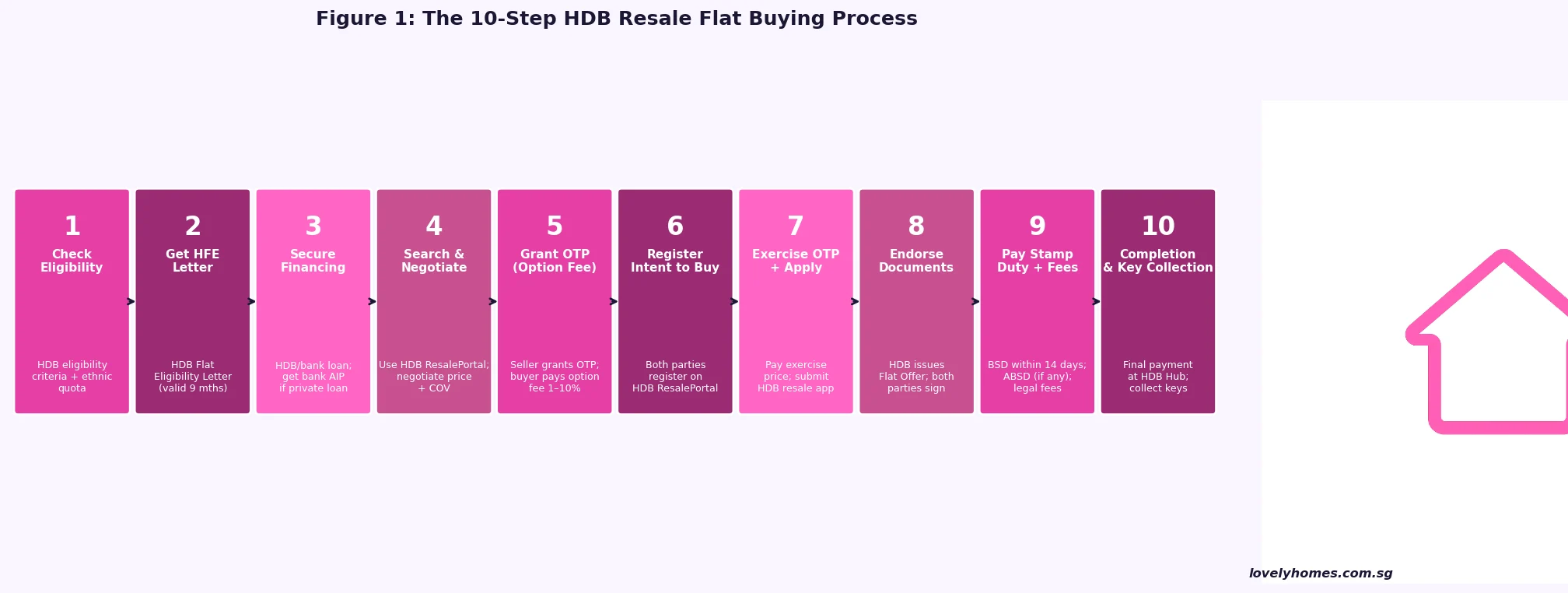
The HDB resale process has ten distinct stages, each with a formal act or document. Understanding all ten before you start house-hunting saves time, prevents costly errors, and gives you negotiating confidence with sellers.
Step 1 , Check Eligibility: Use HDB’s eligibility checker on MyHDBPage or HDB.gov.sg. Confirm that the ethnic quota at your target blocks is not exhausted and that neither you nor your co-applicant owns or recently disposed of private residential property. If buying with a non-citizen or PR spouse, confirm the correct scheme (Public Scheme for SC+PR, Non-Citizen Spouse Scheme for other combinations).
Step 2 , Obtain the HFE Letter: Apply via HDB’s e-service portal. The HDB system will assess your eligibility, grant entitlements, and , if you want an HDB loan , the maximum HDB loan quantum. Processing takes approximately 14 working days. Sellers and their agents will ask to see your HFE Letter before accepting an offer.
Step 3 , Secure Financing: Decide whether you want an HDB concessionary loan (2.6% per annum as at August 2026, subject to quarterly review, pegged at 0.1% above the CPF Ordinary Account rate) or a bank loan (typically SORA-linked floating or a fixed-rate package). For a bank loan, obtain an Approval-in-Principle (AIP) from your bank before making offers , this confirms the loan quantum and conditions. The HFE Letter covers the HDB loan piece; bank AIP is a separate step.
Step 4 , Search and Negotiate: Use HDB’s ResalePortal to search for flats and review the Resale Flat Listings. Access URA’s transaction data on HDB.gov.sg to understand recent transacted prices in your target estate and block. When you find a flat you like, negotiate the price with the seller. COV (the amount above HDB’s assessed value) is legal but must be paid fully in cash at the time of completion.
Step 5 , Receive the OTP (Option Fee Paid): When price is agreed, the seller grants you an Option to Purchase (OTP). The option fee is negotiated and is typically 1% of the purchase price (capped at S$1,000 for HDB resale, although in practice HDB guidance allows up to 1% of the agreed price without a separate cap in the OTP exercise amount). The OTP grants you 21 calendar days to exercise the option by paying the exercise price.
Step 6 , Register Intent to Buy and Sell: After the OTP is granted, both buyer and seller must register their Intent to Buy and Intent to Sell respectively on HDB’s ResalePortal. This must be done within seven days of the OTP grant date. HDB will then check eligibility in real time.
Step 7 , Exercise the OTP and Submit the HDB Resale Application: Within the 21-day OTP validity window, pay the option exercise price (balance of downpayment minus option fee). Submit the HDB Resale Application jointly with the seller via ResalePortal. Both parties must use a licensed conveyancer (lawyer) for this step; HDB no longer runs its own conveyancing service for resale transactions.
Step 8 , HDB Endorsement and Approval: HDB reviews the application, issues a Resale Approval (formerly “In-Principle Approval”), and sends the flat offer letter to both parties. Both buyer and seller must log into ResalePortal to accept and endorse the documents digitally. If HDB requires valuation (for CPF use and grant purposes), an HDB-appointed valuer will assess the flat; the valuation report is used to determine the COV amount.
Step 9 , Pay Stamp Duty, Legal Fees and CPF Funds: BSD is payable to IRAS within 14 days of the date you exercise the OTP (not the completion date). ABSD, if applicable, is due on the same deadline. Your lawyer handles stamp duty via IRAS e-Stamping. CPF funds (from your Ordinary Account) are transferred directly to HDB at completion. Legal fees typically range from S$2,000–S$3,500 depending on purchase price and complexity.
Step 10 , Completion and Key Collection: On the completion date set by HDB (typically eight to ten weeks after the resale application), both parties attend the HDB Hub (Toa Payoh) or complete online. Final payment is disbursed; the balance cash, CPF funds, and loan drawdown settle the remaining purchase price. You receive the keys and take possession of the flat.
Understanding COV , Cash Over Valuation
Cash Over Valuation (COV) is the difference between the negotiated purchase price and HDB’s assessed market value of the flat. For example, if the flat is valued at S$680,000 but you agree to pay S$710,000, the COV is S$30,000. This S$30,000 must be paid fully in cash at completion , it cannot be covered by CPF OA savings or any bank loan, because CPF and loan limits are calculated against the lower of the purchase price and the assessed value.
COV does not affect BSD calculation, which is computed on the actual purchase price (the higher amount). From a grant perspective, grants are computed on the assessed value or the purchase price, whichever is lower, so COV does not boost your grant quantum. As at Q2 2026, median COV in Singapore resale transactions ranged from S$0 in some estates to S$40,000–S$60,000 in popular mature estates such as Toa Payoh, Queenstown, and Bishan. Understanding COV before negotiating is critical to managing your cash position on completion day.
Upfront Costs: What You Will Pay
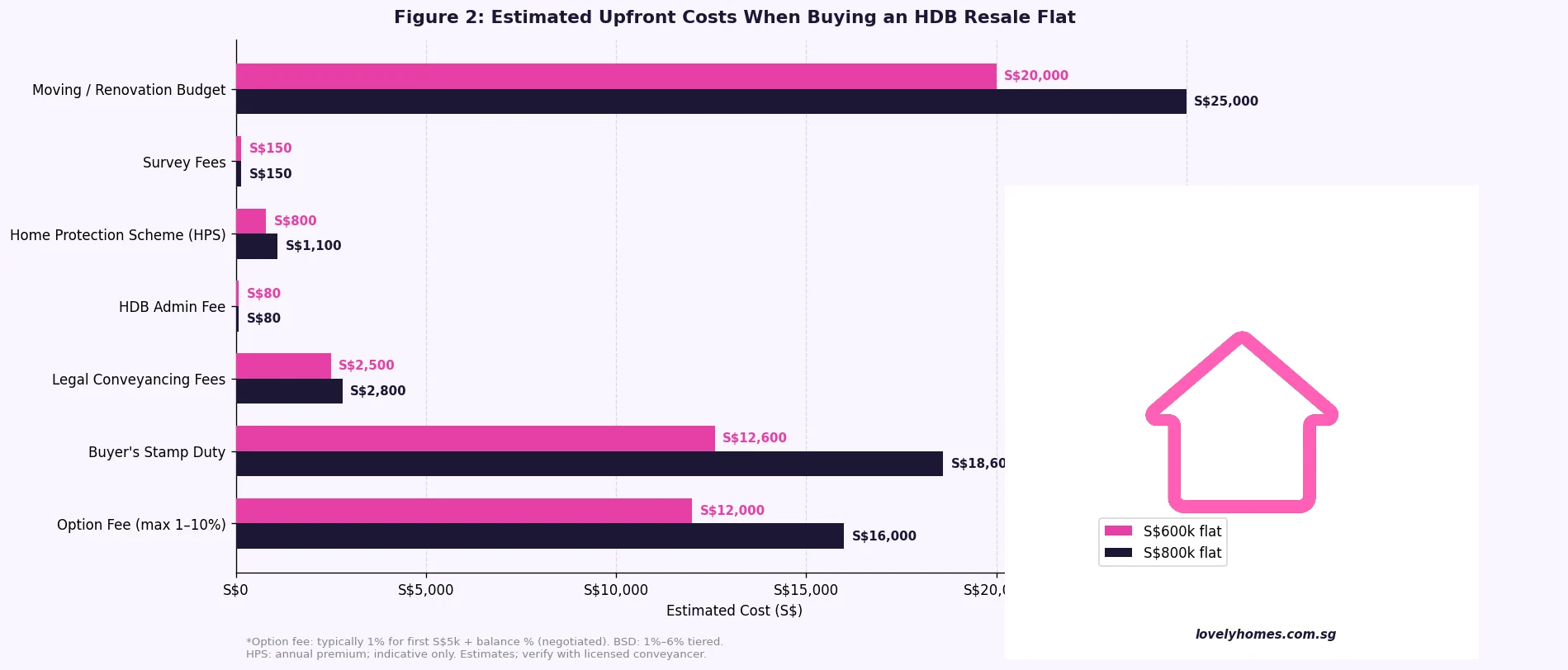
Stamp duties represent the largest single upfront cost beyond the downpayment. BSD is tiered: 1% on the first S$180,000, 2% on the next S$180,000, 3% on the next S$640,000, 4% on the next S$500,000, and 5% and 6% on amounts above S$1.5 million and S$3 million respectively. For a S$600,000 resale flat, BSD equals S$12,600 (effective rate 2.1%). For an S$800,000 flat, BSD equals S$18,600 (effective rate 2.33%). ABSD is layered on top if you already own residential property , see the ABSD Complete Guide 2026 for the full rate schedule.
The Home Protection Scheme (HPS) is a mortgage-reducing insurance administered by the CPF Board. It is compulsory if you use CPF OA savings to service your mortgage. The annual premium is small , typically S$300–S$1,500 depending on age, flat value, and loan tenure , but it must be factored into your budget. Renovation costs are an additional material line item; the HDB renovation guide details typical budgets of S$30,000–S$80,000 for a 4-room flat, depending on condition and extent of works. See our HDB Renovation Guide 2026 for a full breakdown.
Grants for HDB Resale Flat Buyers
Several CPF Housing Grants are available to eligible resale buyers. The grants are credited directly into your CPF Ordinary Account and used to offset the purchase price. They cannot be taken as cash. The key grants for resale purchases in 2026 are:
- Enhanced CPF Housing Grant (EHG): Up to S$90,000 for SC+SC couples and S$60,000 for SC+PR couples, subject to an income ceiling of S$9,000 per month (household). The grant scales with income , lower-income households receive the full amount.
- Family Grant (FG): Up to S$50,000 for SC+SC couples buying a 4-room or larger resale flat (S$40,000 for SC+PR couples). Income ceiling is S$14,000 per month.
- Proximity Housing Grant (PHG): Up to S$30,000 for buying a resale flat in the same building or within 4km of your parents or child (S$20,000 for within 4km, S$30,000 for co-located). No income ceiling for the S$20,000 variant.
Grants can be stacked subject to eligibility. A first-timer SC+SC couple buying near their parents with a household income of S$7,000 per month could potentially receive EHG + FG + PHG(S$20k), totalling as much as S$120,000 in CPF grant support. For a full breakdown of all grants, eligibility conditions, and stacking rules, see our HDB Grants Singapore 2026: Complete Guide.
HDB Resale vs BTO , Making the Right Choice
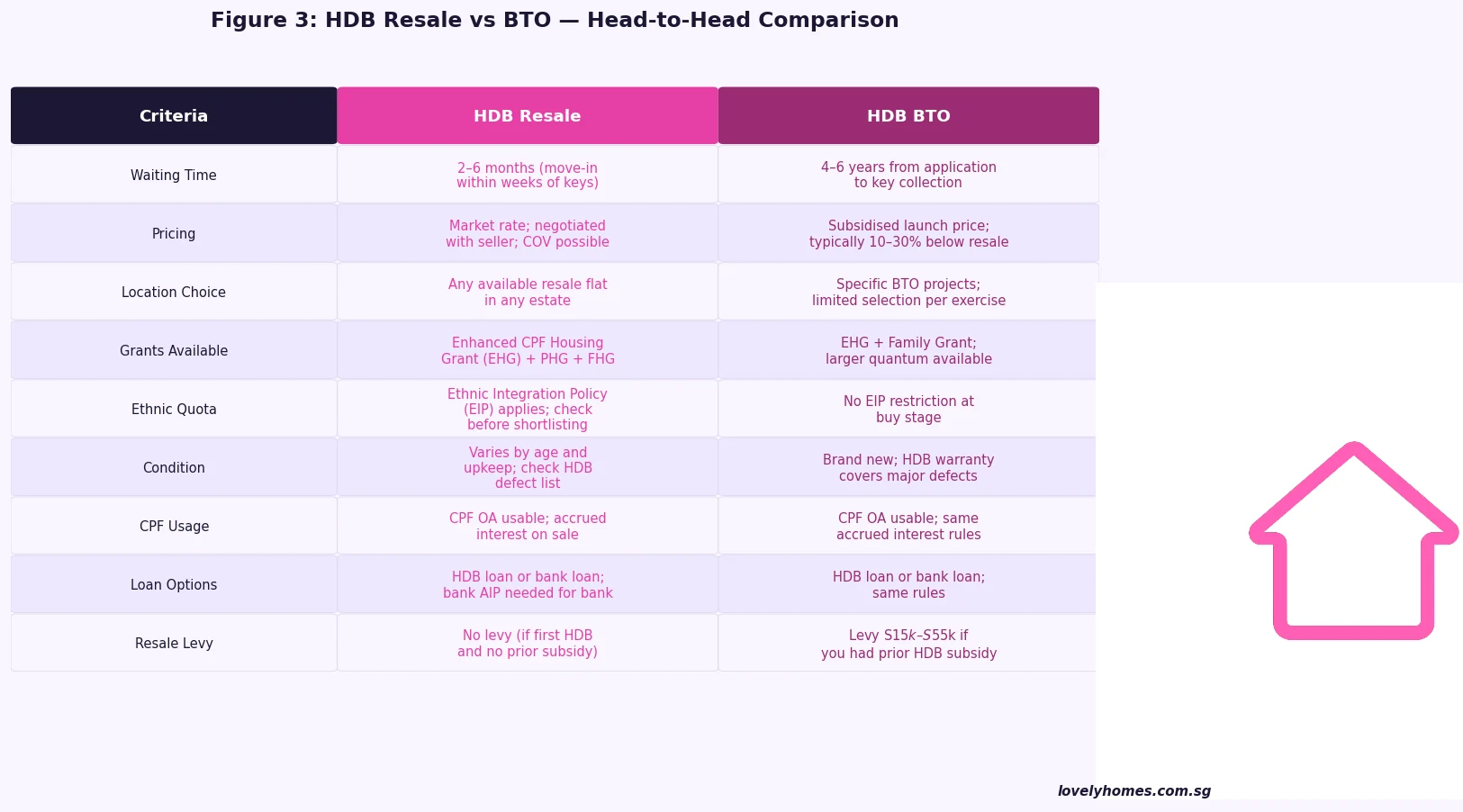
The choice between resale and BTO is fundamentally a trade-off between time and price. A resale flat lets you move in within two to six months , sometimes faster if the seller is motivated and HDB processing is smooth. A BTO flat typically requires a wait of four to six years from ballot to key collection. The trade-off is price: BTO flats are sold at a subsidy relative to market value, while resale flats are priced by the market. However, BTO grants are generally larger in quantum (up to S$120,000 EHG for SC+SC couples versus S$90,000 for resale), partly compensating for the lower subsidy.
Resale buyers also face the Ethnic Integration Policy: if a block’s ethnic quota for your race is full, you simply cannot buy in that block regardless of how much you are willing to pay. BTO ballots do not have this restriction at the ballot stage (though ethnic composition is managed by HDB at the planning level). For buyers who need to be near ageing parents quickly , a common situation in Singapore , the resale market, combined with the Proximity Housing Grant, is often the more practical route.
Worked Example: Mr and Mrs Lim Buy a Toa Payoh 4-Room Resale Flat
Scenario: SC+SC First-Timer Couple, Mature Estate Purchase
Flat: 4-room HDB resale flat, Toa Payoh, floor 8, 90 sqm, remaining lease 62 years (original 99-year lease commenced 1989).
Agreed purchase price: S$760,000
HDB assessed value: S$735,000
COV: S$25,000 (payable in cash at completion)
Household income: S$9,000/mth (Mr Lim S$5,500 + Mrs Lim S$3,500)
First-time buyers: Yes, no prior HDB flat or subsidised housing.
CPF OA balance: Mr Lim S$85,000 / Mrs Lim S$42,000
Grants received (all credited to CPF OA):
- EHG: S$30,000 (income S$9,000/mth → EHG tier reduces grant significantly; verified at HDB.gov.sg EHG table)
- Family Grant: S$50,000 (SC+SC, 4-room, income ≤ S$14,000)
- PHG: S$0 (parents live in Ang Mo Kio , more than 4km away)
- Total grants: S$80,000
Financing (HDB Concessionary Loan):
Purchase price: S$760,000
Assessed value: S$735,000
HDB loan ceiling: 80% of assessed value = S$588,000
Funded by CPF OA (Mr + Mrs after grant): S$127,000 + S$80,000 grants credited = S$207,000 (combined OA + grants)
Cash downpayment (10%): S$73,500 + COV S$25,000 = S$98,500 cash on completion
HDB loan amount: S$588,000
Monthly repayment (@2.6%, 25 years): approximately S$2,678/mth
MSR check: S$2,678 / S$9,000 = 29.8% , PASS (MSR ≤ 30% for HDB loan)
Stamp duties:
BSD on S$760,000: 1%×S$180k + 2%×S$180k + 3%×S$400k = S$1,800 + S$3,600 + S$12,000 = S$17,400
ABSD: S$0 (first property, SC+SC)
Legal fees (estimated): S$2,800
Day-1 cash outlay: S$98,500 (downpayment + COV) + S$17,400 (BSD) + S$2,800 (legal) = approximately S$118,700
Note on remaining lease: At 62 years remaining, CPF OA funds can be used but are subject to a lease-based apportionment rule if the lease does not cover the youngest buyer to age 95. Mr Lim is 35; 62 remaining years covers him to age 97. CPF use is unrestricted in this case. Buyers of older flats (remaining lease < 30 years) face CPF restrictions and potential bank loan limitations.
Why This Matters: The Role of the Resale Market in Singapore’s Housing Ecosystem
HDB resale transactions are a critical safety valve in Singapore’s housing market. When BTO supply is constrained , as it was during 2020–2022 when construction was disrupted , resale demand surges and prices rise sharply. The HDB Resale Price Index reached a peak in Q1 2022 before cooling gradually under successive government interventions; as at Q2 2026, the RPI has declined modestly, with flat prices stabilising across most estates. This makes 2026 a relatively balanced environment for resale buyers: supply is healthier than in peak years, and the government has signalled no further near-term cooling measure changes after the July 2026 policy adjustments.
Internationally, Singapore’s HDB resale market is unusual in combining a heavily regulated eligibility framework with free market price discovery. Hong Kong’s public housing (HOS) has tighter resale restrictions. Australia has no equivalent public housing resale market. The Singaporean model ensures that public housing assets remain primarily for eligible owner-occupiers while still allowing capital appreciation , a balance unique in global housing policy.
What Might Come Next: HDB Resale Market Outlook 2026–2027
Several developments are worth watching for resale flat buyers in the near term. The government removed the 15-month wait-out period for private property owners buying non-subsidised HDB resale flats (effective 28 July 2026), which may increase demand in the upper end of the resale market as private property owners who wish to downgrade move more freely. The 30-month wait-out period for those seeking HDB loans or CPF grants remains in place, limiting the impact at the subsidised end of the market.
HDB’s Build-to-Order supply pipeline for 2026–2028 is the largest in a decade, with the government targeting 12,000–13,000 BTO units per year. Higher BTO supply historically moderates resale prices by providing a near substitute. Whether resale prices in mature estates , which have little direct BTO competition , respond to the same dynamics remains an open question.
On the financing side, SORA-linked bank loan rates have eased from their 2023–2024 peaks, making bank loans relatively more competitive versus the HDB concessionary loan rate of 2.6%. Buyers with higher-value flats (above S$500,000) and longer loan tenures should model both options carefully before committing.
Frequently Asked Questions
Do I need an HFE Letter before I can view flats?
You can view flats without an HFE Letter , no law prevents you from attending viewings before applying. However, you cannot legally exercise an OTP or register your Intent to Buy on HDB’s ResalePortal without a valid HFE Letter. In practice, serious sellers and their agents will not entertain offers from buyers who cannot produce an HFE Letter, because the letter confirms your eligibility and financing capacity. Apply for your HFE Letter as early as possible , it takes up to 14 working days and is valid for nine months.
What happens if the flat’s remaining lease is very short?
HDB allows the purchase of flats with remaining leases as short as 20 years, but the practical implications are significant. CPF usage is restricted or prohibited if the remaining lease does not cover the youngest buyer to age 95. Most banks will not grant mortgage loans on flats with fewer than 30 years of lease remaining. For flats with 30–60 years remaining, CPF use is subject to a lease-based pro-ration: only a proportion of your CPF OA balance can be used, calculated by HDB’s formula. Always check the remaining lease duration and model your CPF and loan capacity accordingly before making an offer.
Can I buy an HDB resale flat if my spouse is a foreigner?
Yes, provided you (as the SC) form the eligible nucleus and your foreign spouse is listed as an occupier (not a co-owner, as HDB ownership is generally limited to citizens and PRs). The Non-Citizen Spouse Scheme allows an SC to buy a resale flat with a non-citizen spouse listed as an essential occupier. Your foreign spouse must be named on the flat ownership document as an occupier. Note that foreigner spouses cannot use their CPF funds (if any Singaporean CPF contributions apply) for the purchase in this configuration, and grant eligibility may be affected. Verify the current rules at HDB.gov.sg before proceeding.
How long does the whole process take from OTP to key collection?
Under typical conditions in 2026, the HDB resale process takes 8–16 weeks from the date you exercise the OTP to completion and key collection. The main variable is HDB’s internal processing time (typically 8 weeks), but additional time may be needed if there are complications such as a CPF charge on the seller’s flat that needs to be discharged, title issues, or late document submission by either party. The OTP itself is valid for 21 days from the grant date, giving you time to exercise after arranging your financing. Plan for approximately four months end-to-end from your first viewing to moving in.
What is the Mortgage Servicing Ratio (MSR) and how does it affect resale buyers?
The Mortgage Servicing Ratio (MSR) is a rule administered by the Monetary Authority of Singapore (MAS) that caps monthly HDB loan repayments (and HDB resale flat bank loan repayments) at 30% of the borrower’s gross monthly income. For example, if your household monthly income is S$9,000, your maximum monthly repayment is S$2,700. The MSR applies to HDB flat purchases , it does not apply to private property. Unlike the Total Debt Servicing Ratio (TDSR) of 55%, which counts all debt obligations, the MSR is a standalone test applied specifically to the housing loan repayment for HDB flats. Both MSR and TDSR must be passed; the MSR is often the binding constraint for HDB buyers.
Can I use my CPF savings for COV?
No. COV , the portion of the purchase price above the assessed value , must be paid entirely in cash. CPF Ordinary Account savings can only be used up to the lower of the purchase price and the HDB assessed value. If HDB values the flat at S$700,000 and you agree to pay S$740,000, only S$700,000 can be funded by CPF, bank loan, and grants combined; the S$40,000 COV must come from cash savings. This is a firm rule enforced by CPF Board under the CPF Act.
Can singles buy HDB resale flats?
Yes. Singapore Citizens aged 35 and above can buy an HDB resale flat as a single under the Single Singapore Citizen Scheme (SSC Scheme). Singles can buy any HDB resale flat type from 2-room flexi to 5-room, subject to EIP quota. They may also qualify for the Singles Grant of up to S$25,000 (for 4-room and above) or S$20,000 (for 2/3-room flats), subject to an individual income ceiling of S$7,000 per month. Singles cannot apply for BTO flats larger than 2-room flexi under the current rules. The resale market is therefore the primary route for singles who need more space.
Related Articles
- HDB Grants Singapore 2026: Complete Guide to EHG, Family Grant, PHG and All CPF Housing Grants
- ABSD Singapore 2026: Complete Guide to Additional Buyer’s Stamp Duty
- Singapore Buyer’s Stamp Duty (BSD) Guide 2026: Rates, Calculation and Worked Examples
- Singapore HDB Flat Types Guide 2026: 2-Room Flexi to Executive and 3Gen Explained
- Singapore HDB MOP Guide 2026: Complete Minimum Occupation Period Rules Explained
- Singapore Property Purchase Process Guide 2026: Step-by-Step from Search to Keys
- Singapore Property Downgrade Guide 2026: How to Sell Private and Buy HDB Resale
- Singapore HDB Renovation Guide 2026: Costs, Rules, Timeline and Grants
Disclaimer
This article is produced for general informational and educational purposes only. HDB eligibility rules, grant quantum, stamp duty rates, and loan parameters are subject to change by the Housing & Development Board, CPF Board, Monetary Authority of Singapore, and IRAS. All figures quoted reflect publicly available information as at August 2026. Readers should verify current rules at HDB.gov.sg, CPF.gov.sg, and IRAS.gov.sg before making any property decision. This article does not constitute financial, legal, or property advice. Readers are advised to engage a licensed property agent (registered with the Council for Estate Agencies) and a licensed conveyancer for transaction-specific guidance.
Supporting graphics
Original article illustrations are available below.
- Figure 1: The 10-Step HDB Resale Flat Buying Process , from eligibility check to key collection. Source: HDB.gov.sg, LovelyHomes editorial.
- Figure 2: Estimated Upfront Costs for an HDB Resale Flat Purchase (S$600k vs S$800k flat). Option fee, BSD, legal fees, HPS and moving budget. Source: LovelyHomes editorial, IRAS, HDB.
- Figure 3: HDB Resale vs BTO Head-to-Head Comparison , key differences across timing, price, grants, and conditions. Source: LovelyHomes editorial, HDB.