Home staging — the art of presenting a property at its most attractive to prospective buyers — is one of the highest-return, lowest-risk investments a seller in Singapore can make before listing. In a market where buyers have more choice in 2026 than at any point since 2016, first impressions are not merely useful; they are often the deciding factor between a swift sale at or above valuation and a listing that sits on the market for months, accumulating perception of stigma.
This guide covers the full spectrum: from the quick, low-cost interventions that deliver outsized returns, to the staging philosophy that matches presentation to the buyer profile most likely to be viewing your property. Whether you are selling a 3-room HDB flat in Toa Payoh or a S$3 million penthouse in the Core Central Region, the principles are the same — buyers do not buy properties, they buy how they feel when they walk through the door.
Quick Answer — Singapore Home Staging at a Glance
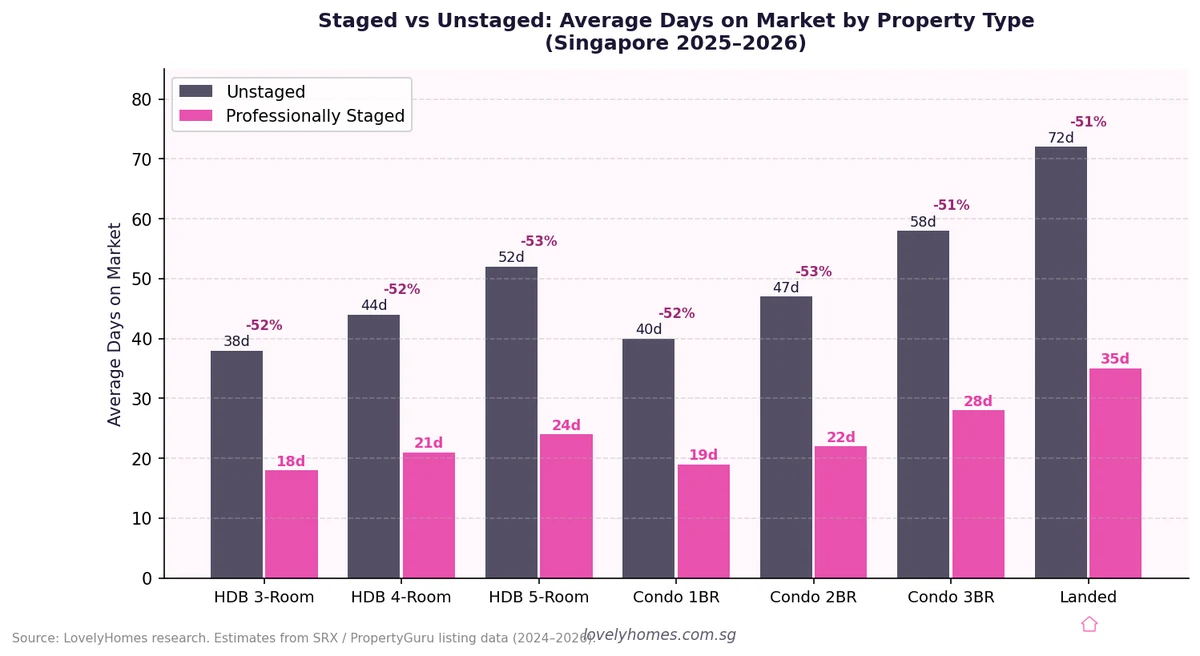
- Staged homes in Singapore sell on average 40–55% faster than unstaged equivalents across all property types
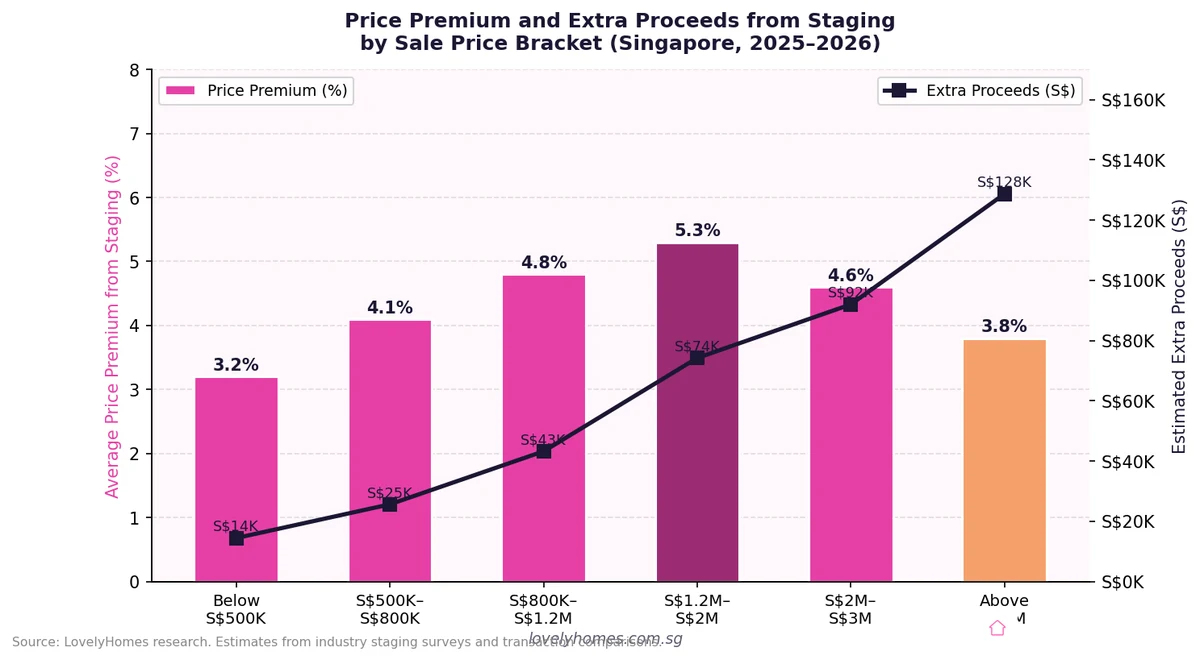
- Professional staging can achieve a 3–5% price premium, equivalent to S$30,000–S$74,000 on a S$1–S$1.5M sale
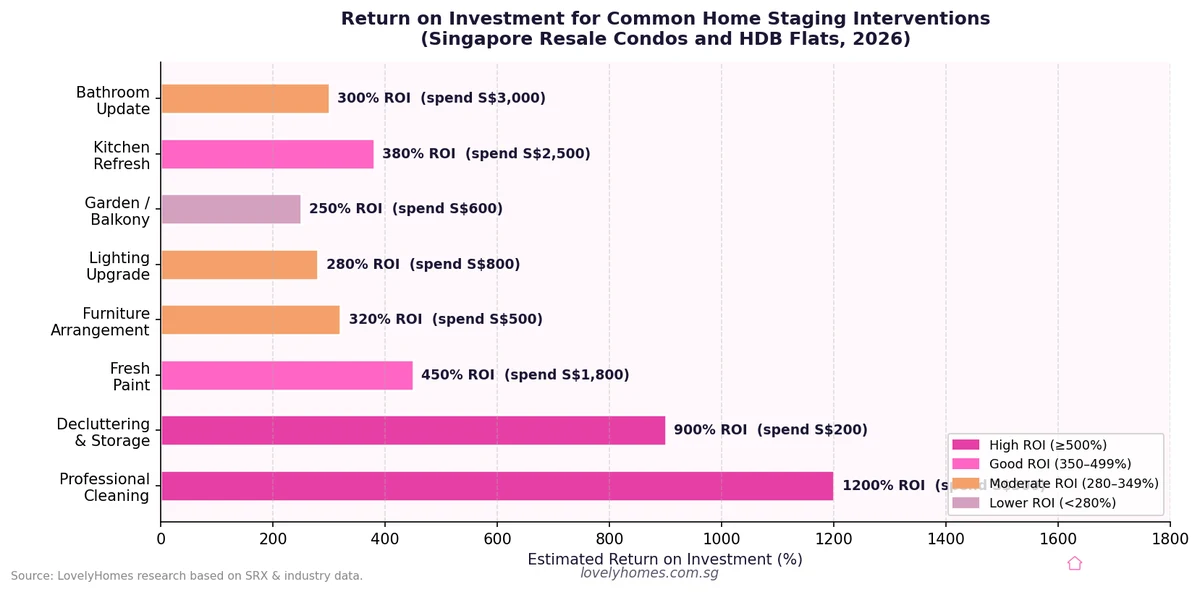
- The highest-ROI interventions: professional cleaning (1,200% ROI), decluttering and storage (900%), fresh neutral paint (450%)
- Common mistakes: over-personalising, ignoring the entrance, leaving obvious defects unaddressed, and staging for the wrong buyer profile
- Cost range: S$800 (DIY clean/declutter) to S$8,000 (full professional staging); budget S$2,500–S$4,500 for a typical 3-room HDB or small condo
- HDB sellers: ensure you have satisfied the MOP before listing; staging does not trigger any HDB restriction
What Is Home Staging and Why Does It Work?
Home staging is the deliberate preparation of a residential property for sale, with the goal of appealing to the widest possible pool of buyers and maximising perceived value. It is distinct from renovation: renovation improves the physical property; staging manages how the existing property is experienced.
It works because residential property purchases are driven far more by emotion than buyers typically acknowledge. Research consistently shows that buyers form their primary impression of a home within 8 seconds of walking through the door, and that impression disproportionately anchors their valuation and negotiating behaviour. A cluttered, poorly lit, or personalised home suppresses a buyer’s ability to imagine themselves living there, which in turn suppresses their willingness to pay the asking price or move quickly.
In Singapore’s 2026 market — where resale condo and HDB listings have increased as completions add supply — buyers have the luxury of viewing multiple properties before deciding. A well-staged home stands out not because it hides defects (buyers will see those at the survey), but because it creates an emotional connection that unstaged competitors cannot replicate.
The 8 Staging Interventions That Deliver the Best Returns
Not all staging effort is equal. The chart above illustrates the return on investment of the most common staging interventions for Singapore resale condos and HDB flats. Here is what each intervention involves and what drives its return.
1. Professional Deep Cleaning (ROI: approx. 1,200%)
Cost: S$200–S$400 for a typical condo or HDB. A professionally cleaned home signals to buyers that it has been well maintained. Clean kitchens, spotless bathrooms, and streak-free windows remove the psychological barrier of “I would have to clean this before I could live here.” Grout cleaning, aircon coil servicing, and exhaust hood degreasing are the highest-impact specifics. This is the single highest-return staging investment available to any Singapore seller.
2. Decluttering and Storage (ROI: approx. 900%)
Cost: S$150–S$250 (skip hire or self-storage for 1–2 months). Clutter reduces the perceived size of a room and tells buyers the property has insufficient storage. Remove at least one-third of existing furniture and personal items; pack family photographs, trophies, certificates, and religious items into temporary storage. Buyers need to see themselves in the space, not you. In Singapore, where square footage is expensive, the “space” a buyer perceives is as important as the actual floor area.
3. Fresh Neutral Paint (ROI: approx. 450%)
Cost: S$1,500–S$2,500 for a full HDB 4-room repaint by a professional. Fresh paint in a neutral palette — warm whites, soft greiges, pale sage — makes every room appear cleaner, brighter, and more recently refurbished. It also allows buyers to project their own colour preferences onto the space. Bold or highly personalised colour choices — however attractive to the current owner — narrow the buyer pool and can trigger price negotiations.
4. Furniture Arrangement (ROI: approx. 320%)
Cost: S$500 (staging consultant fee, 2–3 hour visit). Most people arrange their furniture for personal convenience rather than photogenic impact. A staging consultant will reposition sofas, coffee tables, and dining sets to maximise sightlines, create clear traffic flow, and make the main living area photograph well for online listings. In a market where over 80% of buyer search journeys begin online, how a room looks in a photograph drives viewing rates as much as price.
5. Lighting Upgrade (ROI: approx. 280%)
Cost: S$600–S$1,000. Singapore’s common-spec ceiling lights are functional but rarely flattering. Replacing recessed lights with warm-white LEDs (2,700–3,000K colour temperature), adding table lamps in the living and master bedroom, and ensuring all blown bulbs are replaced creates an ambiance that makes the home feel warm and inviting rather than institutional. During viewings and photography sessions, turn on every light in the property.
Room-by-Room Staging Priorities
Not every room carries equal weight in a buyer’s decision. Research from Singapore property transactions identifies the following hierarchy:
| Room / Area | Buyer Impact | Key Actions | Budget |
|---|---|---|---|
| Front door and entrance | Very High | Fresh paint on door, clean letterbox, shoe rack out of sight, fresh mat | S$50–S$200 |
| Living room | Very High | Declutter, rearrange furniture, neutral throw cushions, single potted plant | S$150–S$500 |
| Kitchen | High | Clear all countertops, deep clean, replace cabinet handles if dated | S$200–S$800 |
| Master bedroom | High | Fresh white bedlinen, clear bedside tables, remove all personal photos | S$100–S$400 |
| Bathrooms | High | Re-grout tiles, replace shower curtain, fresh white towels, clear counter | S$200–S$600 |
| Balcony / yard | Medium | Clear clutter, wash floor, one or two potted plants, small seating set | S$100–S$400 |
| Second bedrooms | Medium | Remove excess furniture, clear wardrobes to 50%, fresh bed linen | S$50–S$150 |
Photography: The Often-Ignored Staging Multiplier
In Singapore’s property market, where listings on platforms such as PropertyGuru and 99.co compete for buyer attention through thumbnail images, professional photography is not optional — it is the staging element with the highest reach. A staged home photographed on a smartphone in natural light is still a competitively disadvantaged listing. Professional real estate photography typically costs S$200–S$400 and produces images that increase listing click-through rates by an estimated 30–40% relative to amateur photography.
Key photography staging rules: shoot during the golden hour (late afternoon for most Singapore orientations), turn on all lights, open all curtains, remove all visible rubbish bins and toilet rolls, and shoot from corners to maximise the perceived room depth. A virtual tour or 360-degree Matterport scan — available from specialist Singapore property photographers for S$300–S$600 — further increases qualified viewing rates by filtering in buyers who are genuinely interested in the layout before they visit in person.
Worked Example: Staging a S$1.4M OCR Condo for Sale
Mr and Mrs Tan own a 2BR condo in Jurong East that they purchased in 2019 for S$980,000. Current market value is approximately S$1.4 million. They are planning to sell in September 2026 to fund an upgrade. Their staging budget: S$4,500.
| Staging Item | Cost | Action |
|---|---|---|
| Professional deep clean | S$380 | Full unit including aircon coils and grout |
| Declutter and self-storage (2 months) | S$280 | Remove 40% of furniture; pack personal items |
| Repaint (full unit, neutral warm white) | S$2,100 | Replace dated beige walls and feature navy wall |
| New bedlinen, cushions, neutral towels | S$450 | Fresh, hotel-style presentation |
| Lighting refresh (warm-white LEDs) | S$620 | Replace 18 ceiling lights and add 2 table lamps |
| Professional photography + Matterport | S$580 | 24 HDR images plus 360-degree virtual tour |
| Total staging investment | S$4,410 | Well within budget |
At a 4.8% price premium (the estimated staging premium for S$1.2M–S$2M properties), the additional sale proceeds would be approximately S$67,200 on a S$1.4 million sale. For an outlay of S$4,410, that represents a return of over 15 times the investment. Even at half that premium (2.4%), the extra proceeds of S$33,600 still deliver a 7.6x return on staging spend. In a market where the gap between listed price and achieved price can easily exceed the cost of staging, not staging is the more expensive choice.
What Might Come Next: Staging in a Buyer’s Market
With Singapore’s private residential vacancy rate at approximately 9.2% in mid-2026 and more supply completing through 2027, the property market is shifting towards buyers having greater choice. In a buyer’s market, presentation differentiates properties that sell quickly at asking price from those that either receive low-ball offers or sit unsold. The imperative to stage well is higher in 2026 than it was in 2021 or 2022, when most properties sold with minimal preparation because demand exceeded supply. Sellers who present their properties to the standard described in this guide will command a meaningful advantage in the next 12 to 18 months.
Frequently Asked Questions
Do I need to use a professional staging company in Singapore?
Not necessarily. For HDB flats and smaller condos in the OCR, a thorough DIY staging — deep cleaning, decluttering, repainting in a neutral colour, fresh bedlinen, and good photography — can achieve most of the available gain at a fraction of the cost of a professional staging service. Professional staging companies (which typically charge S$2,000–S$6,000 for a full service including furniture hire) add the most value for larger, higher-priced properties (above S$1.5 million) where the cost is proportionally small relative to the potential price premium, and where the buyer pool includes discerning high-net-worth individuals who compare multiple premium listings simultaneously.
Should I disclose defects before staging?
Staging is not concealment. Under Singapore law, sellers of property have a duty to disclose latent defects — material defects that are not apparent upon reasonable inspection — and failure to do so can expose the seller to claims for misrepresentation or breach of contract even after completion. Staging should enhance the presentation of a well-maintained property, not mask defects that a buyer would find material. Addressing defects before listing (where cost-effective) is both ethically correct and commercially rational: buyers who discover problems during the survey period frequently use them as leverage for renegotiation, eroding the price premium that staging was designed to create.
Can I stage an occupied property in Singapore?
Yes, and in fact most Singapore resale transactions involve staging occupied properties. The key is disciplined decluttering: remove everything that is not serving a presentation purpose and store it off-site. Living with a staged property during the marketing period requires compromise — maintaining the cleaning standard, keeping surfaces clear, and making the bed every morning before any viewing. For families with children or pets, this is manageable for a marketing period of 4–8 weeks. If you are renting the property out while marketing it, coordinate with your tenant well in advance: under Singapore law, tenants have a right to quiet enjoyment, and viewings must be agreed in the tenancy agreement or by separate arrangement.
What is the biggest staging mistake Singapore sellers make?
Over-personalisation is the most common and most costly mistake. Sellers who present their property as a reflection of their own life — displaying family photographs, personal collections, religious iconography, and idiosyncratic colour choices — are effectively telling buyers “this is my home, not yours.” The goal of staging is to present a lifestyle aspiration that the target buyer can project themselves into. The second most common mistake is neglecting the entrance: the front door, letterbox, and short corridor leading to the main living area are the first thing every buyer sees, and a disproportionate amount of their subconscious evaluation happens in those first three to five seconds. A cracked letter box, a scratched door, or a cluttered shoe rack at the entrance quietly signals poor maintenance of the entire property.
How long does staging take before listing in Singapore?
A realistic timeline for a thorough staging programme for a typical 3–4-room HDB or 2BR condo in Singapore is three to four weeks: one week for decluttering and organising storage, one to two weeks for repainting (if required), two to three days for deep cleaning and final furniture arrangement, and one day for photography. Rushing the process — listing before the paint has dried or before the decluttering is complete — produces inferior photographs and diminishes the impact of the staging investment. Budget for a four-week preparation window before your target listing date.
Does staging work for HDB flats in Singapore, or mainly for condos?
Staging is as effective for HDB resale flats as for condos, and arguably delivers a higher proportional impact at the lower price point. The competitive set for an HDB 4-room in a mature estate like Toa Payoh or Queenstown in 2026 is significant: buyers have dozens of comparable listings to choose from. A well-cleaned, decluttered, and freshly painted HDB flat in a move-in-ready condition will transact faster and above valuation relative to an equivalent flat that presents as tired or dated. The same principles apply: neutral colours, maximum light, decluttered rooms, and professional photography. At an average HDB 4-room price of S$550K–S$700K in mature estates in 2026, a 3–4% premium translates to S$16,500–S$28,000 in additional proceeds from a total staging spend that need not exceed S$2,500.
Related Articles
- ABSD Singapore 2026: Complete Guide to Additional Buyer’s Stamp Duty
- Buying Your Second Property in Singapore 2026: ABSD, Decoupling and the Upgrade Path
- Singapore En Bloc Sale Process Guide 2026
- Singapore Stamp Duty Guide 2026: BSD, ABSD and SSD Explained
- Singapore HDB MOP Guide 2026
- Singapore Rental Market Outlook 2026
Disclaimer: This article is for general information and educational purposes only. Staging cost and return estimates are based on Singapore industry research and comparable property data as at 14 August 2026 and will vary by property type, condition, location, and market conditions. This article does not constitute legal, financial, or property valuation advice. Always verify current market conditions through the URA and consult a licensed property professional before making any decision to sell.
Supporting graphics
Original article illustrations are available below.
- Figure 1: Return on investment for common home staging interventions. Professional cleaning and decluttering deliver the highest ROI for the lowest outlay; kitchen and bathroom updates cost more but still return multiples of their spend.
- Figure 2: Staged properties sell significantly faster across all property types. The reduction in days on market ranges from 40% for HDB 3-rooms to 51% for landed homes.
- Figure 3: The price premium from staging peaks at 5.3% for properties in the S$1.2M–S$2M bracket, translating to an average S$74,200 in additional proceeds on a S$1.5M sale.