
Checked 23 September 2026. Singapore’s cooling measures affect different parts of a purchase: tax, borrowing and the cost of an early exit. Passing one test does not mean the home is affordable. A buyer can owe no Additional Buyer’s Stamp Duty (ABSD) yet still lack the cash needed to complete.
Start with three separate figures: the tax bill, the loan your lender will actually approve, and the money available on each payment date. This guide covers individual residential buyers. Company, trust and developer purchases need their own assessment.
1. Establish the buyer profile before calculating ABSD
For purchases on or after 27 April 2023, the standard individual ABSD rates are:
| Buyer | Rate by property count |
|---|---|
| Singapore citizen | First: 0% Second: 20% Third or later: 30% |
| Permanent resident | First: 5% Second: 30% Third or later: 35% |
| Foreigner | 60% for any residential property |
ABSD uses the higher of consideration and market value. A partial ownership interest can count as a property. For joint buyers with different profiles, the highest applicable rate generally applies to the whole purchase, rather than adding each person’s rate. Reliefs can change the result, so verify eligibility instead of budgeting an assumed refund. See IRAS’s ABSD rates, counting rules and concessions.
For an upgrader, ask the conveyancer which signed sale and purchase documents determine your ownership count. Separately ask the bank how it will treat the existing housing loan. The tax answer and lending answer need not be identical. Do this while you can still change the sequence of the transactions.
2. Count outstanding housing loans, not just properties
For bank residential loans to individuals, the ordinary LTV ceilings are 75% with no outstanding housing loan, 45% with one, and 35% with two or more. The corresponding lower ceilings are 55%, 25% and 15% where the loan exceeds 30 years (25 for an HDB flat) or extends beyond age 65. Minimum cash downpayments are respectively 5% or 10% with no outstanding housing loan, and 25% otherwise. These are regulatory ceilings, not promised loans. MoneySense explains the bank-loan limits.
The standard TDSR threshold is 55% of gross monthly income for total debt repayments, subject to the applicable rules and exemptions. MSR is a separate 30% housing-payment limit for HDB flats and ECs whose minimum occupation period has not expired. Obtain the lender’s assessment; a spreadsheet using only the advertised interest rate is not proof of eligibility.
HDB loans have a different framework. For complete resale applications received on or after 20 August 2024, the LTV ceiling is 75%, with a 25% initial payment from cash and/or eligible CPF savings. There is no universal 10% cash-downpayment rule for this HDB-loan route. Your assessed loan may be smaller. HDB’s current resale financing table sets out payment modes and the older application cohort separately.
3. Test the whole purchase, not only the minimum cash deposit
Hypothetical example: a Singapore citizen buying a first private home for S$1.5 million, with an equal valuation, obtains a 75% bank loan. Assume no ABSD and sufficient eligible CPF for permitted payments. The loan is S$1,125,000; the price balance is S$375,000. A 5% minimum cash component is S$75,000, leaving S$300,000 to fund with cash and/or permitted CPF. Deposits already paid form part of that price balance; do not add them again.
Residential BSD is another S$44,600: S$1,800 + S$3,600 + S$19,200 + S$20,000 across the applicable bands. That gives S$419,600 outside the loan before legal fees, renovation and other costs. This is a funding requirement, not a statement that S$419,600 must all be cash. The calculation uses IRAS’s residential BSD bands effective from 15 February 2023.
If the same property’s approved loan falls to S$1 million, the price balance rises by S$125,000. A lower asking price, more available funding or a different purchase may be necessary. Extending the tenure can change the LTV band and increase total interest, so it is not a reliable shortcut.
ABSD is not categorically cash-only: CPF use is subject to the housing schemes’ conditions. Confirm both eligibility and disbursement timing with the conveyancer. An expected refund or future sale receipt does not pay a bill due today. Keep a separate cash reserve for the move, repairs and a period of reduced household income.
4. Build an exit test using the correct SSD cohort
For residential property acquired on or after 4 July 2025, SSD is 16% when disposed of within one year, then 12%, 8% and 4% in the following annual holding bands through four years. The 11 March 2017 to 3 July 2025 cohort instead has a three-year schedule of 12%, 8% and 4%. Verify the legal acquisition and disposal dates and any exemption with IRAS’s cohort table.
Do not assume waiting for SSD to end automatically produces the best outcome. Compare the duty saved with interest, maintenance, taxes and the possibility of a lower sale price. Our early-sale cost comparison works through that decision.
What to obtain before committing
- A written tax computation using every buyer’s actual profile and ownership interests.
- A lender assessment for the specific property, loan tenure and existing debts.
- A payment calendar identifying cash, permitted CPF and sale proceeds separately.
- A household budget that still works if income falls, repairs arrive or the home cannot be sold when planned.
For an owner-occupier, compare the affordable home with the school, care and commuting routines it must support. For an investor, test vacancy and the cost of an early exit before treating a gross rental yield as a return. None of these measures guarantees prices or predicts the next policy change.
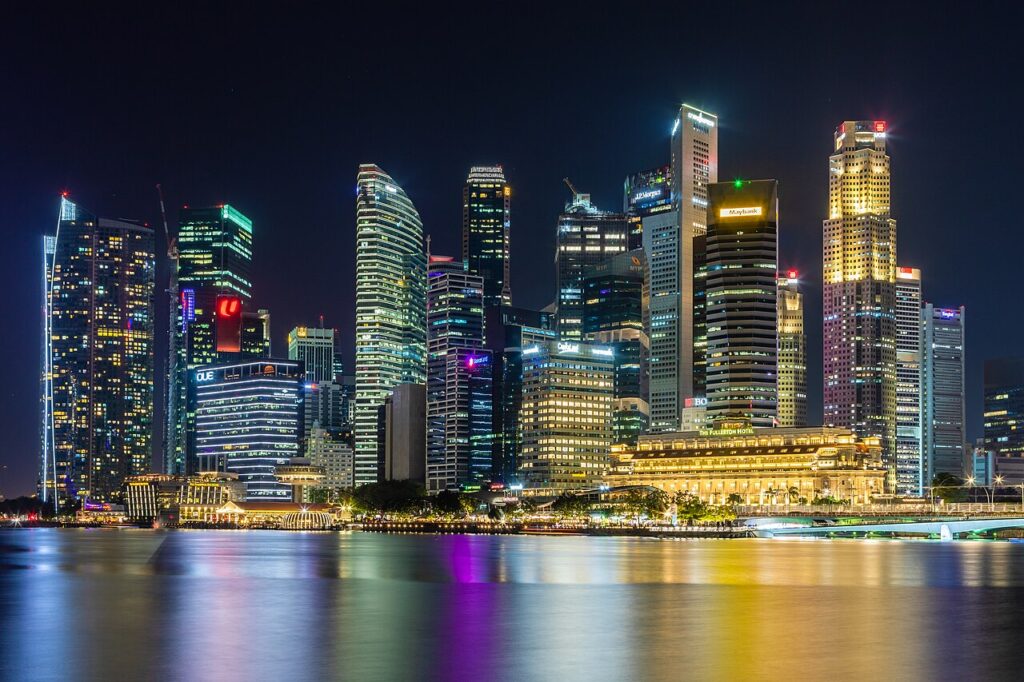
General information, not an individual financing or tax assessment. Correction on 23 September 2026: replaced outdated SSD and HDB-loan figures, the cash-only ABSD claim, misleading borrowing examples and unsupported policy forecasts. Previous charts were removed. Featured photograph: Marina Bay in 2023, Bijay Chaurasia, source, CC BY-SA 4.0; contextual photography, not price evidence.
