
Updated 22 September 2026. A property with a 4% advertised rental yield can still need money from your salary every month. The rent figure may assume full occupancy, the yield usually excludes purchase taxes, and the mortgage payment contains principal as well as interest.
Before choosing an investment condo, build three separate views: the cash needed to enter, the cash needed to hold, and the proceeds on exit. This guide uses a hypothetical completed private apartment to show how. It does not report current asking rents, transactions or investment returns for a particular development.
Start with the buyer, then the property
For acquisitions from 27 April 2023, standard individual ABSD rates are 0%, 20% and 30% for a Singapore citizen’s first, second and subsequent residential properties; a permanent resident’s corresponding rates are 5%, 30% and 35%. The standard foreign individual rate is 60%, not 65%. Duties use the higher of consideration and market value. Remissions and treaty treatment require a separate eligibility check. See the IRAS ABSD tables and exceptions.
A property count is not an outstanding-loan count. Someone with a fully paid first home can still face second-property ABSD. Conversely, a borrower who has an existing housing loan cannot simply assume the same financing as a borrower with none. Obtain the lender’s assessment before making an offer.
The example below assumes a Singapore citizen acquiring a second residential property, no remission, no outstanding housing loans, and an approved S$900,000 loan. It does not establish eligibility to retain an HDB flat, purchase a restricted property or rent out a home. Those questions must be settled separately.
Entry cost: include the money that will never become equity
Assume the purchase price and market value are both S$1.5 million. The buyer contributes S$600,000 towards the price and borrows S$900,000. The amounts for legal work and furnishing below are planning assumptions, not market quotations.
| Item | Amount |
|---|---|
| Price not financed by the loan | S$600,000 |
| Buyer’s Stamp Duty | S$44,600 |
| ABSD at 20% | S$300,000 |
| Assumed legal and transaction costs | S$5,000 |
| Assumed initial furnishing | S$20,000 |
| Total funds outside the loan | S$969,600 |
The BSD calculation is S$1,800 + S$3,600 + S$19,200 + S$20,000 under the current residential bands. Deposits paid towards the price belong within the S$600,000 contribution, not on top of it.
This total is not a cash-only figure. CPF permits OA use for BSD and ABSD subject to its rules. For completed properties, eligible duty reimbursement is processed at completion, with the application made beforehand alongside the lump-sum drawdown. Budget for the earlier cash payment and confirm your usable CPF amount; an OA balance is not a promise that every dollar can be withdrawn.
Holding cost: gross yield is only the first line
Assume rent of S$5,000 a month, one vacant month in the first year, and the expenses below. These are sensitivity inputs chosen for the calculation. Replace them with comparable rental evidence, the actual maintenance bill, insurance quote, repair needs and your IRAS tax assessment.
| Item | Annual amount |
|---|---|
| Rent for 11 occupied months | S$55,000 |
| Letting, repairs and insurance allowance | Less S$4,000 |
| Maintenance | Less S$4,800 |
| Property tax, assumed AV S$40,800 | Less S$5,760 |
| Operating income before financing and income tax | S$40,440 |
Full-year headline rent would give 4% gross yield: S$60,000 / S$1.5 million. After the assumed vacancy and operating expenses, yield on purchase price falls to 2.70%. Measured against the S$1,869,600 total acquisition cost including taxes and furnishing, it is about 2.16%, before financing and income tax.
The assumed Annual Value is separate from collected rent. Under non-owner-occupier residential rates effective from 1 January 2024, the example’s tax is S$30,000 x 12% + S$10,800 x 20% = S$5,760. Use your assessed AV, not the example or a rent figure copied automatically into an AV field.
Interest expense and cash shortfall are different
For the S$900,000 loan, assume 3.5% annual interest, monthly amortisation, a 25-year term and an unchanged rate throughout the first year. The monthly payment is approximately S$4,506. The first 12 payments total S$54,067, comprising about S$31,134 interest and S$22,933 principal. Calculations use unrounded payments; a lender’s daily-interest method may differ.
That leaves approximately S$9,306 after interest but before income tax. Yet the household must fund a S$13,627 cash shortfall after the full loan payments. Principal repayment reduces the debt; it is still money that must be available. Calling the interest-only surplus “cashflow” would conceal this obligation.
For a two-month vacancy instead, rent falls by another S$5,000. Keeping other assumptions unchanged increases the annual funding gap to S$18,627. A major repair or higher reset rate makes it larger. A tenant’s security deposit is money held against lease obligations, not dependable investment income to spend.
MoneySense’s bank-loan table distinguishes borrowers with no, one, or at least two outstanding housing loans. Its standard upper LTV bands are 75%, 45% and 35%, with lower bands for specified age/tenure conditions. These are ceilings, not guaranteed offers. Our example deliberately assumes 60% financing and still requires lender approval.
Taxable rent is a fourth calculation
Property tax and income tax are different charges. IRAS allows eligible residential landlords to use 15% deemed rental expenses plus qualifying mortgage interest, or actual allowable expenses. Conditions and exclusions apply, including consistent treatment across residential properties. Mortgage principal is not deductible. The 15% method is a tax deduction, not a statement that your actual costs equal 15%.
Do not apply a personal income-tax rate to the example without knowing the owner’s other income, status and deductible expenses. Keep a cash budget alongside the tax working so that a deductible cost is not mistaken for a cash refund.
Exit: test a flat price before assuming appreciation
Build the exit calculation using sale price, selling expenses, any SSD, loan redemption and applicable CPF refund. Compare the resulting proceeds with every initial and later contribution. Use a dated cash-flow calculation if you want an annualised return. Dividing a ten-year profit by the initial cash alone overlooks subsequent top-ups and CPF funding.
At an unchanged S$1.5 million sale price, assume S$30,000 selling expenses and no SSD. The property has not recovered the S$344,600 purchase duties, S$5,000 acquisition costs, S$20,000 furnishing and S$30,000 selling costs through price growth. These total S$399,600 before counting rental results, interest and changes in furnishing value. This is an entry/exit cost illustration, not a total-return forecast.
Check the acquisition cohort before excluding SSD. Our SSD and early-exit guide compares holding costs against the potential duty saving. A future buyer, collective sale or favourable refinancing offer should not be treated as assured.
What would make this purchase acceptable to your household?
- A documented rent assumption with a vacancy scenario you can fund without selling urgently.
- Enough reserves for your own home, dependants and retirement after all entry payments.
- An exit plan that works without an assumed annual capital gain.
- A unit whose condition, tenant appeal and management costs justify its price against actual alternatives.
Compare buying with retaining liquidity or using diversified investments. Listed property exposure brings different market, financing and distribution risks; it is not a guaranteed higher-return substitute. A useful comparison uses the same holding period and the same money committed.
Correction, 22 September 2026: replaced unsupported segment yields, appreciation forecasts and an inconsistent return model. Corrected foreign and PR ABSD, CPF duty funding, BSD and rental-tax treatment. Removed blanket HDB buy-to-let recommendations. This is an illustrative decision framework, not personalised investment advice.
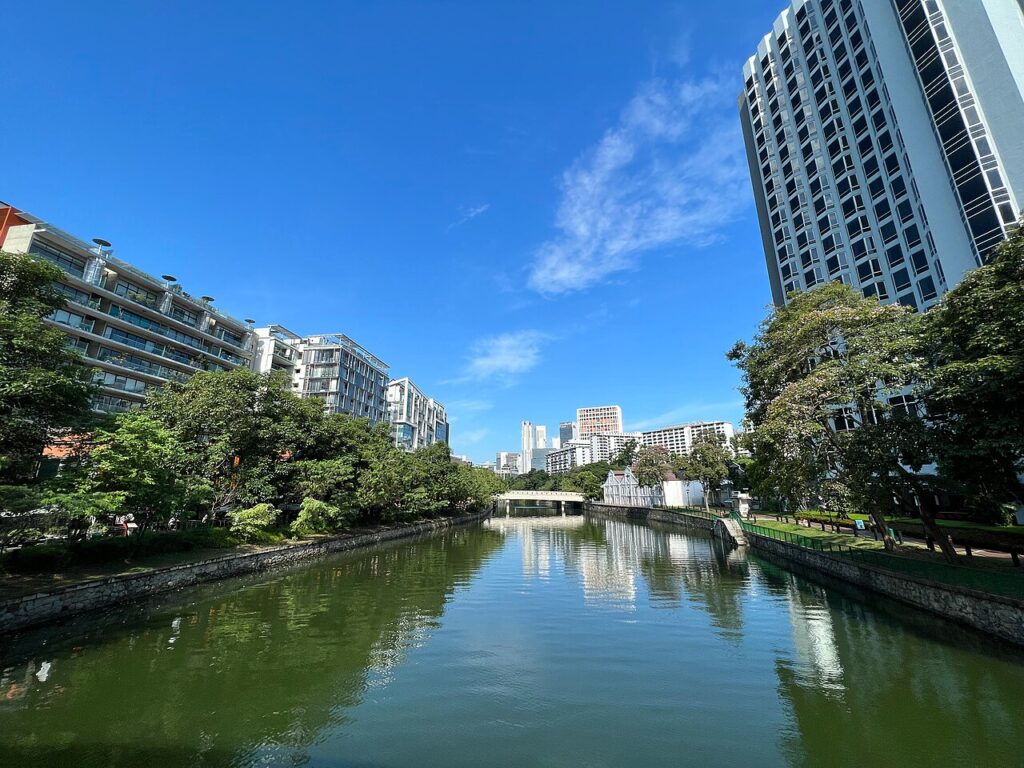
Photograph: Robertson Quay in 2022 by Wzhkevin, via Wikimedia Commons, CC BY-SA 4.0. Resized for display; the illustration is not a transaction involving a pictured property.
