
Quick Answer: Property and Rental Scams in Singapore
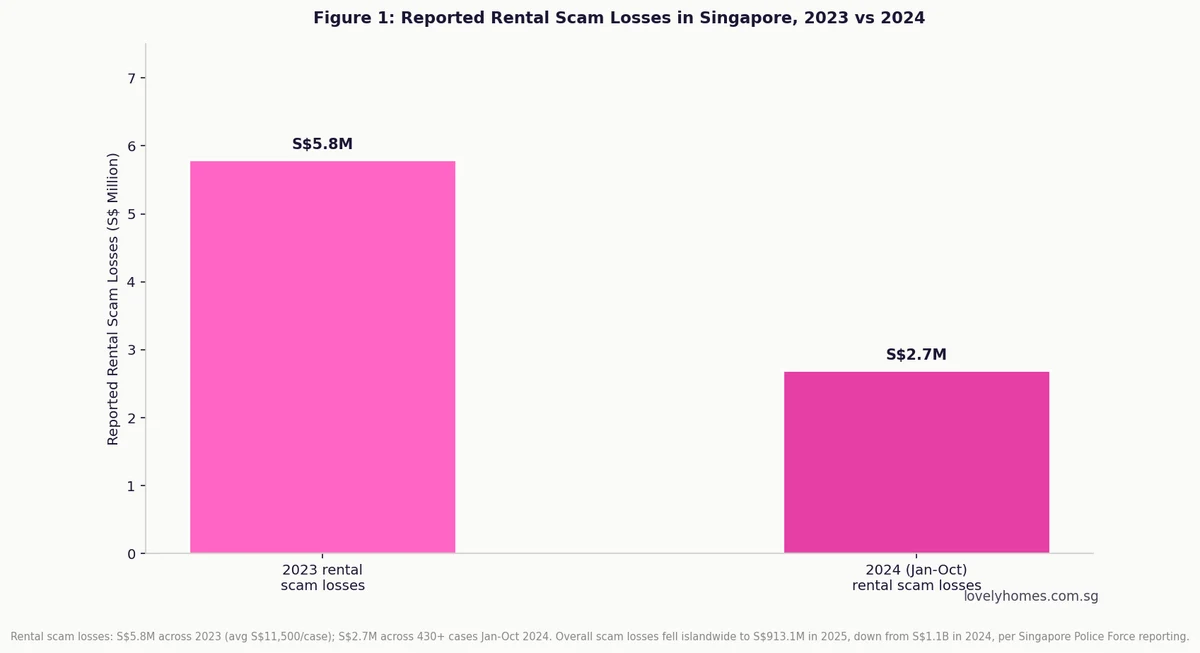
- Reported rental scam losses reached roughly S$5.8 million across 2023, averaging about S$11,500 per case, and a further S$2.7 million across more than 430 cases in just the first ten months of 2024.
- Overall scam losses in Singapore fell to S$913.1 million in 2025, down from S$1.1 billion in 2024, a roughly 24.8% drop in cases, but property and rental scams remain a persistent, well-documented pattern.
- The most common tactic is a fake listing scam: genuine photos of a real property are reposted by someone with no actual right to rent or sell it, often at a price noticeably below market.
- Always verify a property agent through the CEA Public Register at cea.gov.sg before making any payment; the Council for Estate Agencies (CEA) has repeatedly warned that scammers impersonate real, licensed agents using their genuine names and registration numbers.
- A genuine landlord or agent will always allow an in-person viewing before any deposit changes hands; pressure to pay quickly because the “owner is overseas” is one of the clearest warning signs of a scam.
- If you believe you have been scammed, call the ScamShield Helpline on 1799 (24 hours, +65 6869 1799 from overseas), lodge a police report, and consider the Small Claims Tribunal for civil claims up to S$20,000, or S$30,000 with a signed Memorandum of Consent.
- Ownership of a property can be independently verified through a title search with the Singapore Land Authority (SLA), which is a low-cost way to confirm the person you are dealing with actually owns or has the right to rent out the unit.
Why Property and Rental Scams Keep Happening in Singapore
Singapore’s property market is fast-moving, high-value and largely conducted online, which makes it an attractive target for scammers. A typical rental transaction can involve a tenant transferring a deposit and advance rent worth several thousand dollars before ever meeting the landlord in person, which creates a real window for fraud if a prospective tenant is not careful about verification. The problem is significant enough that both the Council for Estate Agencies (CEA) and the Singapore Police Force have issued repeated public advisories on the topic, including a notable February 2024 advisory specifically addressing scammers who impersonate real, licensed property agents using their actual names and CEA registration numbers, without those agents’ knowledge.
Property scams are not limited to renting. Sale transactions, room rentals, and even co-living arrangements have all seen variations of the same underlying pattern: a plausible-looking listing, a sense of urgency, and a request for payment before the usual verification steps have taken place. This guide sets out the most common scam patterns seen in Singapore in 2026, how to verify a listing, agent or landlord before paying anything, and what to do if you have already lost money.
The Five Most Common Property and Rental Scams
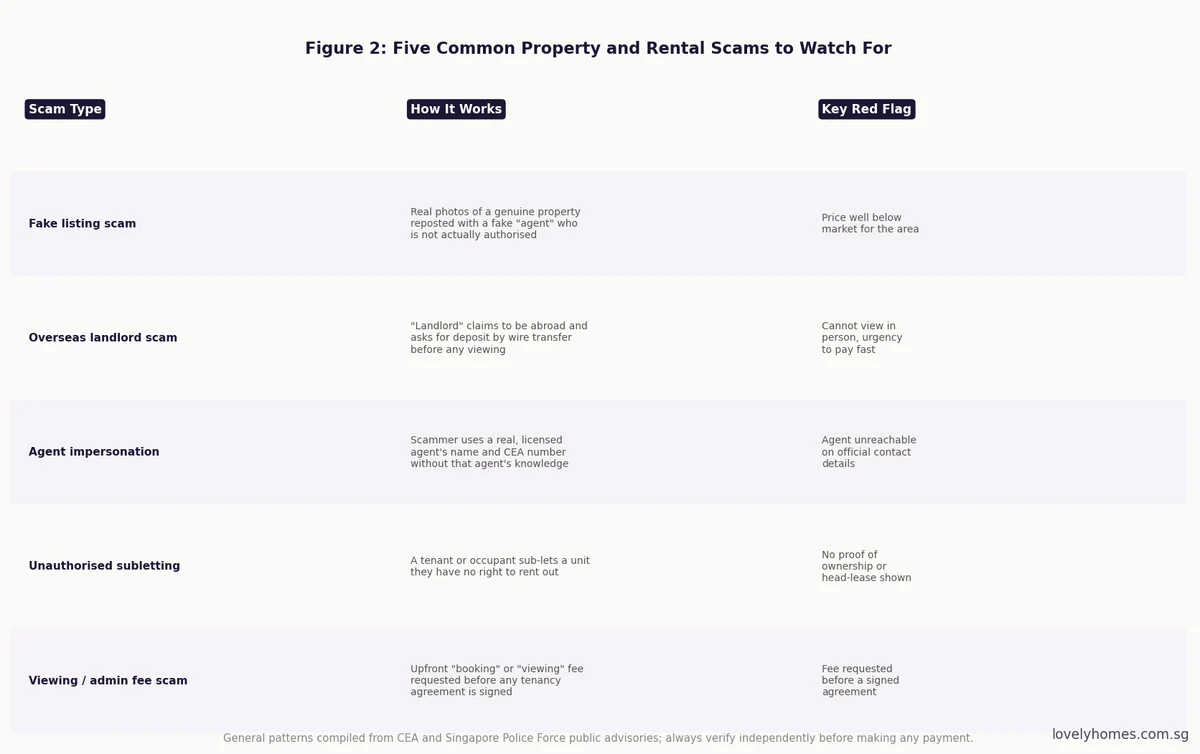
Most property and rental scams in Singapore fall into a small number of recognisable patterns. The fake listing scam uses genuine photos of a real property, often taken from a legitimate past listing, reposted by someone with no actual connection to the unit, usually priced attractively below the going rate to generate quick interest. The overseas landlord scam has the supposed owner claim to be abroad for work and unable to conduct a viewing, asking instead for a deposit by wire transfer as a condition of “holding” the unit, a request no genuine landlord should ever need to make. Agent impersonation is a more sophisticated variant where a scammer uses a real, licensed agent’s actual name and CEA registration number without that agent’s knowledge, making the listing appear fully legitimate on the surface.
Unauthorised subletting occurs when a tenant or occupant, who has no right under their own lease to sublet, rents the unit out to an unsuspecting third party, collects a deposit, and disappears, leaving the new “tenant” with no legal right to occupy the property at all. Finally, the viewing or admin fee scam asks for a small upfront payment, sometimes framed as a “booking fee” or “processing fee”, before any tenancy agreement is signed, a request that has no legitimate basis in a normal Singapore rental transaction.
How to Verify a Listing, Agent or Landlord Before You Pay
The single most effective protection against a property or rental scam is verification before payment, not after. Start with the CEA Public Register at cea.gov.sg, which allows anyone to check whether a named individual is a currently registered property agent and confirm their registration number matches what appears on the listing. If a listing does not name a real agent, or claims to be a private landlord, ask for proof of ownership, such as the property tax bill or a recent utility bill in the owner’s name, and where genuine uncertainty remains, a formal title search through the Singapore Land Authority (SLA) will confirm who legally owns the property for a modest fee.
Insist on an in-person viewing before paying anything beyond, at most, a nominal and clearly agreed booking fee tied to a signed document. A genuine landlord or agent, whether based locally or overseas, can always arrange a viewing through a trusted representative, a video call combined with independent verification, or a delay until they return, none of which requires an anxious tenant to wire money to a stranger first. Once satisfied, insist on a properly drafted tenancy agreement, stamped through IRAS’s e-Stamping system, and pay deposits into the landlord’s own bank account (matching the name on the property verification) rather than to a third party, an agent’s personal account, or an overseas account, all of which are red flags.
Where These Scams Usually Surface, and the Risk for Landlords Too
Most property and rental scams in Singapore originate on the same channels genuine listings use: property portals, general classifieds sites, and increasingly, social media marketplaces and community chat groups on platforms such as WhatsApp and Telegram, where a listing can be shared widely with none of the verification steps a dedicated property portal might apply before publishing. Scammers favour these less-moderated channels precisely because a fake listing can reach interested tenants quickly and be taken down just as fast once it has served its purpose, often before a platform or the authorities can act on a report.
It is worth remembering that genuine landlords and sellers can be targeted too, not just tenants and buyers. A prospective “tenant” may present fabricated employment letters or identity documents to secure a unit, then default on rent or cause damage that is difficult to recover through a security deposit alone; a “buyer” may issue a cheque or payment that later bounces or is reversed after a landlord has already handed over keys or vacated. Landlords and sellers should apply broadly the same discipline as tenants: verify identity documents independently where anything feels inconsistent, use a properly stamped tenancy or sale agreement rather than an informal arrangement, and be cautious of any counterparty who is unusually eager to bypass standard checks or rushes the transaction timeline.
What to Do If You Have Already Been Scammed
Act quickly. Call the ScamShield Helpline on 1799 (available 24 hours a day, or +65 6869 1799 if calling from overseas) if you are unsure whether a situation is a scam or need immediate guidance, and lodge a police report as soon as possible, since early reporting improves the chance of tracing funds before they are moved further. If the amount involved is modest and the other party can be identified, the Small Claims Tribunal allows civil claims of up to S$20,000, or up to S$30,000 where both parties sign a Memorandum of Consent, without necessarily requiring a lawyer. The Consumers Association of Singapore (CASE) can also assist with mediation in disputes involving a business (such as a property agency, if the individual agent is registered under one), though CASE has more limited ability to help with straightforward criminal fraud, which should be reported to the police directly.
Worked Example: A Near-Miss on a S$2,400 Rental
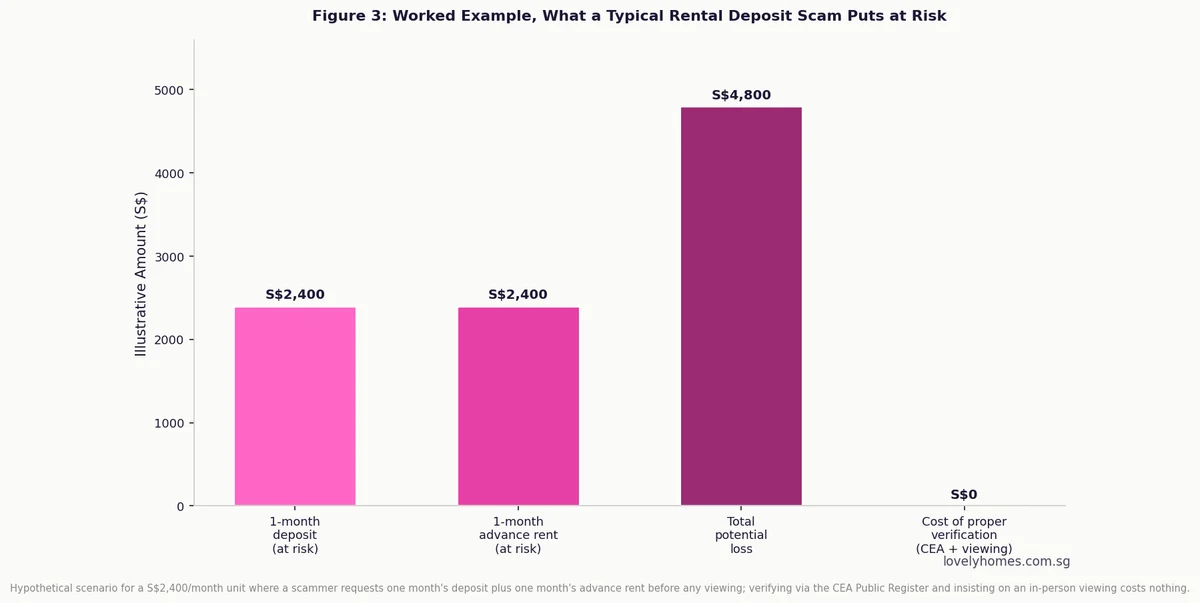
The scenario: Ms Tan finds a well-presented listing for a one-bedroom condo unit at S$2,400 a month, noticeably below similar units in the same development. The “landlord” says she is currently overseas and asks Ms Tan to transfer one month’s deposit plus one month’s advance rent, a total of S$4,800, to secure the unit before a viewing can be arranged.
What Ms Tan does instead: she declines to pay before viewing, checks the CEA Public Register and finds no agent listed matching the name given, and requests a title search through SLA, which shows the unit is registered to a different person entirely. She reports the listing to the platform it appeared on and moves on to a verified listing instead.
The outcome: Ms Tan’s verification steps, checking the CEA register and requesting a title search, cost her nothing beyond a small SLA search fee, against a potential loss of S$4,800 had she paid first and asked questions later. This is the core arithmetic behind every property scam: the cost of verifying is almost always trivial compared to the cost of being wrong.
This scenario is illustrative; real cases vary in amount and circumstance, but the underlying pattern, payment requested before any verification or viewing, recurs across almost all reported property and rental scams in Singapore.
Summary: Property and Rental Scam Facts at a Glance
| Question | Short Answer |
|---|---|
| How much was lost to rental scams in Singapore recently? | Roughly S$5.8 million across 2023, and S$2.7 million across more than 430 cases in the first ten months of 2024. |
| How do I check if an agent is really licensed? | Search their name and registration number on the CEA Public Register at cea.gov.sg before paying anything. |
| What is the single biggest red flag? | Being asked to pay a deposit before any in-person viewing has taken place. |
| Who do I call if I think I have been scammed? | The ScamShield Helpline on 1799, and lodge a police report as soon as possible. |
| What is the Small Claims Tribunal limit? | S$20,000, or S$30,000 with a signed Memorandum of Consent from both parties. |
| How can I confirm who really owns a property? | A title search through the Singapore Land Authority (SLA) confirms the registered owner for a modest fee. |
Why This Matters for Tenants, Buyers and Genuine Landlords
For tenants, particularly those new to Singapore or renting for the first time, understanding these patterns before starting a property search is far more valuable than trying to spot a scam in the moment under time pressure, since scammers deliberately manufacture urgency to short-circuit exactly the verification steps described in this guide. For genuine landlords and licensed agents, the prevalence of impersonation scams is a reminder to proactively direct prospective tenants to verify their CEA registration and to be transparent about the verification process themselves, since a legitimate party has nothing to lose by supporting extra diligence. For buyers, similar caution applies to sale transactions, particularly around unsolicited “too good to be true” listings, wire transfer requests to unfamiliar accounts, and pressure to commit before independent legal or valuation checks are complete.
What Might Come Next
The following is informed speculation, not confirmed policy. As islandwide scam losses overall have started to decline following sustained public education and stronger bank safeguards, it is plausible that property-specific scams will draw further targeted attention from CEA and the police, potentially through more prominent register-verification prompts embedded directly into major property listing platforms. It is also plausible that stamped tenancy agreements, or some form of standardised digital verification of landlord identity at the point of listing, become more strongly encouraged or expected across major platforms in the coming years, given how consistently the “pay before viewing” pattern continues to recur across reported cases, though no such platform-level change has been confirmed as at this writing.
Frequently Asked Questions
How do I check if a property agent is genuinely licensed in Singapore?
Search the agent’s name and registration number on the CEA Public Register at cea.gov.sg, which shows whether they are currently registered and in good standing.
Is it ever normal to pay a deposit before viewing a property?
No. A genuine landlord or agent will always be able to arrange an in-person viewing, or a properly verified alternative, before any deposit is requested.
What should I do immediately if I think I have been scammed?
Call the ScamShield Helpline on 1799, lodge a police report as soon as possible, and preserve all correspondence, payment records and listing screenshots as evidence.
Can I get my money back after a rental scam?
Recovery is not guaranteed, particularly if funds have already moved overseas, but early police reporting improves the chances, and the Small Claims Tribunal is an option for civil claims up to S$20,000, or S$30,000 with consent, where the other party can be identified.
How can I confirm who actually owns a property before renting it?
A title search through the Singapore Land Authority (SLA) confirms the registered owner for a modest fee, which is a reliable way to verify a landlord’s claim to the property.
Are scams more common with certain types of listings?
Listings priced noticeably below market for the area, with an owner who claims to be overseas and unable to meet in person, carry a meaningfully higher risk pattern based on publicly reported cases.
Does using a licensed agent guarantee I cannot be scammed?
It substantially reduces risk, but scammers have impersonated real, licensed agents using their genuine names, so always verify directly through the CEA register and confirm you are actually speaking to that agent through their official contact details.
Related Articles on LovelyHomes
Need a brochure, price list or professional introduction?
Planning your next property purchase? Contact Lin Xuan at 82222556 or Ade at 81888871 to request a project’s full brochure and latest available price list, discuss a viewing, or ask for introductions to bankers who can help you compare home-loan rates and packages to find the best available option for your needs.
WhatsApp Lin Xuan | WhatsApp Ade. Please include the project name and your question. Brochures, prices and unit availability are subject to developer confirmation; loan eligibility, rates and approval are determined by the bank.
Lin Xuan: ONG LIN XUAN, CEA registration R069812H. Ade: CHUA MUAY MUAY (ADE CHUA), CEA registration R014252F. ERA REALTY NETWORK PTE LTD, estate agent licence L3002382K. If you need legal advice, contact Lin Xuan or Ade and we can introduce you to property lawyers.
Supporting graphics
Original article illustrations are available below.