
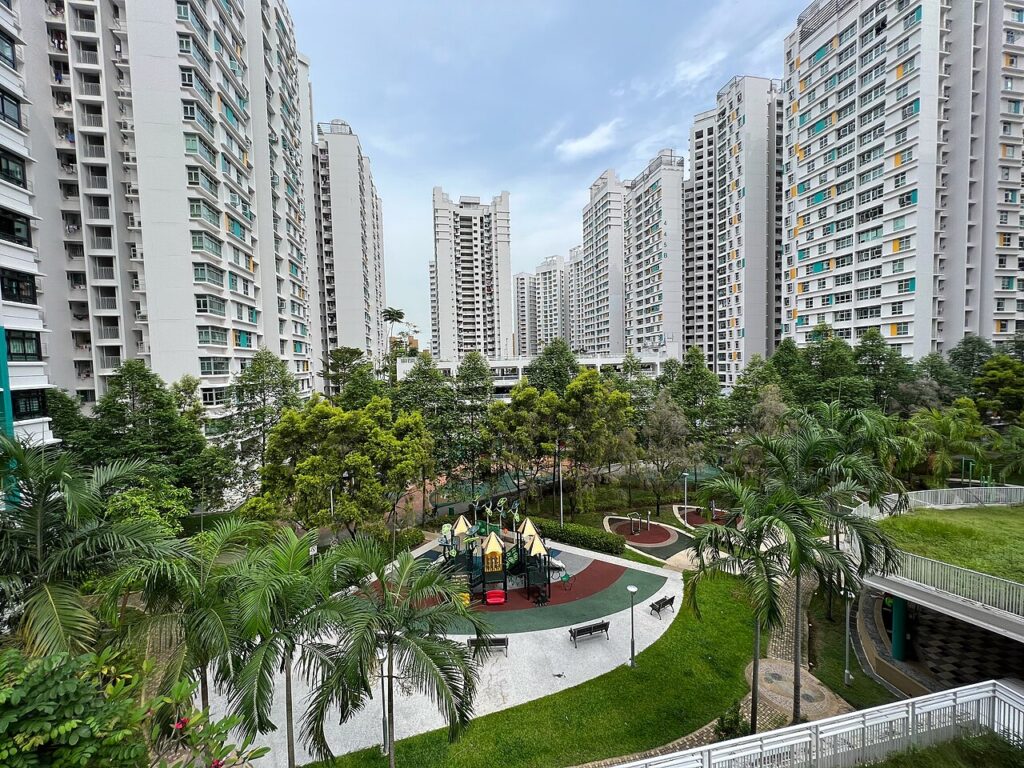
Quick Answer , Sengkang Neighbourhood Guide 2026
- Location: District 19, North-East Region of Singapore, bounded by Punggol, Hougang, and Seletar.
- HDB resale prices: 4-room flats median ~S$565,000; 5-room ~S$685,000 (Q1–Q2 2026).
- MRT access: North East Line (NEL) Sengkang station (NE16) plus an integrated Light Rail Transit (LRT) system with three loops serving the entire town.
- Private condo PSF: approximately S$1,200–S$1,400 for recent transactions in 2026.
- Schools: Nan Chiau Primary, Nan Chiau High, Springdale Primary, CHIJ St Joseph’s Convent, Sengkang Primary.
- Healthcare: Sengkang General Hospital (opened 2018), a major 1,000-bed acute hospital.
- Lifestyle: Compass One mall, Rivervale Mall, Seletar Mall; Punggol Waterway Park and nature trails accessible from Sengkang.
- Investment note: Competitive yields from rental demand driven by proximity to Punggol Digital District and Seletar Aerospace Hub.
What Is Sengkang? An Overview of Singapore’s North-East New Town
Sengkang is one of Singapore’s planned new towns located in the north-east of the island, developed by the Housing and Development Board (HDB) from the late 1990s onwards. Occupying the eastern part of the planning region that also includes Punggol, Sengkang was built on land that was formerly part of the Sengkang fishing village and kampong settlements. Today it is home to roughly 260,000 residents and is one of the most populous HDB towns in Singapore.
The town is administered under Sengkang GRC (Group Representation Constituency) and is served by one of Singapore’s most comprehensive integrated public transport systems , a combination of the Mass Rapid Transit North East Line (NEL) and the Sengkang Light Rail Transit (SLRT), which loops through the town’s residential precincts and feeds directly into the Sengkang MRT interchange station.
For property buyers, Sengkang offers an attractive combination: lower entry prices compared to mature estates such as Bishan, Toa Payoh, or Queenstown; good transport connectivity; and a young, family-friendly community with well-regarded schools and complete town amenities.
HDB Resale Prices in Sengkang 2026
Sengkang is classified as a non-mature estate by HDB, which historically meant lower resale prices compared to mature towns like Bishan or Queenstown. However, as the town has matured over the past two decades, resale prices have risen steadily. Based on HDB Resale Portal data for Q1–Q2 2026, indicative median transaction prices are:
| Flat Type | Median Resale Price (Q1–Q2 2026) | Indicative Range |
|---|---|---|
| 3-Room | ~S$375,000 | S$320,000 – S$440,000 |
| 4-Room | ~S$565,000 | S$490,000 – S$650,000 |
| 5-Room | ~S$685,000 | S$600,000 – S$780,000 |
| Executive | ~S$780,000 | S$710,000 – S$860,000 |
Values vary significantly based on floor level, remaining lease, proximity to MRT, and specific sub-precinct (e.g., Rivervale versus Sengkang West). Flats with longer remaining leases (60+ years) and higher floors command premiums. The highest transacted prices in Sengkang have exceeded S$900,000 for well-positioned 5-room and Executive flats , a figure that would have seemed extraordinary when the town was first developed.
HDB BTO launches in Sengkang typically carry a new flat price at a significant discount to resale , typically 20–30% below market , courtesy of the HDB’s cost-based pricing model. Prospective buyers who qualify for BTO may find Sengkang a compelling entry point into homeownership.
Private Property in Sengkang , Condos and PSF
Private residential development in Sengkang is concentrated in Rivervale and the surrounding areas. The town’s private condo market is driven largely by upgraders from nearby HDB flats and investors seeking exposure to the northeastern corridor. Key projects include:
- Riverfront Residences (2019, 1,472 units) , one of the largest en bloc redevelopments in Singapore’s northeast, consistently among the most transacted condos in D19.
- High Park Residences (2019, 1,390 units) , an integrated development with a childcare centre; popular with families.
- A Treasure Trove (2016, 882 units) , a mid-size project near Punggol Park, often compared to Sengkang alternatives by buyers weighing the two towns.
- Sengkang Grand Residences (2023, 680 units) , an integrated mixed-use development directly above Buangkok MRT station on the NEL; commands a premium for its transport convenience.
- iNz Residence and Parc Botannia , additional mid-scale developments with competitive PSF for the northeast market.
Average PSF for private condos in Sengkang in 2026 is approximately S$1,200–S$1,400, compared to S$2,650+ in the Core Central Region (CCR). This discount to CCR reflects the northeast’s non-prime classification and longer commute times to the CBD, but the gap has been narrowing as Punggol Digital District development progresses and as MRT connectivity improves across the island. Rental yields for Sengkang condos typically range from 3.5%–4.5% gross, driven by demand from Seletar Aerospace Park workers, Punggol Digital District companies, and families priced out of more central locations.
Transport Connectivity , NEL and Sengkang LRT
Sengkang’s transport system is one of its most distinctive features. The town is served by two overlapping rail networks:
North East Line (NEL): Sengkang MRT station (NE16) connects directly to Serangoon (NE12/CC13) in approximately eight minutes and to Dhoby Ghaut (NE6) in the city centre in roughly 25 minutes. The NEL also connects to Harbourfront and Chinatown. Travel time to Raffles Place via a single interchange at Dhoby Ghaut is approximately 35 minutes.
Sengkang LRT (SLRT): The automated light rail system operates in two loops , East Loop and West Loop , radiating from Sengkang MRT station. The SLRT covers all major sub-precincts including Rivervale, Compassvale, Anchorvale, Cheng Lim, and Farmway. This gives Sengkang residents walkable LRT access from virtually every corner of the town without needing a feeder bus, making it notably pedestrian-friendly by Singapore standards.
Bus services connect Sengkang to Tampines, Hougang, Ang Mo Kio, and various expressways (KPE, TPE). Motorists have quick access to the Kallang–Paya Lebar Expressway (KPE) and Tampines Expressway (TPE).
Schools in Sengkang 2026
Education infrastructure is a key drawcard for family buyers. Sengkang is home to a number of well-regarded schools across primary and secondary levels:
| School | Level | Notable Feature |
|---|---|---|
| Nan Chiau Primary | Primary | Top-tier SAP school; regularly among the most sought-after schools in D19 |
| Springdale Primary | Primary | Established school in the heart of Sengkang residential precincts |
| CHIJ St Joseph’s Convent | Primary | Catholic mission school; popular among families seeking faith-based education |
| Sengkang Primary | Primary | Neighbourhood school with strong co-curricular programme |
| Anchor Green Primary | Primary | Located near Rivervale; well-regarded for pastoral care |
| Nan Chiau High | Secondary | Affiliated to Nan Chiau Primary; SAP stream; consistent academic results |
| Compassvale Secondary | Secondary | Long-established neighbourhood school in Sengkang |
Under the Ministry of Education’s (MOE) Primary 1 Registration exercise, proximity to school is a key determining factor. Buyers targeting specific schools, particularly Nan Chiau Primary, often pay a premium for flats and condos within the 1–2km school registration phase radius.
Healthcare and Amenities
The opening of Sengkang General Hospital (SKH) in 2018 was a landmark for the northeast. SKH is a 1,000-bed acute hospital under the SingHealth cluster and the first new acute hospital to be built in Singapore in 23 years. It serves the growing northeast population and reduces the need for residents to travel to distant hospitals like Tan Tock Seng or Singapore General. SKH is located at Sengkang West Road and is accessible via feeder bus from Sengkang MRT.
Commercial amenities are centred around Compass One (Sengkang MRT), a major suburban mall with approximately 200 retail and F&B outlets. Rivervale Mall and Rivervale Plaza serve the eastern precinct, while Seletar Mall (near Fernvale LRT) is a newer lifestyle mall at the northern end of Sengkang. The town also benefits from proximity to Seletar Aerospace Park and Punggol Digital District, with additional retail and dining options developing in those areas.
Worked Example , Buying a 4-Room Resale Flat in Sengkang
Scenario: First-Timer Couple Buying a 4-Room Resale HDB in Sengkang (2026)
Purchase price: S$565,000 (median 4-room resale)
Buyer profile: Singapore Citizen couple, combined income S$8,000/month, first-time buyers, using HDB loan.
| Item | Amount |
|---|---|
| Purchase Price | S$565,000 |
| Buyer’s Stamp Duty (BSD) , 1% × S$180K + 2% × S$180K + 3% × (S$565K – S$360K) | S$11,550 |
| CPF Housing Grant (EHG, max income ceiling S$9,000/mth) , up to S$80,000 | –S$80,000 (if eligible) |
| HDB Loan (90% LTV) → loan on S$485,000 (after grant) | S$436,500 |
| Balance Downpayment (10% after grant; payable fully via CPF OA , no mandatory cash for HDB loan) | S$48,500 (CPF OA) |
| Monthly HDB Loan Repayment @ 2.6% p.a., 25-year tenure | ~S$1,975/month |
Note: BSD is payable on the purchase price. EHG eligibility depends on combined income not exceeding S$9,000/month; amount depends on income band. Consult HDB’s online calculators at hdb.gov.sg for current grant amounts. The above figures are illustrative only.
Why Sengkang Matters for Singapore Property Buyers in 2026
Sengkang occupies a unique position in Singapore’s property market as a non-mature estate that is rapidly maturing. The town has outperformed initial expectations , when BTO launches in Sengkang first opened in the late 1990s and early 2000s, buyers paid prices that in retrospect were deeply discounted relative to today’s resale values. Owners of early-generation flats in Sengkang have seen capital appreciation of 100–150% over 20 years, though future gains will naturally be more modest as the market normalises.
The northeast corridor is undergoing a structural upgrade in economic fundamentals: the Punggol Digital District, expected to reach full development by the early 2030s, is designed to house Singapore’s digital and cybersecurity industries, bringing well-paid PME jobs to the region. The Seletar Aerospace Park to the north already employs thousands of aerospace professionals, many of whom rent or own in Sengkang due to its relative proximity. Both catalysts support rental demand for private condos and larger HDB flats in the area.
For first-timer buyers, Sengkang’s competitive entry prices relative to central and mature estates, combined with strong school choices and full town amenities, make it one of the better-value residential locations in Singapore in 2026. The town does not offer the cachet of Queenstown or the convenience of Toa Payoh, but for buyers prioritising value and community infrastructure over prestige address, Sengkang is a compelling choice.
What Might Come Next for Sengkang Property
Several trends are worth monitoring for buyers and investors tracking Sengkang’s property outlook. First, continued BTO launches in Sengkang North , land pockets at the northern fringe of the town , will add housing supply and could place modest downward pressure on resale prices in those precincts. Second, HDB’s classification of Sengkang as a Standard BTO town (not a Prime or Plus zone under the revised BTO classification framework introduced in 2024) means resale restrictions remain relatively relaxed, which keeps liquidity in the market. Third, the Punggol Digital District employment catchment effect will likely strengthen over the next 5–8 years, pulling rental yields upward as more companies set up operations there. This is speculative at present, and buyers should form their own judgement based on updated development progress. The MRT network in the northeast is largely complete, but planned enhancements to bus rapid transit and cycling infrastructure under the Land Transport Authority’s (LTA) masterplan could further improve liveability.
FAQ , Sengkang Neighbourhood Guide 2026
Is Sengkang a good place to buy property in 2026?
How long does it take to commute from Sengkang to the CBD?
Which HDB precincts in Sengkang command the highest prices?
What are the top schools near Sengkang and how do I get a school place?
Can foreigners buy property in Sengkang?
What is Sengkang’s outlook for rental demand?
How does Sengkang compare to Punggol for property buyers?
Related Articles
- ABSD Singapore Complete Guide 2026 , Rates, Rules and Worked Examples
- Singapore Property Cooling Measures , Full Timeline 2009–2026
- HDB Resale Flat Guide 2026 , How to Buy, Fees and CPF Rules
- CPF Ordinary Account and Property , How CPF Works in a Home Purchase
- First-Time Property Buyer Guide Singapore 2026 , Step-by-Step
- HDB Loan vs Bank Loan 2026 , Which Is Better for You?
Disclaimer: This article is for general information purposes only and does not constitute financial, legal, or property advice. Property prices, HDB policies, stamp duty rates, and grant amounts are subject to change. Data cited reflects publicly available information as at July 2026. Verify all figures with official sources including HDB (hdb.gov.sg), Urban Redevelopment Authority (ura.gov.sg), Inland Revenue Authority of Singapore (iras.gov.sg), and CPF Board (cpf.gov.sg). Always engage a licensed real estate salesperson registered with the Council for Estate Agencies (CEA) and consult a financial adviser before making property decisions.
Supporting graphics
Original article illustrations are available below.
- Figure 1: Sengkang HDB Resale Median Prices by Flat Type (Q1–Q2 2026). Source: HDB Resale Portal.
- Figure 2: Private Condo Average PSF , Sengkang vs Neighbouring Districts in D19 (2026). Source: URA REALIS.
- Figure 3: Sengkang at a Glance , Key Property and Lifestyle Facts (2026). Sources: HDB, URA, MOE.


