Quick Answer: Bankruptcy and Your Property
- Bankruptcy in Singapore is governed by the Insolvency, Restructuring and Dissolution Act 2018 (IRDA), administered through the Ministry of Law’s Insolvency Office, with individual cases handled by either a private trustee or, in select public-interest cases, the Official Assignee.
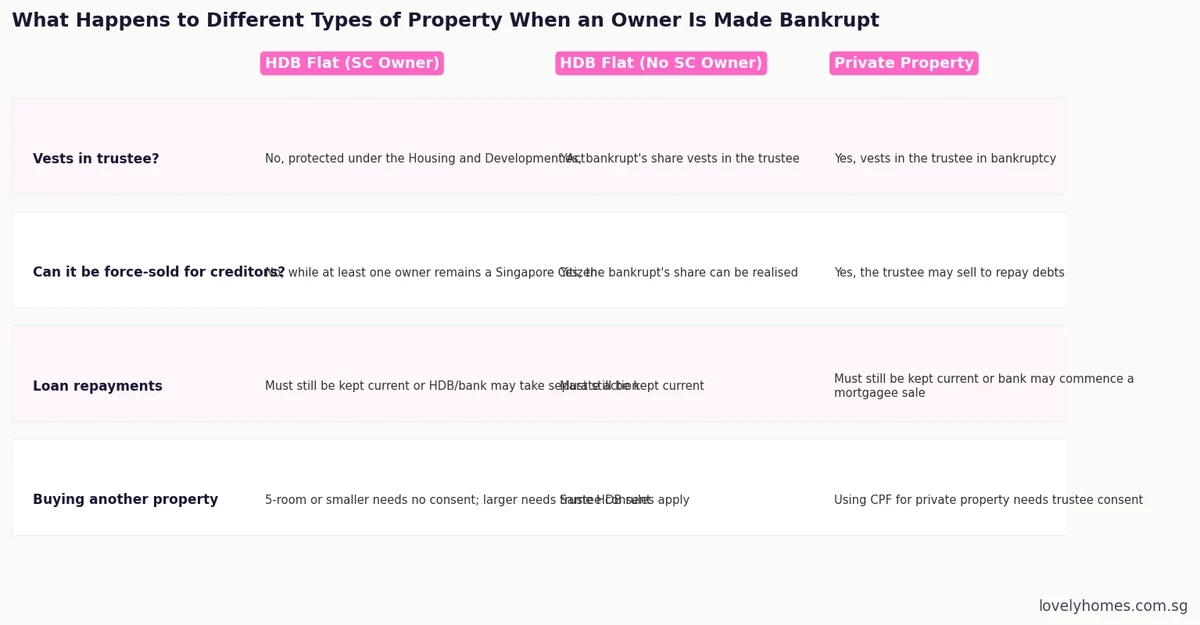
- An HDB flat is protected from being sold to repay creditors under the Housing and Development Act, as long as at least one owner remains a Singapore Citizen. If none of the owners is a Singapore Citizen, the bankrupt’s share can vest in the trustee for creditors’ benefit.
- Private property is not protected. On a bankruptcy order, the bankrupt’s interest in any condominium or landed property vests in the trustee, who can sell it (including the bankrupt’s share in a jointly owned property) to repay creditors.
- Being bankrupt does not automatically stop loan repayments from being required; a bank or HDB can still pursue a mortgagee sale or other action if instalments fall into arrears, independent of the bankruptcy itself.
- A bankrupt can generally buy a 5-room HDB flat or smaller without needing trustee consent; a larger flat, a 3-Generation flat, or one priced at S$500,000 or more requires the trustee’s written consent, along with proof of both means and need.
- Using CPF savings to buy private property while undischarged requires the trustee’s consent first.
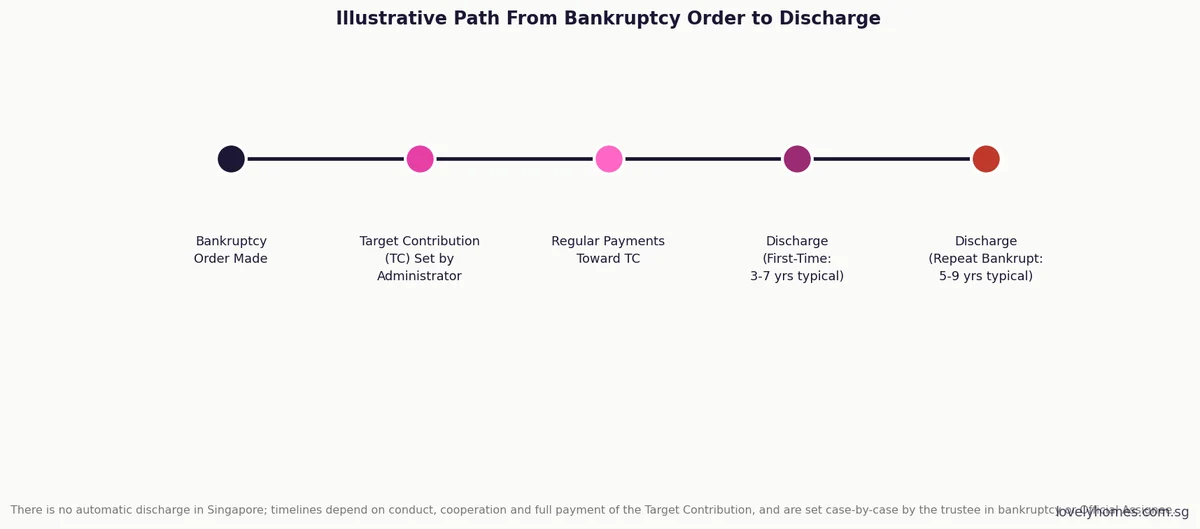
- There is no automatic discharge from bankruptcy in Singapore. Discharge depends on conduct, cooperation and paying a “Target Contribution” set by the trustee, with typical timelines of around 3 to 7 years for first-time bankrupts and 5 to 9 years for repeat bankrupts.
Few property questions carry as much quiet anxiety as what happens to a family home if an owner is declared bankrupt. The honest answer is that it depends heavily on what kind of property is involved, and who owns it, with HDB flats and private property treated very differently under Singapore law. This guide sets out the legal framework, what happens to an HDB flat versus a condominium or landed home, how the road to discharge actually works, and the restrictions a bankrupt faces on buying property while the bankruptcy is ongoing.
The Legal Framework: IRDA and Who Administers It
Personal bankruptcy in Singapore sits under the Insolvency, Restructuring and Dissolution Act 2018, which consolidated and updated Singapore’s previous Bankruptcy Act framework. The Ministry of Law’s Insolvency Office oversees the regime, and since 1 November 2023, individual bankruptcy cases are generally handled by a private trustee in bankruptcy rather than the Official Assignee, except where the Official Assignee assesses that a case involves the public interest and agrees to be appointed. The trustee’s role includes taking control of the bankrupt’s assets that vest in the bankruptcy estate, assessing what should be realised for creditors, setting a monthly contribution plan, and ultimately assessing whether and when the bankrupt should be discharged.
The HDB Flat Protection Rule
The single most important protection for most Singaporean households facing bankruptcy is the rule under the Housing and Development Act that an HDB flat will not vest in the trustee in bankruptcy, and therefore cannot be realised for creditors, as long as at least one of the flat’s owners remains a Singapore Citizen. This protection exists specifically to prevent bankruptcy from rendering a citizen family homeless, and it applies regardless of how large the bankrupt’s personal debts are. The protection has a significant exception, however: if none of the flat’s owners is a Singapore Citizen, for example where the owners are Permanent Residents only, the bankrupt’s share in the flat is not shielded in the same way and can vest in the trustee for the benefit of creditors.
What This Protection Does Not Cover
The HDB flat protection rule is narrower than many owners assume. It protects the flat from being sold specifically because of the bankruptcy order, but it does not excuse the household from continuing to service the outstanding housing loan. If mortgage instalments fall into arrears, HDB or the mortgagee bank can still pursue separate recovery action, including a mortgagee sale in the case of a bank loan, entirely independent of the bankruptcy proceedings. In other words, bankruptcy protects the flat from creditors generally, but it does not protect the flat from the specific lender if loan repayments are not kept current.
What Happens to Private Property
Private property receives no equivalent statutory protection. On the making of a bankruptcy order, the bankrupt’s interest in any condominium, landed home or other private property vests directly in the trustee in bankruptcy, whether that is a private trustee or the Official Assignee. Where the property is jointly owned, for example by spouses, the trustee can apply to sell the bankrupt’s share, and in practice this often means the whole property must be sold since a part-share in a single residential unit is rarely a practical or saleable asset on its own. Once sold, CPF savings used to buy the property, together with the accrued interest that would have been earned had those savings remained in CPF, must be refunded to the relevant CPF accounts before any balance is available, and any shortfall between the sale proceeds and the outstanding mortgage plus CPF refund can itself become a proveable, unsecured debt within the bankruptcy.
Buying Property While Undischarged
Being bankrupt does not prevent a person from buying property outright, but it does restrict what can be bought without consent. A bankrupt may generally buy a 5-room HDB flat or smaller without needing the trustee’s consent. Buying a larger flat, a 3-Generation flat, or a flat with a net purchase price of S$500,000 or more requires the written consent of the trustee in bankruptcy, and the bankrupt must demonstrate both the means and the genuine need for such a flat, with conduct and cooperation during the bankruptcy also taken into account. Separately, if a bankrupt wishes to use CPF savings to purchase private property during the bankruptcy, the trustee’s consent must be obtained first, reflecting the fact that CPF savings used for housing remain within the scope of what the trustee is entitled to scrutinise.
The Road to Discharge
There is no automatic discharge from bankruptcy in Singapore. Instead, the trustee sets a Target Contribution at the outset, a total sum the bankrupt is expected to pay toward the bankruptcy estate over time, based on income and circumstances. A bankrupt who makes regular payments, fully meets the Target Contribution, and demonstrates good conduct and cooperation can be recommended for discharge by the trustee. Typical timelines are around 3 to 7 years for first-time bankrupts who meet these conditions, and around 5 to 9 years for repeat bankrupts, though the exact period is set case by case rather than fixed by statute. Assets that have already vested in the trustee, including any private property sold during the bankruptcy, do not revert to the individual on discharge; discharge ends the bankruptcy status and most restrictions, but it does not undo asset realisations that already took place.
Bankruptcy and Property at a Glance
| Aspect | HDB Flat (SC Owner) | Private Property |
|---|---|---|
| Vests in trustee | No, protected under the HDB Act | Yes, on the bankruptcy order |
| Can be sold for creditors | No, while an SC owner remains | Yes, including a jointly owned share |
| Loan must still be serviced | Yes, independent of bankruptcy status | Yes, or the bank may pursue a mortgagee sale |
| Buying another property | 5-room or smaller needs no consent | CPF use for purchase needs trustee consent |
Worked Example: A Forced Sale With a Shortfall
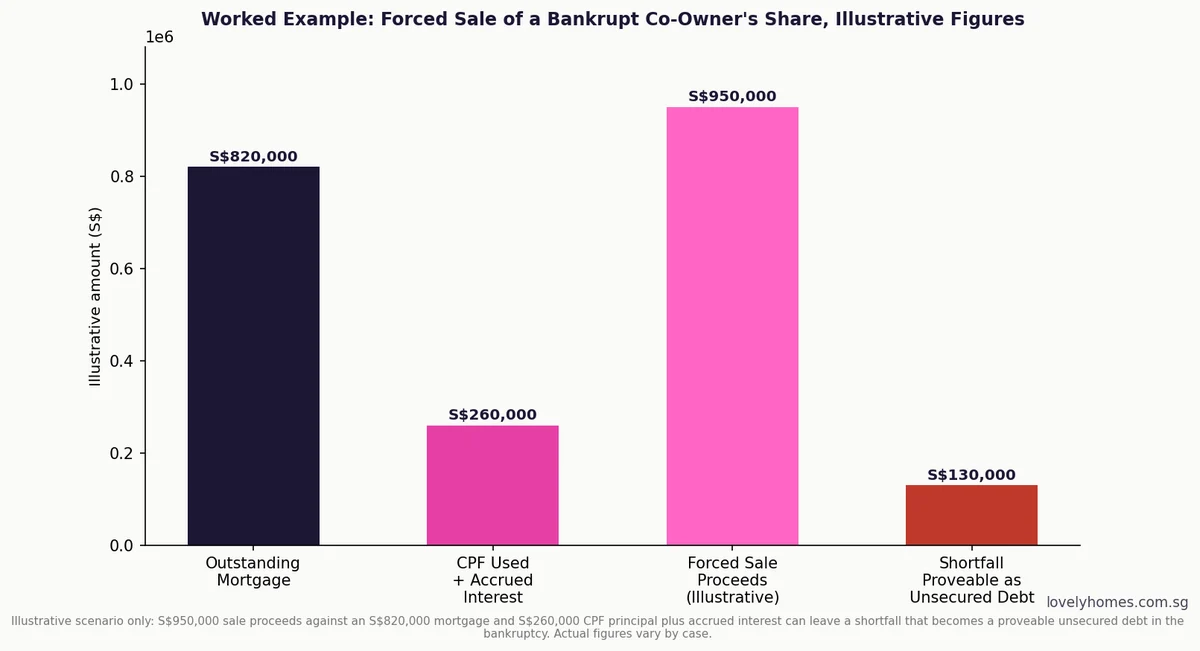
Consider a couple who jointly own a condominium with an outstanding mortgage of S$820,000 and S$260,000 of CPF savings used toward the purchase, now attracting accrued interest. One spouse is subsequently made bankrupt, and their share in the property vests in the trustee. If the property is sold for S$950,000, the mortgage must be redeemed and the CPF savings, plus accrued interest, refunded to the relevant CPF accounts before the couple sees any balance. Where the combined mortgage and CPF refund exceed, or come close to, the sale price, the household can be left with a shortfall rather than a surplus, and any resulting shortfall attributable to the bankrupt’s share can itself become a proveable, unsecured debt within the bankruptcy, adding to what the bankrupt still owes rather than resolving the debt entirely.
Why This Matters
The gap between how HDB flats and private property are treated in bankruptcy is not an accident; it reflects a deliberate policy choice to protect basic public housing for citizen households even in financial crisis, while treating private property, an asset class associated with wealth accumulation rather than a baseline safety net, under the ordinary rules that apply to any other asset. For households holding both an HDB flat and an investment property, or for couples where only one spouse is a Singapore Citizen, understanding exactly where this protection applies, and where it does not, matters well before any financial difficulty arises, since ownership structures are far harder to unwind cleanly once a bankruptcy is already underway.
What Might Come Next
The shift to private trustees handling most bankruptcy cases since November 2023 was itself a significant operational change, and further refinements to the Simplified Insolvency Programme and related IRDA processes have continued since. Given the frequency with which insolvency rules are reviewed, readers facing an actual bankruptcy situation, or considering one, should seek advice from a qualified insolvency practitioner or lawyer, and check the Insolvency Office’s official guidance directly, rather than relying solely on general information such as this article.
Frequently Asked Questions
Can a bankrupt’s HDB flat be seized to repay creditors?
No, as long as at least one of the flat’s owners remains a Singapore Citizen. This protection is set out in the Housing and Development Act. If none of the owners is a Singapore Citizen, the protection does not apply in the same way.
Does bankruptcy stop me from having to pay my housing loan?
No. Loan repayments must still be kept current. HDB or a mortgagee bank can pursue separate recovery action, including a mortgagee sale, if instalments fall into arrears, independent of the bankruptcy itself.
What happens to a private condo owned by a bankrupt?
It vests in the trustee in bankruptcy, whether a private trustee or the Official Assignee, and can be sold to repay creditors. Where the property is jointly owned, only the bankrupt’s share vests, though in practice this often leads to a sale of the whole property.
Can a bankrupt buy another HDB flat?
Yes, a 5-room flat or smaller generally does not require trustee consent. A larger flat, a 3-Generation flat, or one priced at S$500,000 or more requires the trustee’s written consent, with proof of both means and need.
Is there an automatic discharge from bankruptcy in Singapore?
No. Discharge depends on conduct, cooperation and paying the Target Contribution set by the trustee. Typical timelines are around 3 to 7 years for first-time bankrupts and 5 to 9 years for repeat bankrupts, set case by case.
Who handles my bankruptcy case, the Official Assignee or a private trustee?
Since 1 November 2023, most bankruptcy cases are handled by a private trustee in bankruptcy. The Official Assignee generally only takes on cases involving the public interest.
What happens to CPF savings used to buy a property that is later sold in bankruptcy?
CPF savings used for the purchase, together with accrued interest, must be refunded to the relevant CPF accounts from the sale proceeds before any balance is available for creditors or the bankrupt.
Related Articles
- Singapore Negative Equity Property Guide 2026
- Singapore Property Auction and Mortgagee Sale Guide 2026
- Singapore Divorce Property Division Guide 2026
- Home Loan Guarantor Singapore 2026
- Singapore Forced Sale of Joint Property: Co-Owner Disputes 2026
- Singapore Joint Property Ownership Guide 2026
Supporting graphics
Original article illustrations are available below.