Quick Answer: What Is Negative Equity?
- Negative equity happens when a property’s outstanding home loan balance is greater than the property’s current market value, so selling would not generate enough cash to clear the loan.
- Singapore home loans are full recourse: if a forced sale does not cover the outstanding balance, the bank can pursue the borrower personally for the shortfall, unlike “non-recourse” mortgage states in the United States.
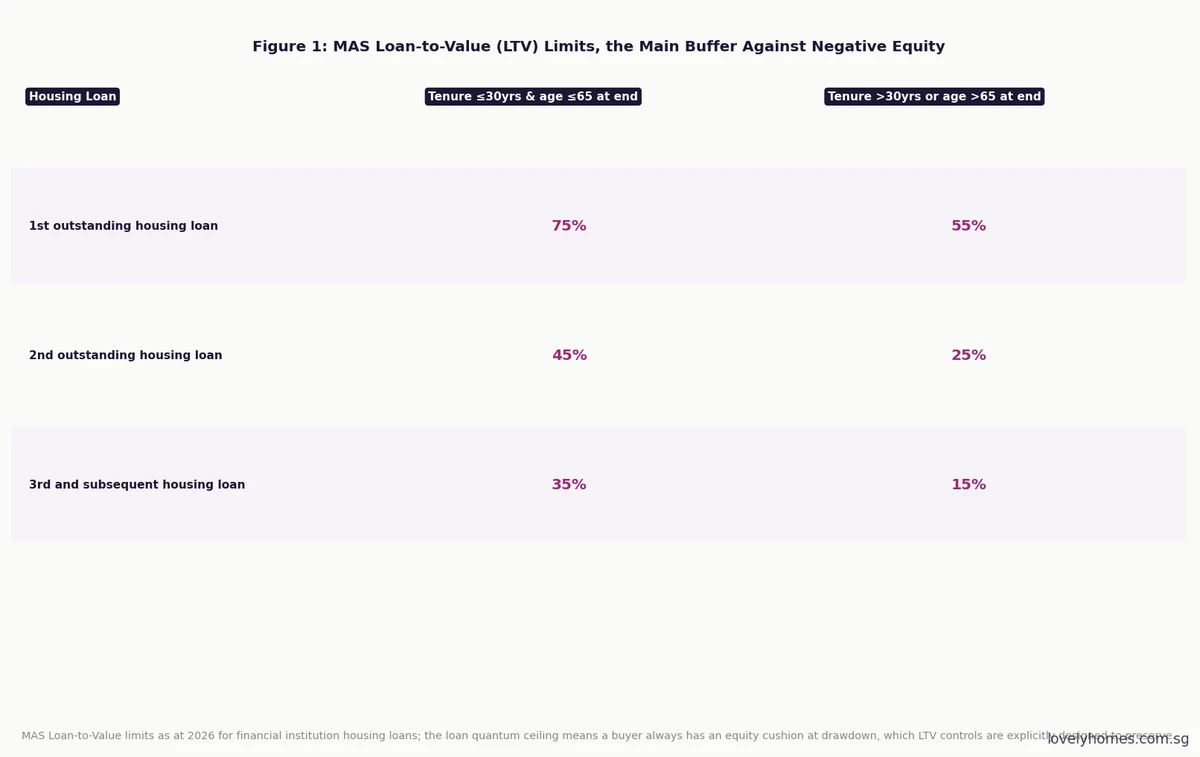
- MAS Loan-to-Value (LTV) limits, 75% for a first housing loan on standard tenure, down to 55%, 45% or as low as 15% for later loans or longer tenures, exist specifically to keep an equity buffer in place from day one.
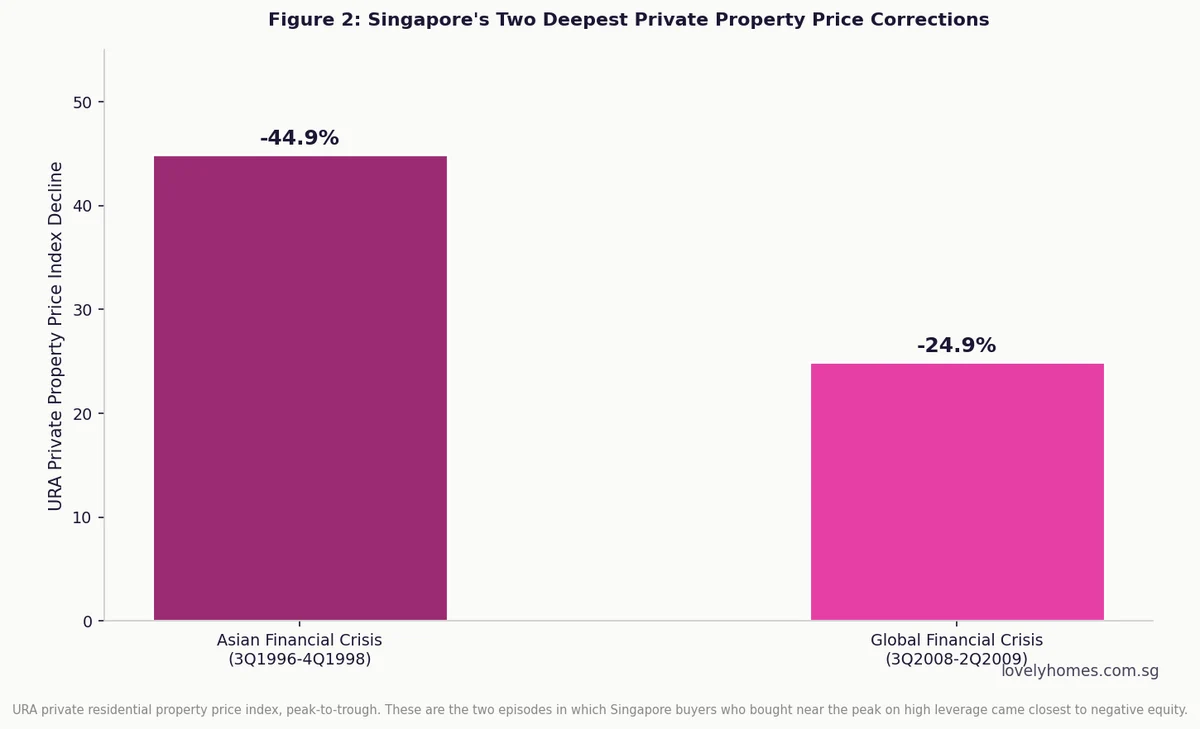
- Singapore’s two deepest price corrections were the 1996Q3-1998Q4 Asian Financial Crisis (URA price index down 44.9%) and the 2008Q3-2009Q2 Global Financial Crisis (down 24.9%).
- A 6-year time bar under the Limitation Act applies to a bank’s legal claim for any shortfall following a mortgagee sale.
- CPF used for the purchase, plus accrued interest, must be refunded to the owner’s CPF account from the sale proceeds, but this refund ranks after the bank’s mortgage, so a seller can face a severe “equity crunch” well before hitting true bank-level negative equity.
- Simply surrendering the keys does not end a Singapore borrower’s liability the way “walking away” can in some non-recourse US states; the debt survives the sale of the property.
- The standard ways to avoid a forced mortgagee sale are engaging the bank early, restructuring or refinancing the loan, or selling voluntarily before falling into serious arrears.
“Negative equity” is a phrase most Singaporean homeowners only half-remember from news coverage of the United States housing crash, and it can feel like a distant, foreign risk in a market where property prices have broadly trended upward for decades. But leverage is leverage everywhere, and Singapore has already lived through two episodes, the 1997-98 Asian Financial Crisis and the 2008-09 Global Financial Crisis, where private property prices fell far enough, fast enough, that highly geared buyers came uncomfortably close to owing more than their home was worth. This guide explains exactly what negative equity means under Singapore’s rules, why the country’s loan structure is deliberately built to make it rare, and what actually happens, legally and financially, if a homeowner ends up there anyway.
What Negative Equity Actually Means in Singapore
In the simplest terms, a homeowner is in negative equity when their property’s fair market value has fallen below the outstanding balance of the loan secured against it. If the owner had to sell at that moment, the sale proceeds would not be enough to fully repay the bank, leaving a shortfall. This is distinct from, though related to, a “paper loss”, where a property is simply worth less than the price originally paid; a paper loss only becomes negative equity once the loan balance itself exceeds the current value, which typically requires either a very large price decline, very high leverage at the point of purchase, or a combination of both.
Why Singapore’s LTV Rules Exist Precisely to Prevent This
Singapore’s Loan-to-Value (LTV) framework, administered by the Monetary Authority of Singapore (MAS), caps how much of a property’s purchase price a bank may lend against it. For a buyer’s first outstanding housing loan, the limit is 75% of the property value if the loan tenure is 30 years or less and the borrower is aged 65 or younger at the end of the loan term, or 55% otherwise. A second outstanding housing loan is capped at 45% or 25% under the same tenure and age conditions, and a third or subsequent loan at 35% or as low as 15%. These caps mean every buyer starts with a built-in equity cushion, at minimum 25% under the most generous first-loan scenario, which prices would have to fall through entirely before the loan balance alone exceeds the property’s value, even before accounting for any principal the borrower has since repaid.
What Happens If You Do End Up Underwater: The Full-Recourse Reality
Where Singapore differs sharply from parts of the United States is what happens if a borrower does end up owing more than their home is worth. Singapore mortgages are full recourse: the loan is a personal debt of the borrower, not merely a claim against the property. If a bank is forced to sell a mortgaged property, whether through a voluntary sale process gone wrong or a formal mortgagee sale after default, and the proceeds are insufficient to clear the outstanding loan, the bank can pursue the borrower personally, through the courts if necessary, for the remaining shortfall. This is fundamentally different from “non-recourse” mortgage states in the US, where in some circumstances a borrower can hand back the keys and walk away with no further liability, an option sometimes nicknamed “jingle mail”. No equivalent exists in Singapore: surrendering the property does not extinguish the debt, and a bank’s right to sue for a deficiency judgment is subject only to a 6-year limitation period under the Limitation Act, running from the date the shortfall crystallises.
The CPF Complication: Why a “CPF Shortfall” Is More Common Than True Bank Negative Equity
Most Singaporean homeowners use CPF Ordinary Account savings to help fund their purchase, and CPF rules require that any CPF principal withdrawn, plus the accrued interest that would otherwise have been earned had the money stayed in the CPF account, be refunded to CPF from the sale proceeds when the property is eventually sold. Critically, this CPF refund obligation ranks behind the bank’s mortgage in a forced sale: the bank is paid first from the proceeds, and only what remains is available to refund CPF, with any residual balance after that going to the owner in cash. This creates a distinct, and considerably more common, problem than true bank-level negative equity: a homeowner whose property has fallen in value can find that after the bank is repaid and CPF is refunded, very little or nothing is left in cash, even though the bank itself was made whole. This “equity crunch” is not negative equity in the strict sense, since the bank suffers no shortfall, but it can feel just as painful to the homeowner, and in a severe enough downturn it can tip into genuine negative equity once both the bank’s claim and any assumed CPF refund exceed the sale price.
Summary: Negative Equity Facts at a Glance
| Question | Short Answer |
|---|---|
| What is negative equity? | When the outstanding loan balance exceeds the property’s current market value. |
| Are Singapore mortgages recourse or non-recourse? | Full recourse; the bank can pursue the borrower personally for any shortfall. |
| What is the maximum LTV for a first housing loan? | 75% (30-year tenure, borrower 65 or younger at loan end), or 55% otherwise. |
| How long can a bank pursue a shortfall claim? | Up to 6 years under the Limitation Act. |
| Does CPF refund rank above or below the bank? | Below; the bank is repaid first, CPF refund comes from what remains. |
| When did Singapore prices fall the most? | 1996Q3-1998Q4 (down 44.9%), the deepest correction on record. |
Worked Example: Mr Tan’s Equity Crunch
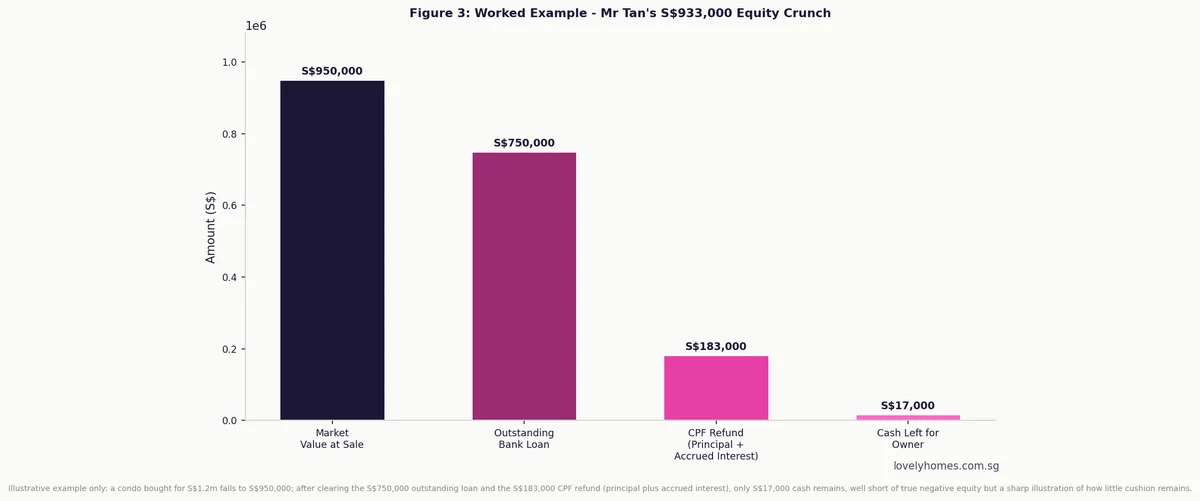
The scenario: Mr Tan bought a condo for S$1.2 million, taking a 75% LTV loan of S$900,000 and using S$150,000 of CPF Ordinary Account savings toward the downpayment and costs. Several years and a severe market downturn later, the property is now worth only S$950,000, and steady repayment has reduced his outstanding loan to S$750,000.
The CPF refund: His CPF principal of S$150,000, plus accrued interest compounding at the CPF Ordinary Account rate over the intervening years, has grown to roughly S$183,000 that must be refunded to his CPF account from the sale proceeds.
The waterfall: If Mr Tan sold at S$950,000 today, the bank is repaid its S$750,000 first, leaving S$200,000; CPF then takes its S$183,000 refund, leaving Mr Tan with only around S$17,000 in cash, technically still positive equity, but a razor-thin cushion far below what he might have expected.
Where true negative equity begins: Had prices fallen further, to say S$700,000, against his S$750,000 loan, the bank would recover only S$700,000 from the sale, a S$50,000 shortfall that Mr Tan would still owe personally, and his CPF refund, ranking behind the bank, would likely go largely or entirely unmet, potentially requiring a separate arrangement with the CPF Board.
These figures are illustrative only and do not reflect any specific loan, CPF or property; actual outcomes depend on the individual’s loan terms, CPF usage, accrued interest rate and the property’s true sale price, and should be modelled with the bank and the CPF Board directly.
Why This Matters, and What to Do If You’re Worried About This
For the overwhelming majority of Singaporean homeowners, negative equity in the strict, bank-facing sense remains rare precisely because LTV limits, mandatory principal repayment and a property market that has not seen a correction anywhere near 1998 levels since, have kept loan balances comfortably below property values. The more realistic risk for a highly leveraged, recently purchased property in a sharp downturn is the “equity crunch” illustrated above: technically solvent, but with far less cash at the end of a sale than expected. Anyone concerned about this should model their own numbers, outstanding loan, CPF principal and accrued interest, and a realistic stressed sale price, well before any financial difficulty arises, and should speak to their bank early if repayment becomes difficult; banks generally prefer restructuring a loan or agreeing a longer tenure over forcing a mortgagee sale, which is costly and slow for them too.
What Might Come Next
The following is informed speculation, not confirmed policy. Given that MAS has repeatedly signalled that its LTV and cooling measure framework exists specifically to prevent a US-style negative equity crisis, it is plausible that LTV limits could be tightened further, rather than loosened, in the event prices begin rising too quickly again, though no such change is confirmed as at 2026. It is also plausible that CPF’s accrued interest and refund mechanics could face periodic review as policymakers continue to balance retirement adequacy against housing affordability, though again this remains speculative.
Frequently Asked Questions
Can I just hand back the keys if I can’t pay my mortgage?
No. Singapore mortgages are full recourse, so surrendering the property does not end your liability. If a forced sale does not cover the loan, the bank can still pursue you for the shortfall.
Does CPF get repaid before or after the bank in a forced sale?
After. The bank’s mortgage has first charge over the sale proceeds; the CPF refund of principal and accrued interest comes from whatever remains.
How long can a bank chase me for a shortfall after a forced sale?
Generally up to 6 years from when the shortfall arises, under the Limitation Act, though this can be a complex area and specific advice should be sought.
Has Singapore ever actually had widespread negative equity?
Prices fell 44.9% in the 1996Q3-1998Q4 Asian Financial Crisis and 24.9% in the 2008Q3-2009Q2 Global Financial Crisis, the two episodes in which highly leveraged buyers came closest to true negative equity, though LTV limits have since been tightened further.
What should I do if I think I might be close to negative equity?
Speak to your bank early. Lenders generally prefer to restructure a loan, extend tenure, or agree a repayment plan rather than force a costly and slow mortgagee sale.
Do LTV limits fully prevent negative equity?
They greatly reduce the risk by building in an equity cushion from the start, but a severe enough price decline could still, in principle, erode that cushion entirely over time.
Is an “equity crunch” the same as negative equity?
No. An equity crunch means little or no cash is left for the owner after the bank and CPF are repaid, but the bank itself is still made whole. True negative equity means even the bank is not fully repaid.
Related Articles on LovelyHomes
- Singapore Property Auction & Mortgagee Sale Guide 2026: How Bank Repossession Sales Really Work
- Singapore TDSR & MSR Borrowing Limits Guide 2026: How Much Can You Borrow?
- Singapore HDB CPF Usage Guide 2026: OA Limits, Accrued Interest and Sale Proceeds Explained
- Equity Term Loan (Cash-Out Refinancing) Singapore 2026: How to Unlock Cash From Your Property
- Singapore Property Cooling Measures Timeline 2009-2026
- Singapore Property Market Outlook 2027
Supporting graphics
Original article illustrations are available below.