Quick Answer: Using CPF for Your HDB Flat , Key Facts
- You can use your CPF Ordinary Account (OA) balance to pay for the downpayment, monthly mortgage instalments, BSD, legal fees and valuation fees on your HDB flat.
- Total CPF usage is capped at the Valuation Limit (VL) , the lower of purchase price or market valuation at the time of purchase.
- Once the VL is reached, you can continue using CPF up to the Withdrawal Limit (WL), which equals the VL plus the accrued CPF interest (calculated at 2.5% p.a.).
- CPF accrued interest accumulates at 2.5% p.a. on every dollar withdrawn and must be refunded to your OA when you sell , reducing your cash proceeds.
- On an HDB loan (2.6% p.a.), monthly CPF deductions happen automatically once you authorise HDB to deduct from your OA.
- On a bank loan, you instruct the bank to debit your CPF OA for the monthly instalment up to the CPF usage limit.
- If the HDB flat’s remaining lease does not cover the youngest buyer to age 95, CPF usage is prorated proportionally.
- If the remaining lease is below 20 years, no CPF may be used.
- ABSD and BSD must always be paid in cash , CPF cannot be used for stamp duties.
The Central Provident Fund (CPF) is at the centre of how most Singaporeans and Permanent Residents finance their HDB flat. For many buyers, the OA balance accumulated over years of employment represents the single largest source of funds for the downpayment and ongoing mortgage , and understanding exactly how much you can use, and what it costs when you eventually sell, is essential to making sound housing decisions.
This guide explains the CPF housing rules for HDB buyers in full: what you can pay with CPF, the Valuation Limit, the Withdrawal Limit, how accrued interest works, what happens to your CPF when you sell, and a worked example that walks through the full financial picture. All figures reflect CPF Board rules as at 20 August 2026.
What You Can Pay with CPF OA for an HDB Flat
CPF Ordinary Account funds may be used for the following HDB-related payments:
- The downpayment (after the mandatory cash component: 5% cash for bank loan; 0% cash for HDB loan, though a 5% cash payment is typical)
- Monthly mortgage instalments , whether on an HDB loan or a bank loan
- Buyer’s Stamp Duty (BSD)
- Legal and conveyancing fees
- Property valuation fees
- HDB resale levy (if applicable)
CPF cannot be used for ABSD, renovation costs, agent commissions, or HDB administrative fees. These must all be paid in cash.
The Valuation Limit and Withdrawal Limit Explained
The CPF Board imposes two successive caps on how much CPF can be withdrawn for a property:
Valuation Limit (VL): The lower of (a) the purchase price and (b) the market valuation of the flat at the time of purchase. For most straightforward purchases with no Cash Over Valuation (COV), the purchase price and valuation are the same, making VL equal to the purchase price. You can use CPF freely up to this limit.
Withdrawal Limit (WL): Once the VL is reached, you may continue using CPF, but only up to the WL , which is the VL plus the amount that would have been earned in CPF interest (at 2.5% p.a. for OA) had the withdrawn funds remained in the OA. This effectively means the WL is the VL grossed up for the accrued interest that will need to be refunded on sale. In practice, the WL is rarely reached in the normal course of a 25–30 year mortgage, but it becomes relevant for buyers who make very large upfront CPF withdrawals.
| Rule | HDB Loan (80% LTV) | Bank Loan (75% LTV) |
|---|---|---|
| Minimum Cash Downpayment | S$0 (0% cash required by HDB, though 5% typically applies) | 5% of purchase price in cash (cannot be CPF) |
| CPF for Downpayment | Up to 20% of purchase price (if OA balance allows) | Up to 20% of purchase price (after 5% cash) |
| CPF for Monthly Instalment | Yes , HDB debits OA each month automatically | Yes , instruct bank to debit CPF OA |
| Valuation Limit (VL) | Lower of purchase price or valuation | Lower of purchase price or valuation |
| Withdrawal Limit (WL) | VL + accrued CPF interest | VL + accrued CPF interest |
| Stamp Duties (BSD, ABSD) | BSD from CPF; ABSD cash only | BSD from CPF; ABSD cash only |
How CPF Accrued Interest Works , and Why It Matters
Every dollar you withdraw from CPF OA for housing continues to accrue interest in a notional “shadow account” at 2.5% per annum , the current CPF OA interest rate (reviewed annually by the CPF Board). This is the same rate your OA would have earned had the money remained invested in the fund. The rationale is to ensure CPF members are not financially worse off in retirement as a result of using their CPF for housing.
When you sell the flat, the CPF Board requires you to refund:
- The principal: the total amount of CPF withdrawn (downpayment + all monthly contributions over the loan tenure).
- The accrued interest: 2.5% compound interest on every dollar, for the entire period it was withdrawn.
These refunds go back to your CPF OA , they are not a cost to you in cash-flow terms, but they do reduce the net cash you receive from the sale. A seller who expects to pocket S$200,000 from selling their flat may be surprised to discover that a large CPF refund obligation leaves them with far less cash after repaying CPF.
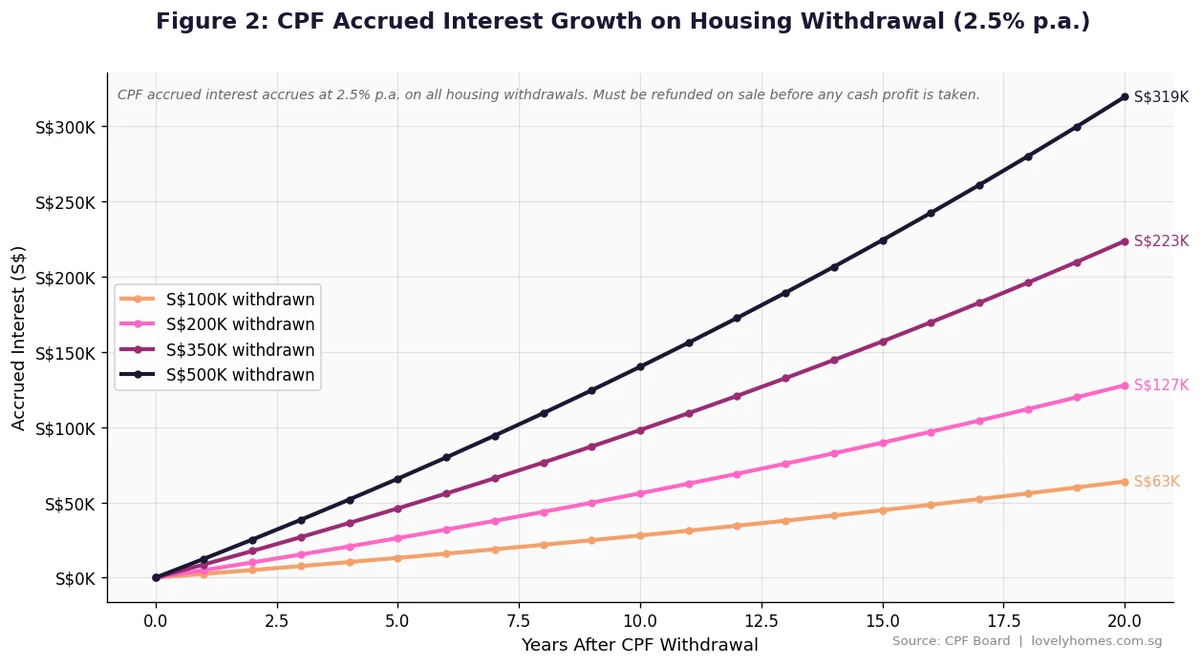
The accrued interest compounds aggressively over long hold periods. On S$200,000 withdrawn and not yet refunded, the accrued interest after 20 years at 2.5% p.a. is approximately S$128,500 , meaning the total refund obligation on that withdrawal alone is S$328,500. For buyers who use CPF heavily from day one, accrued interest can reach S$100,000–S$250,000 over a typical 20–25 year hold period.
CPF and Lease Remaining , Proration Rules
For HDB resale flats, CPF usage is subject to lease-based restrictions introduced to protect CPF members from locking retirement funds into flats that may depreciate as the lease runs down:
- Remaining lease ≥ 60 years: Full CPF usage allowed up to the Valuation Limit.
- Remaining lease 20–59 years: CPF usage is prorated. The formula is: maximum CPF = VL × (remaining lease / years needed to cover youngest buyer to age 95). For example, if the youngest buyer is 40 and the remaining lease is 50 years (covers to age 90), coverage shortfall is 5 years. The proration fraction = 50 / 55 = 91%. CPF capped at 91% of VL.
- Remaining lease < 20 years: No CPF may be used at all. The purchase must be entirely in cash (plus bank loan proceeds, if any lender is willing).
For new BTO flats (typically 99-year leases), lease-based CPF proration is not a concern for the original buyer. It becomes relevant for subsequent buyers purchasing older resale flats.
HDB Loan vs Bank Loan , CPF Implications
The choice between an HDB concessionary loan (2.6% p.a.) and a bank loan affects how CPF is used:
With an HDB loan, the Board automatically deducts the monthly instalment from your CPF OA each month, provided the OA has sufficient balance. If the OA runs dry in a given month, the shortfall must be topped up in cash. Many HDB borrowers find their OA balance growing over the years as CPF contributions from employment exceed the monthly deduction, providing a liquidity buffer.
With a bank loan, you instruct the bank to debit your CPF OA each month. The same Valuation Limit and Withdrawal Limit apply. Unlike the HDB loan, bank loans carry variable or fixed-rate interest that can change over time; the CPF deduction amount adjusts accordingly when rates change.
What Happens to CPF When You Sell Your HDB Flat
When you sell your HDB flat, the following sequence applies to the sale proceeds:
- Repay the outstanding mortgage (if any) to HDB or the bank.
- Refund CPF principal + accrued interest to your CPF OA , this is mandatory and deducted from proceeds before any cash reaches you.
- Deduct transaction costs: agent commission (typically 1–2% of sale price), legal fees (~S$2,000–S$3,000), HDB administrative fee (S$80–S$800 depending on flat type).
- The remainder is your net cash proceeds.
Note that there is no capital gains tax on property in Singapore. The full gain (above cost basis) is available to you , but a significant portion may flow back into CPF rather than arriving as cash.
Worked Example: The Lee Family
Mr and Mrs Lee (both SCs, aged 35 and 33) bought a 4-room HDB resale flat in Bishan for S$520,000 in August 2016. They used an HDB loan at 2.6% p.a., tenure 25 years. Loan amount: S$416,000. They used CPF for the S$104,000 downpayment (20% × S$520,000) and the monthly HDB loan instalment.
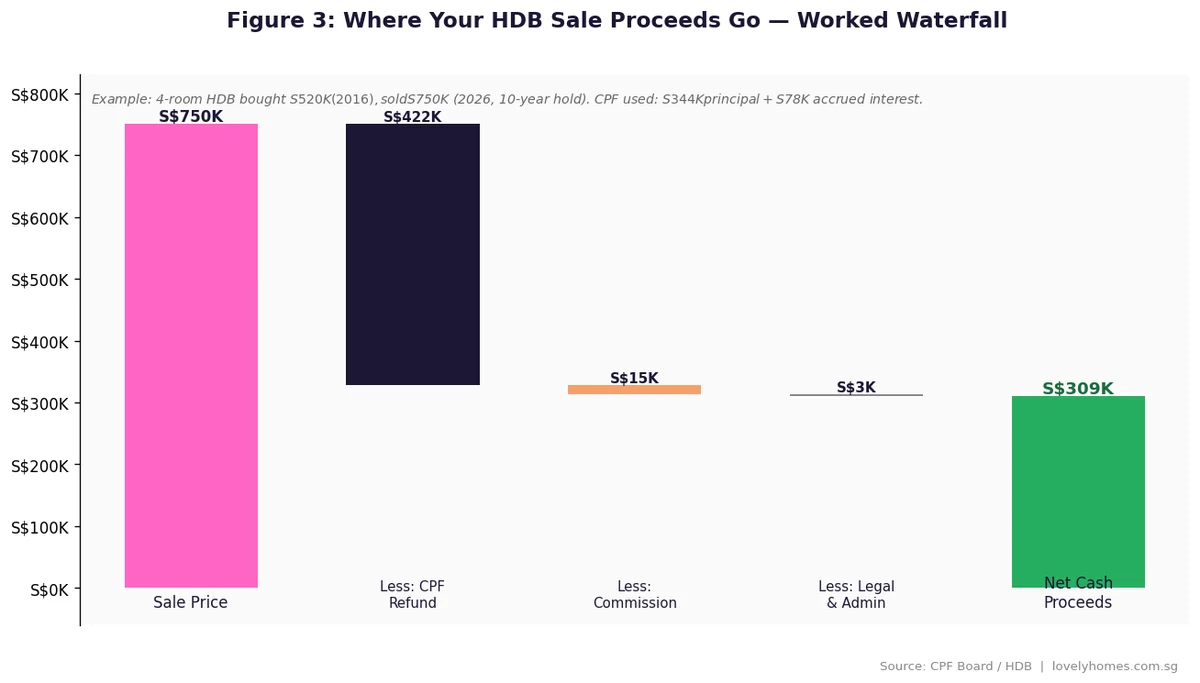
In August 2026, they sell the flat for S$750,000 (a 10-year hold). By this point, the HDB loan is fully paid off (they made additional CPF top-ups). Total CPF withdrawn over the 10 years: S$344,000 (S$104,000 downpayment + S$240,000 monthly contributions). Accrued CPF interest at 2.5% p.a. compound, blended over the variable withdrawal periods, totals approximately S$78,000. Total CPF refund obligation: S$422,000.
Sale proceeds breakdown:
- Sale price: S$750,000
- Less outstanding loan: S$0 (fully repaid)
- Less CPF refund (principal + accrued interest): S$422,000
- Less agent commission (2% × S$750,000): S$15,000
- Less legal fees + HDB admin: S$3,300
- Net cash to Mr and Mrs Lee: S$309,700
- CPF refund to OA: S$422,000 (available for retirement or next property)
The total wealth created , S$309,700 cash + S$422,000 CPF refund , is S$731,700 against an original cost of S$520,000 plus transaction costs. The flat appreciated S$230,000 (44%) over 10 years, and the Lees also avoided 10 years of private rental costs, saving an estimated S$350,000–S$450,000 in rental outgoings over the period.
Why CPF Accrued Interest Matters More Than Most Buyers Realise
Many buyers focus on the upfront cost of purchasing and the monthly repayment , but the accrued CPF interest is a slow-building obligation that comes due on the day of sale. Its compounding nature means it grows exponentially: the same S$350,000 withdrawn from CPF accrues S$115,000 in interest over 15 years, but S$227,000 over 25 years , nearly double.
For buyers who plan to sell within 5–8 years, accrued interest is modest. For long-term holders (20+ years), particularly those who used CPF heavily from day one, the refund obligation can be very large. Planning ahead , for example, by making occasional voluntary CPF OA top-ups to reduce the net balance “owed” , can help, though the arithmetic remains the same: you simply return funds to your CPF OA more gradually rather than in one large lump on sale.
Compared to other developed-economy housing markets, Singapore’s CPF system is unusual: it creates a parallel “internal loan” that is charged at the OA rate rather than a commercial mortgage rate. For HDB buyers, this rate (2.6% on the HDB loan, 2.5% on accrued interest) is typically lower than private bank mortgage rates , meaning the effective cost of CPF housing financing remains competitive even accounting for the accrued interest obligation.
What Might Change
The CPF OA interest rate is reviewed annually (1 January each year for the base rate) and quarterly for the additional floor interest applied to the first S$60,000 of combined CPF balances. As at 2026, the OA rate remains 2.5% p.a. Should MAS or the CPF Board revise the OA rate upward , which has been discussed in the context of rising risk-free rates globally , accrued interest obligations would grow correspondingly for future withdrawals. There is no suggestion of imminent change as at August 2026.
Frequently Asked Questions
Can I use CPF to pay both the downpayment and the monthly mortgage on an HDB flat?
Yes. For an HDB concessionary loan, there is no minimum cash downpayment , the entire 20% downpayment can be funded from your CPF OA if the balance allows (though in practice, a 5% cash payment is required at the Option to Purchase stage, before CPF can be accessed). The monthly mortgage is then automatically deducted from your OA by HDB each month. For a bank loan, the minimum 5% cash downpayment is mandatory and cannot be replaced by CPF; the remaining 20% can be from CPF, and monthly instalments can also be debited from CPF.
What happens if my CPF OA runs out midway through my mortgage?
If your CPF OA balance is insufficient in a given month to cover the full instalment, you must pay the shortfall in cash that month. HDB will not automatically sell your flat or declare a default because of a temporary OA shortfall, but persistent cash shortfalls , where the mortgage is consistently not being met , can lead to arrears and, ultimately, enforcement action. Many buyers use their OA balance as a buffer and pay cash when the OA is low; others top up the OA voluntarily to maintain a cushion. For bank loans, if CPF OA is insufficient, the instalment defaults to the linked bank account.
Can I voluntarily refund CPF early to reduce accrued interest?
Yes, but with an important caveat: voluntarily refunding CPF early returns money to your OA, but the accrued interest calculation is still based on the full amount that was withdrawn and the full period it was outstanding. You cannot retroactively reduce accrued interest by returning funds early , the accrued interest is locked in from the date of withdrawal. What early voluntary top-ups can do is increase your OA balance available for the next property purchase and improve your CPF retirement adequacy, but they do not reduce the accrued interest owed on past withdrawals.
Does accrued CPF interest affect my ability to sell at a profit?
Yes, it can. If the sale price of your flat does not exceed the total CPF refund obligation (principal + accrued interest) plus the outstanding loan, the transaction would result in a “loss” in cash terms , you would get no cash from the sale. In extreme cases (flat depreciated significantly, high accrued interest, large outstanding loan), you might owe more to CPF and the lender than the sale proceeds. This situation is more theoretical than common for HDB flats in Singapore, but it is a real risk for flats with very short remaining leases that have depreciated in value.
Can I use CPF OA for a private condo if I already used it for my HDB flat?
Yes, but the CPF Board imposes rules on sequential usage. When you sell your HDB flat, CPF principal and accrued interest are refunded to your OA. You can then use that refunded balance (and any new OA contributions) for a subsequent private property purchase, subject to the same Valuation Limit and Withdrawal Limit rules for the new property. There is no lifetime cap on CPF housing usage, but each property is assessed independently against its own VL and WL.
What if I buy the flat with my spouse , how is CPF usage split?
Each co-owner uses their own CPF OA independently. HDB and the bank will record the CPF contribution of each owner separately , so if Mr Tan contributes S$150,000 from his OA and Mrs Tan contributes S$100,000 from hers, each owes their respective CPF Board the principal plus accrued interest on their own contribution. On sale, the proceeds are split between the two CPF refunds (each to the respective owner’s OA) before any net cash is distributed. If one spouse has a larger OA balance, they will typically carry a larger CPF housing burden.
Related Articles
- Singapore Property Downpayment Guide 2026: How Much Cash and CPF You Need
- Using CPF to Buy Private Property in Singapore 2026: Valuation Limit, Accrued Interest and Sale Rules
- Singapore HDB Lease Decay Guide 2026: CPF Limits, Pricing Impact and What to Do
- Singapore TDSR & MSR Borrowing Limits Guide 2026
- Singapore Property Seller’s Complete Guide 2026: OTP, Timeline, Costs and Proceeds
- HDB Minimum Occupation Period (MOP) Singapore 2026: Complete Guide
Supporting graphics
Original article illustrations are available below.
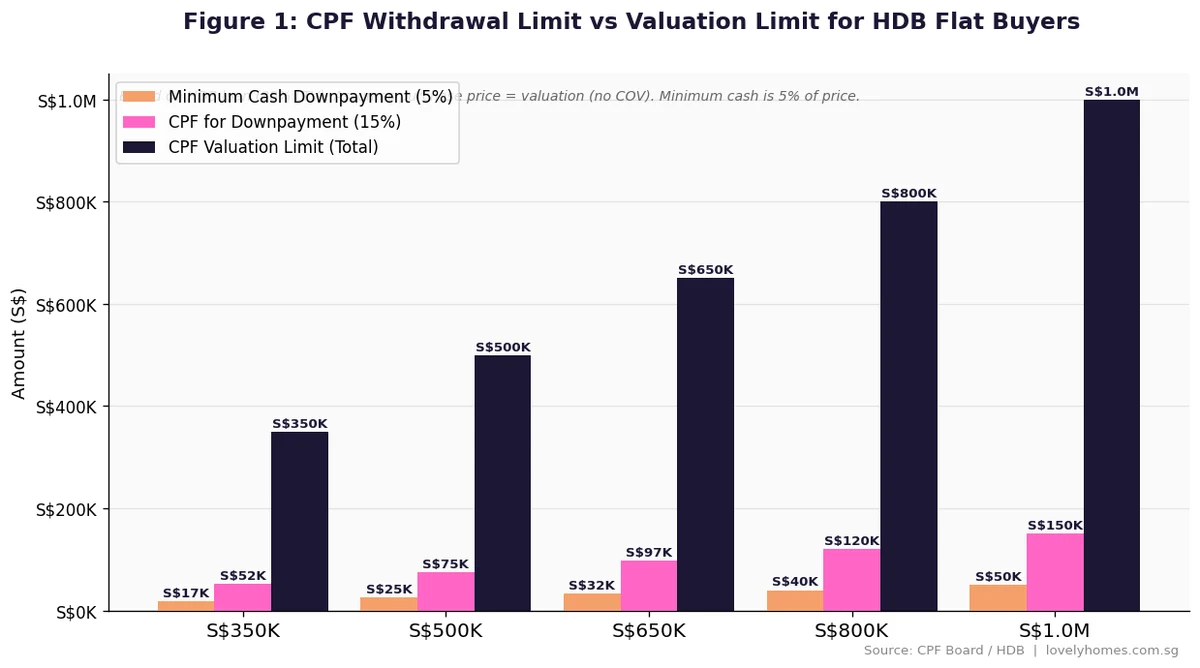
- Figure 1: CPF usage caps at different HDB resale prices (assuming HDB loan, 80% LTV). The Valuation Limit equals the purchase price; the Withdrawal Limit equals the VL plus projected accrued interest. Source: CPF Board / HDB.
- Figure 2: CPF accrued interest on housing withdrawals at 2.5% p.a. compound. On S$350,000 withdrawn, accrued interest after 20 years is approximately S$227,000 , a significant claim on sale proceeds. Source: CPF Board.
- Figure 3: Where HDB sale proceeds go. In this example (S$750,000 sale, 10-year hold), CPF refund of S$422,000 reduces gross proceeds substantially, leaving S$309,700 in net cash. Source: CPF Board / HDB.