⚡ Quick Answer , Singapore Property Market Outlook 2027
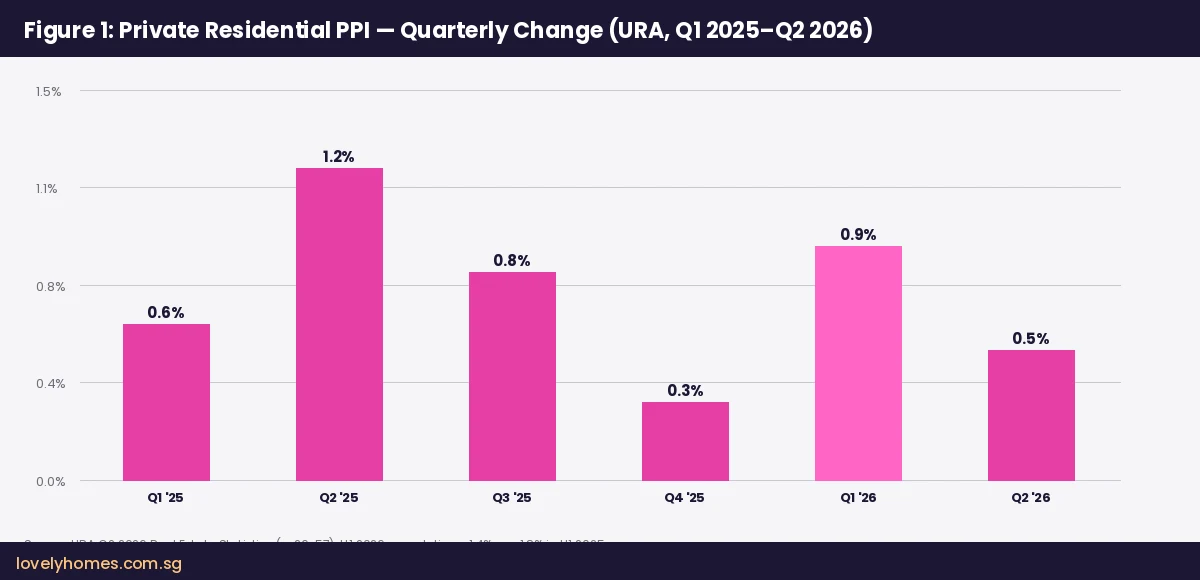
- The URA’s private residential Property Price Index (PPI) rose 0.5% in Q2 2026, slowing from 0.9% in Q1. Cumulative H1 2026 growth of 1.4% is below the 1.8% in H1 2025.
- Landed property rebounded strongly at +2.5% in Q2, while non-landed prices eased slightly by -0.1% , a divergence driven by scarcity of landed land.
- The Core Central Region (CCR) is the only non-landed segment still rising (+1.8% in Q2), supported by foreign capital and prime upgrader demand.
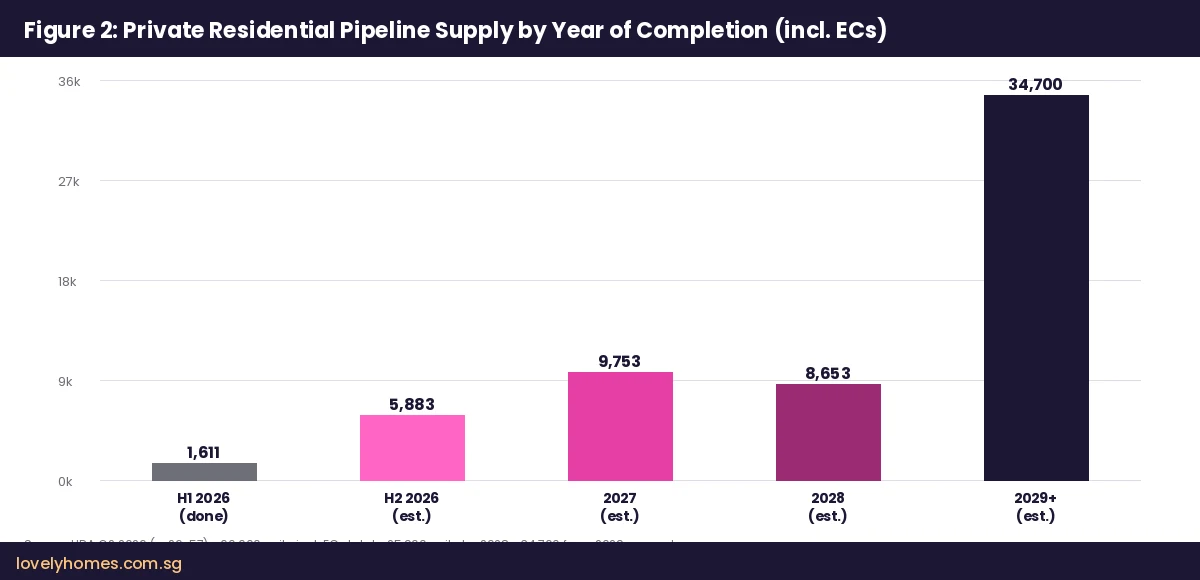
- ~60,600 private residential units (incl. ECs) are expected to complete in the coming years; roughly 9,750 units are due in 2027 alone.
- The vacancy rate rose to 6.4% in Q2 2026 and is expected to climb further as completions accelerate in 2027, which may moderate rental growth.
- HDB resale prices eased 0.3% in Q2 2026 , the first quarterly slip in several years , as a wave of MOP-cleared flats enters the market.
- The IMF forecasts Singapore’s GDP growth at 3.5% in 2026 and 2.7% in 2027; slower growth typically tempers speculative property demand.
- Consensus outlook for 2027 private residential prices: +1% to +3%, with wide variance depending on US rates, trade conditions, and cooling measure adjustments.
The Singapore Property Market in Context
Singapore’s private residential property market has been one of the most resilient in the Asia-Pacific region. Even through successive rounds of cooling measures since 2009 , including landmark Additional Buyer’s Stamp Duty (ABSD) rate hikes in April 2023 and September 2022 , prices have continued their long-run upward trajectory. The Urban Redevelopment Authority (URA) oversees the market through its quarterly price index releases, Government Land Sales (GLS) programme, and planning regulations that constrain new supply.
As at August 2026, the market is entering a new phase: one defined by meaningful supply delivery, softening rental momentum, and a more cautious macroeconomic backdrop. Understanding the data from H1 2026 is the starting point for any view on 2027.
Private Residential Prices , The H1 2026 Snapshot
The URA’s Q2 2026 Real Estate Statistics, released on 24 July 2026, confirmed a further moderation in price growth. The overall private residential PPI grew 0.5% in Q2 2026, down from 0.9% in Q1 2026. This brings the cumulative gain for H1 2026 to 1.4%, below the 1.8% recorded in the same period of 2025. The direction of travel is clear: price growth is slowing, but the market has not turned outright negative on an overall basis.
Rental momentum provides additional context. Residential rentals rose 0.7% in Q2 2026 (following +0.3% in Q1), driven by landed rentals (+2.7%) while non-landed rentals grew a more modest 0.4%. The vacancy rate for completed non-landed private property rose from 6.2% in Q1 to 6.4% in Q2 , a signal that supply is catching up with occupied demand.
Landed vs Non-Landed: A Diverging Story
The headline PPI masks a significant divergence within the private residential market. Landed property , comprising terrace houses, semi-detached homes, bungalows and Good Class Bungalows (GCBs) , rebounded sharply to +2.5% in Q2 2026 after a brief -0.4% dip in Q1. This rebound reflects the structural scarcity of landed supply in Singapore, where the total landed stock barely grows and GCBs are restricted to Singapore Citizens. Landed residential land simply cannot be replicated at scale, giving the segment a long-term price floor.
Non-landed properties, by contrast, dipped 0.1% in Q2 2026 against the +1.3% in Q1 , a clear signal of easing demand relative to supply. Breaking this down by region tells an important story. The Core Central Region (CCR), comprising Districts 9, 10, 11, Downtown Core and Sentosa, saw non-landed prices rise 1.8% in Q2 (up from +0.6% in Q1). The Rest of Central Region (RCR) fell 1.2% (from +0.8% in Q1). The Outside Central Region (OCR), which makes up the bulk of mass-market volume, dipped 0.1% (from +2.2% in Q1).
The OCR shift is particularly noteworthy. The OCR saw the strongest gains through 2024 and early 2025 as buyers priced out of the CCR moved into mass-market condominiums in Tengah, Tampines, Woodlands and Punggol. That momentum is now moderating as a wave of new completions enters the market and TDSR constraints cap affordability at prevailing income levels.
Supply Pipeline: What Is Coming in 2027
The URA’s pipeline data as at end Q2 2026 confirms the extent of coming supply. There were 42,472 private residential units (including executive condominiums) with planning approval, of which 15,810 remained unsold by developers. A further 18,153 units without planning approval included the 4,745 units on the Confirmed List of the GLS programme for H2 2026. The Government has maintained the 2026 full-year Confirmed List at 9,320 units , over 50% above the 10-year annual average , confirming its policy commitment to supply-side stability.
Looking specifically at 2027: approximately 9,753 private residential units are expected to complete that year, compared with approximately 7,494 (1,611 in H1 + 5,883 in H2) units in 2026. This acceleration in completions will put upward pressure on vacancies and moderate the rental price level , a structural shift from the supply drought of 2021–2022 that drove rental spikes of 30%+ in some submarkets.
Demand Drivers: Employment, Population and Global Capital
Singapore’s property market demand rests on three structural pillars. First, employment and income growth: the labour market has remained tight, with unemployment at historically low levels, supporting mortgage affordability at TDSR-constrained households. The Ministry of Manpower and the Economic Development Board have continued to attract high-value global businesses, keeping expatriate and professional demand for both owner-occupied and rental residential stock elevated.
Second, population and household formation: Singapore’s resident population has grown steadily, and the government’s ongoing public housing programme cannot fully absorb demand for private residential living among higher-income residents. The permanent resident community, at around 550,000, provides a significant pool of buyers eligible for private property on day one of obtaining PR status.
Third, global capital allocation: Singapore functions as a regional wealth management and family office hub. Ultra-high-net-worth individuals (UHNWIs) from Southeast Asia, mainland China, India and beyond have established Singapore as a base, driving demand for GCBs, CCR condominiums and District 9/10 landed properties. While the 60% ABSD rate for foreigners introduced in April 2023 has sharply reduced individual foreign buyer volumes, institutional and family office-channelled demand has continued through Singapore Citizens and permanent residents.
HDB Resale: Supply Pressure in 2026 and Beyond
HDB resale prices eased 0.3% in Q2 2026, according to HDB’s flash data , the first quarterly decline in several years. This is primarily a supply story. Approximately 13,484 HDB flats reached their five-year Minimum Occupation Period (MOP) in 2026, adding a large cohort of eligible resale supply to the market. At the same time, HDB plans to launch approximately 7,960 new BTO flats in the October 2026 sales exercise (covering towns including Bedok, Geylang, Sembawang, Tengah, Toa Payoh and Yishun), providing buyers with additional alternatives to the resale market.
The interaction between the HDB and private property market is direct. HDB upgraders , SC households exercising their HDB flat equity to purchase private properties , are among the largest buyers of new-launch condominiums in the OCR. If HDB resale prices remain flat or continue to ease, upgrader equity is constrained, reducing the pool of cash-equipped buyers for OCR new launches. This downward transmission effect is one reason why OCR private prices softened in Q2 2026.
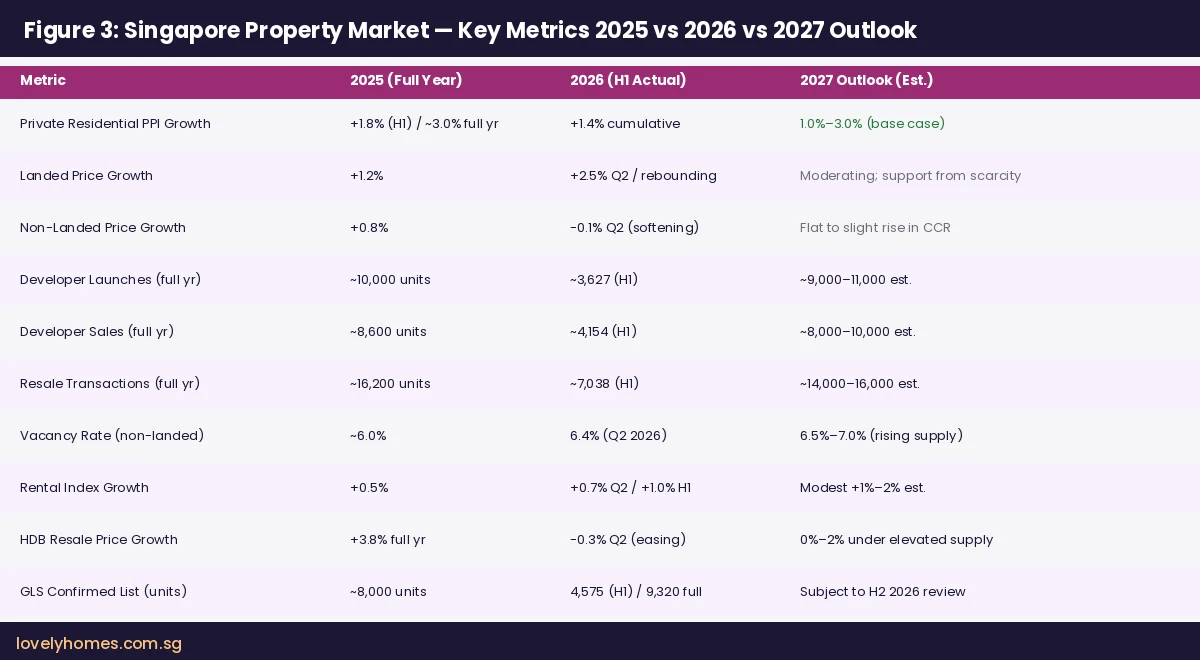
The Key Market Metrics at a Glance
| Metric | H1 2026 (Actual) | Full Year 2025 (Ref.) | 2027 Consensus Est. |
|---|---|---|---|
| Private PPI Growth (half-year) | +1.4% | +1.8% H1 / ~3.0% FY | +1.0%–3.0% (full year) |
| Developer Launches | ~3,627 units | ~10,000 units | ~9,000–11,000 units |
| Developer Sales | ~4,154 units | ~8,600 units | ~8,000–10,000 units |
| Resale Transactions | ~7,038 units | ~16,200 units | ~14,000–16,000 units |
| Vacancy Rate (non-landed) | 6.4% (Q2) | ~6.0% | 6.5%–7.0% (rising supply) |
| Rental Index Growth | +1.0% cumulative | +0.5% FY | +1%–2% (moderating) |
| HDB Resale Price Growth | -0.3% Q2 (easing) | +3.8% FY | 0%–2% |
| GLS Confirmed List Units | 4,575 (H1) | ~8,000 | Subject to H2 2026 review |
| Pipeline (unsold, approved) | 15,810 units | ~18,000 | Declining as launches clear |
| Vacancy (CCR / RCR / OCR) | 8.3% / 6.1% / 5.6% | ~8.0% / 5.8% / 5.0% | Rising modestly in all |
Macroeconomic Wild Cards for 2027
Several macro factors will shape the 2027 outlook. The IMF projects Singapore’s GDP growth at 3.5% in 2026, slowing to 2.7% in 2027 , a meaningful deceleration driven by global trade uncertainty, softening demand from major trading partners, and the knock-on effects of US Federal Reserve monetary policy on regional capital flows. A sustained high-rate environment in the United States keeps the opportunity cost of holding leveraged Singapore property elevated, even with SORA-based mortgages running at approximately 3.4% in mid-2026.
Currency dynamics also matter: a stronger Singapore dollar relative to the Chinese yuan, Indian rupee and regional currencies reduces the purchasing power of foreign-origin UHNWIs , a secondary factor given Singapore’s position as a wealth management hub. Conversely, any softening of the ABSD regime for foreigners (currently 60%, introduced April 2023) could trigger a sharp uptick in CCR demand; however, there are no public signals that this is imminent.
Finally, the Government’s track record of preemptive calibration must be accounted for. Singapore has adjusted cooling measures eight times since 2009 , both tightening and easing , in response to market conditions. Any sharp price acceleration in 2027 would likely prompt further supply-side or demand-side measures; any sustained downturn could trigger targeted relaxation.
Worked Example: A 2027 Purchase Decision
📈 Case Study: Mr and Mrs Lau , Buying a 3BR OCR Condo in Early 2027
Profile: Mr and Mrs Lau, both Singapore Citizens, ages 38 and 36. Combined gross monthly income S$16,000. First-time private property purchase. Target: 3BR OCR resale condo, Sengkang or Punggol, projected price S$1,750,000 in early 2027.
Buyer’s Stamp Duty (BSD):
First S$180,000 × 1% = S$1,800
Next S$180,000 × 2% = S$3,600
Next S$640,000 × 3% = S$19,200
Next S$500,000 × 4% = S$20,000
Remaining S$250,000 × 5% = S$12,500
Total BSD: S$57,100. ABSD: S$0 (first property, both SC).
Financing (bank loan, LTV 75%):
Loan amount: S$1,312,500. Stress-test rate 4% over 30 years: monthly instalment ~S$6,265. TDSR: 6,265/16,000 = 39.2% , well within the 55% cap.
Cash outlay at exercise:
5% cash OTP deposit: S$87,500. Balance 20% (CPF OA + cash): S$262,500. BSD: S$57,100. Legal fees: ~S$4,500. Total required capital: approximately S$411,600 (partly from CPF OA).
Rental yield check (if investor): OCR 3BR market rent in Sengkang/Punggol approximately S$4,200–S$4,600/mth (mid-2026 data). Gross yield: ~2.9%–3.1% on S$1.75M , below mortgage carrying cost at 3.4%, implying a negative carry of ~0.3%–0.5% per annum before tax deductions. A long hold (7+ years) and capital appreciation thesis is required for this to be positive-return.
What This Means for Buyers and Investors
For owner-occupiers, the 2027 outlook is cautiously supportive. Price growth is moderating rather than collapsing, and the Government has made clear it will sustain a high level of GLS supply to prevent a speculative boom. Buyers who can comfortably meet TDSR and have genuine long-term holding intent are not buying at a cyclical peak by the standards of Singapore’s property history. OCR condominiums, in particular, may benefit from continued HDB upgrader demand even as individual transactions become more price-sensitive.
For investors, the calculus is more nuanced. Gross rental yields of 2.5%–3.5% remain below mortgage carrying costs in most OCR segments, meaning residential investment is primarily a capital appreciation play. With the vacancy rate rising and rental growth moderating, investors with short holding periods face negative carry. The CCR , particularly Districts 9 and 10 , offers slightly stronger yield compression dynamics driven by the wealth management clientele, but entry prices are higher and the market is more susceptible to global capital flow shifts.
For HDB upgraders, the sequencing of sale and purchase matters more in 2027 than in prior years: with HDB resale prices plateauing and OCR private prices also moderating, the relative exchange rate between the two markets is more favourable for upgraders who sell HDB and buy OCR private. Timing the HDB sale to maximise equity extraction while avoiding the 3-year SSD window on any private property they already own will be the key planning challenge.
What Might Come Next , Looking Beyond 2027
This section represents editorial analysis and is not a forecast or guarantee of future performance.
Singapore’s long-run property market is shaped by three structural forces that are unlikely to reverse: land scarcity, population policy (the government continues to attract global talent), and the city-state’s role as a regional financial hub. These factors argue for a moderate upward drift in prices over any five-to-ten year period, punctuated by policy-induced cooling episodes.
The near-term risk to watch in 2027 is an overshoot in vacancy. If the approximately 9,753 completions due in 2027 arrive into a market where rental demand growth is decelerating , driven by cooling global tech sector hiring and a slower inflow of new employment pass holders , vacancy could push toward 7.5%–8% in the non-landed private segment. Landlords would face downward rental pressure, reducing carrying returns for investors and potentially triggering resale by over-leveraged owners.
The URA’s Q3 2026 flash estimates, expected in October 2026, will be the next major data point. Any acceleration in prices would likely prompt a GLS supply response; any continued softening may prompt a relaxation of the 15-month wait-out period for private-to-HDB purchasers (introduced July 2023), which was already removed in July 2026 for most cases. Watch this space.
Frequently Asked Questions
Will Singapore private property prices fall in 2027?
A broad-based price decline is not the base-case scenario under current data. The market has seen price growth slow , from +1.8% in H1 2025 to +1.4% in H1 2026 , but not turn negative on the overall PPI. Specific submarkets such as RCR (-1.2% in Q2 2026) have already seen quarterly softening. Whether 2027 produces a full-year decline depends heavily on global interest rates, Singapore’s GDP trajectory, and whether the Government adjusts cooling measures. Most industry analysts see a range of +1% to +3% for the full year 2027, with a flat or marginally negative outcome possible if macro conditions deteriorate sharply.
What is the current TDSR cap and how does it affect my borrowing?
The Total Debt Servicing Ratio (TDSR) is set by the Monetary Authority of Singapore (MAS) at 55% of gross monthly income for all property loan applications. It includes all debt obligations , mortgage, car loans, personal loans, credit card minimum payments, and any guarantor arrangements. The stress test for residential property loans requires the bank to apply a minimum rate of 4% per annum when calculating whether the TDSR is met, regardless of the actual prevailing rate. For a household earning S$12,000/mth, the maximum total monthly debt is S$6,600; if the only debt is the new mortgage, the maximum loan supported is approximately S$1,385,000 on a 30-year term at 4% stress-test rate.
Is now a good time to buy private property in Singapore?
This depends entirely on your financial position, holding period and purpose. For long-term owner-occupiers with stable income and a 10+ year horizon, Singapore residential property has historically delivered positive real returns after accounting for ABSD, BSD, maintenance and mortgage interest. For investors with a 3–5 year horizon, the current rent-to-price yield of 2.5%–3.5% in most segments is below mortgage carrying cost, implying negative carry. Anyone buying primarily for short-term capital gain faces meaningful risk given the slowing price growth environment and the Seller’s Stamp Duty (SSD) applicable to properties sold within 3 years. Always take advice from a licensed financial adviser before any major purchase.
What happens to property prices if interest rates fall in 2027?
Lower interest rates reduce mortgage servicing costs and improve TDSR-affordability, which typically expands the pool of eligible buyers and supports price growth. Since Singapore mortgages are predominantly SORA-linked (3-month SORA was approximately 2.55% in mid-2026), any US Federal Reserve rate cuts would transmit into Singapore lending rates over a 3–6 month lag. However, the government has historically offset rate-driven demand surges with cooling measures (GLS supply increases, ABSD tightening) to prevent a speculative boom. A fall in rates is therefore unlikely to produce a sustained price acceleration unless the Government simultaneously relaxes demand-side measures.
How does the GLS programme affect 2027 supply?
The Government Land Sales (GLS) programme is the primary mechanism by which the URA manages private residential supply. The Confirmed List for the full year 2026 is 9,320 units , over 50% above the 10-year annual average. These units, once tendered and developed, will complete approximately 3–4 years later, adding to the 2029–2030 delivery pipeline. The H2 2026 Confirmed List of 4,745 units was released in the June 2026 GLS announcement and includes sites in areas such as Marina Gardens Lane and Orchard Boulevard. The GLS Reserve List provides additional potential supply if developer demand justifies activation through competitive bids.
Should I wait for cooling measures to be lifted before buying?
Waiting for cooling measure relaxation is a timing strategy that carries its own risks. When cooling measures have been relaxed in the past , for example, the partial SSD reduction in March 2017 , prices responded quickly as pent-up demand was released. By the time a relaxation is announced and implemented, the best-value units may already be under offer. Additionally, there is no certainty on the timing of any relaxation: the Government has consistently stated that measures will be calibrated to market conditions, which means relaxation only occurs when the market has already moderated. Buying at moderation (today) may be preferable to waiting for a signal that pushes prices back up. Personal holding capacity and purpose remain the deciding factors.
How does the 2027 pipeline compare to historical supply?
The approximately 9,753 private residential units (incl. ECs) expected to complete in 2027 is significantly above the completion volumes of 2021 and 2022, when fewer than 7,000 units were delivered annually due to COVID-19 construction delays. The post-COVID catch-up delivery, combined with the sustained GLS programme since 2022, means 2026–2028 will see above-average supply. Historical completions of 14,000–18,000 units per year occurred in the 2015–2017 cycle; the current 2026–2028 cycle, at approximately 7,500 to 9,750 per year, is moderate rather than aggressive by Singapore standards. This context is important: even elevated 2027 completions do not represent the extreme oversupply scenarios seen in some other global markets.
Related Articles on LovelyHomes
- ABSD Singapore 2026: Complete Guide to Additional Buyer’s Stamp Duty
- Singapore BSD Complete Guide 2026: All Buyer’s Stamp Duty Rates Explained
- Singapore Property Financing Options Guide 2026
- Singapore Private Property Buying Guide 2026
- Singapore Property Stamp Duty Calculator Guide 2026
- HDB Resale Prices by Town 2026 , LovelyHomes
- Singapore Property Cooling Measures Timeline 2009–2026
Supporting graphics
Original article illustrations are available below.
- Figure 1: Singapore private residential PPI quarterly change Q1 2025–Q2 2026 (Source: URA pr26-57, 24 July 2026)
- Figure 2: Private residential pipeline supply by expected year of completion (incl. ECs), as at end Q2 2026 (Source: URA pr26-57)
- Figure 3: Singapore property market key metrics , 2025, 2026 H1, and 2027 consensus outlook (Sources: URA, Cushman & Wakefield, IMF)