⚡ Quick Answer , Stamp Duty Singapore 2026
- Singapore levies three property stamp duties: Buyer’s Stamp Duty (BSD) on all purchases, Additional Buyer’s Stamp Duty (ABSD) based on buyer profile and property count, and Seller’s Stamp Duty (SSD) when selling within three years.
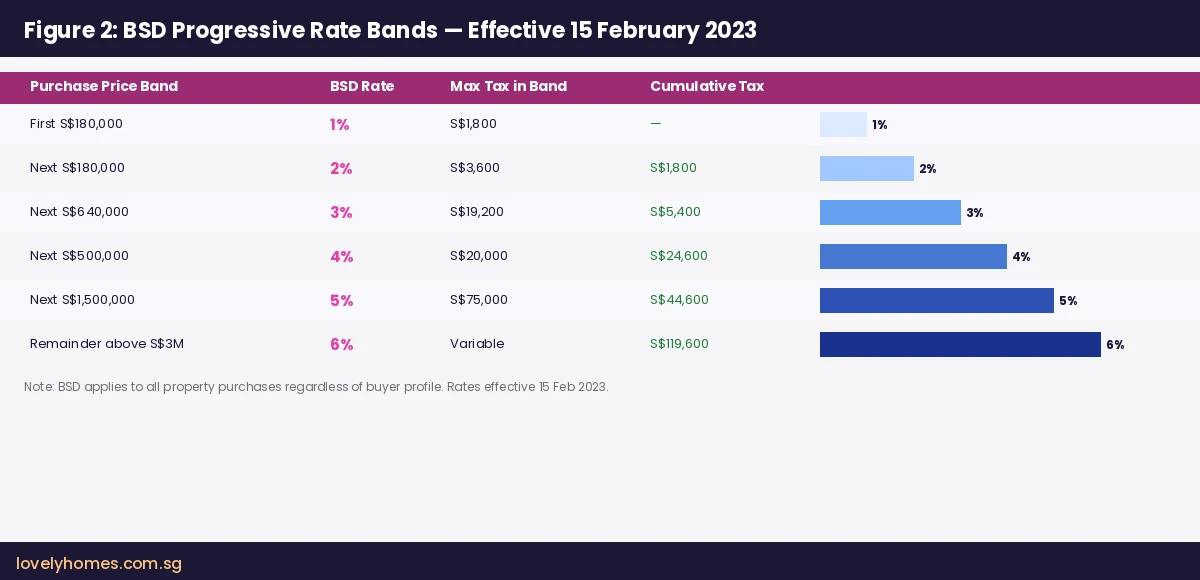
- BSD rates are progressive: 1% to 6%, with the top 6% band applying to amounts above S$3,000,000 (effective 15 February 2023).
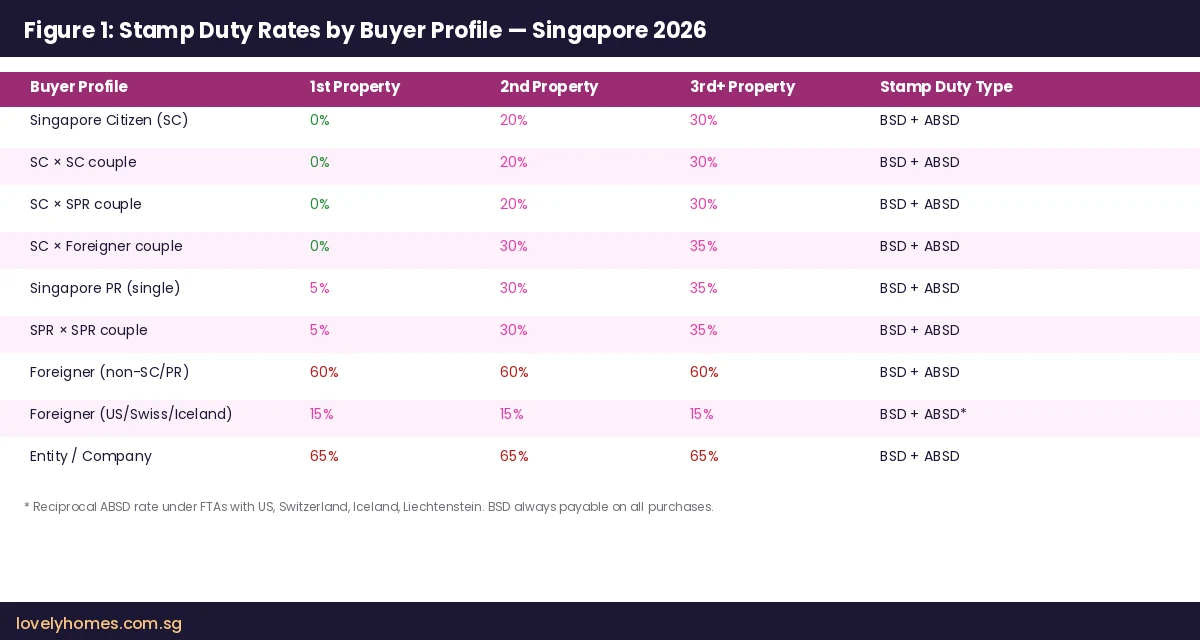
- ABSD for a Singapore Citizen buying a first residential property is 0%; a second property incurs 20% ABSD; a third incurs 30%.
- Foreigners pay 60% ABSD on any residential property (except nationals of the US, Switzerland, Iceland and Liechtenstein who pay 15% under free trade agreements).
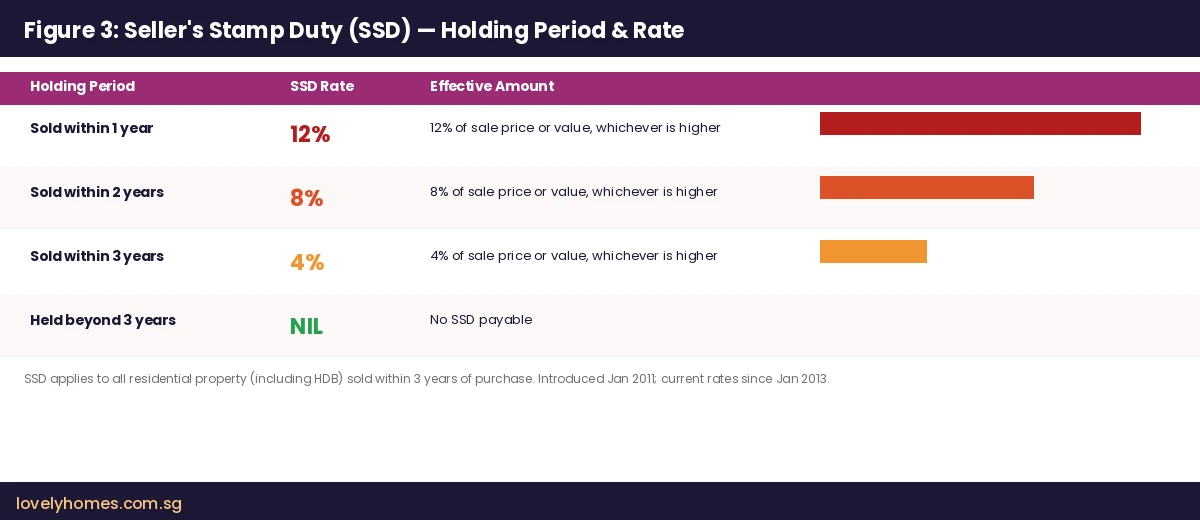
- SSD applies if you sell within three years of purchase: 12% (year 1), 8% (year 2), 4% (year 3).
- BSD is computed on the higher of purchase price or market value , not just contract price.
- Stamp duty must be paid within 14 days of executing the Option to Purchase or Sales and Purchase Agreement, whichever is earlier.
- IRAS administers all stamp duties in Singapore; payment is made via e-Stamping on the IRAS portal.
What is Stamp Duty in Singapore?
Stamp duty is a tax levied by the Inland Revenue Authority of Singapore (IRAS) on documents relating to immovable property. Under the Stamp Duties Act (Cap. 312), any instrument effecting a transfer of property , whether a sale, gift or otherwise , must be stamped within 14 days of execution if the document is signed in Singapore, or within 30 days if signed overseas. Failure to stamp on time attracts penalties of up to four times the unpaid duty.
Three separate stamp duties operate in the Singapore residential property market. BSD applies to every purchaser regardless of nationality or number of properties owned. ABSD is an additional layer imposed on top of BSD; it is calibrated by IRAS and the Ministry of Finance as a demand-management tool to cool the market. SSD is a hold-period tax designed to deter short-term speculation.
Understanding all three , and how they interact , is essential before committing to any property purchase or sale in Singapore.
Buyer’s Stamp Duty (BSD) , Progressive Rate Calculator
BSD is computed on a tiered, progressive basis on the higher of the purchase price or the market value of the property as assessed by IRAS. The current progressive rate schedule, which came into effect on 15 February 2023 following an upward revision to the top bands, is as follows:
| Purchase Price / Value Band | BSD Rate | Tax on This Band | Cumulative BSD Up to Top of Band |
|---|---|---|---|
| First S$180,000 | 1% | S$1,800 | S$1,800 |
| Next S$180,000 (up to S$360,000) | 2% | S$3,600 | S$5,400 |
| Next S$640,000 (up to S$1,000,000) | 3% | S$19,200 | S$24,600 |
| Next S$500,000 (up to S$1,500,000) | 4% | S$20,000 | S$44,600 |
| Next S$1,500,000 (up to S$3,000,000) | 5% | S$75,000 | S$119,600 |
| Remainder above S$3,000,000 | 6% | Variable | Variable |
Using this schedule, the formula for properties priced between S$1,000,001 and S$1,500,000 is: S$24,600 + 4% of (purchase price minus S$1,000,000). For properties between S$1,500,001 and S$3,000,000: S$44,600 + 5% of (purchase price minus S$1,500,000).
Additional Buyer’s Stamp Duty (ABSD) , By Profile and Property Count
ABSD was first introduced in December 2011 as a cooling measure. It has been revised multiple times, most recently in April 2023, when rates were raised significantly across nearly all buyer profiles. ABSD is charged on the full purchase price or value (not progressively), and it applies in addition to BSD.
For Singapore Citizens purchasing their first residential property, ABSD remains at 0% , the government’s intention is to make home ownership accessible to citizens buying their principal residence. A married SC couple acquiring their first joint property also pays 0% ABSD. However, once a citizen already owns one property, the rate jumps to 20% on the second and 30% on the third and subsequent properties.
Singapore Permanent Residents (PRs) pay 5% ABSD on their first property , the same rate that applied to citizens on their second property in the period before April 2023. PRs buying a second property incur 30%, and a third 35%. Foreigners bear the highest standard rate at 60% on any residential property, a rate introduced in April 2023 that effectively doubled the previous 30% rate.
Entities , including companies, LLPs and trusts , pay 65% ABSD on any residential property. This high rate reflects the government’s policy of steering investment through individual, not corporate, channels. Housing developers who purchase residential land or units as part of their business are subject to separate remission arrangements.
ABSD Remissions , Married Couples and Housing Developers
The Ministry of Finance provides specific ABSD remission schemes under the Stamp Duties (Residential Properties) (Remission) Rules. The most important for individual buyers is the married couple remission: where a Singapore Citizen and a Singapore Permanent Resident (or another citizen) jointly purchase a residential property and it is the first jointly-owned property for both of them, and neither holds any other residential property at the time of purchase, an ABSD remission applies to reduce the combined ABSD to the rate applicable to the lower-status spouse. The application must be made to the Commissioner of Stamp Duties within six months of purchase.
Housing developers who purchase land designated for residential development under the Government Land Sales (GLS) programme or collective sale scheme may apply for a remission of ABSD, subject to a remission clawback if they do not sell all units within five years of the date of the collective sale order or the land purchase, as applicable.
Seller’s Stamp Duty (SSD) , Hold Period Matters
SSD was introduced by IRAS in January 2011 to deter short-term property flipping. Under the current regime (rates applicable to properties acquired on or after 11 March 2017), SSD applies if the residential property is sold or disposed of within three years of acquisition:
SSD is computed on the higher of the sale price or the market value assessed by IRAS at the time of sale. It applies to all residential properties including HDB flats and private residential units. Industrial and commercial properties have their own SSD regime with different holding periods and rates.
Stamp Duty on HDB Purchases
HDB flat purchases are subject to BSD in the same way as private property, computed on the resale price (for resale flats) or the purchase price set by HDB (for new BTO/SBF flats). ABSD generally does not apply to SC-only purchasers buying their first HDB flat; however, if a citizen already owns another residential property, ABSD will apply on the HDB purchase at the appropriate rate. SSD applies to HDB resale flats sold within three years of purchase at the same rates as private property.
One important nuance: for HDB flat purchases using CPF Ordinary Account (OA) funds, the CPF Board requires that BSD be paid before CPF is disbursed for the flat purchase. In practice, buyers often pay BSD in cash initially and reimburse themselves from the CPF grant or OA on completion.
Worked Example , Full Stamp Duty Computation
Case Study: Mr and Mrs Goh , Second Property Purchase
Profile: Mr Goh is a Singapore Citizen; Mrs Goh is also a Singapore Citizen. Both are co-owners of their current HDB flat in Bishan (their first property). They are purchasing a 2-Bedroom resale condominium at Tanjong Rhu as a second property. Purchase price: S$1,480,000. Market value confirmed by IRAS: S$1,475,000. Stamp duty is computed on the higher of the two: S$1,480,000.
BSD Computation:
- First S$180,000 at 1%: S$1,800
- Next S$180,000 at 2%: S$3,600
- Next S$640,000 at 3%: S$19,200
- Remaining S$480,000 at 4%: S$19,200
- Total BSD: S$43,800
ABSD Computation: Mr and Mrs Goh each already own an HDB flat (first property). This purchase is their second residential property. As Singapore Citizens buying a second property, ABSD rate = 20%.
- ABSD = 20% of S$1,480,000 = S$296,000
SSD: Not applicable at point of purchase (SSD applies on the sell side, if they were to sell within 3 years).
Total Stamp Duty Payable: BSD S$43,800 + ABSD S$296,000 = S$339,800
Payment deadline: Both BSD and ABSD must be paid via IRAS e-Stamping within 14 days of exercising the Option to Purchase (OTP).
What This Means for Property Buyers
Singapore’s layered stamp duty system is among the most comprehensive globally, and it is deliberately designed to achieve specific outcomes: home ownership for citizens at low cost on the first purchase, strong demand management through ABSD on subsequent properties, and a disincentive for quick-flip speculation via SSD. For buyers, the practical implication is that stamp duty must be factored into upfront capital planning , it cannot be financed by the bank mortgage and must be paid in cash or CPF within 14 days.
In peer comparison, Hong Kong applies a Buyer’s Stamp Duty of 7.5% on non-permanent residents and a Special Stamp Duty of 60% on residential properties sold within 3 years. Australia levies state-level stamp duties that range from around 4% to 5.5% for typical residential purchases. Canada imposes a 15–20% foreign buyer tax in most major cities. Singapore’s framework is broadly consistent with the regional approach of using stamp duties as active demand tools, though the absolute ABSD quantum for foreigners at 60% is among the world’s highest.
For Singaporeans buying within their means for a primary residence, stamp duty is manageable , BSD on a S$600,000 flat is S$12,600, and ABSD is nil. The burden rises steeply with investment-grade purchases: a citizen buying a S$1.5M second property pays S$44,600 (BSD) + S$300,000 (ABSD) = S$344,600 in stamp duties alone, before legal fees, renovation, or financing costs.
What Might Come Next
The Ministry of Finance and MAS conduct periodic reviews of the cooling measure framework and have historically adjusted ABSD rates when the market shows signs of overheating or excessive speculation. The April 2023 hike , which doubled foreign ABSD from 30% to 60% and raised citizen second-property ABSD from 17% to 20% , was widely seen as a response to record transaction volumes and rising prices in 2021 and 2022. Industry observers note that the Q2 2026 private residential price index (rising 0.5% quarter-on-quarter) suggests prices remain elevated but stable, making a near-term rate reduction unlikely. Any future adjustment would likely be graduated, with the foreign ABSD rate seen as having the most room for eventual relaxation if external demand cools naturally. BSD rates, having been revised upwards in February 2023, are considered unlikely to change in the near term.
Frequently Asked Questions
Is BSD the same for HDB flats and private condominiums?
Yes. The same progressive BSD schedule (1% to 6%) applies to all residential property purchases in Singapore regardless of property type. The rate bands are computed on the higher of the purchase price or the property’s market value as assessed by IRAS. For most resale transactions, IRAS will use the contracted price unless it is materially below the assessed market value, in which case the higher value is used.
Do I pay ABSD if I am a Singapore Citizen buying my first home jointly with my PR spouse?
Under the ABSD remission framework, a Singapore Citizen and Singapore PR couple buying their first jointly-owned residential property , where neither currently owns any other residential property , may apply for an ABSD remission. If eligible, ABSD is effectively zero, as the citizen’s first-property rate of 0% governs. The application must be submitted to the Commissioner of Stamp Duties within six months of purchase, and it requires confirming that both spouses have no other residential property interest at the point of purchase. If either spouse owns another property, even an overseas one that HDB or Singapore authorities have record of, the remission may be declined.
How does SSD interact with inheritance or gifted property?
SSD is triggered by the date of acquisition, not by the reason for acquisition. If you inherit a property or receive it as a gift, the date on which the transfer is executed is your acquisition date for SSD purposes. However, a key relief applies: property transferred via a will or intestate succession (i.e., genuinely inherited without consideration) is specifically exempted from SSD under the Stamp Duties Act. If you receive a property as a gift (not via inheritance) and subsequently sell it within three years, SSD will apply. The SSD rate is computed on the sale price or assessed value, whichever is higher, and the holding period is measured from the date of acquisition.
Can BSD or ABSD be paid using CPF?
BSD may be paid using CPF Ordinary Account (OA) funds, provided your CPF OA has sufficient balance and the property qualifies for CPF usage (i.e., it meets the minimum remaining lease requirement of at least 20 years, and the lease extends beyond the youngest owner’s age of 95). ABSD, however, cannot be paid from CPF , it must be paid entirely in cash. This is an important liquidity planning consideration for buyers who carry a significant ABSD obligation, particularly investors buying a second or third property where ABSD can easily exceed S$200,000.
What happens if I pay stamp duty late?
IRAS imposes a penalty for late stamping. If duty is paid beyond the 14-day deadline (or 30-day deadline for documents signed overseas), the penalty is the higher of S$10 or an amount equal to the duty unpaid , effectively a doubling of the duty for short delays. For prolonged non-payment, the penalty can escalate to four times the unpaid duty. IRAS also has the power to refuse recognition of an unstamped document in legal proceedings, which has significant practical implications for property transactions.
Are commercial properties subject to BSD, ABSD and SSD?
Commercial and industrial properties are subject to BSD at different rates (generally lower for commercial property: 1% on first S$180,000, 2% on next S$180,000, and 3% on the remainder). ABSD does not apply to commercial or industrial properties , it is exclusively a residential property duty. SSD applies to industrial property (but not commercial property) under a separate regime: 15% if sold within the first year, 10% in the second year, and 5% in the third year. Buyers switching from residential to commercial investment strategies should verify the applicable duties carefully with a conveyancing solicitor or IRAS.
How do I pay stamp duty in Singapore?
Stamp duty is paid through the IRAS e-Stamping portal at myTax.iras.gov.sg. Buyers or their conveyancing solicitors submit the relevant transaction details, IRAS computes the duty, and payment is made by PayNow, GIRO, or credit/debit card. Your solicitor will typically handle stamping as part of the conveyancing process and will invoice you for the stamp duty alongside their legal fees. Always retain the stamp certificate issued by IRAS , it is an official document confirming that duty has been paid and is required for registration of the transfer at the Singapore Land Authority (SLA).
Related Articles
- ABSD Singapore 2026 , Complete Guide to Additional Buyer’s Stamp Duty
- Singapore Property Cooling Measures Timeline 2009–2026
- Singapore Property Ownership Transfer Guide 2026
- Singapore Private Property Buying Guide 2026
- Singapore HDB CPF Usage Guide 2026
- Singapore Property Conveyancing Process Guide 2026
Supporting graphics
Original article illustrations are available below.