⚡ Quick Answer , Property Ownership Transfer in Singapore 2026
- Property ownership can be transferred by gift, sale, inheritance, or court order (divorce) , each has different stamp duty and CPF consequences.
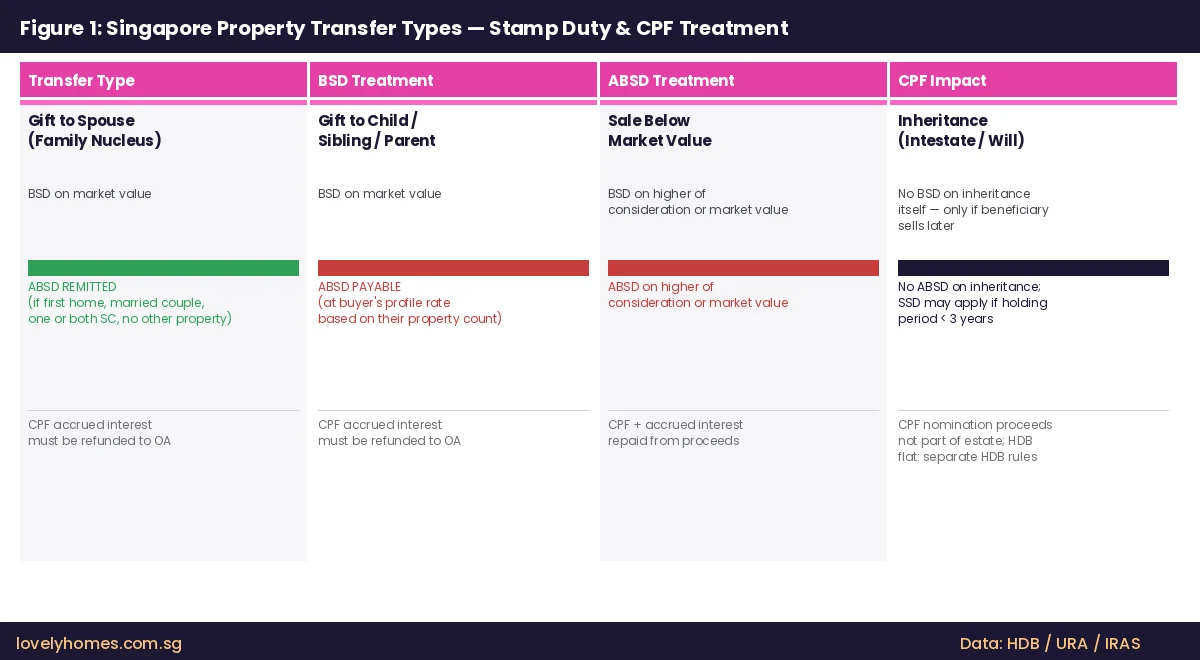
- Gifting a property to a spouse within the family nucleus qualifies for ABSD remission , potentially saving tens of thousands of dollars , if the couple will jointly own only one residential property.
- Buyer’s Stamp Duty (BSD) is payable on all transfers (including gifts) at the market value rate under the Stamp Duties Act (Cap. 312).
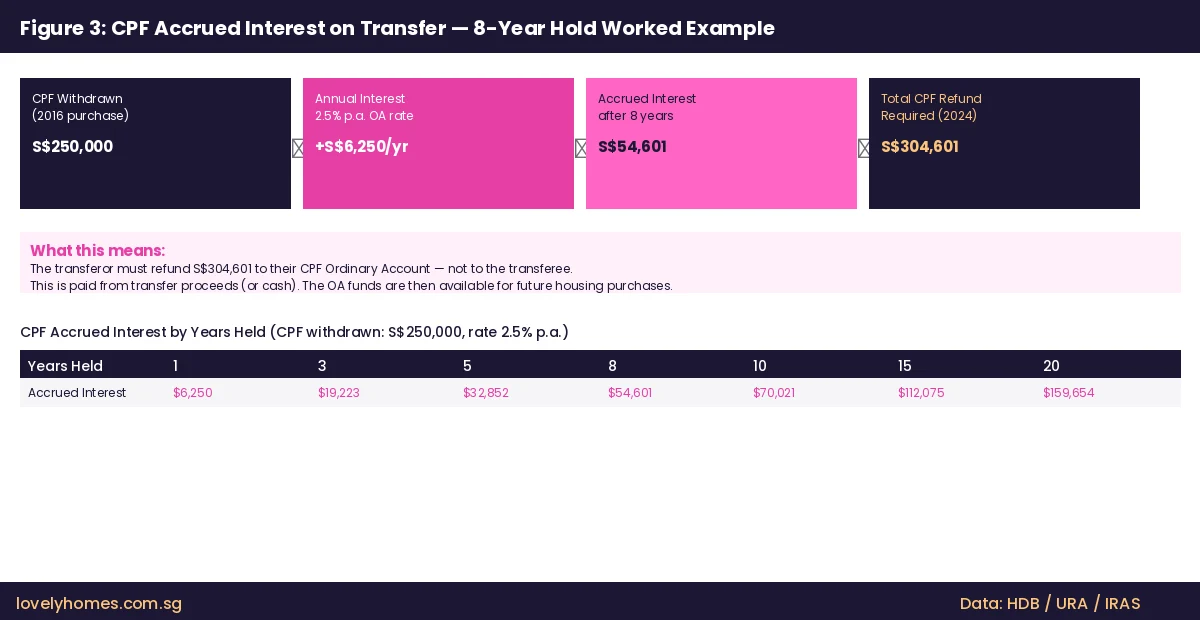
- The transferor must refund all CPF principal withdrawn plus accrued interest at 2.5% p.a. to their CPF Ordinary Account upon transfer.
- A transfer by inheritance (via will or intestate succession) is generally not subject to BSD or ABSD , but Seller’s Stamp Duty (SSD) may apply if the estate sells within 3 years of the deceased’s original purchase.
- All transfers must be lodged with the Singapore Land Authority (SLA) via the Conveyancing and Law of Property (CLPA) framework.
- A licensed conveyancing lawyer is required for all private property transfers; HDB transfers can use HDB’s in-house legal team.
- ABSD remission applications for family nucleus transfers must be filed within 6 months of the instrument of transfer.
Understanding Property Ownership Transfer in Singapore
Transferring a property in Singapore is a legal process governed primarily by the Conveyancing and Law of Property Act (CLPA, Cap. 61), the Land Titles Act (LTA, Cap. 157), and the Stamp Duties Act (Cap. 312). The Singapore Land Authority (SLA) maintains the authoritative register of all property titles in Singapore under the Torrens system, which grants indefeasible title , meaning once registered, ownership is guaranteed by the state.
Transfers occur in several common situations: a property owner wishes to add a spouse or child as a co-owner; an owner wishes to gift the property outright; a property owner passes away and the flat or private property is distributed to beneficiaries; or a court order in divorce proceedings awards the property to one spouse. Each pathway carries distinct legal, stamp duty, and CPF obligations that must be carefully navigated.
This guide walks through each transfer type, the applicable stamp duties, CPF obligations, and the process involved , with specific reference to 2026 rules and rates administered by IRAS, CPF Board, HDB, and SLA.
Types of Property Transfer and Stamp Duty Treatment
Gifting Property to a Spouse , The Family Nucleus ABSD Remission
One of the most significant tax planning opportunities available in Singapore property law is the ABSD remission for transfers within the family nucleus, established under the Stamp Duties (Remission) (No. 2) Rules and administered by IRAS. A married couple , where at least one spouse is a Singapore Citizen , may transfer a residential property between themselves (or add the other spouse as co-owner) with the ABSD portion remitted, provided they meet all of the following conditions at the time of transfer:
- The couple must be legally married at the time of the transfer;
- The property transferred must be a residential property (including HDB flats and private residential);
- After the transfer, the property must be jointly owned by both spouses (not solely by one);
- Neither spouse may own any other residential property locally or overseas at the time of transfer; and
- The ABSD remission application must be filed within 6 months of executing the instrument of transfer.
Note that BSD is still payable even where ABSD is remitted. BSD is computed on the market value of the property at the time of transfer, not the consideration (which may be nil in a gift). For a private condo valued at S$1,500,000, for instance, BSD of approximately S$33,600 would be payable even on a gift transfer. For HDB flats, HDB rules additionally require that the transferor and transferee together remain eligible under HDB’s flat ownership rules (e.g., SC/SPR citizenship requirements, no private property owned).
Gifting to Children, Parents, or Siblings , No ABSD Remission
Transfers to family members outside the married-couple nucleus do not benefit from the ABSD remission. If you gift a property to your adult child, parent, or sibling, the transferee is treated as a buyer for ABSD purposes. The ABSD rate applicable is based on the transferee’s profile (Singapore Citizen, Singapore PR, or foreigner) and the number of residential properties they own or are deemed to own at the time of transfer , exactly as if they were purchasing the property on the open market.
For example, a Singapore Citizen child who already owns one residential property and receives a second property by gift from a parent would be liable for ABSD at 20% (SC second property rate) computed on the market value of the gifted property. On a S$1,500,000 flat, this would amount to ABSD of S$300,000 in addition to BSD. Families considering this type of transfer should carefully model the stamp duty costs before proceeding.
Buyer’s Stamp Duty , Calculation on Transfer
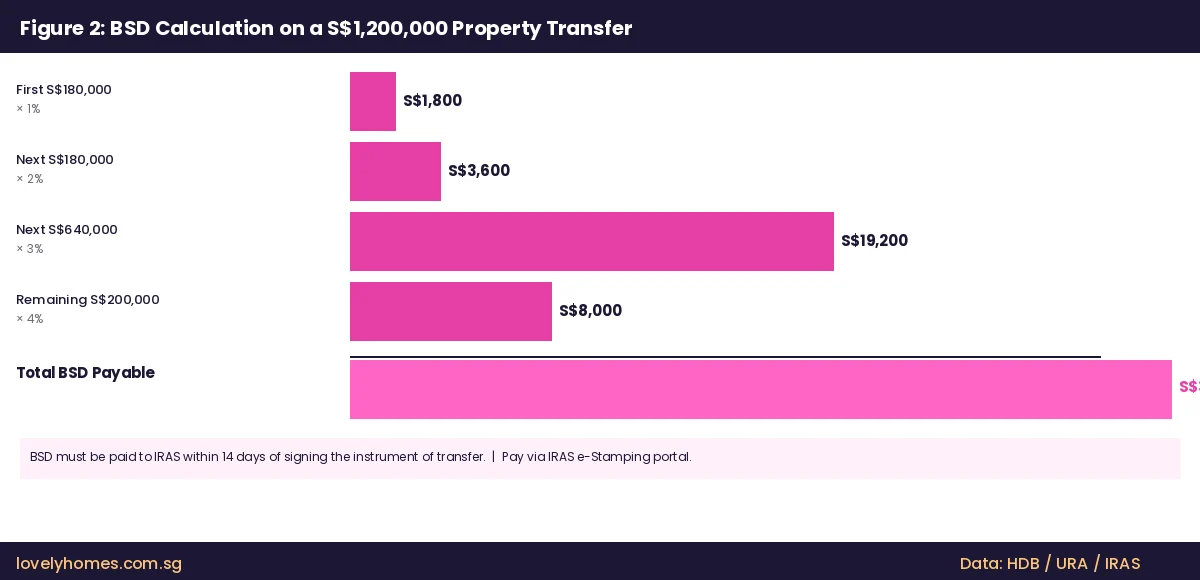
Buyer’s Stamp Duty is levied at progressive rates on the market value of the property (or the consideration, whichever is higher). The 2026 BSD rate schedule for residential property is:
| Band | Rate | BSD on That Band |
|---|---|---|
| First S$180,000 | 1% | S$1,800 |
| Next S$180,000 (S$180,001–S$360,000) | 2% | S$3,600 |
| Next S$640,000 (S$360,001–S$1,000,000) | 3% | S$19,200 |
| Next S$500,000 (S$1,000,001–S$1,500,000) | 4% | S$20,000 |
| Next S$1,500,000 (S$1,500,001–S$3,000,000) | 5% | Up to S$75,000 |
| Above S$3,000,000 | 6% | On excess |
BSD must be paid to IRAS within 14 days of the instrument of transfer being signed. Payment is made via the IRAS e-Stamping portal. Late payment attracts a penalty of up to 4× the original stamp duty. On a S$1,200,000 property, total BSD is S$1,800 + S$3,600 + S$19,200 + S$8,000 = S$32,600.
CPF Accrued Interest , The Often-Overlooked Obligation
When a property is purchased using CPF Ordinary Account (OA) savings, the CPF Board treats the OA funds as a loan to the property owner at the prevailing OA interest rate of 2.5% per annum, compounding annually. Upon transfer, sale, or full repayment of the CPF housing loan, the transferor is required to refund to their CPF OA the full principal amount withdrawn plus all accrued interest to the date of transfer.
This obligation applies regardless of whether the transfer is by gift, sale below market value, or court order in divorce. It cannot be waived. The CPF refund must come from the transfer proceeds, or from the transferor’s personal cash if the proceeds are insufficient. The refunded amount is credited to the transferor’s CPF OA and earns OA interest from that point , it remains available for future housing purchases or retirement.
Worked Example , Gifting a Condo to Spouse
🔭 Worked Example: Mr Chan transfers his condo to joint ownership with Mrs Chan (family nucleus)
Property: 2-Bedroom condominium in Buona Vista. Market value: S$1,580,000. Mr Chan (SC) currently sole legal owner. Mrs Chan (SC) has no other residential property. They have been married 9 years.
Objective: Transfer 50% share to Mrs Chan, making them joint owners. Claim ABSD family nucleus remission.
BSD payable (on 50% share at market value):
Market value of 50% = S$790,000
BSD: 1% × S$180,000 = S$1,800 + 2% × S$180,000 = S$3,600 + 3% × S$430,000 = S$12,900 = S$18,300
ABSD: Nil , family nucleus remission applies (both SC, first and only residential property, jointly owned after transfer, remission application filed within 6 months). Without remission, ABSD at 20% (Mrs Chan’s second property rate if she owned another) could have been S$158,000.
CPF obligation for Mr Chan:
CPF OA principal withdrawn over 9 years: S$280,000
Accrued interest @2.5% p.a. compounding: S$280,000 × (1.025⁹ − 1) = S$280,000 × 0.2489 = S$69,700
Total CPF refund: S$349,700
This must be refunded to Mr Chan’s CPF OA from the refinancing or transfer proceeds.
Legal fees: S$4,000–S$5,500 for private conveyancing solicitor (both parties advised to have independent counsel).
Total cost of transfer: BSD S$18,300 + Legal fees ~S$4,500 + CPF refund S$349,700 (goes back to his OA, not lost) = net out-of-pocket approximately S$22,800 (excl. CPF refund which is retained in CPF).
Transfer by Inheritance , Wills, Intestate Succession, and HDB Rules
When a property owner passes away, the property is transferred to beneficiaries either under a valid will or, if no will exists, under the Intestate Succession Act (Cap. 146). For non-Muslims, the Intestate Succession Act determines the distribution hierarchy: spouse (first) then children, and so forth. For Muslims, Islamic inheritance law (faraid) applies under the Administration of Muslim Law Act.
The transfer of property upon death does not attract BSD or ABSD in the hands of the beneficiary for the purpose of the inheritance itself. However, if the beneficiary subsequently sells the inherited property within 3 years of the deceased’s original purchase date, Seller’s Stamp Duty (SSD) at the prevailing rate may apply. Additionally, beneficiaries who already own other residential properties should be aware that the inherited property counts towards their property count for ABSD purposes on any future purchase.
For HDB flats specifically, HDB’s separate nomination rules apply. An HDB flat owner can make an HDB Flat Nomination (distinct from a CPF nomination) to direct the flat to a specific eligible family member. If no HDB nomination is made and no valid will names an eligible beneficiary, the flat falls into the estate administered by the Public Trustee. Crucially, the beneficiary must be eligible under HDB’s scheme to retain the flat , a foreigner beneficiary, for instance, cannot retain an HDB flat and must sell within 6 months of obtaining legal title.
Transfer on Divorce , Court Orders and Property Division
The Women’s Charter (Cap. 353) gives the Family Justice Courts wide powers to divide matrimonial assets, including properties, on divorce. The court may order a transfer of the property from one spouse to the other, or order a sale with the proceeds divided. Where a court order directs a transfer, the transferee spouse is generally exempt from ABSD on that transfer (IRAS treats court-ordered transfers differently from voluntary transfers). BSD, however, remains payable computed on the market value.
For HDB flats, the transfer must also comply with HDB’s eligibility rules , the retaining spouse must be eligible under an applicable HDB scheme. Where neither spouse qualifies (for example, both own private property), HDB may require the flat to be sold on the open market.
The Transfer Process , 7 Steps
What Might Change , Policy Outlook
The family nucleus ABSD remission is a deliberate policy tool to encourage married couples to consolidate into a single home rather than accumulate multiple properties. This policy has remained stable since its introduction but could be tightened if speculative transfer activity becomes a concern for authorities. Any changes would be announced in the Singapore Budget or via IRAS press releases. Separately, the BSD progressive rate structure (the 5% and 6% top bands were introduced in February 2023) is unlikely to be reduced in the near term given the government’s stated intent to keep residential property affordable.
Frequently Asked Questions
If I gift my property to my spouse, do I still need to pay BSD?
Yes. BSD is payable on all property transfers in Singapore, including gifts. The BSD is computed on the market value of the property (or the proportion being transferred), not the consideration (which may be zero). Only ABSD may be remitted under the family nucleus rules if conditions are met. BSD is administered by IRAS and must be paid via the e-Stamping portal within 14 days of signing the instrument of transfer.
Can I transfer my property to my adult child without triggering ABSD?
No , transfers to children (even adult children) do not qualify for the family nucleus ABSD remission. ABSD is levied on the transferee (child) based on their profile and the number of residential properties they own. If your child already owns a property, they would pay ABSD at the SC second-property rate (20% as at 2026) on the market value. Careful tax planning and professional legal advice are strongly recommended before proceeding with such a transfer.
How much CPF do I need to refund when I transfer my property?
You must refund the full amount of CPF OA funds withdrawn for the property purchase plus accrued interest at 2.5% per annum, compounding annually, from the date of each withdrawal to the date of transfer. The CPF Board provides an online calculator and will issue a letter confirming the exact refund amount. The refund must come from transfer proceeds (or your personal cash if proceeds are insufficient) and is credited back to your CPF OA , it is not lost but simply returned to your retirement savings.
Does an inheritance of property attract stamp duty?
No BSD or ABSD is levied on the inheritance itself. The transfer from estate to beneficiary by way of inheritance is not treated as a purchase. However, if the inherited property is subsequently sold within 3 years of the deceased’s original acquisition date, Seller’s Stamp Duty (SSD) may apply. The beneficiary should also be aware that the inherited property counts as a residential property for ABSD purposes on any future property purchase they make.
Can foreigners receive Singapore property as a gift or inheritance?
Foreigners can receive private non-landed residential property (condominiums, apartments) by gift or inheritance without restriction. They may also receive landed property subject to approval from the Singapore Land Authority under the Residential Property Act (Cap. 274) , approval is not automatic and is rarely granted outside specific exceptions. Foreign beneficiaries who inherit an HDB flat cannot retain it and must sell within 6 months of obtaining legal title, as foreigners are ineligible to own HDB flats.
What happens to my outstanding mortgage if I transfer my property?
The existing mortgage must be addressed as part of the transfer. If you have an outstanding bank loan, the bank must consent to the addition of a co-owner (often requiring the new co-owner to be assessed for creditworthiness and potentially requiring a formal assumption or refinancing). For a full gift or outright transfer, the loan must typically be fully discharged before or simultaneously with the transfer, unless the bank agrees to a formal novation of the debt to the transferee. HDB loans are similarly subject to HDB’s consent and re-assessment of the transferee’s eligibility.
How long does a property transfer take in Singapore?
Timeline varies by complexity and transfer type. A straightforward spousal transfer (adding co-owner, private residential, no mortgage complications) can complete in 4–6 weeks from engagement of solicitor to SLA registration. A transfer involving mortgage discharge, CPF refund, and ABSD remission application typically takes 6–10 weeks. Court-ordered transfers in divorce proceedings may take longer depending on when the court order is finalised and whether both parties cooperate. Engage your solicitor as early as possible and allow adequate time for the CPF refund calculation and stamp duty payment steps.
Related Articles
- ABSD Singapore 2026 , Complete Guide to Additional Buyer’s Stamp Duty
- Singapore HDB CPF Usage Guide 2026 , Withdrawal Limits and Accrued Interest
- HDB Flat Inheritance Singapore 2026 , Nomination, Transmission and Eligibility
- Singapore Property Conveyancing Process Guide 2026
- Singapore BSD 2026 , Complete Guide to Buyer’s Stamp Duty
- Singapore Property Financing Options Guide 2026
Supporting graphics
Original article illustrations are available below.
- Figure 1: Property Transfer Types , BSD, ABSD, and CPF Treatment at a Glance. Source: IRAS, CPF Board, HDB.
- Figure 2: BSD Calculation on a S$1,200,000 Property Transfer , Rate Bands 2026. Source: IRAS.
- Figure 3: CPF Accrued Interest Refund on Transfer , 8-Year Hold Worked Example. Rate: 2.5% p.a. compounding. Source: CPF Board.