Quick Answer: Singapore Property Financing in 2026
- Two main loan types: HDB loan (2.60% p.a., HDB flats only) and bank mortgage (fixed or SORA-pegged, all property types).
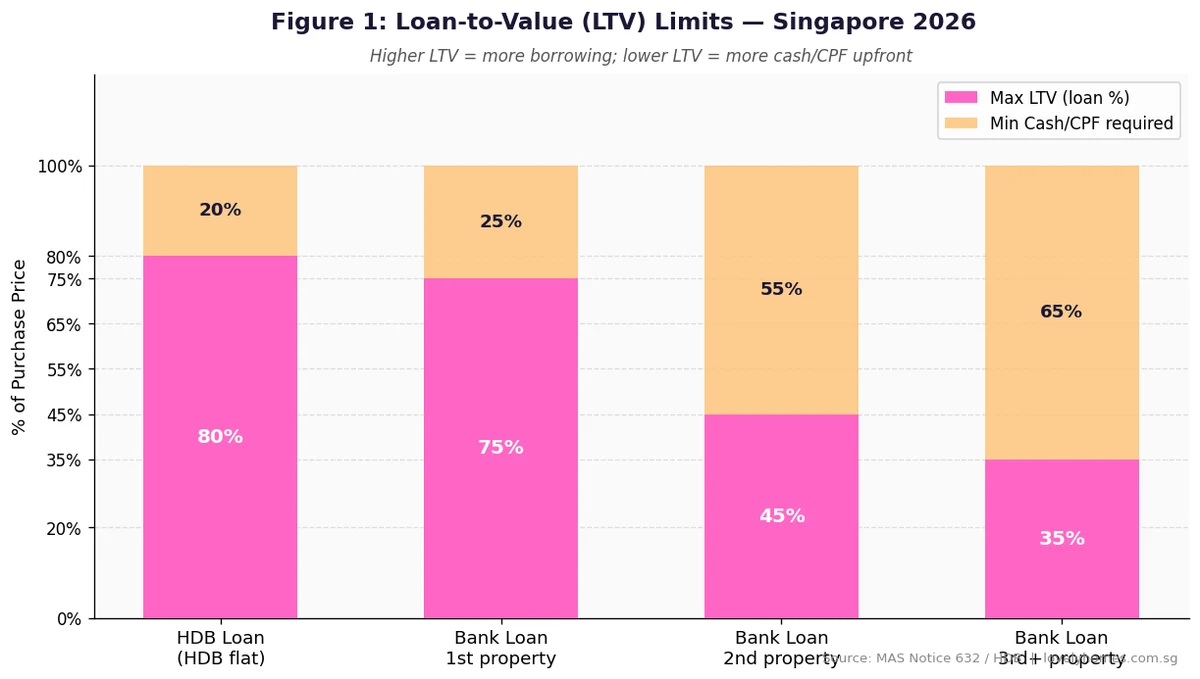
- Loan-to-Value (LTV): HDB loan up to 80%; bank loan 75% (1st property), 45% (2nd), 35% (3rd+).
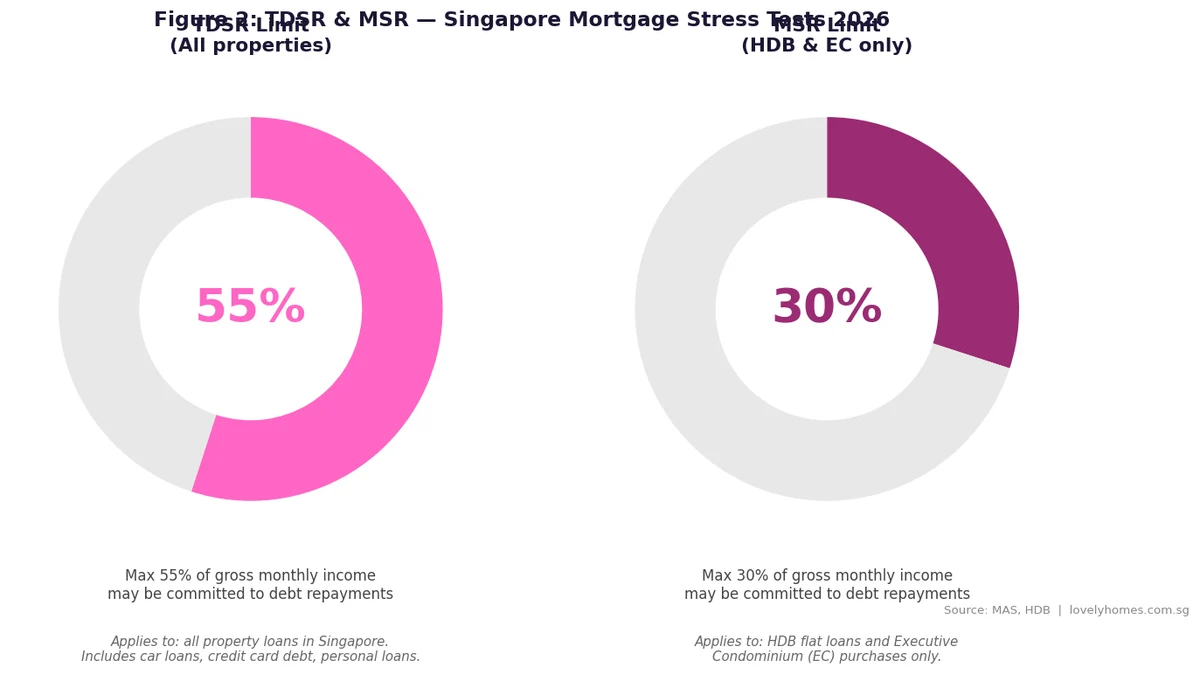
- TDSR cap: all monthly debt repayments cannot exceed 55% of gross monthly income (MAS rule).
- MSR cap: HDB flat and EC loan repayments cannot exceed 30% of gross monthly income.
- SORA is the benchmark rate for floating bank mortgages since 2024; it replaced SIBOR.
- CPF Ordinary Account (OA) funds can service mortgage instalments, subject to the Withdrawal Limit.
- Bridging loans are available (typically 6–12 months, ~5.5–6.0% p.a.) to bridge the gap between buying and selling.
- Always get an In-Principle Approval (IPA) from your lender before signing an Option to Purchase.
Buying property in Singapore involves navigating a structured financing framework administered by the Monetary Authority of Singapore (MAS) and the Housing Development Board (HDB). Whether you are purchasing your first HDB flat or upgrading to a private condominium, understanding your financing options , and the regulatory guardrails that govern them , is the essential first step before signing any property document.
This guide covers every major financing pathway available to Singapore buyers in 2026: HDB concessionary loans, bank mortgages (fixed and SORA-linked), CPF usage rules, the TDSR and MSR stress tests, bridging loans, and the real cost of each option over a 25-year tenure.
I. The HDB Concessionary Loan
The HDB loan is administered by the Housing Development Board and is available exclusively for the purchase of HDB flats , it cannot be used for private property or Executive Condominiums. The interest rate is pegged at 0.10 percentage points above the prevailing CPF Ordinary Account rate, which as of 2026 stands at 2.50% p.a., making the HDB loan rate 2.60% p.a. This rate has remained stable since 2023 and is reviewed quarterly.
The maximum LTV under the HDB loan is 80% of the lower of the purchase price or HDB’s assessed valuation. Buyers must fund the remaining 20% from CPF OA savings, cash, or a combination. Unlike bank loans, the HDB loan does not impose a minimum cash component , the entire 20% can come from CPF OA if sufficient funds are available.
HDB loan eligibility requires that at least one buyer be a Singapore Citizen, that the household’s gross monthly income does not exceed S$14,000 (S$21,000 for extended families), and that no buyer currently owns or has disposed of any private residential property within the 30 months preceding the application. Buyers who have previously taken a HDB loan twice are not eligible for a third.
When to choose the HDB loan
The HDB loan suits buyers who prioritise payment stability, have limited cash savings, and are purchasing a resale or Build-To-Order flat. Its fixed rate eliminates interest rate risk entirely, and early partial repayment carries no penalty. The trade-off is that the HDB loan rate (2.60%) is generally higher than the best promotional bank rates in low-rate environments, and it is not available for private property purchases.
II. Bank Mortgages , Fixed and SORA-Linked
Bank mortgages are regulated by MAS under Notice 632 and are available for all property types, including HDB flats, private condominiums, landed houses, and commercial property. Two broad structures exist: fixed-rate packages and floating-rate packages pegged to the Singapore Overnight Rate Average (SORA).
Fixed-rate mortgages
Fixed packages lock the interest rate for an initial period , typically two or three years , after which the loan reverts to a floating rate. As of Q3 2026, two-year fixed rates from major Singapore banks range from approximately 2.85% to 3.25% p.a., with the best rates available to borrowers with strong credit profiles and LTVs at or below 60%. After the fixed period expires, rates typically reset to the prevailing SORA plus a spread of 0.80–1.00 percentage points.
SORA-linked mortgages
Since MAS wound down SIBOR-based mortgages in 2024, the Singapore Overnight Rate Average (SORA) is the sole benchmark rate for new floating-rate home loans. SORA is the volume-weighted average rate of overnight interbank Singapore dollar transactions and is published daily by MAS. Most bank packages use the three-month compounded SORA (3M-SORA) plus a spread.
As of August 2026, 3M-SORA stands at approximately 2.55% p.a. With a typical bank spread of 0.80–0.90 percentage points, effective SORA-linked rates are approximately 3.35–3.45% p.a. SORA-linked packages generally have lower lock-in penalties than fixed packages and suit buyers who expect rates to fall, or who anticipate refinancing within two to three years.
III. TDSR and MSR , The Stress Tests Every Borrower Must Pass
MAS introduced the Total Debt Servicing Ratio (TDSR) framework in 2013 to prevent over-leveraging by property buyers. The MSR (Mortgage Servicing Ratio) is an additional, stricter limit applied specifically to HDB and EC purchases.
TDSR , 55% of gross monthly income
Under the TDSR framework, a borrower’s total monthly debt obligations , including the proposed mortgage instalment, car loans, personal loans, credit card minimum payments, and any other liabilities , cannot exceed 55% of verified gross monthly income. Financial institutions are required to apply a minimum stress-test rate of 4.0% p.a. when computing TDSR for property loans, meaning the instalment is calculated at the higher of the actual rate or 4.0% for TDSR purposes.
MSR , 30% of gross monthly income
The MSR is a sub-limit within the TDSR that applies exclusively to loans for HDB flats and Executive Condominiums purchased directly from developers. The monthly instalment for the HDB/EC loan alone cannot exceed 30% of gross monthly income. Where a borrower already holds another property loan, the MSR applies only to the HDB/EC instalment, while the TDSR encompasses all debt.
| Limit | Applies To | Cap | Income Basis |
|---|---|---|---|
| TDSR | All property loans in Singapore | 55% | Verified gross monthly income |
| MSR | HDB flat loans & EC (from developer) | 30% | Verified gross monthly income |
IV. Loan-to-Value Rules for Multiple Properties
MAS tightened LTV limits progressively to cool speculative demand. The current LTV framework, in place since the September 2022 cooling measures, works as follows for bank loans:
| Property Count | Max LTV (No Existing Loan) | Min Cash Component |
|---|---|---|
| 1st property (no existing property loan) | 75% | 5% (balance from CPF/cash) |
| 2nd property (with existing property loan) | 45% | 25% |
| 3rd+ property (with existing property loans) | 35% | 25% |
The minimum cash component means that a portion of the down payment must come from cash , not CPF. For a first property with a bank loan, at least 5% of the purchase price must be paid in cash, with the remaining 20% (total 25% down payment) from CPF or cash.
V. Using CPF to Service Your Mortgage
CPF Ordinary Account (OA) funds may be used to pay the down payment and service monthly mortgage instalments, subject to two limits administered by the CPF Board:
The Valuation Limit (VL) is the lower of the purchase price or the HDB/private valuation at time of purchase. CPF withdrawals for housing are capped at the VL.
The Withdrawal Limit (WL) is the VL plus accrued interest that would have been earned had those funds remained in the OA (currently 2.5% p.a., compounded annually). On selling the property, CPF funds withdrawn plus accrued interest must be refunded to the CPF OA before the seller receives any cash proceeds.
For leasehold properties, CPF usage is further prorated by remaining lease. If the remaining lease covers the buyer to at least age 95, full CPF usage is permitted. If the remaining lease is less than 60 years, CPF usage is restricted proportionally. Properties with fewer than 20 years of remaining lease are ineligible for CPF usage entirely.
VI. Worked Example , Mr Lim’s HDB Resale Flat in Tampines
Mr Lim is a Singapore Citizen aged 38, purchasing a 4-room HDB resale flat in Tampines (non-mature estate) for S$600,000. His gross monthly income is S$8,500. He has no other debt. He is applying for an HDB loan.
Step 1 , HDB loan eligibility: Mr Lim is a SC, income S$8,500 (below S$14,000 ceiling), no private property ownership in the past 30 months, no prior HDB loans. Eligible.
Step 2 , LTV and down payment: HDB loan max LTV = 80% of S$600,000 = S$480,000 loan. Down payment = 20% = S$120,000 from CPF OA or cash.
Step 3 , MSR check: Monthly instalment on S$480,000 over 25 years at 2.60% p.a. ≈ S$2,190/mth. MSR = S$2,190 ÷ S$8,500 = 25.8% , within the 30% MSR cap. ✓
Step 4 , TDSR check: No other debt. TDSR = 25.8% , well within 55% cap. ✓
Step 5 , Stamp duty: BSD on S$600,000: first S$180,000 × 1% = S$1,800 + next S$180,000 × 2% = S$3,600 + next S$240,000 × 3% = S$7,200 = BSD S$12,600. No ABSD (first property, Singapore Citizen).
Total upfront costs: Down payment S$120,000 + BSD S$12,600 + legal/conveyancing ~S$3,500 + valuation ~S$300 = approximately S$136,400. CPF OA can fund the down payment and BSD components subject to available balances.
Total interest over 25 years at 2.60%: approximately S$177,600 , meaning the total cost of the flat including financing is approximately S$777,600.
VII. What This Means for Singapore Buyers
The HDB loan’s rate stability makes it attractive in rising-rate environments, but in 2026 the differential between HDB (2.60%) and competitive bank fixed packages (from ~2.85%) has narrowed. Buyers who choose bank loans gain access to a wider range of lenders and can refinance when better deals emerge , but they absorb interest rate risk and face lock-in penalties during the fixed period, typically 1.5% of the outstanding loan amount.
For private property buyers, bank mortgages are the only option. The decision between fixed and SORA-linked packages depends on the buyer’s view of the interest rate cycle. With MAS maintaining the Singapore dollar’s appreciation trajectory as the primary monetary policy tool, SORA movements are partly influenced by global rate expectations, particularly the US Federal Reserve’s policy path.
Buyers upgrading from an HDB flat to a condominium face the sharpest LTV cliff , the second property LTV drops to 45% for bank loans, requiring a minimum 25% cash component. On a S$2 million condominium, that means S$500,000 in cash before stamp duties , a significant hurdle that explains why many upgraders time their HDB sale to coincide closely with the private property purchase.
VIII. What Might Come Next
Analysts expect MAS to maintain the current TDSR and LTV framework through 2026 barring a significant deterioration in household debt metrics. The more likely near-term shift is in SORA itself: if the US Fed begins cutting rates in late 2026, 3M-SORA could ease modestly, benefiting existing SORA-linked mortgage holders. However, MAS has signalled that property cooling measures will remain in place until price growth moderates more sustainably.
There is also ongoing discussion in the industry about whether the MSR limit of 30% should be reviewed as HDB resale prices have risen significantly since the limit was last adjusted. As of this writing, no formal review has been announced by HDB or MAS. Buyers should not plan financing on the basis of a potential MSR increase.
Frequently Asked Questions
Can I take both an HDB loan and a bank loan for the same property?
No. You must choose one financing source for each property purchase. If you choose an HDB loan, the full quantum is from HDB. If you choose a bank loan, you source the full loan from a licensed financial institution. You cannot split the loan between HDB and a bank for a single property.
What happens if my TDSR exceeds 55% after including my new mortgage?
If your computed TDSR (including the proposed mortgage at the stress-test rate of 4.0% p.a.) exceeds 55%, the financial institution is required to decline or reduce the loan. You would need to either reduce the loan amount (increase your down payment), pay off existing debt to lower your TDSR, or defer the purchase until your income increases sufficiently. There is no waiver process for TDSR.
How does refinancing work, and when should I consider it?
Refinancing means switching your existing mortgage to a new package , either with the same bank or a different one. After a bank loan’s fixed-rate period ends, borrowers typically have a 3–6 month window to refinance before the lock-in resets. The key costs to compare are: the interest saving from the new rate versus the legal and valuation fees (typically S$2,000–S$3,500 total) and any penalty from the old package (if still in lock-in). Many buyers refinance every two to three years to capture promotional rates.
Can foreigners or Singapore Permanent Residents access HDB loans?
No. The HDB concessionary loan is available only to households where at least one buyer is a Singapore Citizen. Singapore Permanent Residents purchasing an HDB resale flat as a PR-only household must use a bank loan. Foreigners are not eligible to purchase HDB flats at all, so the HDB loan does not apply to them.
What is an In-Principle Approval (IPA) and is it required?
An IPA (also called an Approval in Principle or AIP) is a conditional letter from a bank or HDB confirming that it will lend you up to a specified amount, subject to full underwriting at the time of formal application. While not legally required before signing an Option to Purchase, it is strongly advisable , it confirms your borrowing capacity, prevents you from committing to a property you cannot finance, and speeds up the formal loan approval after you exercise the OTP.
Can I use my CPF OA to pay the 5% minimum cash requirement for bank loans?
No. The minimum cash component required by MAS (5% for first property bank loans, 25% for second and subsequent) must be paid in cash , CPF OA funds cannot substitute for this cash requirement. CPF OA can only cover the balance down payment beyond the mandatory cash portion, and subsequently the monthly mortgage instalments, subject to the Valuation Limit and Withdrawal Limit.
Related Articles
- ABSD Singapore 2026 , Complete Guide to Additional Buyer’s Stamp Duty
- Singapore BSD Complete Guide 2026 , Buyer’s Stamp Duty Explained
- Singapore HDB CPF Usage Guide 2026 , Accrued Interest and Refund Rules
- Singapore PR Property Buying Guide 2026 , What PRs Can Buy and Own
- Singapore Property Cooling Measures Timeline 2009–2026
- HDB BTO vs Resale Singapore 2026 , Full Comparison Guide
Disclaimer: This article is for general informational purposes only and does not constitute financial or legal advice. Mortgage rates, LTV limits, TDSR/MSR thresholds, and CPF rules are subject to change by MAS, HDB, and CPF Board. Always verify current rules at mas.gov.sg, hdb.gov.sg, and cpf.gov.sg, and consult a licensed mortgage broker or financial adviser before making financing decisions.
Supporting graphics
Original article illustrations are available below.
- Figure 1: LTV limits by loan type. The HDB loan allows 80% LTV on resale flats; bank loans step down sharply for second and third properties. Source: MAS Notice 632 / HDB.
- Figure 2: TDSR and MSR , Singapore’s two debt-servicing guardrails. TDSR applies to all property loans; MSR applies specifically to HDB flat and EC purchases. Source: MAS, HDB.
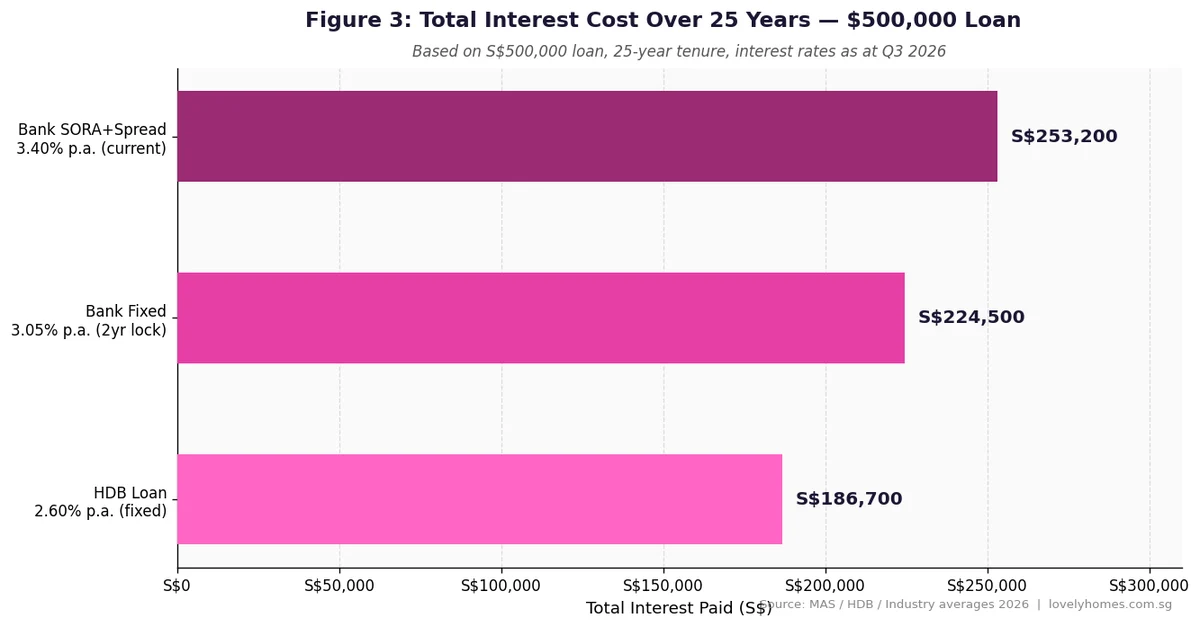
- Figure 3: Total interest paid on a S$500,000 loan over 25 years across three financing structures. The HDB loan is cheapest at today’s rates, but bank fixed packages offer short-term certainty for private property buyers. Source: MAS / industry averages Q3 2026.