Quick Answer: Singapore PR Property Buying , Key Facts
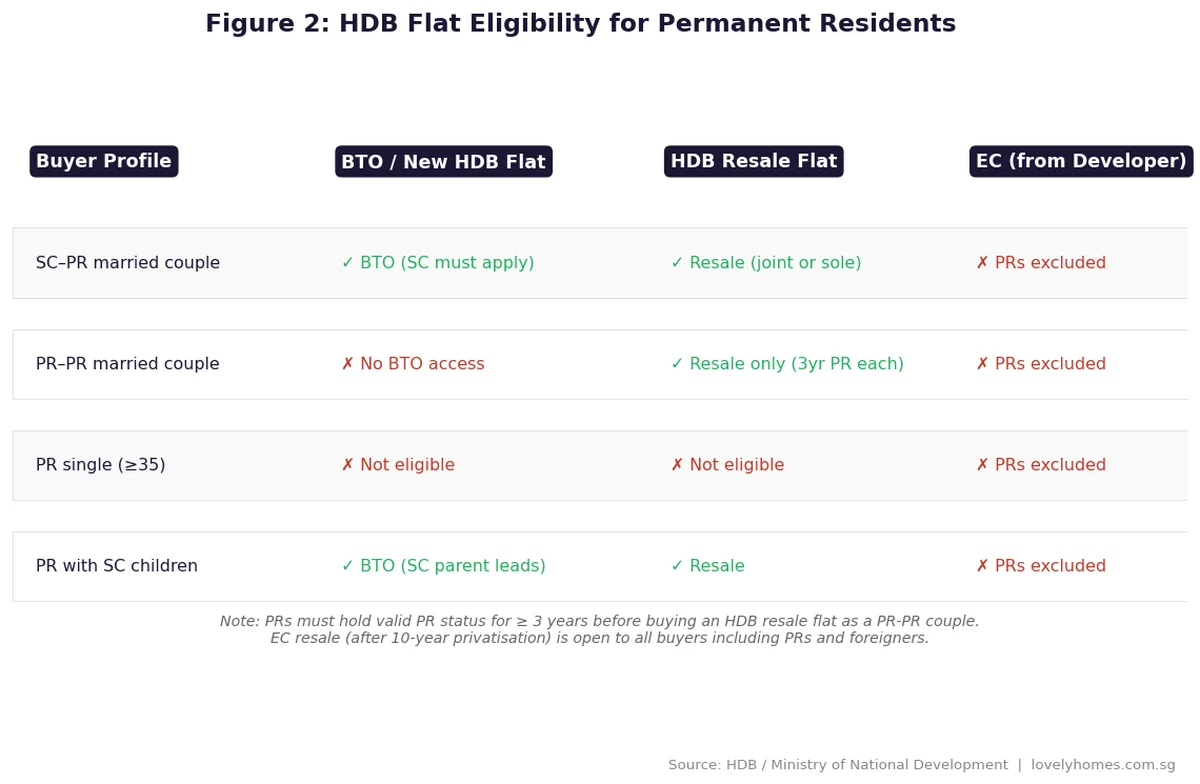
- PRs can buy HDB resale flats but not BTO flats on their own , a BTO application requires at least one Singapore Citizen.
- A SC–PR married couple qualifies for BTO flats and HDB resale flats immediately (no 3-year wait). A PR–PR couple must each hold PR status for at least 3 continuous years before buying HDB resale.
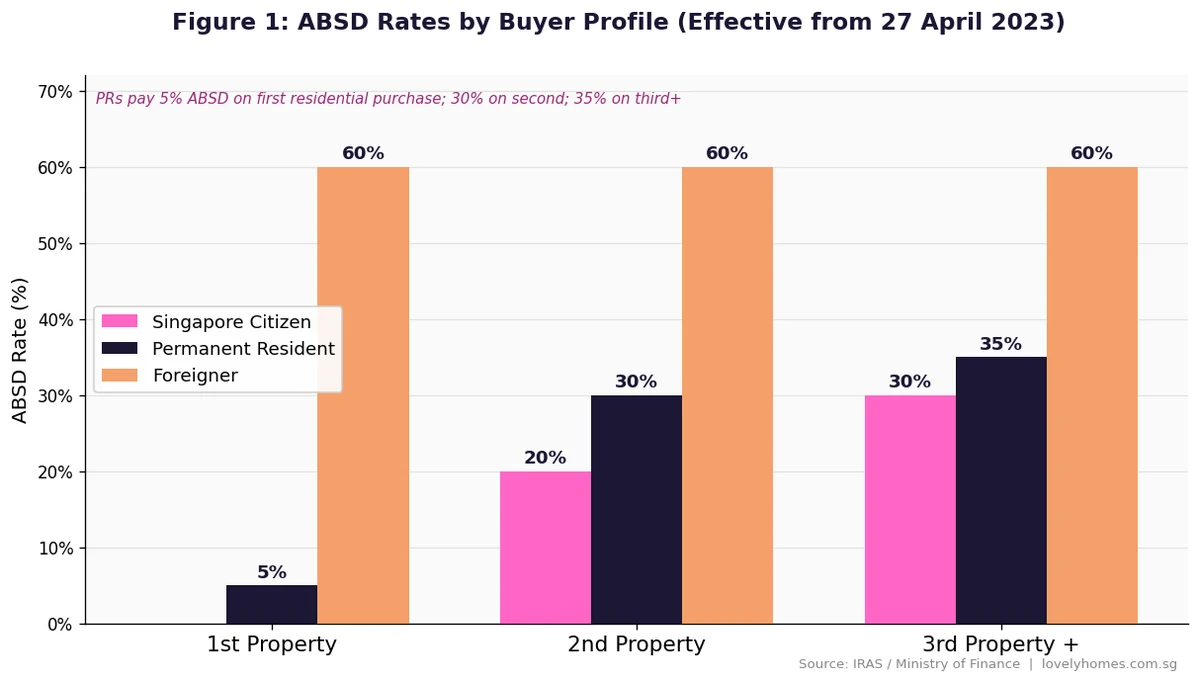
- PRs pay 5% ABSD on their first residential property; 30% on the second; and 35% on the third or subsequent.
- A SC–PR married couple buying their first jointly-owned residential property is remitted to SC rates , effectively 0% ABSD on the first home.
- PRs can buy all types of private property (condo, apartment, strata-landed) without a waiting period.
- Landed residential property requires Singapore Land Authority (SLA) approval for PRs; it is not automatically available.
- PRs use CPF Ordinary Account savings for housing on the same terms as SCs , subject to Valuation Limit and accrued interest rules.
- HDB concessionary loans are available to PR-inclusive households at 2.6% p.a., up to 80% LTV.
- There is no income ceiling for private property; the HDB resale income ceiling is S$14,000/month for families.
Becoming a Singapore Permanent Resident opens the door to most of the country’s property market , but not all of it. The Ministry of National Development (MND), the Housing & Development Board (HDB), the Singapore Land Authority (SLA), and the Inland Revenue Authority of Singapore (IRAS) each administer rules that determine what a PR can buy, what additional stamp duties apply, and how CPF may be used.
This guide covers every rule relevant to a PR buyer in 2026: HDB eligibility by household type, Additional Buyer’s Stamp Duty (ABSD) rates effective from 27 April 2023, HDB loan eligibility, the income ceiling, CPF housing rules, and private property access. All figures are current as at 20 August 2026.
Who Counts as a Permanent Resident for Property Purposes?
For property purchase purposes, a Singapore Permanent Resident is any person holding a valid Re-Entry Permit , in practice, anyone whose PR application has been formally approved by the Immigration & Checkpoints Authority (ICA). Foreign professionals on Employment Pass, S Pass, or Work Permit do not qualify as PRs for property purposes; they are treated as foreigners and subject to the 60% foreign ABSD rate.
The ABSD Order classifies buyers into three tiers , Singapore Citizen (SC), Permanent Resident (PR), and Foreigner (FR) , and each tier attracts different rates based on the number of residential properties already owned.
ABSD Rates for PRs in 2026
The Additional Buyer’s Stamp Duty (ABSD) was last revised on 27 April 2023 as part of a broader property market cooling package. The current rates applicable to PRs are:
| Buyer Profile | 1st Residential Property | 2nd Property | 3rd Property + |
|---|---|---|---|
| Singapore Citizen | 0% | 20% | 30% |
| Permanent Resident | 5% | 30% | 35% |
| Foreigner | 60% | 60% | 60% |
| SC + PR married couple (first jointly-owned property)* | 0% (remitted to SC rate) | , | , |
* Subject to ABSD remission conditions , see below.
An important nuance: for a joint purchase by a SC and a PR, ABSD is ordinarily calculated at the highest profile rate (i.e., 5%). However, a specific remission exists for SC–PR married couples buying their first jointly-owned residential property. Under the Stamp Duties (Residential Properties)(Remission)(No.2) Order, they are remitted to the SC first-property rate of 0% , making that first purchase ABSD-free. The couple must apply for this remission through IRAS, provide a valid marriage certificate, and confirm that neither party has previously held a residential property in Singapore.
No equivalent remission exists for a PR buying alone. A single PR acquires their first property at 5% ABSD.
HDB Flat Eligibility for PRs
SC–PR Married Couple
This is the most common PR household type engaging with the HDB market. Where one spouse is an SC and the other a PR, the couple may apply for BTO flats under the Family Scheme (the SC must be the main applicant). They may also buy HDB resale flats immediately upon marriage , the 3-year PR holding period does not apply when the household includes an SC. They are also eligible to apply for new Executive Condominiums (ECs) from developers.
PR–PR Couple or Family
Where all buyers in the household are PRs, access is more restricted:
- BTO flats , not eligible. At least one SC must be in the household.
- HDB resale flats , eligible, but only after each PR in the household has held continuous PR status for at least 3 years from the date of their Re-Entry Permit.
- New EC from developer , not eligible. EC first-hand purchases require an SC or an SC–PR household.
- EC resale (after 10-year privatisation) , open to all buyers including PR–PR households and foreigners.
Single PRs
A single PR , regardless of age , is not eligible to buy any HDB flat, whether BTO or resale, as the sole applicant. There is no PR equivalent of the Single Singapore Citizen Scheme. Single PRs who wish to own residential property must buy private residential property.
HDB Loan Eligibility for PRs
PRs are eligible for the HDB concessionary loan at 2.6% per annum (currently; reviewed quarterly at 0.1 percentage point above the CPF OA interest rate), provided:
- At least one buyer is a Singapore Citizen or the household meets the PR–PR family nucleus requirements.
- Gross monthly household income does not exceed S$14,000 (or S$21,000 for extended families).
- No more than one previous HDB loan has been obtained.
- The household does not own or recently disposed of private residential property.
The HDB loan covers up to 80% of the purchase price or market value, whichever is lower. The remaining 20% is the downpayment: a minimum of 5% must be in cash; the balance (15%) can be CPF Ordinary Account savings.
Bank loans follow the same loan-to-value (LTV) limits for PRs as for SCs: 75% LTV for a first loan, 45% for a second, and 35% for a third or subsequent loan. The minimum cash portion is 5% for a first bank loan (the remaining 20% can be CPF or cash).
Private Property for PRs
PRs can purchase any type of private residential property , condominiums, private apartments, strata-landed units , from the first day they obtain PR status. There is no waiting period, and no HDB-equivalent income ceiling applies. ABSD at the PR rate (5% first, 30% second) will apply.
Landed residential property (detached, semi-detached, terraced houses) is restricted under the Residential Property Act 1976. PRs and foreigners generally require SLA approval to purchase landed property; approval is discretionary and typically granted only to PRs who have made exceptional economic contributions to Singapore. PRs should not assume landed property is freely available to them.
Commercial property (office, retail, industrial) is not covered by ABSD and is generally open to all buyers including PRs and foreigners, though different stamp duty regimes apply.
CPF for Property , PR Rules
PRs who are CPF members (all PRs employed in Singapore contribute to CPF under the CPF Act) can use their Ordinary Account (OA) savings to purchase residential property on the same terms as SCs. This includes paying option fees, BSD, ABSD, legal fees, the downpayment, and monthly mortgage instalments.
The key rules are:
- Valuation Limit (VL): Total CPF usage is capped at the lower of the purchase price or the property’s market valuation at the time of purchase.
- Withdrawal Limit (WL): CPF can be used up to the VL plus accrued interest (i.e., the amount that would have accumulated in OA at 2.5% p.a. had the funds not been withdrawn).
- On sale: The full CPF principal withdrawn, plus accrued OA interest, must be refunded to the CPF OA before any cash profit is taken.
- Lease rules: For HDB resale flats, CPF usage is prorated if the remaining lease does not cover the youngest buyer to age 95. If the remaining lease is below 20 years, no CPF may be used.
Cost Comparison: SC vs PR Buying an S$850,000 HDB Resale
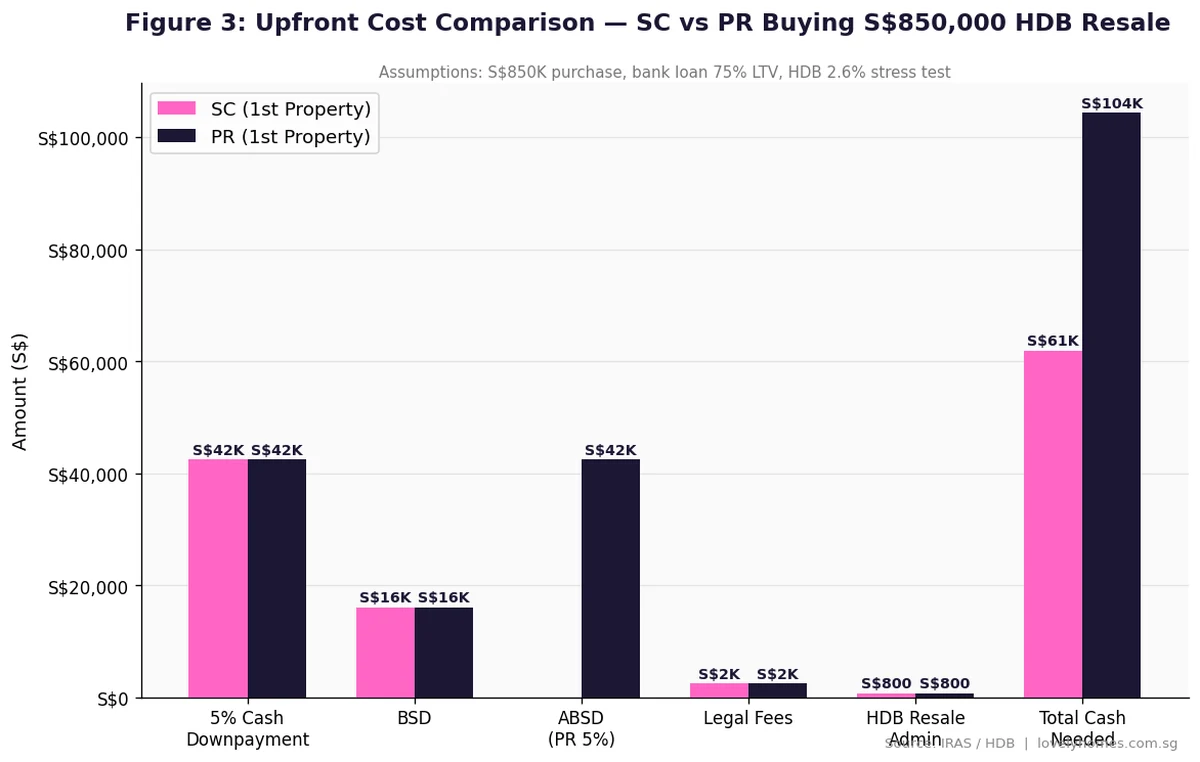
| Cost Item | SC (Sole, 1st Property) | PR–PR Couple (1st Property) | SC–PR Couple (1st Joint Property)* |
|---|---|---|---|
| Purchase Price | S$850,000 | S$850,000 | S$850,000 |
| Buyer’s Stamp Duty (BSD) | S$16,100 | S$16,100 | S$16,100 |
| Additional Buyer’s Stamp Duty (ABSD) | S$0 (0%) | S$42,500 (5%) | S$0 (remitted) |
| HDB Loan (80% LTV) | S$680,000 | S$680,000 | S$680,000 |
| Cash Downpayment (5% min) | S$42,500 | S$42,500 | S$42,500 |
| CPF Downpayment (15%) | S$127,500 | S$127,500 | S$127,500 |
| Legal Fees (est.) | S$2,500 | S$2,500 | S$2,500 |
| HDB Admin Fee | S$800 | S$800 | S$800 |
| Total Cash Needed Upfront | S$61,900 | S$104,400 | S$61,900 |
* SC–PR married couple, first jointly-owned residential property. ABSD remission subject to IRAS approval and eligibility conditions.
Worked Example: The Patel Household
Mr Arnav Patel holds Singapore PR status (granted 4 years ago). His wife, Mrs Priya Patel, is a Singapore Citizen. They earn a combined gross monthly income of S$12,500. They wish to buy a 4-room HDB resale flat in Tampines for S$850,000. Neither has previously owned any residential property in Singapore.
HDB eligibility check: SC–PR married couple, first purchase , eligible for HDB resale immediately. Income S$12,500 < S$14,000 ceiling , PASS. No prior HDB or private property , no Resale Levy applicable. Mr Patel’s 4-year PR holding period exceeds 3 years , PASS (though the 3-year rule only applies to PR–PR couples; it does not apply to SC–PR couples).
HDB loan assessment: Eligible. Loan amount: 80% × S$850,000 = S$680,000. Monthly instalment at 2.6% p.a. over 25 years: S$3,091. MSR: S$3,091 ÷ S$12,500 = 24.7% , within the 30% MSR cap. TDSR: S$3,091 ÷ S$12,500 = 24.7% , well within the 55% TDSR limit.
ABSD: SC–PR couple, first jointly-owned residential property , ABSD remitted to SC first-property rate = S$0. Mrs Patel will submit the ABSD remission form to IRAS within 6 months of signing the Option to Purchase.
BSD: 1% × S$180,000 + 2% × S$180,000 + 3% × S$490,000 = S$1,800 + S$3,600 + S$14,700 = S$16,100.
Total upfront cash: S$42,500 (5% cash downpayment) + S$16,100 (BSD) + S$2,500 (legal) + S$800 (HDB admin) = S$61,900 cash, plus S$127,500 from CPF OA.
What This Means for PRs Considering Property
The ABSD framework positions PRs as a distinct tier , more favoured than foreigners (60%) but less favoured than SCs (0% first property). For PRs buying property alone, the 5% ABSD on a first purchase is a real additional cost: on a S$1,200,000 condo unit, that is S$60,000 above and beyond BSD and other transaction costs.
The SC–PR married couple remission, however, is a significant policy feature that effectively levels the field for couples on their first jointly-owned home. PRs with SC spouses should ensure they claim this remission through IRAS; it is not automatically applied.
The 3-year waiting period for PR–PR couples to buy HDB resale flats is another meaningful constraint. Newly-minted PRs who are not yet in a relationship , or whose partner is also a PR , will find themselves limited to private property during that initial period.
What Might Come Next
The current ABSD framework has been in place since April 2023. There has been no official signal from MND or MAS of any near-term revision as at August 2026. The property market is broadly stable, and the government has consistently stated that cooling measures will remain in place as long as market conditions warrant.
One area to watch is the PR–PR HDB eligibility rules. As Singapore’s PR population ages and more PR households form, there may be policy review of the 3-year waiting rule , though any liberalisation would likely be modest and conditioned on citizen supply and demand dynamics.
Frequently Asked Questions
Can a PR buy an HDB BTO flat without an SC spouse?
No. BTO flat applications require at least one SC in the household. A PR family nucleus without any SC member cannot apply for BTO flats under any scheme. The only exception is where a SC-PR couple applies under the Family Scheme, with the SC as the main applicant. A PR who has subsequently obtained SC status may then apply as an SC.
Does the 3-year PR waiting period apply to SC–PR couples buying HDB resale?
No. The 3-year continuous PR holding requirement applies only to households where all members are PRs (i.e., PR–PR couples or PR families). Where the household includes at least one SC, the 3-year waiting period does not apply, and the SC–PR couple may purchase an HDB resale flat immediately after marriage registration.
How does ABSD work if a PR already owns a property and buys a second?
A PR buying their second residential property pays 30% ABSD on the full purchase price. On a S$1,500,000 condo, that amounts to S$450,000 in ABSD alone. Unlike SCs, PRs do not receive any ABSD upgrader remission , there is no mechanism to reclaim ABSD paid on the second property after selling the first. PRs considering a second property purchase should factor in this substantial cost.
Can a PR buy landed property in Singapore?
Generally, no , not without SLA approval. Landed residential property (detached houses, semi-detached, terraced houses, and bungalows) is restricted under the Residential Property Act 1976. PRs and foreign nationals must apply to the SLA’s Land Dealings (Approval) Unit for approval. Approval is discretionary and is typically granted to PRs who have made exceptional economic or professional contributions to Singapore. The vast majority of PR applicants for landed property are not approved. Strata-landed units (such as cluster homes within a strata development) are treated like condominiums and are freely available to PRs.
What happens to ABSD if a PR later becomes a Singapore Citizen?
Taking up SC citizenship does not automatically trigger a refund of ABSD previously paid as a PR. However, it resets the buyer’s profile for future purchases. If a PR who owns one property takes up SC, any subsequent purchase will be assessed at SC second-property rates (20%) rather than PR second-property rates (30%). From a tax planning perspective, this can represent a material saving , S$150,000 on a S$1.5M purchase , making the citizenship timing decision financially relevant for property investors.
Can a PR’s CPF be used to pay ABSD?
No. CPF Ordinary Account funds may not be used to pay stamp duties, including ABSD. BSD and ABSD must both be paid in cash. CPF can be used for the downpayment, monthly mortgage payments, legal fees, and certain other qualifying costs , but stamp duties are explicitly excluded from CPF usage under the CPF Housing Schemes.
Related Articles
- ABSD Singapore 2026: Complete Guide to Additional Buyer’s Stamp Duty
- Buying a Condo in Singapore 2026: Complete Guide to Costs, Eligibility and Process
- Using CPF to Buy Private Property in Singapore 2026
- Singapore Property Downpayment Guide 2026: How Much Cash and CPF You Need
- Singapore Stamp Duty Remission Guide 2026: ABSD Upgrader Refunds and Exemptions
- Singapore TDSR & MSR Borrowing Limits Guide 2026
Supporting graphics
Original article illustrations are available below.
- Figure 1: ABSD rates effective 27 April 2023. A PR pays 5% on the first property, 30% on the second, and 35% on the third or subsequent. Source: IRAS / Ministry of Finance.
- Figure 2: HDB eligibility by household composition. PRs without an SC family member cannot access BTO flats or new ECs. Source: HDB / Ministry of National Development.
- Figure 3: Upfront costs for a S$850,000 HDB resale purchase. A PR buying alone pays S$42,500 more in ABSD than an SC. A SC–PR couple buying jointly as their first property pays 0% ABSD (remitted). Source: IRAS / HDB.