Quick Answer: Singapore Private Property Buying in 2026
- Singapore Citizens may buy any private residential property, including restricted landed housing with SLA approval.
- Singapore Permanent Residents may buy non-landed private property freely; landed property requires SLA approval.
- Foreigners may purchase non-landed private condominiums without restriction but face 60% ABSD on any residential purchase.
- The standard bank loan LTV for a first residential property is 75%; you need at least 5% cash and 20% cash or CPF as downpayment.
- Total Debt Servicing Ratio (TDSR) caps all monthly debt obligations at 55% of gross monthly income.
- Buyer’s Stamp Duty (BSD) applies to all purchases; ABSD applies based on buyer profile and property count.
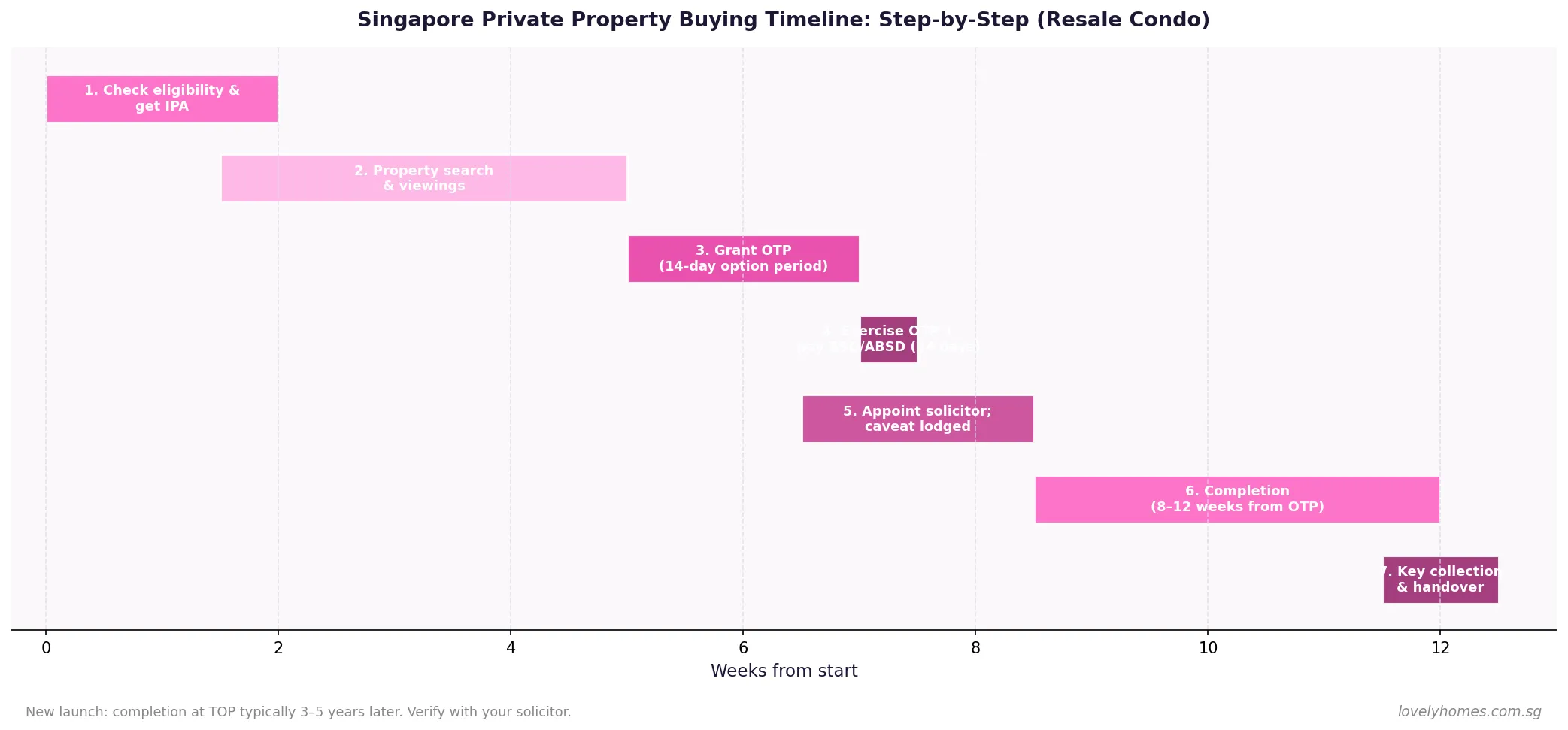
- The OTP (Option to Purchase) gives buyers a 14-day window to exercise; completion for resale typically takes 8 to 12 weeks from OTP.
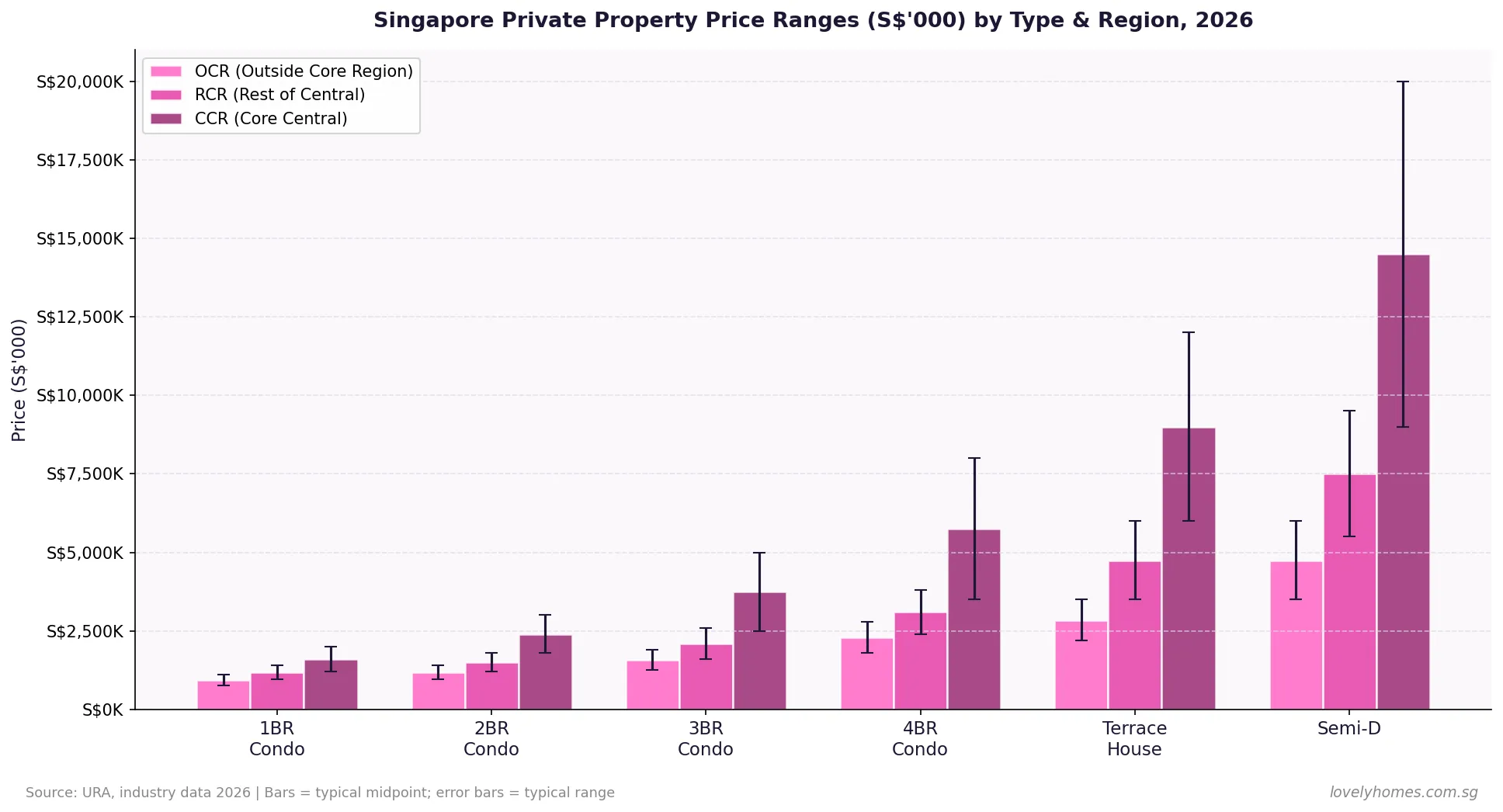
- Private property prices in 2026 range from approximately S$750,000 for an OCR 1-bedroom to over S$20 million for a CCR semi-detached house.
I. Who Can Buy Private Property in Singapore?
Singapore private property buying eligibility is set by the Residential Property Act (Cap. 274) and administered by the Singapore Land Authority (SLA). Understanding your eligibility category is the first step in any Singapore private property buying guide for 2026, because it determines which property types you may purchase, what ABSD rate applies, and whether any approvals are required before you can complete the transaction.
Singapore Citizens (SC) face the fewest restrictions. They may purchase non-landed private residential property (condominiums, apartments, strata units) freely, and may purchase landed residential property (terrace houses, semi-detached houses, detached bungalows, Good Class Bungalows) subject to obtaining SLA approval under the Residential Property Act. In practice, SLA approval for landed property purchases by Singaporeans is granted routinely unless the applicant has a poor financial or criminal history.
Singapore Permanent Residents (SPR) may freely purchase non-landed private property. For landed residential property, SPRs must obtain SLA approval, and approval is granted on a more discretionary basis than for SCs, with SLA weighing factors such as length of residency, economic contribution, and family ties in Singapore. As of 2026, SPRs who own HDB flats must dispose of their HDB flat within 6 months of acquiring private residential property (or vice versa), unless the HDB MOP has not been satisfied.
Foreigners may purchase non-landed private residential property (condominiums and apartments in buildings of more than six dwelling units) without restriction or SLA approval. Foreigners are, however, subject to the 60% Additional Buyer’s Stamp Duty (ABSD) on all residential property purchases, making Singapore’s private market amongst the most expensive for foreign buyers globally. Foreigners may not purchase HDB flats, landed residential property (except on Sentosa Cove, with SLA approval), or Executive Condominiums during the initial 10-year restriction period.
II. Types of Private Residential Property
The Singapore private residential market encompasses several distinct property categories, each with its own characteristics, price range, and ownership rules. Condominiums and apartment developments form the bulk of private housing stock. New launch condominiums are sold by developers under a progressive payment scheme, with buyers paying in instalments tied to construction milestones. Resale condominiums are transacted on the secondary market between private parties. Both categories are accessible to SCs, SPRs, and foreigners (non-landed).
Landed residential property includes terraced houses, semi-detached houses, and detached bungalows. These are primarily accessible to SCs (with SLA approval if required), and represent a significant price premium over condominium units of equivalent size. Good Class Bungalows (GCBs), which are large detached houses in gazetted GCB Areas, are restricted to Singaporeans only and require SLA approval for transfer even between Singaporeans. In 2026, GCBs trade at S$15 million and above for the entry tier.
Strata landed houses, which are landed properties within a larger condominium development (sharing common facilities), are governed by a different set of rules. They may be purchased by foreigners as part of an approved condominium project, distinguishing them from freestanding landed property. Cluster housing developments are another variant , freehold or leasehold strata landed homes in gated communities , that are accessible to foreigners depending on the project’s approved status under the Residential Property Act.
III. The Buying Process: Step by Step
Buying private property in Singapore follows a structured legal process administered primarily through the Law Society of Singapore’s standard conveyancing documentation. The first step is establishing your eligibility and financial capacity. This means running a check on your ABSD liability (based on your nationality and existing property holdings), engaging a bank to assess your loan eligibility and obtain an In-Principle Approval (IPA), and confirming whether any SLA approval is required for the property type you intend to purchase.
Once you identify a suitable property and agree on a price with the seller (or developer, for new launches), the seller issues an Option to Purchase (OTP). For resale private property, the OTP is typically valid for 14 days from the date of grant. You pay the seller an option fee of approximately 1% of the purchase price to receive the OTP. During the 14-day option period you commission a property lawyer, conduct due diligence (title search, caveat search, inspection of maintenance accounts for strata properties), arrange final loan documentation, and decide whether to exercise.
If you exercise the OTP, you pay the exercise fee (typically 4% of the purchase price), bringing total upfront payments to 5% of the price. Your lawyer lodges a caveat against the property title, protecting your interest. The Buyer’s Stamp Duty and Additional Buyer’s Stamp Duty (if applicable) must be paid within 14 days of exercising the OTP or 30 days of the date of the OTP (whichever is earlier) to avoid IRAS penalties. Completion (the transfer of legal title and balance purchase price) typically takes 8 to 12 weeks from OTP exercise for resale transactions.
IV. Financing: LTV, TDSR and CPF
Private property financing in Singapore is governed by the Monetary Authority of Singapore (MAS) through the Loan-to-Value (LTV) framework and the Total Debt Servicing Ratio (TDSR) rule. For a first residential property purchased with a bank loan, the maximum LTV is 75%. This means you must fund at least 25% of the purchase price from your own resources, of which a minimum of 5% must be in cash (the remainder may come from CPF Ordinary Account savings).
For buyers who already own one residential property, the LTV drops to 45% (minimum 25% cash), and for buyers with two or more existing properties, the LTV falls further to 35% (minimum 25% cash). These tiered LTV limits were introduced as part of Singapore’s property cooling measures to prevent over-leveraging and speculative purchasing. They apply whether the existing property is HDB, private residential, or a commercial-residential strata unit.
The Total Debt Servicing Ratio (TDSR) caps your total monthly debt obligations , including the proposed property loan, all personal loans, credit card outstanding, car loans, student loans, and any other credit facilities , at 55% of your verified gross monthly income. Banks stress-test the loan at a minimum of 4% per annum (the MAS-mandated medium-term interest rate) regardless of the actual rate offered. CPF Ordinary Account savings may be used to fund the downpayment and monthly instalments for private property purchases, subject to the Valuation Limit (the lower of purchase price or valuation) and Withdrawal Limit (Valuation Limit plus accrued interest at 2.5% per annum).
V. Stamp Duties: BSD and ABSD
Two stamp duties apply to private property purchases: Buyer’s Stamp Duty (BSD) and Additional Buyer’s Stamp Duty (ABSD). BSD is payable by all buyers regardless of nationality or property count. It is calculated on a progressive basis: 1% on the first S$180,000, 2% on the next S$180,000, 3% on the next S$640,000, 4% on the next S$500,000, 5% on the next S$1,500,000, and 6% on the remainder above S$3,000,000 (the 5% and 6% bands were introduced in February 2023). BSD must be paid within 14 days of executing the agreement or 30 days of the document date.
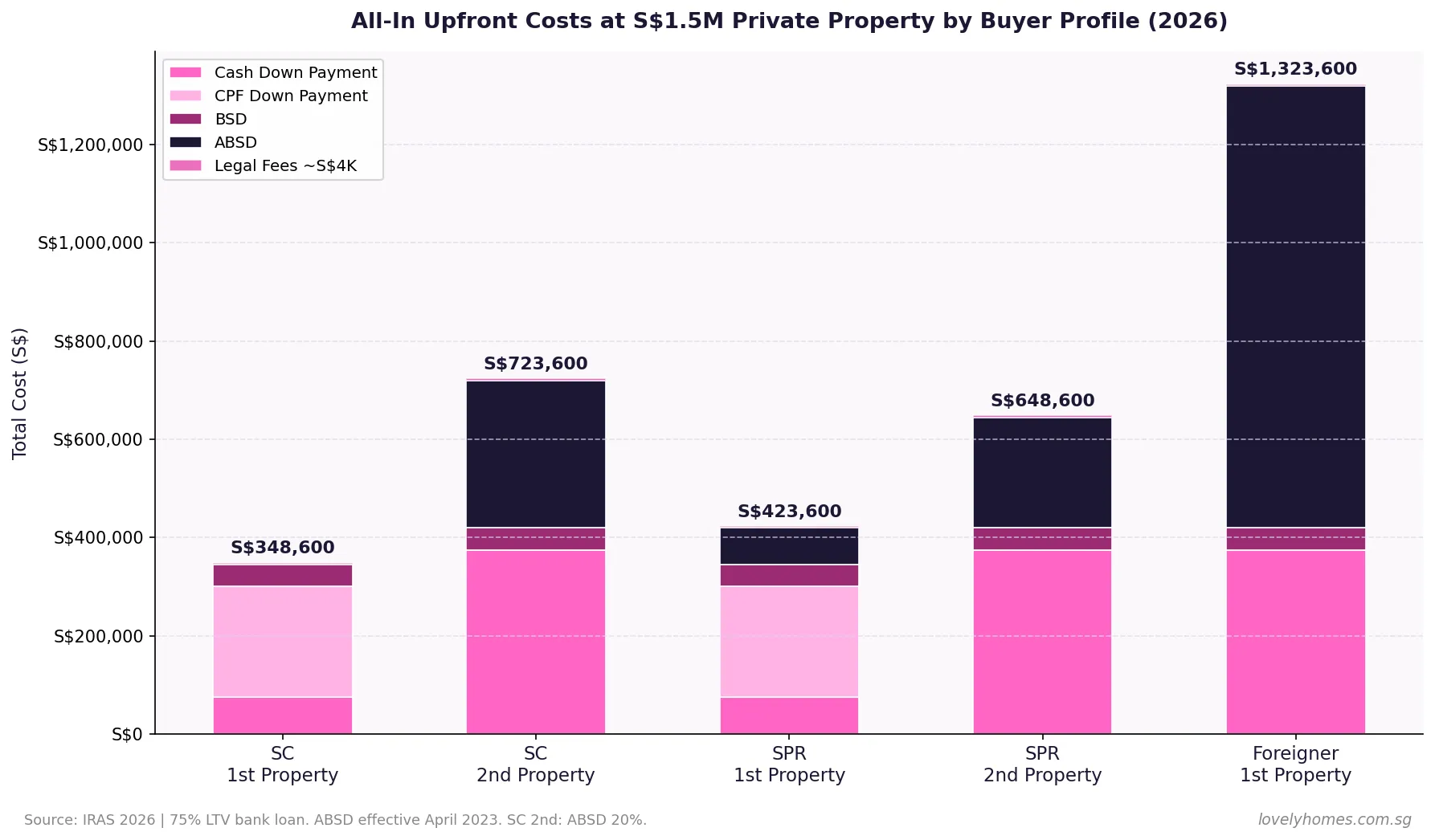
ABSD is the more significant cost for most buyers. Singapore Citizens buying their first residential property pay 0% ABSD. SC buyers of a second property pay 20% ABSD; third and subsequent properties attract 30% ABSD. SPRs pay 5% on a first purchase, 30% on a second, and 35% on third and subsequent. Foreigners pay a flat 60% ABSD regardless of property count. Married SC/SPR couples may be remitted the ABSD on a jointly-purchased first property if the SC spouse is a co-owner , this is the SC/SPR couple ABSD remission scheme administered by IRAS.
| Buyer Profile | 1st Property ABSD | 2nd Property ABSD | 3rd+ Property ABSD | BSD Applicable? |
|---|---|---|---|---|
| Singapore Citizen | 0% | 20% | 30% | Yes (all) |
| Singapore PR | 5% | 30% | 35% | Yes (all) |
| Foreigner | 60% | 60% | 60% | Yes (all) |
| SC/SPR married couple (1st joint property) | 0% (remission available) | 20% (SC basis) | 30% (SC basis) | Yes (all) |
| Housing Developer (residential) | 35% (refundable if sold within 5yr) | N/A | N/A | Yes (all) |
VI. New Launch vs Resale: Key Differences
The choice between a new launch condominium and a resale unit is one of the most consequential decisions in any private property purchase. New launch condominiums are sold by developers under a progressive payment scheme (PPS) where buyers pay in tranches tied to construction stages: foundation, structural frame, concrete walls, roofing, and so on through to TOP (Temporary Occupation Permit). This spreads the financial outlay over three to five years, reducing immediate cash pressure, but buyers must service the loan or pay interest during the construction period if the loan has been drawn.
Resale condominiums offer immediate occupancy, which is valuable for buyers who need to move in quickly, are selling their existing home simultaneously, or want to avoid the uncertainty of TOP delays. Resale prices are negotiable and subject to market conditions. The buyer has the advantage of inspecting the actual unit (not a showflat), reviewing the MCST’s maintenance fund status, and understanding the property’s actual condition. However, resale units may require renovation costs, and older developments may have shorter remaining leases for 99-year leasehold properties.
VII. Worked Example: Mr & Mrs Goh Buy a Resale Condo
Case Study: SC Couple, First Private Property, OCR 3-Bedroom Resale
Buyers: Mr Goh SC (38) and Mrs Goh SC (36), combined gross monthly income S$16,000. This is their first private property purchase; they currently rent and have no prior HDB ownership.
Property: 3-bedroom resale condominium, OCR (Sengkang), 1,100 sq ft, 99-year leasehold with 72 years remaining. Agreed price: S$1,480,000.
Stamp duties:
- BSD: 1%×S$180K + 2%×S$180K + 3%×S$640K + 4%×S$480K = S$1,800 + S$3,600 + S$19,200 + S$19,200 = S$43,800
- ABSD: 0% (SC, first property). S$0
Financing:
- LTV 75% → Loan: S$1,110,000. Bank SORA-linked rate 3.40% p.a. (3M-SORA 2.55% + spread 0.85%)
- Stress test at 4.0%: monthly instalment = S$1,110,000 × 0.004764 ≈ S$5,288/mth (30-year tenure)
- TDSR: S$5,288 ÷ S$16,000 = 33.1% , well within 55% cap. PASS
Downpayment:
- 25% of S$1,480,000 = S$370,000
- Minimum 5% cash = S$74,000. Remainder S$296,000 from CPF OA or cash.
- Mr & Mrs Goh have CPF OA combined S$240,000. Cash supplement: S$56,000.
All-in upfront costs:
- Cash downpayment (5%): S$74,000
- CPF downpayment (20% less CPF OA shortfall): S$240,000 CPF + S$56,000 cash = S$296,000
- BSD: S$43,800
- Legal fees: S$4,200
- Option fee (1%): S$14,800 (credited against downpayment)
- Total cash outlay: approximately S$134,000 (after CPF and option-fee credit)
CPF note: The Valuation Limit = S$1,480,000 (purchase price equals market value). CPF accrued interest accrues at 2.5% p.a. on the OA savings withdrawn; this must be refunded to CPF on sale.
VIII. Why This Matters: Singapore Private Property in 2026
Private property remains a cornerstone of wealth-building in Singapore, but the 2026 market requires careful navigation. URA data for Q2 2026 shows private residential prices rose 0.5% quarter on quarter , a moderate pace following the sharp correction of 2024 when prices fell 2.7% for the full year after the April 2023 ABSD hike. The CCR (Core Central Region) continues to underperform the OCR on a price-index basis, partly due to reduced foreign demand after the 60% foreigner ABSD took effect in April 2023.
For SC buyers purchasing a first private property, 2026 remains attractive: no ABSD, access to CPF, and SORA-linked bank rates that are moderating from their 2024 peak. The risk is primarily on the financing side: a household that stretches its TDSR to 50% to afford a CCR condo has little buffer if income falls or rates rise. Industry data shows median new launch prices OCR at approximately S$2,200 per square foot in mid-2026, while resale OCR units trade at S$1,500 to S$1,900 per square foot , creating a meaningful price gap that favours resale for value-conscious buyers.
IX. Frequently Asked Questions
Can a foreigner buy a condominium in Singapore?
Do I need an agent to buy private property in Singapore?
What is the difference between freehold and 99-year leasehold private property?
Can I use CPF to buy private property?
What is an en bloc sale and how does it affect my investment?
What happens if I cannot complete the purchase after exercising the OTP?
Is Singapore private property a good investment in 2026?
Related Articles on LovelyHomes
- ABSD Singapore 2026: Complete Guide to Additional Buyer’s Stamp Duty
- Buying a Condo in Singapore 2026: Costs, Eligibility and Process
- Using CPF to Buy Private Property 2026: Valuation Limit and Accrued Interest
- TDSR and MSR Borrowing Limits Guide 2026: How Much Can You Borrow?
- Leasehold vs Freehold Singapore 2026: Price Premiums and What to Buy
- Singapore Stamp Duty Remission 2026: ABSD Upgrader Refunds Explained
- Singapore Property Seller’s Complete Guide 2026: OTP, Timeline and Proceeds
Supporting graphics
Original article illustrations are available below.
- Figure 1: Singapore private property typical price ranges (S$’000) by property type and market region, 2026. Error bars show the typical transaction range. OCR = Outside Core Region; RCR = Rest of Central Region; CCR = Core Central Region. Source: URA, industry data 2026.
- Figure 2: Singapore private property buying timeline for a resale condominium. The full process from eligibility check to key handover typically takes 10 to 14 weeks. New launch timelines extend 3 to 5 years to TOP. Source: LovelyHomes analysis.
- Figure 3: All-in upfront costs at a S$1.5 million private property purchase, by buyer profile. The ABSD component dominates for second-property buyers and foreigners. A Singapore Citizen buying a first property faces no ABSD. Source: IRAS 2026.