Quick Answer: Can Foreigners Buy Property in Singapore?
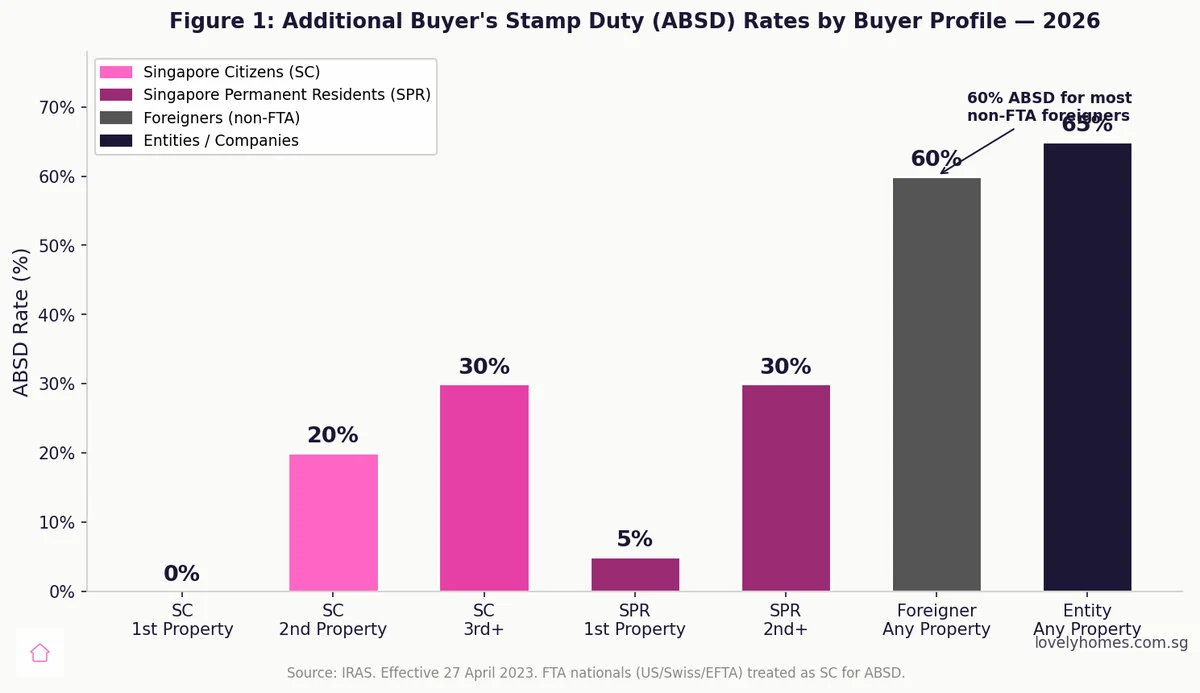
- Foreigners (non-FTA nationals) pay 60% Additional Buyer’s Stamp Duty (ABSD) on any residential property purchase in Singapore, on top of the standard Buyer’s Stamp Duty (BSD).
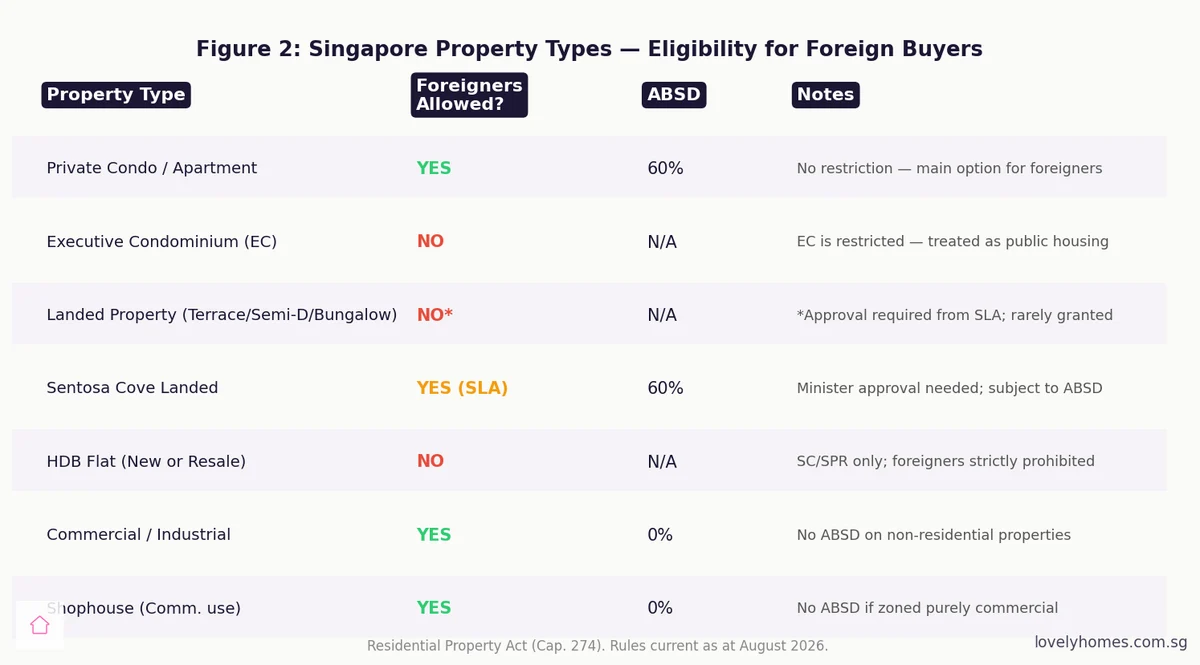
- Foreigners may freely purchase private condominium apartments. Landed property, HDB flats, and Executive Condominiums (ECs) are either restricted or entirely prohibited.
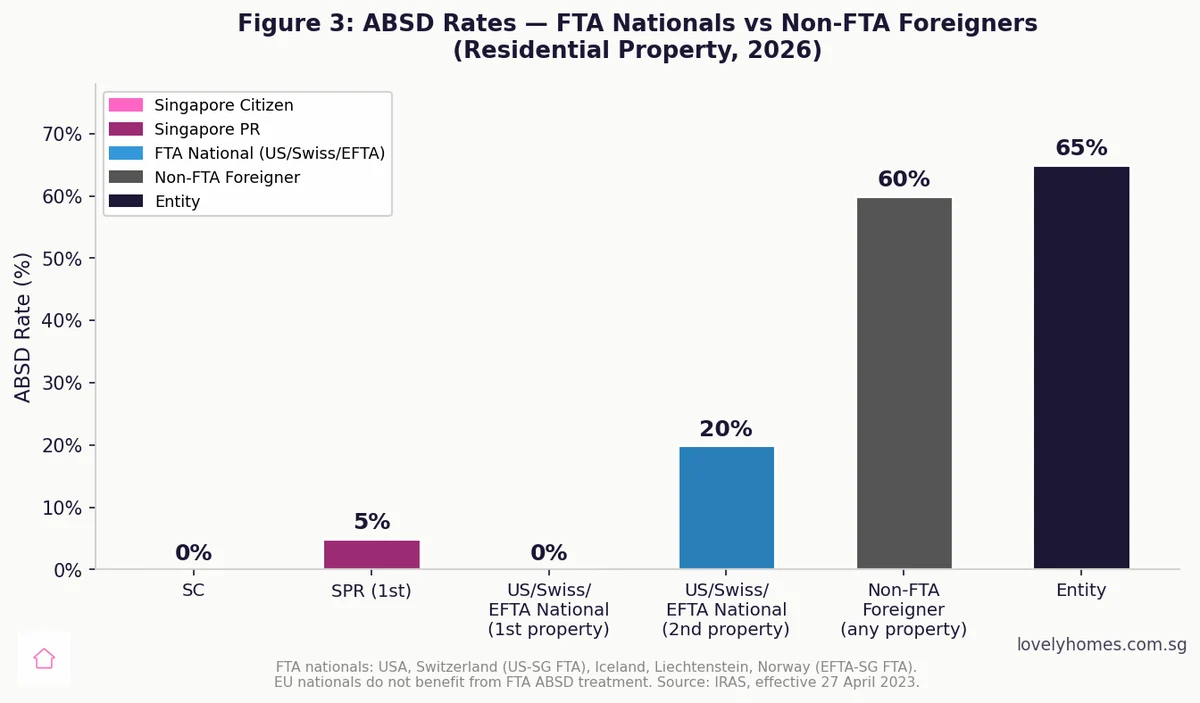
- FTA nationals , citizens of the USA, Switzerland, Iceland, Liechtenstein, and Norway , are treated as Singapore Citizens for ABSD purposes, paying 0% on a first residential property.
- Foreigners cannot use CPF to pay for property purchases; all funds must come from personal savings or bank financing.
- Bank loans are available to foreigners at standard LTV ratios (75% for first property, no outstanding loans), subject to TDSR of 55%.
- Sentosa Cove landed property is the only landed category where foreigners may apply , with approval from the Singapore Land Authority (SLA) and subject to 60% ABSD.
- Foreigners must pay BSD on the purchase price or market value (whichever is higher), assessed by IRAS, within 14 days of signing the Option to Purchase (OTP).
Singapore Property for Foreigners: An Overview
Singapore consistently ranks among the world’s most attractive property markets for foreign investors and residents. Its stable rule of law, transparent land title system (administered by the Singapore Land Authority under the Land Titles Act, Cap. 157), AAA sovereign credit rating, and deep liquidity make it a preferred destination for high-net-worth individuals seeking residential or investment property in Asia.
Yet Singapore deliberately restricts and taxes foreign residential property ownership. The policy rationale is twofold: to keep housing affordable for Singaporeans, and to moderate speculative demand that can overheat prices. The primary instrument is the Additional Buyer’s Stamp Duty (ABSD), introduced in 2011 and progressively tightened. The most recent major adjustment, effective 27 April 2023, set the ABSD rate for non-FTA foreigners buying any residential property at 60% , among the highest residential transaction taxes in the world.
This guide explains who can buy what, at what cost, and how the process works , including the Free Trade Agreement exceptions that benefit nationals from certain countries.
Which Properties Can Foreigners Buy in Singapore?
The Residential Property Act (Cap. 274) is the primary statute governing foreign ownership of Singapore residential property. It classifies property into “restricted” and “non-restricted” categories and sets out which buyers require approval from the SLA’s Controller of Residential Property.
Private Condominiums and Apartments , Open to Foreigners
Private strata-titled condominiums and apartments within a development approved by URA are the main vehicle for foreign property ownership in Singapore. There is no restriction on the number of units a foreigner may own, and no requirement to seek prior SLA approval. The 60% ABSD applies regardless of whether it is a first or subsequent purchase, except for FTA nationals on their first property.
HDB Flats , Strictly Prohibited
Foreigners (including Permanent Residents from outside Singapore) may not buy new HDB Build-To-Order (BTO) flats under any circumstances. Singapore Permanent Residents (SPRs) may buy HDB resale flats after meeting the eligibility criteria set by HDB, but non-PR foreigners are entirely barred.
Executive Condominiums , Restricted
ECs are a hybrid housing type , partially subsidised by the government during construction , and are classified as public housing during the Minimum Occupation Period. Foreigners cannot purchase ECs new from the developer or on the resale market within the MOP period. Only after full privatisation (10 years from TOP date) do ECs become eligible for purchase by foreigners in the secondary market.
Landed Property , Approval Required
Landed residential property (terrace houses, semi-detached houses, bungalows, Good Class Bungalows) is classified as “restricted residential property” under the Residential Property Act. Foreigners wishing to buy landed property outside Sentosa Cove must obtain prior approval from the SLA’s Controller of Residential Property, and approval is rarely granted except to those who have made exceptional economic contributions to Singapore. In practice, non-PR foreigners essentially cannot buy landed property on the mainland.
Sentosa Cove , The Exception
Sentosa Cove is a designated area where foreigners may buy landed residential property, subject to approval from the Minister for Law (SLA acts on his behalf). Approval is discretionary. Purchases at Sentosa Cove are subject to the full 60% ABSD for non-FTA foreigners, which at the prices typical of Sentosa Cove properties (often S$5M–S$20M+) represents an extremely significant additional cost.
The ABSD: How Much Extra Do You Pay?
ABSD is levied on the higher of the purchase price or market value of the property, as assessed by IRAS. It must be paid within 14 days of the date of the contract or agreement. For a foreigner buying a S$2,000,000 condo in Singapore:
| Charge | Rate | On S$2,000,000 |
|---|---|---|
| Buyer’s Stamp Duty (BSD) | Progressive 1%–6% | S$69,600 |
| ABSD (non-FTA foreigner) | 60% | S$1,200,000 |
| Total Stamp Duty | S$1,269,600 | |
| Effective additional cost | 63.5% of purchase price |
This is why most foreign buyers carefully evaluate the long-term case before committing , the entry cost is substantial, and the property must appreciate significantly over the holding period to generate a positive return after accounting for stamp duties, financing costs, maintenance fees, property tax, and eventual divestment costs.
Free Trade Agreement (FTA) Exceptions
Singapore has bilateral Free Trade Agreements with several countries that grant their nationals the same ABSD treatment as Singapore Citizens for residential property. This is a significant concession. The FTA-covered nationalities are:
- United States of America , under the US-Singapore Free Trade Agreement (USSFTA), in force since 1 January 2004
- Switzerland , under the EFTA-Singapore FTA
- Iceland , under the EFTA-Singapore FTA
- Liechtenstein , under the EFTA-Singapore FTA
- Norway , under the EFTA-Singapore FTA
Critically, EU nationals do not benefit from this treatment; there is no EU-Singapore FTA provision covering ABSD. Nationals of China, India, the United Kingdom, Australia, Japan, and most other countries pay the standard 60% rate. The FTA treatment also applies to nationals who hold permanent residency , a US citizen who is also a Singapore PR is assessed as an SC for ABSD, not as an SPR.
Worked Example: Two Buyers, Same Property, Very Different Costs
Property: 2-bedroom condo in District 9, Orchard Road, purchase price S$2,500,000.
Buyer A: Mr John Smith (US citizen, first residential property in Singapore)
- BSD (progressive): 1% × S$180K + 2% × S$180K + 3% × S$640K + 4% × S$500K + 5% × S$500K + 6% × S$500K = S$90,600
- ABSD: 0% (FTA , US national treated as SC for first property)
- Total stamp duty: S$90,600
- Bank loan (75% LTV): S$1,875,000; 25-year tenor at 3.10% fixed → ~S$8,985/mth
Buyer B: Mr Zhang Wei (Chinese citizen, first residential property in Singapore)
- BSD: S$90,600 (same as above)
- ABSD: 60% × S$2,500,000 = S$1,500,000
- Total stamp duty: S$1,590,600
- Effective cost of property (stamp duty inclusive): S$4,090,600
- Bank loan (75% LTV on purchase price S$2,500,000): S$1,875,000 , ABSD must be paid in cash/own funds
The difference in acquisition cost between Buyer A and Buyer B: S$1,500,000 , entirely attributable to ABSD. This illustrates why FTA status is so economically significant for foreign buyers in Singapore.
Financing: Can Foreigners Get a Bank Loan in Singapore?
Yes. Major Singapore banks , DBS, OCBC, UOB, Standard Chartered, Citibank, HSBC , all extend home loans to foreign property buyers. The standard loan-to-value (LTV) ratio is 75% for a first property with no outstanding housing loans, and 45% for a second property. The loan tenure is capped at 30 years (or up to age 75, whichever is shorter). MAS’s TDSR framework (55% of gross monthly income) applies to all borrowers regardless of nationality.
Crucially, ABSD must be paid from the buyer’s own funds , it is not part of the financeable purchase price. A foreigner buying a S$2M condo must have sufficient liquid assets to cover the 25% downpayment (S$500,000) plus 60% ABSD (S$1,200,000) plus BSD (S$69,600) , a total of approximately S$1,769,600 in upfront cash or own-source funds before the bank loan is drawn down.
Property Tax and Annual Holding Costs
Singapore levies annual property tax on all property owners, regardless of nationality. Residential property tax is charged on the Annual Value (AV) of the property , an IRAS estimate of the annual rental income the property would fetch. Owner-occupiers benefit from a lower progressive tax schedule (0%–16%), while non-owner-occupiers (investors, foreigners who do not reside in the property) pay a higher schedule (12%–36% for non-owner-occupied property above a certain AV). For a condo valued at an AV of S$40,000 (typical for a S$2M unit), the non-owner-occupied property tax would be approximately S$3,400–S$4,000 per year.
What Might Come Next: Policy Outlook
The 60% ABSD for foreigners was a deliberate policy signal , Singapore’s government has been explicit that it intends to prioritise Singaporeans’ access to housing. In a parliamentary debate in 2023, the Ministry of Finance stated that it would monitor market conditions and adjust measures if needed, in either direction. Speculation about a potential ABSD reduction for foreigners circulates periodically, but as at August 2026 there has been no official indication of any forthcoming change.
What we can note is that Singapore’s property market has continued to attract foreign interest despite the 60% rate, particularly from buyers who are planning to relocate to Singapore or who view Singapore property as a stable, SGD-denominated hard asset. The sustained demand suggests the market has largely priced in the ABSD regime, and any reduction in the rate , should it ever occur , would be a significant catalyst for foreign-driven price appreciation.
Summary: Key Rules for Foreign Property Buyers in Singapore
| Topic | Rule / Figure |
|---|---|
| ABSD rate (non-FTA foreigner) | 60% of purchase price or AV (whichever higher) |
| ABSD payment deadline | Within 14 days of signing OTP or contract |
| FTA countries (SC-equivalent ABSD) | USA, Switzerland, Iceland, Liechtenstein, Norway |
| Condo purchase | Freely available; no SLA approval required |
| HDB flat purchase | Prohibited for non-PR foreigners |
| EC purchase | Prohibited during MOP; eligible after 10 years from TOP |
| Landed property | Restricted; SLA approval required; rarely granted (except Sentosa Cove) |
| Maximum LTV (first property, no loans) | 75% of purchase price or valuation |
| CPF usage | Not available to foreigners |
| TDSR cap | 55% of gross monthly income (applies equally to foreigners) |
| Property tax (non-owner-occupied) | Progressive 12%–36% on Annual Value |
| Legal documentation | Same as SC/SPR: OTP, caveat (SLA), conveyancing |
Frequently Asked Questions
Do foreigners pay ABSD on commercial property in Singapore?
No. ABSD applies only to residential properties, which include houses, apartments, condominiums, and HDB flats. Commercial property (shophouses zoned commercial, office space, retail units, industrial properties) is not subject to ABSD. This is why some foreign investors opt for commercial shophouses or mixed-use strata units rather than residential condos , there is no ABSD surcharge, though BSD still applies at the same progressive rates.
Can I get an ABSD refund if I become a Singapore Citizen after buying?
No. ABSD is assessed at the point of purchase based on the buyer’s citizenship status at that time. There is no provision under the Stamp Duties Act for an ABSD refund if your citizenship status subsequently changes. If you become a Singapore Citizen after purchase, ABSD already paid cannot be reclaimed. This is an important consideration for foreigners who are on the path to citizenship.
My spouse is a Singapore Citizen. Do we pay reduced ABSD as a couple?
If a married couple consists of one SC and one foreigner, and the property is their first and only residential property (no other residential properties held by either party), ABSD remission under the SC/foreigner couple remission scheme applies , the SC is treated as the qualifying buyer, and ABSD is assessed at 0% for a first property. However, both parties must not hold any other residential property globally at the time of purchase, and the application for remission must be submitted to IRAS within 6 months of the date of purchase. This remission is a significant benefit for mixed-nationality couples buying their first home together.
Is there a minimum purchase price for foreigners buying Singapore condos?
No statutory minimum purchase price applies specifically to foreigners. However, market realities mean that most Singapore condos within accessible commuting distance of the CBD are priced above S$1,000,000. With a 75% LTV bank loan, a foreign buyer would need approximately S$250,000 plus stamp duties (BSD ~S$25,000 + ABSD S$600,000 = S$625,000 in duties alone on a S$1M purchase) in upfront cash. The practical entry point for most foreign buyers therefore starts well above S$1,000,000.
Can foreigners inherit Singapore residential property?
Yes. Foreigners may inherit Singapore residential property, including landed property, without paying ABSD on the inheritance itself. BSD is also not payable on inherited property transferred by court order or by the personal representative of an estate. However, if the foreign heir wishes to retain the inherited landed property, they may need to apply for approval from the SLA , otherwise they may be required to sell within 6 months of acquisition. Inherited condominiums do not require SLA approval.
Are there any annual property ownership restrictions for foreigners?
No annual ownership restrictions apply. Once a foreigner has purchased a private condo and paid all applicable stamp duties, they may hold it indefinitely, rent it out (subject to URA regulations), or sell it. There is no minimum holding period specific to foreigners, but the Seller’s Stamp Duty (SSD) , payable at 12%, 8%, or 4% if sold within 1, 2, or 3 years of purchase respectively , applies to all sellers regardless of nationality.
Do I need a Singapore visa or employment pass to buy property here?
No visa or employment pass is required to purchase Singapore property as a foreigner. Property ownership is a civil right governed by the Residential Property Act, not an immigration matter. A tourist, a non-resident investor, or anyone with legal capacity to enter into a contract may purchase a condo in Singapore without holding any Singapore visa. That said, owning property in Singapore does not confer any immigration status, right of residency, or pathway to permanent residency. These are entirely separate applications governed by ICA (Immigration and Checkpoints Authority).
Related Articles on LovelyHomes
- ABSD Singapore 2026 , Complete Guide to Additional Buyer’s Stamp Duty
- Singapore Expat Property Buying Guide 2026
- Buying a Second Property in Singapore , Complete Guide 2026
- Buyer’s Stamp Duty (BSD) Singapore 2026 , Complete Guide
- Singapore TDSR and MSR Guide 2026
- Singapore Property Loan Refinancing Guide 2026
- Singapore Annual Value and Property Tax Guide 2026
Supporting graphics
Original article illustrations are available below.