- What it is: Seller’s Stamp Duty (SSD) is a tax levied by IRAS when you sell a residential or industrial property within a specified holding period after purchase.
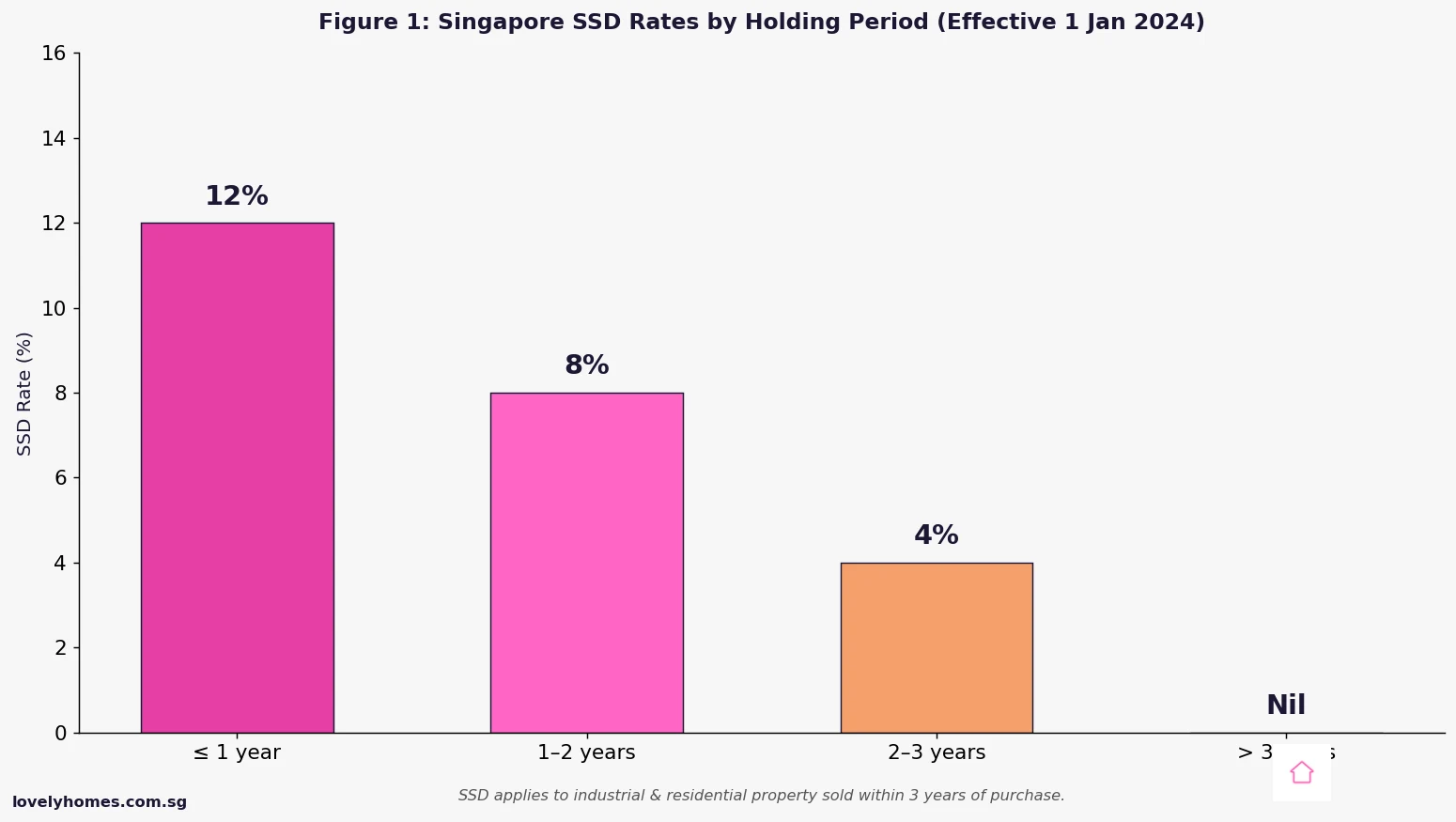
- Current residential SSD rates (from 1 Jan 2024): 12% if sold within 1 year; 8% within 2 years; 4% within 3 years; 0% after 3 years.
- Industrial SSD rates (from 12 Jan 2013): 15% if sold within 1 year; 10% within 2 years; 5% within 3 years; 0% after 3 years.
- Basis: SSD is calculated on the higher of the sale price or market value of the property.
- No exemptions are available for most sellers , including Singapore Citizens, PRs, and foreigners alike.
- Purpose: SSD is a government cooling measure designed to deter short-term property speculation.
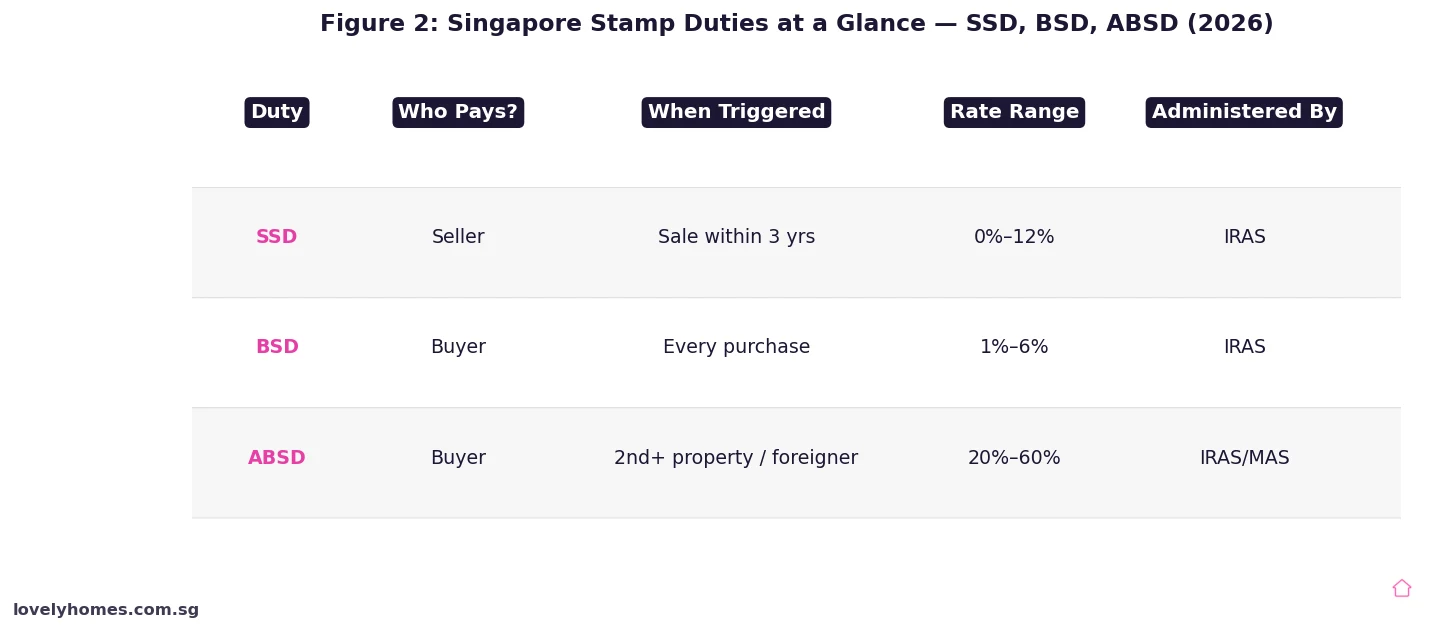
- SSD is separate from BSD and ABSD , you could be liable for all three on the same property transaction.
- HDB flats: Not subject to SSD, but must observe the 5-year Minimum Occupation Period (MOP).
Singapore’s property market is widely regarded as one of the most regulated in Asia , and Seller’s Stamp Duty (SSD) is one of the key instruments the government uses to keep speculation in check. Introduced in February 2010 and tightened multiple times since, SSD is administered by the Inland Revenue Authority of Singapore (IRAS) and targets sellers who flip residential or industrial properties within three years of purchase.
Unlike Buyer’s Stamp Duty (BSD), which applies to every property purchase, or the Additional Buyer’s Stamp Duty (ABSD), which is levied on certain buyers at acquisition, SSD only arises when you sell , and only if you do so too quickly. In a market where private residential prices in the Core Central Region (CCR) rose 2.9% in the first half of 2026 (URA, Q2 2026 flash estimate), understanding SSD is critical for any seller calculating net proceeds.
How SSD Works in Singapore
SSD is levied on the seller of a residential property (including Executive Condominiums under certain conditions) or an industrial property, where the property is disposed of within three years of acquisition. “Acquisition” is defined as the date of exercise of the Option to Purchase (OTP) , not the completion date.
The duty is calculated on the higher of:
- The actual sale price
- The market value of the property at the date of disposal
This prevents sellers from artificially under-declaring sale prices to reduce SSD exposure. IRAS has the authority to assess market value independently, and disputes are uncommon but not unheard of.
Who Administers SSD?
IRAS collects SSD under the Stamp Duties Act (Cap 312). The duty must be paid within 14 days of the date of execution of the sale and purchase agreement in Singapore, or within 30 days if the document is executed overseas. Late payment attracts a penalty of up to 4 times the unpaid duty.
Who Must Pay SSD?
SSD is a seller’s obligation. It applies to:
- Singapore Citizens (SCs) , no exemption
- Singapore Permanent Residents (PRs) , no exemption
- Foreigners , no exemption (though they already face 60% ABSD on purchase)
- Companies and trusts , fully subject to SSD
Notably, HDB flats are not subject to SSD; instead, HDB regulates short-term selling via the five-year Minimum Occupation Period (MOP), and resale within the MOP is flatly prohibited.
SSD Rate Schedule: Residential vs Industrial
There are two SSD regimes in Singapore , one for residential property and one for industrial property. Both were introduced at different times and carry slightly different rates.
| Property Type | Sold Within 1 Year | 1–2 Years | 2–3 Years | > 3 Years | Effective From |
|---|---|---|---|---|---|
| Residential | 12% | 8% | 4% | Nil | 1 January 2024 |
| Industrial | 15% | 10% | 5% | Nil | 12 January 2013 |
The current residential SSD schedule has been revised several times. At its peak (January 2011), rates were as high as 16%/12%/8%/4% across four years. The January 2024 reduction to a three-tier, three-year schedule reflects the government’s calibration of the cooling regime as the market matured.
Industrial SSD was introduced separately in 2013 to cool speculative activity in the factory and warehouse sector, following a sharp run-up in industrial prices. At 15% in the first year, the industrial SSD is actually higher than the residential equivalent , reflecting the government’s concern about speculative “flipping” of industrial units that were ostensibly purchased for business use.
Calculating Your SSD Liability
The formula is straightforward: SSD = Applicable Rate × (higher of sale price or market value). However, the “applicable rate” depends on the exact holding period, measured from the date of OTP exercise to the date of OTP exercise for the subsequent sale.
Holding Period Calculation
IRAS measures the holding period to the day. A property purchased (OTP exercised) on 15 March 2024 and sold (new OTP exercised) on 14 March 2025 falls within the “1 year” band , even though it is exactly 364 days. However, if the new OTP is exercised on 15 March 2025 (exactly one year), it falls into the “1–2 year” band at 8%.
This precision matters enormously for high-value properties. On a S$3 million property, the difference between selling at 11 months versus 13 months is S$120,000 in SSD savings (12% vs 8% = 4% × S$3M).
Worked Example: Calculating SSD on a S$2.5M Condo
Scenario: SC Sells Private Condo After 18 Months
Facts: A Singapore Citizen purchases a private condominium in District 9 for S$2,500,000 on 1 April 2024 (OTP exercise date). She sells it by exercising a new OTP on 1 October 2025 , a holding period of exactly 18 months, falling in the “1–2 year” SSD band.
SSD calculation:
Sale price: S$2,650,000 (above purchase price)
Market value: S$2,600,000 (IRAS valuation)
Higher of the two: S$2,650,000
Applicable rate: 8% (1–2 year band)
SSD payable: 8% × S$2,650,000 = S$212,000
Net proceeds calculation:
Sale price: S$2,650,000
Less: SSD: (S$212,000)
Less: Agent commission (~1%): (~S$26,500)
Less: Legal fees: (~S$3,500)
Less: Outstanding mortgage: (varies)
Less: CPF refund (principal + accrued interest): (varies)
Cash in hand before mortgage/CPF: ~S$2,408,000
Key lesson: Had she waited until 1 April 2026 (24 months from purchase), the rate would drop to 4%, saving S$106,000 in SSD. Waiting a further 12 months to 1 April 2027 (36 months) would eliminate SSD entirely, saving the full S$212,000. SSD is a powerful anchor on short-term exit strategy.
A Brief History of SSD in Singapore
SSD was first introduced by the Ministry of Finance and MAS in February 2010, when residential prices had rebounded sharply after the Global Financial Crisis. The initial scope was narrow , only properties sold within one year attracted SSD at 1%. The government progressively tightened the regime:
- August 2010: SSD extended to three years; rates: 3%/2%/1%.
- January 2011: Rates raised sharply to 16%/12%/8%/4% over four years , a signal of serious concern about speculative activity.
- March 2017: SSD was reduced for the first time , rates cut to 12%/8%/4% over three years as the market cooled following years of falling prices. The fourth year (4%) was also removed.
- January 2024: Current regime. Rates remain 12%/8%/4% over three years, but the government signalled this calibration reflects a “new normal” of higher-for-longer cooling measures alongside elevated ABSD rates.
Industrial SSD has remained unchanged since its January 2013 introduction (15%/10%/5%), reflecting a continued policy view that industrial flipping remains problematic.
SSD Exemptions and Edge Cases
SSD has very few exemptions, and sellers are generally advised to assume they will be liable unless they can confirm they qualify. Known exemptions and reliefs include:
- Death of the seller: Properties inherited by a beneficiary and subsequently sold do not restart the SSD clock , the holding period is measured from the deceased’s original acquisition date. However, if the beneficiary is treated as a new acquirer, SSD could apply.
- Compulsory acquisition: Properties compulsorily acquired by the government (e.g. for infrastructure works) are exempt from SSD on the disposal triggered by compulsory acquisition.
- Divorce transfers: Where a property is transferred between divorcing spouses pursuant to a court order, IRAS may consider remission on a case-by-case basis.
- Development properties: Where a buyer acquires property from a developer and on-sells before completion (sub-sale), SSD applies. This was a significant issue during the en-bloc redevelopment cycle of 2017–2020.
- Executive Condominiums (ECs): ECs are subject to SSD during their first 10 years (the private restriction period). The 3-year SSD clock applies independently to the EC purchaser’s sale.
| Scenario | SSD Applies? | Notes |
|---|---|---|
| Selling within 3 years | Yes | Standard residential SSD |
| Selling after 3 years | No | SSD = 0% |
| HDB flat sale | No | MOP restriction applies instead |
| EC sale (private period) | Yes | If within 3 years of purchase |
| Inherited property sale | Case-by-case | Holding period from deceased’s acquisition |
| Compulsory acquisition | No | Exempt on the government-forced disposal |
| Industrial property sale | Yes (if ≤ 3 yrs) | Rates: 15%/10%/5% |
Why SSD Matters for Singapore Property Investors
SSD is not merely a tax , it is a behavioural constraint that fundamentally shapes investment strategy in Singapore’s residential market. A few implications worth understanding:
The “3-Year Lock-Up”
In practice, SSD creates a de facto minimum holding period of three years for any buyer who wants to exit without a stamp-duty penalty. This is intentional. The government has consistently stated that SSD is designed to encourage long-term ownership rather than speculative short-term flipping.
Impact on Leveraged Investors
An investor who finances a S$2M property with 25% equity (S$500K) and sells at 18 months faces an 8% SSD bill of approximately S$160,000 , or 32% of their initial equity. Even if the property appreciated 5%, the net return after SSD would be approximately negative.
Interaction with ABSD
For buyers who paid ABSD on purchase (20–60% depending on profile), SSD at exit compounds the total stamp-duty burden. A permanent resident buying a second property at S$1.5M in 2026 would pay ABSD of S$270,000 (20% × S$1.35M above S$150K, using a simplified BSD-then-ABSD approach). If they sell within a year, SSD adds another S$180,000. Total stamp duties on an in-out trade: potentially S$450,000 or more. Only very strong capital appreciation can overcome this burden.
Comparison with Regional Markets
Singapore’s SSD regime is among the most onerous in Asia. Hong Kong abolished its equivalent (Buyer’s Stamp Duty surcharge for non-residents and Special Stamp Duty) in February 2024. Australia has no equivalent seller’s tax at the federal level. Singapore’s retention of SSD as a permanent structural feature , rather than a crisis-response measure , distinguishes its property policy approach from most peers.
What Might Come Next for SSD
The following is editorial analysis, not official policy.
SSD has not been adjusted since the January 2024 reduction. Government statements since then have been consistent in characterising the current cooling measure suite (SSD + ABSD + TDSR) as appropriate for prevailing conditions. A further reduction to SSD seems unlikely in the near term, given that private residential prices continue to rise in most segments (URA, Q2 2026 flash estimate: +0.5% for the quarter).
However, the 2024 reduction to a three-year/three-tier schedule suggests the government is willing to simplify and moderate SSD where speculative pressures ease. If transaction volumes remain subdued and price growth decelerates materially in 2027, a further easing , perhaps to a two-tier schedule (12%/6%) , cannot be ruled out. Any change would likely be announced alongside the MAS annual Financial Stability Review (typically November) or the annual Budget (February).
Frequently Asked Questions About SSD Singapore
Is SSD the same as BSD?
No. BSD (Buyer’s Stamp Duty) is paid by the buyer on every property purchase, calculated on a progressive scale of 1%–6% of the purchase price. SSD is paid by the seller only if the property is sold within three years of purchase. They are separate instruments with separate rate schedules, and both are administered by IRAS.
Do I pay SSD if I sell my property to a family member?
Yes. SSD applies to any legal disposal of a residential or industrial property within the SSD holding period, including sales, gifts, and transfers , regardless of whether the buyer is a related party. The duty is calculated on the higher of sale price or market value, so a gift at below-market value would still be assessed at market value.
How is the SSD holding period calculated?
The holding period is measured from the date the Option to Purchase (OTP) is exercised by the buyer (acquisition date) to the date the OTP is exercised by the subsequent buyer (disposal date). Completion dates are not used. The period is calculated to the day; a sale on exactly day 365 falls in the 1–2 year band (not the ≤1 year band).
Does SSD apply to HDB flats?
No. HDB flats are not subject to SSD. However, HDB flat owners are subject to the Minimum Occupation Period (MOP) , currently five years for most BTO and resale flats , during which the flat cannot be sold on the open market at all. The MOP is a separate mechanism from SSD, and its effect is broadly similar: it prevents very short-term disposal of subsidised public housing.
Can I avoid SSD by completing an en-bloc sale?
Yes , in most cases. Where a property is compulsorily acquired by the government or where a collective sale (en-bloc) is completed under the Land Titles (Strata) Act, IRAS generally treats the acquisition as involuntary and SSD does not apply on that disposal. However, individual owners who purchase replacement units with the en-bloc proceeds and subsequently sell those replacement units within three years may be subject to SSD on the new property.
What happens if I fail to pay SSD on time?
Under the Stamp Duties Act, SSD must be paid within 14 days of execution of the sale and purchase agreement (30 days if the document is signed overseas). Failure to pay on time may result in a penalty of up to four times the unpaid duty. The property’s title cannot be transferred until stamp duty (including SSD) is fully paid and the document is properly stamped. Law firms acting on property transactions are required to ensure compliance before registering any transfer with the Singapore Land Authority (SLA).
Does SSD apply to commercial property?
No , SSD only applies to residential property (and industrial property under the separate industrial SSD regime). Commercial property, including retail units, shophouses (where classified as commercial by URA), and office spaces, is not subject to SSD. However, commercial transactions may attract other stamp duties (BSD, ABSD for certain buyers) and are subject to GST where the seller is GST-registered. For shophouses with a mixed residential/commercial classification, the applicable stamp-duty regime depends on the approved use under the URA Master Plan.
Related Articles
- ABSD Singapore 2026 , Complete Guide to Additional Buyer’s Stamp Duty
- Buyer’s Stamp Duty (BSD) Singapore 2026 , Complete Guide
- Singapore Stamp Duty Calculator 2026 , BSD and ABSD Explained
- Singapore ABSD Remission and Refund Guide 2026
- En Bloc Sale Singapore 2026 , Complete Guide to Collective Sales
- Singapore Property Cooling Measures Timeline 2009–2026
- Singapore Property Investment Strategy 2026 , Rental Yields, Leverage, and Returns
Disclaimer: This article is for general informational purposes only and does not constitute legal, tax, or financial advice. SSD rules, rates, and exemptions may change. Always verify current rates directly with IRAS and seek independent advice from a qualified lawyer and tax professional before making property decisions. LovelyHomes is not a licensed financial adviser or property agent.
Supporting graphics
Original article illustrations are available below.
- Figure 1: Singapore SSD rates by holding period. Rates apply to the higher of sale price or market value.
- Figure 2: Singapore’s three stamp duties compared , SSD (seller), BSD (buyer), ABSD (buyer). A single transaction can attract all three.
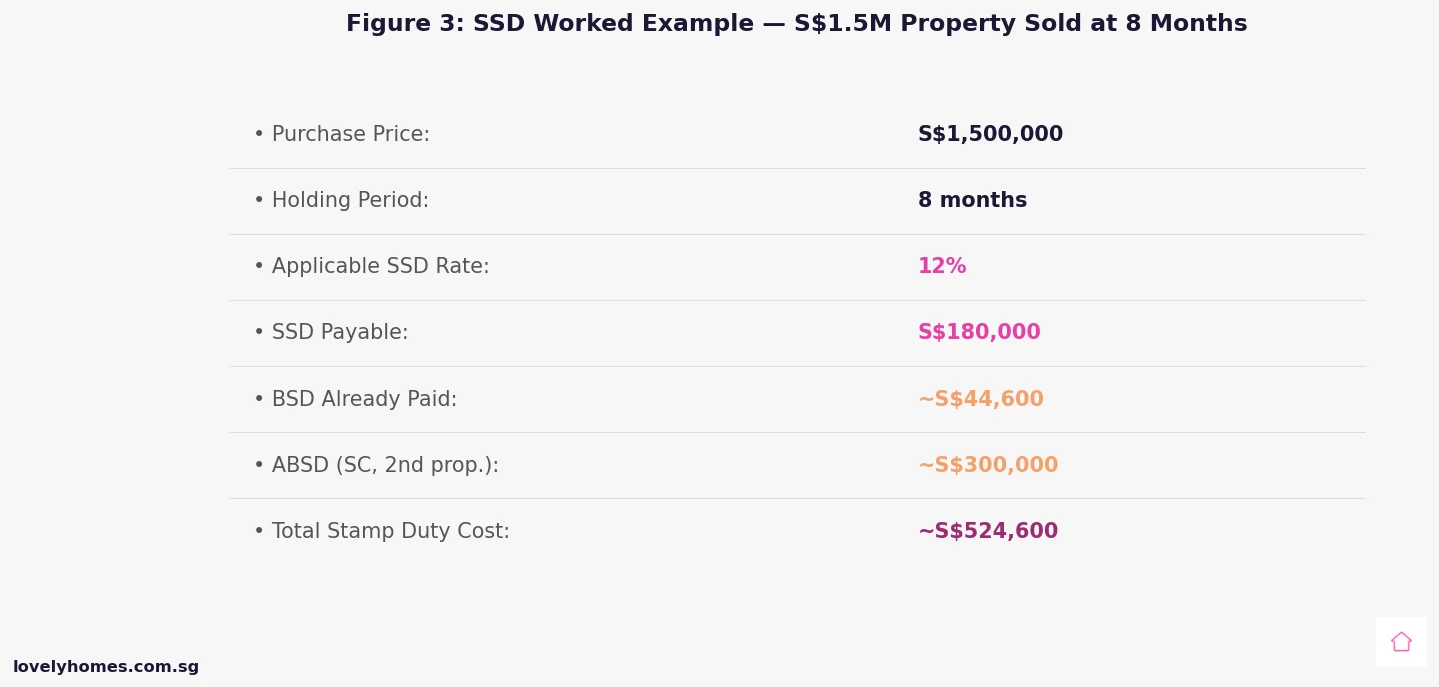
- Figure 3: SSD cost breakdown for an illustrative seller scenario. Stamp duty costs can significantly erode net proceeds on early sales.