HDB BTO Application Guide Singapore 2026: Eligibility, Income Ceilings, Ballot & the EIP Quota

HDB BTO Application Guide Singapore 2026: Eligibility, Income Ceilings, Ballot & the EIP Quota

The Build-To-Order (BTO) flat is the default starting point for most Singaporean households — subsidised, brand-new, and built on land released by the Housing & Development Board (HDB) only when there are enough committed buyers. In 2026, every BTO launch in a mature estate sees a 4-7x oversubscription rate; popular projects in Queenstown or Kallang/Whampoa cross 10x. That ballot pressure is why understanding the eligibility schemes, income ceilings, grant stack, and Ethnic Integration Policy quota is the single most leveraged hour you will spend before keying in your application.

This 2026 guide walks you through every gate — from the four eligibility schemes and the S$14,000 income ceiling, through the ballot mechanics and queue numbers, into the grants stack that can knock S$80,000 off your purchase price, and the EIP/SPR quota that decides which racial profiles can bid for which units. Figures reflect HDB’s policy stack as at April 2026.

Quick Answer — BTO at a glance

  • Income ceiling: S$14,000 (combined, family scheme); S$21,000 (extended-family or joint singles); S$7,000 (single SC, 2-room Flexi only).
  • Citizenship: at least one Singapore Citizen for any scheme except Joint Singles (which requires all SC).
  • Minimum age: 21 for couples; 35 for singles applying alone.
  • Ballot: queue number is randomly drawn within priority groups; first-timers get up to 3 queue numbers (vs 1 for second-timers).
  • Top grant stack (first-timer SC+SC): EHG S$120k + Family Grant S$80k + Proximity Grant S$30k = up to S$230k for resale; up to S$80k for BTO.
  • EIP/SPR quotas: apply at both block and neighbourhood level; a unit may show as “quota reached” for your race even if available physically.
  • Application fee: S$10 non-refundable; ballot results in 4–6 weeks.

What is BTO and Why Does the Scheme Exist?

The Build-To-Order scheme is HDB’s primary public-housing supply channel: instead of speculatively building flats and trying to sell them, HDB collects applications first and only proceeds to construction when at least 65–70% of units in a project have committed buyers. The buyer commits early (signing the lease and paying the 5% downpayment) and waits 3.5–4.5 years for completion, in exchange for a steeply subsidised price relative to comparable resale stock.

The scheme replaced an earlier system called Registration for Flats (RFS) in April 2002 and has since become the dominant route for first-time HDB buyers. Roughly 20,000–25,000 BTO flats are launched per year across four launches (typically February, May, August, November). The 2026 supply target announced by the Ministry of National Development is 22,000 units.

The Five Eligibility Schemes — Pick One

HDB classifies every applicant into exactly one of five schemes. Your scheme determines the income ceiling, age limits, allowed flat sizes, and the grant stack you qualify for. Choosing the right scheme is not optional — HDB will reject the application if you fit one scheme but apply under another.

HDB BTO application guide Singapore 2026 — eligibility schemes and income ceilings comparison
Figure 1: All five BTO eligibility schemes side-by-side — pick the one that maximises your grant entitlement.

Public Scheme (Family Nucleus)

The default scheme for married SC couples or parent-child households. At least one applicant must be a Singapore Citizen and at least one must be 21 or older. Combined gross household income is capped at S$14,000 for a standard application, or S$21,000 for an Extended-Family application (applicant + parents). The full range of flat types is available — 2-room Flexi to 5-room and 3Gen, including Plus and Prime locations.

Fiancé/Fiancée Scheme

For couples not yet married. Both applicants must be 21 or older and at least one a Singapore Citizen. The S$14,000 ceiling applies. The catch: you must produce a marriage certificate within 3 months of key collection, otherwise HDB has the right to repossess the unit. Couples who break off the engagement before key collection can withdraw without forfeiting the option fee.

Single Singapore Citizen Scheme

For singles aged 35 or older holding Singapore Citizenship. Only 2-room Flexi flats are available, and only in selected non-mature estates. Income ceiling is S$7,000. Couples who do not qualify under the Family or Fiancé schemes (e.g. one party is a foreigner) cannot use this route — it is genuinely a singles-only scheme.

Joint Singles Scheme

Two to four singles aged 35+ may co-apply. All must be Singapore Citizens. The combined income ceiling rises to S$21,000. Flat types extend up to 5-room. Joint singles must all hold equal shares; ownership cannot be reorganised after key collection. This scheme is increasingly used by adult siblings and long-term unmarried partners.

Non-Citizen Family Scheme

Where a Singapore Citizen is married to a Singapore Permanent Resident. The SC applicant must be 21 or older, the income ceiling sits at S$14,000, and only 2-room Flexi to 5-room flats are available (Plus and Prime are off-limits). Note: a Singapore Citizen married to a foreigner who is not a PR cannot apply under any HDB scheme — the household must wait for the foreigner to obtain PR status.

Income Ceilings — What Counts and How They Calculate

HDB’s income ceiling is based on average gross monthly household income. “Gross” means before CPF and tax. “Average” means the trailing 12-month average for salaried income; for variable income (commissions, bonuses, self-employment), HDB uses the most recent 24 months, divides by 24, then adds a 30% buffer to be conservative.

Applicants must submit Notice of Assessment (NOA) tax statements, the latest 3 months of payslips, and an Income Declaration (IRAS-issued for self-employed). HDB cross-checks against IRAS records. Inflated declarations to qualify for higher grants will be caught at the HFE (HDB Flat Eligibility) letter stage and the application rescinded; the ban from re-applying is 5 years.

For couples planning a BTO purchase but expecting one party to receive a windfall bonus or commission, timing matters: buy now while the trailing-12-month average is still under the ceiling, or wait until the 12 months have rolled past the bonus event.

The Application Process — What to Do, In Order

HDB BTO application guide Singapore 2026 — application timeline from ballot to key collection
Figure 2: Indicative 4–5 year BTO journey from ballot to key collection.

The mechanics of a BTO application have not changed materially since 2018, but the digital tooling has. Today every step bar key collection happens through the HDB Flat Portal and CPF/MyInfo integration:

  1. Obtain HFE Letter — the HDB Flat Eligibility letter (introduced 9 May 2023) bundles eligibility assessment, grant assessment, and loan eligibility into one document valid for 6 months. You need it before you can apply for any BTO. Generated through the HDB Flat Portal in 21 working days; lenders use it to issue an in-principle approval.
  2. Application window — each launch opens for 7 days. Apply via the HDB Flat Portal; the application fee is S$10 non-refundable. Applicants choose up to two flat types in their preferred town.
  3. Ballot — 3–5 weeks after close. Each application is randomly drawn within its priority group (First-Timer Family, First-Timer Single, Second-Timer, etc.) and assigned a queue number. First-timers receive up to 3 queue-number chances (the “3 queue numbers” rule introduced in 2022); second-timers receive 1.
  4. Flat selection appointment — you are booked into a 4-hour slot starting from queue number 1 onward. Lower queue numbers see the full selection; later applicants see only what is left. Bring your spouse, your HFE letter, and the option fee (S$500–2,000 by flat type, paid by NETS).
  5. Sign Agreement for Lease — about 4 months after selection. You pay 5% downpayment, less the option fee already paid. Funds may come from CPF OA + cash; if you are taking an HDB concessionary loan, no cash is required.
  6. Construction — typically 3.5–4 years. HDB releases progress updates by SMS and the Flat Portal.
  7. Notice of Vacant Possession + Key Collection — the final 5% of the price is paid; you collect keys and the 5-year Minimum Occupation Period (MOP) clock starts ticking.

The Ballot — How Queue Numbers Are Decided

The single biggest source of confusion among first-time applicants is the difference between “ballot” and “flat selection”. The ballot determines your queue number; flat selection is when you actually pick a unit. The queue is sequenced by:

  1. Priority groups (in order): Married Couples Priority Scheme (MCPS); Parenthood Priority Scheme (PPS); Multi-Generation Priority Scheme (MGPS); Tenants Priority Scheme; First-Timer Family; First-Timer Single; Second-Timer; Joint Singles.
  2. Within a priority group: a random ballot.
  3. Tiebreakers: later launches have started using the SC1 (sole-citizen 1-applicant) tiebreaker first.

Practical implication: a first-timer SC+SC couple with one child applying under PPS gets a meaningfully better queue position than the same couple without the priority application. Each launch reserves 30% of supply for first-timers, with the balance for second-timers and singles — so even a poor queue number does not necessarily mean exclusion if you are a first-timer.

The EIP and SPR Quotas — Why “Available” Doesn’t Mean “Available to You”

The Ethnic Integration Policy (EIP) was introduced in 1989 to prevent the formation of mono-ethnic enclaves. Every HDB block and every neighbourhood has a maximum proportion of flats that may be sold to each ethnic group:

  • Chinese: 84% of a neighbourhood, 87% of a block.
  • Malay: 22% of a neighbourhood, 25% of a block.
  • Indian / Other: 10% of a neighbourhood, 13% of a block.

The Singapore Permanent Resident (SPR) Quota sits on top of EIP and limits the proportion of non-Malaysian SPR households per neighbourhood (5%) and per block (8%). Malaysian SPRs are exempt because they are considered demographically and culturally close to Singaporean groups.

Each unit at flat selection shows the live EIP/SPR status. A unit may be physically vacant but unavailable to your ethnic group because the quota is full. You see this most acutely in popular projects in Bishan, Queenstown, or Bukit Merah, where Chinese-quota units sell out first while Indian-quota units may still be open at queue number 200+. Plan your back-up unit choices accordingly.

Grants — The Stack That Can Pay for Your Furniture

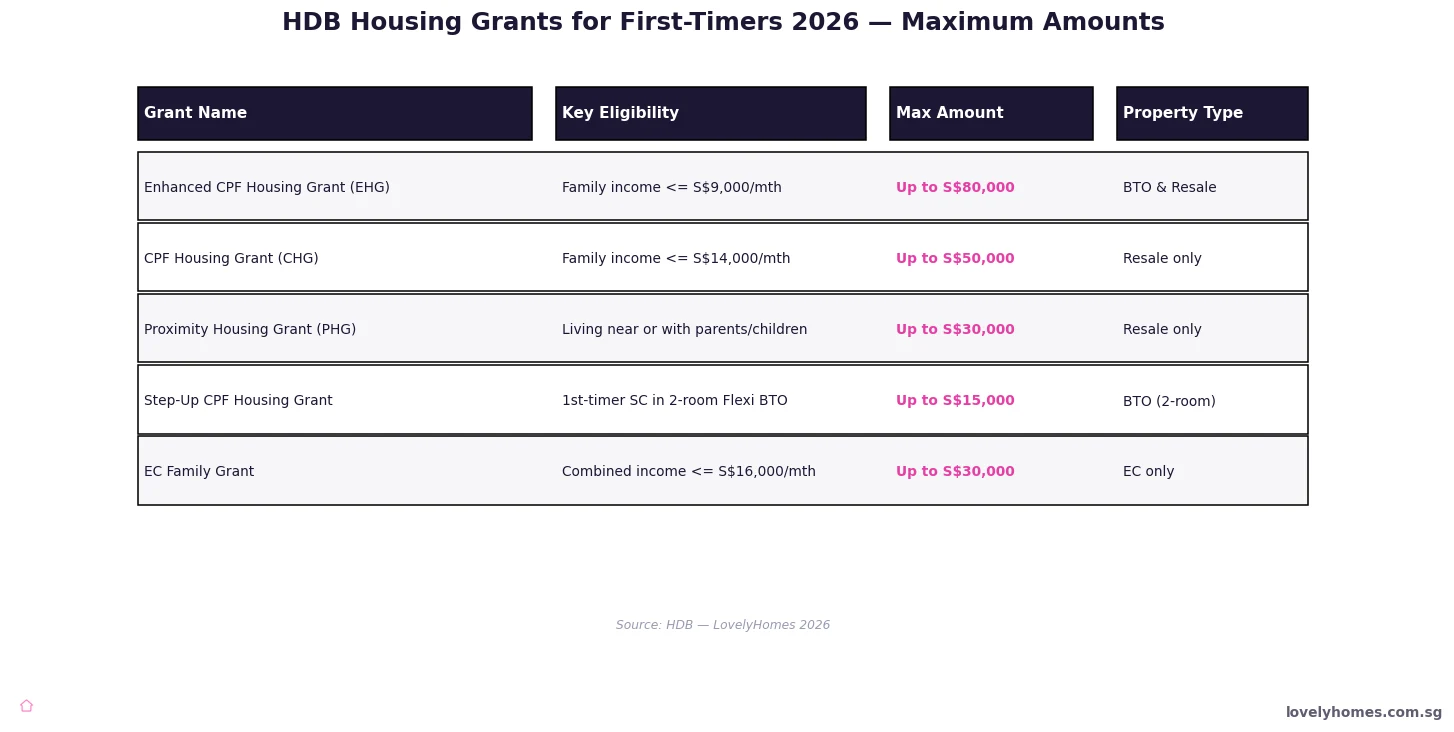
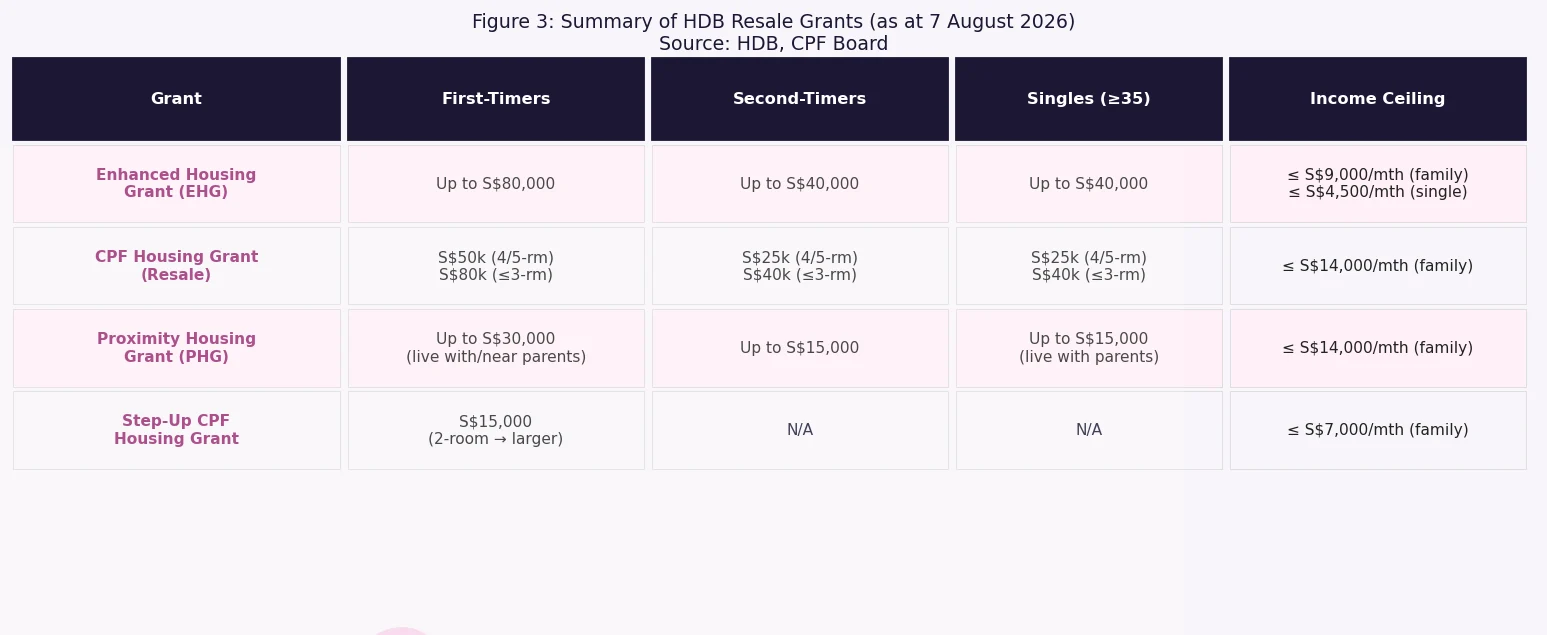
For BTO applicants, grants are awarded in fewer types than for resale buyers, but the absolute amounts are still material. As of 1 February 2024 the BTO-side grants are:

  • Enhanced CPF Housing Grant (EHG): S$5,000 to S$120,000 sliding scale by household income. The full S$120k is available for households earning up to S$1,500/month; the grant tapers to S$5,000 at the S$9,000–9,500 income band.
  • Family Grant: S$10,000 to S$80,000 depending on flat type and income, available only for resale BTO and for Plus/Prime BTO under the new classification. Standard BTOs do not qualify (the subsidy is built into the price).
  • Proximity Housing Grant (PHG): S$30,000 if buying with parents living in the same household; S$15,000 if buying within 4 km of parents’ existing flat.
HDB BTO application guide Singapore 2026 — S$520K 4-room cost stack with grants
Figure 3: Worked example — SC+SC couple buying a S$520K 4-room BTO with a S$80K grant stack.

BTO Classification — Standard, Plus, Prime

From October 2024 onwards, every new BTO is classified as Standard, Plus, or Prime. This shifts the subsidy structure and the resale rules:

  • Standard: the legacy framework. 5-year MOP, no resale-price clawback, no income ceiling on the resale buyer. The default for non-mature estates.
  • Plus: 10-year MOP, income ceiling of S$14k applies even on resale, partial subsidy clawback at resale. Found in choicer locations within outer-mature estates.
  • Prime: 10-year MOP, S$14k income ceiling on resale, 6% subsidy clawback, no whole-flat rental ever (only room rental). Reserved for the most attractive locations like Queenstown and Kallang/Whampoa.

The classification affects your effective return on the flat 10 years out. A Plus flat in Hougang sold to a quota-restricted resale buyer will trade at a discount to the equivalent Standard flat in nearby Sengkang — that is the design intent, to keep the subsidy in the public-housing system.

Worked Example — SC+SC Couple, Combined S$10,500/Month

Take a 32-year-old + 30-year-old SC+SC couple, married, no children, combined gross income S$10,500/month. They are first-timers and applying under the Family Scheme. They target a 4-room BTO at S$520,000 in Punggol Coast (a Standard project).

  • Income ceiling check: S$10,500 < S$14,000. PASS.
  • Grants: EHG at the S$8,001–10,500 income band = S$45,000. Family Grant: not applicable for Standard BTOs. PHG: S$15,000 if their parents live within 4 km. Total: S$60,000.
  • Effective price: S$520,000 − S$60,000 = S$460,000.
  • Down payment (5% with HDB loan): S$23,000, payable from CPF OA.
  • HDB loan @ 2.6%, 25 years: S$437,000 principal × 2.6% ⇒ monthly instalment ~S$1,985.
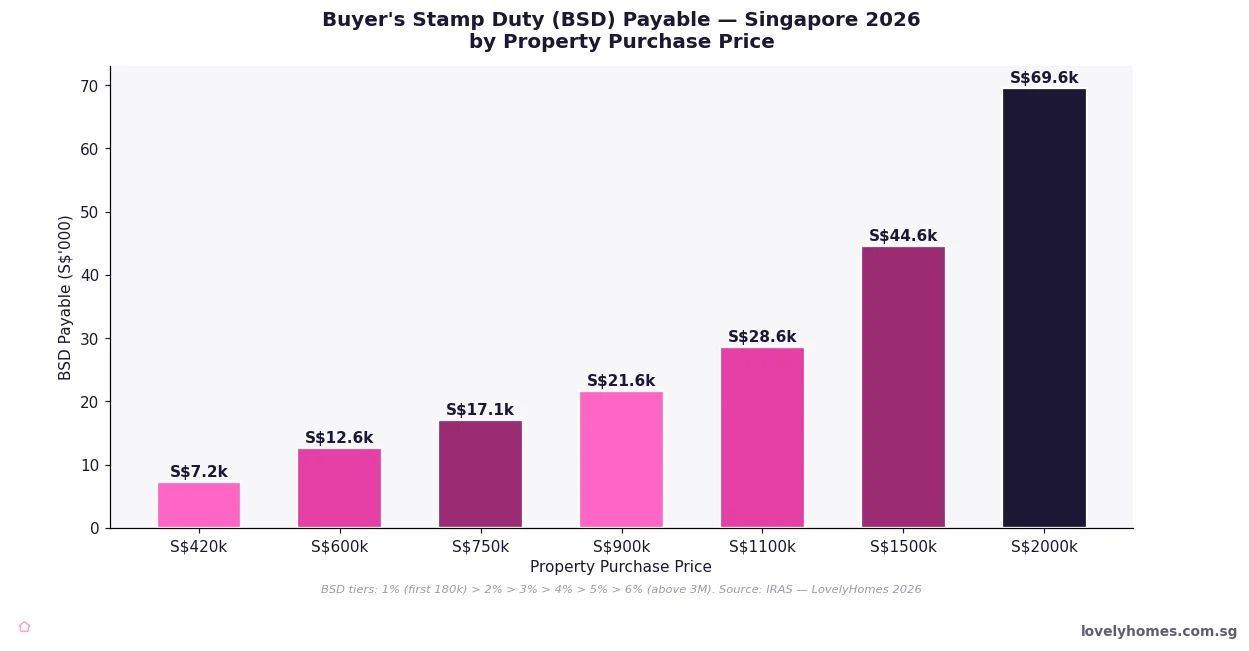
  • BSD: 1% on first S$180k + 2% on next S$180k + 3% on next S$160k ≈ S$8,200, payable in cash or CPF OA.
  • Legal fees (HDB conveyancing): ~S$800.

Total upfront cash + CPF outlay: ~S$32,000 (downpayment + BSD + legal + option fee). Monthly outlay during construction: ~S$95/month service & conservancy charges only. Monthly outlay after key collection: ~S$2,070 (loan + S&C). Against a household income of S$10,500/month gross (~S$8,400 take-home), the loan is comfortably within the 30% MSR (Mortgage Servicing Ratio) limit for HDB loans.

Common Mistakes BTO Applicants Make

  1. Skipping the HFE letter — without it, you cannot apply. Generate the HFE 6–8 weeks before the launch you want.
  2. Choosing a project where your ethnic quota is already full — check the EIP status on the launch site before applying.
  3. Underestimating the income ceiling buffer — HDB adds a 30% buffer for variable income. Sit just under the ceiling, not at it.
  4. Applying as Family before marriage — if you are not yet married, you must use the Fiancé scheme. The Family scheme is for already-married couples.
  5. Ignoring the 5-year MOP — or now 10-year for Plus/Prime. The MOP starts on key collection, not application; selling within MOP requires HDB’s express consent and is rarely granted.

What This Means for You

For most Singaporean first-timer households, BTO remains the single most subsidised real-estate transaction available. A successful 4-room BTO in 2026 typically delivers a paper gain of 60–100% by the end of the 5-year MOP — not because the project is special, but because the price gap between BTO and resale is structurally maintained. The key is winning the ballot. Increase your odds by applying under the right priority scheme (PPS for couples with children, MCPS for newlyweds), targeting non-mature estates where oversubscription is lower, and being flexible on flat type (4-room ballots have higher success rates than 5-room).

What Might Come Next

The Ministry of National Development has signalled three policy directions for the 2026–2028 horizon. First, BTO supply is forecast to remain at 22,000–25,000 per year through 2028, after which the pipeline tapers to 18,000 as the demographic bulge passes. Second, the Plus/Prime classification is expected to be applied to roughly 30% of new launches by 2028, up from ~15% in 2025. Third, the Joint Singles Scheme age threshold may be lowered from 35 to 30 if the Singapore Together Forward dialogue feedback gains policy traction. None of these is yet officially confirmed; watch the COS speech each March for the firm announcements.

Summary — Eligibility & Grant Stack by Scheme (Quick Reference)

Scheme Min Age Citizenship Income Ceiling Flat Sizes Top Grant Stack
Public (Family Nucleus) 21 (one) ≥1 SC S$14,000 2-rm to 5-rm + 3Gen EHG up to S$120k + PHG S$30k
Fiancé/Fiancée 21 (both) ≥1 SC S$14,000 2-rm to 5-rm EHG up to S$120k + PHG
Single SC 35 SC only S$7,000 2-rm Flexi only EHG-Singles up to S$60k
Joint Singles 35 (each) All SC S$21,000 (combined) 2-rm Flexi to 5-rm EHG-Singles up to S$60k each
Non-Citizen Family 21 (SC) 1 SC + 1 PR S$14,000 2-rm Flexi to 5-rm EHG up to S$120k

Frequently Asked Questions

Can I apply for a BTO if I already own a private property?

Yes, but you must dispose of your private property within 30 months of key collection of the BTO. If you fail to do so, HDB may compulsorily acquire the BTO at original cost. The 30-month window is intended to allow for sale logistics. You also forfeit any first-timer status — you will be treated as a second-timer for grant calculations. Most second-time HDB applicants in this position are downsizing from a private property after children leave home, or rebalancing portfolios after en-bloc proceeds.

How long does the entire process take, from application to keys?

Plan for 4 to 4.5 years from application close to key collection on a typical BTO project, with a further 5 years (Standard) or 10 years (Plus/Prime) of Minimum Occupation Period before you can sell. The construction stage is the longest phase — typically 36–48 months from breaking ground. Projects in Tengah and Punggol have generally tracked the lower end; mature-estate projects in Queenstown and Bishan have hit the upper end due to site constraints.

What happens if I fail the ballot?

You forfeit only the S$10 application fee and may apply again at the next launch. There is no penalty or queue-number penalty for non-selection — in fact, first-timers retain their first-timer status and the 3-queue-number allocation. Many couples cycle through 4–6 launches before securing a unit in their preferred town. To shorten the wait, broaden the geographies you are willing to apply in, or apply under a priority scheme like Parenthood Priority if you have children.

Can I use a private bank loan instead of an HDB concessionary loan?

Yes — bank financing is allowed for BTO buyers, and currently many do because SORA-pegged floating rates have hovered around 3.5–3.8% (vs the HDB concessionary rate at 2.6%, fixed at CPF OA + 0.1%). The trade-off: bank loans require a 25% downpayment (5% cash + 20% cash/CPF) instead of the 0% cash + 20% CPF on an HDB loan. Once you choose bank financing for your first BTO, you cannot switch back to an HDB concessionary loan for the same flat. Most first-timer BTO buyers stay on the HDB loan for the cash-flow flexibility.

If we are not yet married, can we still apply?

Yes — under the Fiancé/Fiancée Scheme. Both applicants must be 21+ and at least one a Singapore Citizen. You declare your intention to marry; HDB requires you to produce a marriage certificate within 3 months of key collection. If the relationship breaks down before key collection, you may withdraw from the application and forfeit only the option fee — HDB will not pursue you for damages.

How does the EIP affect resale value of my flat?

The EIP can constrain the buyer pool when you eventually sell. If your block’s Chinese quota is full and you are Chinese, you can only sell to a non-Chinese buyer — which is a smaller market and typically yields a 1–3% price discount. The reverse is also true: minority-quota sellers in mature estates often see a small premium. Most owners do not feel this until they list; consult your conveyancing lawyer for an EIP-aware listing strategy.

Can I rent out my BTO flat after MOP?

For Standard BTOs: yes, after the 5-year MOP, you may rent out the entire flat under HDB’s Whole Flat Rental scheme (subject to a 6-monthly registration). For Plus and Prime BTOs: only room rental is permitted, never whole-flat rental. The whole-flat rental rule is a permanent restriction designed to keep the subsidy in the owner-occupier pool. Non-citizen sub-tenant quotas also apply: the Non-Citizen Quota caps non-Malaysian PRs at 5% of a neighbourhood and 8% of a block.

Related Articles

Disclaimer

This guide is for general information only and does not constitute legal, financial, or housing advice. Eligibility schemes, income ceilings, grant amounts, EIP/SPR quotas, and BTO classification rules are illustrative as at April 2026 and are subject to change at the discretion of the Housing & Development Board, the Ministry of National Development, and the Central Provident Fund Board. Always verify the latest figures with primary sources — the Housing & Development Board, the CPF Board, the Inland Revenue Authority of Singapore, and consult a qualified housing consultant or conveyancing lawyer before signing any agreement.

First-Time Home Buyer Singapore 2026: The Complete Walkthrough

First-Time Home Buyer Singapore 2026: The Complete Walkthrough

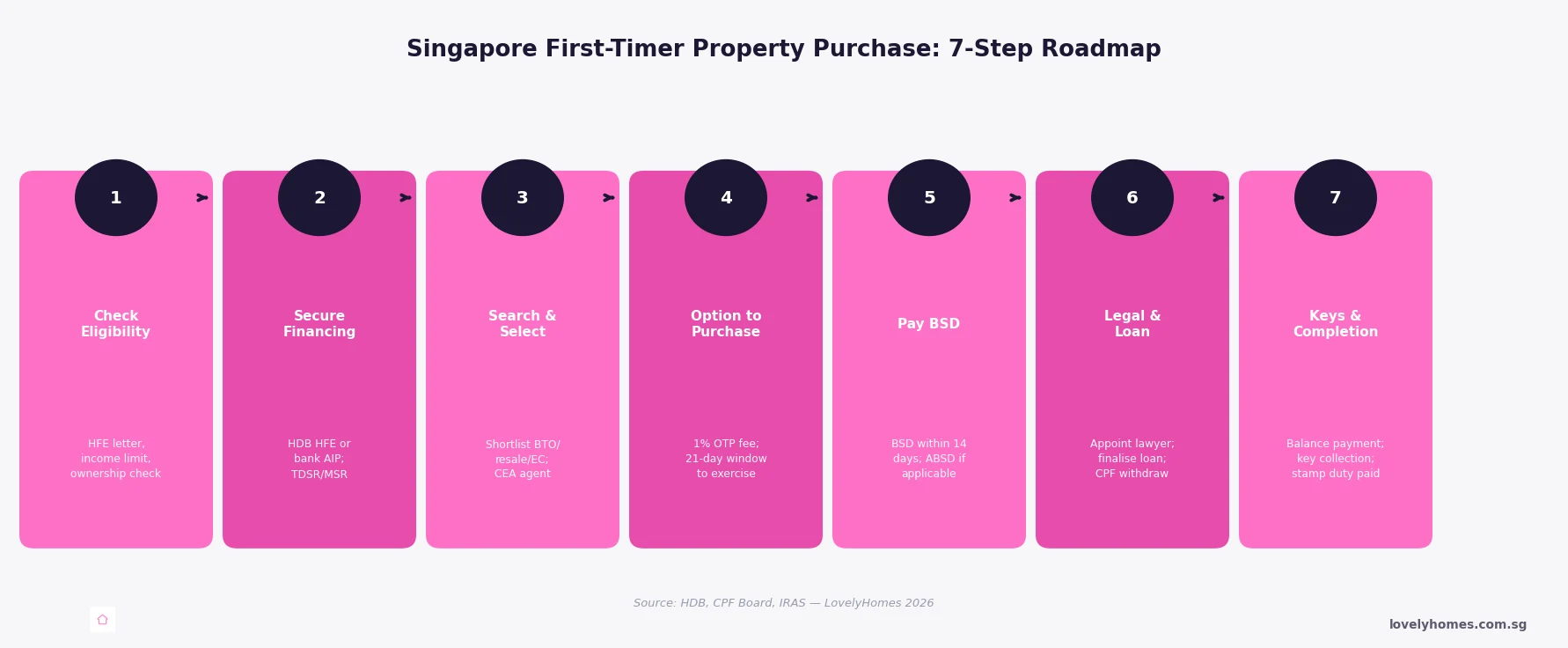
Buying your first home in Singapore is the single largest financial decision most people ever make. It has regulatory gates (HFE, TDSR, MSR), financial gates (downpayment, stamp duty, renovation), and procedural gates (OTP, resale application, completion). This 2026 walkthrough moves through all eight gates in the order you will actually encounter them.

If you are still deciding between flat types, read our comparison of BTO, resale and EC first. This article assumes you know roughly what you want to buy, and are ready to work out how.

Quick Answer — The 8 Gates

  1. Budget and debt audit — work out TDSR and MSR.
  2. HFE letter or bank IPA — locks your loan ceiling.
  3. Shortlist and compare — narrow to 3–5 options.
  4. Viewings and offer — expect 3–8 viewings before firming.
  5. OTP and option fee — commits both parties.
  6. Stamp duty and loan drawdown — the money phase.
  7. Completion — legal transfer and final balance.
  8. Keys and renovation — you own a home.
First-time home buyer 8-step journey Singapore 2026
Every Singapore first-time buyer moves through the same eight gates — in order.

Gate 1: Budget and Debt Audit

Before you look at a single listing, sit down with your household income and debt obligations. Two ratios govern what banks will lend you:

  • TDSR 55%: All monthly debts (existing loans, minimum credit-card payments, new home loan) must be at or below 55% of gross income.
  • MSR 30%: For HDB and EC buyers only — home loan alone is capped at 30% of gross income.

See our detailed TDSR and MSR guide for a worked example.

Work out your upfront cash

Your upfront cash comprises:

  • Option fee and exercise fee (HDB: up to S$5,000 total; private: typically 5% of purchase price)
  • Downpayment beyond CPF (minimum 5% cash for all property types with a bank loan)
  • Buyer Stamp Duty (BSD) — see our BSD guide
  • ABSD if applicable — see our ABSD guide
  • Legal fees, valuation fees, agent commission
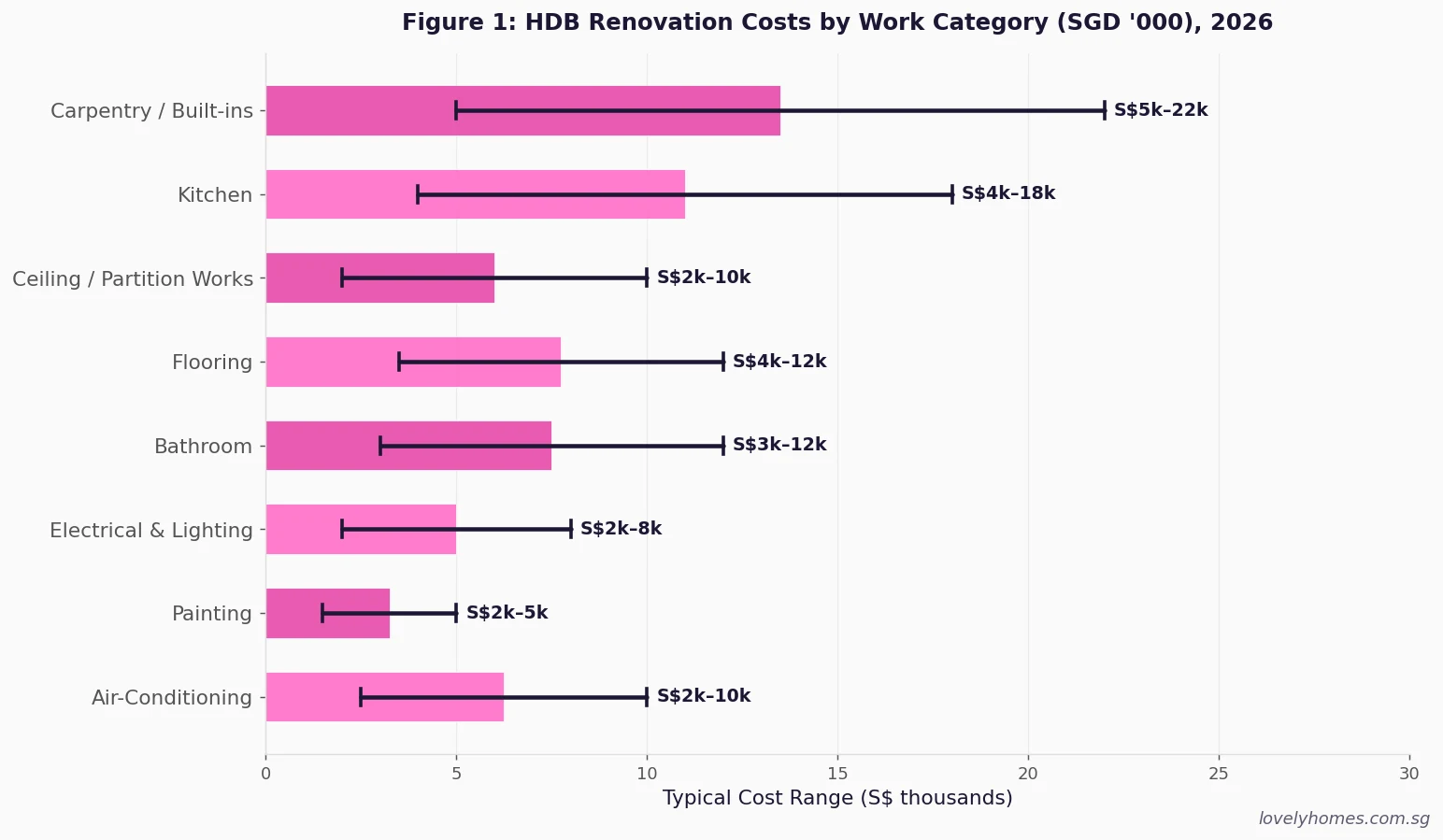
  • Renovation buffer — typical 3–5 room HDB renovation runs S$50k–S$100k

Gate 2: HFE Letter or Bank IPA

With the maths squared away, you need a financing lock:

  • HDB route: Apply for an HFE letter via the HDB Flat Portal. Takes ~2 weeks. Valid 6 months.
  • Private condo route: Apply for Bank IPA (in-principle approval). Typically 3–5 working days. Valid 30 days.

An HFE or IPA is the document a seller or developer will ask to see before engaging seriously. It also tells you how much you can actually borrow, which constrains your flat search.

Gate 3: Shortlist and Compare

Use the HDB Resale Portal (for HDB), 99.co, PropertyGuru, and our own LovelyHomes listings (for private) to narrow a shortlist. Criteria that matter:

  • Transport: Walking distance to MRT, commute to work, future Cross Island Line / Jurong Region Line stations.
  • Schools: 1km and 2km catchment for primary schools if you have young children.
  • Layout: North-South orientation, natural ventilation, bomb shelter location.
  • Remaining lease (HDB): Affects loan tenure and CPF usage.
  • Maintenance fees (private): Check the strata table for the monthly MCST fee.

Gate 4: Viewings and Offer

Expect 3–8 viewings before you firm on a unit. At each viewing, check:

  • Water pressure and drainage (run taps, flush toilets)
  • Ceiling for water staining (upstairs leaks)
  • Door frames for termite damage
  • Window seals for water ingress
  • Electrical outlet locations and DB box condition
  • Noise during the day and evening

When you are ready to offer, recognise that asking prices are typically 3–8% above the agreed-on transaction price for HDB resale, and 5–10% for private condos. Start below asking.

Gate 5: OTP and Option Fee

Once price is agreed, the seller issues the Option to Purchase:

  • HDB resale: S$1,000 option fee (fixed by HDB). 21 days to exercise.
  • Private resale: 1% of purchase price. 14 days to exercise.
  • New launch condo: 5% on booking, then S&P Agreement within 8 weeks.

This is the commitment point. Engage a conveyancing lawyer during this window, and if buying private with a bank loan, lock the loan offer now.

Gate 6: Stamp Duty and Loan Drawdown

Within 14 days of OTP exercise, you must pay Buyer Stamp Duty via IRAS. If ABSD applies (second or subsequent property, PR, or foreigner), it is due at the same time. Your lawyer will handle the filing and remittance.

Your bank will now process the loan in earnest. They will send a valuer to the property, finalise the loan offer, and coordinate with your lawyer for completion.

Gate 7: Completion

For HDB, completion happens at the HDB Hub, typically 8–12 weeks after the resale application. For private, it happens at your lawyer’s office, typically 8–12 weeks after OTP exercise. At completion:

  • You pay the final cash balance
  • Your CPF is debited for the CPF portion
  • Your bank disburses the loan
  • The seller receives the proceeds
  • Legal title transfers to you
  • You receive the keys

Gate 8: Keys and Renovation

Congratulations — you own a home. From this point:

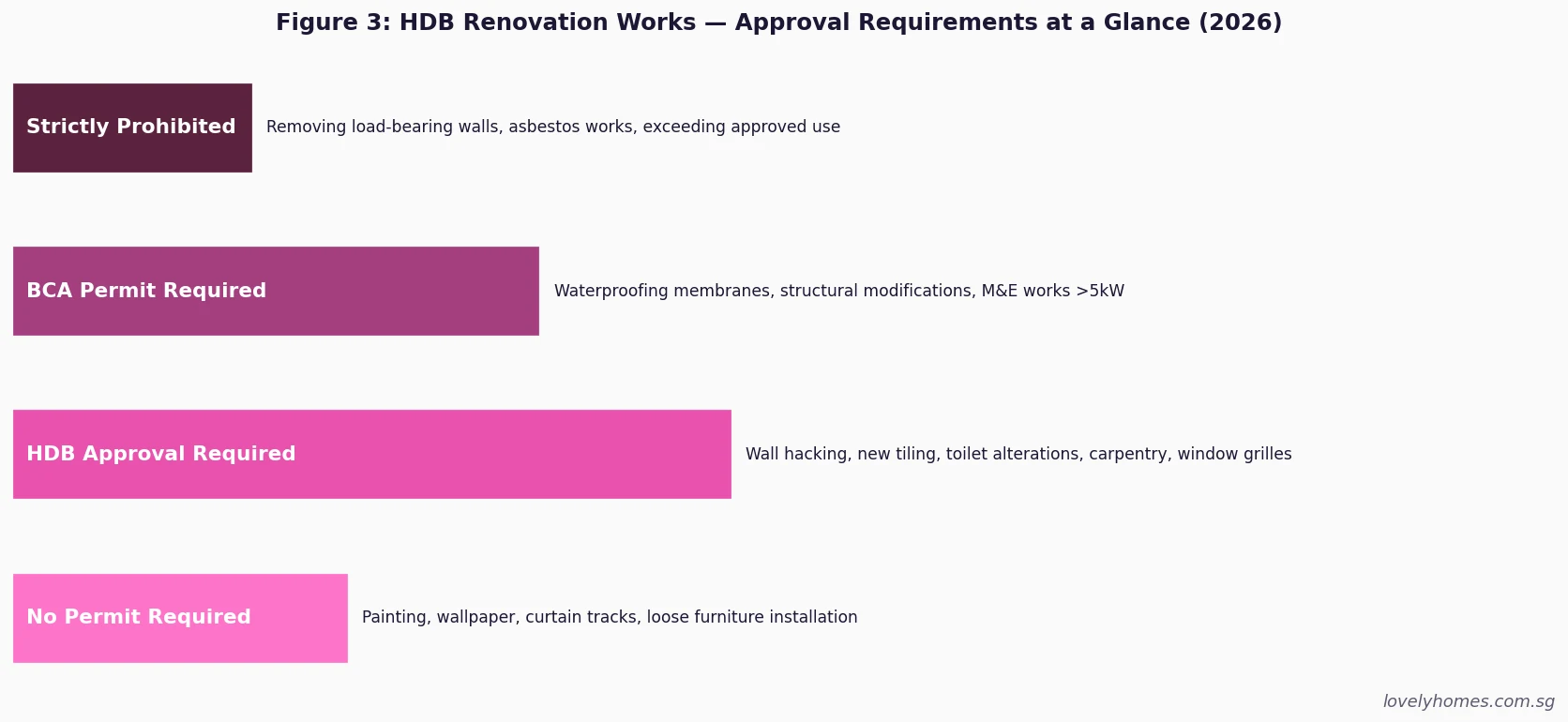
  • Apply for HDB renovation permit if structural changes (hacking, plumbing relocation).
  • Pay renovation deposit (HDB: S$200 refundable; MCST: varies).
  • Attend fire-safety briefing (HDB only) before renovation begins.
  • Budget realistically: 4-room HDB renovation runs S$50,000–S$80,000 on average in 2026.
  • MOP clock starts (HDB and EC) from the completion date.

Worked Example: S$780,000 BTO Flat, First-Timer Couple

A married couple, both SCs, combined monthly income S$9,500, buying a 4-room BTO in Tengah at S$380,000 (Standard flat):

Component Amount
Purchase price S$380,000
CPF Housing Grant (EHG) S$55,000
Effective price S$325,000
HDB loan @ 75% S$244,000
Downpayment (cash + CPF) S$81,000
Of which minimum cash S$16,300 (5%)
Buyer Stamp Duty S$5,700
Legal fees ~S$500
Minimum cash upfront ~S$23,000
Monthly HDB loan (25 yr, 2.6%) ~S$1,108

Against a household income of S$9,500, this represents an MSR of 11.7% — well inside the 30% limit. TDSR is also comfortable if there are no other debts.

Common Mistakes First-Timers Make

  • Viewing first, financing second. Without an HFE or IPA, you cannot make a binding offer.
  • Forgetting renovation cost. Budget S$50k–S$100k. It is often the second-largest cost after the downpayment.
  • Ignoring CPF accrued interest. The CPF you use will need to be returned with ~2.5% annual compounding when you sell. See our CPF guide.
  • Choosing HDB Legal for complex cases. HDB Legal is great for straightforward cases but offers no flexibility if your situation has quirks (trust ownership, divorce partial transfer, etc).
  • Maxing the loan tenure. The longest tenure minimises instalments but means vastly more interest over time.

FAQ — First-Time Buyer 2026

How long does the whole process take from first viewing to keys?

For HDB resale: 4–6 months. For private condo: 3–5 months. For BTO: add the 3–5 year build wait after selection.

Can I use my parents’ CPF to buy?

Yes, if they are named as co-applicants or under the Essential Occupier scheme. Their contribution becomes a charge on the flat like any other CPF usage.

Should I choose HDB loan or bank loan?

HDB loan: fixed 2.6% rate, forgiving on TDSR stress test, flexible on prepayment. Bank loan: potentially lower floating rates but exposed to SORA volatility. See our fixed vs floating guide.

Do I need a lawyer for my first home purchase?

Yes. For HDB, the HDB Legal service is low-cost. For private, you will need an external conveyancing firm. Expect to pay S$2,000–S$3,500 including disbursements.

What grants am I eligible for as a first-timer?

CPF Housing Grant (up to S$80k for families depending on income), Enhanced CPF Housing Grant, and Proximity Housing Grant if living near or with parents. Your HFE letter will compute your exact entitlement.

Disclaimer: Regulations, rates and grants change over time. Verify current rules with HDB, your bank, and IRAS before committing. Consider engaging a qualified financial advisor for tax and CPF planning on large purchases.


Condo Downpayment Singapore 2026: LTV, Cash & CPF Breakdown

Condo Downpayment Singapore 2026: LTV, Cash & CPF Breakdown

The condo downpayment question — how much cash does a Singapore buyer actually need on day 1 — sounds simple, but it is where most first-time buyers underestimate by S$50,000 or more. The answer depends on three overlapping rules (LTV, minimum cash, and stamp duties), and it changes dramatically if this is your second or third property.

This 2026 guide walks through exactly what you need to write cheques for on the day you collect your condo keys, with worked tables for first-property Singaporean citizens, second-property buyers, and foreign buyers. For the regulator’s guidance, see MAS Notice 632 on residential LTV.

Quick Answer — Condo Downpayment on a S$1.5m Unit

  • First condo, Singapore Citizen: ~S$119,600 cash + S$225,000 CPF/cash = S$344,600 total day-1 outlay (including BSD).
  • Second condo, Singapore Citizen: ABSD alone adds S$300,000. Total day-1 outlay S$1,169,600.
  • Foreigner buyer, any property: 60% ABSD on top of a 45% LTV. Total day-1 outlay S$1,769,600.
  • Minimum cash: 5% of purchase price for 75% LTV; 10% for 45% or 35% LTV.
  • BSD & ABSD: payable in cash within 14 days of OTP (reimbursable from CPF OA after).

The Three Rules That Set Your Downpayment

Three layers combine to set the cash and CPF you need:

  1. Loan-to-Value (LTV) ratio. MAS caps bank lending at 75% for a first housing loan, 45% for a second, and 35% for a third and beyond. The balance is your downpayment.
  2. Minimum cash portion. MAS requires at least 5% of the purchase price in cash for a first property, 10% for second and subsequent.
  3. Stamp duties. BSD and, where applicable, ABSD are paid in cash within 14 days of OTP. You can reimburse from CPF afterwards.
Condo downpayment comparison for S$1.5m Singapore property showing first, second and foreigner cash requirements
Figure 1: Same S$1.5m condo, three buyer profiles, cash needed on day 1 varies by nearly S$1.7 million.

First Property: Singapore Citizen on a 75% LTV

The easiest case. On a S$1.5m condo, an SC buying their first home gets:

  • Bank loan: up to S$1,125,000 (75% LTV, subject to TDSR).
  • Downpayment: S$375,000 split as:
    • Minimum 5% cash: S$75,000 — this is a hard floor, not a guideline.
    • Remaining 20%: up to S$300,000 can come from CPF OA, cash, or a combination.
  • BSD: ~S$44,600 (progressive on S$1.5m, capped at 5% at this level).
  • ABSD: 0% (first residential property for a Singapore Citizen).

Total cash needed on day 1: S$75,000 (min. cash) + S$44,600 (BSD) = S$119,600. BSD can be reimbursed from CPF OA after stamping.

Second Property: Singapore Citizen on a 45% LTV

Two major shifts bite here. First, LTV drops to 45% — meaning you fund 55% of the purchase. Second, ABSD kicks in at 20%.

  • Bank loan: S$675,000 maximum.
  • Downpayment: S$825,000 split as:
    • Minimum 10% cash: S$150,000.
    • Remaining 45%: S$675,000 from CPF OA, cash, or combination.
  • BSD: S$44,600.
  • ABSD (20% SC 2nd): S$300,000.

Total cash needed day 1: S$150,000 + S$44,600 + S$300,000 = S$494,600. That is before the S$675,000 of CPF/cash needed to reach the loan ceiling.

This is why many Singaporean upgraders follow the sell-first-buy-second route — or take a bridging loan — to avoid holding two properties simultaneously.

Foreigner: 45% LTV + 60% ABSD

The most expensive profile. Foreign non-residents face LTV 45% (most banks drop to 40% for non-residents without local income), plus a flat 60% ABSD.

  • Bank loan: S$675,000 maximum.
  • Downpayment: S$825,000 in cash (no CPF access for foreigners).
  • BSD: S$44,600.
  • ABSD (60%): S$900,000.

Total cash needed day 1: S$1,769,600 against a S$1.5m purchase price. Many foreign buyers end up paying 100%+ cash when accounting for legal fees and renovation.

What About CPF OA?

CPF Ordinary Account can cover most of the non-minimum-cash portion of the downpayment, plus BSD/ABSD reimbursement after stamping. Critical caveats:

  • CPF cannot cover the mandatory minimum cash portion (5% first, 10% subsequent).
  • For private property, CPF usage caps at the Valuation Limit (purchase price or valuation, whichever lower) and the Withdrawal Limit of 120% of VL.
  • Every dollar used compounds at 2.5% accrued interest — see our CPF for Property guide for the full maths.

New Launch vs Resale: Different Cash-Flow Timing

For a new launch (BUC — Building Under Construction), payments are staggered via the Progressive Payment Scheme. You typically need 25% at the Sale & Purchase Agreement (5% OTP deposit + 20% at S&PA), then 10% at foundation, 10% at reinforced concrete, etc. This reduces upfront cash strain dramatically.

For a resale, the entire downpayment hits at completion — typically 10–14 weeks after OTP. You need the full amount in cash and CPF by completion day.

TDSR Still Applies

The LTV numbers above are ceilings, not entitlements. Your actual bank loan may be smaller if your TDSR maxes out first — see our TDSR & MSR guide. A couple earning S$16,000 a month may qualify for a S$1.1m loan under TDSR even if LTV would allow S$1.125m on a S$1.5m purchase. In that case, the extra S$25,000 shortfall is yours to fund in cash or CPF.

Frequently Asked Questions

Can I put down more than 5%/10% in cash?

Yes. The minimums are floors, not ceilings. Some buyers put 20%+ cash to reduce their loan quantum and future interest.

Does option fee count as part of the downpayment?

Yes. The 1% Option Money and the 4% Option Exercise Fee together form the initial 5%, which is also the minimum cash portion for a first property.

Can I borrow more than 75% LTV?

Not from a MAS-regulated bank. Some private financing vehicles lend above 75% but at materially higher rates and with punitive terms — we do not recommend this route.

Does the 75% LTV apply to under-construction properties?

Yes, but payment is progressive — you do not need the full downpayment on day 1 for a new launch.

What if I am using an HDB loan for an HDB flat, not a bank loan for a condo?

HDB concessionary loans offer up to 75% LTV with 0% minimum cash. See our HDB Loan vs Bank Loan guide for the full difference.

What to Do Next

  1. ABSD Singapore 2026 Complete Guide — the biggest line in any upgrader’s cash-flow.
  2. BSD Singapore 2026 — full progressive rate ladder.
  3. TDSR & MSR 2026 — what your loan can actually be.

Disclaimer: This guide is general information, not financial advice. LTV and stamp-duty rules are subject to change. Verify current rules at mas.gov.sg and iras.gov.sg, and consult a licensed mortgage broker.


HDB BTO vs Resale vs Executive Condo (EC): Which Should a First-Time Buyer Choose in 2026?

HDB BTO vs Resale vs Executive Condo (EC): Which Should a First-Time Buyer Choose in 2026?

For most Singapore citizens, the decision between a Build-To-Order (BTO) flat, an HDB resale flat, or an Executive Condominium (EC) represents the single largest financial commitment of their lives. Yet the answer is far from straightforward: each option offers distinct advantages and trade-offs in price, location, waiting time, and long-term wealth building.

In 2026, first-time buyers face more choices than ever before. HDB’s new Standard, Plus and Prime classification (introduced October 2024) has reshaped BTO pricing and subsidy structures. The Enhanced CPF Housing Grant (EHG) has been raised to S$120,000 for families and S$60,000 for singles. Executive Condos remain a viable middle ground for those earning S$10,000–S$16,000 monthly. Meanwhile, resale flats offer immediate occupancy but at a premium price.

This comprehensive guide walks you through all three options, compares the financial reality with worked examples, and helps you choose the path that fits your circumstances, timeline and budget.

Quick Answer — Which one is right for you?

  • Choose BTO if: You can wait 3–5 years, want the cheapest entry price, and prioritise subsidised flats in newer estates. Best for budget-conscious buyers and families.
  • Choose Resale if: You need to move in within 12 months, want an established neighbourhood with proven amenities, and have sufficient CPF savings. Best for upgraders and those near MOP.
  • Choose EC if: Your household income is S$10,000–S$16,000, you value hybrid public–private living, and you’re willing to pay a premium for potential capital appreciation after the 10-year privatisation period.
Eligibility by household income: BTO, Resale, EC
Figure 1: Household income is the biggest filter — it determines which paths are open to you.

HDB BTO Explained

What Is BTO?

Build-To-Order (BTO) flats are new HDB units built to demand. HDB launches BTOs in batches (typically every four months), offers them at subsidised prices below market rates, and constructs them over 3–5 years. Once completed and handed over, you own the flat outright and must occupy it for a minimum occupation period (MOP) before you can sell or rent it out.

Eligibility for BTO in 2026

Citizenship: At least one applicant must be a Singapore Citizen. For families, both applicants can be Singapore Citizens or one can be a Permanent Resident (SPR).

Age: You must be at least 21 years old. Singles aged 35 and above can now buy 2-room Flexi BTOs in any location (expanded from 12 non-mature estates in October 2024).

Income Ceiling (2026):

  • Families and couples: S$14,000 monthly
  • Singles (for all flat types and 2-room Flexi): S$7,000 monthly

Ownership: You and your spouse (if applicable) must not own any other property. Inheritance and co-ownership with parents do not disqualify you, provided the flat is not mortgaged.

BTO Pricing Framework: Standard, Plus & Prime (October 2024)

HDB replaced its old classification with three tiers based on location and amenities:

Classification Features MOP Period Subsidy Clawback on Resale
Standard Good connectivity, suburban, new estates 5 years None (keep full subsidy)
Plus Choicer locations, mature estates, proximity to city 10 years 6–8% of resale price
Prime Choicest locations, central, excellent transport 10 years 9% of resale price

Example Prices (October 2024 Launch): A 4-room Standard BTO in Woodlands or Sengkang starts around S$400,000–S$450,000. A 4-room Plus BTO in a mature estate (e.g. Punggol, Hougang) costs S$550,000–S$650,000. Prime flats (rare) command prices above S$750,000.

Waiting Time & Build Cycle

From the launch month to handover typically takes 3–5 years. HDB now offers a “Shorter Waiting Time” (SWT) option for selected projects, reducing the wait to approximately 3 years. Check each BTO exercise’s buyer’s guide for your project’s expected handover date.

CPF Grants for BTO

Enhanced CPF Housing Grant (EHG) for BTO:

  • Families (SC+SC or SC+SPR): up to S$120,000 (income ceiling S$9,000/month)
  • Singles (aged 35+): up to S$60,000 (income ceiling S$4,500/month)

CPF Housing Grant (for those above EHG income ceiling): Families earning S$9,001–S$14,000 receive a grant tapering from S$120,000 to S$0.

All grants are paid into your CPF Ordinary Account and applied automatically at flat handover.

Minimum Occupation Period (MOP)

Standard flats: 5-year MOP. After 5 years, you can sell without restriction and keep the entire subsidy.

Plus & Prime flats: 10-year MOP. When you sell after 10 years, HDB claws back 6–9% of the resale price to recover a portion of the subsidy you received.

During MOP, you cannot rent out the entire flat (though private let of rooms is allowed for some schemes). You must occupy it as your main residence.

Advantages of BTO

  • Lowest entry price, especially for Standard flats
  • Large CPF grants (up to S$120,000 for families)
  • New flat – minimal repairs for first 5–10 years
  • Predictable pricing and transparent framework
  • New neighbourhoods with fresh amenities

Disadvantages of BTO

  • Long wait (3–5 years) – cannot move in immediately
  • Location not guaranteed (you choose from allocated projects)
  • Longer MOP for Plus/Prime (10 years vs. 5 for Standard)
  • Subsidy clawback on Plus/Prime resales reduces gains
  • Less mature neighbourhoods compared to older estates

HDB Resale Explained

What Is HDB Resale?

HDB resale flats are existing units on the open market, sold by current owners who have completed their MOP. You can view, negotiate and purchase immediately – no waiting for construction. The buyer’s 5-year MOP obligation begins on the date of transfer, even though the previous owner already completed theirs.

Eligibility for HDB Resale in 2026

Citizenship: You must be a Singapore Citizen or a Singapore Permanent Resident. For SC+SPR couples buying in non-mature estates, there is a quota limit (typically 10%) on SPR purchases.

Age: Minimum 21 years old (single or couple).

Income Ceiling: An income ceiling (S$14,000 for families, S$7,000 for singles) applies only if you are claiming CPF grants. If you have sufficient cash and CPF savings, you can buy a resale flat with any income level.

Ownership: You must not own any other property. First-timer status unlocks priority for certain grants.

Resale Flat Pricing

Resale prices are set by market forces and vary widely by location, flat type, floor level, condition and remaining lease:

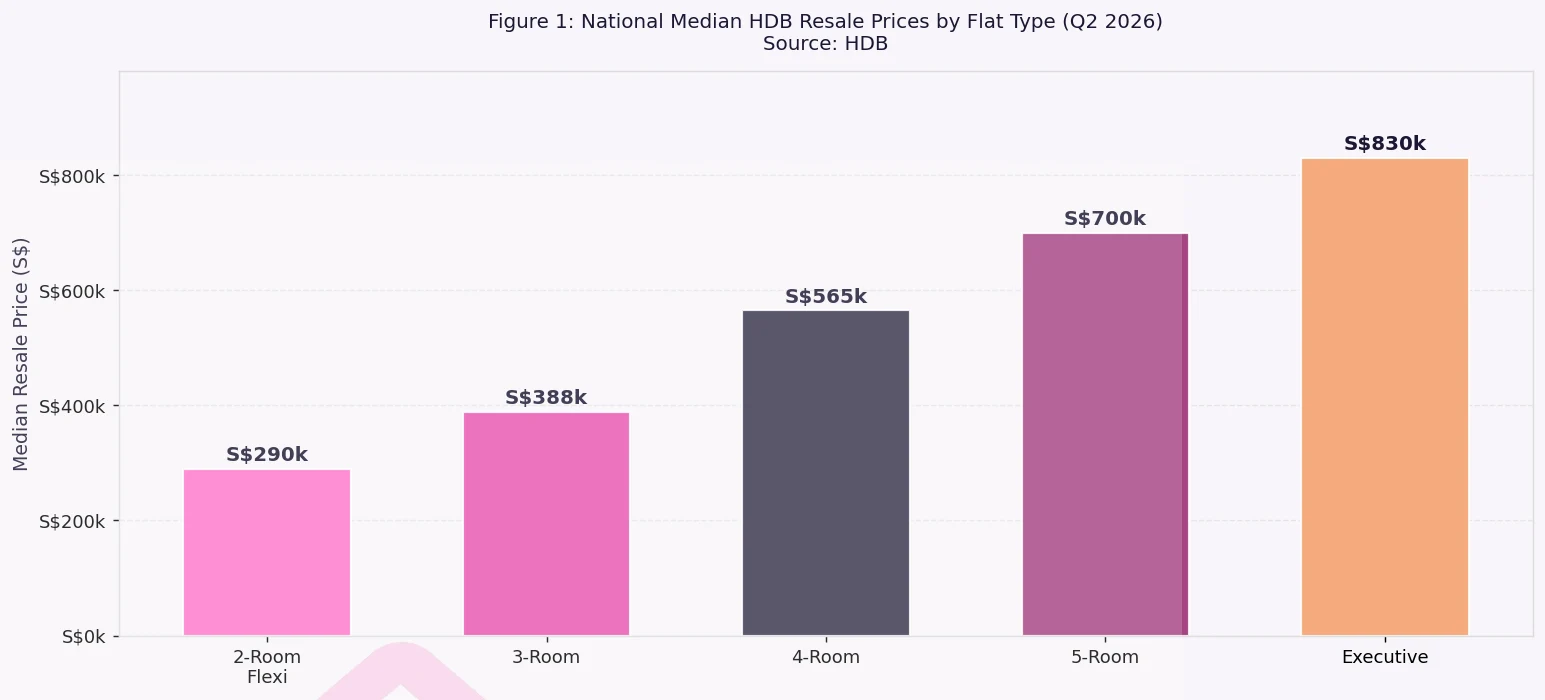
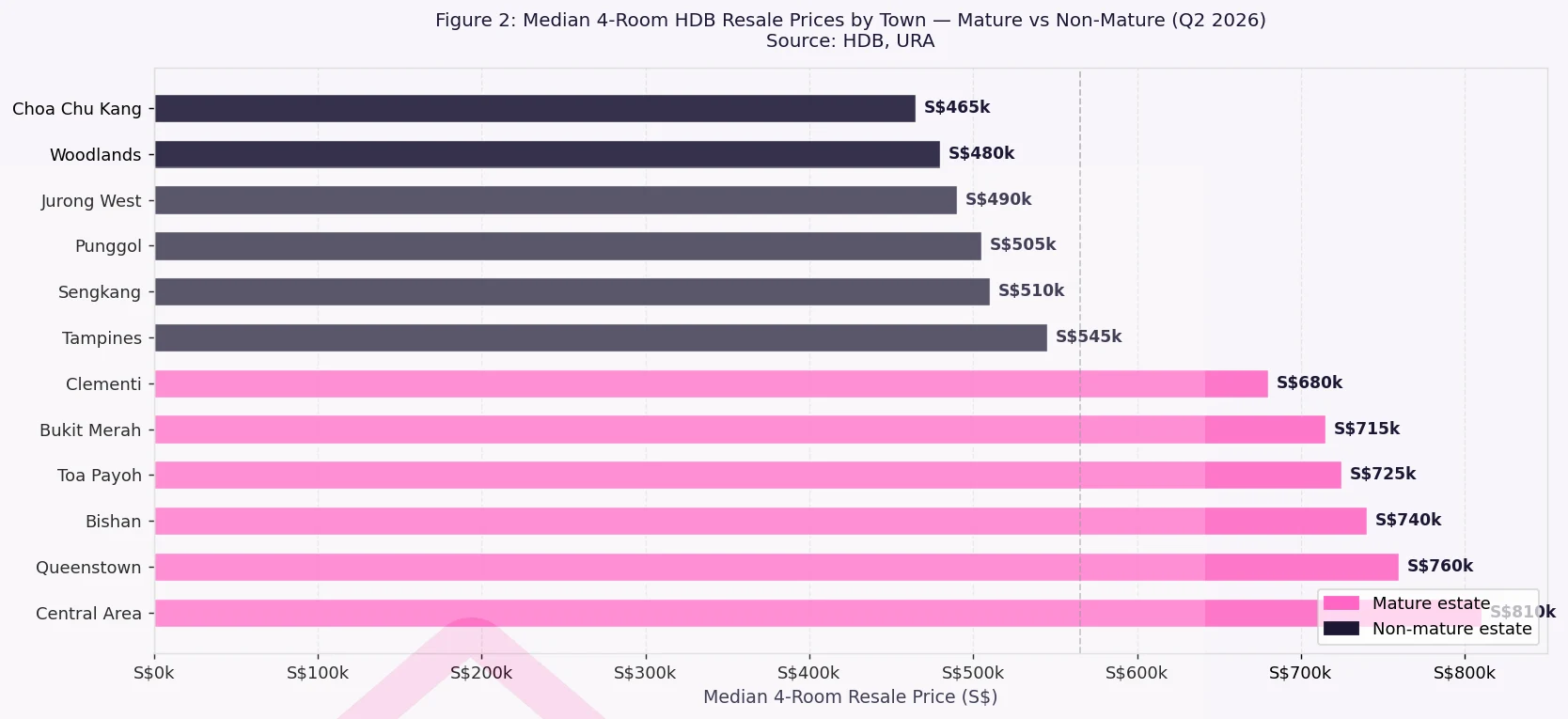
  • 4-room flats in mature estates (Tampines, Bedok, Punggol): S$550,000–S$750,000
  • 4-room flats in central estates (Bukit Merah, Tanjong Pagar): S$700,000–S$950,000
  • 3-room flats in non-mature estates: S$350,000–S$500,000

Prices fluctuate with economic cycles, interest rates and supply.

CPF Grants for HDB Resale

Enhanced CPF Housing Grant (EHG) – Families:

  • Up to S$120,000 (income ceiling S$9,000/month)

CPF Housing Grant (Family) – Standard:

  • SC+SC or SC+SPR couple: S$80,000

Proximity Housing Grant (PHG):

  • Living with parents (same flat): S$30,000
  • Living within 4 km of parents: S$20,000

For Singles (EHG – Resale): Up to S$60,000 (income ceiling S$4,500/month).

Total grant stack (families): EHG (S$120,000) + CPF Housing Grant (S$80,000) + Proximity Grant (S$30,000) = up to S$230,000 if all criteria met.

Minimum Occupation Period for Resale

Once you purchase a resale flat, you must occupy it as your main residence for 5 years before you can sell or rent it out. The previous owner’s MOP is already satisfied; yours begins afresh.

Advantages of HDB Resale

  • Immediate occupancy – move in within weeks
  • Established neighbourhoods with proven amenities
  • Can choose exact location, block and flat
  • Shorter remaining lease (if deliberate) negotiable discount
  • No subsidy clawback (full ownership benefit)
  • Multiple grants available (EHG, CPF, PHG) can stack to S$230,000+

Disadvantages of HDB Resale

  • Significantly higher purchase price than BTO
  • Older flats (20–40 years common) – higher repair/renovation costs
  • Lease decay – remaining lease affects resale value and loan eligibility
  • Must negotiate price, condition and terms yourself
  • Requires more cash upfront (HDB resale loans capped at 80% LTV, BTO can be 90%)

Executive Condominium (EC) Explained

What Is an EC?

An Executive Condominium is a hybrid public–private residential scheme. HDB sells the land to private developers, who build and sell the units directly to buyers. For the first 10 years (the “HDB control period”), ECs are subject to HDB-like rules: you must occupy it, cannot rent the whole unit, and are subject to an income ceiling. After 10 years, the building is privatised, and it becomes a full private condominium with no income restrictions, rental caps, or ownership limits.

Eligibility for EC in 2026

Citizenship: At least one applicant must be a Singapore Citizen.

Family Nucleus: You must be in a family nucleus – married couple, divorced/widowed with child, or parents with adult child (25+). Singles cannot buy ECs directly.

Income Ceiling (2026): Household monthly income must not exceed S$16,000. This applies to all new EC purchases from developers.

Ownership: You must not own any other property. First-timer priority applies to ballot allocation.

EC Pricing & Affordability

ECs are built by private developers and priced above HDB but below private condos:

  • 2-bedroom EC: S$800,000–S$1,200,000
  • 3-bedroom EC: S$1,200,000–S$1,600,000
  • 4-bedroom EC (rare): S$1,600,000+

Price varies by location, developer, and finishing standard.

CPF Grants for EC

Enhanced CPF Housing Grant (EHG) – Families:

  • Up to S$30,000 (income ceiling S$9,000/month for maximum grant)
  • Tiered: households earning S$9,001–S$16,000 receive proportionally lower grants

Note: EC grants are significantly lower than HDB resale (S$30,000 vs. S$120,000) and are based on a lower income threshold.

EC Financing & Loan Requirements

No HDB Concessionary Loan: Unlike HDB flats, ECs cannot be financed with an HDB concessionary loan. You must use a bank mortgage.

Bank Loan Criteria:

  • Loan-to-Value (LTV): up to 75% (vs. 90% for HDB)
  • Mortgage Servicing Ratio (MSR): 30% maximum monthly income
  • Your down payment must be at least 25%

Effective Cost: With a higher down payment (25% vs. 10% for HDB) and a bank mortgage at ~3.5% interest (versus HDB concessionary rates at ~2.6%), monthly payments are significantly higher than a comparable HDB flat.

Minimum Occupation Period & Privatisation

5-year MOP: You must occupy the EC as your main residence for 5 years. You cannot rent it out (whole unit) or sell it.

After 5 years: You can sell on the resale market (still subject to income ceiling if you wish to re-buy an EC or HDB).

After 10 years: The EC block is privatised. Income restrictions are lifted, and it becomes a private condo. You can then rent it out freely, sell to foreigners, or use it as an investment without restriction.

Advantages of EC

  • Hybrid lifestyle – condominium amenities (gym, pool, concierge) with HDB affordability
  • Privatisation upside – potential capital appreciation and rental income from year 11 onwards
  • Better quality finishes than new HDB (private developer standards)
  • Often in prime locations with strong transport and amenities
  • Eligible for CPF grants (though smaller than HDB)

Disadvantages of EC

  • Much higher purchase price than HDB (25–100% more)
  • Require 25% down payment vs. 10% for HDB – significant cash outlay
  • Bank mortgage at market rates (~3.5%) vs. HDB concessionary rate (~2.6%)
  • Lower LTV (75% vs. 90%) – less leverage possible
  • Smaller CPF grants (S$30,000 vs. S$120,000 for HDB)
  • No rental income for first 10 years (occupation requirement)
  • 10-year MOP for first unit – cannot upgrade as easily as HDB
  • Service charges, maintenance fees and sinking funds (not present in HDB)
BTO vs Resale vs EC side-by-side
Figure 2: Price, wait time, grants, MOP and loan type compared across the three options.

Side-by-Side Comparison Table

Factor BTO (Standard) HDB Resale Executive Condo
Entry Price (4-room) S$400–450k S$600–750k S$1.2–1.6m
Occupancy Timeline 3–5 years wait Immediate Immediate
Max CPF Grant (Family) S$120,000 S$230,000 (stacked) S$30,000
Down Payment 10–15% 10–20% 25%
Financing HDB concessional (~2.6%) HDB concessional (~2.6%) Bank mortgage (~3.5%)
Max LTV 90% 80–90% 75%
MOP Period 5–10 years 5 years 5–10 years
Subsidy Clawback None (Standard); 6–9% (Plus/Prime) None None (private)
Rental During MOP Room rental allowed; no whole-unit rental Room rental allowed; no whole-unit rental No rental (whole unit or rooms) for 10 years
Income Ceiling S$14,000 (families); S$7,000 (singles) S$14,000 (families) for grants only S$16,000
Facilities Basic (void deck, lift lobby) Basic (void deck, lift lobby) Premium (gym, pool, concierge)
Ethnic Quota 25% Chinese, 13% Malay, 9% Indian Estate-dependent; no restrictions on resale No ethnic quota

Worked Example: Which Option Costs Less?

The Scenario

Meet Sarah and Michael — both 30 years old, both Singapore Citizens, combined monthly income S$10,000 (S$5,000 each). They are HDB first-timers looking to buy a 4-room flat and need to decide between BTO, resale and EC. Both have S$80,000 in combined CPF Ordinary Account savings (after set-asides). They plan to hold the flat for 10 years, then either sell or upgrade.

Option 1: BTO (Standard 4-room in Sengkang)

Component Amount (S$)
Purchase Price 420,000
CPF Housing Grant –80,000
Net Price After Grant 340,000
Loan Amount (80% LTV) 336,000
Cash Down Payment 4,000
Monthly Mortgage (25 years @ 2.6% HDB) ~1,440
Total Interest Paid (25 years) 94,000
Total All-In Cost After 10 Years ~514,000
Est. Flat Value at Year 10 (assume 2% p.a. appreciation) 512,000
Notional Equity Gain/(Loss) –2,000

Insight: The BTO is the cheapest entry and has the lowest ongoing costs. However, at only 2% annual appreciation, you barely break even on interest costs after 10 years. The real value is housing affordability now and long-term capital preservation.

Option 2: HDB Resale (4-room in Punggol)

Component Amount (S$)
Purchase Price 630,000
Enhanced CPF Housing Grant –80,000
Proximity Housing Grant (living 4km from parents) –20,000
Net Price After Grants 530,000
Loan Amount (80% LTV) 504,000
Cash Down Payment 26,000
Monthly Mortgage (25 years @ 2.6% HDB) ~2,160
Renovation/Repair Estimate (older flat) 30,000–50,000
Total Interest Paid (25 years) 140,000
Total All-In Cost After 10 Years (incl. renovations) ~810,000
Est. Flat Value at Year 10 (assume 3% p.a. appreciation) 846,000
Notional Equity Gain +36,000

Insight: Resale flats cost significantly more upfront (S$630k vs. S$420k for BTO). However, established Punggol flats appreciate faster (~3% p.a. vs. 2% for new Sengkang BTO), and you capture a modest gain after 10 years. You also benefit from higher grants (S$100,000 vs. S$80,000 with PHG) and immediate occupancy, valuable if you need to move within 12 months.

Option 3: Executive Condo (3-bed in Tampines)

Component Amount (S$)
Purchase Price 1,300,000
CPF Housing Grant (EHG, S$9k income threshold) –30,000
Net Price After Grant 1,270,000
Down Payment Required (25%) 325,000
Loan Amount (75% LTV) 975,000
Monthly Mortgage (25 years @ 3.5% Bank Rate) ~4,580
Monthly Service Charges & Maintenance ~300–500
Total Interest Paid (25 years) 371,000
Total All-In Cost After 10 Years ~1,910,000
Est. Flat Value at Year 10 (assume 4% p.a. appreciation pre-privatisation) 1,920,000
Notional Equity Gain (After Privatisation) +10,000 (conservative)

Insight: ECs are dramatically more expensive — S$1.3m vs. S$420k BTO, or S$630k resale. Monthly payments are triple a BTO (S$4,580 vs. S$1,440). However, ECs benefit from stronger appreciation (4% p.a. vs. 2–3%) due to privatisation upside and prime locations. After 10 years (and especially after privatisation at year 11), rental income and capital gains potential accelerate. An EC makes sense only if your timeline is 15+ years and you can afford the premium monthly cost.

10-year all-in cost of BTO vs Resale vs EC
Figure 3: Ten-year all-in cost of ownership for the same couple — BTO S$514k, Resale S$810k, EC S$1.91M.

Summary: 10-Year Cost Ranking

  1. BTO (Cheapest): S$514,000 all-in cost; minimal appreciation
  2. Resale (Moderate): S$810,000 all-in cost; modest capital gains (S$36,000)
  3. EC (Premium): S$1,910,000 all-in cost; conservative gains, but privatisation upside at year 11+

Key Takeaway: If you want to minimise housing costs and build equity steadily, BTO wins. If you need to move now and expect moderate appreciation, resale is rational. If you want premium lifestyle and long-term wealth (15+ year hold), EC can pay off after privatisation.

Which Should You Choose?

Choose BTO If:

  • You can wait 3–5 years for occupancy
  • You want the lowest entry price and monthly mortgage
  • You prioritise maximising CPF grants (up to S$120,000 for families)
  • You value a brand-new flat with minimal repairs for 15+ years
  • You are budget-conscious and wish to minimise lifetime housing costs
  • You are comfortable with newer, less-established neighbourhoods
  • You are open to the estate HDB assigns you (limited location choice)

Choose Resale If:

  • You need to move in within 12 months (or less)
  • You want to choose your exact location, estate and block
  • You value established neighbourhoods with proven amenities and connectivity
  • You have sufficient CPF savings and can afford the higher purchase price
  • You are a second-time buyer or upgrader (eligible for larger grants)
  • You live near parents and are eligible for Proximity Housing Grant
  • You expect faster capital appreciation (established estates appreciate 2.5–3.5% p.a.)
  • You plan to hold the flat for 10+ years

Choose Executive Condo If:

  • Your household income is S$10,000–S$16,000 (above HDB ceiling but below private condo buyers)
  • You value condominium lifestyle (pool, gym, concierge) but cannot afford pure private condo
  • You can afford a 25% down payment and monthly mortgage of S$4,000+
  • You plan to hold for 15+ years, targeting post-privatisation rental income and capital gains
  • You prefer prime or central locations (ECs are often well-positioned)
  • You are willing to pay a premium for privacy, space and amenities vs. HDB
  • You can accept no rental income for the first 10 years and an income ceiling restriction

Frequently Asked Questions

1. Can I apply for BTO and HDB resale simultaneously?

Yes, but strategically. You can submit a BTO application for one project and bid for a resale flat at the same time. However, if you win the resale first, you must withdraw your BTO application (as you cannot own two properties). Many buyers use this two-pronged approach: they apply for BTO as a backup while actively bidding on resale flats.

2. Can a single person buy an Executive Condo?

No, singles cannot buy ECs directly. You must be in a family nucleus (married couple, divorced/widowed with child, or parent with adult child 25+). If you are single and interested in hybrid housing, your only option is HDB (BTO or resale).

3. What happens if I miss the BTO ballot multiple times?

You can keep applying. There is no limit to the number of BTOs you can apply for. However, if you consistently miss (do not win the ballot), it may be a signal that you should pivot to resale or EC if you have the means and timeline allows.

4. Is an Executive Condo considered a private condo?

For the first 10 years: No. ECs are HDB-controlled and subject to HDB rules (income ceiling, occupancy requirement, no whole-unit rental). After 10 years, the block is privatised, and it becomes a full private condo with no restrictions. At that point, it is legally and practically identical to any other private condo.

5. Can I rent out my BTO flat during the MOP?

Not the whole flat. During MOP, you can rent out individual rooms to lodgers, but you cannot rent out the entire flat to a tenant. This occupancy rule is strict. After MOP (5 years for Standard BTO), you can sell or rent out the whole flat freely.

6. What grants am I eligible for?

It depends on your household structure, income and purchase type:

  • For BTO: Enhanced CPF Housing Grant (families up to S$120,000; singles up to S$60,000, both with income ceilings S$9,000 and S$4,500 respectively).
  • For HDB Resale: Enhanced CPF Housing Grant + CPF Housing Grant (family) + Proximity Housing Grant, totalling up to S$230,000 if you meet all criteria.
  • For EC: Enhanced CPF Housing Grant (families up to S$30,000, tiered between S$9,000 and S$16,000 income).

Apply for an HDB Flat Eligibility (HFE) letter to confirm your exact grant amount.

7. Should I wait for BTO or buy resale now?

This depends on three factors:

  1. Timeline: If you need housing within 12 months, buy resale. If you can wait 4–5 years, BTO may save you S$150k–S$250k.
  2. Location: If a specific neighbourhood is critical (e.g. near parents, near your workplace), resale gives you certainty. BTO assigns location at ballot.
  3. Finances: If you have substantial CPF savings but limited cash, resale grants are larger (S$230k vs. S$80k for BTO). If cash is tight, BTO’s lower entry price wins.

Pragmatic approach: Apply for BTO while simultaneously bidding for resale flats. Whichever closes first is your home; the other falls away.

Related Articles

  • LovelyHomes Buying Guide Collection — Browse our full suite of guides for first-timers and upgraders.
  • Upgrader’s Guide — Planning your second property? Learn about upgrading from 4-room to 5-room, EC to private condo, and tax implications.
  • Property Finance Hub — Understand CPF Housing Grants, HDB loans, bank mortgages, and financing strategies.
  • Home Loans & Mortgages — Deep-dive into HDB concessionary loans, bank mortgage rates, MSR and TDSR calculations.
  • ABSD Complete Guide 2026 — If upgrading to private property, understand Additional Buyer’s Stamp Duty and tax planning.

Disclaimer

This guide is for general information only and does not constitute legal, tax or financial advice. HDB policy, grants, income ceilings and pricing frameworks change periodically. The figures and eligibility rules cited reflect policy as of April 2026, but may be subject to change. Always verify current information on HDB’s official website (https://www.hdb.gov.sg), consult HDB’s Customer Service or engage a licensed mortgage advisor or housing consultant before committing to any property purchase. CPF withdrawal limits and grant eligibility are subject to CPF Board rules (https://www.cpf.gov.sg). For EC and resale purchases, seek independent legal and financial counsel.


Translate »