Singapore HDB BTO Eligibility Guide 2026: Who Can Apply, Income Ceilings, Priority Schemes and CPF Grants

Singapore HDB BTO Eligibility Guide 2026: Who Can Apply, Income Ceilings, Priority Schemes and CPF Grants

Quick Answer: HDB BTO Eligibility in Singapore 2026

  • At least one applicant must be a Singapore Citizen (SC). SC + Singapore Permanent Resident (SPR) couples can apply for BTO flats together.
  • The household income ceiling for most BTO flat types is S$14,000 per month (gross); for Executive Condominiums (EC), S$16,000 per month.
  • Singles aged 35 and above who are SC can apply for 2-Room Flexi flats under the Single Singapore Citizen (SSC) Scheme.
  • First-timer applicants receive a priority ballot — they have roughly twice the chance of success as second-timers in most BTO exercises.
  • You must not own or have an interest in any private residential property locally or overseas at the time of application.
  • Key grants available: Enhanced CPF Housing Grant (EHG) up to S$120,000; Family Grant up to S$50,000 for resale; Proximity Housing Grant (PHG) up to S$30,000.
  • The October 2026 BTO exercise is expected to offer close to 8,000 new flats across several estates — applications are typically open for one week.

What Is the HDB BTO Scheme and Who Administers It?

The Housing and Development Board (HDB) Build-To-Order (BTO) scheme is Singapore’s primary mechanism for supplying new subsidised public housing to eligible applicants. Under BTO, HDB announces available flat projects in new and existing estates, and eligible applicants ballot for a chance to select a flat. Construction begins only after a sufficient number of flats have been booked, with keys typically collected 3–5 years after booking.

BTO exercises are held quarterly — typically in February, May, August and October — with the October 2026 exercise expected to introduce close to 8,000 new flats. The scheme is administered entirely by HDB under the Housing and Development Act 1959, and is distinct from the HDB Resale market (second-hand transactions between existing flat owners) and the Executive Condominium (EC) market (a hybrid public-private product).

BTO eligibility is detailed, and the rules matter financially: only eligible buyers can access CPF Housing Grants worth up to S$190,000 for some buyer profiles, and only first-timer buyers receive the priority ballot advantage that meaningfully reduces waiting time.

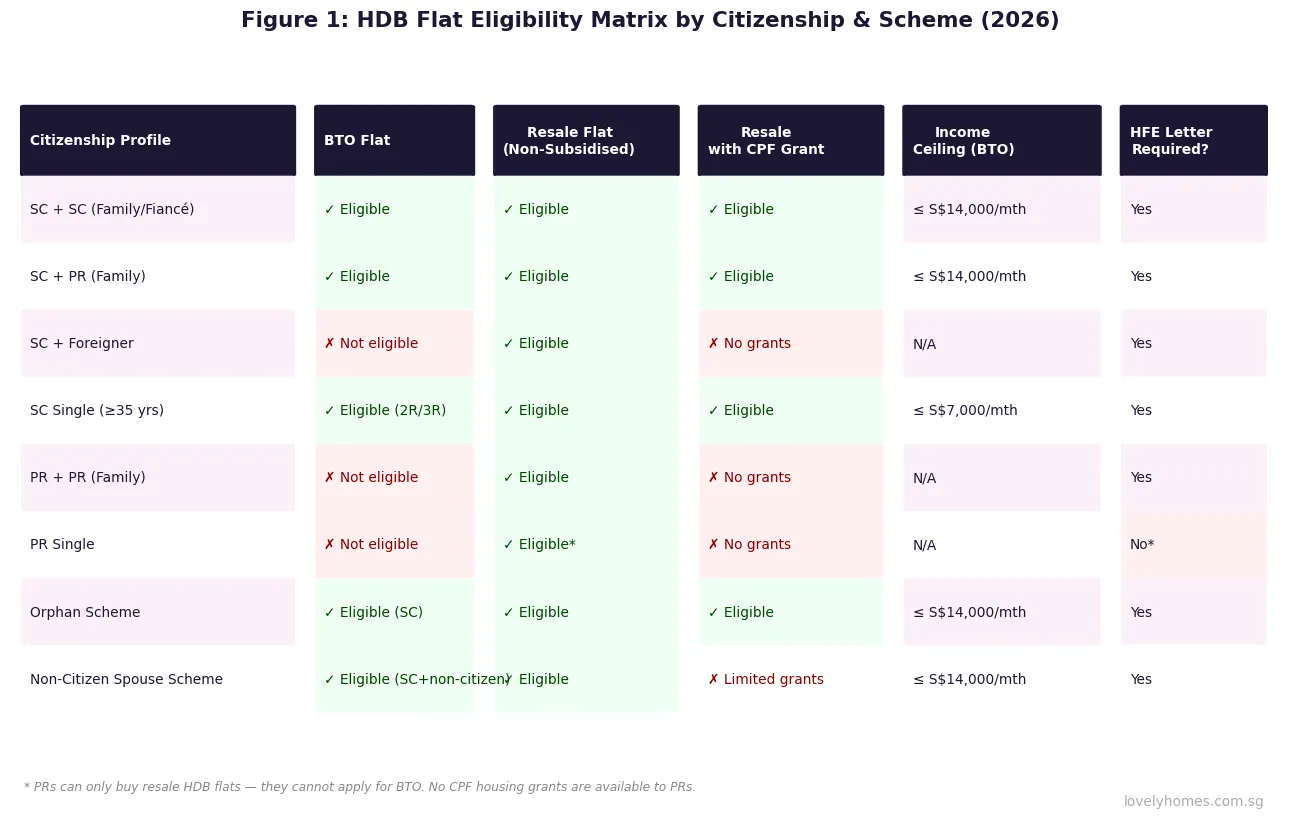
HDB BTO eligibility matrix by household type Singapore 2026
Figure 1: HDB BTO and Resale eligibility comparison by household composition — Singapore 2026. Source: HDB.gov.sg

Core BTO Eligibility Criteria: The Five Requirements

To apply for an HDB BTO flat, your household must satisfy five core requirements set by HDB. Failing any single requirement disqualifies your application.

1. Citizenship: At least one applicant must be a Singapore Citizen (SC). SC + SC couples, SC + SPR couples, and single SCs aged 35 and above are eligible. Two SPRs cannot apply for a BTO flat, nor can a SC + foreigner couple (though they can purchase HDB resale flats under specific conditions). SPR holders who are part of an eligible SC household are treated as co-applicants.

2. Family Nucleus: Applicants must form an eligible family nucleus. The principal schemes are: (a) Public Scheme — applying with a spouse, or a fiancé/fiancée (must marry before key collection); (b) Fiancé/Fiancée Scheme — for engaged couples; (c) Orphans Scheme — for SC orphans; (d) Joint Singles Scheme — for two or more single SCs aged 35 and above; and (e) Single Singapore Citizen (SSC) Scheme — for a single SC aged 35 and above applying alone (2-Room Flexi only). There is no scheme for a single SC under 35 to apply for a BTO flat alone.

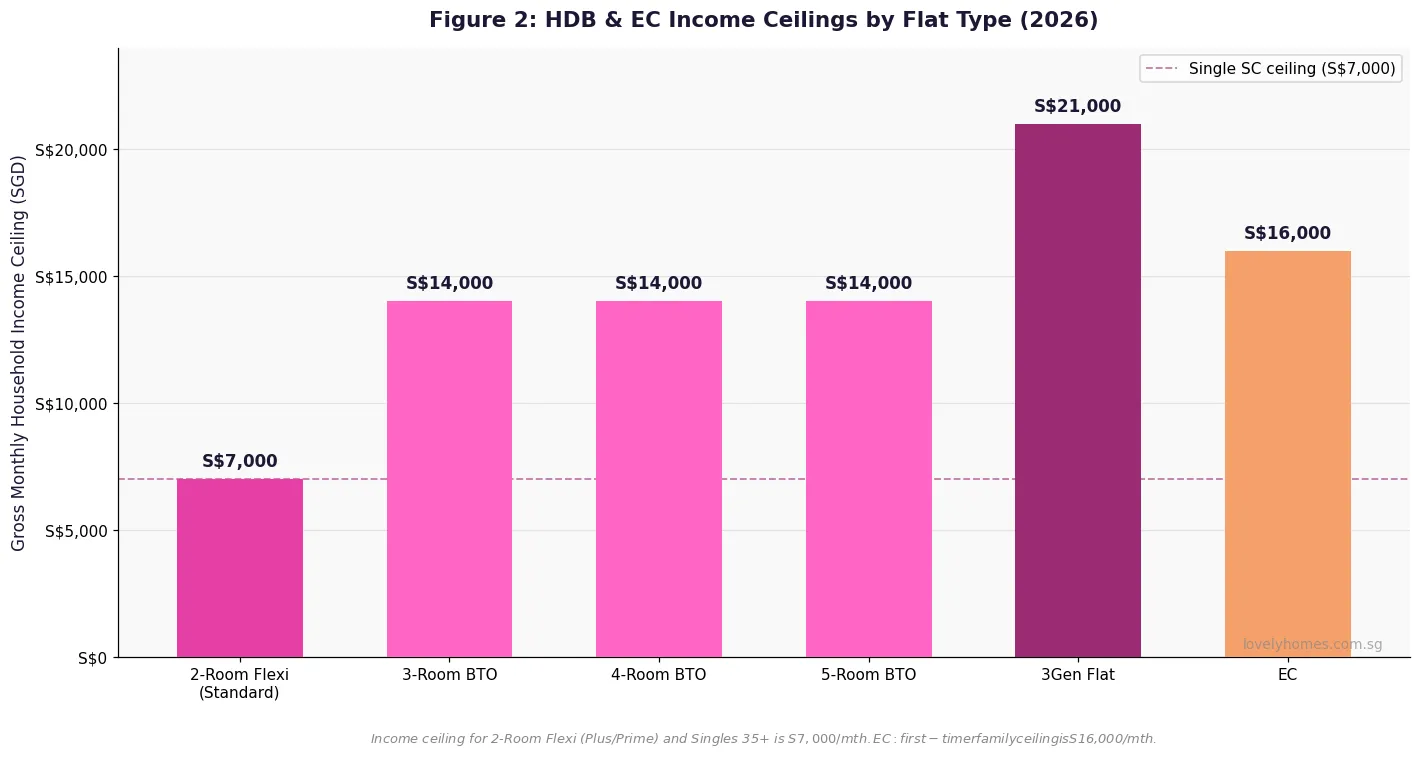
3. Income Ceiling: The average gross monthly household income must not exceed S$14,000 for most BTO flat types. There is no income ceiling for 2-Room Flexi flats (which are available to all eligible buyers regardless of income), and the income ceiling for Executive Condominiums is S$16,000. Income is assessed at the point of application and includes all household members’ employment income, business income, and overseas income.

4. Property Ownership: Neither the applicant nor any listed household member must own, have an interest in, or have disposed of a private residential property (locally or overseas) within 30 months before the BTO application date. This includes private condominiums, landed property, commercial-residential shophouses, and overseas properties. HDB flat ownership is subject to a separate “first-timer/second-timer” distinction rather than an outright bar.

5. Concurrent Application: An applicant may only have one active BTO or Sale of Balance Flats (SBF) application at any time. Applicants also cannot concurrently be in the process of purchasing a resale HDB flat via the HDB resale procedure.

First-Timer vs Second-Timer: Why the Distinction Matters

HDB classifies applicants as first-timers or second-timers, and this classification has a direct and significant impact on your chances of obtaining a BTO flat. First-timer applicants are those who have never received a subsidised housing benefit from HDB — meaning they have not previously purchased an HDB flat directly from HDB (BTO, DBSS, or SBF), have not previously received a CPF Housing Grant, and have not previously taken the Selective En-Bloc Redevelopment Scheme (SERS) replacement unit.

In each BTO exercise, HDB allocates a large proportion of units specifically to first-timer applicants. As a result, first-timers in a given ballot queue face significantly lower oversubscription ratios than second-timers. Industry figures show that in popular BTO projects, first-timer queues are typically 3–5× oversubscribed while second-timer queues can be 15–25× oversubscribed. This translates directly into waiting time: a first-timer who applies consistently may expect to receive a flat within 2–4 BTO exercises (approximately 1–2 years of active applying), while a second-timer may wait considerably longer.

A second-timer who has previously sold their HDB flat may also be subject to a Resale Levy of S$15,000–S$55,000 (depending on flat type) when purchasing a second subsidised flat. The resale levy is deducted from the CPF refund upon completion and cannot be paid in cash voluntarily before the sale.

CPF Housing Grants: What You Can Receive and When

CPF housing grants by buyer profile Singapore 2026 bar chart
Figure 2: Maximum CPF Housing Grants available by buyer profile for BTO and resale flat purchases (2026). The resale market offers the highest total grants — up to S$190,000 for an SC couple with proximity to parents. Source: HDB.gov.sg

Eligible BTO buyers can access two primary CPF Housing Grant streams administered by HDB and CPF Board. All grants are paid in CPF and cannot be taken as cash. They reduce the purchase price effectively but must be refunded (with accrued interest at 2.5% per annum) to your CPF Ordinary Account when the flat is eventually sold.

Enhanced CPF Housing Grant (EHG): Available for all first-timer SC and SC+SPR applicants purchasing both BTO and resale flats. The EHG is income-tiered: households earning S$1,500 per month or less qualify for the maximum S$120,000 (for couples) or S$60,000 (for singles). The grant reduces as income rises and is fully phased out at S$9,000 per month. The EHG is permanently tied to the flat — it cannot be retained if you sell, and the proportional grant amount is refunded to CPF on sale.

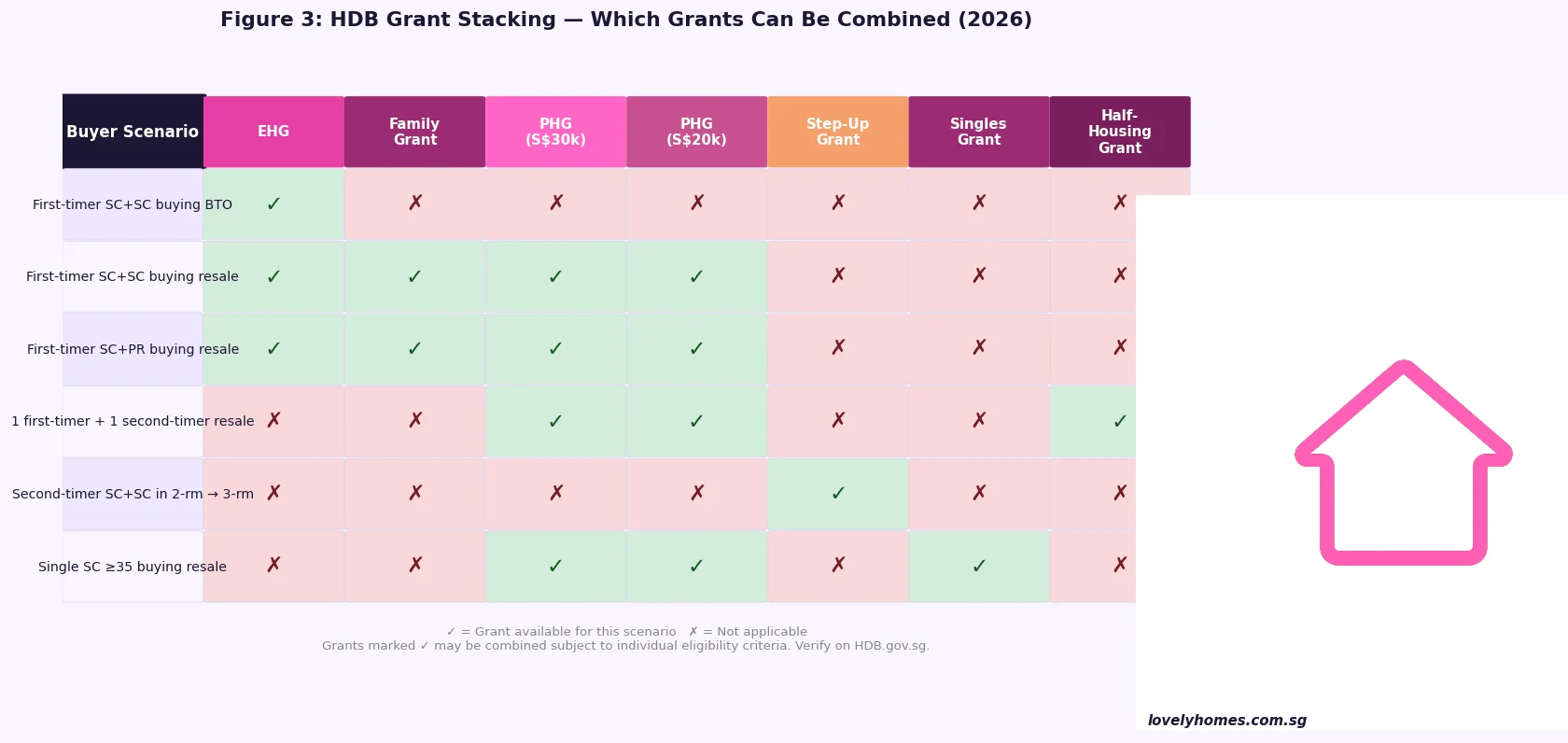
Family Grant (FG): Available for first-timer applicants purchasing resale flats (not new BTO flats). The grant is S$50,000 for SC+SC couples and S$30,000 for SC+SPR couples purchasing a 4-room or larger resale flat; lower amounts for smaller flat types. It stacks with the EHG, bringing total resale grants to S$190,000 for the most eligible SC couple profile (including the Proximity Housing Grant).

Proximity Housing Grant (PHG): Available for first-timers purchasing resale flats near their parents or children (within 4km, or in the same town). The PHG is S$30,000 for living with/near parents, and S$20,000 for those who live near but not with parents. It stacks on top of EHG and FG, making the resale grant quantum potentially larger than BTO for eligible families.

Priority Schemes: How HDB Allocates BTO Flats

HDB BTO priority scheme unit allocation Singapore 2026
Figure 3: Approximate share of BTO units allocated to each priority scheme queue (2026). First-timer applicants in the general ballot receive the lion’s share. Note: HDB adjusts allocations by project type, location, and estate maturity. Source: HDB.gov.sg

Beyond the first-timer vs second-timer distinction, HDB maintains several priority schemes that grant applicants additional ballot chances or reserved unit allocations. Understanding these schemes is important because they can dramatically accelerate a successful application.

Married Child Priority Scheme (MCPS): SC couples where one spouse is a child of SC or SPR parents who are HDB flat owners can apply under MCPS to live with or near their parents. MCPS applicants receive double the ballot chances compared to other first-timers and have access to a reserved quota of flats. This scheme has historically been the single most effective way to improve BTO success odds for eligible couples.

Multi-Generation Priority Scheme (MGPS): Allows parents and a child’s family to simultaneously apply for two flats in the same BTO project. Subject to project availability — MGPS is only offered in select projects.

Third Child Priority Scheme (TCTS): Families with three or more children receive additional ballot chances under this scheme, supporting the government’s pro-family housing policy.

Seniors Priority Scheme: SC seniors aged 55 and above who are current HDB flat owners can apply for 3-room or smaller flats with priority consideration, intended to facilitate right-sizing.

Assisted Living Priority Scheme (ALP): For seniors aged 65 and above who need assisted-living facilities — these applicants ballot for specific assisted-living BTO flats.

Summary Table: HDB BTO Eligibility at a Glance (2026)

Criterion Standard BTO (3-Room+) 2-Room Flexi BTO Executive Condo (EC)
Minimum SC applicants 1 SC required 1 SC required (or single SC ≥35) 1 SC required
Household income ceiling S$14,000/mth No ceiling S$16,000/mth
Minimum age 21 years old 21 (couple) / 35 (single) 21 years old
Private property bar Must not own Must not own Must not own
First-timer benefit Priority ballot + EHG Priority ballot + EHG Priority ballot
Resale Levy applies? If second subsidised flat If second subsidised flat Yes (5% of EC price, capped)
MOP before selling 5 years from key collection 5 years (or lease term) 5 years from TOP

Worked Example: The Rahman and Tan Households

Household A — Rahman family: Mr Rahman (SC, 28) and Ms Siti (SPR, 26), combined income S$7,200/month. They are first-timers (neither has owned a subsidised flat). They apply for a 4-Room BTO flat in Tengah (OCR) priced at S$520,000.

  • Eligibility: SC + SPR couple — eligible. Income S$7,200 < S$14,000 ceiling — eligible. Neither owns private property — eligible. First-timers — priority ballot applies.
  • EHG: At S$7,200/mth, EHG = S$30,000 (SC+SPR reduced rate for SPR spouse).
  • After EHG: Effective purchase price S$490,000.
  • HDB loan (if eligible — SC+SPR eligible if SPR is the secondary applicant): At 80% LTV S$392,000 @2.60% 25yr = S$1,775/mth. MSR 24.7% — PASS (within 30%).
  • Cash required at booking: Option fee S$2,000 (cash); downpayment 20% = S$98,000 (CPF OA); BSD S$10,200 (CPF OA).
  • Estimated TOP: Tengah launches with ~3–4 year construction. Est. key collection mid-2029.

Household B — Tan family: Mr Tan Wei Ming (SC, 35, single), gross income S$6,500/month. He has never owned a flat. He wants to apply for a 2-Room Flexi BTO in Queenstown (Mature Estate).

  • Eligibility: Single SC aged 35 — eligible under SSC Scheme (2-Room Flexi only). No income ceiling for 2-Room Flexi. First-timer — priority ballot applies.
  • EHG (Singles): At S$6,500/mth, EHG for singles = S$15,000.
  • Typical 2-Room Flexi price (Mature Estate): ~S$180,000–S$260,000 depending on lease option (45yr or 65yr) and floor.
  • HDB loan: Eligible. At S$220,000 (after EHG S$205,000) @ 2.60% 25yr = S$928/mth. MSR 14.3% — well within limit.
  • Key consideration: 2-Room Flexi in Mature Estates is typically heavily oversubscribed for singles. Mr Tan may need to apply 2–4 times before receiving a queue number. He can also consider a non-mature estate for a better chance of success.

BTO vs HDB Resale: Which Is Better for Eligibility and Cost?

Both routes have distinct advantages. BTO flats are priced at a discount to the resale market — typically 15–25% below resale market value for equivalent locations — and are newly built. However, BTO requires a waiting period of 3–5 years. Resale flats can be occupied almost immediately after transaction completion, and in some cases attract higher total CPF grants (EHG + Family Grant + PHG can reach S$190,000 for resale, versus S$120,000 EHG cap for BTO). Resale flats also do not restrict the buyer’s income at the point of purchase (the EHG has an income ceiling but the flat itself does not), giving buyers more flexibility.

For couples who cannot wait — for example, those who need immediate accommodation, or who are above the BTO income ceiling but below the resale market grant income ceiling — resale with the Family Grant and PHG can be more financially attractive than waiting for a BTO allocation that may take 18–36 months to secure.

What Might Come Next: BTO Policy Direction in 2H 2026

HDB announced the introduction of the new Standard, Plus, and Prime flat classification in August 2023, replacing the Mature/Non-Mature estate framework. Under this system, Plus and Prime flats carry additional restrictions — a 10-year Minimum Occupation Period (MOP) and a subsidy clawback on resale. As of July 2026, this classification is being applied to all new BTO launches, and buyers should be mindful of the additional restrictions when choosing a Plus or Prime flat project. Industry observers note that the longer MOP and subsidy clawback may reduce the investment appeal of Plus/Prime flats and drive buyers toward Standard flats in non-central estates where no additional restrictions apply.

The October 2026 BTO exercise — expected to include close to 8,000 flats across multiple estates — will be the largest single exercise of the year. HDB has not yet announced confirmed projects, but industry commentary points to likely sites in Woodlands, Tampines, Tengah, and potentially a further tranche of Bishan or Toa Payoh Plus/Prime flats. Applicants should register their interest at HDB’s portal (hdb.gov.sg) when the October exercise is announced.

Frequently Asked Questions

Can a single person under 35 buy an HDB BTO flat in Singapore?

No. Under current HDB rules, a single applicant must be at least 35 years old to apply for a BTO flat under the Single Singapore Citizen (SSC) Scheme, and even then, only for 2-Room Flexi flats. Singles under 35 cannot apply for any HDB BTO flat regardless of income or citizenship status. If you need housing before age 35 and are single, your options include renting privately, purchasing a condominium (if budget allows), or applying for an HDB flat jointly with a family member who qualifies under one of HDB’s other eligible schemes.

What happens if our income exceeds S$14,000 after we have applied for a BTO flat?

HDB assesses income at the time of application. If your household income was within the ceiling at the time you submitted your application and at the time of flat booking, you are eligible even if income subsequently rises above S$14,000 after booking. The income ceiling is not re-assessed at the point of key collection or during the MOP. However, misrepresenting your income at the time of application or booking is a serious offence that can result in HDB compulsorily acquiring your flat.

My spouse is a foreigner (not SPR). Can we apply for a BTO flat together?

No. A SC + foreigner household is not eligible to apply for an HDB BTO flat under any scheme. You can, however, apply under the Non-Citizen Spouse (NCS) Scheme to purchase an HDB resale flat — not a BTO flat — once your spouse has been an SPR or obtained an appropriate long-term pass for a specified period. Your foreign spouse must obtain SPR status before you can jointly purchase a new HDB flat. In the meantime, the Singapore Citizen spouse cannot purchase a BTO flat alone (unless the marriage can be dissolved or the SC applies alone under the SSC Scheme after age 35).

Does owning an overseas property disqualify me from applying for an HDB BTO flat?

Yes. HDB requires that neither the applicant nor any listed household member owns, has sold, or has disposed of a private residential property locally or overseas within 30 months before the BTO application date. An overseas private residential property — for example, a condominium in Malaysia or Australia — counts as a disqualifying interest. You would need to sell the overseas property and ensure the 30-month disposal bar has passed before applying for a BTO flat.

What is the difference between the 2-Room Flexi flat lease options (45-year vs 99-year)?

The 2-Room Flexi flat is designed primarily for singles and seniors. It comes with two lease-term options: a standard 99-year lease (or the remaining lease of the site, whichever is shorter) and a shorter-lease option that can be selected in multiples of 5 years (minimum 15 years, maximum 45 years). The shorter lease is available only to applicants aged 55 and above, and is priced lower accordingly. The shorter-lease flat cannot be sublet, and the reduced lease term limits its resale appeal, but it allows right-sizing seniors to release CPF savings and cash while retaining a place to live for a fixed period.

I was previously an SC PR couple who bought a resale flat. Are we first-timers for the next BTO application?

No. If you used a CPF Housing Grant (including EHG, Family Grant, or any legacy grant) when purchasing your previous resale flat, you are classified as a second-timer for BTO purposes. If you purchased the resale flat without any CPF Housing Grant, you retain first-timer status. Separately, if either of you has ever bought an HDB BTO or DBSS flat directly from HDB, you are a second-timer regardless of CPF grant usage. Second-timers face a much smaller unit allocation ballot and may also be subject to the Resale Levy when booking a new subsidised flat.

Can I use CPF savings to pay for my BTO flat?

Yes. CPF Ordinary Account (OA) savings can be used to pay for the downpayment on a BTO flat, the BSD, and the monthly mortgage instalments — whether you take an HDB concessionary loan or a bank loan. However, ABSD (if applicable — generally not for first-timer BTO buyers) cannot be paid with CPF. There is no cash component mandated for BTO flat purchases taken with an HDB loan; the entire downpayment and instalments can come from CPF OA if your balance is sufficient. For bank loans, a minimum 5% cash downpayment applies, with up to 20% from CPF OA.

Related Articles

Disclaimer

This article is for general informational purposes only and does not constitute professional advice. HDB eligibility rules, income ceilings, CPF Housing Grant amounts, and BTO scheme details are set by HDB and the CPF Board and are subject to change. Always verify current eligibility conditions directly at hdb.gov.sg and cpf.gov.sg before applying for any flat. Readers with complex household circumstances are encouraged to consult HDB directly or seek advice from a registered property agent (CEA-licenced) familiar with HDB transactions.

HDB Resale Flat Eligibility Singapore 2026: Who Can Buy, Income Limits and CPF Grants

HDB Resale Flat Eligibility Singapore 2026: Who Can Buy, Income Limits and CPF Grants

Quick Answer: HDB Resale Flat Eligibility Singapore 2026

  • At least one applicant must be a Singapore Citizen (SC). PR-only households and foreigners cannot buy HDB resale flats.
  • Eligible profiles include SC + SC couples, SC + PR couples, and SC singles aged 35 or above. PR + PR couples may buy only if both have held PR status for at least three years, and they receive no CPF housing grants.
  • There is no income ceiling for the purchase itself — income limits apply only to CPF housing grants, not to eligibility to buy.
  • Maximum CPF grants reach S$200,000 for an SC couple with combined gross monthly income at or below S$4,500 (EHG + Family Grant + Proximity Housing Grant combined).
  • Buyers must not own private property locally or overseas, and must not have disposed of one within the 30 months before the resale application.
  • The resale process typically takes 8–12 weeks from granting the Option to Purchase to key handover.
  • Transaction costs on a S$620,000 4-room resale flat total approximately S$22,390 in one-off fees (BSD, legal, agent, HDB admin, valuation, insurance).

What Is an HDB Resale Flat?

HDB resale flats are public housing units sold on the open market between private buyers and sellers — not by HDB directly — at prices negotiated between the parties. Unlike new Build-To-Order (BTO) flats, which HDB prices at a significant discount to market and allocates by ballot, resale flats are available for immediate purchase without a queue, at market prices that reflect location, condition, remaining lease, and current demand.

Resale flats represent the bulk of Singapore’s secondary residential transaction volume. In the first half of 2026, approximately 12,553 HDB resale transactions were recorded — compared with roughly 4,000–5,000 new BTO flat completions per half-year — making the resale market the primary route to home ownership for buyers who need a flat quickly, who missed a BTO ballot, or who prefer an established neighbourhood over waiting three to five years for a new flat’s completion.

The resale flat market is open to a wider range of buyers than the BTO market. No income ceiling applies to the purchase itself (though grants are income-capped). Certain foreigner-involving family structures — such as an SC married to a non-PR foreigner — are eligible under specific schemes. And the flat can be purchased in any location, any flat type, at any remaining lease length above 20 years (subject to CPF and HDB loan restrictions on shorter leases).

Who Can Buy an HDB Resale Flat? Core Eligibility Conditions

HDB’s eligibility framework for resale flat purchases is built around five core requirements, all of which must be satisfied at the time of application.

1. Singapore Citizenship: At least one applicant must be a Singapore Citizen. Permanent Residents may co-purchase with a SC spouse or parent, or may purchase as a PR couple provided both have held PR status for at least three years. Foreigners — regardless of marital status or length of residence — cannot purchase HDB resale flats.

2. Age: All applicants must be at least 21 years old. SC or PR singles applying under the Single Singapore Citizen Scheme or Joint Singles Scheme must be at least 35 years old at the time of application. Divorcees and widowed persons may apply under the relevant single-person scheme regardless of age, subject to other conditions.

3. Family Nucleus: Applicants must form a recognised family nucleus — typically a married or engaged couple, a parent-child unit, or siblings buying together. SC singles aged 35 or above may purchase a flat of any type except 5-room or larger under the Single Singapore Citizen Scheme.

4. Property Ownership: Applicants must not own any other residential property, whether in Singapore or overseas, at the time of application. If they have disposed of a private property, they must have done so at least 30 months before the HDB resale application date. This rule applies to all applicants listed on the application — including a spouse who owns overseas property.

5. HDB Ownership History: Applicants who have previously purchased a subsidised HDB flat or executive condominium (EC) must have served the full Minimum Occupation Period (MOP) of their current or most recent flat before they can purchase another resale flat. Buyers who have received two or more housing subsidies face additional restrictions.

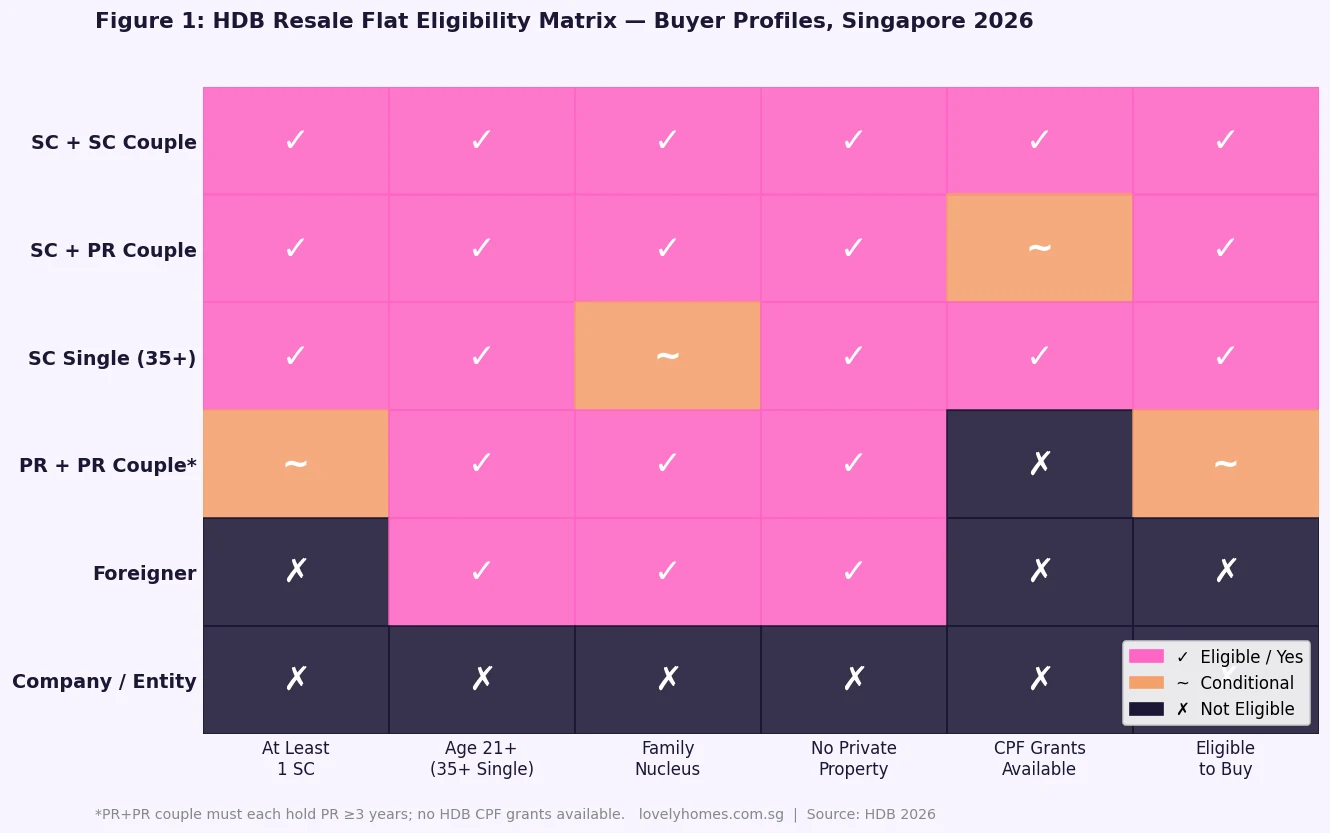
HDB resale flat eligibility matrix buyer profiles Singapore 2026
Figure 1: HDB resale flat eligibility matrix by buyer profile, Singapore 2026. Pink = eligible; orange = conditional; navy = not eligible. *PR + PR couples require both holders to have held PR for at least three years; no CPF grants apply. Source: HDB 2026.

Income Ceiling: For Grants, Not for Purchase

One of the most common misconceptions about HDB resale flat purchases is that an income ceiling applies to eligibility. It does not. Any household that meets the five core conditions above may purchase a resale flat regardless of income — a household earning S$20,000 per month is just as eligible as one earning S$4,000 per month.

Income ceilings apply only to CPF housing grants. The Enhanced Housing Grant (EHG) — HDB’s most generous grant — is available only to households with a combined gross monthly income at or below S$9,000 (couples) or S$4,500 (singles). The EHG tapers on a sliding scale: at the S$4,500 combined-income threshold, an eligible couple receives the maximum S$120,000; at S$9,000, the grant is S$0. Family Grants and Proximity Housing Grants have no income ceiling.

Higher-income households purchasing resale flats at market prices simply forgo the EHG. They remain fully eligible to purchase and may still receive other grants — notably the Family Grant and Proximity Housing Grant — if they qualify by household composition and proximity to parents.

CPF Grants for HDB Resale Flats

CPF housing grants for resale flat purchases are among the most generous in Singapore’s housing policy toolkit, reflecting the government’s intent to keep resale flat ownership accessible to lower- and middle-income households even as market prices have risen through the 2020s.

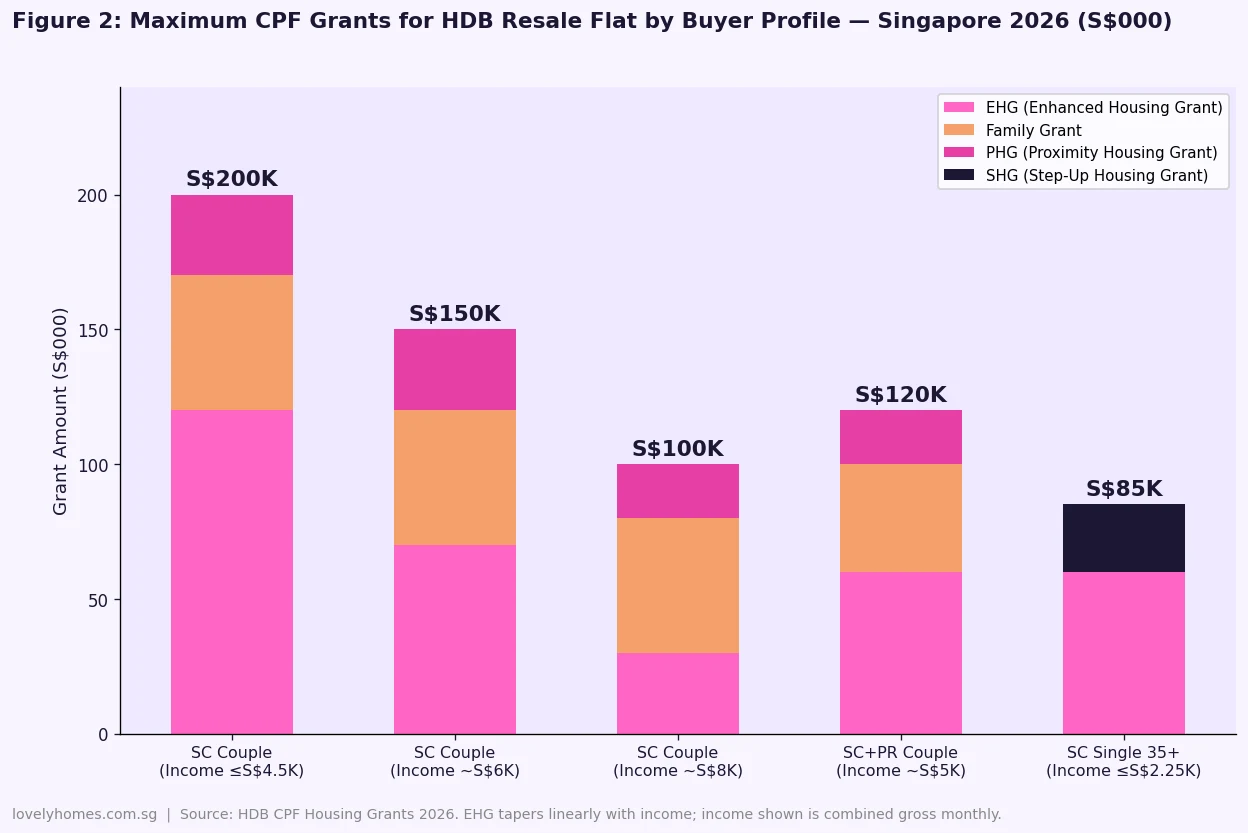
CPF housing grants HDB resale flat by buyer profile Singapore 2026 stacked bar chart
Figure 2: Maximum CPF housing grants for HDB resale flat purchases by buyer profile, Singapore 2026. An SC couple on combined income at or below S$4,500/mth may receive up to S$200,000 in total grants. Source: HDB CPF Housing Grants 2026.

The Enhanced Housing Grant (EHG) is the flagship grant: up to S$120,000 for eligible couples and S$60,000 for eligible singles, disbursed into the CPF Ordinary Account and applied towards the purchase price. The EHG is a first-timer grant — it is available only to buyers who have not previously received any HDB housing subsidy. It applies to both new BTO and resale purchases, making it portable across the two markets.

The Family Grant provides S$50,000 to SC couples (or S$40,000 to SC + PR couples) purchasing a resale flat as first-timers. Unlike the EHG, the Family Grant has no income ceiling — it is available to all eligible first-time SC and SC + PR couples regardless of household income. Eligible flat types are 2-room to 5-room (the grant quantum varies slightly by flat size in some schemes).

The Proximity Housing Grant (PHG) rewards buyers who live with or near their parents or children. S$30,000 is available for buyers moving into the same town or within 2 kilometres of a parent’s home; S$20,000 is available for buyers living within 4 kilometres. The PHG is available to both first-timer and second-timer buyers and has no income ceiling.

The Step-Up Housing Grant provides S$15,000 to eligible public rental flat residents purchasing a 2-room Flexi or 3-room resale flat for the first time, supporting the transition from rental to ownership.

The HDB Resale Process: Step by Step

The resale process follows a structured sequence managed primarily through the HDB Flat Portal. Both buyer and seller must complete their respective steps through the portal; HDB acts as regulator and facilitator rather than direct party to the transaction.

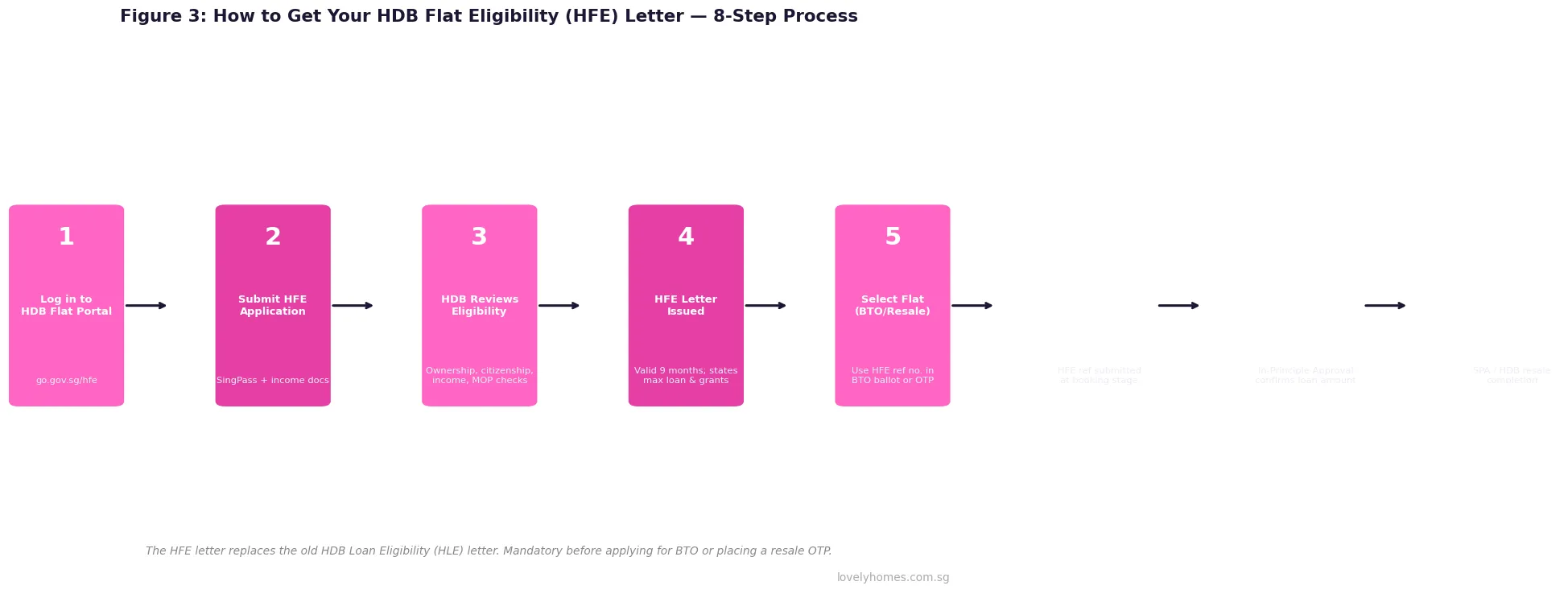
Step 1 — Check eligibility: Buyers should verify their eligibility using HDB’s My Flat Dashboard and, if planning to use an HDB loan, obtain an HDB Flat Eligibility (HFE) letter before starting their search. The HFE letter confirms loan eligibility, grant eligibility, and any existing HDB ownership restrictions.

Step 2 — Secure financing: Buyers using a bank loan should obtain an Approval-in-Principle (AIP) from their chosen bank. This confirms the borrowing quantum and demonstrates financial readiness to sellers. Buyers using an HDB loan must have a valid HFE letter.

Step 3 — View flats and negotiate: Buyers may view flats listed on the HDB Flat Portal, PropertyGuru, or other property listing platforms. Negotiation covers the resale price and, where applicable, a cash premium above valuation (Cash Over Valuation, or COV).

Step 4 — Grant the Option to Purchase (OTP): The seller issues an OTP to the buyer on payment of a 1% option fee (negotiable; capped at S$1,000 for flats priced up to S$100,000 and at S$5,000 for higher-priced flats). The OTP grants the buyer an exclusive right to purchase the flat for 21 days.

Step 5 — Exercise the OTP: Within 21 calendar days, the buyer exercises the OTP by paying an additional 4% exercise fee (making 5% total initial payment). At this stage, both parties must register the OTP exercise on the HDB Flat Portal and submit their respective resale applications simultaneously.

Step 6 — HDB processes the application: HDB verifies eligibility, computes the grant amounts, and appoints a resale completion date. This typically takes four to eight weeks. HDB may request additional documents — CPF statements, income proofs, or statutory declarations — during this period.

Step 7 — Resale completion: On the completion date, the balance of the purchase price is paid (via CPF, HDB loan, or bank loan drawdown), BSD is paid (from CPF or cash), and the property title is transferred. The buyer receives the keys.

Total timeline from OTP grant to key handover: typically 8–12 weeks.

HDB Resale Transaction Costs

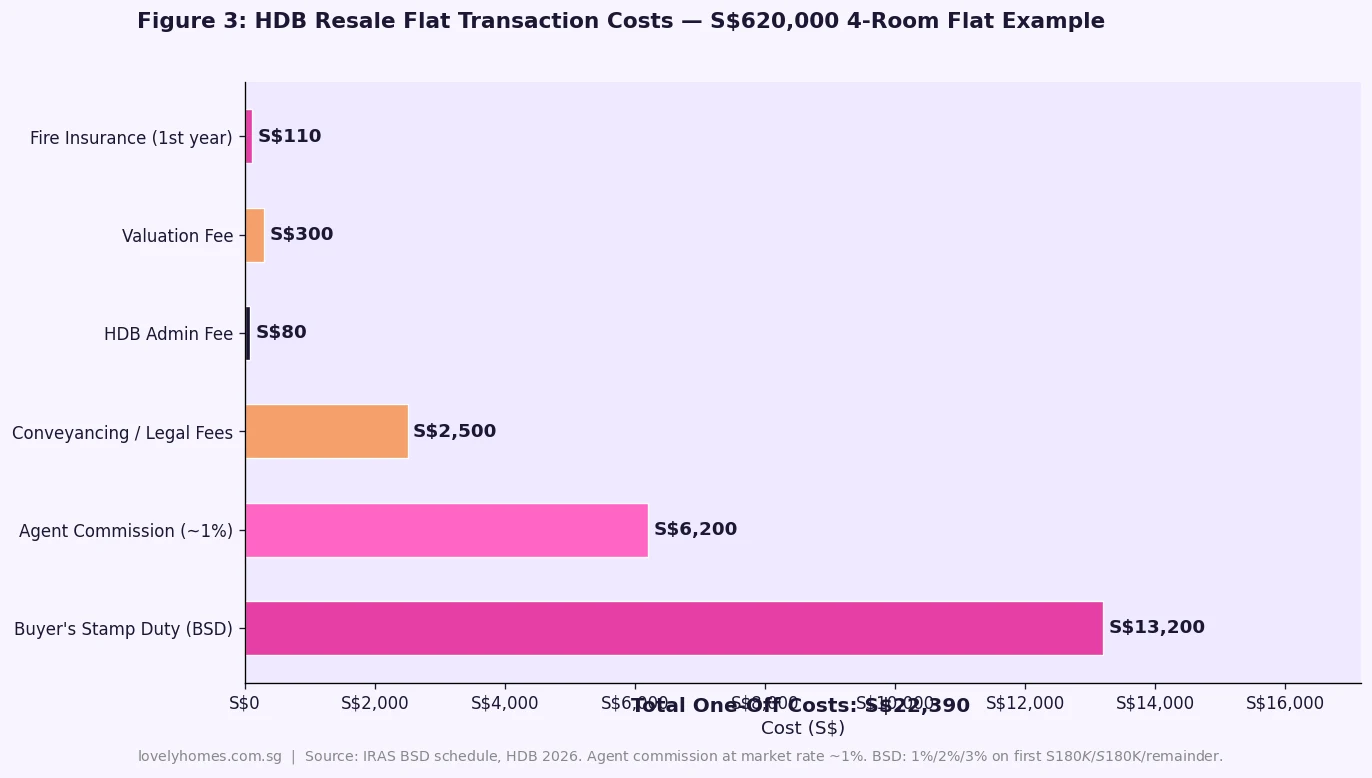
HDB resale flat transaction costs breakdown S$620000 4-room Singapore 2026
Figure 3: HDB resale flat transaction costs — S$620,000 4-room example, Singapore 2026. Total one-off costs approximately S$22,390. BSD computed on the standard IRAS sliding scale. Agent commission at prevailing market rate. Source: IRAS, HDB 2026.

The Buyer’s Stamp Duty (BSD) is the largest one-off transaction cost. BSD is computed on the purchase price (or market value, whichever is higher) using the IRAS sliding scale: 1% on the first S$180,000, 2% on the next S$180,000, and 3% on the remainder up to S$1,000,000. For a S$620,000 flat, BSD is S$13,200 — payable from CPF Ordinary Account.

Conveyancing fees cover the legal cost of transferring title and registering the mortgage. For a S$620,000 resale flat, these typically run S$2,000–S$3,000 depending on the law firm engaged. HDB charges an administrative fee of S$80 for processing the resale application. A formal valuation, if required by HDB or the bank, costs approximately S$200–S$400.

Agent commission — if a licensed agent is engaged — is typically around 1% of the purchase price paid by the buyer (S$6,200 on a S$620,000 flat), though this is negotiable. Many buyers transact directly through the HDB Flat Portal without an agent, particularly for straightforward resale purchases in familiar estates.

Summary: HDB Resale Eligibility at a Glance

Buyer Profile Eligible? HDB Loan? CPF Grants? Max Grants
SC + SC Couple (first-timer) ✓ Yes ✓ Yes EHG + FG + PHG Up to S$200,000
SC + PR Couple (first-timer) ✓ Yes ✓ Yes EHG + FG + PHG Up to S$180,000
SC Single (35+) ✓ Yes ✓ Yes EHG + SHG Up to S$85,000
PR + PR Couple (both 3yr+ PR) ✓ Yes* ✗ No None S$0
Foreigner (any status) ✗ No ✗ No None N/A
Company or Entity ✗ No ✗ No None N/A

*PR + PR couple: both must have held Permanent Residence for at least three years at time of application. No HDB loan or CPF housing grants available. Bank loan only. Source: HDB 2026.

Worked Example: SC + PR Couple Buying 4-Room Resale in Tampines

Mdm Farah (SC, 30) and her husband Ahmad (SPR, 31) have a combined gross monthly income of S$7,200. They wish to purchase a 4-room resale flat in Tampines at S$560,000 to live near Mdm Farah’s parents in the same town.

Eligibility check: SC + PR couple ✓ • Both aged 21+ ✓ • Married (family nucleus) ✓ • No private property locally or overseas ✓ • First-time buyers ✓. Result: Eligible to purchase.

CPF grants:
EHG: combined income S$7,200 (below S$9,000 ceiling) → approximately S$40,000 (SC + PR couple EHG rate; SC + SC couple would receive slightly more).
Family Grant (SC + PR): S$40,000.
Proximity Housing Grant (PHG): living in same town as Mdm Farah’s parents → S$30,000.
Total grants: S$110,000 (disbursed to CPF OA).

Financing: Combined income S$7,200 — below the HDB loan income ceiling of S$9,000 — so an HDB loan is available. LTV 80%. Loan amount = 80% × S$560,000 = S$448,000. Less grants applied to downpayment: S$110,000 exceeds the S$112,000 downpayment required, so the effective loan is S$560,000 − S$110,000 − S$2,000 (option fee already paid) = approximately S$448,000. Monthly instalment at 2.60% over 25 years: approximately S$2,041. MSR: S$2,041/S$7,200 = 28.3% ✓ PASS (below 30% MSR limit).

Transaction costs:
BSD: S$11,400 (1% × S$180K + 2% × S$180K + 3% × S$200K = S$1,800 + S$3,600 + S$6,000) — payable from CPF OA.
Legal fees: S$2,500. HDB admin fee: S$80. Valuation: S$300. Fire insurance: S$110.
Cash required upfront: approximately S$2,990 (option fee S$5,600 less exercise credit; legal + admin + valuation + insurance).

What Might Come Next

HDB resale prices have posted back-to-back quarterly declines in 2026: the Resale Price Index (RPI) fell -0.1% in Q1 2026 and a further -0.3% in Q2 2026 (flash estimate), the first consecutive decline since 2018–2019. Total Q2 transactions of 6,268 were down from the elevated volumes of 2022–2023, and the 1H 2026 total of 12,553 is 8.3% below the 12-month 2025 pace. Full Q2 2026 HDB resale statistics are expected around 23 July 2026 and will provide a more complete picture of price movements by flat type, town, and transaction tier.

HDB’s expanded BTO supply programme — including the newer Plus and Prime classification of flats in better-located estates — may gradually reduce demand pressure on resale flats in sought-after mature estates as more buyers gain access to subsidised options in those locations. However, the five-year MOP on BTO flats means any supply-side relief from Plus and Prime launches in 2024–2026 will only filter into the resale pool from 2029 onwards.

CPF housing grants are unlikely to be reduced in the near term. The government has consistently maintained and expanded the grant framework as a counterbalance to rising resale prices.

Frequently Asked Questions

Can I buy an HDB resale flat if my spouse is a foreigner (not a PR)?

Yes — under the Non-Citizen Spouse Scheme. A Singapore Citizen may purchase a resale flat with a non-citizen, non-PR spouse provided the couple is legally married. The SC spouse must be listed as the primary applicant. Eligible flat types under this scheme are 2-room Flexi to 5-room; Executive flats may not be purchased. The non-citizen spouse is not eligible for CPF housing grants and cannot use their CPF (if any) to finance the purchase. The family must use a bank loan, as HDB loans are not available under this scheme.

What is Cash Over Valuation (COV), and do I have to pay it?

COV is the amount by which the agreed resale price exceeds HDB’s commissioned valuation of the flat. If a flat is valued at S$580,000 but the seller and buyer agree to a price of S$620,000, the COV is S$40,000. COV must be paid entirely in cash — it cannot be financed by CPF, HDB loan, or bank loan, all of which are based on the valuation figure. COV is negotiable between buyer and seller. If the agreed price is at or below valuation, there is no COV. Buyers are not obliged to agree to COV; they may negotiate the price or walk away from a flat where the COV is unacceptable.

Can I use my CPF Ordinary Account to pay for the entire resale flat?

CPF Ordinary Account funds may be used to pay BSD, the downpayment (excluding the minimum cash portion), and monthly mortgage instalments. They cannot be used to pay the option fee, COV, or conveyancing fees. The minimum cash downpayment is 5% of the purchase price for a bank loan or 10% for an HDB loan (though HDB loan allows 10% from any source including CPF). Additionally, if the remaining lease of the flat at the time of purchase is below 60 years, there are stricter limits on CPF usage for older buyers — the CPF withdrawal limit may be reduced proportionally based on the buyer’s age relative to the flat’s remaining lease.

What is the Minimum Occupation Period (MOP) and how does it affect resale eligibility?

The MOP is the minimum period during which a subsidised HDB flat owner must physically occupy their flat before they are permitted to sell it on the open market or purchase private residential property. For most flats, the MOP is five years from the date of key collection (for new BTO flats) or flat completion. Buyers applying to purchase an HDB resale flat who previously owned a subsidised flat must confirm they have completed the MOP on that earlier flat before their application will be approved. If you are currently within your MOP, you cannot simultaneously purchase a resale flat as an investment or a second property — you would need to sell or wait until the MOP is served.

Are resale flats eligible for HDB loans?

Yes, HDB loans are available for resale flat purchases provided eligibility conditions are met. These include: at least one SC applicant; combined gross monthly household income at or below S$9,000; not having previously taken two or more HDB concessionary interest rate loans; and not owning private property. The HDB loan rate is currently 2.60% per annum — pegged at 0.10% above the prevailing CPF OA interest rate — and is fixed for the life of the loan. The LTV for HDB loans is 80%. Buyers who do not meet HDB loan eligibility must use a bank loan, typically at a floating rate linked to the Singapore Overnight Rate Average (SORA).

Can I buy a resale flat and rent it out immediately?

No. You must physically occupy the resale flat as your principal home for the first five years (the MOP) before you may sublet the entire flat. However, you may sublet individual rooms within the flat immediately after purchase, provided you continue to reside in the flat yourself and obtain prior HDB approval for the subletting arrangement. HDB requires that tenants for the entire flat (post-MOP) or individual rooms must be Singapore Citizens, PRs, or certain non-citizens with valid long-term passes — HDB approval is required and tenant details must be registered with HDB within seven days of commencement of tenancy.

Related Articles

Disclaimer: This article is for general information and educational purposes only. It does not constitute legal, financial, or housing advice. HDB eligibility rules, CPF grant amounts, income ceilings, and loan conditions are correct as at 11 July 2026 but are subject to revision by HDB, CPF Board, MAS, and IRAS. Readers should verify all eligibility conditions and grant amounts directly with HDB at hdb.gov.sg and consult a licensed conveyancing solicitor or HDB-appointed solicitor before transacting. BSD rates are set by IRAS at iras.gov.sg.

×
Enlarged view
Click anywhere to close

HDB Resale Procedure Guide 2026: Step-by-Step for Buyers and Sellers

HDB Resale Procedure Guide 2026: Step-by-Step for Buyers and Sellers

Quick Answer: HDB Resale in 2026 — Key Facts

  • Who manages HDB resale: the Housing & Development Board (HDB) via the HDB Resale Portal (my.hdb.gov.sg).
  • Process duration: typically 8–14 weeks from OTP exercise to legal completion.
  • Option to Purchase (OTP): validity up to 21 calendar days; option fee S$1–S$1,000 (non-refundable); exercise fee S$1–S$5,000.
  • Both parties must submit resale application within 7 days of OTP exercise — failure may invalidate the transaction.
  • Grants available: EHG (up to S$120,000), Family Grant (up to S$50,000), Proximity Housing Grant (S$20,000–S$30,000), Singles Grant — subject to eligibility.
  • Minimum Occupation Period (MOP): sellers must have occupied the flat for the MOP (typically 5 years) before listing for resale. Prime and Plus flats have enhanced MOP rules.
  • Ethnic Integration Policy (EIP): buyers must ensure the resale does not breach HDB’s EIP quota for the block and neighbourhood before exercising the OTP.
  • HDB loan vs bank loan: HDB loan offers up to 80% LTV at the concessionary rate (2.6% p.a. as at 2026); bank loans offer up to 75% LTV but competitive variable rates.

What Is the HDB Resale Market?

HDB resale flats are Housing & Development Board flats that have completed their Minimum Occupation Period (MOP) and are being sold by existing flat owners on the open market — as opposed to new BTO (Build-To-Order) or SBF (Sale of Balance Flats) exercises directly from HDB. The resale market offers buyers immediate availability and greater locational choice than BTO exercises, but at higher prices and without the benefit of the new-flat purchase price.

As at the second quarter of 2026, the HDB resale market is active: the HDB regularly publishes resale transaction data showing strong demand across mature and non-mature estates alike. Understanding the resale procedure thoroughly — from the first portal registration through to the handover of keys — is essential for both buyers and sellers navigating this market.

The HDB Resale Portal (accessible via my.hdb.gov.sg with a Singpass login) is the single platform through which all HDB resale transactions are managed. Both buyers and sellers must use this portal, and all key milestones — Intent to Sell, Intent to Buy, resale application, valuation request, and approval confirmation — flow through it.

HDB resale 8-step process guide Singapore 2026

Figure 1: HDB resale transaction — 8 core steps from registration to completion. Source: HDB, LovelyHomes.

Step 1: Register Intent to Sell (Seller) and Intent to Buy (Buyer)

Sellers must register their Intent to Sell (ITS) on the HDB Resale Portal before marketing the flat. This registration is valid for 12 months and can be done at any time — there is no fee. Once the ITS is active, the portal generates an indicative valuation range, a list of financial planning requirements, and eligibility details including whether any co-owners need to be involved. Sellers cannot grant an OTP to a buyer before registering ITS.

Buyers register their Intent to Buy (ITB) on the portal. This is where eligibility checks are made: HDB verifies whether the buyer meets the citizenship and family nucleus requirements, whether the EIP quota is available at the target flat, and whether the buyer has a valid HDB Loan Eligibility (HLE) letter or a bank Approval In Principle (AIP). The ITB is also valid for 12 months.

Both registrations can be done concurrently — buyers and sellers do not need to find each other before registering. In practice, most buyers register ITB first (to get their finances ready) before actively searching for a flat.

Step 2: Secure Financing — HLE Letter or Bank AIP

Before proceeding to the OTP stage, buyers must have their financing in place. There are two routes:

Feature HDB Concessionary Loan Bank Loan
Maximum LTV 80% of lower of valuation/price 75% of lower of valuation/price
Interest rate (2026) 2.6% p.a. (pegged to CPF OA rate + 0.1%) Variable; fixed/floating packages from ~2.5%–3.8% p.a.
MSR limit 30% of gross monthly household income 30% of gross monthly household income (HDB flats)
TDSR 55% (applies in conjunction with MSR) 55%
Cash down payment Minimum 20% (CPF OA can cover) Minimum 25% (5% must be in cash)
Eligibility SC/SC or SC/SPR households; income ceiling S$14,000/mth All eligible flat buyers
Prepayment penalty None Depends on package (typically 1.5% for fixed-rate packages)

A HDB Loan Eligibility (HLE) letter must be obtained from HDB before the buyer can proceed if using an HDB loan. The HLE is valid for 6 months and must be renewed if it lapses before the OTP is exercised. For bank loans, an Approval In Principle (AIP) from the bank serves the equivalent role.

The Mortgage Servicing Ratio (MSR) cap of 30% of gross household income applies specifically to HDB flat purchases. This is more restrictive than the general TDSR of 55% — buyers with higher incomes buying higher-priced resale flats may find the MSR the binding constraint on their loan quantum.

Step 3: Negotiate Price and Grant the Option to Purchase (OTP)

Once buyer and seller agree on a price, the seller issues an Option to Purchase. The OTP is a legally binding option contract: the buyer pays an option fee (S$1 to S$1,000 at the seller’s discretion) in exchange for the right to purchase the flat at the agreed price within the OTP validity period.

The OTP validity period must be at least 7 calendar days and no more than 21 calendar days. This gives the buyer time to exercise the option (i.e., formally commit to buy) while providing a brief cooling-off window. A buyer who decides not to exercise the option forfeits the option fee but has no further obligation to proceed.

Key negotiating points at this stage include: whether the seller agrees to include any fittings (air-conditioners, kitchen cabinets, curtain tracks), the completion timeline, and the allocation of expenses such as property tax for the partial year. These should be documented in the OTP or in a separate Schedule of Fixtures.

Step 4: Exercise the Option to Purchase

To exercise the OTP, the buyer signs the OTP and pays the exercise fee (S$1 to S$5,000) to the seller. Once exercised, the transaction is legally binding on both parties — neither party can withdraw without facing legal consequences. The exercise fee forms part of the overall purchase price (i.e., it is not a separate cost on top of the agreed price).

Before exercising, the buyer should: (a) confirm the EIP quota is available (this can be checked on the HDB Resale Portal using the flat’s postal code), (b) confirm the flat’s resale levy status if upgrading from a subsidised flat, and (c) confirm the CPF and cash amounts needed for completion. Exercising the OTP without completing these checks can result in a failed transaction and forfeiture of the exercise fee.

HDB resale transaction timeline weeks end to end Singapore 2026

Figure 2: Typical HDB resale timeline — ~14 weeks end-to-end from registration to completion. The longest phase is HDB processing (5–8 weeks). Source: HDB, LovelyHomes.

Step 5: Submit Resale Application (Both Parties, Within 7 Days)

After the OTP is exercised, both the buyer and seller must each submit their respective halves of the resale application on the HDB Resale Portal within 7 days of the OTP exercise date. This is a strict requirement — failure by either party to submit within 7 days may cause the application to lapse and require the OTP to be re-issued.

The buyer’s application requires: confirmation of financing (HLE letter or bank AIP), CPF withdrawal details, grant applications (EHG, Family Grant, etc.), and SPR/citizenship verification. The seller’s application requires: confirmation of bank loan redemption details (if there is an outstanding mortgage), CPF refund instructions, and details of any co-owners.

HDB will send an SMS or email to both parties confirming receipt of the complete application and providing an estimated processing timeline.

Step 6: HDB Valuation and Financial Endorsement

For buyers using an HDB concessionary loan, HDB commissions an official valuation of the flat. This valuation determines the loan quantum and the maximum CPF amount that may be used — the LTV ceiling is applied against whichever is lower, the agreed price or the HDB valuation. If the agreed price exceeds the HDB valuation (i.e., there is a Cash-Over-Valuation, or COV), the excess must be paid entirely in cash — CPF cannot be used for COV.

Cash-Over-Valuation became a significant market dynamic in the 2021–2023 resale boom, when median COV for 4-room resale flats in mature estates reached S$30,000–S$60,000. In a more moderate 2026 market, COV remains common in sought-after areas (central districts, near MRT) but has compressed from peak levels.

For bank loan buyers, the bank conducts its own valuation for lending purposes. The buyer should discuss the valuation outcome with the bank’s mortgage specialist before endorsing the financial plan.

Step 7: Resale Approval by HDB

HDB processes the resale application and checks that all eligibility conditions are met: flat ownership rules, EIP compliance, income ceiling (for grants), CPF withdrawal limits, MOP completion, and resale levy (if applicable for second-subsidised-flat buyers). Processing typically takes 5–8 weeks from the complete application date.

HDB notifies both buyer and seller by SMS and email once the resale is approved in principle and a completion appointment is set. At this stage, the conveyancing lawyers for both parties also receive documents to prepare for the transfer of title at completion.

Step 8: Completion Appointment at HDB Hub

The final step is the completion appointment, held at HDB Hub in Toa Payoh (or virtually for eligible straightforward cases). At this appointment:

  • Buyer and seller (or their lawyers) sign the Transfer Deed transferring ownership.
  • CPF refunds to the seller’s CPF OA account are processed (CPF monies used toward the original flat purchase must be returned with accrued interest).
  • The sale proceeds (net of CPF refund, outstanding mortgage redemption, and any resale levy) are disbursed to the seller.
  • Stamp duties (BSD, and ABSD if applicable) are confirmed as paid.
  • Keys are handed over, and the buyer takes possession of the flat.

The entire process from OTP exercise to completion typically takes 8–12 weeks, though complex cases (outstanding mortgage redemptions, CPF disputes, estate matters) may take longer.

HDB resale buyer upfront cost breakdown Singapore S$550,000 flat 2026

Figure 3: Typical upfront costs for a buyer of a S$550,000 4-room HDB resale flat — excluding grants and CPF housing schemes. Source: HDB, IRAS, LovelyHomes calculations.

HDB Resale Grants: Reducing Your Out-of-Pocket Cost

Eligible first-timer buyers of HDB resale flats may receive substantial CPF grants from HDB to reduce the effective purchase price. The main grants in 2026 are:

Grant Maximum Amount Key Eligibility Conditions
Enhanced CPF Housing Grant (EHG) S$120,000 (families); S$60,000 (singles) At least one first-timer applicant; monthly household income ≤ S$9,000 (families) or ≤ S$4,500 (singles); must buy flat that meets income-tiered price ceiling
Family Grant S$50,000 (SC/SC, 4-room and smaller); S$40,000 (SC/SC, 5-room and larger) At least one SC applicant; first-timer buying with SC or SPR spouse/fiancé; income ≤ S$14,000/mth
Half-Housing Grant S$25,000 (4-room and smaller); S$20,000 (5-room and larger) One first-timer, one second-timer applicant in the same household
Proximity Housing Grant (PHG) S$30,000 (moving to be near parents/children within 4km) SC or PR; living within 4km or in the same town as parents or married child; conditions apply
Singles Grant S$40,000 (SC, 4-room and smaller); S$25,000 (SC, 5-room and larger) Singapore Citizen aged 35+; first-timer single; resale flat only; income ≤ S$7,000/mth

Grants are disbursed directly by HDB into the buyer’s CPF OA account and can only be used toward the flat purchase — they cannot be withdrawn as cash. Buyers who receive grants are subject to a resale grant clawback if they sell the flat within 5 years of the grant. Planning the long-term holding horizon is therefore important when maximising grants.

Worked Example: Mr and Mrs Tan’s First HDB Resale Flat

Case Study — 4-room Jurong West Resale, S$550,000

Profile: Mr Tan (SC, 29) and Mrs Tan (SC, 28), first-timer household, combined gross income S$7,500/mth, no existing property.

Target flat: 4-room HDB resale in Jurong West (District 22), agreed price S$550,000. HDB valuation: S$545,000. COV = S$5,000 (to be paid in cash).

Grants:

  • EHG: income S$7,500/mth → S$55,000 (income band S$7,001–S$8,000 for families)
  • Family Grant (SC/SC, 4-room): S$50,000
  • Total grants: S$105,000 — credited to CPF OA

Effective purchase cost after grants: S$550,000 − S$105,000 = S$445,000

Financing: HDB loan at 80% of S$545,000 (valuation) = S$436,000 maximum; MSR check: S$436,000 at 2.6% over 25 years ≈ S$1,982/mth. MSR = 30% × S$7,500 = S$2,250. S$1,982 ≤ S$2,250 → MSR PASS.

Upfront cash/CPF needed (excluding grants):

  • Down payment (20% of S$545,000 valuation): S$109,000 — payable from CPF OA or cash
  • COV: S$5,000 — must be cash (cannot use CPF for COV)
  • BSD: (S$180k×1%) + (S$180k×2%) + (S$190k×3%) = S$1,800 + S$3,600 + S$5,700 = S$11,100 (payable via CPF OA)
  • Legal fees (buyer’s conveyancing): ~S$2,500
  • OTP option fee (non-refundable): up to S$1,000
  • Total cash minimum: ~S$8,500 (COV + legal + option fee)
  • CPF OA used: ~S$109,000 + S$11,100 = S$120,100 (offset by S$105,000 grants → net CPF outflow ~S$15,100 if grants insufficient; actual depends on existing CPF OA balance)

This illustrates why first-timer couples with combined income around S$7,500/mth can often purchase a resale 4-room flat in a non-mature estate with relatively modest cash upfront, provided grants are maximised.

What This Means for Buyers and Sellers in 2026

The HDB resale market in mid-2026 is characterised by solid but moderating demand. With the BTO backlog largely cleared and significant new flat supply coming onstream, buyers have more choices than in the 2021–2022 peak. Resale prices in non-mature estates such as Jurong West, Woodlands, and Sengkang have stabilised or softened modestly, while mature estates — particularly those near Thomson-East Coast Line (TEL) stations — continue to command premiums.

For sellers, the 14-week timeline to completion means planning is critical, especially if the sale proceeds are needed to fund a new home purchase. Sellers should align OTP issuance with their own housing timeline to avoid a gap period. Where a new purchase is concurrent, engaging a conveyancing lawyer who can coordinate both transactions is strongly recommended.

For buyers, the combination of a higher-priced resale market and HDB’s 80% LTV cap means the absolute cash and CPF commitment is substantial. Maximising eligible grants — particularly the EHG and Family Grant — is the single most effective way to reduce upfront costs. Buyers should apply for the HLE letter well in advance and factor in the COV risk for popular precincts.

What Might Come Next

The following is analytical commentary based on publicly available signals — not official guidance.

HDB’s June 2026 BTO exercise produced 6,952 flats across 7 projects, with the Prime-classified Berlayar Rise (Bukit Merah) oversubscribed at 4.5× and Lakeview Cascadia (Bishan) at 4.7×. The continued strong demand for Prime and Plus flats signals that buyers remain willing to accept the enhanced MOP and clawback conditions for well-located flats. Over the medium term, as these new Prime/Plus flats reach their MOP in the early 2030s, they will add an entirely new tier of resale transactions subject to the Prime/Plus resale conditions — including clawback on subsidy.

HDB has signalled it will continue to release BTO supply at elevated levels to address the demand backlog. As supply catches up with demand over 2026–2028, resale prices — particularly in non-mature estates — are expected to moderate gradually. Buyers with a long-term horizon and flexibility on location have a strengthening case to wait for upcoming BTO exercises, while those needing immediate occupation continue to turn to the resale market.

Frequently Asked Questions

Can I buy an HDB resale flat without an HLE letter?

Yes — if you are using a bank loan rather than an HDB concessionary loan, you do not need an HLE letter. You would instead provide your bank’s Approval In Principle (AIP) letter as part of the resale application. However, you will need to have registered your Intent to Buy on the HDB Resale Portal and confirmed your financing method before the OTP is issued. If you wish to switch from a bank loan to an HDB loan at any point before completion, you would need to obtain an HLE letter at that stage — switching mid-way can delay the completion timeline.

What is Cash-Over-Valuation (COV) and how does it affect my purchase?

Cash-Over-Valuation (COV) is the difference between the agreed resale price and the HDB or bank valuation of the flat, when the agreed price is higher than the valuation. Because CPF and HDB loan proceeds are capped at a percentage of the lower of the valuation or the agreed price, any COV must be paid entirely in cash. For example, if the agreed price is S$680,000 but HDB’s valuation is S$650,000, the S$30,000 COV must be paid in cash. Buyers should budget for COV when purchasing in popular precincts where demand regularly pushes prices above HDB’s assessed value — checking recent transaction prices on the HDB website before negotiating helps set realistic expectations.

What happens if the HDB resale application lapses?

An HDB resale application lapses if both parties do not submit within 7 days of the OTP exercise, or if required documents are not provided within HDB’s stipulated timeframe. A lapsed application means the transaction does not proceed; the seller is not obligated to return the option fee and exercise fee, and both parties may face legal liability depending on which party caused the lapse. To prevent this, ensure both parties understand the 7-day submission window, and engage conveyancing lawyers before the OTP is exercised — they can guide both parties through the submission process efficiently.

How long does a seller have to vacate the flat after completion?

The transfer of possession happens at the completion appointment. From the completion date, the seller is typically required to vacate the flat immediately or within a very short grace period agreed in the OTP. In practice, seller and buyer may negotiate a short leaseback arrangement (where the seller continues to occupy for a few weeks post-completion as a tenant) if both parties agree and the terms are documented. Such arrangements must be disclosed to HDB as they may affect certain ownership rules. The flat must be vacant and in the agreed condition (with agreed fittings left in place) by the agreed possession date.

Can a Singapore Permanent Resident (SPR) buy an HDB resale flat?

Yes, Singapore Permanent Residents may purchase HDB resale flats — but with important restrictions. An SPR cannot buy an HDB resale flat alone; they must purchase with an SC spouse, child, or parent (i.e., the household must include at least one SC under the family scheme). SPRs applying under the Non-Citizen Spouse Scheme or the Non-Citizen Family Scheme with at least one SC member can proceed. Fully SPR households (no SC member) cannot buy HDB resale flats. SPRs also pay ABSD on the resale purchase (5% for an SPR purchasing a first residential property), while SCs buying their first residential property pay no ABSD.

What is the Resale Levy and when does it apply?

The HDB Resale Levy is a levy payable by second-timer buyers — those who have previously purchased a subsidised HDB flat (BTO, DBSS, or bought a resale flat with CPF housing grants) and now wish to purchase a second subsidised flat. The levy ranges from S$15,000 (2-room) to S$55,000 (5-room), must be paid in cash (not CPF), and is deducted from the sale proceeds of the first flat if the first flat is sold to HDB. The resale levy applies regardless of whether the second purchase is a BTO or a resale flat purchased with grants. Detailed levy amounts by flat type are covered in our dedicated HDB Resale Levy guide.

Do I need a lawyer for an HDB resale transaction?

Yes. Both buyer and seller in an HDB resale transaction are required to engage licensed conveyancing lawyers to represent their respective interests. Lawyers handle the OTP preparation and review, HDB portal submissions, CPF withdrawal applications, BSD and ABSD stamping, title transfer documentation, and coordination with the seller’s bank (for mortgage redemption). HDB maintains a list of conveyancing law firms and recommended panels for HDB transactions. Legal fees for an HDB resale transaction typically range from S$1,800 to S$3,000 for standard cases.

Related Articles

Disclaimer

This article is for general informational purposes only and does not constitute legal, financial, or housing advice. HDB resale eligibility criteria, grant amounts, interest rates, MOP requirements, and administrative procedures are set by the Housing & Development Board (HDB), IRAS, and the CPF Board and may change without prior notice. Readers should refer to official sources — www.hdb.gov.sg, www.iras.gov.sg, and www.cpf.gov.sg — for authoritative and up-to-date information. Before any property transaction, consult a licensed conveyancing solicitor and a qualified financial adviser.

Singapore HDB Grants Guide 2026: EHG, Family Grant, PHG and All CPF Housing Grants Explained

Singapore HDB Grants Guide 2026: EHG, Family Grant, PHG and All CPF Housing Grants Explained

⚡ Quick Answer — HDB CPF Housing Grants at a Glance (2026)

  • Enhanced CPF Housing Grant (EHG): up to $120,000 for eligible couples; $60,000 for singles — applies to both BTO and resale flats, income ceiling $9,000/mth (couple).
  • CPF Family Grant (FG): $50,000–$60,000 for eligible SC-SC couples buying a resale flat; no income ceiling applies.
  • Proximity Housing Grant (PHG): up to $30,000 to live with or near parents/children — resale flats only.
  • Grants can be stacked: a first-timer SC couple buying a resale flat near parents could qualify for EHG + FG + PHG = up to $160,000 in total grants.
  • Grants are credited to CPF Ordinary Account (OA) and deducted from the purchase price; they reduce your outstanding loan and accrued interest.
  • Second-timers may still access PHG (resale only) and a reduced FG if one party is a first-timer.
  • All grants are administered by HDB and disbursed via CPF Board — you apply through the HDB Flat Portal after obtaining an HDB Flat Eligibility (HFE) letter.

What Are CPF Housing Grants?

CPF housing grants are cash subsidies that the Singapore Government channels through the Central Provident Fund (CPF) Ordinary Account to help eligible buyers afford Housing & Development Board (HDB) flats. Unlike the earlier Building & Construction Authority rebates or direct handouts, these grants go directly into the buyer’s CPF OA and are credited against the flat’s purchase price — reducing the loan quantum and, over the life of the mortgage, the accrued interest the buyer ultimately owes CPF.

The grant framework has evolved significantly since the early 2000s. The Additional CPF Housing Grant (AHG) and Special CPF Housing Grant (SHG) were consolidated and superseded on 11 September 2019 by the Enhanced CPF Housing Grant (EHG), which provides a single, tiered subsidy that scales down with household income. The Family Grant and Proximity Housing Grant, both introduced in 2015 for resale flat buyers, remain active. Together, these three grant streams — EHG, FG, PHG — form the backbone of Singapore’s HDB affordability architecture in 2026.

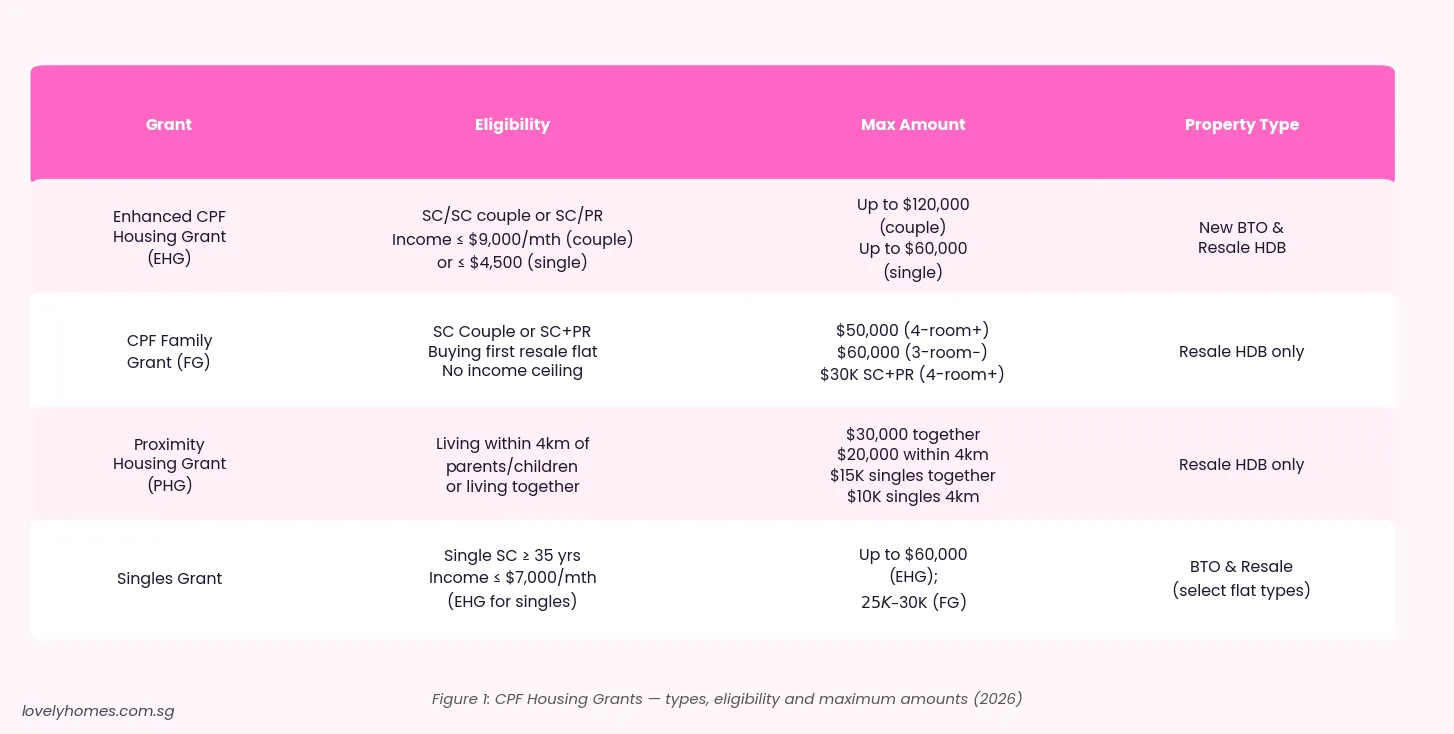
CPF housing grants types eligibility and maximum amounts Singapore 2026 table
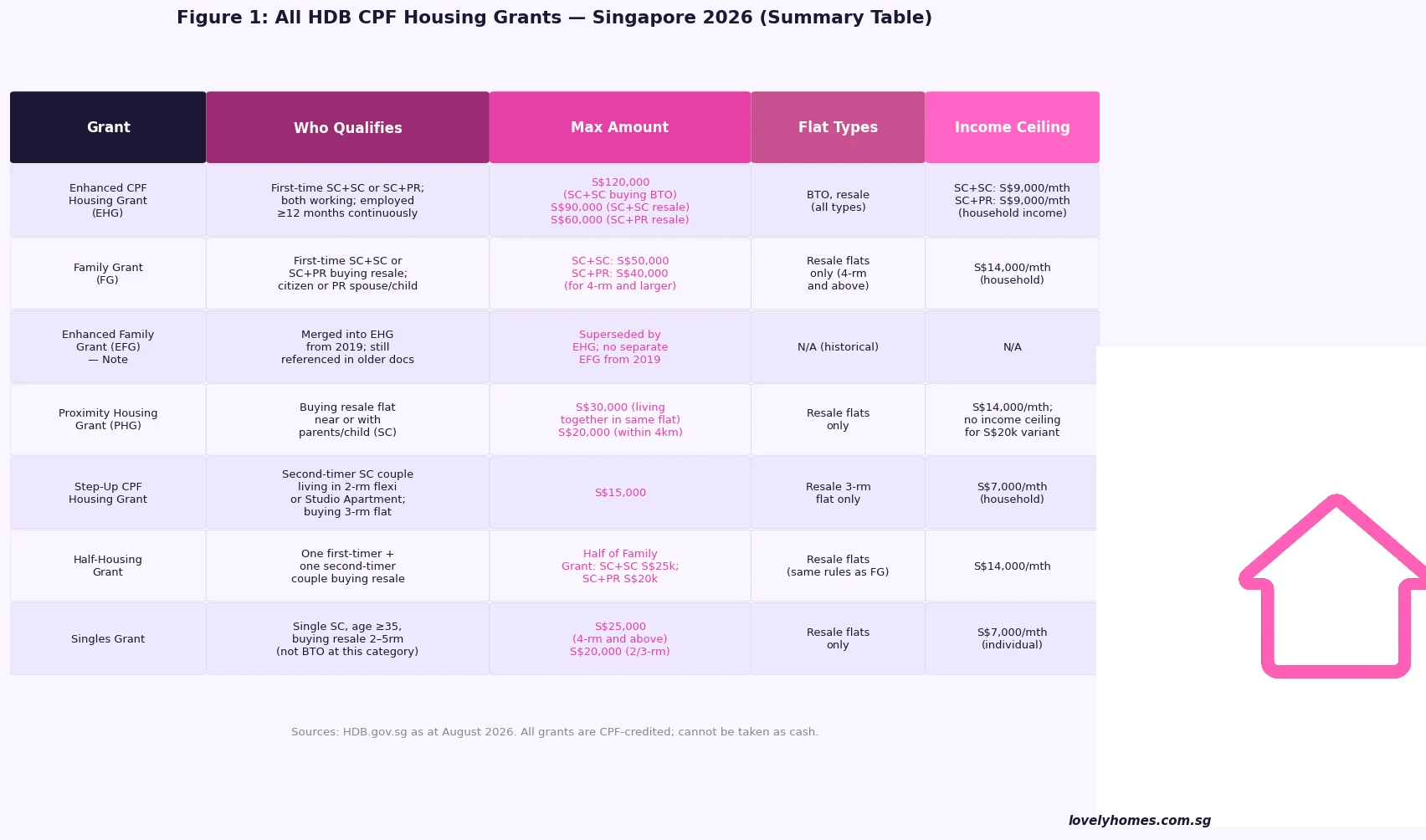
Figure 1: CPF Housing Grants — types, eligibility and maximum amounts (2026). Source: HDB Singapore.

Enhanced CPF Housing Grant (EHG) — The Foundation Grant

The EHG, introduced in September 2019, is the primary income-based subsidy for first-timer buyers. Unlike its predecessors, the EHG applies to both new BTO flats and resale flats, eliminating a long-standing disparity where resale buyers received less support than BTO buyers. HDB administers the scheme; CPF Board disburses the funds.

EHG Eligibility Criteria

To qualify for EHG, the household must meet all of the following:

Criterion Couples / Families Singles (≥ 35 years old)
Citizenship At least one Singapore Citizen Singapore Citizen
Gross Monthly Income ≤ $9,000/month ≤ $4,500/month
Prior Housing Grant Must not have received AHG or SHG previously Same
Flat Type (BTO) Any HDB flat type (2-room Flexi to 5-room) 2-room Flexi (BTO) only
Flat Type (Resale) Any eligible resale flat 2-room or 3-room resale only
Continuous Employment At least one applicant employed for ≥ 12 months continuously Same

The EHG quantum scales inversely with income: buyers at the bottom of the income band receive the maximum grant, while those approaching the $9,000 ceiling receive the minimum. The grant is calculated based on the average gross monthly household income over the preceding 12 months.

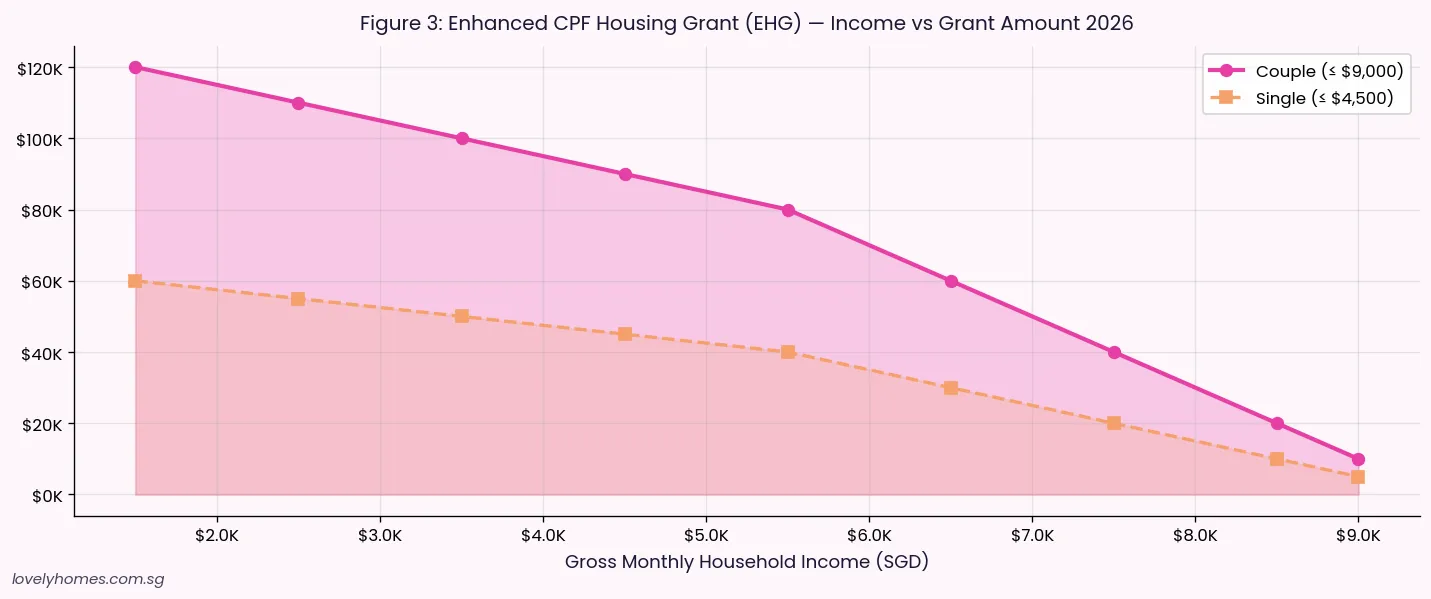
Enhanced CPF housing grant EHG income ceiling versus grant amount Singapore 2026
Figure 3: Enhanced CPF Housing Grant (EHG) — income versus grant amount for couples and singles (2026). Source: HDB Singapore.

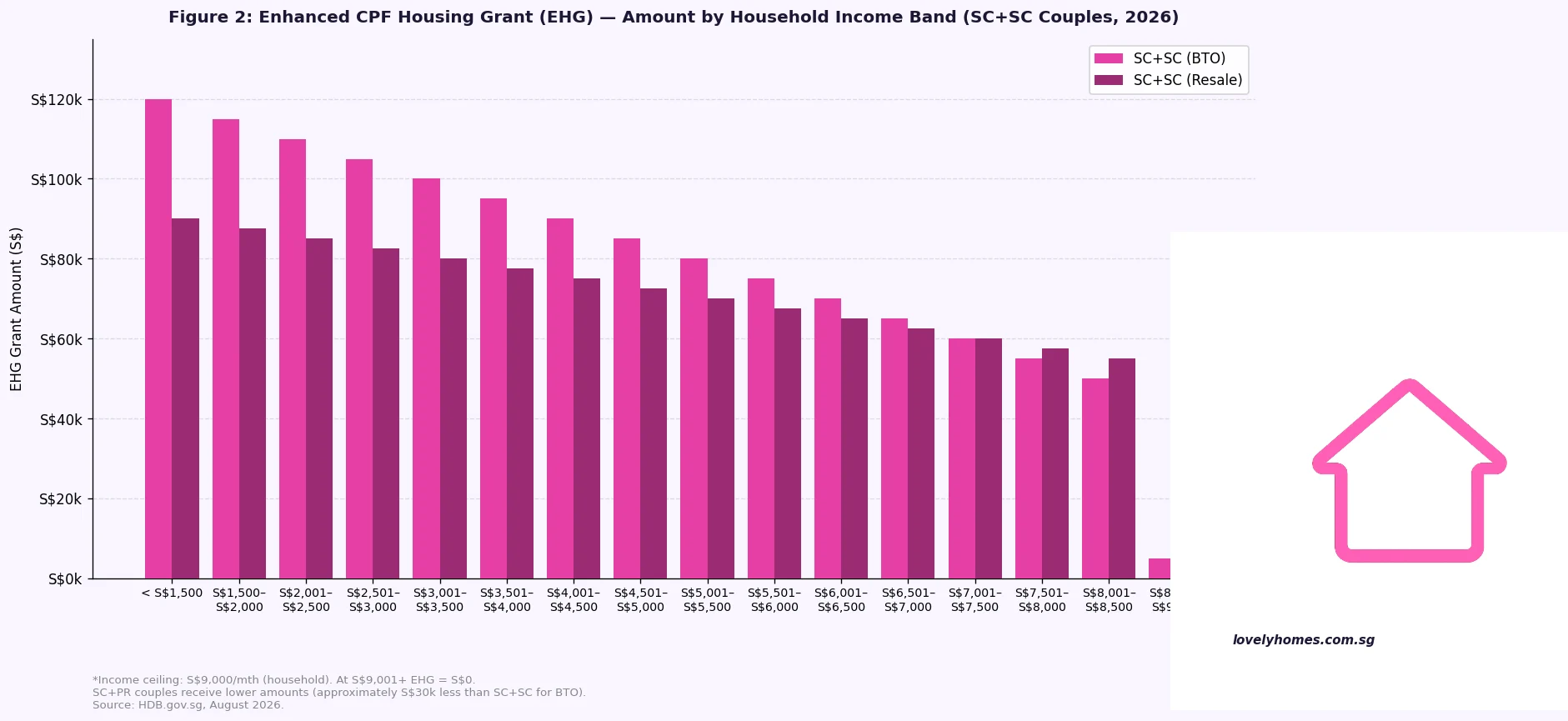
EHG Grant Amounts

For couples with a household income at or below $1,500/month, the maximum EHG is $120,000. The grant steps down by $5,000 for every additional $500 in household income until it reaches a minimum of $5,000 at the $8,500–$9,000 income band. Singles receive exactly half the couple quantum at each band (maximum $60,000 at ≤$750/month income). The EHG is credited to the buyer’s CPF OA and applied to the purchase price at completion.

CPF Family Grant (FG) — For Resale Flat Buyers

The CPF Family Grant targets first-timer buyers purchasing a resale HDB flat and does not have an income ceiling — making it accessible to middle-income households that earn too much for the EHG. The Family Grant replaced the Additional CPF Housing Grant (Resale) in 2015 and has remained structurally unchanged since.

Family Grant Amounts by Flat Type and Household Composition

Buyer Profile Resale Flat ≤ 3-room Resale Flat 4-room+
SC + SC Couple (first-timer) $60,000 $50,000
SC + PR Couple (first-timer SC) $40,000 $30,000
SC Single (≥ 35 yrs, first-timer) $30,000 $25,000

Where one spouse is a second-timer and the other is a first-timer, the couple may receive half the applicable Family Grant. The Family Grant is not available for BTO flats — that distinction is important for buyers weighing resale against new launches.

Proximity Housing Grant (PHG) — Living Near Loved Ones

The Proximity Housing Grant encourages multi-generational living arrangements by subsidising buyers who choose to live with, or within 4 kilometres of, their parents or children. Available for resale flats only, it was introduced in 2015 to address Singapore’s social goal of strengthening family ties and providing informal eldercare support networks.

PHG Amounts

Living Arrangement SC-SC Couple SC-PR or Single
Living with parents / child (in same flat) $30,000 $15,000
Living within 4 km of parents / child $20,000 $10,000

The PHG is granted based on the residential address of the parent or child at the time of application. There is no income ceiling. However, buyers must satisfy a 5-year occupation requirement: if they move away from the stated proximity within 5 years of flat completion, the grant is subject to clawback by HDB.

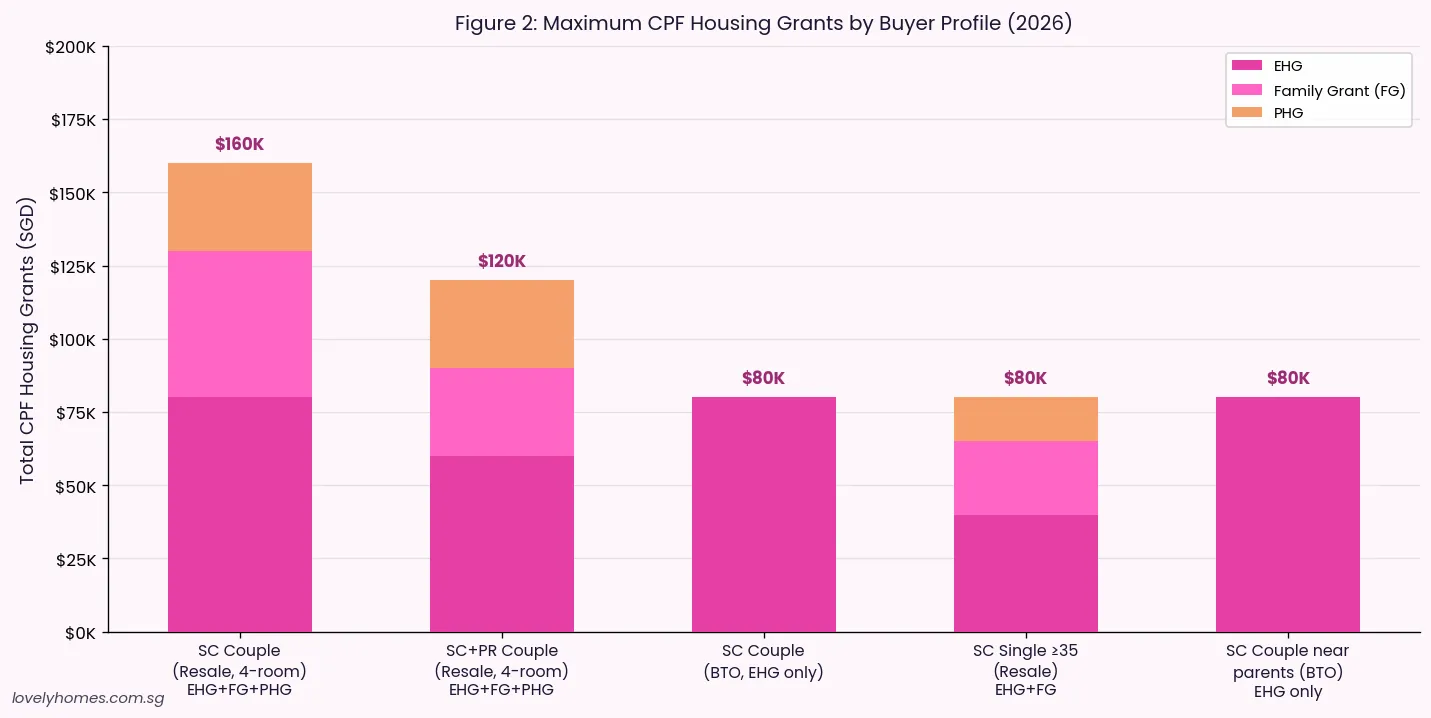
Maximum CPF housing grants by buyer profile Singapore 2026 bar chart EHG family grant PHG
Figure 2: Maximum CPF Housing Grants by buyer profile — EHG, Family Grant and PHG stacked (2026). Source: HDB Singapore.

Step-Up CPF Housing Grant (SHG)

The Step-Up CPF Housing Grant is a smaller, targeted subsidy of up to $15,000 for second-timer households who currently live in 2-room flats and are upgrading to a larger BTO flat (3-room or bigger) in a non-mature estate. Unlike EHG, FG and PHG — which are first-timer grants — SHG is specifically for second-timers making an upward move. The household income ceiling for SHG is $7,000 per month.

SHG is far less commonly used than the three main grants, but it plays an important role for low-income second-timer families who need more space but cannot afford private property.

Summary: All HDB Grants at a Glance

Grant Max Amount Income Ceiling BTO? Resale? First-timer?
EHG (couple) $120,000 $9,000/mth Yes
EHG (single) $60,000 $4,500/mth ✓ (2-room) ✓ (≤3-room) Yes
Family Grant (SC-SC) $60,000 None Yes (both)
Family Grant (SC-PR) $40,000 None Yes (SC spouse)
Proximity Housing Grant $30,000 None Both tiers
Step-Up Grant (SHG) $15,000 $7,000/mth ✓ (≥3-room) Second-timer

Worked Example: How Much Can a First-Timer Couple Receive?

📺 Case Study — the Wong Family

Profile: Mr and Mrs Wong, both Singapore Citizens, both first-timers. Combined gross income $6,200/month. Buying a 4-room resale flat in Ang Mo Kio for $650,000. Mrs Wong’s parents live in the same estate (within 4 km).

EHG: Income $6,200 → falls in $6,000–$6,500 band → EHG = $60,000.

Family Grant (FG): SC-SC couple, 4-room resale → $50,000 (no income ceiling).

Proximity Housing Grant (PHG): Living within 4 km of Mrs Wong’s parents → $20,000.

Total grants = $130,000 credited to their combined CPF OA.

Effective purchase price: $650,000 − $130,000 = $520,000.

HDB Loan (80% LTV on $520,000 effective): $416,000. Monthly instalment at 2.60% p.a. over 25 years ≈ $1,886/month. MSR check: $1,886 / $6,200 = 30.4% — marginally above 30% MSR. The couple reduces their loan to $390,000 using additional CPF savings, bringing the monthly instalment to $1,770/month (MSR 28.5%, PASS).

Key takeaway: Without the grants, the Wongs would need a $520,000 loan; with grants, their effective loan burden drops by 25%. Grants reduce lifetime accrued interest by an estimated $48,000 over 25 years.

Why Housing Grants Matter for Singapore’s Property Affordability

Singapore’s CPF housing grant framework is one of the most generous owner-occupier subsidy systems in developed Asia. The EHG alone — at up to $120,000 for eligible couples — represents roughly 15%–20% of the purchase price of a 4-room or 5-room flat in many non-mature estates. When stacked with the Family Grant and PHG, the aggregate subsidy can exceed $160,000, decisively reducing the loan quantum and monthly servicing burden for lower- and middle-income families.

The policy rationale is threefold. First, it sustains home-ownership rates: Singapore’s resident home-ownership rate has remained above 88% for over two decades, among the highest globally, partly because of demand-side grants that reduce the effective cost to buy. Second, grants embedded in CPF rather than cash reduce the risk of inflation in the resale market — sellers cannot directly “see” the grant quantum and adjust prices accordingly in the way they might with a cash handout. Third, by tiering EHG to income and removing the income ceiling on FG, HDB broadens access across the income spectrum: lower-income families get the largest EHG; middle-income families (who earn too much for EHG) still benefit from FG.

The PHG specifically addresses Singapore’s demographic challenge: with a rapidly ageing population, encouraging younger families to live near or with their parents reduces formal eldercare costs while maintaining social cohesion in mature estates. HDB data has historically shown a meaningful uptick in resale transaction volumes in estates with a large elderly population whenever PHG quantum is adjusted upward.

What Might Come Next: Grant Outlook

The EHG has not been adjusted since its introduction in September 2019. With Singapore’s median household income rising steadily — the median resident household income grew from $9,520 in 2019 to approximately $11,200 by 2025 — the real coverage of the EHG income ceiling has gradually eroded. An increasing share of first-timer households now earn above $9,000/month and are therefore ineligible for EHG even for their first BTO flat.

Industry observers anticipate that the next round of grant revisions could raise the EHG income ceiling or adjust the grant quantum bands, possibly linked to a broader review of BTO pricing and the housing affordability framework. HDB has historically reviewed grant levels every five to seven years. With the next review potentially due in 2025–2027, buyers with incomes close to the current ceilings should monitor MND/HDB announcements closely. Any upward revision to EHG or FG would directly benefit middle-income first-timers locked out of the current framework.

FAQ: HDB CPF Housing Grants 2026

Can I receive CPF housing grants for a BTO flat and a resale flat in my lifetime?

Only if you are a genuine first-timer for each purchase — which is almost never possible, since receiving the EHG for your BTO flat makes you a grant recipient and therefore ineligible for EHG again. However, you may qualify for PHG (resale only, no income ceiling) as a second-timer if you meet the proximity requirement. First-timer status resets only in very limited circumstances, such as divorce where neither party retains the flat and no grant was previously disbursed.

Does receiving a CPF housing grant affect how much I need to repay CPF when I sell?

Yes. Grants credited to your CPF OA are treated as CPF withdrawals. When you sell the flat, you must refund the principal grant amount plus accrued interest at the CPF OA rate (currently 2.5% per annum, compounded annually) back into your CPF account. This does not mean you “lose” the money — it remains in your CPF for retirement — but it does reduce the net cash proceeds you receive on sale. Buyers often underestimate this accrued-interest obligation, particularly for long holding periods.

Can I use CPF housing grants to pay for ABSD?

No. Additional Buyer’s Stamp Duty (ABSD) must be paid in cash within 14 days of signing the Agreement for Lease (for BTO) or the Sales & Purchase Agreement (for resale). CPF funds — including housing grants — cannot be used to pay ABSD, stamp duties, or Cash Over Valuation (COV). Only Buyer’s Stamp Duty (BSD) may be paid via CPF OA.

Can Singapore Permanent Residents (PRs) receive CPF housing grants?

PRs are ineligible for CPF housing grants on their own. However, a SC-PR couple buying their first resale HDB flat together qualifies for the Family Grant (reduced quantum — $30,000 for 4-room+, $40,000 for 3-room or smaller) provided the Singapore Citizen spouse is a first-timer. PRs are not eligible for EHG or PHG in their own right. PRs also cannot purchase new BTO flats.

What happens if I sell my flat within the Minimum Occupation Period (MOP)?

HDB grants are linked to the Minimum Occupation Period. If you sell your flat before satisfying the MOP (5 years for most BTO and resale flats; 10 years for PLH BTO flats under the Prime Location Public Housing model), you must refund all housing grants received, on top of repaying the CPF principal and accrued interest. Early sale also attracts resale levy obligations for subsidised flat owners.

Are grants available for Executive Condominiums (ECs)?

Yes, but only the Family Grant and an EC-specific variant. First-timer SC-SC couples buying a new EC may receive a Family Grant of $30,000. The EHG is not applicable to ECs. EC buyers must also satisfy the EC income ceiling of $16,000/month gross household income, and must not own or have disposed of any private residential property in the 30 months before the EC application.

How do I apply for CPF housing grants?

Grants are applied for through the HDB Flat Portal (flat.gov.sg) as part of the HDB Flat Eligibility (HFE) letter application — or via the Sales of Balance Flats / BTO application process. You do not need to file a separate grant application; HDB assesses your eligibility automatically based on the information submitted in the HFE or flat application. The HFE letter will specify the grants you qualify for and the indicative amounts before you commit to a purchase.

Disclaimer: This article is for general informational and educational purposes only. CPF housing grant eligibility criteria, income ceilings and grant amounts are set by the Housing & Development Board (HDB) and CPF Board and are subject to change. Readers should verify the latest terms at hdb.gov.sg and cpf.gov.sg before making any property purchase decision. This article does not constitute financial, legal or property advice. Consult a licensed property agent and financial adviser for personalised guidance.

Singapore HDB CPF Housing Grants Guide 2026: EHG, Family Grant, PHG and Every Dollar You Can Claim

Singapore HDB CPF Housing Grants Guide 2026: EHG, Family Grant, PHG and Every Dollar You Can Claim

Quick Answer: Key Takeaways

  • Singapore first-time HDB buyers can receive up to S$230,000 in combined CPF housing grants (resale) or up to S$120,000 for a BTO flat.
  • The Enhanced CPF Housing Grant (EHG) is the cornerstone — up to S$80,000 for couples, tapering with income. It applies to both BTO and resale flats.
  • The CPF Housing Grant (Family Grant) for resale adds up to S$80,000 on top of EHG; the Proximity Housing Grant (PHG) can add another S$30,000.
  • Income ceilings vary: EHG caps at S$9,000/mth (couples); Family Grant and PHG cap at S$14,000/mth.
  • All grants are disbursed into your CPF Ordinary Account and used for the flat purchase — they do not arrive as cash.
  • Second-timer families buying BTO flats can access the Step-Up CPF Housing Grant (S$15,000) if upgrading from a 2-room Flexi.
  • Apply for grants during the HDB Flat Eligibility (HFE) Letter application process — grants are assessed and confirmed before you book a flat or submit an OTP.

What Are HDB CPF Housing Grants?

Singapore’s CPF housing grant system is one of the most comprehensive homeownership subsidy programmes in the world. Administered jointly by the Housing & Development Board (HDB) and the Central Provident Fund (CPF) Board, these grants reduce the effective purchase price of an HDB flat by transferring funds directly into your CPF Ordinary Account. You then draw on that CPF balance to pay your flat’s downpayment and monthly instalments — effectively cutting your out-of-pocket cash requirements.

Grants apply to Singapore Citizens (SCs) buying HDB flats, whether new BTO or resale. Permanent Residents purchasing resale flats together with an SC spouse are eligible for reduced grant amounts on certain schemes. Grants do not reduce your BSD liability — stamp duty is levied on the full purchase price — but they substantially lower the cash you need to bridge.

As at 1 July 2026, the four active grant schemes are: the Enhanced CPF Housing Grant (EHG), the CPF Housing Grant for resale (sometimes called the Family Grant), the Proximity Housing Grant (PHG), and the Step-Up CPF Housing Grant for eligible second-timers.

Singapore HDB CPF Housing Grants by buyer profile 2026 — stacked bar chart showing EHG, Family Grant and Proximity Grant maximums
Figure 1: Maximum CPF housing grants stacked by type and buyer profile — Singapore 2026. Source: HDB.

Grant 1: Enhanced CPF Housing Grant (EHG)

The EHG is the flagship grant available to first-timer families and singles buying their first subsidised home — applicable to both BTO and resale HDB flats. It was introduced in September 2019, replacing the earlier Additional CPF Housing Grant (AHG) and Special CPF Housing Grant (SHG), and is designed to taper sharply with household income so that the lowest-income buyers receive the most support.

EHG eligibility

  • At least one applicant must be a Singapore Citizen.
  • All applicants and occupiers must not own or have disposed of any private property (locally or overseas) in the 30 months before the flat application.
  • All applicants and essential occupiers must have been in continuous employment for at least 12 months before the application, or be self-employed for 12 months with CPF contributions.
  • Gross monthly household income must not exceed S$9,000 for families (or S$4,500 for singles aged 35 and above).
  • Buying a flat with a remaining lease of at least 20 years that covers the youngest buyer to age 95.

EHG amounts

The EHG is income-progressive. The lower your household income, the higher your grant. For a couple or family, the maximum is S$80,000 (for households earning S$1,500 per month or less), tapering in roughly S$5,000 increments as income rises, to a minimum of S$5,000 for households earning S$8,501–S$9,000 per month. For singles aged 35 and above, the amounts are halved: maximum S$40,000 at income ≤ S$1,500, down to S$2,500 at ≤ S$4,500. Note that the EHG applies for every flat type — a couple buying a 2-room BTO in Tengah receives the same EHG as one buying a 5-room resale flat in Bishan, as long as income and other criteria are met.

EHG Enhanced CPF Housing Grant tapering by income level Singapore 2026 — line chart couples vs singles
Figure 3: EHG tapering schedule — grant amount falls as household income rises. Source: HDB (indicative bands, 2026).

Grant 2: CPF Housing Grant — Family Grant (Resale Flats)

The CPF Housing Grant for resale flats — commonly called the Family Grant — applies exclusively when you buy a resale HDB flat from the open market. It is layered on top of the EHG and brings the total potential subsidy to well over S$100,000 for eligible buyers.

Family Grant amounts

Buyer Profile 2-room / 3-room flat 4-room flat and above
SC couple or family (both SC) S$50,000 S$80,000
SC + SPR couple (one SC, one PR) S$40,000 S$60,000
SC singles (35 and above) S$25,000 S$40,000

Family Grant eligibility

  • At least one applicant must be an SC.
  • For couples: at least one must have been working and making CPF contributions continuously (or self-employed) for at least 12 months immediately before the OTP date.
  • Gross monthly household income must not exceed S$14,000 (couples/families) or S$7,000 (singles).
  • First-timer families only (you must not have previously received any CPF housing grant).
Key takeaway: The Family Grant and the EHG are stackable. A SC couple earning S$6,000/month buying a 4-room resale flat could receive EHG S$35,000 + Family Grant S$80,000 = S$115,000 in combined grants — potentially eliminating any cash downpayment requirement.

Grant 3: Proximity Housing Grant (PHG)

Singapore’s Proximity Housing Grant incentivises multigenerational living — or at least living close to family. Administered by HDB, it applies when you buy a resale flat to live near or with your parents, children, or in-laws. The PHG recognises that family proximity reduces social isolation and supports informal caregiving, and it is stacked on top of EHG and the Family Grant.

PHG amounts

Living arrangement Grant
Living WITH parents / child (in the same flat, at time of application) S$30,000
Living NEAR parents / child (within 4 km, different flat) S$15,000

PHG eligibility

  • The applicant and the relevant family member (parent/child) must both be SCs or PRs.
  • The family member being lived near/with must be in a qualifying flat (HDB, EC, or private).
  • Income ceiling: S$14,000/month (couples/families).
  • Applies to resale flats only — not BTO.
  • The applicant’s flat and the parent’s/child’s flat must each be in Singapore, and the 4 km radius is measured door-to-door (straight line) by HDB.

Grant 4: Step-Up CPF Housing Grant

The Step-Up CPF Housing Grant was introduced to help Singapore Citizens who are second-timers but from lower-income backgrounds make the jump from a 2-room Flexi BTO flat to a larger subsidised flat. It is specifically designed for households that may have missed the first-timer grant window or have more modest means.

Step-Up Grant criteria

  • Both applicants must be SCs, and at least one must be currently living in a 2-room Flexi BTO flat (built by HDB after 2017).
  • Household income must not exceed S$7,000/month.
  • Buying a 3-room BTO flat or larger from HDB.
  • Grant amount: S$15,000.

Singapore HDB housing grant income ceilings comparison chart 2026 — couples vs singles across EHG, Family Grant, PHG, Step-Up
Figure 2: Income ceiling comparison across all four HDB CPF housing grant schemes — 2026. Source: HDB.

How the Grants Stack: A Summary Table

Grant BTO / Resale Max Amount (SC Couple) Income Ceiling Stackable With
EHG Both S$80,000 S$9,000/mth Family Grant, PHG
Family Grant Resale only S$80,000 S$14,000/mth EHG, PHG
Proximity HG (PHG) Resale only S$30,000 S$14,000/mth EHG, Family Grant
Step-Up CPF HG BTO only (3-room+) S$15,000 S$7,000/mth EHG (limited)
Maximum (Resale, SC Couple) Resale S$190,000 S$9,000/mth (EHG) + S$14,000/mth (others) All stacked
Maximum (BTO, SC Couple) BTO S$80,000 S$9,000/mth EHG only (+ Step-Up if 2nd-timer)

Worked Example: The Lim Family

Mr and Mrs Lim are a Singapore Citizen couple, both aged 29, with a combined gross monthly income of S$5,500. They have been continuously employed for over 12 months. Their CPF OA balance is S$28,000 combined. They are buying a 4-room resale HDB flat in Tampines for S$620,000. Mrs Lim’s parents live in Tampines, approximately 1.8 km away.

Step 1 — Determine EHG. Income S$5,500, SC couple, first-timers. EHG taper table: at S$5,001–S$5,500, the grant is approximately S$45,000.

Step 2 — Determine Family Grant. 4-room resale flat, SC couple, income below S$14,000 → Family Grant = S$80,000.

Step 3 — Determine PHG. Mrs Lim’s parents are within 4 km but not in the same flat → Near-parents PHG = S$15,000.

Total grants: S$140,000.

Step 4 — Work out the purchase.
Purchase price: S$620,000
BSD: S$620,000 × (1% × S$180K + 2% × S$180K + 3% × S$260K) = S$15,000 (paid from CPF OA)
HDB loan (80% LTV): S$496,000 (assuming they take HDB loan)
CPF contribution: S$620,000 − S$496,000 = S$124,000 needed (grants S$140,000 disbursed into CPF OA — covers this entirely)
Cash outlay: approximately S$0 for downpayment (CPF + grants cover it); cash needed for legal fees ~S$2,000.
Monthly instalment: S$496,000 at 2.6% over 25 years ≈ S$2,255/mth, within HDB’s 30% MSR rule on S$5,500 income (MSR = 41% — slightly over; they may consider a bank loan at lower rate or extend tenure to reduce instalment).

Planning note: The EHG and Family Grant together can eliminate the cash component of an HDB purchase. However, CPF accrued interest (at 2.5% p.a.) still accrues on all CPF withdrawn for the flat and must be refunded upon sale. Always model your net sale proceeds with the CPF refund factored in.

Why Singapore’s Grant System Is Designed This Way

The tiered grant structure reflects HDB’s policy objective: to ensure that housing affordability scales with means. Lower-income households receive proportionally larger subsidies, while higher-income households approaching the ceiling still receive meaningful support. The separation between BTO and resale grants — with resale grants being substantially higher — is deliberate: it reflects the higher market price of resale flats and provides a counterweight to the price premium that resale commands over BTO. Singapore’s model is unusual globally in that subsidies are not means-tested as one-time eligibility checks; rather, the progressive tapering of EHG mirrors the progression of income in a household’s early career.

What Might Come Next

The grant framework has been broadly stable since the 2019 EHG introduction and the 2023 cooling-measure adjustments. Looking forward, analysts expect the income ceiling for the Family Grant (S$14,000) to remain unchanged through 2026–2027 given that median household incomes in Singapore are still well below this level. There is some speculation — given rising resale prices, particularly in mature estates — that the EHG maximum for resale buyers could be revised upward before the next major budget cycle. Any revision would likely be announced in the Singapore Budget (typically February) or as a standalone HDB policy announcement.

Frequently Asked Questions

Can I receive both EHG and Family Grant for the same resale purchase?

Yes — the EHG and the Family Grant are stackable for resale purchases. For a first-timer SC couple buying a 4-room or larger resale flat, you can receive up to S$80,000 EHG (subject to income) + S$80,000 Family Grant = up to S$160,000 in combined grants, before the PHG. This is the “full stack” for resale purchasers and represents the most generous scenario in the HDB grant system.

Can a SC buying with a foreigner (non-PR) spouse receive any grants?

No. The CPF housing grants require that the co-applicant be at least a Singapore Permanent Resident. A SC buying with a foreign national (non-PR) does not qualify for the EHG, Family Grant, or PHG. The SC buyer would also be subject to ABSD at 60% on the non-citizen co-buyer’s share. In this situation, the SC typically purchases the flat in their own name, without the foreign spouse as a co-applicant — which means only one income is assessed for the MSR/TDSR, and the flat may not be co-owned by the foreigner.

Are BTO buyers eligible for the Proximity Housing Grant?

No. The PHG applies to resale flats only. When you buy a BTO flat, there is no equivalent proximity grant. This is one of the reasons why resale buyers in proximity to their parents can receive substantially more total grants than BTO buyers — resale buyers can access EHG + Family Grant + PHG simultaneously, while BTO buyers only receive the EHG (plus Step-Up Grant for eligible second-timers).

How are the grants disbursed — do I receive cash?

Grants are not paid in cash. HDB disburses the approved grant amount into your CPF Ordinary Account (OA). Once in your OA, the funds can be used to pay the flat’s downpayment, BSD, and monthly loan instalments — but they remain in the CPF ecosystem until the flat is sold or the CPF balance reaches a withdrawal limit. This means grants directly reduce your cash outlay (by building up your CPF OA balance), but they do not arrive in your bank account.

Does receiving grants affect my CPF accrued interest obligation when I sell?

Yes, indirectly. The more CPF you draw on for the flat (including grant monies credited to your OA and subsequently withdrawn for the flat), the larger the CPF refund — principal plus 2.5% p.a. accrued interest — due upon sale. The grants increase your CPF OA balance, which you then draw down. Upon sale, the full CPF drawn amount plus accrued interest is refunded to your CPF accounts first. This can significantly reduce your net cash proceeds, particularly if you hold the flat for 15–20 years and have drawn heavily on CPF. Always model this in your net-proceeds calculation before deciding whether to maximise CPF usage.

Can I use my grants to pay Buyer’s Stamp Duty (BSD)?

Indirectly, yes. The grants are credited to your CPF OA, and you may use your CPF OA balance to pay BSD on the flat. So while the grants themselves do not directly pay BSD, they boost your OA balance from which BSD can be paid, reducing the cash you need to set aside. BSD is capped at the amount the CPF Board allows you to use based on the flat’s valuation, so very low-valuation flats may require some cash top-up for BSD regardless.

What is the HDB Flat Eligibility (HFE) Letter and how does it relate to grants?

The HFE Letter is the entry point to both the HDB loan and the grants system. Introduced in 2023, it replaced the HDB Loan Eligibility (HLE) letter and the older grant assessment process. You apply for the HFE letter on the HDB Flat Portal before booking a flat or submitting an OTP for a resale purchase. HDB assesses your eligibility for an HDB loan AND all applicable grants simultaneously, so you know upfront exactly what financial support you qualify for. The HFE letter is valid for 6 months, after which you must reapply if you have not completed the purchase.

Related Articles

Disclaimer

This article is for general information only and does not constitute financial, legal, or property advice. Grant amounts, income ceilings, and eligibility conditions are subject to change; always verify current rules with the Housing & Development Board (HDB) and the Central Provident Fund (CPF) Board before making any purchase decision. Stamp duty figures are indicative only. Please consult a licensed financial adviser or HDB-registered solicitor for advice tailored to your circumstances.

×Click anywhere to close

HDB BTO October 2026 Guide: All 7 Projects, Prices, Grants and Application Tips for Bedok Bayshore, Toa Payoh Caldecott, Yishun, Tengah and More

HDB BTO October 2026 Guide: All 7 Projects, Prices, Grants and Application Tips for Bedok Bayshore, Toa Payoh Caldecott, Yishun, Tengah and More

Quick Answer: HDB BTO October 2026 Key Facts

  • Total supply: approximately 7,970 flats across 7 projects in 6 towns.
  • Towns: Bedok (Bayshore ×2), Toa Payoh (Caldecott), Geylang (Mattar), Yishun (Chencharu), Tengah (Garden Avenue), Sembawang North.
  • Classification: Bedok Bayshore (Prime), Toa Payoh Caldecott (Prime), Geylang Mattar (Plus), Yishun/Tengah/Sembawang (Standard).
  • HFE letter deadline: Submit all supporting documents to HDB by 15 September 2026 to ensure your HDB Flat Eligibility (HFE) letter is ready for the October sales exercise.
  • Estimated 4-room prices: Standard (Yishun/Tengah) ~S$360K–S$400K; Plus (Geylang) ~S$500K–S$540K; Prime (Bedok/Toa Payoh) ~S$500K–S$555K.
  • MOP: 5 years for Standard; 10 years for Plus and Prime classifications.
  • Subsidy clawback: Plus and Prime flats are subject to a subsidy clawback on resale, calculated as a percentage of the resale price or value.
  • Hottest picks: Toa Payoh Caldecott (only Prime project; next to Caldecott MRT interchange); Bedok Bayshore (waterfront precinct; near East Coast Park).

Overview: Singapore’s Final BTO Launch of 2026

The October 2026 Build-To-Order (BTO) exercise is the final sales launch of the year and one of the largest in recent memory, with the Housing and Development Board (HDB) offering approximately 7,970 flats across seven projects in six towns. The October exercise completes the government’s 2026 BTO calendar, which has collectively offered around 19,600 new flats — matching HDB’s earlier public commitment to sustain high supply to moderate resale prices and address first-timer demand.

The exercise is notable for the geographic spread of its projects: it spans the sought-after east (Bedok’s new Bayshore waterfront precinct), the central region (Toa Payoh’s Caldecott precinct), an inner-city mixed area (Geylang’s Mattar neighbourhood near the Downtown Line), and the established growth corridors of Yishun and Tengah. For first-timer applicants who missed earlier launches, this is a high-stakes application exercise with a meaningful mix of price points and location quality.

HDB BTO October 2026 all 7 projects overview table classification units MRT prices
Figure 1: All 7 projects in the HDB BTO October 2026 exercise — location, classification, flat types, unit count, nearest MRT station and indicative 4-room prices. Prices are pre-launch market estimates and will be confirmed only when HDB releases official pricing during the sales exercise.

Project-by-Project Analysis

Bedok — Bayshore I & II Prime

The two Bedok Bayshore projects together supply 2,500 flats (1,640 and 860 units respectively) in the new Bayshore housing estate along Bayshore Drive, adjacent to East Coast Park. Both are served by Bayshore MRT station on the Thomson-East Coast Line (TEL), which provides direct access to the CBD via Marina Bay. The Bayshore precinct is a purpose-built waterfront residential neighbourhood — the first HDB estate developed in this part of Singapore — and the BTO flats sit alongside private condominiums and commercial amenities in a mixed-use environment.

Both projects carry Prime classification under HDB’s 2023 flat classification framework, meaning buyers are subject to a ten-year Minimum Occupation Period (MOP) and a subsidy clawback on resale. Flat types span 2-room Flexi, 3-room, and 4-room, with no 5-room units offered — reflecting the Prime classification’s intent to maximise accessibility for first-timers rather than offer larger investment-grade units. Indicative 4-room pricing is estimated at approximately S$500,000–S$520,000.

Toa Payoh — Caldecott Prime

The Toa Payoh Caldecott project is expected to be the single most competitive project in October 2026. With 1,430 units — comprising around 590 two-room Flexi flats, 580 four-room flats, and a tranche of public rental units — it occupies land immediately adjacent to Caldecott MRT station, the interchange between the Circle Line (CCL) and the Downtown Line (DTL). This provides unparalleled MRT connectivity in a mature estate known for its proximity to Bishan, Ang Mo Kio, and Novena.

Caldecott is the only Pure Prime project in this exercise. Indicative 4-room prices are estimated to start from approximately S$550,000, reflecting the mature estate premium and the exceptional MRT interchange location. The ten-year MOP and subsidy clawback apply. Ballot competition is expected to be intense — the June 2026 Queenstown Prime project saw approximately 8× first-timer ballot rates for 4-room units, and Caldecott may approach similar demand.

Geylang — Mattar Plus

The Geylang Mattar project offers approximately 440 flats near Mattar MRT station on the Downtown Line (DTL3), within walking distance of MacPherson and the MacPherson estate. Geylang carries Plus classification — a ten-year MOP and subsidy clawback — reflecting its central location and good MRT connectivity without meeting the full Prime threshold. Flat types are expected to be 2-room Flexi and 4-room, with indicative 4-room pricing around S$500,000–S$540,000. The Geylang Mattar neighbourhood is undergoing gradual upgrading, and the BTO project sits in an area with established hawker centres, schools, and neighbourhood commercial facilities.

Yishun — Chencharu Standard

The Yishun Chencharu project is the largest single project in the October 2026 exercise at 1,580 units. Flat types run the full range — 390 two-room Flexi, 80 three-room, 460 four-room, and 650 five-room units — making it the most options-rich project for buyers seeking larger flat types at Standard pricing. Chencharu is the fifth BTO project launched in this new Yishun sub-precinct, which HDB is systematically building out on the former Chencharu estate lands near Khatib MRT station. Standard classification means a five-year MOP and no subsidy clawback. Indicative 4-room prices are estimated around S$360,000–S$400,000 — among the most affordable in this exercise.

Tengah — Garden Avenue Standard

Tengah Garden Avenue continues the ongoing build-out of Tengah New Town, the first car-lite eco-town in Singapore’s western corridor. The project is expected to offer approximately 620 units with 3-room, 4-room, and 5-room flat types. Tengah’s future MRT stations on the Jurong Regional Line (JRL) are under construction; the nearest current public transport option is bus connectivity to Bukit Gombak and Bukit Batok MRT stations. Standard classification applies; indicative 4-room prices are approximately S$360,000–S$380,000. Tengah’s car-free town centre design and green corridors are a lifestyle draw for buyers who prioritise environment over MRT proximity.

Sembawang — North Standard

The Sembawang North project adds approximately 400 units in the northern growth corridor, near Canberra MRT on the North-South Line. Flat types are expected to include 2-room Flexi, 3-room, 4-room, and 5-room options. Standard classification; indicative 4-room prices around S$320,000–S$360,000 — the most affordable in this exercise. Sembawang has seen a consistent stream of BTO launches in recent years as HDB continues to develop the Sembawang New Town precinct. The area is served by Canberra Plaza (opened 2020), Sembawang Shopping Centre, and a growing number of amenities. Bus connectivity is the primary mode of access to the town centre from the BTO site.

HDB BTO October 2026 indicative 4-room prices and unit count by project bar chart
Figure 2: Left — Indicative 4-room BTO prices by town and classification. Right — Unit count by project. Prime projects (Bedok, Toa Payoh) are expected to command the highest ballot rates. Prices are indicative pre-launch estimates; actual prices will be confirmed by HDB at launch.

BTO Flat Classification — Standard, Plus and Prime in October 2026

The October 2026 exercise marks the third full year under HDB’s revised flat classification framework (Standard / Plus / Prime), which replaced the former Open Market / Prime Location Housing (PLH) and Mature / Non-Mature estate designations. The classification is determined by HDB based on locational advantage, transport connectivity, and proximity to the city centre:

Feature Standard Plus Prime
MOP 5 years 10 years 10 years
Subsidy clawback on resale None Yes (% of resale price) Yes (higher % of resale price)
Private property ownership during MOP Not allowed Not allowed Not allowed
Eligible buyers Usual HDB eligibility Only first-timers (for 95% of units at launch) Only first-timers (for 95% of units at launch)
Rental during MOP With HDB approval after 3 yrs (rooms only) Not allowed during MOP Not allowed during MOP
October 2026 projects Yishun, Tengah, Sembawang Geylang Mattar Bedok Bayshore, Toa Payoh Caldecott

A critical implication of Plus and Prime classification is the subsidy clawback: when you resell a Plus or Prime flat after the ten-year MOP, HDB recovers a percentage of the gross resale price. This amount is not refunded to you — it is recovered by HDB as a repayment of the additional subsidy embedded in the below-market launch price. For buyers who plan to sell their flat after MOP to unlock equity, the subsidy clawback meaningfully reduces net sale proceeds.

Grants — What First-Timers Can Receive in October 2026

First-timer Singapore Citizen households applying for BTO flats may be eligible for the following CPF housing grants:

Grant Maximum Amount Eligibility Income Ceiling
Enhanced CPF Housing Grant (EHG) S$80,000 (couple); S$40,000 (single) First-timer SC couple or single; buying new or resale HDB S$9,000/mth (couple); S$4,500/mth (single)
CPF Housing Grant — BTO S$40,000 (SC couple); S$20,000 (single) First-timer buying directly from HDB (BTO, SBF) S$14,000/mth
Step-Up CPF Housing Grant S$25,000 Second-timer moving from 2-room to larger BTO in non-mature/Standard estate S$7,000/mth
Proximity Housing Grant (Resale only) S$30,000 (couple); S$20,000 (single) Buying resale HDB within 4km of parents; does not apply to BTO Not applicable for BTO

For a qualifying SC first-timer couple with household income below S$9,000 per month, the maximum combined BTO grant (EHG + CPF Housing Grant) is S$120,000. This means a Yishun Standard 4-room BTO estimated at S$380,000 could effectively cost as little as S$260,000 after grants — making it among the most subsidised home-ownership options available in 2026.

HDB BTO October 2026 CPF housing grant EHG by buyer profile eligibility bar chart
Figure 3: Maximum CPF housing grant amounts by buyer profile and grant type for the October 2026 BTO exercise. SC couples (both first-timers) are eligible for the highest total grant quantum of up to S$120,000 for BTO. Grants are means-tested against average household income over the 12 months preceding application.

How to Apply — Key Steps and Dates

The October 2026 BTO application process follows the standard HDB BTO application procedure:

1. Obtain a valid HDB Flat Eligibility (HFE) Letter. An HFE letter confirms your eligibility to buy an HDB flat, the loan amount you qualify for, and the grants you may receive. HFE letters are valid for six months. HDB recommends applying for the HFE letter early — submit all required documents by 15 September 2026 to ensure your letter is processed before the October application window opens. Apply via the HDB Flat Portal at homes.hdb.gov.sg.

2. Select your project and flat type. When the October 2026 sales exercise opens (HDB will announce the exact application window), log into the HDB Flat Portal, browse available projects, and submit your application for one project and flat type.

3. Ballot and queue number. HDB conducts a computer ballot. First-timer SC applicants receive priority balloting status (two ballot chances before being deemed a second-timer). Your queue number determines the order in which you book a flat. A lower queue number (closer to 1) means you have first pick of available units within your shortlisted flat type.

4. Flat selection and signing of Agreement for Lease (AFL). When called for flat selection, you choose a specific unit, pay the option fee (typically S$2,000), and subsequently sign the Agreement for Lease and pay the down payment (5% of flat price from cash/CPF, plus stamp duty).

5. Keys collection. BTO construction timelines typically run 3–5 years. For most projects in non-mature towns (Yishun, Tengah, Sembawang), expected completion is 2029–2031. For Prime projects in mature areas, timelines may be shorter given higher development priority, though HDB has not yet released official completion estimates for the October 2026 projects.

Worked Example: The Wong Family Apply for Yishun Chencharu 4-Room

Scenario

Mr and Mrs Wong, both Singapore Citizens aged 28, are first-time home buyers. Combined gross monthly income: S$7,500/mth. Both are applying for the Yishun Chencharu 4-room BTO in October 2026.

Grant eligibility:

  • EHG (S$7,500/mth income → proportionate to income): approximately S$50,000
  • CPF Housing Grant (BTO, SC couple): S$40,000
  • Total grants: S$90,000

Estimated 4-room flat price: S$380,000

Effective price after grants: S$380,000 − S$90,000 = S$290,000

HDB Loan (90% LTV on post-grant price, subject to MSR):

  • Maximum HDB loan: 80% of flat price = S$304,000 (before grants reduce the price quantum; HDB loan is on flat price, grants reduce initial outlay)
  • Monthly instalment at HDB loan rate 2.6% p.a., 25 years on ~S$290,000: approximately S$1,320/mth
  • MSR check: S$1,320 / S$7,500 = 17.6% — well within the 30% MSR cap — PASS

Cash outlay at sign of AFL: approximately S$3,200 (option fee S$2,000 + legal S$1,200)

BSD payable: S$290,000 × 1% = S$2,900 (paid from CPF OA)

Estimated waiting time: approximately 3.5–4 years; expected keys collection 2030–2031.

For this couple, the Yishun BTO is an exceptionally affordable path to home ownership — the effective post-grant cost of S$290,000 for a new 4-room flat in a growth precinct compares favourably to current HDB resale 4-room prices in Yishun (~S$420,000–S$490,000).

What Might Come Next — BTO Supply and Policy Outlook

The October 2026 exercise completes the government’s publicly stated 19,600-flat target for 2026. For 2027, HDB is expected to announce the BTO supply target in January — industry observers anticipate a maintained high supply of 18,000–22,000 units given continued strong first-timer demand. The government has signalled that BTO supply will remain elevated until the HFE application-to-first-timer-receipt wait time is consistently below four years for most non-Prime projects.

The longer-term supply story for October 2026 buyers is positive: Bedok Bayshore (TEL fully operational 2025), Toa Payoh Caldecott (Caldecott interchange operational), and Yishun Chencharu (fifth project in a maturing precinct) will all benefit from continued infrastructure investment and precinct maturation during the waiting period. Tengah buyers face a longer MRT wait — the Jurong Regional Line stations serving Tengah are not expected to open until 2028–2029 — but the car-free town centre design and cycling-focused layout are increasingly valued by younger buyers.

Summary: October 2026 BTO At-a-Glance

Town Project Class Units MOP Est. 4-Room MRT
Bedok Bayshore I Prime 1,640 10 yrs ~S$510K Bayshore (TEL)
Bedok Bayshore II Prime 860 10 yrs ~S$510K Bayshore (TEL)
Toa Payoh Caldecott Prime 1,430 10 yrs ~S$555K Caldecott (CCL+DTL)
Geylang Mattar Plus ~440 10 yrs ~S$520K Mattar (DTL)
Yishun Chencharu Standard 1,580 5 yrs ~S$380K Near Khatib (NSL)
Tengah Garden Avenue Standard ~620 5 yrs ~S$370K Future JRL
Sembawang North Standard ~400 5 yrs ~S$340K Canberra (NSL)
Total ~7,970 HFE deadline: 15 September 2026

Frequently Asked Questions

What is the difference between Prime, Plus and Standard BTO flats in October 2026?

The classification reflects the locational advantage of each project and determines the restrictions placed on the flat. Prime flats (Bedok Bayshore, Toa Payoh Caldecott) carry a ten-year MOP, a subsidy clawback on resale, and a restriction on renting out the whole flat or any room during the MOP period. Plus flats (Geylang Mattar) have the same ten-year MOP and clawback, but the subsidy is calibrated as less than Prime. Standard flats (Yishun, Tengah, Sembawang) have a five-year MOP and no subsidy clawback — they behave like traditional BTO flats and can be resold on the open market at prevailing prices after the MOP. If you are buying primarily as a home rather than as an investment, the classification matters mainly for your lifestyle flexibility during MOP. If you intend to sell after five to seven years, Standard is strongly preferable.

Can I apply if I currently own a private property?

No. HDB BTO eligibility requires that you do not own a private residential property (in Singapore or overseas) at the time of application, and that you have not disposed of any private property within 30 months before the HDB flat application date. If you or your co-applicant own or recently sold a private property, you are ineligible to apply for a BTO flat. This 30-month wait-out period also applies if your private property is held through a company or other entities where you hold a significant interest. Check your eligibility carefully via the HDB Flat Eligibility portal before submitting an application.

What happens if my ballot number is beyond the available units — can I try again for free?

Yes. If you applied as a first-timer and your ballot number is beyond the available units (or you did not receive any ballot chance), you are considered to have made an unsuccessful attempt. Your first-timer priority status is not used up by simply not receiving a queue number low enough to select a flat. You retain your first-timer priority ballot chips for future exercises. However, if you receive a queue number and are called for flat selection but decline to select a flat, you lose one ballot chip and may be deemed a non-first-timer for subsequent exercises. HDB provides two priority ballot attempts for first-timer SC households before reclassifying them as second-timers.

Can Singapore Permanent Residents (SPRs) apply for October 2026 BTO flats?

SPRs cannot apply for BTO flats as the sole applicant or as two SPR co-applicants. However, a SPR can co-apply as a joint applicant with a Singapore Citizen spouse or family member under the Public Scheme or Fiance/Fiancee Scheme. In that case, the SC-SPR household is eligible to apply for Standard and Plus classification BTO flats but may not apply for Prime classification flats (which are restricted to SC households only at launch). The SC-SPR household also qualifies for a reduced set of CPF grants — for example, the CPF Housing Grant for BTO is capped at S$20,000 (rather than S$40,000 for SC-SC couples), and EHG applies at the SC first-timer level for the SC co-applicant only.

How is the EHG (Enhanced CPF Housing Grant) calculated — is it always S$80,000?

The EHG is means-tested. The maximum of S$80,000 (for SC couples) is only available to households with an average gross monthly income of S$1,500 or less. As income rises, the EHG tapers down in steps. At S$4,500/mth the EHG for a couple is approximately S$50,000; at S$6,000/mth it is approximately S$30,000; at S$9,000/mth (the income ceiling) it is S$5,000. Income is assessed as the average gross monthly household income over the 12 months preceding the flat application, including variable components such as overtime, commissions, and bonuses. Check the official HDB EHG calculator at hdb.gov.sg for your specific income band.

Can I buy a BTO flat on a single income if I am not applying as a single?

Yes, but your borrowing capacity and grant eligibility are assessed on the household’s combined income. If you are applying as a couple (Public Scheme or Fiance/Fiancee Scheme) but only one person is currently working, HDB assesses your income ceiling based on the working person’s income alone for grant purposes, but the MSR (Mortgage Servicing Ratio) of 30% is applied to the working person’s gross monthly income for loan affordability. At an income of S$4,000/mth, MSR 30% allows a monthly HDB loan repayment of up to S$1,200, which at 2.6% over 25 years supports a loan of approximately S$268,000. Combined with grants, this can comfortably support a 4-room BTO in a Standard estate like Yishun or Tengah.

Is there a priority ballot for applicants near the project location?

Yes, under certain conditions. HDB provides a Married Child Priority Scheme (MCPS) for applicants whose parents live in the same town or within 4km of the BTO project. MCPS allocates a portion of units (typically 30% for those in the same town, 15% for within 4km) to eligible applicants before the general ballot. This priority scheme is separate from the EHG and does not require an income ceiling. To qualify, both the applicant household and the parents’ household must be Singapore Citizens, and the parents must be registered at an HDB address in the applicable town or within 4km of the BTO site. There is no corresponding scheme for applicants working near the project — only family proximity qualifies.

Disclaimer: This article is for general informational and educational purposes only. Flat prices shown are indicative pre-launch estimates compiled from publicly available market commentary and are not official HDB figures. Actual flat prices, flat types, unit counts and specific project details will be confirmed only when HDB officially launches the October 2026 sales exercise. Grant eligibility and amounts are subject to HDB’s assessment of your specific household circumstances. Always verify eligibility, pricing, and grant quantum directly with HDB at hdb.gov.sg or homes.hdb.gov.sg before making any decision. This article does not constitute financial, legal, or housing advice.

Translate »