
After collecting the keys to a new HDB flat, inspect and record its condition before renovation makes problems harder to trace. Use the reporting route in your Welcome Kit, keep a numbered list and attend the follow-up inspection. Do not treat a single submission as proof that everything has been repaired.
This guide covers newly completed HDB flats. It is not a resale completion checklist or a promise about a particular project’s key-collection appointment. Follow your own HDB appointment instructions for documents and payments. Updated 29 Sep 2026.
Separate the one-year period from prompt reporting
HDB’s defects guidance provides a one-year Defects Liability Period from key collection. HDB asks owners to report items within one month and before renovation. That prompt-reporting instruction should not be rewritten as a one-month DLP. Report later discoveries promptly rather than assuming the first-month mark ends the reporting route.
Use a calendar to record the key date, first inspection, submission and follow-up appointments. If there is uncertainty about an item or its timing, ask the Building Service Centre (BSC) to address that specific point. Do not leave an unresolved report until the last week because an appointment was tentatively discussed.
Use the reporting route supplied for your flat
HDB directs owners to the QR code in the Welcome Kit or kitchen-wall notice, or the temporary BSC identified in the kit. After a report, the BSC arranges a joint inspection, assigns rectification work and arranges a closing inspection. HDB says repairs usually take less than two weeks; this is not a guaranteed deadline for every defect.
Save the submission acknowledgement and a copy of the report. If you report an additional item, record it separately and cross-reference the earlier list. Ask for an agreed attendance date and a contact for changes so that your household does not take leave for an appointment nobody has confirmed.
Build a room-by-room record
| Area | Useful record |
|---|---|
| Walls and ceilings | Photograph visible cracks, stains or damaged finishes with the room and position identified. |
| Doors and windows | Record a sticking panel, damaged handle or lock that does not operate normally. Do not force it. |
| Visible fittings | Note missing or damaged supplied items against your flat’s specifications. |
| Water and drainage | Where supplies are available, note visible leaks or slow drainage during ordinary safe use. |
| After a repair | Recheck the reported symptom and surrounding finishes; identify anything that remains open. |
These are observation prompts, not a technical pass/fail standard. Take one wide photograph and one close photograph for each item. A numbered floor-plan sketch can help locate a mark behind a door or below a window. Avoid declaring a structural fault from a photograph or treating every hollow sound as proof of a defective tile.
Do not dismantle electrical points, test exposed wiring, open gas fittings or climb outside windows. For suspected safety problems, keep people away and obtain suitable professional assistance. Tell the BSC what you observed and what conditions produced it.
Coordinate repairs with renovation and daily life
List which rooms must remain accessible and which renovation tasks would cover the affected surface. Share that sequence with the BSC and your renovation contractor. HDB says some repairs can be arranged during or after renovation if appropriate, and minor work may be possible after moving in. Obtain arrangements for your actual case.
HDB advises against handing flat keys to the rectification contractor and asks owners to bring a lock to secure the flat. Agree access in advance. Keep valuables and personal documents elsewhere while different trades attend.
Before accepting a delivery date for beds or cabinetry, consider whether the access route and installation wall will be clear. Ask about storage, redelivery and rescheduling charges in the supplier’s terms. A flexible delivery window may be more useful than a discount tied to a date your repair programme cannot support.
Attend the closing inspection with the original list
Compare each repaired item with its original photograph and description. Note the result in writing: resolved, partly resolved or still requiring attention. If a stain has been painted over, ask what investigation or repair addressed the cause. Do not mark an item resolved just because a contractor attended.
For a recurring issue, preserve both sets of photographs and dates. Describe the recurrence plainly and ask for the next step. Your own diary is useful for explaining the sequence, but it does not establish technical responsibility on its own.
After the DLP, HDB’s guidance directs owners to arrange necessary repairs with a contractor and approach their HDB Branch if further help is needed. Do not assume a blanket structural warranty covers every later flat defect.
Correction, 29 Sep 2026: removed unsupported pre-key inspection appointments, app features, fixed repair deadlines, blanket MOP statements, an invented family case and incorrect stamp-duty timing and arithmetic. The earlier first-month wording overstated the reporting deadline. Sources: HDB’s current defects page linked above. For renovation permissions, see our home renovation guide. No flat inspection or guaranteed repair outcome is implied.
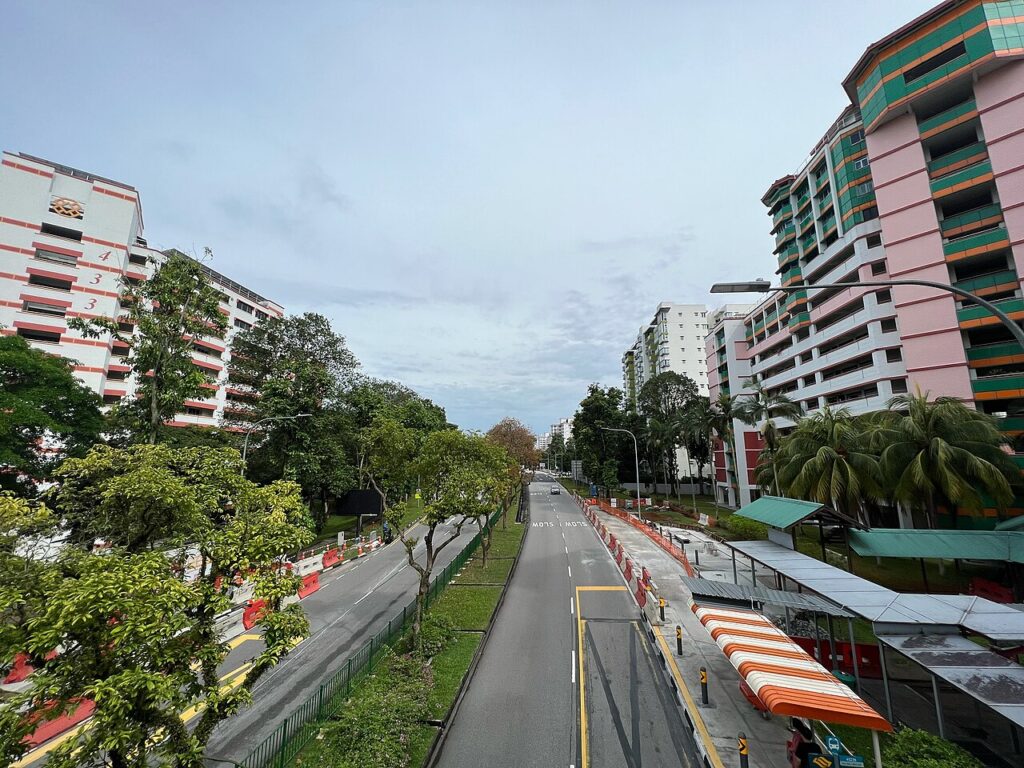
Photograph: Choa Chu Kang Way 2 (photographed 2022). Photo: Wzhkevin. Source · CC BY-SA 4.0.
