Singapore First-Timer Home Buyer Complete Guide 2026: Grants, BTO vs Resale, HFE and Everything You Need

Singapore First-Timer Home Buyer Complete Guide 2026: Grants, BTO vs Resale, HFE and Everything You Need

Buying your first home in Singapore is one of the biggest financial decisions you will ever make — and the government has designed a system that genuinely rewards first-timers. From priority balloting in the Build-To-Order (BTO) exercise to grants worth up to S$230,000 for resale flat buyers, first-timer status unlocks advantages that second-timers and investors cannot access. This guide covers everything from how HDB defines a first-timer to the full buying timeline, so you can make the right choice with confidence.

Quick Answer: Key Facts for Singapore First-Timer Buyers 2026

  • First-timer status applies to Singapore Citizens (SC) and Permanent Residents (PR) who have never owned a subsidised HDB flat or private residential property in Singapore.
  • CPF housing grants can total up to S$230,000 for SC couple buying an HDB resale flat (EHG + Family Grant + PHG combined).
  • BTO priority balloting: first-timers get two ballot chances for every one chance given to second-timers.
  • HDB Flat Eligibility (HFE) letter is mandatory before you can apply for any BTO or resale HDB flat — validity is 9 months.
  • ABSD: SC buying first property pays 0% ABSD; PR pays 5%; foreigners pay 65%.
  • MSR cap: monthly HDB/EC mortgage must not exceed 30% of gross monthly income.
  • BTO waiting time: 2.5–5 years for standard flats; resale is immediate.
  • New classification (2024 onwards): BTO flats are now categorised Standard, Plus, or Prime — each with different resale restrictions and grant levels.
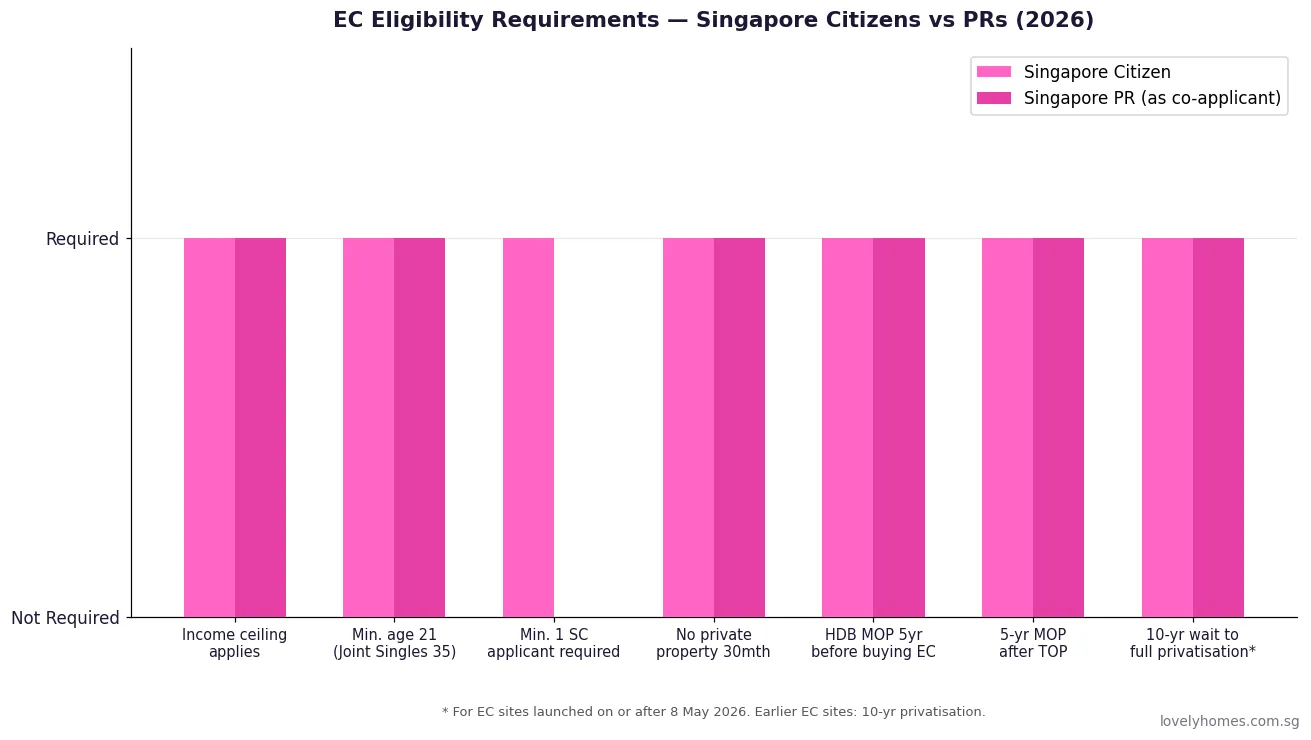
  • MOP: standard flats require 5-year Minimum Occupation Period; Plus/Prime BTO and new ECs (from May 2026) require 10 years.
  • BSD is payable by all buyers regardless of first-timer status — progressive from 1% to 6% on purchase price.

What Makes You a First-Timer in Singapore’s Property System?

HDB defines a first-timer applicant as someone who has not previously received a housing subsidy from HDB. Practically, you are a first-timer if all the following are true: you have never owned an HDB flat (purchased directly from HDB), you have not previously received an HDB grant, and you have not owned a private residential property in Singapore in the 30 months before your flat application (this 30-month rule applies to resale applications). If you co-own a private property overseas, it does not automatically disqualify you for HDB purposes, but you must divest any Singapore private property.

The key distinction is subsidised housing: inheriting an HDB flat from a deceased parent does not strip your first-timer status, provided you sell it within the required period. Similarly, owning a commercial property or industrial unit does not affect your HDB eligibility. HDB reassesses your status at the point of application, so the 30-month rule runs backwards from the date you submit your HFE application.

First-timer home buyer eligibility and CPF housing grants matrix Singapore 2026
Figure 1: Singapore First-Timer Eligibility and Grant Overview — who qualifies and what grants are available in 2026. Source: HDB 2026.

CPF Housing Grants: What First-Timers Can Claim

The CPF housing grant system is tiered and means-tested. Higher grants are available to buyers with lower household incomes, with most grants phasing out at S$9,000 per month for couples. All grants are disbursed as CPF Ordinary Account (OA) credits — they reduce the cash you need for the purchase, but they accumulate accrued interest at 2.5% per annum that must be refunded to CPF when you sell.

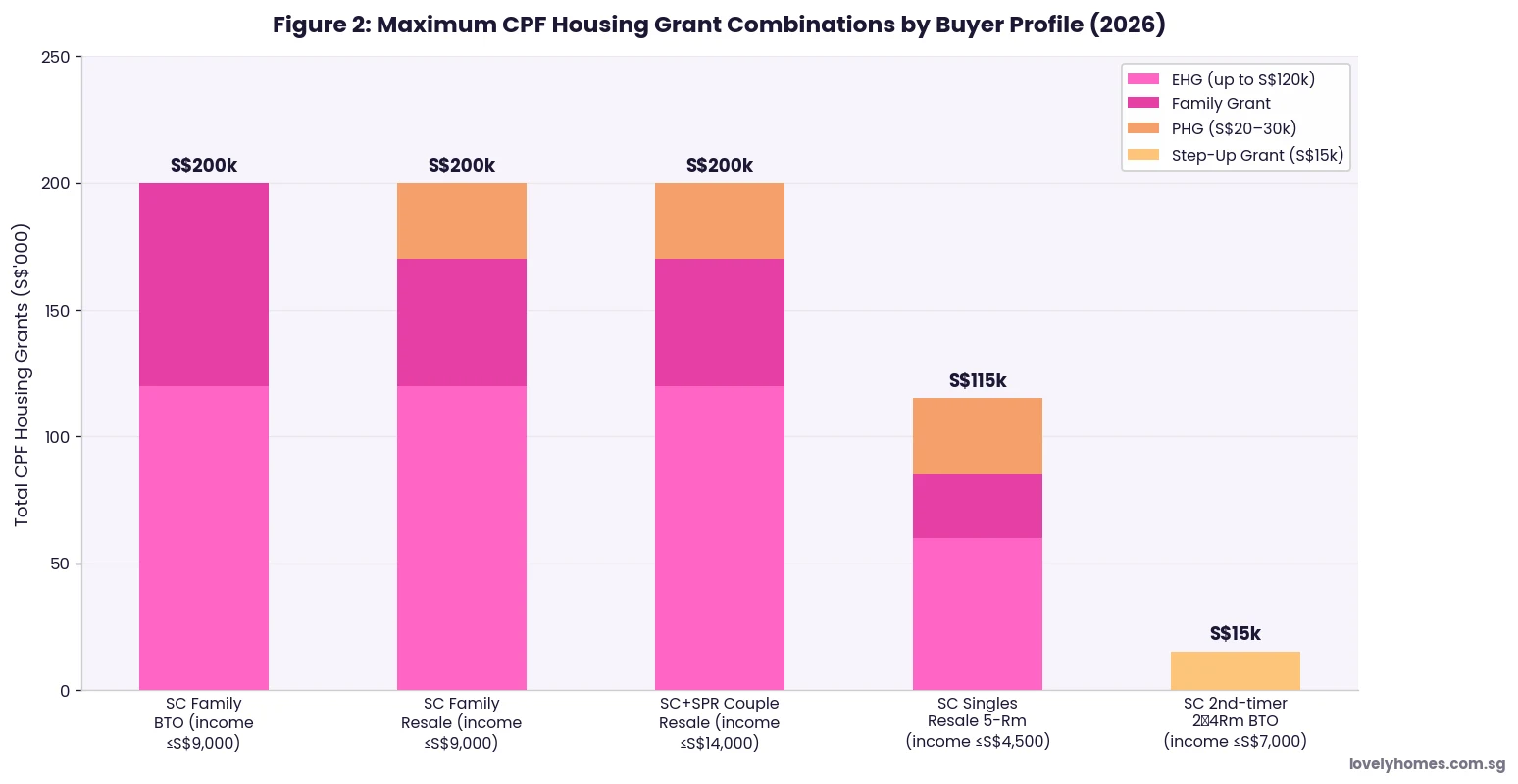
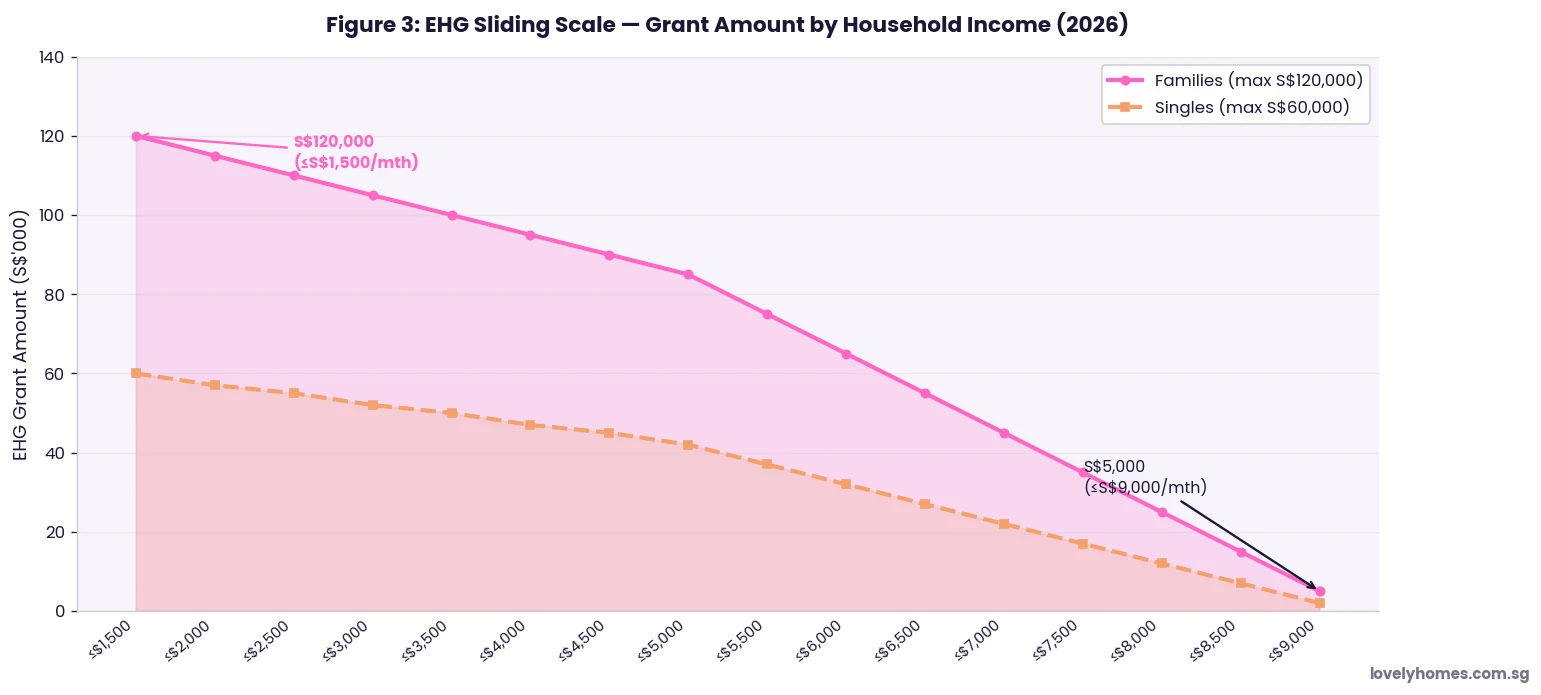
Enhanced CPF Housing Grant (EHG) is the most generous and the most means-tested. For SC couples buying a BTO, EHG ranges from S$5,000 (income S$8,501–S$9,000) up to S$120,000 (income ≤S$1,500). For SC couples buying resale, the EHG is capped at S$80,000 (income ≤S$1,500). Singles aged 35 and above can claim up to S$60,000 for BTO and S$40,000 for resale. The EHG requires that at least one buyer is buying a flat with a remaining lease that can cover the youngest buyer until age 95.

Family Grant applies to resale flats only and is a flat amount: S$80,000 for SC couples, S$60,000 for SC + SPR couples. There is no income ceiling for the Family Grant itself, but the EHG already tapers to zero above S$9,000 household income, so high-income buyers effectively claim only the Family Grant.

Proximity Housing Grant (PHG) rewards buyers who choose a resale flat within 4 km of their parents or children, or who buy in the same town. Amounts range from S$10,000 (living within 4 km of parents) to S$30,000 (living with parents in the same flat). PHG is available to SC buyers only.

Half-Housing Grant: where one buyer is a first-timer and the other is a second-timer, the first-timer can still claim half the Family Grant — S$40,000 for SC + SC, S$30,000 for SC + SPR — on a resale flat purchase.

Maximum CPF housing grants for first-timer buyers by profile Singapore 2026 stacked bar chart
Figure 2: Maximum CPF Housing Grants by First-Timer Buyer Profile 2026. BTO buyers access EHG only; resale buyers can stack EHG + Family Grant + PHG. Source: HDB 2026.

The HDB Flat Eligibility (HFE) Letter: Your First Step

Before you can ballot for a BTO or make an offer on an HDB resale flat, you must obtain an HFE letter from HDB. The HFE replaced the earlier Eligibility Letter (EL) in 2023 and now serves a dual purpose: it confirms your eligibility to purchase, and it indicates the CPF grants and HDB housing loan you may be entitled to. The HFE letter is valid for 9 months from its date of issue.

Applying for an HFE takes roughly 2–3 weeks. You submit an application through the HDB Flat Portal (homes.hdb.gov.sg), providing details of your household members, income documents, and ownership declaration. HDB pulls information from government databases — IRAS for income, SLA for property records — so you do not need to submit separate ownership declarations for most scenarios. If you plan to use an HDB loan, you receive a Loan Eligibility assessment alongside the HFE. If you prefer a bank loan, you should obtain an In-Principle Approval (IPA) from your chosen bank separately.

BTO vs Resale: The Core Decision for Every First-Timer

The most consequential decision for any first-timer is whether to buy a BTO flat or an HDB resale flat. This is not purely a financial decision — it involves trade-offs between price, location, waiting time, grant entitlements, and lifestyle.

BTO flats are sold by HDB directly at subsidised prices — typically 20–40% below the equivalent resale transaction in the same estate. The trade-off is time: you ballot for a flat first, and you wait for it to be built, which takes 2.5–5 years from booking to key collection. In the meantime, you and your partner typically have to continue renting or living with family. BTO flats in Plus and Prime zones (central estates and highly sought-after areas) carry additional resale restrictions under the 2024 classification framework, including a 10-year MOP and a clawback of HDB subsidy on resale.

Resale flats are immediately available and offer greater locational flexibility — you can buy in virtually any HDB estate, at any floor level, and move in within 8–12 weeks of completing the transaction. They are more expensive than BTOs on a per-unit basis, but first-timers can use the full resale grant stack (EHG + Family Grant + PHG), which partially offsets the premium. Resale flats also come with a shorter remaining lease, which affects CPF withdrawal limits and future resale value — so buyers should check that the remaining lease covers the youngest buyer to age 95.

BTO vs HDB resale price and waiting time comparison for first-timer buyers 2026
Figure 3: BTO vs HDB Resale — Price Range and Waiting Time for First-Timer Buyers 2026. BTO prices are after HDB pricing subsidy, before grants. Source: HDB 2026.

Financing Your First Home: LTV, MSR, TDSR and Choosing Your Loan

First-timer buyers have two loan options: an HDB Concessionary Loan or a bank loan. Understanding the constraints and advantages of each is critical, because the choice is largely irreversible — once you switch from an HDB loan to a bank loan, you cannot switch back.

HDB Concessionary Loan: available to SC buyers only (not PR-only households), with a combined household income cap of S$14,000 per month. The interest rate is pegged to the prevailing CPF OA rate plus 0.1%, currently 2.6% per annum. LTV ratio is 80%, and there is no cash down payment requirement beyond the minimum 20% top-up (which can be entirely from CPF). The monthly repayment must not exceed 30% of gross income (MSR rule).

Bank loans: available to all buyers. LTV is 75% for the first property, meaning a minimum 25% down payment (with at least 5% in cash and the remaining 20% from cash or CPF). Bank loan interest rates are tied to the Singapore Overnight Rate Average (SORA) — as of June 2026, the 3-month compounded SORA is approximately 1.07%, with typical bank packages for new HDB purchases ranging from 1.5% to 2.2% on floating-rate terms and 2.4%–2.7% on fixed-rate terms. Bank loans are subject to both MSR (30%) and TDSR (55%).

Stamp Duty for First-Timers

Buyer’s Stamp Duty (BSD) is payable on all property purchases in Singapore, without exception. It is calculated on the higher of the purchase price or the market value at a progressive rate: 1% on the first S$180,000, 2% on the next S$180,000, 3% on the next S$640,000, 4% on the next S$500,000, and 5%–6% on amounts above that. For a S$500,000 HDB resale flat, BSD is approximately S$9,600. For a S$650,000 flat, BSD is approximately S$14,400. BSD is payable within 14 days of signing the Option to Purchase and can be paid from your CPF OA.

Additional Buyer’s Stamp Duty (ABSD) for SC buyers purchasing their first property is 0% — no ABSD applies. PR buyers purchasing their first property pay 5% ABSD, and foreigners pay 65% on any residential property. The ABSD rates announced in the April 2023 cooling measures remain in effect as of June 2026.

Summary Table: First-Timer Home Buying at a Glance

Topic HDB BTO (First-Timer SC Couple) HDB Resale (First-Timer SC Couple)
Max CPF Grants Up to S$120,000 (EHG only) Up to S$230,000 (EHG+FG+PHG)
Income Ceiling (loans/grants) S$14,000/mth (HDB loan); S$9,000/mth for max EHG Same; Family Grant has no separate income ceiling
Waiting Time 2.5–5 years from ballot to keys 8–12 weeks from OTP to keys
Loan Options HDB (2.6%) or bank loan (SORA-based) Same
Min Down Payment 20% (all CPF; 5% cash if bank loan) Same
BSD Payable (from CPF OA) Payable (from CPF OA)
ABSD (SC 1st property) 0% 0%
MOP (Standard) 5 years from key collection 5 years from key collection
MOP (Plus/Prime) 10 years; subsidy clawback on resale N/A (Plus/Prime applies to BTO only)
Ballot Priority 2× chances vs second-timer N/A (open market)

Worked Example: First-Timer Couple Buying Their First HDB Flat

Mr and Mrs Ng are a Singapore Citizen couple. Both are first-timers aged 29. Their combined gross monthly income is S$7,800. They are considering two options: a 4-room BTO flat at a non-mature estate, or a 4-room resale flat in Tampines.

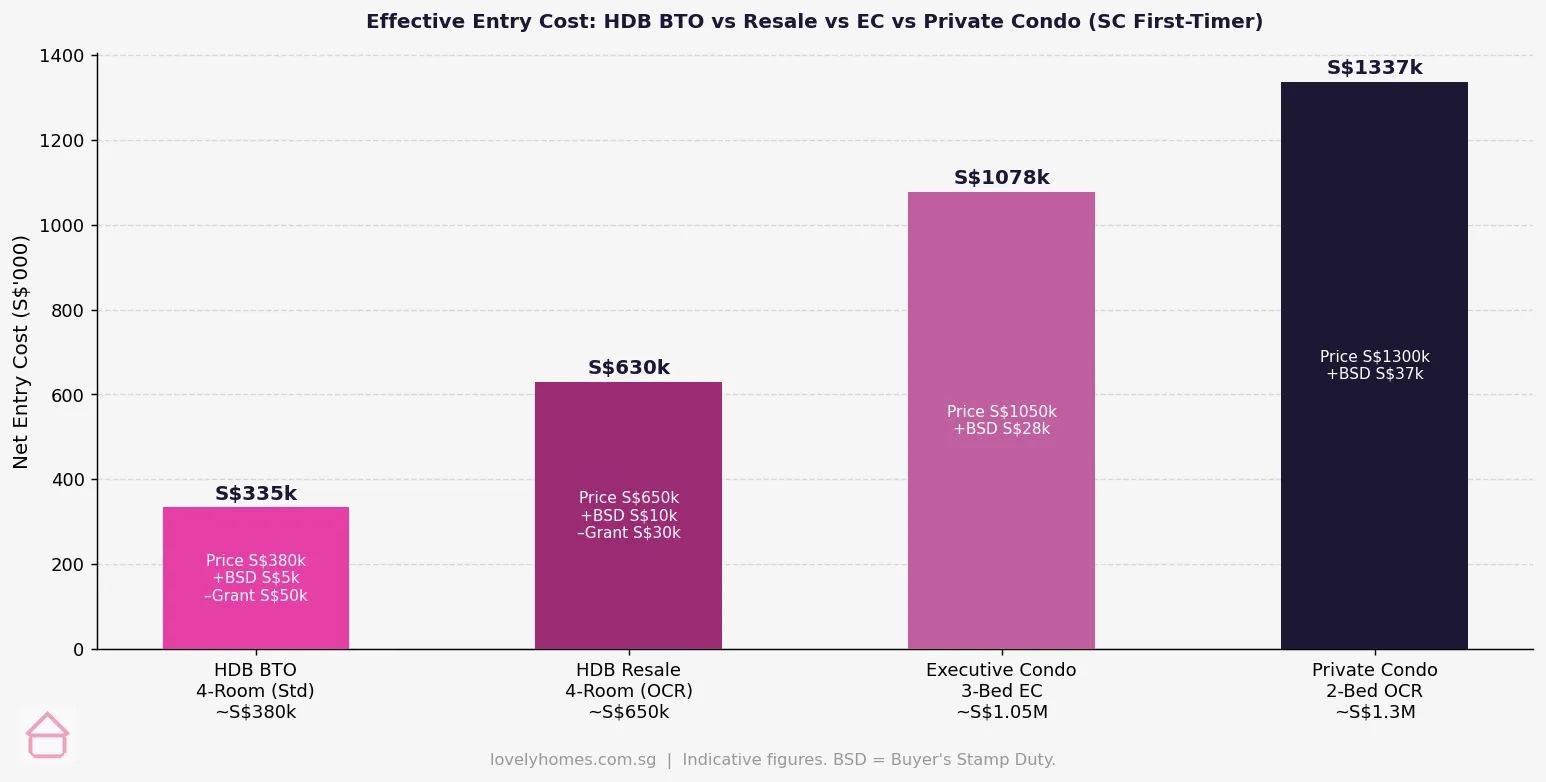
Option A — BTO (non-mature estate, 4-room): Indicative price S$380,000. EHG entitlement at S$7,800/mth income: approximately S$45,000 (income bracket S$7,501–S$8,000, couple BTO). Effective price after EHG: S$335,000. HDB loan at 80% LTV: S$268,000. Monthly repayment at 2.6% over 25 years: S$1,218/mth — MSR = 15.6%, well within the 30% cap. BSD on S$380,000: S$7,100 (payable from CPF). Cash required: essentially S$0 if CPF OA balance is sufficient (S$67,000 down payment + BSD from CPF). Waiting time: approximately 3.5 years.

Option B — Resale (Tampines, 4-room, ~25 years remaining lease): Price S$620,000. Grant entitlement: EHG S$45,000 + Family Grant S$80,000 + PHG S$10,000 (living within 4 km of parents) = S$135,000 total grants. Effective cost after grants: S$485,000 cash/CPF. HDB loan at 80% LTV: S$496,000 (on purchase price; capped to MSR: at S$7,800/mth income, MSR cap S$2,340/mth, loan tenure 25yr @ 2.6% → max loan S$515,000 — CLEAR). Monthly repayment: approximately S$2,250/mth — MSR 28.8% PASS. BSD: S$13,800 from CPF. Cash outlay: S$800 (OTP exercise fee) + legal fees ~S$2,500. Move-in: approximately 10 weeks from OTP.

Decision: Option A is S$240,000 cheaper in sticker price but requires a 3.5-year wait. Option B is immediately available and offers full grant stacking. At S$7,800/mth combined income, both options are financially feasible. The couple should weigh the rental cost during the BTO wait period (estimated S$80,000–S$100,000 over 3.5 years if renting privately) against the S$240,000 BTO price advantage.

What First-Timers Often Get Wrong

The most common mistake is treating the HFE letter as a mere formality — in fact, it is the document that locks in your grant entitlement. Applying for an HFE too early (income changes between HFE and purchase can reduce grants) or too late (HFE takes 2–3 weeks, which can cause you to miss an OTP deadline) both have real financial consequences. A second common error is underestimating CPF accrued interest: every dollar of CPF and grants deployed for the property accumulates 2.5% interest annually, which must be refunded to CPF upon sale. On a S$300,000 CPF drawdown over 10 years, that refund obligation reaches approximately S$85,000 — significantly reducing net cash in hand at sale. Third, first-timers sometimes overlook the BSD timing difference between BTO (payable on exercise of the Sale and Purchase Agreement, typically several years after ballot) and resale (payable within 14 days of signing the OTP) — a BTO purchase technically defers the BSD cash outflow.

What Might Come Next

Industry observers note that the new Standard/Plus/Prime BTO classification, introduced in 2024, is still bedding in. The October 2026 BTO exercise is expected to offer approximately 7,970 flats across Bedok, Geylang, Sembawang, Tengah, Toa Payoh, and Yishun — providing first-timer couples with options across multiple towns. The Bedok Bayshore sites (adjacent to Bayshore MRT) are being watched closely as the first BTO flats in a new waterfront neighbourhood. Policy observers have also been monitoring whether HDB will adjust the EHG income bands as Singapore’s median household income continues to rise, though no changes have been announced as of June 2026. The 15-month Wait-Out Period (WOP) for private property owners who wish to purchase an HDB resale flat — introduced in September 2022 — remains in place, adding a structural floor to HDB resale demand as upgraders are prevented from buying immediately.

Frequently Asked Questions

Can I apply for a BTO as a first-timer if I currently live in a private property?

Yes, provided you are an SC citizen and have never previously purchased a subsidised HDB flat. However, if you (or your spouse) currently own a private residential property in Singapore, you must dispose of it within 6 months of receiving the keys to your BTO flat. Overseas private property does not disqualify you. The 30-month Look-Back Period applies to resale HDB flat applications, not BTO ballot applications — so private property owners can ballot for a BTO flat while still holding their private property, as long as they sell it after receiving keys.

My spouse is a second-timer. Do we still get first-timer benefits?

You are treated as an “essential occupier + first-timer” family unit. For BTO balloting, you get first-timer ballot priority (2 chances). For grants, you can still claim the EHG based on your individual first-timer status. For resale, you can claim the Half-Housing Grant (half the Family Grant amount) rather than the full Family Grant. Your spouse’s second-timer status does not eliminate your personal grant eligibility, but it does reduce the total grant quantum compared to an all-first-timer couple.

How long does the HFE letter application take, and when should I apply?

The HFE letter typically takes 2–3 weeks to process from the date of submission. You should apply before — not after — you identify a flat. For BTO applicants, apply at least 3 weeks before the BTO launch window opens. For resale buyers, apply before you start your flat search, since an OTP seller may ask you to exercise within 14–21 days, and you need your HFE confirmed before you can proceed to the resale portal. The HFE is valid for 9 months; if it expires, you must reapply.

Can I use CPF to pay for the Option to Purchase (OTP) fee and BSD?

No — the OTP option fee (S$500–S$1,000) and the OTP exercise fee (1% of purchase price) must be paid in cash. BSD, however, can be paid from your CPF OA once the Option to Purchase is exercised. Your solicitor will process the CPF withdrawal for BSD after the OTP is exercised and the conveyancing process begins. Cash payments made before CPF is available cannot be reclaimed from CPF later.

What is the Deferred Income Assessment (DIA) and does it affect my grants?

The Deferred Income Assessment (DIA) allows eligible first-timer couples who are full-time students, National Service (NS) personnel, or freelancers with irregular income to defer their income declaration until key collection, when the EHG quantum is then assessed. This prevents buyers from being penalised during a temporarily low-income phase. The DIA is not automatic — you must declare eligibility at the HFE application stage. If your income rises significantly between application and key collection, your EHG may be lower than expected.

What is the Minimum Occupation Period (MOP) and what can I do during it?

The MOP is the minimum period you must live in an HDB flat before you can sell it on the open market. For standard HDB flats purchased from HDB (BTO), the MOP is 5 years from the date you collect your keys. For Plus classification BTO flats, the MOP is 10 years. During the MOP, you cannot rent out the entire flat (you can rent out individual bedrooms, subject to HDB approval and quota rules). You also cannot purchase a private residential property in Singapore until the MOP is cleared, unless you are buying it to upgrade and will sell the HDB flat within 6 months.

How much cash do I actually need to buy my first HDB flat?

For an HDB loan (no bank loan), the minimum cash required is remarkably low. The 20% down payment can come entirely from CPF OA. BSD is payable from CPF. Legal fees (~S$2,000–S$3,000) are payable in cash. The OTP option fee (S$500–S$1,000) and exercise fee (1%) are in cash, but these are modest. Total cash outlay for a S$500,000 BTO with HDB loan and S$80,000 CPF balance: approximately S$6,000–S$8,000 in cash (legal fees + OTP fees). For a bank loan, the minimum 5% cash down payment on S$500,000 is S$25,000 — the largest single cash item.

Related Articles

Disclaimer

This article is for general information only and does not constitute financial, legal, or conveyancing advice. Grant amounts, income ceilings, LTV ratios, and stamp duty rates are subject to change by HDB, IRAS, and MAS at any time. All figures quoted are as of June 2026. Readers should verify all information with official sources — HDB (www.hdb.gov.sg), IRAS (www.iras.gov.sg), MAS (www.mas.gov.sg), and CPF Board (www.cpf.gov.sg) — before making any property purchase decision. For complex situations involving second-timer spouses, foreign co-buyers, or inherited properties, consult a licensed conveyancing lawyer.

×Click image to close

HDB BTO vs Resale Flat 2026: Complete Comparison — Prices, Grants, Waiting Time and New Classification Rules

HDB BTO vs Resale Flat 2026: Complete Comparison — Prices, Grants, Waiting Time and New Classification Rules

Quick Answer: HDB BTO vs Resale — Key Differences in 2026

  • BTO flats are sold directly by HDB at subsidised prices; resale flats are bought from existing HDB owners at market prices.
  • BTO typically takes 3–5 years from application to keys; resale flats can complete within 8–16 weeks.
  • Resale buyers qualify for more grants in total (up to S$230,000 for an SC couple) versus BTO (up to S$120,000 EHG only), but resale prices are generally higher.
  • BTO flats are brand new; resale flats are second-hand and vary significantly in age, condition, and remaining lease.
  • The new HDB classification — Standard, Plus, Prime — applies to BTO flats from August 2024 onwards, introducing longer resale restrictions for Plus and Prime flats.
  • Resale buyers must comply with the Ethnic Integration Policy (EIP) quota at point of purchase; BTO buyers face EIP only when they later sell.
  • Both BTO and resale flats are subject to a 5-year MOP (10 years for PLH flats), HDB loan eligibility rules, and the same TDSR/MSR framework.
  • For most first-time buyers with flexible timelines, BTO offers better value; for those with urgent housing needs or preferring mature-estate locations, resale may be more practical.

The decision between buying an HDB Build-To-Order (BTO) flat and a resale flat is one of the most consequential financial choices a Singapore household will make. Both routes lead to the same product — a Housing and Development Board flat — but the economics, timelines, and trade-offs are fundamentally different. BTO flats come at a subsidised price set by HDB, with a waiting period of three to five years; resale flats trade at market value with immediate occupancy. The introduction of the new Standard, Plus, and Prime flat classification from August 2024, combined with an increase in BTO supply and a moderation in resale prices following the 2023–2024 cooling cycle, has shifted the calculus for buyers in 2026. This guide walks through every key dimension of the comparison so you can make an informed decision.

HDB BTO vs resale comparison table 2026 — 12 key factors including price, waiting time, grants and MOP
Figure 1: HDB BTO vs Resale — 12 Key Factors Compared. Source: HDB, as at June 2026.

Price: BTO Subsidy vs Resale Market Value

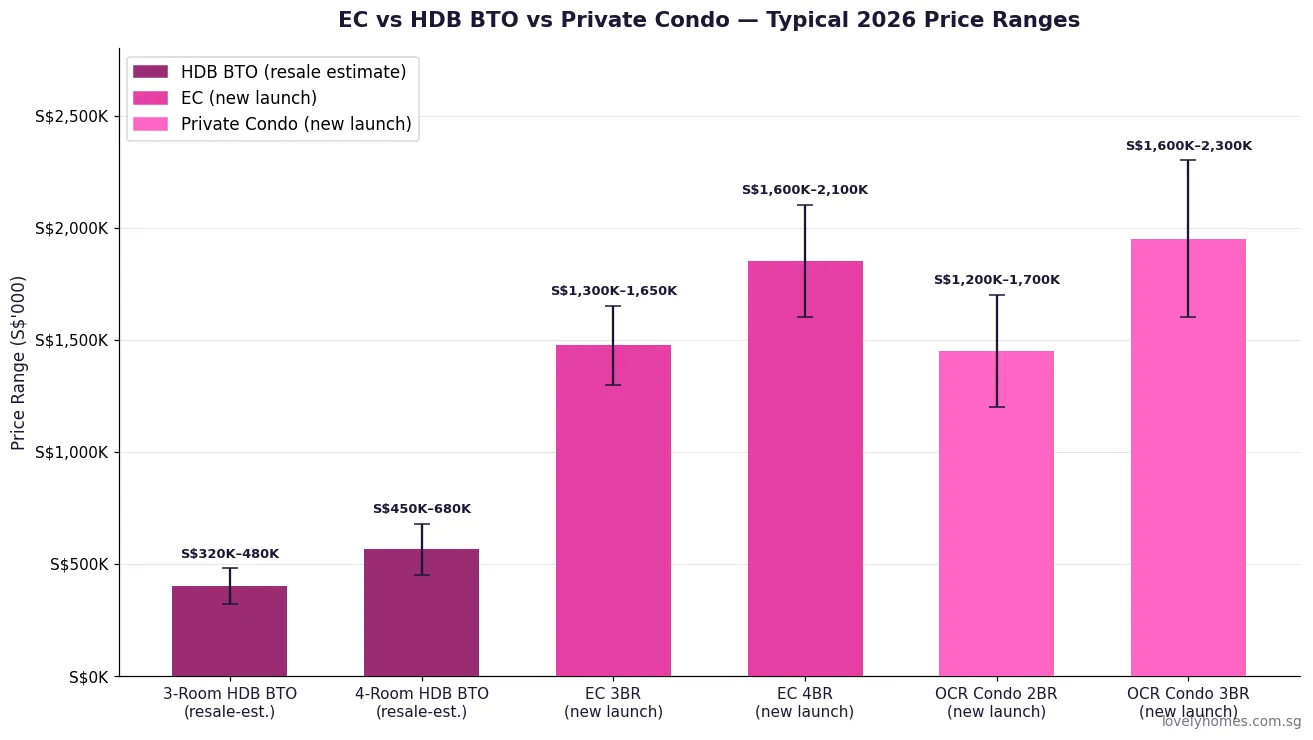
The most obvious difference between BTO and resale is price. HDB sells BTO flats at a price that reflects a deliberate subsidy relative to market value. For a typical 4-room flat in a non-mature estate, a BTO price might be S$350,000–S$550,000 at launch, while a resale flat of similar size in the same town might transact at S$500,000–S$700,000. The gap narrows in mature estates, where BTO launches are rarer and resale supply is the only option for buyers who want to live in areas like Queenstown, Bishan, or Marine Parade.

It is important to note that BTO prices are not static: HDB adjusts BTO launch prices for each exercise based on prevailing market conditions, and the subsidy quantum (the gap between BTO price and estimated market value) has been explicitly referenced by HDB in its public communications as a policy instrument to keep public housing affordable. In 2025–2026, HDB increased BTO supply substantially — over 19,000 units are planned for 2026 across four exercises — as part of a concerted effort to reduce waiting times and moderate the resale price premium.

New flat classification impact on price. From August 2024, all new BTO flats are classified as Standard, Plus, or Prime. Plus flats (near MRT interchange, town centre) and Prime flats (city-fringe, Queenstown, Rochor) are sold at a deeper subsidy but carry a subsidy clawback mechanism on resale and stricter resale restrictions. Standard flats follow the traditional BTO framework. When comparing BTO to resale, ensure you understand which classification the BTO flat falls under, as it affects your net position on eventual resale.

Waiting Time: BTO vs Resale Completion

BTO construction timelines have improved since the post-pandemic supply chain delays of 2021–2022, but the typical wait remains three to five years from the launch exercise to key collection, and this excludes the time spent waiting for a ballot exercise in your preferred town. Popular towns with first-timer subscription rates of 2×–5× may require multiple attempts before a successful ballot. Add the construction period and many buyers face an effective six-to-seven-year wait from first application to occupancy.

Resale flats can complete within eight to sixteen weeks of exercising the Option to Purchase (OTP). Buyers who need housing immediately — couples with an imminent wedding, families moving out of parents’ flats, or those relocating for work — have only one viable HDB option: the resale market. The opportunity cost of the BTO waiting period also includes continued rental expenditure, which can total S$80,000–S$120,000 over a four-year wait at current market rates.

HDB BTO vs resale price ranges by flat type Singapore 2026
Figure 2: HDB BTO vs Resale Price Ranges by Flat Type, 2026. Source: HDB. BTO prices are indicative subsidised launch prices; resale prices are median transacted prices Q1 2026.

CPF Housing Grants: Where Resale Has the Edge

CPF housing grants are means-tested subsidies administered by HDB and disbursed from the Central Provident Fund (CPF) to help buyers finance their flat purchase. The grant landscape differs meaningfully between BTO and resale:

For BTO buyers, the primary grant is the Enhanced CPF Housing Grant (EHG), which provides up to S$120,000 for an SC couple earning a combined monthly income of S$1,500 or below, tapering to S$0 at income above S$9,000 per month. No additional grants apply for BTO purchases.

For resale buyers, three grants can stack: the EHG (up to S$80,000 for resale), the Family Grant (up to S$80,000 for SC couples buying a 4-room or smaller resale), and the Proximity Housing Grant (PHG) of up to S$30,000 for buyers choosing to live near parents or children. An SC couple at the lowest income bracket can receive up to S$230,000 in grants for a resale flat — nearly double the BTO maximum.

The higher grant quantum for resale partially offsets the higher purchase price. At mid-range incomes (combined S$7,000–S$8,000 per month), the effective all-in cost difference between BTO and resale may be narrower than headline prices suggest, once grants and the value of time saved (by avoiding the BTO waiting period) are factored in.

CPF housing grants BTO vs resale by buyer profile Singapore 2026
Figure 3: Maximum CPF Housing Grants — BTO vs Resale by Buyer Profile, 2026. Source: HDB. Grant amounts are income-tested; figures shown are maximums at lowest income bracket.

Flat Condition, Age, and Remaining Lease

BTO flats are handed over as bare concrete units — no flooring, no kitchen fittings, no bathroom tiles beyond the developer’s basic provision. A full renovation budget of S$40,000–S$80,000 is typical for a 4-room BTO flat. This is a significant additional cost that is sometimes overlooked in simple price comparisons.

Resale flats may require less renovation (in some cases none) if the existing fittings are in good condition. However, older flats — particularly those with 50 years or fewer remaining on their 99-year leases — carry meaningful risks. CPF withdrawal for older flats is restricted under the CPF property rules, and bank valuations may not fully support the asking price. HDB resale flats built in the 1980s and 1990s are now approaching the age at which lease decay begins to have a material effect on financing options and eventual resale value.

The New BTO Classification Framework

From August 2024, all new BTO flats are classified under HDB’s new Standard / Plus / Prime framework, replacing the previous Mature / Non-Mature categorisation for new launches. The key distinctions are:

Classification Locations Subsidy Level Resale Restriction Income Ceiling
Standard Heartland estates, non-central towns Standard subsidy Standard 5-yr MOP then open resale S$14,000/mth
Plus Near MRT interchange, town centre, amenity-rich sites Deeper subsidy 5-yr MOP + 10-yr restricted resale (SC/SPR only) + subsidy clawback S$14,000/mth
Prime City-fringe, central locations (Queenstown, Rochor) Deepest subsidy 10-yr MOP + restricted resale + subsidy clawback on sale S$14,000/mth

The subsidy clawback for Plus and Prime flats means that on eventual resale, a proportion of the subsidy received is returned to HDB. This reduces your net sale proceeds but is structured to prevent windfall gains from publicly subsidised flats. For buyers primarily motivated by investment upside, Standard flats or resale flats may offer better flexibility; for buyers prioritising lower entry cost and location quality, Plus or Prime BTO flats may still be the better long-term choice.

Worked Example: Lee Family — BTO vs Resale Decision

Scenario: Mr and Mrs Lee, SC Couple, Combined Income S$8,500/mth

The Lees are first-time buyers. They are considering two options: (A) a 4-room BTO flat in Tengah (Standard classification) at S$420,000, with an expected wait of 4 years from launch to keys; or (B) a 4-room resale flat in Bukit Batok at S$610,000, with completion expected in 12 weeks.

Option A: BTO — Tengah 4-Room Standard, S$420,000

BTO selling priceS$420,000
EHG (income S$8,500, SC couple, BTO)-S$35,000
Net price after grantS$385,000
HDB loan (80% of S$420,000)S$336,000
Monthly instalment (25yr @ 2.6%)~S$1,516/mth
MSR check (S$1,516 / S$8,500)17.8% — PASS
Estimated renovation budget (4-room BTO)S$55,000
Interim rental costs (4 years @ S$2,000/mth)S$96,000

Option B: Resale — Bukit Batok 4-Room, S$610,000

Resale priceS$610,000
EHG (resale, S$8,500/mth)-S$35,000
Family Grant (4-room or smaller, SC couple)-S$50,000
Proximity Housing Grant (if applicable, live near parents)-S$20,000
Net price after grantsS$505,000
HDB loan (80% of S$610,000)S$488,000
Monthly instalment (25yr @ 2.6%)~S$2,203/mth
MSR check (S$2,203 / S$8,500)25.9% — PASS (under 30%)
Renovation (existing condition — minimal)~S$15,000
Interim rental costs (0 — move in within 12 weeks)S$0

Comparison summary: Option A BTO total out-of-pocket over 4 years (before valuation appreciation): S$420K price + S$55K renovation + S$96K rental − S$35K grant = effective all-in entry cost ~S$536K. Option B resale: S$610K price + S$15K reno − S$105K grants = effective all-in ~S$520K. In this scenario, the Lees’ resale option is marginally cheaper in total outlay — driven by the larger grant stack and the elimination of four years of rental costs — though their monthly mortgage commitment is S$687/mth higher than the BTO.

What This Means for Buyers in 2026

The BTO versus resale decision in 2026 is more finely balanced than it was during the 2021–2022 resale price surge, when resale flats were trading at sharp premiums over BTO prices. The HDB resale price index recorded its first quarterly decline since Q2 2019 in Q1 2026 (down 0.1% quarter-on-quarter), while BTO supply has increased materially. Buyers who previously felt priced out of resale now have a more realistic comparison to make.

Several structural shifts make resale more attractive in 2026 than it has been in recent years. The new classification framework means that some BTO sites carry extended resale restrictions that limit eventual exit flexibility. Meanwhile, the grant system for resale has been left intact and continues to provide up to S$230,000 for qualifying first-timer couples. For buyers who prioritise a specific location — a mature town, proximity to ageing parents, or a well-established school cluster — resale remains the only viable route.

Conversely, buyers with flexible timelines and no urgent housing need continue to find BTO the better financial proposition in most non-mature towns. The government’s stated policy goal — ensuring that public housing remains within reach for first-timer households across a range of income levels — means BTO subsidies are unlikely to be withdrawn. The deeper subsidies attached to Plus and Prime flats, in particular, make BTO viable in locations that would otherwise be inaccessible to median-income households.

What Might Come Next

HDB has indicated that BTO waiting times should return to the pre-pandemic norm of three years or fewer for most projects by 2026–2027, as the construction backlog clears and new projects are designed from the outset with more efficient procurement. A shorter BTO waiting time would reduce one of the main deterrents to the BTO route. The October 2026 BTO exercise, expected to offer approximately 7,960 flats in six towns, will be the final exercise of the year and is likely to attract significant demand from buyers who held back during the 2025 exercises. On the resale side, the 2026 MOP cohort (13,480 flats) will continue to put new supply onto the resale market through the year, exerting some downward pressure on resale prices — a trend to watch for buyers on the fence between the two routes.

Frequently Asked Questions

Can I apply for a BTO flat if I currently own a private property?
No. If you own or have owned a private residential property within the 30 months preceding your HDB flat application — whether as sole owner, joint owner, or essential occupier — you are not eligible to apply for a new BTO flat. You must dispose of any private property at least 30 months before the BTO application date. This rule also applies if your spouse or any listed essential occupier owns a private property. The 30-month restriction does not apply to resale flats bought without HDB grants; however, if you apply for a resale flat with CPF housing grants, the same private property ownership restriction applies.
What is the difference between Plus and Prime BTO flats?
Both Plus and Prime flats are sold at a deeper subsidy than Standard flats and carry a subsidy clawback on resale. The difference is primarily one of location and the degree of restriction. Prime flats are located in city-fringe or central areas (such as Queenstown, Buona Vista, or Rochor) and carry a 10-year MOP plus restricted resale to eligible SC and SPR buyers only (not foreigners or entities). Plus flats are located near MRT interchanges, town centres, or amenity-rich sites in heartland towns, and carry a 5-year MOP followed by a period during which resale is restricted to eligible SC and SPR buyers only (with a clawback). Standard flats have a standard 5-year MOP with no additional resale restrictions after that point.
How does the EHG work for resale flats?
The Enhanced CPF Housing Grant for resale flats works on the same income-testing principle as BTO: the lower your household income, the higher the grant. However, the maximum EHG for a resale flat is S$80,000 (versus S$120,000 for BTO) for an SC couple. This is because resale buyers also qualify for the Family Grant (up to S$80,000 for 4-room or smaller) and the Proximity Housing Grant (up to S$30,000), making the aggregate grant potential higher for resale. The EHG is credited to your CPF Ordinary Account and can be applied toward the flat’s purchase price or the monthly mortgage. You do not receive EHG in cash.
Can a first-timer apply for both BTO and resale at the same time?
You may not hold an active BTO application and simultaneously exercise an Option to Purchase for a resale flat. The two processes are mutually exclusive in the sense that exercising the OTP for a resale flat will render your outstanding BTO application void (or you must withdraw the BTO application). However, you can be on the BTO ballot queue in one exercise while actively house-hunting for resale flats, provided you have not yet been balloted successfully or exercised any OTP. Many buyers do pursue both in parallel as a contingency strategy, and withdraw the less favourable option once a concrete choice is available.
Is there a price ceiling for resale flats eligible for grants?
Yes. The resale price ceiling for CPF housing grant eligibility is S$750,000 for the Family Grant and S$750,000 for the Proximity Housing Grant. There is no price ceiling for the EHG specifically, but the other grants require the resale price to be at or below S$750,000. If you purchase a resale flat above S$750,000, you may still qualify for the EHG (subject to income), but you will not be eligible for the Family Grant or PHG. Note that the S$750,000 threshold applies to the higher of the resale price or HDB’s assessed value of the flat.
What is the Deferred Income Assessment for BTO flats?
The Deferred Income Assessment (DIA) applies to couples applying for a BTO flat before they are officially married. Under the DIA, HDB will assess your income eligibility for grants at the point of key collection (rather than at the time of application), using the income you were earning during the 12-month period before key collection. This is useful for students or those who were not yet earning a full salary at application time. The DIA is only available for first-timer SC couples applying under the fiancé/fiancée scheme. If your income at the time of key collection is higher than at application, the DIA may result in a lower grant quantum — so plan accordingly.
Can I rent out a BTO flat immediately after MOP?
For Standard BTO flats, you may sublet individual bedrooms (room rental) from day one of ownership, and may sublet the whole flat after the 5-year MOP. For Plus flats, the same rules apply, but subletting the whole flat during the restricted resale period (after MOP but before the restriction expires) requires HDB approval, and HDB may impose additional conditions. For Prime BTO flats (which carry a 10-year MOP), the same subletting rules as PLH flats apply: whole flat subletting is permitted after MOP but is capped at 5 years in aggregate over your ownership period.
Disclaimer: The information in this article is for general educational purposes only and reflects HDB policies and grant amounts as at June 2026. HDB policies, grant quantum, and BTO classification rules may change; always verify current information at hdb.gov.sg and cpf.gov.sg. Price figures are illustrative and do not constitute a valuation. This article does not constitute financial or legal advice. Consult a licensed HDB-registered property agent or a qualified financial adviser for advice tailored to your specific circumstances.

HDB CPF Housing Grant Guide 2026: EHG, Family Grant, Step-Up, PHG and Singles Grant Explained

HDB CPF Housing Grant Guide 2026: EHG, Family Grant, Step-Up, PHG and Singles Grant Explained

×

Click outside or press Esc to close

For most Singaporeans, the CPF Housing Grant system is the single most valuable financial lever available when buying an HDB flat. The right grant — or combination of grants — can reduce the purchase price by S$30,000 to S$160,000 and cut the cash outlay needed at the point of sale dramatically. Yet many buyers remain unclear about which grants they qualify for, how the grants interact, and what happens when eligibility conditions change before completion. This guide covers every HDB CPF Housing Grant available in 2026: the Enhanced CPF Housing Grant (EHG), Family Grant, Step-Up CPF Housing Grant, Proximity Housing Grant (PHG), and the Singles Grant — with full eligibility tables, income ceiling rules, and a worked example.

Quick Answer — HDB Grants at a Glance (2026)

  • The Enhanced CPF Housing Grant (EHG) provides up to S$80,000 for first-timer SC couples buying BTO or resale flats (income ceiling S$9,000/mth).
  • The Family Grant provides S$80,000 (SC couple, BTO) to S$50,000 (resale), on top of EHG — making combined grants up to S$160,000 for qualifying couples.
  • The Step-Up CPF Housing Grant gives second-timer SC families S$15,000 towards a 4-room or smaller BTO flat.
  • The Proximity Housing Grant (PHG) provides S$30,000 (living with) or S$20,000 (living near) parents or child — for resale buyers.
  • The Singles Grant gives eligible single SC applicants aged ≥35 up to S$25,000 towards a resale flat or S$25,000 for a 2-room BTO.
  • All grants are administered by HDB and applied via the HDB Flat Portal (homes.hdb.gov.sg) — not through the CPF Board directly.
  • Grants offset the purchase price and reduce the HDB loan quantum required; they are not paid in cash to the buyer.

What Are HDB CPF Housing Grants and Who Administers Them?

HDB CPF Housing Grants are subsidies provided by the Housing and Development Board (HDB) under Singapore’s public housing policy. Despite the “CPF” label, the grants are designed and administered entirely by HDB; the Central Provident Fund (CPF) Board plays a secondary role in that CPF Ordinary Account (OA) savings may be used to fund the portion of the flat price not covered by grants. The grants exist because HDB’s policy mandate — set by the Ministry of National Development (MND) — is to ensure that public housing remains affordable across a wide income range. Grants are structured to taper off as household income rises, so they provide the greatest assistance to lower-income first-time buyers.

Importantly, grants are credited directly to reduce the flat’s purchase price or loan quantum — they are never paid to buyers in cash. This means they reduce the amount you borrow (and therefore the interest you pay over the loan tenure) rather than arriving as a lump sum in your bank account. Understanding this distinction is critical when doing upfront cost planning.

Grant Amounts by Household Income — EHG and Family Grant

HDB CPF Housing Grant EHG and Family Grant amounts by household income 2026
Figure 1: Enhanced CPF Housing Grant (EHG) and Family Grant amounts by average household income — HDB BTO, SC couple first-timer, 2026. Source: HDB.

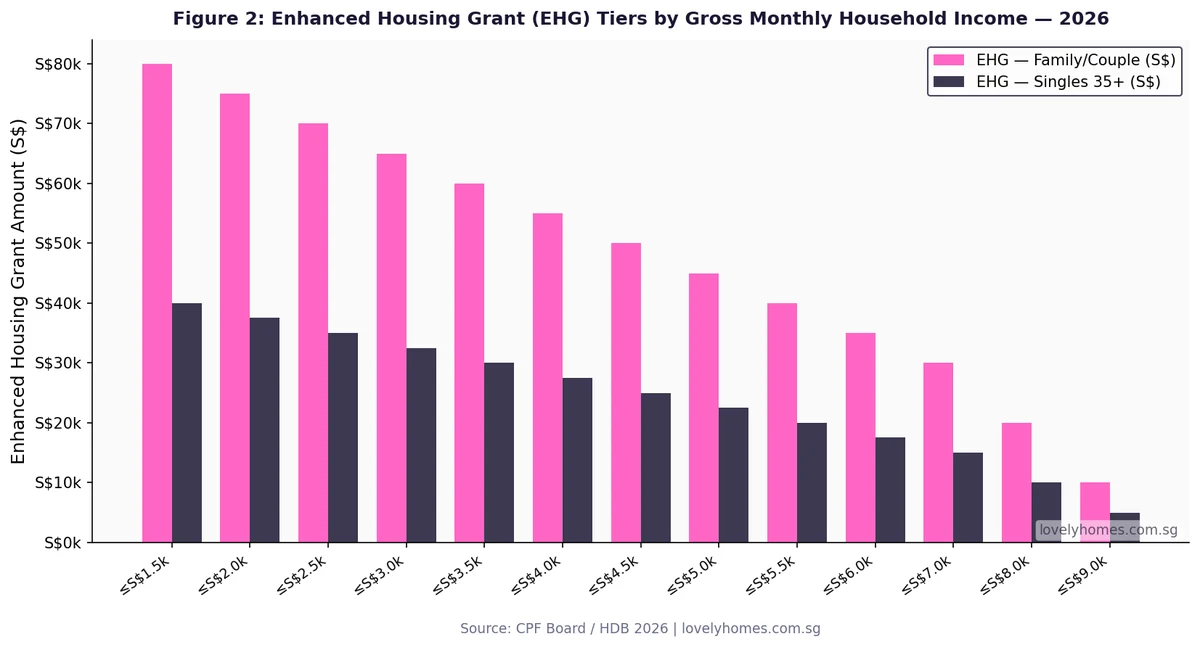
The EHG is the largest single grant available and applies across a wide income spectrum. Its key feature is that the grant amount decreases as income rises, in S$5,000–S$10,000 steps, from a maximum of S$80,000 for couples earning S$1,500 per month or less, stepping down to S$5,000 for couples earning between S$8,500 and S$9,000 per month. Couples with a gross monthly income above S$9,000 do not qualify for the EHG. Importantly, “household income” for grant purposes is the average gross monthly income of all working persons listed on the flat application, typically the two applicants and any occupants who are working.

Grant Eligibility Matrix — Who Qualifies for What

HDB CPF Housing Grant eligibility matrix 2026 — EHG Family Grant Step-Up PHG Singles
Figure 2: HDB CPF Housing Grant eligibility matrix — key buyer profiles versus grant type (2026). Source: HDB Grant Guide.

The matrix above illustrates how grants are layered across buyer profiles. An SC couple buying a BTO as first-timers can potentially stack the EHG (up to S$80,000) and the Family Grant (S$80,000), for a combined S$160,000 grant — the maximum available under any HDB grant combination. SC/SPR mixed-citizenship couples receive the Family Grant at a lower quantum (S$60,000 for BTO; S$50,000 for resale) and are eligible for the EHG, but at the EHG rate applicable to the SPR-tier income rules. Singles aged 35 and above receive a dedicated Singles Grant and are eligible for a scaled-down EHG.

Deep Dive: The Five Main HDB Grants in 2026

1. Enhanced CPF Housing Grant (EHG)

The EHG replaced the Additional CPF Housing Grant (AHG) and Special CPF Housing Grant (SHG) in September 2019. It is the most broadly applicable grant and covers both BTO and resale applications. Key conditions include: both applicants must have worked continuously for at least 12 months before the application date; the flat must not exceed a purchase price ceiling (for resale, the flat must be valued within the HDB resale price cap for the flat type and town); and applicants must not currently own or have disposed of private residential property within 30 months of application. The EHG applies regardless of flat type or location — a unique feature distinguishing it from the old SHG, which was restricted to non-mature estates.

2. Family Grant (BTO and Resale)

The Family Grant is citizenship-tiered and applies on top of the EHG. For SC-SC couples purchasing a new BTO flat, the Family Grant is S$80,000 regardless of income (subject to the S$14,000/mth income ceiling). For SC-SPR couples, the BTO Family Grant is S$60,000. For resale purchases, the quantum is S$50,000 (SC-SC) or S$40,000 (SC-SPR). The Family Grant can also be claimed by first-timer applicants who are singles applying under the Joint Singles Scheme, though the quantum is halved. There is no separate income ceiling for the Family Grant beyond the general resale/BTO eligibility income ceiling of S$14,000 per month gross household income.

3. Step-Up CPF Housing Grant

The Step-Up Grant is specifically for second-timer SC families — meaning applicants who previously owned or occupied an HDB flat, received a housing subsidy (including previous BTO application grant), or are currently living in a subsidised rental flat. The grant amount is S$15,000 and applies only to the purchase of a 4-room or smaller BTO flat. It is HDB’s way of facilitating the upgrading or right-sizing journey for mature families, while channelling the most significant grants to genuine first-timers. The income ceiling is S$7,000 per month.

4. Proximity Housing Grant (PHG)

The PHG is unique in that it is available for resale flat purchases only — it does not apply to BTO. It rewards buyers who choose to live near their parents or adult children. The quantum is S$30,000 if you buy a resale flat to live with parents or an unmarried child, and S$20,000 if you buy within 4 km of parents or a married child’s home. PHG can be combined with the EHG and Family Grant for resale purchases, making it a powerful stacking grant for families with a proximity reason to choose resale over BTO. There is no income ceiling for the PHG — it is available across all income levels subject to basic HDB eligibility.

5. Singles Grant

The Singles Grant is available to SC singles aged 35 and above applying for a 2-Room Flexi BTO flat or a resale flat. The quantum is S$25,000 for resale (4-room or smaller) and a scaled-down EHG for 2-Room Flexi BTO applications. Since January 2024, singles have been able to apply for 4-room resale flats (previously restricted to 5-room or smaller), broadening the effective pool. Singles who subsequently marry and upgrade to a larger flat may be treated as first-timers for the purposes of the EHG and Family Grant, subject to HDB’s conditions at the time of the subsequent purchase.

Summary Table — 2026 HDB Grant Quantum at a Glance

Grant Max Quantum Income Ceiling BTO / Resale
Enhanced CPF Housing Grant (EHG) S$80,000 S$9,000/mth Both
Family Grant (SC couple, BTO) S$80,000 S$14,000/mth BTO
Family Grant (SC couple, Resale) S$50,000 S$14,000/mth Resale
Family Grant (SC+SPR, BTO) S$60,000 S$14,000/mth BTO
Step-Up CPF Housing Grant S$15,000 S$7,000/mth BTO (4-room or smaller)
Proximity Housing Grant — With S$30,000 No ceiling Resale only
Proximity Housing Grant — Near S$20,000 No ceiling Resale only
Singles Grant (Resale) S$25,000 S$7,000/mth Resale (4-room or smaller)

Grant Impact on Upfront Cost — Three Worked Scenarios

HDB grant impact on upfront cost before and after grants BTO resale 2026
Figure 3: Illustrative upfront cost (downpayment + BSD) before and after applying maximum available grants — three buyer scenarios (2026). Source: LovelyHomes estimates based on HDB data.

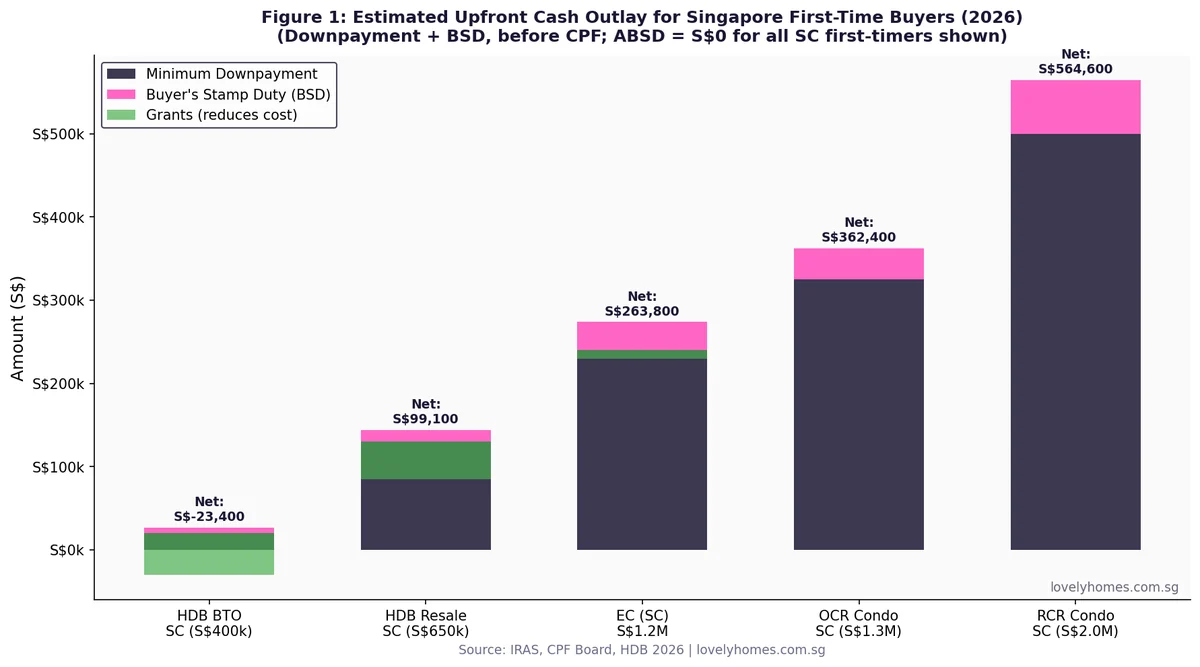
Scenario A — BTO 4-Room, SC Couple, S$9,000/mth household income: A 4-room BTO flat in a non-mature estate at S$420,000. Gross monthly income is S$9,000 — at the EHG ceiling, so EHG is S$5,000. Family Grant (BTO, SC couple) is S$80,000. Total grants: S$85,000. Adjusted purchase price for grant purposes: S$335,000. 10% downpayment (HDB loan): S$33,500 cash/CPF. BSD on S$335,000: S$5,350. Estimated upfront: ~S$38,850. Without grants: 10% of S$420,000 = S$42,000 + BSD S$6,900 = ~S$48,900. Grant saving: ~S$10,050 in upfront costs, plus S$85,000 reduction in loan principal.

Scenario B — Resale 4-Room, SC+SPR Couple, S$6,000/mth income: Resale flat at S$560,000. EHG at S$6,000 income = S$35,000; Family Grant (resale, SC+SPR) = S$40,000; PHG (living near parents) = S$20,000. Total grants: S$95,000. Adjusted price: S$465,000. 25% downpayment (bank loan): S$116,250. BSD on S$560,000: S$12,200. Upfront: ~S$128,450. Without grants: 25% of S$560,000 = S$140,000 + BSD S$12,200 = ~S$152,200. Grant saving upfront: ~S$23,750 — largely via reduced loan principal.

Scenario C — Single SC, Aged 38, Resale 4-Room, S$5,000/mth income: Resale flat at S$380,000. Singles Grant: S$25,000. EHG (single, S$5,000 income) = S$40,000. Total: S$65,000. Adjusted price: S$315,000. HDB loan 90% LTV: S$283,500; 10% downpayment cash/CPF: S$31,500. BSD on S$380,000: S$6,300. Upfront: ~S$37,800. Without grants: S$38,000 + S$6,300 = ~S$44,300.

Common Pitfalls and Misconceptions

The most common misconception is that HDB grants are paid out as cash. They are not — they reduce the assessed purchase price or outstanding loan, so the benefit is realised over the loan tenure (less interest) rather than immediately. A second common error is failing to check whether either applicant has previously received a housing subsidy. Any prior CPF Housing Grant, AHG, SHG, or EHG will classify you as a “second-timer” for certain grants, which can significantly reduce your eligible quantum. Third, buyers sometimes conflate the EHG income ceiling (S$9,000/mth) with the general HDB eligibility income ceiling (S$14,000/mth for families; S$7,000/mth for singles buying new 2-room BTO). These are separate thresholds — you can be eligible to buy an HDB flat but not eligible for the EHG if your income exceeds S$9,000/mth.

What Might Change — HDB Grant Policy Outlook (2026–2028)

Editorial analysis — not financial advice or a government forecast. Grant amounts have been periodically revised upward since the EHG’s introduction in 2019 to keep pace with rising HDB resale prices. Given that median resale prices have risen materially since 2021, there is broad industry expectation that the income ceilings and/or grant quanta will be reviewed again in either the FY2026 or FY2027 Budget. The Singles Grant was enhanced in January 2024 to allow 4-room resale access; further extension to cover 5-room flats remains a periodic policy discussion. The PHG’s absence from BTO purchases is another area where advocacy groups have sought extension, particularly for couples who choose resale specifically for proximity to elderly parents.

Frequently Asked Questions

Can I get both the EHG and the Family Grant at the same time?
Yes — the EHG and Family Grant are designed to be stacked. A first-timer SC couple buying a BTO flat can receive both grants simultaneously, for a combined maximum of S$160,000 (S$80,000 EHG + S$80,000 Family Grant) if their household income is S$1,500 per month or below. For most couples in the S$6,000–S$9,000 income range, the combined grant will be in the S$95,000–S$130,000 range. For resale purchases, the EHG (up to S$80,000) and Family Grant (up to S$50,000 for SC-SC couples) can similarly be stacked, and the Proximity Housing Grant can be added on top if proximity conditions are met.
What counts as “household income” for grant eligibility?
HDB uses the “average gross monthly household income” over the 12 months before your HDB application as the reference figure. This includes the gross income of all applicants and any listed occupants who are working. Income from employment (salary, allowances, commissions) and self-employment is included. CPF contributions, rental income from existing property, and investment returns are generally excluded. If one applicant is unemployed, their income is counted as S$0 for averaging purposes — which can actually raise grant eligibility for some couples where only one partner works.
Can permanent residents (SPRs) receive HDB grants?
SPRs cannot receive HDB grants in their own right — grants are tied to Singapore Citizenship status. However, in a SC-SPR couple, the SC spouse’s citizenship status makes the household eligible for the Family Grant (at the SC+SPR quantum: S$60,000 for BTO, S$40,000 for resale) and the EHG. The PHG and Step-Up Grant are also available to SC-SPR couples. Couples where both applicants are SPR receive no CPF Housing Grants and must pay full market price for their HDB flat.
What happens to the grant if I sell the flat within the Minimum Occupation Period (MOP)?
Selling an HDB flat before meeting the Minimum Occupation Period (MOP — typically 5 years for standard BTO/resale, 10 years for Prime/Plus location BTO flats purchased on or after the new classification framework) is not permitted. If you are forced to sell due to approved exceptional circumstances before MOP, HDB may claw back the grant amount. After the MOP, you retain the benefit of the grant — but you will not be eligible for further CPF Housing Grants on your next HDB purchase if you have already been classified as a second-timer.
Does the Proximity Housing Grant apply if I buy near a sibling rather than a parent?
No — the Proximity Housing Grant (PHG) applies only to proximity with parents or an unmarried child living with you, or proximity to a married child’s home. Siblings, grandparents, aunts, uncles, or other relatives are not eligible as the proximity anchor. The “living with” condition means the parents are registered as occupants of the flat you purchase. The “living near” condition means your new resale flat must be within 4 km of the parents’ or child’s current home. HDB verifies proximity using registered addresses.
If I previously took a CPF Housing Grant, can I get another one for my next flat?
Generally, no — once you have received a CPF Housing Grant (including the old AHG, SHG, or the current EHG or Family Grant), you are classified as a “second-timer” for subsequent flat purchases. Second-timers can apply for the Step-Up CPF Housing Grant (S$15,000 for 4-room or smaller BTO), but are not eligible for the EHG or Family Grant again. The Singles Grant and PHG may still be available in specific circumstances. This is why it is important to use your first-timer grant status strategically — ideally for the property where you will stay for the long term.
How do I apply for HDB grants and how long does approval take?
Grant applications are integrated into the HDB Flat Portal (homes.hdb.gov.sg) — you apply for grants as part of the flat application process, not as a separate standalone application. For BTO applications, grant eligibility is assessed after the HDB Letter of Offer (LOO) is issued, typically within 3–5 months of the ballot outcome. For resale transactions, grant eligibility is confirmed at the HDB appointment stage, after the Option to Purchase (OTP) has been granted and exercised. HDB typically completes the eligibility assessment within 2–4 weeks of receiving the required income documents. The grant credit appears on your HDB Resale Completion Appointment confirmation or your BTO Signing of Agreement for Lease document.

Related Articles


Disclaimer: This article is produced by the LovelyHomes Editorial Team for informational purposes only and does not constitute financial, legal, or housing advice. Grant amounts, income ceilings, and eligibility conditions are set by HDB and are subject to change without prior notice. All figures cited are based on publicly available HDB data as at June 2026. Readers should verify current grant eligibility and quantum directly with HDB via the HDB Flat Portal (homes.hdb.gov.sg), the HDB InfoWEB, or by calling the HDB Sales/Resale Enquiry hotline. Consult a licensed financial adviser before making any housing or financial decisions.

Singapore HDB Flat Eligibility Guide 2026: HFE Check, Income Ceilings and What Qualifies You

Singapore HDB Flat Eligibility Guide 2026: HFE Check, Income Ceilings and What Qualifies You

Quick Answer: HDB Flat Eligibility Singapore 2026

  • The HDB Flat Eligibility (HFE) letter replaced the old HDB Loan Eligibility (HLE) letter in May 2023. It is a single document that confirms both your eligibility to buy an HDB flat and your eligibility for an HDB housing loan and CPF housing grants.
  • The HFE letter is mandatory before you can apply for a BTO flat or place an Option to Purchase (OTP) on a resale HDB flat.
  • It is valid for 9 months from the date of issue and can be renewed by reapplying.
  • The income ceiling for most BTO flat types (excluding Singles schemes) is S$14,000 per month gross household income.
  • For Singles 35+ buying 2-Room Flexi under the Single Singapore Citizen Scheme, the income ceiling is S$7,000/mth.
  • You cannot buy a subsidised HDB flat if you currently own private property or have sold private property within the last 30 months.
  • Permanent Residents (PRs) can buy resale HDB flats but are not eligible for BTO flats or CPF housing grants.
  • For Executive Condominiums (ECs), the income ceiling is S$16,000/mth for first-timer families.

What Is HDB Flat Eligibility — and Why the HFE Letter Matters

Buying an HDB flat in Singapore is not simply a matter of picking a unit and signing a contract. The Housing and Development Board (HDB) administers the most heavily subsidised public housing programme in the world: as of 2026, over 78% of Singapore’s resident population lives in HDB flats, many purchased at significant subsidies relative to market prices. To maintain the fairness and integrity of this system, the HDB enforces a detailed eligibility framework governing who can buy which type of flat, under what conditions, and with what assistance.

The centrepiece of this framework — for buyers — is the HDB Flat Eligibility (HFE) letter, introduced in May 2023. The HFE letter replaced both the old HDB Loan Eligibility (HLE) letter and the separate eligibility self-check that buyers previously performed themselves. Today, a single HFE application, submitted via the HDB Flat Portal, generates a letter that simultaneously confirms your:

  • Eligibility to purchase an HDB flat (including flat type and scheme).
  • Eligibility for an HDB concessionary housing loan and the maximum loan quantum.
  • Eligibility for CPF housing grants and the grant amounts applicable to you.

No HFE letter means no BTO application and no resale OTP. Understanding how to obtain the HFE letter — and what it assesses — is therefore the logical starting point for any prospective HDB buyer in 2026.

Figure 1: HDB flat eligibility matrix by citizenship and scheme Singapore 2026
Figure 1: HDB flat eligibility by citizenship profile and scheme in Singapore (2026). Green = eligible; red = not eligible for that pathway.

The Seven HDB Eligibility Schemes: Which One Applies to You?

The HDB does not use a single eligibility rule. Instead, it operates seven distinct eligibility schemes, each designed to accommodate a specific family or household configuration. Every applicant must qualify under one of these schemes.

1. Public Scheme: The most common scheme. Requires at least one Singapore Citizen (SC) applicant. The other person(s) in the nucleus (spouse, children, parents, or siblings) can be SCs or Permanent Residents (PRs). This covers the vast majority of married couples and families applying for BTO or resale flats.

2. Fiancé/Fiancée Scheme: Allows SC couples who are not yet married to apply for a BTO flat or book a resale flat together. Both parties must be at least 21 years old and must register their marriage within three months of the resale flat keys being collected, or within three months of the BTO flat booking.

3. Orphan Scheme: For applicants who are single SCs (i.e., unmarried, widowed, or divorced) and whose parents are deceased. The applicant must have at least one sibling who is also unmarried or widowed and who was living with the parents prior to their passing. This scheme allows siblings to pool their eligibility to purchase a flat together.

4. Non-Citizen Spouse Scheme: Allows an SC to buy a flat with a foreign (non-PR, non-SC) spouse. The SC applicant must be the essential occupier; the foreign spouse is named as an occupier. Only a limited selection of HDB flat types is available under this scheme, and CPF grant eligibility is more restricted.

5. Single Singapore Citizen (SSC) Scheme: For SCs aged 35 and above who are single (unmarried, widowed, or divorced). Singles may only purchase 2-Room Flexi flats in non-mature estates under BTO, or any resale flat size. The income ceiling under this scheme is S$7,000 per month.

6. Joint Singles Scheme: Allows two to four single SCs, each aged 35 or above, to buy a flat jointly. The same rules as the SSC Scheme apply; participants must remain as joint owners during the Minimum Occupation Period (MOP).

7. Joint Singles with Widowed/Divorced Persons Scheme: A specific subset allowing a widowed or divorced SC of any age to purchase a resale flat jointly with other single SCs (aged 35+).

Income Ceilings: BTO, Resale and EC

Figure 2: HDB and EC income ceiling by flat type Singapore 2026 BTO eligibility
Figure 2: HDB income ceilings by flat type (2026). Income ceiling for 2-Room Flexi BTO in Plus/Prime classification and Singles 35+ is S$7,000/mth.

Income ceilings for BTO flat purchases exist to ensure subsidised flats are channelled to households that genuinely cannot afford private market alternatives. The ceilings are based on gross monthly household income — the sum of all assessable income of all applicants and essential occupiers listed in the application.

Flat Type / Scheme Income Ceiling (Gross Monthly) Notes
2-Room Flexi BTO (Standard estates) S$14,000 (family) / S$7,000 (singles) Singles 35+ eligible for S$7,000 ceiling
2-Room Flexi BTO (Plus / Prime) S$7,000 (family) Lower ceiling for higher-subsidy estates
3-Room BTO S$14,000 Standard, Plus, and Prime classifications
4-Room BTO S$14,000 Most common flat type
5-Room and 3Gen BTO S$14,000 / S$21,000 (3Gen) 3Gen flats require multi-generational households
HDB Resale (no CPF grant) No income ceiling Any eligible buyer can purchase at market price
HDB Resale (with CPF grants) S$14,000 (family) / S$7,000 (singles) EHG eligibility requires household income check
Executive Condominium (EC) S$16,000 (first-timer family) EC is quasi-private; higher ceiling than HDB BTO

Ownership History and Private Property: The 30-Month Rule

One of the most consequential eligibility rules concerns private property ownership. To prevent higher-income households from simultaneously benefiting from HDB subsidies and private market appreciation, the HDB imposes strict conditions:

  • You and any listed occupier must not currently own private residential property in Singapore or overseas at the time of application.
  • You and any listed occupier must not have disposed of any private residential property (in Singapore or overseas) within the 30 months immediately before the HFE application date (for subsidised BTO or resale with grants). This is the so-called “30-month wait-out period” for private property owners.
  • Owning a commercial property does not affect HDB eligibility, but owning a residential property held through a company or trust may be assessed on a case-by-case basis.

For buyers purchasing a resale flat at market price without any CPF housing grant, the private property ownership rule does not apply — you can own a private property and buy a resale HDB flat simultaneously, subject to paying the applicable stamp duty. However, you would need to sell the private property if you wish to continue owning the HDB flat beyond the applicable occupation period under the terms of the purchase.

MOP Interaction: When Previous Flat Ownership Matters

If you have previously owned an HDB flat, your Minimum Occupation Period (MOP) history affects your eligibility for a subsequent subsidised purchase:

  • You must have fully completed the MOP on your current or most recently sold HDB flat before applying for a new BTO flat.
  • If you are currently within the MOP of an existing HDB flat, you cannot book a new BTO flat — you must wait until the MOP is cleared and the existing flat is sold.
  • Second-timer applicants applying for BTO flats have reduced priority balloting and are subject to a resale levy payable to HDB if they had previously received a housing subsidy on a first subsidised flat.
  • The resale levy ranges from S$15,000 to S$55,000 depending on the flat type of the first subsidised flat, and is payable upon the booking of the second flat.

Figure 3: HFE letter 8-step application process flowchart HDB flat eligibility Singapore 2026
Figure 3: The 8-step HDB HFE (Flat Eligibility) letter application process in Singapore (2026). The HFE replaces the old HLE letter and combines loan and grant eligibility in one document.

How to Apply for the HFE Letter: Step-by-Step

Applying for the HFE letter is done entirely online via the HDB Flat Portal at homes.hdb.gov.sg (also accessible at go.gov.sg/hfe). The process requires all applicants to log in via Singpass and provide income documentation. Here is what you need:

  • Singpass login for each applicant.
  • Latest CPF contribution history (auto-retrieved with Singpass consent).
  • Latest payslip(s) for each employed applicant.
  • Income Tax Notice of Assessment (if self-employed or commission-based).
  • Documents for variable income, including bonuses, allowances, and rental income (typically the average over the past 12 months).
  • Details of all outstanding loans (used to assess HDB loan quantum and TDSR/MSR compliance).

Once submitted, HDB typically issues the HFE letter within 5 to 7 working days, though complex applications (e.g., overseas property interests, atypical income structures, or previous flat ownership history) may take longer. The HFE letter is valid for 9 months. If you do not book a flat or sign a resale OTP within this window, you must renew the HFE application.

Worked Example: The Lee Family’s HFE Application and BTO Journey

Mr Lee Jian Ming and Ms Tan Wei Ling are Singaporean citizens, both aged 29, engaged to be married in August 2026. They wish to apply for a 4-Room BTO flat in Bishan under the Fiancé/Fiancée Scheme. Their combined gross monthly income is S$9,200. Neither owns any private property; both are first-time flat buyers.

Step 1 — HFE Application: They apply jointly via the HDB Flat Portal, logging in via Singpass and uploading their payslips. Mr Lee earns S$5,800/mth; Ms Tan earns S$3,400/mth. Combined: S$9,200/mth.

Eligibility check: Income S$9,200 < ceiling S$14,000 ✓. Both are SCs ✓. Neither owns private property ✓. Both are first-timers ✓. Scheme: Fiancé/Fiancée (Public Scheme) ✓.

HFE Letter outcome: Eligible to purchase 4-Room BTO. Eligible for HDB concessionary loan at 2.6% p.a. (pegged to CPF OA rate + 0.1%). Maximum loan quantum: based on TDSR/MSR — HDB assesses their monthly repayment capacity. Eligible for Enhanced CPF Housing Grant (EHG) at S$9,200/mth household income = approximately S$20,000 (tapering scale, family; income ≥ S$9,001 and ≤ S$9,500 band).

At ballot: The Lees apply for a 4-Room flat in Bishan Lakeview (June 2026 BTO exercise, Prime classification). As first-timers under the Fiancé/Fiancée Scheme, they receive a First-Timer Priority ballot advantage. Wait time: approximately 4.5 years (Top in 2031).

Key numbers: BTO price approximately S$680,000 (indicative, Prime D20 4-Room). BSD: S$14,400. No ABSD (first HDB purchase). HDB loan 90% LTV = S$612,000 at 2.6% 25 years = S$2,780/mth. MSR 30%: maximum monthly mortgage S$2,760 — just at the boundary. The couple may consider topping up CPF or adjusting the loan tenure to keep monthly payments within MSR.

Why HFE Matters: Singapore’s Public Housing System and What It Delivers

The HFE framework reflects the extraordinary scope of Singapore’s public housing commitment. The government subsidises HDB flats at prices well below what a private developer would charge for comparable space in comparable locations — a deliberate policy to enable homeownership across virtually all income bands. This subsidy comes with conditions, and the HFE is how those conditions are enforced consistently and fairly.

For buyers, the HFE letter serves another practical function: it gives you certainty before committing. Knowing your exact grant quantum, maximum loan, and MSR headroom before entering the ballot prevents over-commitment and planning failures — a significant improvement over the old system where buyers sometimes discovered eligibility issues only at the booking stage.

By global comparison, few countries provide both a guaranteed right to affordable housing and a structured eligibility framework as rigorous as Singapore’s. The HFE system continues to be refined: the HDB has signalled that digital verification of income will become more automated through MyInfo and CPF integration, reducing the documentation burden on applicants whilst maintaining eligibility integrity.

What Might Change in HDB Eligibility Rules From 2026 Onwards

The HDB and the Ministry of National Development have signalled several potential directions for HDB eligibility policy in the medium term. Observers expect further calibration of the Plus and Prime flat classification framework — introduced in October 2024 — including the possibility of expanding the number of estates with Plus-level restrictions as the scheme matures. The resale levy quantum, last revised in 2006, is overdue for review given the rise in flat prices. The HDB has also mooted reforms to the singles policy, potentially lowering the age threshold below 35 in future BTO launches for certain flat types, in response to demographic changes and the rising number of young singles. Any policy changes would be announced by the Ministry of National Development and take effect for BTO sales exercises from the announcement date.

Frequently Asked Questions

How long is the HFE letter valid, and what happens if it expires?

The HFE letter is valid for 9 months from the date of issue. If you do not apply for a BTO flat or place a resale OTP within this period, you must reapply. The reapplication process is the same as the original application — you log in via the HDB Flat Portal, update your income and financial details, and HDB reassesses your eligibility. Your eligibility may change if your income, property ownership status, or household composition has changed since the last application. There is no limit on the number of times you can renew an HFE application.

Can a Permanent Resident buy a BTO flat in Singapore?

No. Permanent Residents (PRs) are not eligible to apply for BTO flats. PRs may only purchase resale HDB flats, and only if they form a family nucleus with at least one SC (or apply under the PRs-only joint purchase arrangement for resale flats). PRs are not entitled to CPF housing grants. Furthermore, PRs who buy an HDB resale flat must sell the flat before buying or owning any private residential property.

What is the resale levy, and when does it apply?

The resale levy is a payment to HDB made by second-timer applicants who are buying a second subsidised HDB flat (BTO or resale with CPF grants) after having previously received a housing subsidy on a first flat. The levy ranges from S$15,000 (for a previous 2-Room flat) to S$55,000 (for a previous 5-Room or larger flat), indexed to the flat type at time of first subsidy. The levy is intended to reduce the cumulative housing subsidy received by any one household. It is payable at the booking of the second flat and can be paid from CPF OA funds.

Can I apply for the HFE letter if I am currently renting an HDB flat?

Yes. Renting an HDB flat — whether through HDB directly or through a sub-tenancy arrangement from a flat owner — does not disqualify you from applying for the HFE letter or purchasing an HDB flat, provided you meet the other eligibility criteria (citizenship, income, ownership history, age). Your rental status is not assessed as part of the HFE eligibility check. However, note that if you are renting a room in an HDB flat owned by someone else, the owner’s eligibility is what governs the rental — not yours as a tenant.

What happens if my income exceeds the ceiling after I have already booked a BTO flat?

Once you have successfully booked a BTO flat and the booking is confirmed, the income ceiling is assessed at the point of application and booking — not retrospectively at key collection. A temporary increase in income after booking (for example, a salary increment or bonus) does not cause you to lose your booking. However, if you fraudulently misrepresented your income at the time of application, HDB can cancel your booking and take disciplinary action. The CPF grant quantum is fixed at the time the HFE letter is issued; subsequent income changes do not affect the grant amount already confirmed.

Can foreigners buy HDB flats in Singapore?

Foreigners (non-SC, non-PR) cannot buy HDB flats in Singapore under any scheme. They are also ineligible for CPF housing grants. Foreigners may purchase private residential property subject to paying Additional Buyer’s Stamp Duty (ABSD) at 60% of the purchase price (as at 2026). A small category of citizens from countries with bilateral Free Trade Agreements (Iceland, Liechtenstein, Norway, and Switzerland under the EUSFTA/FTA frameworks) may be treated similarly to SCs for ABSD purposes on first purchases, but are still ineligible to purchase HDB flats.

Does the 30-month wait-out period apply if I am giving up my private property through inheritance?

The 30-month wait-out period applies to the disposal of private residential property, not to its acquisition through inheritance. If you inherit private residential property, you are not immediately disqualified from HDB eligibility — however, you must dispose of the inherited private property before your HFE application or BTO booking (within the timeframe specified by HDB). If you are applying for a subsidised BTO flat or resale flat with CPF grants, you cannot hold private property simultaneously. The 30-month clock starts running from the date you legally dispose of the inherited private property, not from the date of inheritance.

Related Articles

Disclaimer

This article is intended for general information purposes only and does not constitute legal, financial, or professional advice. HDB eligibility rules, income ceilings, grant quantum, and related policies described in this article are accurate to the best of our knowledge as at June 2026 but are subject to change by the Housing and Development Board and the Ministry of National Development. Readers should verify all information directly with HDB before making any purchase decisions. Official HDB flat eligibility information is available at hdb.gov.sg. CPF housing grant information is available at cpf.gov.sg. Income tax and stamp duty information is available at iras.gov.sg.

×

Singapore HDB CPF Housing Grant Guide 2026: EHG, Family Grant, PHG and More Explained

Singapore HDB CPF Housing Grant Guide 2026: EHG, Family Grant, PHG and More Explained

Quick Answer — CPF Housing Grants at a glance

  • Singapore has six main CPF Housing Grants for HDB flat buyers: the Enhanced Housing Grant (EHG), Family Grant, Half-Housing Grant, Proximity Housing Grant (PHG), Step-Up CPF Housing Grant, and Singles Grant.
  • The most valuable is the EHG — up to S$120,000 for eligible SC couples on both BTO and resale HDB flats; income ceiling S$9,000/month household.
  • On top of EHG, resale HDB buyers can layer the Family Grant (up to S$80,000) and the PHG (up to S$30,000) — a combined maximum of S$230,000 for qualifying SC couples on resale.
  • Grants are credited directly to the CPF OA after HDB approval — they reduce your cash outlay by offsetting the purchase price, not by reducing the sticker price.
  • All grants are income-tested; the EHG is assessed on the average monthly household income over the preceding 12 months of continuous employment.
  • Deferred Income Assessment (DIA) is available for BTO buyers: if you start a new job or are self-employed, HDB can assess your income at key collection instead of application — useful if your income fluctuates.
  • Grants are not free money in the usual sense — if you sell the property before the Minimum Occupation Period (MOP), HDB will claw back the full grant amount.
  • Singapore Permanent Residents (SPRs) generally do not qualify for CPF Housing Grants on HDB purchases, with limited exceptions (SPR buying resale jointly with an SC may qualify for the Family Grant at S$40,000).

How CPF Housing Grants Work — the Basics

CPF Housing Grants are a government subsidy mechanism administered by the Housing and Development Board (HDB) and funded by the CPF Board. They are designed to make public housing ownership accessible to lower- and middle-income Singapore households by reducing the effective purchase price of an HDB flat.

When HDB approves a grant, the grant quantum is credited to the buyer’s CPF Ordinary Account (OA). From the OA, it is then applied against the purchase price of the flat — either as a lump-sum offset against the cash downpayment, or it reduces the HDB or bank loan required. Grants are not paid in cash; they flow through the CPF system and are subject to CPF’s usual rules on property withdrawal, accrued interest, and refund upon sale.

The practical effect is that the buyer needs to bring less cash to the transaction and/or can service a smaller loan. For a Tampines 4-room resale flat at S$560,000, a couple receiving S$120,000 EHG + S$80,000 Family Grant effectively pays only S$360,000 from their own resources (before CPF usage rules) — a reduction of 36% from sticker price.

Grants are tied to the flat and buyer, not the price alone. HDB will verify eligibility at application, and if circumstances change (e.g., income rises above the ceiling before completion), the grant may be revised or withdrawn.

Enhanced Housing Grant (EHG) — The Flagship Grant

Enhanced Housing Grant EHG quantum by monthly household income Singapore 2026
Figure 1: Enhanced Housing Grant (EHG) quantum by monthly household income — 2026. Maximum S$120K for couples, S$60K for singles (income ceiling S$9,000/month).

The Enhanced Housing Grant was introduced in September 2019, replacing the Additional CPF Housing Grant (AHG) and Special CPF Housing Grant (SHG). It is the cornerstone of Singapore’s housing subsidy framework.

Key EHG rules

  • Applicable flat types: Both BTO (all flat types and classification tiers — Standard, Plus, Prime) and resale HDB flats.
  • Quantum: S$5,000–S$120,000 for families/couples; S$2,500–S$60,000 for singles. The grant tapers as income rises (see Figure 1).
  • Income ceiling: S$9,000/month household for families; S$4,500/month for singles.
  • Employment requirement: At least one applicant must have worked continuously for at least 12 months immediately before the HDB flat application. Self-employed applicants must have contributed to Medisave for at least 12 months.
  • First-timer requirement: All applicants must be first-timers (never received a housing subsidy from HDB before).
  • Citizenship: All applicants must be Singapore Citizens. SPR-only households do not qualify.
  • Property ownership: No applicant can own, or have disposed of, a private property within 30 months before the HDB application.

Deferred Income Assessment (DIA)

If you are a BTO buyer and one or more applicants is currently not working, recently started a new job, or has been self-employed for less than 12 months, you may apply for Deferred Income Assessment. Under DIA, HDB assesses your income at the time of key collection rather than at the application stage. This is helpful for buyers who expect their employment situation to stabilise before TOP — but note that if your income is higher at key collection, you may receive a smaller EHG than initially indicated.

Family Grant and Half-Housing Grant

The Family Grant and Half-Housing Grant apply only to resale HDB flat purchases — they are not available for BTO flats (where EHG alone provides the subsidy for first-timers). They were designed to make the higher prices typical of resale flats more affordable.

Family Grant

  • Quantum: S$80,000 for SC couple (both buyers are Singapore Citizens); S$40,000 for SC + SPR couple.
  • Income ceiling: S$14,000/month combined household income.
  • Flat type: Resale HDB flats (2-room Flexi to 5-room; Executive flats also qualify).
  • Eligibility: At least one applicant must be a first-timer. Both applicants must not currently own private residential property.
  • Stackable: Can be combined with EHG (if income ≤ S$9,000) and PHG (if buying near parents).

Half-Housing Grant

The Half-Housing Grant is a variant of the Family Grant designed for mixed first-timer / second-timer SC couples buying a resale flat. One applicant is a first-timer; the other is a second-timer (has received a housing subsidy before). The grant quantum is half the Family Grant — S$40,000 (versus S$80,000 for two first-timers). The income ceiling of S$14,000/month applies. This grant acknowledges the fairness concern that a second-timer applicant who never received a grant should not be penalised simply because they are buying jointly with someone who has.

Proximity Housing Grant (PHG)

The Proximity Housing Grant incentivises multi-generational living by offering a subsidy to buyers who purchase a resale HDB flat near their parents or married children. It is stackable with the EHG and Family Grant and is available to both first-timers and second-timers — making it one of the few grants accessible to repeat buyers.

  • Quantum: S$30,000 for families/couples; S$15,000 for singles buying alone.
  • Proximity condition: Within 4 km of parents’/married child’s home, or in the same HDB town. “Same town” is defined by HDB’s official town boundaries.
  • Income ceiling: S$14,000/month combined household.
  • Occupation requirement: The parents or married child you are buying near must continue to live in their property for at least 5 years after you receive your PHG. If they move away before that, HDB may claw back the grant.
  • HDB flat only: The parent/child’s dwelling must be an HDB flat (not private property) to qualify.
  • PHG is also available to second-timers — unlike EHG and Family Grant, which require first-timer status from at least one buyer.

Step-Up CPF Housing Grant

The Step-Up CPF Housing Grant is specifically designed for lower-income households who are currently living in a 2-room subsidised HDB rental flat or in a 2-room Flexi flat they own, and wish to upgrade to a larger BTO flat.

  • Quantum: S$15,000.
  • Applicable flat type: BTO 2-room Flexi flats only (on the Confirmed List).
  • Income ceiling: S$7,000/month combined household.
  • Eligibility: Second-timer SC household currently occupying or owning a 2-room subsidised flat. Applicants must intend to surrender or sell the existing flat upon receiving keys to the new flat.
  • Note: This is a second-timer grant — it does not apply to first-timers. It is one of the few grants available to those who have previously received a housing subsidy.

Singles Grant

Singapore Citizens aged 35 and above buying an HDB flat alone (or divorced/widowed SC aged 21 and above) may qualify for the Singles Grant.

  • Quantum: S$40,000 for resale HDB flats (up to 5-room); S$25,000 for BTO 2-room Flexi flats.
  • Income ceiling: S$7,000/month individual income.
  • Flat restriction: Singles can only buy 2-room Flexi BTO or resale flats up to 5-room. They cannot buy bigger flats (Executive, DBSS) or new launches above 2-room Flexi.
  • EHG and Singles Grant are stackable for BTO 2-room Flexi buyers: a single SC earning ≤ S$4,500/month could receive S$60,000 EHG + S$25,000 Singles Grant = S$85,000 combined.
  • Divorced/widowed SC aged ≥ 21 may qualify for the same resale grant quantum (S$40,000), subject to the usual eligibility checks.

Maximum Grants by Buyer Profile — What Is Achievable

Singapore CPF housing grant amounts by buyer profile 2026 — EHG Family Grant PHG comparison
Figure 2: Maximum CPF housing grant amounts by buyer profile — EHG, Family Grant and PHG combined. Resale HDB buyers can stack all three grants.

The headline figure that matters for resale buyers is the combined EHG + Family Grant + PHG. For an SC couple on a combined income of S$8,000/month buying a resale flat within 4 km of their parents, the maximum combined grant is S$120,000 + S$80,000 + S$30,000 = S$230,000. This is real money — it represents a 33% reduction on a S$700,000 flat. For BTO buyers, the EHG alone of up to S$120,000 is the primary subsidy; no Family Grant or PHG is available for BTO flats.

Full Grants Comparison Table

All CPF housing grants comparison table Singapore 2026 — EHG Family Grant PHG Step-Up Singles
Figure 3: All CPF Housing Grants — full comparison table for Singapore 2026. Check eligibility at grants.hdb.gov.sg.

How Grants Interact with the HDB Loan, Bank Loan, and CPF

Grants are credited to CPF OA and then applied against the purchase price. In practice, this means they reduce the loan quantum you need (whether HDB concessionary loan or bank loan). If you are taking an HDB loan, grants reduce the loan principal directly. If you are taking a bank loan with a 25% cash/CPF downpayment, grants can fund part of that downpayment from CPF OA, reducing the cash you need to bring.

One important interaction: the Resale Levy. Second-timer SC households buying a subsidised BTO flat must pay a Resale Levy (S$15,000–S$55,000 depending on flat type sold). The Resale Levy reduces your net proceeds from the first HDB flat but is a separate charge from any grant — the two do not net off. If you qualify for a second-timer grant like the Step-Up Grant (S$15,000), the Resale Levy on a 4-room flat previously sold is S$40,000 — so you would still be net negative from the levy perspective.

Grants are also subject to CPF accrued interest rules. When you sell the property, you must refund to CPF the grant principal plus accrued interest at 2.5% per annum, compounded annually. On a S$120,000 EHG held for 10 years, the total refund obligation grows to approximately S$153,000. This does not reduce your sale proceeds in isolation — but it must be factored into your net cash position on exit.

Worked Example: The Lim Family — Resale 4-Room in Tampines

Scenario: Mr and Mrs Lim, both Singapore Citizens (SC) and first-timers, are buying a resale 4-room HDB flat in Tampines at S$580,000. HDB valuation: S$565,000. Combined monthly income: S$7,500. Mrs Lim’s parents live in Tampines (same HDB town), qualifying for the PHG.

Grant eligibility:

  • EHG (household income S$7,500 ≤ S$9,000): S$85,000 (based on HDB’s EHG scale for S$7,001–S$8,000/mth bracket)
  • Family Grant (both SC, resale, income ≤ S$14,000): S$80,000
  • PHG (same HDB town as parents, both parents in HDB flat): S$30,000
  • Total grants: S$195,000

Purchase cost breakdown:

  • Purchase price: S$580,000
  • Cash Over Valuation (COV): S$580,000 − S$565,000 = S$15,000 cash
  • BSD: S$11,400 (S$580,000) — payable via CPF OA or cash
  • HDB loan (80% of HDB valuation, subject to MSR 30%): S$452,000 @2.6% 25 years → S$2,046/month
  • MSR check: S$2,046 / S$7,500 = 27.3% PASS (below 30% MSR)
  • CPF OA used for: S$195,000 grants + own CPF OA savings to fund remaining downpayment and BSD
  • Cash outlay: S$15,000 (COV) + BSD if OA insufficient + agent commission ~S$5,800 (1%) + legal S$2,500 = approximately S$23,300 cash minimum

Key takeaway: The S$195,000 in combined grants reduces the Lims’ effective purchase price to S$385,000 from their own resources (before loan). Without any grants, they would need to fund S$145,000 from cash and CPF savings alone for the downpayment portion — grants save them approximately S$195,000 in CPF/cash outlay compared to a grant-less scenario.

What Might Change in the Grants Framework

Singapore reviews its housing grant framework periodically in conjunction with broader housing affordability measures. The most significant recent change was the October 2023 increase to the Family Grant quantum for SC couples from S$50,000 to S$80,000 — a 60% uplift that reflected rising resale flat prices. The PHG was similarly raised in 2019 from S$20,000/S$10,000 to S$30,000/S$15,000.

There is ongoing policy discussion around whether the EHG income ceiling of S$9,000/month should be raised to keep pace with median household income growth — Singapore’s median household income rose to approximately S$10,100/month by 2025. A ceiling revision would extend EHG access to more households. Meanwhile, the government has signalled continued monitoring of resale flat affordability, and further grant adjustments cannot be ruled out in the next Budget.

What is unlikely to change is the CPF-routing mechanism — grants have been channelled through CPF since the 1990s and the accrued-interest framework serves an important long-term retirement savings purpose. Any buyer should therefore plan for the CPF refund obligation at sale, not just the grant receipt at purchase.

Summary — CPF Housing Grants at a Glance

Grant Max Quantum Flat Type Income Ceiling First-Timer?
EHG (Enhanced Housing Grant) S$120K couple / S$60K single BTO + Resale HDB S$9,000/mth household Yes (all applicants)
Family Grant S$80K (SC+SC) / S$40K (SC+SPR) Resale HDB only S$14,000/mth household At least one
Half-Housing Grant S$40K Resale HDB only S$14,000/mth household One party only
Proximity Housing Grant S$30K couple / S$15K single Resale HDB only S$14,000/mth household Not required
Step-Up Grant S$15,000 BTO 2-room Flexi S$7,000/mth household No (2nd-timer)
Singles Grant S$40K resale / S$25K BTO 2Rm Resale (≤5Rm) / BTO 2Rm S$7,000/mth individual Yes (first-timer)

Frequently Asked Questions

Can I receive CPF Housing Grants if I buy a resale HDB as a second-timer?

Generally, no — most grants (EHG, Family Grant, Half-Housing Grant) require at least one first-timer applicant. However, the Proximity Housing Grant (PHG) is an exception: it is available to both first-timers and second-timers buying a resale HDB flat near their parents or married child. The Step-Up CPF Housing Grant is specifically for second-timers, but only for BTO 2-room Flexi flats. If you are a second-timer buying a resale flat of 3-room or larger, the PHG (if applicable) is likely your only available grant.

Are grants credited before or after I pay for the flat?

Grants are credited to your CPF OA after HDB approves your application and before the resale completion appointment (for resale flats) or before key collection (for BTO). At the completion/key collection appointment, HDB applies the CPF OA funds — including the grant amount — against the purchase price. You do not receive the grant first and then pay; it is applied in one transaction at completion. If you are taking a bank loan, the bank will drawdown simultaneously. The net effect is that you bring less cash/CPF from your own savings on the day.

Do grants affect my HDB loan eligibility or how much I can borrow?

Grants themselves do not increase your loan ceiling, but they reduce the loan quantum you need because they cover part of the purchase price. Your HDB Loan Eligibility (HLE) is still calculated based on your household income, outstanding loans, and the Mortgage Servicing Ratio (MSR) of 30%. If your MSR-based maximum loan is, say, S$500,000, but you qualify for S$195,000 in grants on a S$580,000 flat, your actual loan needed falls to approximately S$385,000 (less CPF OA savings) — well below the MSR limit, meaning your monthly repayment is lower than if you had no grants at all.

What happens to my grants if I sell the flat before the MOP?

You cannot sell an HDB flat before completing the Minimum Occupation Period (MOP) — 5 years from key collection for most flats, and 10 years for Prime Location Public Housing (PLH) flats and some Plus flats. If you are permitted to sell under exceptional HDB discretion before MOP (which is rare), HDB will claw back the full grant amount from your sale proceeds. After MOP, you keep the grant — but you must refund it to your CPF OA (as part of the normal CPF refund on property sale, together with accrued interest at 2.5% per annum).

Can my parents’ income affect my grant eligibility?

No. Grant eligibility is assessed on the applicants’ own household income — that is, the income of the people named on the HDB application (typically the buyer(s)). Parents’ income is not considered, even if you live with them or they are financial contributors. However, if you are buying a flat jointly with your parents (which is possible under certain HDB schemes), their income would be included in the household income calculation for grant purposes.

Does receiving a grant affect my ABSD position?

Grants are only available for HDB flats, and first-time SC buyers of HDB flats already pay 0% ABSD (no Additional Buyer’s Stamp Duty on a first property). So in most cases, grants and ABSD do not interact — the buyer paying no ABSD is also the buyer most likely to qualify for grants. However, if an SC owns private property and is buying an HDB flat (which is restricted — SCs can generally only own one HDB flat), ABSD rules and grant eligibility would need careful individual assessment. The scenario where ABSD and grants both apply is narrow and requires professional advice.

What is the CPF accrued interest refund and how much will I owe when I sell?

When you sell an HDB flat that was purchased with CPF funds (including grants), you must refund to your CPF OA the principal withdrawn plus accrued interest at 2.5% per annum, compounded annually. For a S$120,000 EHG held for 10 years: S$120,000 × (1.025)^10 = approximately S$153,600 to be refunded to CPF. This refund is not a loss — it goes back into your CPF OA for retirement savings. However, it means your net cash from the sale is lower than the gross sale proceeds minus outstanding mortgage. Always model the CPF refund when planning a property exit.

Related Articles

Disclaimer: Grant amounts, income ceilings, and eligibility criteria are accurate as of June 2026 based on publicly available information from HDB and the CPF Board, but may change at any time. Grant eligibility is assessed individually by HDB at the time of application. This article is for general information only and does not constitute financial, legal, or housing advice. Always verify current grant details directly at hdb.gov.sg or the CPF Board website, and consult a licensed HDB solicitor or financial adviser before making property decisions.

HDB Resale Levy Singapore 2026: Complete Guide for Second-Timer Flat Buyers

HDB Resale Levy Singapore 2026: Complete Guide for Second-Timer Flat Buyers

Quick Answer — HDB Resale Levy at a Glance

  • The HDB Resale Levy applies when a second-timer household buys a new BTO flat or a new Executive Condominium (EC) from a developer after previously enjoying a housing subsidy.
  • Levy amounts range from S$15,000 (2-Room Flexi) to S$55,000 (Multi-Generation flat), based on the flat type you are selling.
  • The levy does not apply if you buy a resale HDB flat on the open market, or if you buy private property.
  • Payment comes from your sale proceeds (CPF refund + cash). If proceeds fall short, you must top up in cash.
  • The policy ensures those who already benefited from a large housing subsidy pay back a portion before receiving a second round of public housing support.
  • If your previous subsidised home was an Executive Condo (EC), the levy is calculated differently: 15% of your net EC resale proceeds, subject to a minimum of S$15,000.
  • Singles under the Single Singapore Citizen (SSC) scheme or Joint Singles Scheme may also be subject to the levy if buying a second subsidised flat.

What Is the HDB Resale Levy?

The HDB Resale Levy is a financial charge levied by the Housing and Development Board (HDB) on households who apply to purchase a second new subsidised flat — either a Build-to-Order (BTO) flat or a new Executive Condominium (EC) sold directly by a developer — after having previously benefited from a public housing subsidy.

The policy exists to uphold the principle of equity in Singapore’s public housing system. New BTO flats and ECs are sold at prices significantly below open-market value, a subsidy funded by taxpayers. HDB’s view is that once a household has enjoyed this advantage, they should not receive the same full quantum of subsidy a second time without contributing back to the system. The resale levy is that contribution.

Introduced in its current fixed-amount form for households that sold their first subsidised flat on or after 3 March 2006, the levy has remained a cornerstone of Singapore’s housing mobility framework. HDB administers the levy directly, collecting it at the point when the second subsidised flat purchase is completed.
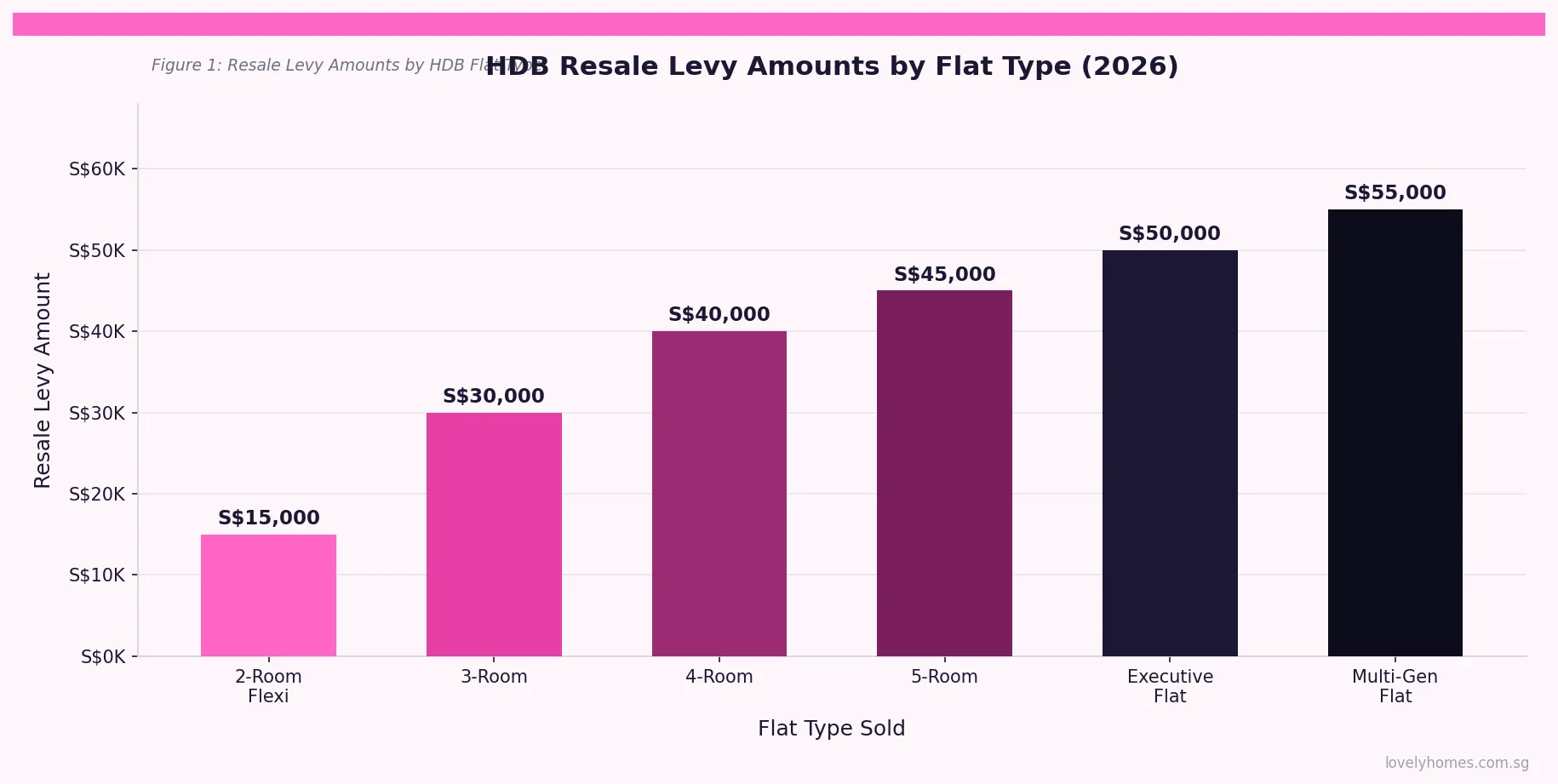
HDB Resale Levy amounts by flat type Singapore 2026 bar chart
Figure 1: HDB Resale Levy amounts by flat type — from S$15,000 (2-Room Flexi) to S$55,000 (Multi-Generation). Source: HDB, 2026.

Who Has to Pay the HDB Resale Levy?

The levy applies specifically to second-timer households. HDB classifies a household as a second-timer when at least one applicant has previously:

  • Received a housing subsidy from HDB — including the Enhanced CPF Housing Grant (EHG), the Central Provident Fund Housing Grant (CPF-HG), the Special CPF Housing Grant (SHG), or any earlier-generation grant — when buying a resale flat; or
  • Bought a new BTO, Build-to-Order Sales of Balance Flats (SBF), or EC flat directly from a developer.

If you are a first-timer — meaning you have never previously bought an HDB flat or EC, and have not received a CPF housing grant for a resale purchase — you do not pay the resale levy on your first BTO or EC purchase, regardless of price or flat type.

The levy also applies to Singles buying under the Single Singapore Citizen (SSC) scheme who have previously owned a subsidised flat, and to non-citizen spouses in joint applications where the Singapore Citizen applicant is a second-timer.

Resale Levy Amounts by Flat Type (2026)

The levy is fixed and based on the type of HDB flat you are selling, not on the purchase price of your next flat. This table shows the 2026 schedule:

Flat Type Sold Resale Levy (Fixed) Notes
2-Room Flexi S$15,000 Lowest levy; applies to Type 1 and Type 2 2-room flats
3-Room S$30,000 Applies to 3-room BTO and resale-with-grant flats sold
4-Room S$40,000 Most common flat type; levy payable on proceeds
5-Room S$45,000 Includes 5-room improved and 5-room model A flats
Executive Flat S$50,000 Applies to executive maisonettes and executive apartments
Multi-Generation (Multi-Gen) Flat S$55,000 Highest fixed levy; Multi-Gen flats are rare and targeted at three-generation families
DBSS Flat By flat type equivalent A DBSS 4-room incurs S$40,000; 5-room incurs S$45,000
Executive Condominium (EC) 15% of net resale proceeds (min. S$15,000) Only applies if you previously bought an EC directly from a developer and are now buying a new BTO/EC

Key point on DBSS flats: Design, Build and Sell Scheme (DBSS) flats are treated equivalently to standard HDB flats of the same flat type for levy purposes. The levy on a 4-room DBSS flat sold is S$40,000 — the same as a standard 4-room HDB.

Key point on ECs: Executive Condominiums sold before their 5-year Minimum Occupation Period (MOP) are treated differently. If you sold your EC at the 5-year MOP mark (when it is still classified as an HDB property for resale purposes) and wish to buy another subsidised flat, your levy is calculated at 15% of the net resale price of the EC, not a fixed sum. The minimum levy is S$15,000.
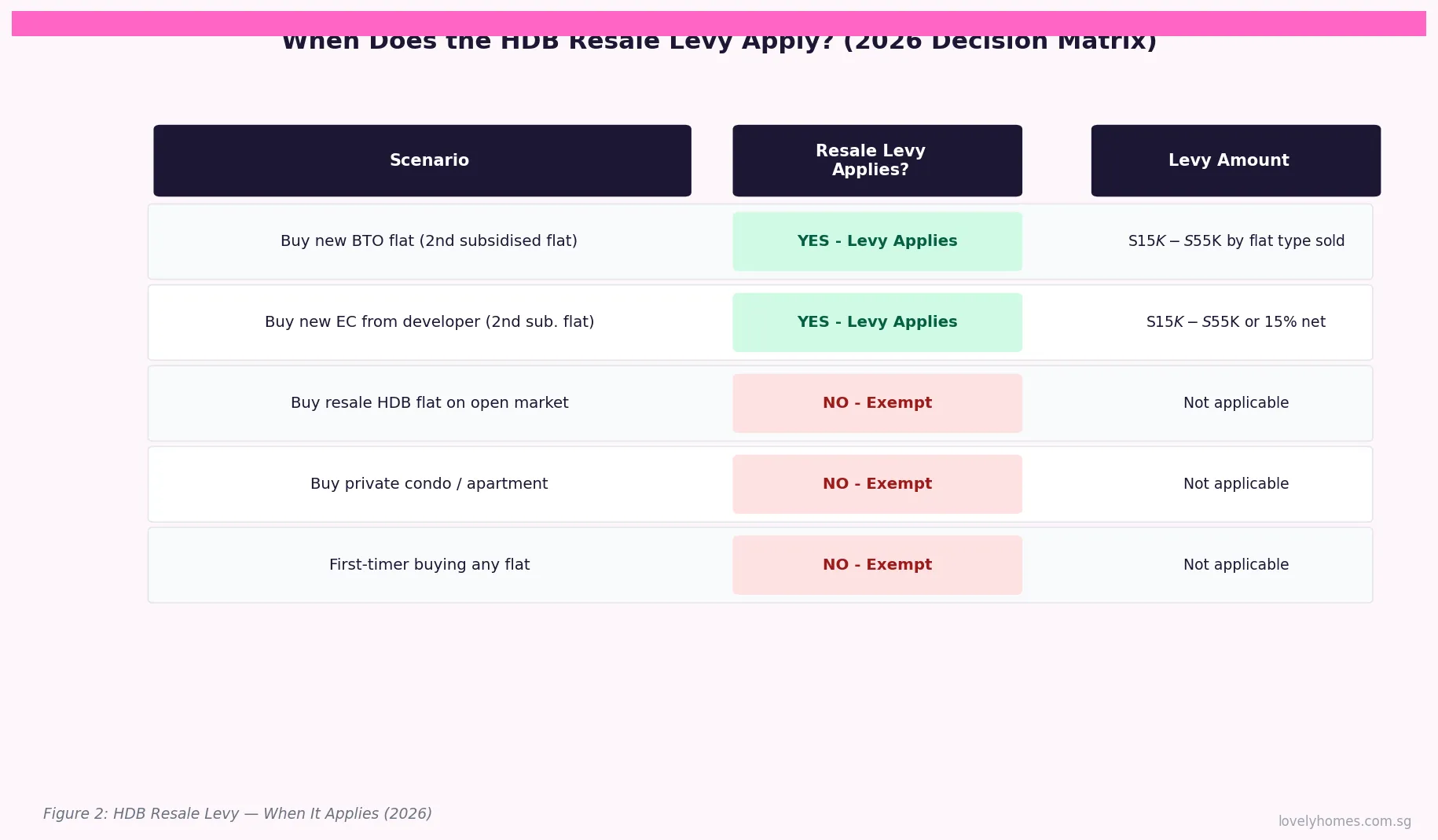
When HDB Resale Levy applies decision matrix Singapore 2026
Figure 2: HDB Resale Levy decision matrix — when the levy applies and when it does not. Source: HDB, 2026.

When Does the Resale Levy Apply?

The trigger for the levy is narrow and precise: it applies only when a second-timer household purchases a new subsidised flat from HDB directly (BTO or SBF exercise) or a new EC from a developer. It does not apply in any of the following scenarios:

  • Buying a resale HDB flat on the open market — even if you are a second-timer, no levy is charged when you buy a resale flat (though you will also receive no EHG or CPF housing grants).
  • Buying private property — the levy is exclusively a feature of the subsidised public housing system.
  • Transferring ownership within the family — an intra-family transfer is not a new subsidised purchase and does not trigger the levy.
  • First-timers — by definition, if you have not previously received a housing subsidy, the levy does not apply.

One nuance worth noting: if you buy a resale HDB flat with a CPF housing grant (making you a subsidised buyer of a resale flat), you become a second-timer for future subsidised flat purchases. Should you later apply for a BTO or new EC, the resale levy will apply at that stage, calculated on the flat you had originally bought with the grant.

How Is the Resale Levy Paid?

The levy is deducted from the proceeds of your flat sale. In practice, HDB coordinates the payment as part of the resale transaction. The sequence is:

  1. You agree to sell your existing flat and apply for a new BTO flat or EC concurrently.
  2. At the point of your existing flat’s resale completion, HDB retains the levy amount from the sale proceeds.
  3. The retained amount is credited to HDB’s account — it is not returned to your CPF Ordinary Account.
  4. If your sale proceeds (after CPF refund) are insufficient to cover the levy, you must make up the shortfall in cash.

Unlike CPF principal and accrued interest (which are refunded to your CPF OA and can be redeployed for the next flat), the resale levy is gone once deducted. It is a one-time levy and cannot be offset against BSD, legal fees, or any other cost of the new purchase.

There is no option to defer the levy or to split it across multiple payment dates. It must be settled in full at the point of sale completion of the existing flat. HDB does not currently offer any hardship waiver or instalment arrangement for the levy.

Net Proceeds After the Levy

Understanding your effective net proceeds after the levy is deducted helps with financial planning for your next purchase. The chart below illustrates how the S$40,000 levy on a 4-room flat affects gross sale proceeds at five common price points:
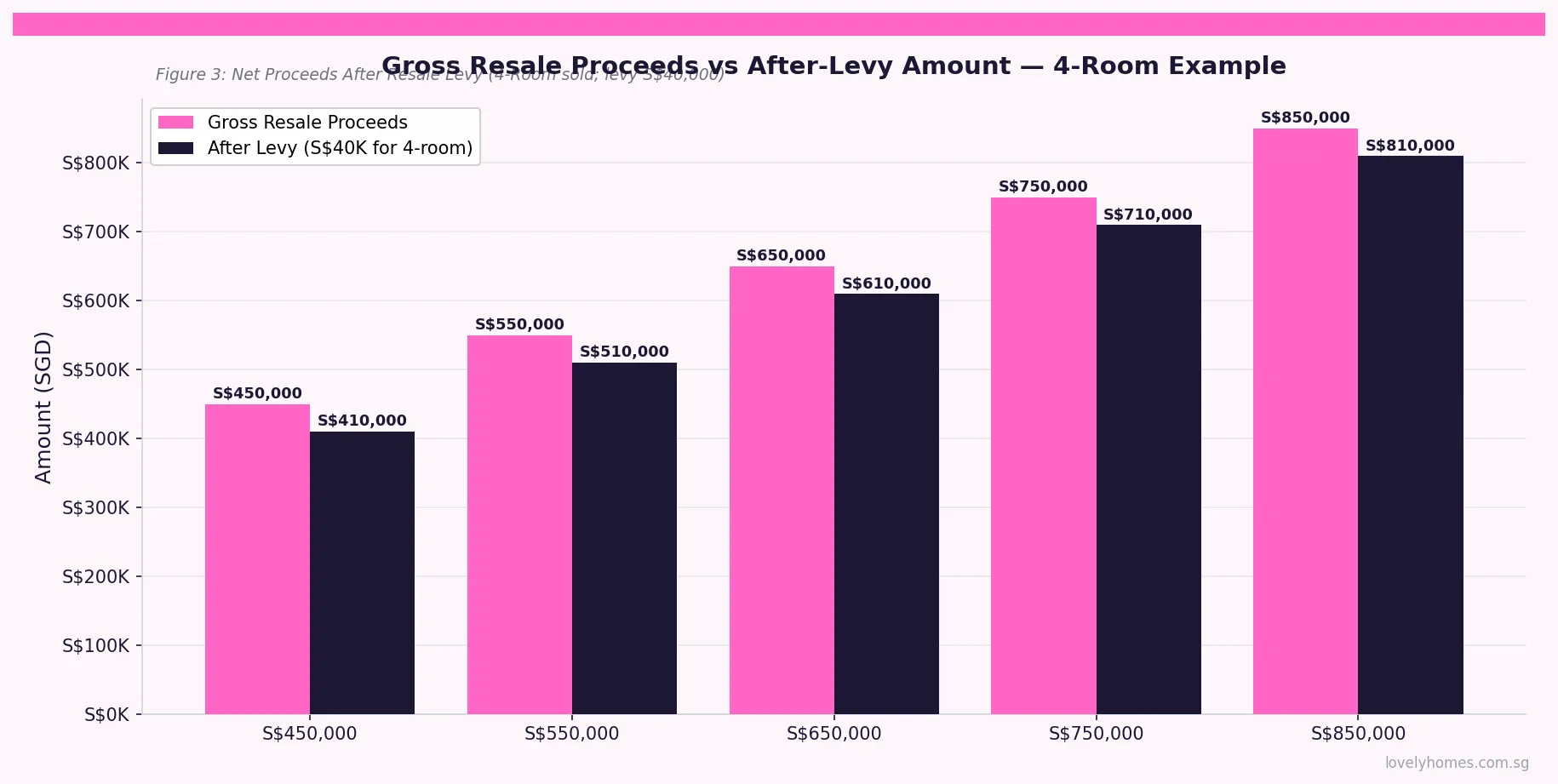
HDB resale proceeds after levy deduction 4-room flat Singapore 2026
Figure 3: Gross resale proceeds vs after-levy amount for a 4-room flat at five price points. Levy of S$40,000 deducted at source. Source: HDB; LovelyHomes calculations, 2026.

Critically, the levy reduces the pool of funds available for your CPF Ordinary Account refund and cash portion. If you are relying on the proceeds to fund the downpayment on a new BTO flat, factor the levy deduction in from the outset. A 4-room flat sold at S$550,000 effectively becomes S$510,000 in terms of what flows back to you and HDB.

Resale Levy vs HDB Grants: The Netting Question

A common question from second-timers is whether HDB grants can offset the resale levy. The short answer is no. Grants and the levy operate entirely separately:

  • Second-timers who buy a new BTO flat receive reduced grants compared to first-timers. For example, a second-timer buying a new BTO flat under the Step-Up CPF Housing Grant may receive S$15,000 — far less than the S$80,000–S$120,000 available to first-timer families under the EHG.
  • The resale levy is charged in addition to the reduced grant quantum. It is not deducted from any grant or factored into the BTO price.
  • The combined effect is that second-timers face a higher effective cost of a new BTO purchase: less grant assistance AND an upfront levy payment.

This is the intended design. HDB’s rationale is that second-timers have already benefited significantly from the subsidised housing system and have had the opportunity to accumulate equity in their first flat. The reduced grants and levy together calibrate the subsidy quantum to reflect that prior benefit.

Worked Example: The Yip Family’s Resale Levy Calculation

Scenario: 4-Room Flat Sold, New 4-Room BTO Purchased

Mr and Mrs Yip, both Singapore Citizens, bought a 4-room BTO flat in Punggol in 2014 for S$390,000. They are now selling the flat (estimated market value S$610,000) and applying for a new 4-room BTO flat in Tengah under the Married Child Priority Scheme.

Item Amount
Gross resale price of Punggol 4-room flat S$610,000
CPF principal drawn + accrued interest (estimated) S$320,000 (refunded to CPF OA)
Outstanding HDB mortgage balance S$48,000 (repaid from proceeds)
HDB Resale Levy (4-room sold) S$40,000
Agent commission (1% + 9% GST) S$6,649
Legal fees (seller) S$2,500
Net cash proceeds to Mrs & Mr Yip S$192,851

New Tengah BTO (4-room, estimated S$480,000 — Plus model):

Item Amount
BTO price S$480,000
Step-Up CPF Housing Grant (2nd-timer) -S$15,000
Net payable S$465,000
HDB loan (80% LTV, 2nd-timer eligible) S$372,000 @2.60% 25yr = S$1,682/mth (MSR 18.7% of S$9,000/mth joint income)
Downpayment (20% — CPF OA) S$93,000 from CPF OA refund
BSD (S$480,000) S$8,700
Legal fees (buyer) S$2,500
Remaining CPF OA balance after DP S$227,000 (reserve for mortgage servicing)

MSR check: S$1,682 / S$9,000 = 18.7% — within 30% MSR limit. TDSR not applicable (HDB loan). The S$40,000 resale levy is a sunk cost; Mr and Mrs Yip’s CPF OA reserve of S$227,000 provides strong mortgage cover for the Tengah BTO.

What This Means for Second-Timers Planning to Upgrade

The resale levy is best understood as a built-in “subsidy recapture” mechanism. For households who bought a 3-room or 4-room BTO flat in the 2010s and have watched flat values rise substantially — Tampines 4-rooms regularly changing hands above S$600,000 in 2025–2026 — the S$30,000–S$40,000 levy is relatively modest relative to the capital gain they have made. In such cases, the levy is unlikely to derail the upgrade path.

The levy becomes more financially significant in two scenarios: (a) where the flat was held for a shorter period and appreciation is limited, or (b) where the household plans to buy a new EC priced at the upper end of the income ceiling — here, the reduced grant quantum combined with the levy can meaningfully increase the cash component required at completion.

From a policy perspective, Singapore’s resale levy is notably lighter than comparable mechanisms in other high-density housing markets. Hong Kong’s Home Ownership Scheme imposes resale restrictions rather than monetary levies; Taiwan’s affordable housing schemes cap resale gains outright. Singapore’s fixed-levy approach offers transparency and predictability — households know their exact levy exposure from the moment they decide to sell.

What Might Come Next

The following is editorial speculation based on observed policy trends and should not be relied upon for financial decisions.

HDB has not adjusted the fixed resale levy amounts since the current schedule took effect in 2006. Given that resale flat prices have increased substantially over the past two decades — the HDB Resale Price Index rose from a base of 100 in 1998 to approximately 183 in early 2026 — there is a reasonable argument that the S$15,000–S$55,000 range represents a declining proportion of the subsidy value enjoyed by second-timers.

Industry observers have periodically suggested that HDB may consider indexing levy amounts to flat values or the RPI. A levy pegged at, say, 7%–8% of the median resale price of the flat type sold would automatically adjust over time. Whether HDB will move in this direction is unknown; any change would likely be accompanied by an extended transition period given the direct impact on household finances.

Frequently Asked Questions

I’m selling a 4-room flat but buying a 3-room BTO. Does the levy depend on what I buy or what I sell?

The levy is calculated based on the flat type you are selling, not the flat type you are buying. If you sell a 4-room flat, you pay S$40,000 regardless of whether you buy a 2-room, 3-room, or 5-room BTO next. The type of your next flat does not affect the levy amount.

My spouse is a first-timer but I am a second-timer. Do we pay the resale levy?

Yes. In a joint application, if any one applicant is classified as a second-timer, the household is treated as a second-timer application and the resale levy applies. The levy is calculated on the flat type sold by the second-timer applicant. This is a common scenario for couples where one partner previously owned a subsidised flat before the marriage.

Can I use CPF Ordinary Account funds to pay the resale levy?

No. The resale levy is not a property purchase cost that HDB allows to be paid from CPF. It is deducted from the proceeds of the sale of your existing flat — which includes CPF funds refunded from that sale — but the levy itself flows out of those proceeds before they are returned to your CPF OA. The practical effect is that the levy reduces the CPF amount credited back to your OA, and any shortfall must be topped up in cash. You cannot make a direct CPF OA withdrawal specifically for the levy.

Does the resale levy apply if I sell my HDB flat to buy a private condo?

No. The resale levy only applies when you are purchasing a new subsidised flat (BTO, SBF, or new EC from a developer). If you sell your HDB flat and purchase a private condominium, no resale levy is charged. You may, however, incur ABSD if you own or co-own any other residential property at the time of the private property purchase. The levy and ABSD are separate instruments with separate triggers.

What happens if my resale proceeds are not enough to cover the levy?

If the net proceeds from your flat sale (after repaying the HDB mortgage and refunding CPF principal + accrued interest to your CPF OA) are insufficient to cover the levy, you must pay the shortfall in cash before the resale transaction can be completed. HDB will not approve the new flat application until the levy is settled in full. There is no waiver, reduction, or instalment scheme for the levy, even in cases of genuine financial hardship.

I sold my 4-room flat in 2004. Does the current levy schedule apply to me?

No. The fixed-levy schedule described in this guide applies only to households who sold their first subsidised flat on or after 3 March 2006. If you sold your first subsidised flat before that date, the earlier levy framework applies, which was based on a percentage of the resale price (15% for 3-room and above). If you are uncertain which regime applies to you, contact HDB directly with your transaction details.

My previous flat was a DBSS flat I bought from a developer. Do I pay the levy?

Yes, if the DBSS flat was purchased directly from a developer under HDB’s Design, Build and Sell Scheme, you are considered to have purchased a subsidised flat. When you sell the DBSS flat and apply for a new BTO or EC, the resale levy applies based on the flat type of the DBSS flat sold. A 4-room DBSS attracts S$40,000; a 5-room DBSS attracts S$45,000. The levy is the same as for a standard HDB flat of the equivalent type.
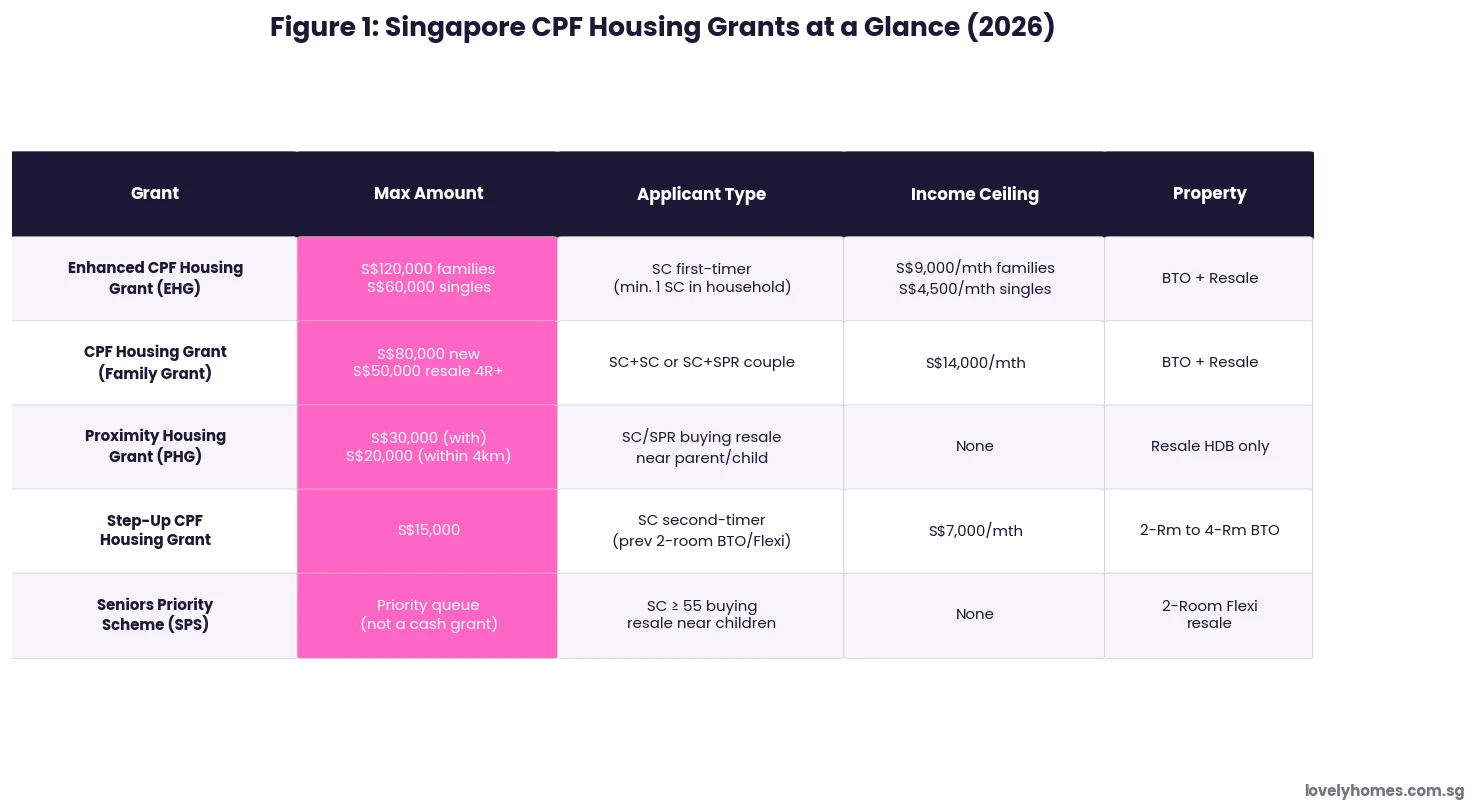
Disclaimer: This article is for general informational purposes only and does not constitute financial, legal, or property advice. HDB policies, levy amounts, and grant quantum are subject to change. Readers should verify current rules directly with HDB at hdb.gov.sg, and with IRAS at iras.gov.sg for stamp duty matters and cpf.gov.sg for CPF withdrawal rules. Worked examples use estimated figures for illustration; actual financial outcomes will vary. Consult a licensed property professional and a qualified financial adviser before making any housing decision.

×

Click anywhere to close

Translate »