SORA-Pegged Mortgage Rates Singapore — April 2026 Update & What Borrowers Should Do

SORA-Pegged Mortgage Rates Singapore — April 2026 Update & What Borrowers Should Do

Singapore Overnight Rate Average (SORA) — the benchmark that replaced the retired SIBOR in 2024 — has held steady in the 2.85-3.00% band through the first four months of 2026. Floating-rate mortgages pegged to 3-month compounded SORA are pricing at all-in rates around 3.65-3.75% for private condo borrowers, and 3.55-3.65% for HDB borrowers. For anyone weighing a new purchase or a refinance, the April snapshot is the cleanest read of the market since 3M SORA peaked near 3.8% in late 2023.

Singapore benchmark rates — April 2026 3-month compounded SORA plus typical bank spread = all-in mortgage rate

Private condo floating (SORA+0.75%) bps 370

HDB floating (SORA+0.70%) bps 365

3-month compounded SORA bps 295

Overnight SORA (spot) bps 290

MAS S$-NEER policy band bps 285

US 10-year Treasury (reference) bps 385

lovelyhomes.com.sg Source: MAS data; bank published rates — April 2026

Where we are

The three-month compounded SORA index stood at 2.95% on 21 April 2026, unchanged from the previous week and inside the narrow trading band of the past two quarters. SORA has declined roughly 85 basis points from its cycle peak in mid-2023 (3.82% on 5 September 2023) but the pace of decline has slowed materially since Q3 2025. The Monetary Authority of Singapore (MAS) has not adjusted its policy stance since October 2023; the S$-NEER policy band remains on an appreciation bias, with unchanged slope and width.

Bank spreads above SORA have narrowed modestly over the past six months. Major local banks are quoting SORA+0.70% to SORA+0.85% on private condo floating-rate loans, down from SORA+0.85% to SORA+1.00% at the start of 2025. The competitive pressure stems from the slower mortgage-book growth banks are seeing (a function of the moderating new-launch volume) — they are fighting harder for each customer.

Fixed-rate alternatives

Two-year and three-year fixed packages have converged with floating pricing. As of mid-April, representative fixed rates are 3.45-3.65% for 2-year fixes and 3.55-3.75% for 3-year fixes. The fixed-to-floating spread, historically 20-40 basis points in favour of fixed when rates were expected to fall, has compressed to zero or even inverted. Borrowers are being offered comparable rates to lock in versus float, reflecting bank expectations that 3M SORA is near the bottom of this cycle.

Fixed vs floating — April 2026
For a new purchase, the choice between fixed and floating is less about betting on rate direction and more about matching your own risk tolerance. Fixed gives cashflow certainty for 2-3 years at essentially the same rate as floating. Floating carries the optionality — if SORA breaks below 2.5% (unlikely absent a major economic shock), monthly instalments fall immediately.

Refinancing

The refinancing window is genuinely open. Borrowers on legacy fixed packages that were priced at 4.0-4.3% during 2023-24 can refinance today to 3.45-3.65% fixed — a 55-85 basis-point saving. On a S$1.0m outstanding balance at a 25-year remaining tenure, a 70 basis-point drop saves approximately S$435 a month in interest, or S$5,220 a year. Net of the S$2,000-3,000 legal and valuation costs of refinancing, the breakeven is inside 8 months.

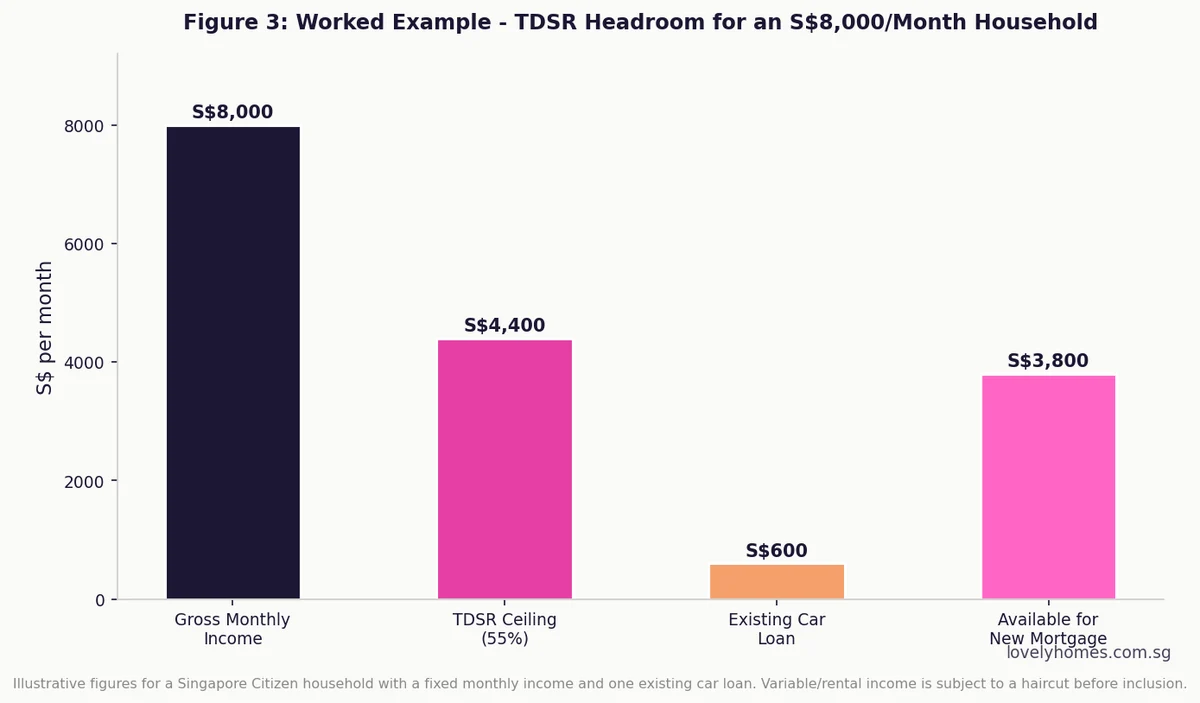
The tighter TDSR framework applies at refinancing. Your TDSR must still fit within 55% of gross monthly income at the new rate. For investment property, the rental-income haircut (70% of assessed rent) remains in force. Borrowers who have changed employment or whose income has dipped may find the refinancing window narrower than the savings optics suggest; arrange the refinancing conversation with the bank before the lock-in period expires so a renegotiation of terms is an option if TDSR is tight.

HDB loans — HDB concessionary vs bank

HDB concessionary loans remain at 2.60% — the floor of 0.1 percentage point above the CPF Ordinary Account interest rate. Bank HDB loans at SORA-based floating are pricing at 3.55-3.65%, making the HDB loan meaningfully cheaper on a coupon basis. But the eligibility rules remain restrictive: HDB concessionary requires at least one Singapore-citizen buyer, gross monthly household income ceilings of S$14,000 (couple) or S$21,000 (multi-generation), and the household must not own or have owned more than one other property in the last 30 months.

For eligible first-time HDB BTO buyers, HDB concessionary is the default choice — 90 basis points below bank HDB, with the added option to use the HDB Home Protection Scheme (HPS) at concessionary rates. For HDB resale buyers who have outgrown eligibility, bank floating is typically the cheaper route, especially with 2-year fixed packages pricing around 3.45%.

What the MAS signal tells us

MAS’s April 2026 Monetary Policy Statement reiterated the existing stance — S$-NEER appreciation bias maintained, slope and band width unchanged. The statement noted ‘core inflation easing broadly in line with projections’ and ‘the domestic economy expanding at a moderate pace’. No forward guidance was provided. In practice, this means the MAS is watching the same data as the market, and rate volatility is likely to be lower over the next two quarters than it was during the 2023 rate-cycle peak.

The read-across for the mortgage market: 3M SORA is likely to stay in a 2.80-3.10% range through the middle of 2026 unless the US Federal Reserve moves aggressively in either direction. Bank spreads may compress another 5-10 basis points if loan-book growth continues to be sluggish. All-in mortgage rates of 3.60-3.75% are the reasonable planning assumption for a new purchase today.

Three practical moves

If you are buying: the competitive tension between banks is real. Obtain at least three written indicative offers before committing to a loan. Ask for spread (not just headline rate), lock-in period, prepayment penalties and free-conversion clauses. A free-conversion clause after the second year is worth 5-10 basis points against the lowest headline rate.

If you are refinancing: start 4 months before your lock-in ends. Most legacy packages allow a ‘repricing’ with the existing bank 3 months before lock-in ends — use the competing offers from other banks to negotiate a sharper repricing without the legal costs of a full refinance. Savings can land at 80-90% of a full-refinance move with 0% of the hassle.

If you are on a floating-rate loan and considering a fixed: model the break-even by comparing a 24-month sum of current floating payments versus 24 months at the fixed rate, plus the fixed-conversion fee. If the break-even is inside 12 months and you value cashflow certainty, move. If the break-even is further out, the optionality of staying floating is worth more than the spread.

Bottom line

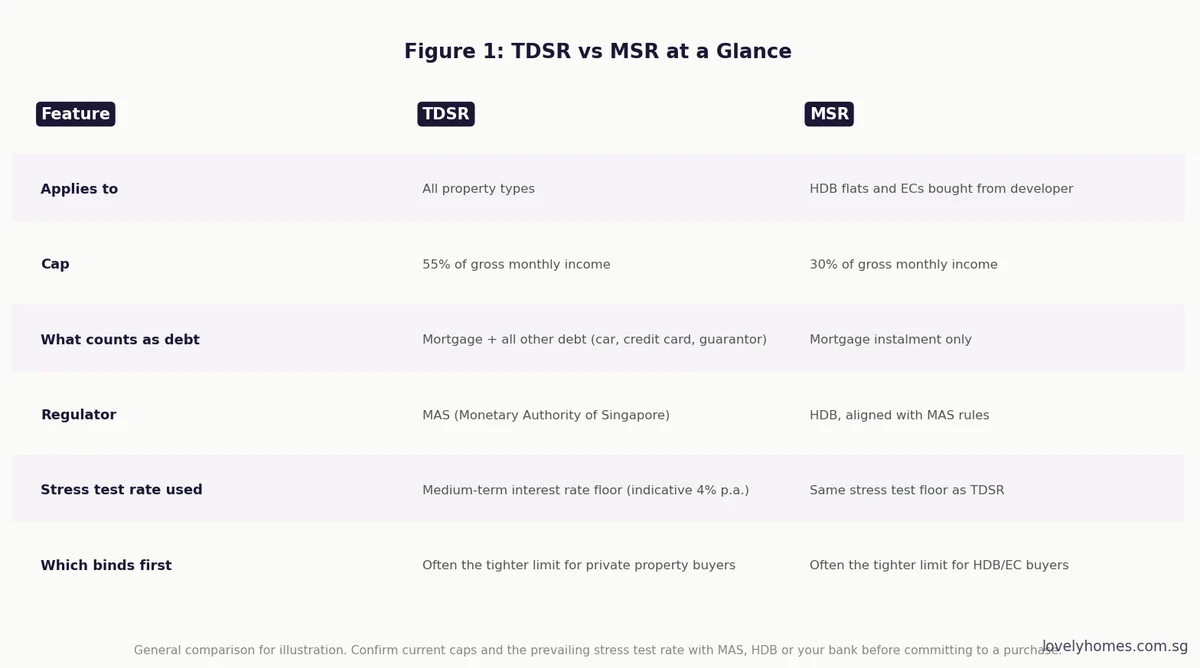
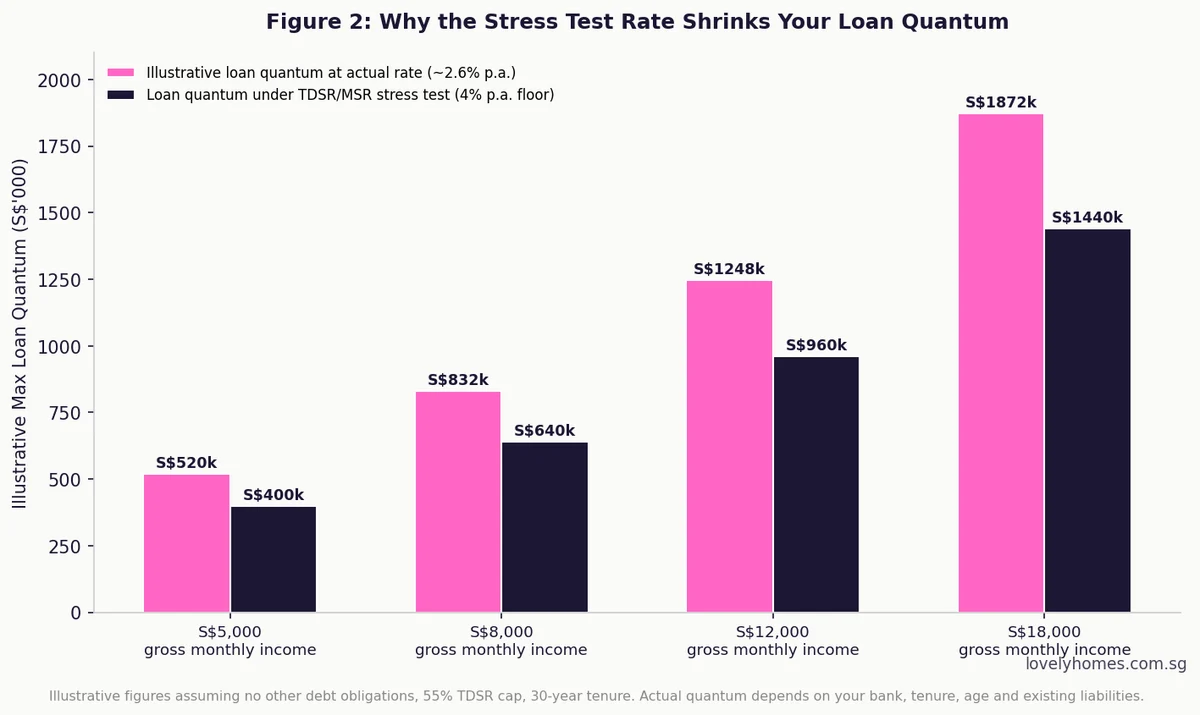
Mortgage rates in April 2026 look settled. Floating at 3.60-3.75%, fixed at 3.45-3.65%, HDB concessionary at 2.60%. The refinancing economics are meaningful for anyone locked into a 2023-vintage fixed package above 4%. For new purchases, run your TDSR at the regulatory stress-test rate of 4.00%, not at the headline rate offered — the same rate banks test your loan against. That way, if rates unexpectedly rise, your cashflow buffer is intact.

Related reading on LovelyHomes

Sources: Monetary Authority of Singapore (MAS) SORA daily fix (https://www.mas.gov.sg/); bank published rate sheets for DBS, UOB, OCBC, Maybank and StanChart — April 2026. This article is editorial commentary produced by the LovelyHomes team and does not constitute investment or financial advice. Rates, indices and figures are current as at the date of publication. Buyers and investors should consult a licensed professional before making a property-related decision.

Singapore Property Tax 2026: Owner-Occupier vs Investor Rates, Annual Value & How It’s Calculated

Singapore Property Tax 2026: Owner-Occupier vs Investor Rates, Annual Value & How It’s Calculated

Property tax is the annual levy every Singapore property owner pays to the Inland Revenue Authority of Singapore (IRAS). Unlike Buyer’s Stamp Duty, which you pay once at acquisition, property tax recurs every year for as long as you hold the property. The rates are modest for a 4-room HDB owner-occupier (often under S$200 a year), but they escalate steeply for larger homes and for investors who rent out residential units.

Quick Answer
  • Property tax is an annual tax on every Singapore property, paid to IRAS by 31 January each year.
  • It is calculated as AV × tax rate. AV (Annual Value) is IRAS’s estimate of the annual rent the property could command, unfurnished.
  • Owner-occupiers get the concessionary rate — a progressive 0-32% scale with a generous S$12,000 AV zero band.
  • Non-owner-occupiers pay investor rates — flat 12/28/32/36% bands, with no zero band and no concessionary relief.
  • Rates were increased in Budget 2023 and held steady in Budget 2026 — higher-AV owners are feeling the progressive bite.

Owner-occupier property tax rates — 2026 Progressive marginal rates on Annual Value (AV)

AV >S$100,000 portion 32

AV >S$85,000 portion 32

AV >S$70,000 portion 28

AV >S$55,000 portion 24

AV >S$40,000 portion 20

AV >S$30,000 portion 12

AV >S$12,000 portion 8

First S$12,000 AV 0

lovelyhomes.com.sg Source: IRAS Property Tax — Budget 2026 owner-occupier schedule

How property tax actually works

The formula is simple: Annual Tax Payable = Annual Value × Applicable Rate. Annual Value (AV) is IRAS’s administrative estimate of the rent the property could fetch on the open market if it were let out unfurnished, on a yearly tenancy. IRAS assesses AV based on current market rents of comparable properties within the same development, district or estate. For a condo in a mature development, the AV moves up and down as rental comparables move — though not in lock-step; AV revisions typically lag spot rent by two to four quarters.

Two different rate schedules apply, depending on whether the owner lives in the property (owner-occupier) or rents it out or leaves it vacant (non-owner-occupier). Owner-occupier rates are concessionary. Non-owner-occupier rates are much higher. The policy intent is to reward owner-occupation and to capture a larger share of rental income at source.

The 2026 rate schedule — owner-occupier

Annual Value bands — what do they actually imply? Annual Values shown are illustrative; actual AV is assessed by IRAS. AV BandRough housing type (2026)Owner-occ PT (annual)S$8,000Older 3-room HDB, non-mature estateS$0S$13,5004-room HDB, mature estateS$120S$22,0005-room HDB / condo 1BR, OCRS$800S$38,0003BR condo, OCR / mid-sized RCRS$2,520S$65,000Large condo / small CCR 3BRS$8,600S$120,000GCB, CCR luxury penthouseS$26,840

lovelyhomes.com.sg Source: IRAS AV assessment methodology; LovelyHomes modelling

The owner-occupier schedule is progressive, with seven bands rising from 0% on the first S$12,000 of AV to 32% on AV above S$100,000. The structure is designed so that most HDB owner-occupiers pay very little property tax, while owners of premium homes pay meaningful amounts. A key change was introduced in Budget 2023: the top rate was raised from 23% to 32% for AV above S$100,000, with interim tiers bumped too. Budget 2026 held these rates steady — no further increases, no decreases.

The 2026 rate schedule — non-owner-occupier

Non-owner-occupier property tax rates — 2026 Rented-out or investor-held residential properties; flat bands

AV >S$60,000 portion 36

AV >S$45,000 portion 32

AV >S$30,000 portion 28

First S$30,000 AV 12

lovelyhomes.com.sg Source: IRAS Property Tax — Budget 2026 non-owner-occupier schedule

If you rent out your property, or leave it vacant (held as investment), the non-owner-occupier rates apply. Four bands: 12% on the first S$30,000 of AV, 28% on the next S$15,000, 32% on the next S$15,000, and 36% on AV above S$60,000. Note that there is no zero band. Even a modest AV attracts 12% tax. For a landlord with a property at S$45,000 AV, annual property tax is roughly S$7,800 — an important line item in any rental-yield computation.

How IRAS determines Annual Value

AV is not what the owner declares, and it is not the actual rent the property commands. IRAS uses a bottom-up comparables approach: for each property, it references a pool of comparable rented units within the same development and computes a central tendency (typically a median or trimmed mean). For HDB flats, IRAS publishes a simplified AV table updated each year. For private condos, AV follows a comparable-rent methodology with adjustments for size, floor level and facing.

IRAS reviews AV annually. If market rents in your development have moved more than 5-10% over the past 12 months, expect a re-assessment notice in November or December. You have 30 days from the date of the notice to object under s.20 of the Property Tax Act if you disagree with the revised AV. Objections that succeed typically rely on specific, documented evidence — actual rental agreements, a licensed valuer’s opinion, or comparable-rent data showing the AV is above market.

Worked example 1 — owner-occupier 4-room HDB

A Singapore-citizen owner-occupier of a 4-room HDB flat in a mature estate. IRAS-assessed AV for 2026: S$13,500.

First S$12,000 × 0% = S$0
Next S$1,500 × 8% = S$120
Annual property tax = S$120

For the owner-occupier HDB household, property tax is effectively a token charge. This is deliberate policy — the MOF has kept HDB owner-occupier tax burdens minimal since the current schedule was introduced.

Worked example 2 — owner-occupier mid-sized condo

A Singapore-citizen owner-occupier of a 3-bedroom condo in the OCR. IRAS-assessed AV: S$38,000.

First S$12,000 × 0% = S$0
Next S$18,000 × 8% = S$1,440
Next S$8,000 × 12% = S$960
Annual property tax = S$2,400

On a S$1.6m market-value condo with an S$38,000 AV, the effective property-tax rate is 0.15% of market value per annum — substantially lower than property-tax rates in most comparable global cities.

Worked example 3 — investor condo (non-owner-occupier)

An investor holds the same 3-bedroom OCR condo in worked example 2 for rental purposes. The unit is rented out or held vacant. Non-owner-occupier rates apply.

First S$30,000 × 12% = S$3,600
Next S$8,000 × 28% = S$2,240
Annual property tax = S$5,840

The same property, same AV, same owner — but held as investment rather than occupied — attracts 2.4× the property tax. Budget this into rental-yield calculations: property tax is typically the second-largest operating cost for a Singapore landlord after mortgage interest.

Key takeaway
Owner-occupier property tax rates are low by international standards. Non-owner-occupier rates are meaningfully higher and compound the investment case on rental property. If your living arrangements change and your home is no longer owner-occupied, IRAS must be notified within 15 days — failure to update the designation is a compliance issue.

Owner-occupier concession — eligibility rules

To qualify for the owner-occupier rate, the property must be occupied by the owner as their main residence. An individual can only enjoy the owner-occupier rate on one property at a time. Joint owners of two properties cannot claim owner-occupier on both — only one can receive the concession.

A spouse who also owns property can claim owner-occupier on their own home, provided each home is actually occupied by at least one of the owners. The rule, in effect, is: one owner-occupier concession per owner. Overseas assignments, military posting, or temporary vacancy up to 24 months do not automatically forfeit the concession — but IRAS must be notified if the property is not occupied for a sustained period.

Payment — deadlines and billing

Property tax bills are issued in December and are payable in full by 31 January of the following year. Most owners use GIRO monthly instalments — 12 instalments starting in January, automatically debited from the owner’s bank account. Late payment attracts a 5% surcharge after 30 days, plus monthly interest of 1.5% per month up to 12 months (compounding on the unpaid amount).

Reliefs, rebates and exemptions

Parenthood Property Tax Rebate (budget-driven): From time to time, the Ministry of Finance grants one-off rebates — for example, Budget 2023 announced a rebate of up to S$60 for lower-AV owner-occupied homes for the 2023 tax year. Budget 2026 did not introduce new rebates but retained the existing schedule.

Heritage/conservation properties: Owners of gazetted conservation properties may apply for concessionary assessment where the conservation designation restricts commercial use. Applications go through URA’s conservation secretariat.

Charitable or educational use: Properties used exclusively for registered charity or educational purposes may qualify for full or partial exemption under s.4 of the Property Tax Act. Application is made to IRAS with supporting documentation.

Appealing an AV assessment

If you believe your AV is too high, you can object within 30 days of the notice. The strongest objections bring specific data: (a) actual rental agreements for comparable units in your development, (b) a signed opinion from a licensed valuer, or (c) URA-registered rental transactions for comparable private homes. IRAS considers objections on the balance of evidence; a general argument that ‘rents have softened’ without supporting numbers is unlikely to succeed.

Common mistakes

First — do not assume the HDB standard AV will stay constant. IRAS updates AV tables annually, and estate-level rental movements feed into the tables. Budget a modest property-tax increase year-on-year.

Second — do not forget to notify IRAS when a property stops being owner-occupied. If you rent out the spare room or move overseas and let the property, non-owner-occupier rates apply from the first day of the change. Late notification attracts back-assessment.

Third — do not assume property tax is deductible against rental income on your personal income tax return. It is, but only for the portion of the year the property was rented out, and only in the year it was incurred. Keep clean records.

Frequently asked questions

1. When is property tax due each year?

By 31 January. Bills are issued in December. Most owners use GIRO monthly instalments.

2. What if I own the property jointly with my spouse?

Property tax is levied on the property, not the individual. The bill is addressed to the first-named owner but is a joint obligation. Owner-occupier concession applies if at least one owner occupies as main residence and no other owner has claimed the concession on another property.

3. Is property tax deductible against rental income for income tax?

Yes — for the period the property is rented out. The deduction is claimed in your personal income tax return under rental expenses.

4. What is the difference between Annual Value and market rent?

AV is IRAS’s administrative estimate based on comparables. Market rent is the rent a willing landlord can command from a willing tenant. AV typically lags market rent by 2-4 quarters, so AV may understate rent in rising markets and overstate rent in falling markets.

5. Can I appeal my AV?

Yes, within 30 days of the assessment notice. Objections should cite specific comparable-rent data, preferably a licensed valuer’s opinion or URA-registered lease transactions.

6. If I leave my HDB flat vacant, do I still pay the owner-occupier rate?

For short periods yes. If the vacancy extends beyond 24 months, or if you have moved overseas and the flat is empty, IRAS may reassess under the non-owner-occupier schedule. Contact IRAS to discuss your specific situation before the 24-month mark.

7. Does property tax change if I add or remove a room?

Structural changes that affect the usable floor area will trigger a reassessment. Routine renovation (flooring, repainting, kitchen replacement) does not.

8. How is property tax calculated on a new condo not yet TOP?

Before TOP, the property is typically vacant land or a construction site and property tax is assessed on the land value at non-residential rates. Once TOP is issued, residential property tax kicks in. Developers typically pay the pre-TOP tax; this rolls over to the buyer from the date of Temporary Occupation Permit onwards, pro-rated.

9. What happens if I sell a property mid-year?

Property tax is apportioned between buyer and seller at completion. Your conveyancing solicitor handles the apportionment on the completion statement.

10. Is there a discount for senior citizens?

No structural discount. Budget packages have occasionally included one-off rebates for lower-AV owner-occupied homes (benefiting retirees who downsize to HDB flats), but there is no permanent senior-citizen concession.

11. Can I use CPF to pay property tax?

No. Property tax must be paid in cash. CPF Ordinary Account is usable for mortgage servicing and conservancy fees (on some schemes), but not for property tax or utilities.

12. Where do I check my current AV?

Log in to myTax Portal (IRAS) with your Singpass. Your AV and current property tax assessment are shown under the ‘Property’ tab.

Related LovelyHomes guides

Disclaimer: This article is produced by the LovelyHomes editorial team for general information only. Figures, rates and rules reflect IRAS, HDB, URA, MAS and CPF publications current as at April 2026 and are subject to change. IRAS rates shown follow the Budget 2023 schedule, held steady through Budget 2026. No information on this page constitutes legal, tax or financial advice. Buyers should obtain independent professional advice before making a property decision.

Singapore Property Valuation 2026: How Banks Decide Your Home’s Worth

Quick Answer — Singapore property valuation in a nutshell

  • A property valuation is an independent, licensed opinion of market value used by banks to size your home loan.
  • Banks lend on the lower of purchase price or valuation — never on the higher figure. This is the single most important rule in Singapore home finance.
  • Four standard methods are used: comparable sales, cost, income/yield, and residual land value. For a completed private condo, comparable sales dominates.
  • Desktop valuations are free and fast but not contractually binding; full indemnity reports are paid, signed, and accepted by the bank.
  • Cash Over Valuation (COV) is the gap you must make up in cash when the purchase price exceeds valuation — especially common in HDB resale.

Why property valuation decides the deal

Every successful property purchase in Singapore runs through a valuation report, whether you notice it or not. The bank uses it to size your home loan. The Inland Revenue Authority of Singapore (IRAS) uses a separate valuation methodology to calculate your Buyer’s Stamp Duty and Additional Buyer’s Stamp Duty. HDB uses valuation to govern your Cash Over Valuation obligation on a resale flat. CPF uses valuation to cap how much you can withdraw. A good grasp of how valuation works is therefore not a nice-to-have — it is the financial backbone of the whole transaction.

Singapore’s valuation profession is regulated by the Singapore Institute of Surveyors and Valuers (SISV) and its members are licensed to sign reports that banks will accept. The Monetary Authority of Singapore’s rules under the MAS 645 and MAS 632 notices set out that banks must base Loan-To-Value (LTV) ratios on the lower of purchase price or market value as certified by an independent, licensed valuer. That single “lower-of” rule is the source of many first-time buyer surprises.

The four standard valuation methods

In Singapore, four methods are commonly used depending on property type and data availability. A residential condominium is almost always valued with comparable sales. A commercial shophouse is often valued with a blended income approach. Vacant land is valued with a residual approach.

Method Where it’s used How it works
Comparable sales HDB resale, private condo resale, most strata-titled property Find recent arms-length caveats for similar units; adjust for floor, view, size, facing, renovation, remaining lease.
Cost approach New landed, purpose-built assets, specialised buildings Market value = land value + depreciated replacement cost of improvements.
Income / yield Shophouses, office, retail, industrial, investment-grade assets Capitalise net rental income at an appropriate market yield to derive a capital value.
Residual land En-bloc, vacant land, redevelopment sites Estimate Gross Development Value minus development cost and developer profit; the remainder is the land’s residual value.

Desktop valuation vs full indemnity report

Banks offer two kinds of valuation service to buyers. The distinction is frequently confused and it matters.

A desktop valuation (also called an “indicative valuation”) is free, fast (usually within 24 hours), and produced by comparing the subject property to recent caveats without a site inspection. It is not contractually binding on the bank. It is perfect for prospecting — letting you know whether a listing is price-aligned before you put in an Option to Purchase.

A full indemnity valuation report is paid (usually S$300–S$450 for an HDB flat; S$500–S$900 for a private condo; more for landed), involves a site inspection, and is signed by a licensed valuer. This is the report that the bank’s credit team uses to confirm the loan amount and to release the Letter of Offer. It is contractually indemnified — if it is wrong, the valuer is professionally liable.

As a rule: use desktop valuations when you are screening; request a full report the moment you sign the Option to Purchase or commit a booking fee.

How valuation sets your loan size

The LTV ratio caps how much you can borrow. For a first residential property loan from a bank, LTV is 75% of the lower of purchase price or valuation, with a 55% cap on any loan tenure that stretches past age 65 or more than 30 years.

Worked example — the lower-of rule in action

You agree to buy a D15 condo for S$2,000,000. The bank’s valuation comes in at S$1,900,000. What happens?

The bank uses the lower figure (S$1.9m) as the loan-sizing base. Maximum loan is 75% × S$1.9m = S$1,425,000. That leaves:

  • 5% minimum cash on purchase price: S$100,000
  • 20% cash/CPF on purchase price: S$400,000
  • Plus the S$100,000 shortfall between purchase price and valuation — which must come from cash or CPF, not loan.

Total upfront: S$575,000, versus S$500,000 if the valuation had matched the purchase price.

Cash Over Valuation (COV) in HDB resale

For HDB resale flats the equivalent concept is called Cash Over Valuation, and it is explicit. Since HDB’s March 2014 valuation reform, the seller and buyer first agree on a price and then apply for a valuation. Any amount paid above the valuation is COV, and must be paid in cash upfront. If the valuation comes in at S$650,000 but the agreed price is S$680,000, the S$30,000 gap is pure cash that cannot be financed by bank loan or CPF.

COV was a household concept in 2012–2013 (the Singapore resale market was running at median COV of S$30,000+ for mature estates). After the policy reform, COV collapsed to near zero and stayed subdued until 2022–2024 when it crept back up alongside the million-dollar-flat phenomenon. For 2026 transactions, understanding the COV mechanic is a precondition to any HDB resale negotiation.

What the valuer looks at

When a valuer inspects your property, the report is essentially building a case for a market value opinion. The factors that move the figure the most:

Location micro-grading. Postal code is table stakes; the valuer cares about which side of the block, which stack, what is directly opposite (MRT? rubbish chute? cemetery? school?), and where the next launch is.

Floor and facing. In high-rise condos, the mid-to-high floor premium over a low-floor equivalent can be 3%–8%; a premium facing (unblocked, park view, waterfront) can add a further 2%–5%.

Size and layout. A regular-shape 3BR of 900 sqft will value higher than an awkward 3BR of 920 sqft. Bay windows, planter boxes, and air-con ledges are not counted as strata area but may be valued modestly depending on scheme.

Condition and renovation. A fully renovated unit typically values 2%–5% above comparable base stock for the same block; severely worn units may be graded below.

Remaining lease. For 99-year leaseholds, the remaining lease on the valuation date is priced in using a Bala’s Curve-style curve (mandated by the SLA for leasehold pricing). A 60-year-remaining leasehold sells at roughly 70%–80% of the equivalent freehold.

Recent comparable transactions. Ideally three or more arm’s-length caveats within the last 3 months, same project or one-block radius, similar floor and size. Valuers discount transactions that look like related-party or distressed sales.

How long does a valuation take?

Valuation type Typical turnaround Typical cost
Desktop (bank indicative) Same day to 24 hours Free
Full HDB resale report 3–5 working days S$300–S$450
Full private condo report 3–7 working days S$500–S$900
Full landed report 5–10 working days S$900–S$2,500
Commercial / industrial 7–14 working days S$1,500+

What to do if the valuation comes up short

Three practical options exist when the valuation is lower than the purchase price, and all three are being used across the Singapore market right now.

Option 1 — top up the shortfall in cash or CPF. This is the default route. The price gap becomes an additional cash payment at completion. Advantage: deal closes cleanly. Disadvantage: you have less cash runway to renovate or invest.

Option 2 — request a second valuation from a different panel valuer. Banks maintain a panel of accredited valuers; asking for a re-valuation through a different valuer (or a different bank) can produce a materially different number when the first used an outdated comparable set. This works best when a fresh caveat has landed in your building since the first report.

Option 3 — renegotiate the purchase price. This is the seller’s nightmare but it happens, especially in HDB resale. The valuation shortfall becomes a documented negotiation lever, and sellers who are motivated will sometimes meet the valuation. The trade-off is that the seller can walk away and forfeit the OTP deposit back to you (with the 1% option fee, depending on the OTP terms).

Valuation vs IRAS market value — why they differ

IRAS uses its own “market value” for stamp-duty purposes. For most arm’s-length transactions, IRAS will accept the stated purchase price. But when IRAS believes the purchase price materially understates market value (common in related-party and intra-family transfers), it will reassess stamp duty against its own market-value estimate, usually by reference to the Singapore Land Authority’s Property Valuation System.

Outcome: BSD and ABSD are almost always calculated on the higher of purchase price or IRAS market value — the exact inverse of the bank’s “lower-of” loan-sizing rule. In an undervalued related-party transfer, the buyer can therefore be short on loan (bank sized down) and long on stamp duty (IRAS sized up) at the same time.

Valuation vs annual value — what’s the difference?

These are three different “values” on the same property and they serve different purposes:

Term Issued by Purpose
Market value Licensed valuer Bank loan sizing
IRAS market value IRAS (via SLA PVS) Stamp duty calculation on non-arm’s-length transfers
Annual Value (AV) IRAS Property-tax calculation based on estimated annual rental

Valuation tips — for sellers, buyers, and owners

For sellers. Price your listing with visibility into recent caveats for your stack. If there are no caveats in the last 90 days, you are a price-discovery trade and valuation will lag; offer a slightly lower asking to seed a transaction that becomes the next comparable. Refurbish defects before the valuer visits — functional wear (hairline cracks, stained kitchens, tired bathrooms) reads immediately.

For buyers. Always request a desktop valuation before committing. If you are in a competitive tender, ask for desktop valuations from two or three banks in parallel — a low variance gives you confidence to bid; a wide variance signals price uncertainty. Budget for the full-report fee once you commit.

For existing owners. Even without a sale, a valuation can be useful for refinancing (when the bank redo-sizes a fresh loan against current market value), for CPF withdrawal planning, and for estate planning. Valuations are also accepted evidence in matrimonial proceedings, divorce-related asset splits, and probate.

Frequently asked questions

Do I need a valuation to buy a property in Singapore?
Yes, if you are taking a bank loan. The bank requires a valuation report before disbursing the loan. For all-cash buyers, valuation is optional but still recommended for price sanity.

Who pays for the valuation?
The buyer typically pays for the full valuation report commissioned through their bank. Desktop valuations are free.

Can I use a valuation from one bank at a different bank?
Not automatically. Each bank generally requires a report from its own panel valuer. Some banks accept transferred valuations for refinancing but not for purchase — confirm upfront.

Why did two banks give me different valuations?
Because they use different panel valuers who may weigh comparable caveats differently. A 3%–5% variance between two banks is normal; beyond that, the property has low price discovery and a re-inspection may be warranted.

Is a desktop valuation accurate?
For a property with many recent caveats (stable resale condo, active HDB block), yes — usually within 2% of the full report. For a unique, rarely-transacted, or freshly-renovated property, the desktop can be materially off.

What is a bank panel valuer?
A licensed valuation firm approved by the bank’s credit team to produce loan-acceptable reports. Panels are rotated to avoid over-reliance on any single firm.

Does renovation count toward valuation?
Quality renovations generally add 2%–5% to valuation versus base stock, but never dollar-for-dollar on the renovation spend. A S$100,000 reno will not add S$100,000 to valuation.

Is HDB valuation different from private condo valuation?
Philosophically no (both use comparable sales), operationally yes: HDB valuation is requested via the HDB Resale Portal after the OTP is granted, whereas private condo valuation is requested through your mortgage banker.

Can the valuation go up over time?
Yes — if market values rise. A refinancing valuation three years after purchase typically reflects the prevailing market, which may allow a larger home-equity line or better LTV.

What if the property is under construction?
New launches have no physical unit to inspect; valuation for progressive-payment draws relies on developer sale price and stage completion. LTV calculations use the purchase price (not a certified market value) until TOP.

Does leasehold decay affect valuation?
Yes. For 99-year leaseholds, remaining lease is priced via a Bala’s Curve-style adjustment relative to freehold. At ~40 years remaining, the lease-decay discount becomes material and banks may cap LTV further.

Key takeaway

Valuation is the pivot point of every Singapore property transaction. Treat the desktop valuation as a pre-bid sanity check. Treat the full indemnity report as the document that releases your loan. Treat the “lower-of” rule as the immovable truth that determines your cash requirement at completion. Get those three things right and most of the unpleasant surprises in Singapore home-buying disappear.

Related guides on LovelyHomes

Authoritative external references

Disclaimer: This guide is general information only, current as at publication. Rates, rules and processes are subject to change by MAS, HDB, IRAS and the Singapore Institute of Surveyors and Valuers. Consult a licensed mortgage banker, valuer, conveyancing lawyer or tax adviser for your specific transaction. LovelyHomes is an independent editorial publication.

CPF for Property Purchase Singapore 2026: OA Withdrawal, Valuation Limit & Accrued Interest Explained

CPF for Property Purchase Singapore 2026: OA Withdrawal, Valuation Limit & Accrued Interest Explained

Quick Answer — CPF for Property in Singapore

  • You can use your CPF Ordinary Account (OA) to pay the down payment and monthly mortgage instalments on a Singapore residential property.
  • For HDB flats, there is no Valuation Limit cap — you can use CPF up to the property value.
  • For private residential properties, CPF is capped at the Valuation Limit (VL) — the lower of purchase price or market valuation — unless your CPF Full Retirement Sum (FRS) is met.
  • There is a Withdrawal Limit (WL) of 120% of the VL for private residential properties — the absolute maximum you can ever withdraw for one property.
  • Accrued interest (2.5% per annum on all CPF used) must be refunded to your CPF account when you sell the property — this is not a cost, but a return to your retirement savings.
  • Remaining lease must be at least 20 years for CPF usage; for buyer’s age + remaining lease to satisfy the 80-year rule for properties with shorter leases.
CPF for property purchase Singapore 2026 OA withdrawal limit valuation limit guide
Figure 1: CPF for Property Purchase — the three pillars: Ordinary Account (OA), Valuation Limit (VL) and Withdrawal Limit (WL). Source: CPF Board.

What is CPF OA and how does it accumulate?

The CPF Ordinary Account (OA) is one of three CPF accounts (alongside the Special Account and MediSave Account) that Singapore Citizens and Permanent Residents contribute to throughout their working lives. The OA is the account used for housing — and it is also the one that earns the lowest base interest rate of 2.5% per annum (floor rate). As of 2026, CPF contribution rates for employees below 55 are 37% of wages (23% employer + 17% employee = 20% to OA, 6% to Special Account, 8% to MediSave, approximately, depending on wage bracket). A Singaporean earning S$7,500/month will see approximately S$1,250 flow into their OA every month — a meaningful housing war chest that accumulates fast if untouched.

The OA earns 2.5% per annum, guaranteed by the Singapore Government. Additional 1% interest is paid on the first S$60,000 of combined balances (with OA capped at S$20,000 of this). This means a S$50,000 OA balance earns effectively 3.5% p.a. on the first S$20,000 and 2.5% on the rest. When you use CPF for property, you lose this compounding — which is why CPF Board requires accrued interest to be refunded to your account on sale, effectively restoring the retirement savings as if you had never withdrawn.

Which properties can you use CPF for?

CPF OA funds can be used for residential properties in Singapore only. This covers HDB BTO flats, HDB resale flats, Executive Condominiums (ECs) during the first 5 years (developer payment), private condominiums (new launch and resale), and landed property. You cannot use CPF for commercial properties, industrial units, overseas properties, or short-term leasehold properties with insufficient remaining lease.

CPF property usage HDB vs private condo rules valuation limit withdrawal limit Singapore 2026
Figure 3: CPF property usage rules — HDB vs private residential at a glance. The Valuation Limit and Withdrawal Limit apply to private property only.

Valuation Limit (VL) — the private property CPF ceiling

For private residential properties (condominiums, landed homes, ECs post-privatisation), CPF OA usage is capped at the Valuation Limit (VL). The VL is defined as the lower of: (a) the purchase price, or (b) the property’s valuation at the time of purchase. In practice, this means if you buy a condominium at S$1.5M and it is independently valued at S$1.45M, your VL is S$1.45M — and CPF usage is capped there, unless you meet the Full Retirement Sum (FRS) exemption.

The FRS exemption: if you have set aside the Full Retirement Sum (FRS) — which is S$213,000 for persons turning 55 in 2026 — in your CPF Special Account and Retirement Account (or pledged the property for half the FRS), then the VL cap does not apply. You can continue withdrawing OA funds beyond the VL, up to the Withdrawal Limit (WL) of 120% of the VL. This is a significant incentive for older buyers (approaching 55) who have built up a substantial CPF SA balance.

ConceptDefinitionApplies toExample
Valuation Limit (VL)Lower of purchase price or valuationPrivate residential onlyS$1.45M (if valuation < purchase price of S$1.5M)
Withdrawal Limit (WL)120% of VLPrivate residential onlyS$1.74M (if VL = S$1.45M)
Full Retirement Sum (FRS)S$213,000 (2026)Set aside in CPF SA/RAExempts buyer from VL cap

How CPF accrued interest works — the most misunderstood part

When you use CPF OA money for your property, the CPF Board charges accrued interest — 2.5% per annum — on all CPF withdrawn, from the date of withdrawal until the date of refund (on sale or full loan repayment). This is not an additional cost; it is a notional return that your CPF OA would have earned had the money remained there. On sale of the property, the gross proceeds must first be used to refund the CPF principal withdrawn plus the accrued interest, before you receive any cash.

The implication is profound: a buyer who uses S$200,000 of CPF for their property and sells 10 years later must refund approximately S$256,000 back to CPF (S$200,000 × 1.025^10). If the property has appreciated significantly, this is a rounding error. If the property has not appreciated, the refund obligation can reduce or eliminate the cash proceeds from the sale.

CPF accrued interest worked example Singapore property 200000 10 years 2.5% per annum
Figure 2: Accrued interest on S$200,000 CPF used for property over 10 years at 2.5% p.a. — the refund obligation grows to S$256,018 by Year 10.

Worked example — CPF usage for an S$800,000 HDB resale purchase

ItemAmountNote
HDB resale purchase priceS$800,000
Cash component (Option fee + exercise)S$40,000 (min 5% for resale HDB with bank loan)From savings
Down payment via CPF OAS$120,000 (15%)Drawn from CPF OA
Bank loan (80% LTV)S$640,000
Monthly mortgage (25 yr, 3.2% p.a.)~S$3,085/monthCan be paid from CPF OA monthly
CPF used in Year 1 (down + 12 months)~S$157,000
Accrued interest if sold at Year 10 on full CPF drawn (~S$450,000)~S$579,000 to refund
Remaining CPF OA cash if sale price S$1.05MS$1,050,000 − S$640,000 loan − S$579,000 CPF refund = S$−169,000 — shortfallCash proceeds: S$0 (bank loan must be cleared first)

This illustrative example assumes the entire HDB mortgage is serviced by CPF OA over 10 years and the full OA drawdown accumulates accrued interest. Actual figures depend on monthly payment, valuation and prevailing rates. Always use the CPF Board’s online calculator for your specific scenario.

CPF usage for private property — worked example (S$1.5M condo)

ItemAmountNote
Purchase priceS$1,500,000
Valuation (assumed equal)S$1,500,000VL = S$1,500,000
Withdrawal Limit (WL)S$1,800,000 (120% of VL)Absolute maximum CPF
Minimum cash down payment (25% LTV)S$375,000Of which 5% (S$75K) must be cash
CPF used for down paymentS$300,000 (remaining 20%)From OA
Bank loan (75% LTV)S$1,125,000
Monthly CPF for mortgage (TDSR test passed)~S$5,100/monthFrom OA
FRS met? (Age 50 buyer with S$250K in SA)Yes — VL cap waivedCan draw up to WL of S$1.8M

Remaining lease rules — the age-lease equation

CPF Board introduced lease-based restrictions in 2019 to prevent buyers from over-leveraging their retirement savings on properties with declining lease values. The key rules are:

  • Minimum lease of 20 years remaining at time of purchase for any CPF usage.
  • Buyer’s age + remaining lease ≥ 80 years: If this condition is not met, CPF usage is prorated based on the lease remaining at age 55.
  • HDB flats: If remaining lease is 20–59 years, CPF usage is limited to the amount that covers the flat from age of purchase to age 95. If lease is 60+ years, full CPF usage allowed.
  • Private property: Same age + lease formula applies. A 45-year-old buyer purchasing a condo with 30 years remaining (age 45 + 30 = 75 < 80) will face a prorated CPF withdrawal limit.
  • Implication: older buyers considering older 99-year leasehold condos should model their CPF eligibility carefully. A 50-year-old buyer buying a 30-year-old 99-year condo with 69 years remaining: 50+69=119 ≥ 80, so full CPF available. No issue. But a 55-year-old buying a 1990-vintage 99-year condo with only 64 years left: 55+64=119 ≥ 80. Still fine.

HDB vs private — what is different?

RuleHDB FlatPrivate Property
Valuation Limit?No (HDB grants and valuations handled separately)Yes — critical for private property
Withdrawal Limit?No — can draw from OA as long as lease/age rule met120% of VL (hard cap)
Accrued interest?Yes — 2.5% p.a., refunded on saleYes — same
CPF Housing Grant?Yes (EHG, PHG, AHG available for resale HDB)No CPF housing grants for private
Minimum cash outlay?0–5% depending on loan type (HDB/bank)5% in cash + up to 20% CPF (bank loan)
CPF for monthly mortgage?Yes (HDB loan or bank loan)Yes (bank loan; must pass TDSR)

Top 5 CPF property strategies for Singapore buyers in 2026

  1. Max out OA before drawing CPF for property — the OA earns a guaranteed 2.5%–3.5% p.a. For buyers who can service the mortgage in cash, keeping CPF untouched preserves retirement savings and eliminates accrued interest obligations. This makes sense for investors who expect property appreciation to outrun 2.5% by a wide margin.
  2. Use CPF for HDB, save cash for private — for HDB upgraders, using CPF for the HDB monthly mortgage is common practice and sensible (no VL cap, no WL). On upgrading to a private property, the HDB sale refund restores CPF and the proceeds fund the new purchase. Plan the refund timeline carefully to avoid a cash-flow gap.
  3. Meet FRS before buying private property — buyers approaching 55 who have sufficient CPF SA balance can meet the FRS and unlock CPF usage beyond the VL on private property. This is particularly valuable for high-value CCR purchases where the loan quantum alone may not cover the purchase price.
  4. Model the accrued interest in every resale scenario — before deciding how much CPF to use, run the numbers on your break-even price. If you use S$300,000 CPF today and sell in 8 years, you will owe ~S$362,000 back. Your property must appreciate enough to cover: (a) accrued CPF refund, (b) ABSD (if applicable), (c) legal and agent fees, (d) SSD (if within 3-year hold), before you see any net cash profit.
  5. Check CPF eligibility for older resale condos early — if you are buying a 20+ year old condominium, verify that the remaining lease satisfies the age+lease ≥ 80 rule before making an offer. Properties that fail this test may require a larger cash component than budgeted.

Frequently asked questions — CPF for property

Can I use CPF to buy a second property in Singapore?

Yes. You can use your CPF OA balance for a second private residential property, but the Valuation Limit and Withdrawal Limit apply, and you must set aside the Basic Retirement Sum (BRS) in your CPF Retirement Account before using the excess CPF for the second property (if you are aged 55 or above). For buyers below 55, there is no BRS deduction requirement — you can use available OA funds for the second property subject to normal VL/WL rules. Note that ABSD on a second property (20% for Singapore Citizens, 30% for PRs as of 2026) must be paid in cash and cannot be covered by CPF.

Does accrued interest mean I pay more to buy my property?

No — accrued interest is not an additional cost. It is the interest your CPF OA would have earned had the money not been withdrawn for property. When you sell, the principal and accrued interest are refunded to your CPF account, restoring your retirement savings. The cost implication is opportunity cost: if you had not used CPF, your OA would be larger. The practical effect on your net cash from sale depends entirely on property appreciation versus the 2.5% accrual rate.

Can I use CPF to pay for renovation or stamp duties?

No. CPF OA can only be used for the purchase price, legal fees (in limited circumstances), and monthly mortgage instalments. It cannot be used to pay for renovations, Buyer’s Stamp Duty (BSD), Additional Buyer’s Stamp Duty (ABSD), property tax, or maintenance fees. All stamp duties must be paid in cash.

What happens to CPF if my property goes into negative sale?

If the sale proceeds are insufficient to cover the outstanding bank loan and the CPF refund obligation, the CPF Board allows a shortfall arrangement in limited circumstances — but you must still settle the bank loan in full from other funds. You are not released from the CPF accrued interest obligation simply because the property lost value. This is a key risk for buyers who use maximum CPF leverage and purchase at the market peak.

Is CPF usage different for an Executive Condominium (EC)?

EC purchase rules vary by phase. During the initial launch and construction phase (developer payment), ECs are treated like HDB flats — the VL does not apply and you can use CPF freely for the down payment and progress payments, plus any CPF housing grants you are eligible for. After TOP and during the Minimum Occupation Period (MOP), the EC is still treated as public housing for CPF purposes. After the 5-year MOP, if you sell, CPF rules transition to private property rules for the buyer.

Can foreigners use Singapore CPF for property?

No. CPF is exclusively for Singapore Citizens and Permanent Residents. Foreigners working in Singapore on an Employment Pass or other work pass do not contribute to CPF and have no CPF OA to draw on for property purchases. They must fund 100% of the purchase price (minus any bank loan) in cash.

What is the CPF accrued interest rate and is it subject to change?

The OA accrued interest rate is pegged to the CPF OA interest rate — currently 2.5% p.a. (floor rate set by the Government). The actual rate is the higher of 2.5% or the 3-month SIBOR average. Since SIBOR has been below 2.5% for most of the past decade, 2.5% has been the effective floor. If Singapore rates normalise materially higher, the accrued interest rate would increase accordingly, making the refund obligation on sale larger.


Related guides and property resources


Disclaimer: This article provides general information only and does not constitute financial, legal, or CPF-specific advice. CPF rules, interest rates, FRS amounts and withdrawal limits are subject to change by the CPF Board and the Singapore Government. Always verify the latest rules and limits directly with the CPF Board (cpf.gov.sg) or consult a licensed financial adviser before making any property or CPF withdrawal decision.

Translate »