
An EC can cost less to buy than a private condo and still require more upfront funding. The answer depends on the actual homes, the loan your household qualifies for and how long you can commit to living there. There is no reliable universal saving or guaranteed profit at privatisation.
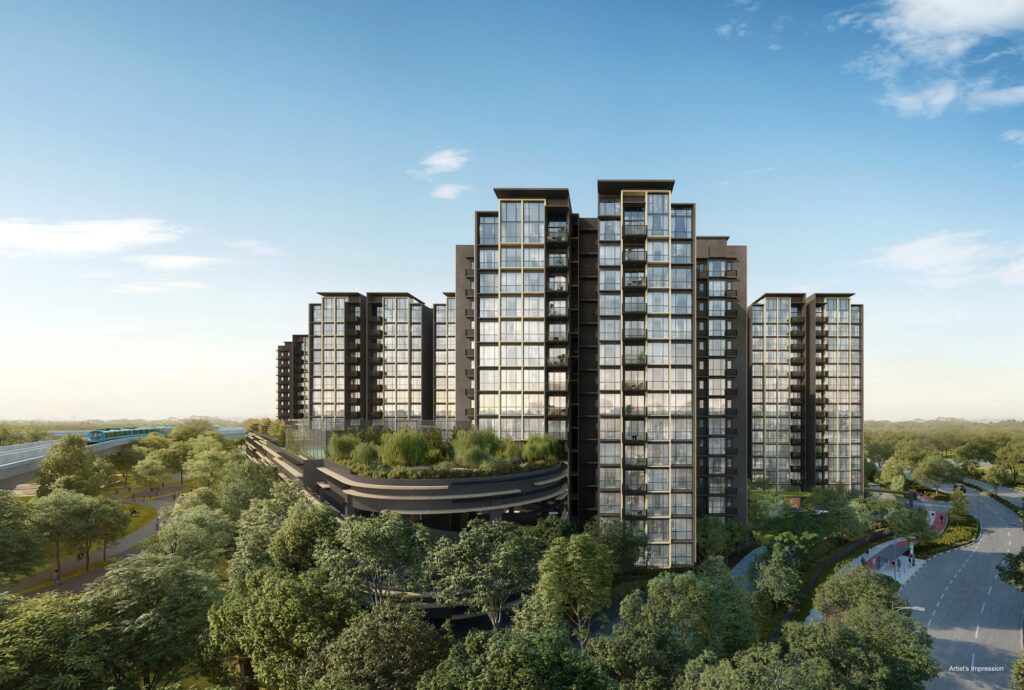
This EC versus private condo comparison was checked on 19 September 2026. It compares a new EC bought from its developer with an ordinary private condo. The worked prices are hypothetical, not asking prices, transactions or current launch offers. The featured image is Copen Grand’s developer artist’s impression, credited to City Developments Limited and MCL Land. It does not depict either hypothetical purchase.
First decide whether the new EC route fits
A new EC has household eligibility conditions. HDB’s current rules set an S$18,000 household monthly income ceiling for projects with tenders closing on or after 24 August 2026; new units on sites awarded before that date retain S$16,000. Citizenship, family composition, property interests and previous subsidies also matter. A calendar-year label is not enough to establish eligibility.
Resale ECs are a separate option. HDB’s open-market EC rules have no household income ceiling, but buyers must satisfy the applicable citizenship restrictions. Resale EC purchases do not qualify for CPF housing grants, and second-timers do not pay a resale levy for buying one on the open market.
If your priority is moving promptly, compare completed homes you can inspect. If you are buying an uncompleted home, include the construction wait, temporary housing and the risk that your family or work arrangements change before you collect the keys.
Why the cheaper purchase may need more of your own money
For a new EC, the 30% mortgage servicing ratio can constrain borrowing before the bank’s loan-to-value ceiling does. Bank loans also face the 55% total debt servicing ratio. MoneySense explains these limits. An ordinary private condo purchase is not subject to the EC mortgage servicing ratio, but a larger approved loan still has to be repaid.
Consider two Singapore Citizen first-time buyers, both aged 35, with S$16,000 combined gross monthly income, no other debts, no existing property and no previous housing subsidy. Assume the new EC’s other eligibility conditions are met, a 25-year loan and valuations equal to prices. The loans below are illustrative amounts, not approvals or calculated maximum entitlements.
| Item | New EC | Private condo |
|---|---|---|
| Assumed price | S$1,500,000 | S$2,000,000 |
| Assumed bank loan | S$900,000 | S$1,500,000 |
| Price funded outside loan | S$600,000 | S$500,000 |
| Buyer’s Stamp Duty | S$44,600 | S$69,600 |
| Price contribution plus BSD | S$644,600 | S$569,600 |
| Monthly payment at assumed 4% | S$4,751 | S$7,918 |
The 4% is a modelling assumption, not a current bank quotation. At that rate the EC payment is just below S$4,800, or 30% of the assumed income. A 75% loan on the same S$1.5 million EC would instead cost about S$5,938 monthly and exceed that limit. The private-condo payment is below S$8,800, or 55% of the assumed income with no other debts. The lender must still apply its actual income, rate and credit assessment.
In this example the EC requires S$75,000 more for the price contribution and BSD together, despite costing S$500,000 less. That result comes from borrowing less, not an extra EC tax. These are funding totals, not all-cash requirements: eligible CPF can cover part of the contribution, subject to usage rules. Under the assumed 75% bank LTV tier, at least 5% of the price must be cash, but the actual payment schedule may require more cash at particular dates. Neither total includes legal fees, renovation, moving costs, reserves or the timing of payments during construction.
Both buyers are assumed to have no ABSD liability as Singapore Citizens buying their first residential property. IRAS’s ABSD rules must be checked again if citizenship, ownership or the buying structure differs. A resale EC is not automatically exempt from ABSD for a Permanent Resident buyer.
The BSD figures use IRAS’s residential bands effective from 15 February 2023, on the assumption that market value does not exceed the price. The first S$1 million attracts S$24,600; the next S$500,000 adds S$20,000; a further S$500,000 adds S$25,000. No EC grant is deducted: at S$16,000 income this household falls above the grant-paying bands in HDB’s EC grant table.
A ten-year financing comparison needs a defined starting point
To isolate financing, suppose each loan is fully drawn at the start of the comparison and stays at 4% for 120 months, with a 25-year original term. There are no fees, prepayments or refinancing. This is ten years of fully disbursed borrowing, not ten years from booking an uncompleted unit.
| Loan result | S$900,000 loan | S$1,500,000 loan |
|---|---|---|
| Interest paid | S$312,298 | S$520,497 |
| Principal repaid | S$257,765 | S$429,609 |
| Debt remaining | S$642,235 | S$1,070,391 |
Calculations use equal monthly instalments, an annual rate divided by 12 and unrounded balances, then round displayed results to the nearest dollar. The lower interest bill follows from the smaller loan. It does not prove that ECs outperform private condos. Different rates, progressive drawdowns and early repayments would change it.
Do not add the full purchase price and every mortgage instalment to call the result a cost of ownership. That counts the principal twice. Keep three separate worksheets: cash and CPF payments over time; non-recoverable ownership costs; and equity remaining at a possible sale.
Add the costs that the loan table leaves out
- Maintenance and future works: obtain the unit’s actual charges and share value. For a completed estate, read the budgets, accounts and meeting minutes for proposed works. An EC does not automatically have lower charges.
- Property tax: use the property’s assessed Annual Value and applicable owner-occupier or non-owner-occupier rates. Purchase price is not Annual Value.
- Renovation and defects: compare the supplied finishes, usable layout and work needed in the actual unit. Similar bedroom counts do not establish equivalent specification.
- Waiting and moving: include rent, storage, duplicate housing costs and travel while an uncompleted home is built.
- Buying and selling: add legal bills, any applicable resale levy, agent fees and duties. Get the solicitor’s payment dates and check what can use CPF; a future CPF reimbursement is not cash already available today.
Use written quotations and actual documents for these lines. Leaving an unknown visible is more useful than filling it with a precise-looking ten-year estimate. At a sale, distinguish money used to discharge the mortgage and meet required CPF refunds from cash you can deploy elsewhere.
The exit date may matter more than a modelled saving
Under HDB’s occupation conditions, EC projects whose land sales tender closed on or after 8 May 2026 have a ten-year MOP; other projects have five years. It runs from TOP, not booking. Whole-unit rental is permitted only after MOP.
For the five-year-MOP cohort, resale buyers remain restricted to Singapore Citizens and Permanent Residents until ten years from TOP. For the ten-year-MOP cohort, that citizenship restriction lasts until fifteen years from TOP. These dates come from HDB’s open-market rules linked above. They are legal milestones, not promised price jumps.
A family planning an overseas move, a different school catchment or caring for an ageing parent should test the occupation commitment against that possibility. A private condo offers more freedom from EC occupation rules, but an early exit can still involve stamp duty, financing penalties, selling costs and a poor market price. Flexibility has value; it does not make an expensive home affordable.
Choose the home before predicting its return
Shortlist the actual units and compare the same things: usable rooms, floor and facing, remaining lease, completion timing, noise exposure and the household’s daily journeys. Check a proposed school or childcare route yourself at the times you would use it. An extra bedroom that cannot take the furniture you need is not equivalent space.
A new EC is worth considering if you meet its rules, can fund the required contribution without exhausting reserves and expect to live there through its MOP. A resale EC deserves its own comparison if you want to inspect a completed home or cannot meet the new-EC income ceiling. An ordinary private condo may suit a household that needs wider location choices or greater freedom to move, provided its full cost remains manageable.
For an investor, start with lawful letting availability, achievable rent supported by comparable transactions, expenses and downside. Do not buy a new EC on the assumption of immediate whole-unit rental or automatic gains at privatisation. For an occupier, a financially resilient home that supports daily life is the stronger starting point.
Read our Singapore EC eligibility and buying guide for the scheme details and mortgage guide for rate and refinancing decisions. This is general education, not a forecast or a personalised loan assessment.