Property Agent Commission Singapore 2026: CEA Rules, COA Rates and Who Really Pays the Agent

Property Agent Commission Singapore 2026: CEA Rules, COA Rates and Who Really Pays the Agent

Property Agent Commission Singapore 2026: CEA Rules, COA Rates and Who Really Pays the Agent

Quick Answer

  • Property agent commissions in Singapore are guided by the CEA’s Commission on Agency (COA) — not legally fixed, but strongly benchmarked by the industry.
  • For HDB and private resale: seller pays ~2% of the transaction price; buyer pays ~1%. Both rates are subject to 9% GST if the agent is GST-registered.
  • For new launch condos, the developer pays the agent’s commission (typically 2–5%), so the buyer pays no direct commission.
  • For HDB rental (whole unit): ½ month rent from landlord + ½ month rent from tenant = approximately 1 month rent total.
  • All agents must be registered with the Council for Estate Agencies (CEA); verify via the public register at public.cea.gov.sg.
  • Commission is always negotiable — the CEA guidelines are benchmarks, not caps. However, agents who consistently undercut may provide reduced service.
  • Co-broke (one agent per side) is the norm; the 2% seller’s commission is split 1% + 1% between the two agents in a co-broke arrangement.
  • Agents representing both buyer and seller in the same transaction must disclose this conflict — dual representation is regulated under the CEA Code of Ethics.

How Property Agent Commissions Work in Singapore

In Singapore, property agent commissions are not regulated by statute — there is no law that fixes the maximum or minimum percentage a client must pay. Instead, the Council for Estate Agencies (CEA) — the Government regulator for the real estate profession, under the Ministry of National Development — issues guidelines via its Commission on Agency (COA) framework that set the industry benchmark for what is reasonable.

In practice, the COA rates function as the de facto market standard. Clients who agree to pay below-COA rates may find it difficult to attract responsive agents, while clients paying above the benchmark are not common. Negotiation is possible, especially for high-value transactions where the absolute dollar amount is large even at a lower percentage.

The commission is always separate from the purchase price — it is a service fee paid by the client (buyer or seller) to the agent, not a part of what the counterparty receives or pays. Understanding which party owes what is essential before engaging any agent or signing a representation agreement.

Singapore property agent commission rate matrix HDB private rental 2026
Figure 1: Commission rate matrix by transaction type — HDB resale, private resale, new launch and rental. Source: CEA COA guidelines 2026.

Resale Transactions: The 2% + 1% Framework

For both HDB resale and private residential resale transactions, the COA guideline sets the following benchmark:

Party Commission Paid To GST (9%) Applicable?
Seller ~2% of sale price Seller’s agent Yes, if agent is GST-registered
Buyer ~1% of sale price Buyer’s agent Yes, if agent is GST-registered
Co-broke split 1% + 1% Split between seller’s and buyer’s agent As above

In a co-broke transaction — by far the most common arrangement — the seller’s 2% commission is typically split 1% to the seller’s agent and 1% to the buyer’s agent. The buyer still pays their 1% directly to their own agent. Total commission paid across both sides of a deal is approximately 3% of the transaction price, split 2% (seller) and 1% (buyer).

The buyer is not obligated to pay a commission — some buyers opt to engage a non-co-broke agent who receives 1% directly from the buyer. Others attempt to transact without a buyer’s agent, in which case they may negotiate a modest co-broke referral from the seller’s agent. This is less common and can create conflicts of interest.

New Launch Condos: Developer-Paid Commission

For new launch condominiums bought directly from the developer, the commission structure is entirely different. Developers build agent commission into their project cost and marketing budget — buyers pay no direct commission whatsoever. The developer pays the appointed agents a commission of typically 2–5% of the unit’s sale price, which varies by project, developer, and phase of sales.

This is one reason why buyers of new launches are often encouraged to engage a property agent: the service costs the buyer nothing, as the developer covers all agent fees. The buyer’s agent acts as a facilitator between buyer and developer showroom, provides comparative market analysis across projects, and assists with the booking and payment timeline. The agent is paid by the developer after the sale is completed.

There is no legal cap or floor on the commission a developer pays to agents, and some launches increase commissions during slow-sale periods to incentivise agent referrals. Buyers should be aware that agents presenting certain projects may do so partly because of higher commission structures — though professional agents are obligated by the CEA Code of Ethics to act in the client’s best interest regardless.

Rental Commission: The ½ + ½ Rule

For the rental of an entire HDB flat or private residential property, the COA guideline differs from the sales benchmark:

  • HDB whole-unit rental: ½ month rent from landlord + ½ month rent from tenant, totalling approximately 1 month rent. This applies to a 1-year tenancy; the commission is not pro-rated for shorter tenancies in practice.
  • Private residential rental: 1 month rent from landlord (most common); the tenant’s agent may receive ½ month rent from the tenant, though many private rentals operate on a landlord-pays-all basis with a 1-month co-broke split.
  • Room rental: No specific COA guideline — typically 1 month room rent from the room landlord, sometimes split with the tenant side.

Tenancy periods are relevant: for a 2-year lease with a 1-year renewal option, the commission is usually calculated on the first year’s rent only. Renewals typically carry a reduced commission of ½ month to 1 month, depending on whether the agent’s involvement continues.

The CEA Licensing Framework: Who Is Qualified to Act

CEA estate agent licence salesperson key executive officer Singapore 2026
Figure 2: CEA licensing structure — Estate Agency Licence, individual Salesperson licence and Key Executive Officer role.

The Estate Agents Act (Cap 95A) requires all property agents and agencies operating in Singapore to be licensed with the CEA. This is a criminal offence if breached — unlicensed agents face fines of up to S$75,000 and/or imprisonment of up to 3 years. The CEA maintains a public register of all licensed agencies and individual salespersons, searchable by name, licence number, or agency at public.cea.gov.sg.

There are two tiers of individual registration: the Salesperson Licence, held by individual agents, and the Key Executive Officer (KEO) designation, which applies to the responsible officer of a licensed estate agency. All agents must also complete Continuing Professional Development (CPD) hours annually to maintain their licence.

The Real Estate Salesperson (RES) examination is the entry requirement for all new entrants to the industry. Passed candidates must then attach to a licensed agency before they can practise — a sole-trader model (individual agent without an agency entity) is not permitted under Singapore law.

Dual Representation: When One Agent Acts for Both Sides

A single agent may represent both the buyer and the seller in the same transaction — this is called dual representation. The CEA Code of Ethics does not prohibit it, but requires the agent to disclose the dual role in writing to both clients and obtain their written consent before proceeding. The agent is also required to act fairly and in the interest of both parties — which is inherently difficult, since buyer and seller have opposing interests on price.

In practice, many experienced agents prefer to avoid dual representation to protect themselves from complaints. Buyers and sellers who become aware that their agent is also representing the other side should satisfy themselves that they have received impartial advice before proceeding. Both parties may terminate the representation if they are uncomfortable with the arrangement.

Worked Example: Full Commission Cost on a S$1.3M Resale Condo

Property agent commission worked example S$1.3M condo sale Singapore 2026 cost breakdown
Figure 3: Full commission and transaction cost breakdown for a S$1.3M resale condo — seller’s side and buyer’s side.

Scenario: S$1.3M D15 Resale Condo

Mr Tan (SC, no outstanding home loan) sells his District 15 condominium at S$1,300,000. Ms Lim (SC, first property) buys it. Both engage separate property agents in a co-broke arrangement. Commission is at the COA benchmark.

Seller (Mr Tan): 2% commission = S$26,000. His agent is GST-registered, so 9% GST = S$2,340. Total commission outlay: S$28,340. Legal fees (est.): S$2,500. Total selling cost: ~S$30,840. Net from S$1.3M sale after all costs: approximately S$1,269,160.

Buyer (Ms Lim): 1% commission = S$13,000 + S$1,170 GST = S$14,170. Buyer’s Stamp Duty (BSD) on S$1.3M = first S$180k at 1% (S$1,800) + next S$180k at 2% (S$3,600) + next S$640k at 3% (S$19,200) + remaining S$300k at 4% (S$12,000) = S$36,600. Additional BSD: nil (MS Lim is SC, first property, within the standard BSD schedule). ABSD: nil (SC, first property). Legal fees: ~S$3,000. Total buying costs on top of purchase price: approximately S$53,770.

This means Ms Lim needs to budget S$1,353,770 all-in before financing — the S$1.3M price plus roughly S$53,770 in stamp duties, commission, and legal fees. She can use CPF Ordinary Account savings for BSD and the down payment, but her agent’s commission and legal fees must typically be paid in cash.

Common Mistakes When Engaging Property Agents

The most frequent errors buyers and sellers make in agent engagements include: failing to sign an Exclusive Estate Agency Agreement (giving away exclusivity without a formal contract), not verifying the agent’s CEA registration before paying any fees, misunderstanding the co-broke arrangement (and inadvertently agreeing to pay both sides), and not clarifying whether the agent’s quoted commission is before or after GST. Always confirm in writing the commission amount, the GST treatment, the scope of services, and the duration of the representation agreement before proceeding.

What Might Come Next for Agent Commissions

The CEA has been moving toward greater transparency in the property industry. There is periodic industry discussion about whether commission rates should be more clearly disclosed in marketing materials, and whether platforms should be required to show whether a listing is being marketed by the seller’s own agent (exclusive) or on co-broke. Any formal changes would require CEA consultation with the industry and would likely be signalled well in advance through CEA circulars.

Frequently Asked Questions

Is it compulsory to use a property agent in Singapore?

No. Buyers and sellers can transact directly without an agent — this is called a “HDB Direct Purchase” for HDB flats or a direct private transaction for private properties. For HDB resale, both parties must still use the HDB Resale Portal to submit their application and complete the required HDB documentation. The benefit of transacting without an agent is the saving on commission; the risk is that without professional guidance, parties may miss procedural steps, valuation nuances, or contractual obligations. Private transactions also require both sides to draft or review the OTP, which typically requires legal input.

Can I negotiate the agent’s commission?

Yes — all commissions are negotiable. The COA rates are guidelines, not floors or ceilings. In practice, commission is most frequently negotiated on very high-value transactions (where 2% represents a significant absolute sum) and on rentals in a competitive agent market. Sellers sometimes offer higher-than-COA commissions to attract more agent attention for their listing, especially in a slow market. Buyers negotiating a lower fee should be aware that co-broke etiquette means a lower buyer’s agent commission may reduce the pool of agents willing to show the property.

What does the 9% GST on commissions mean for me?

If the property agent is GST-registered (mandatory for agents or agencies whose annual turnover exceeds S$1 million; voluntary for others), they must charge 9% GST on top of their commission fee. You should ask upfront whether the quoted commission is inclusive or exclusive of GST. At 2% on S$1.3M = S$26,000, the GST adds S$2,340, bringing the total to S$28,340. For large transactions, the GST component is material and should be budgeted explicitly.

How do I check if a property agent is legitimate?

Visit public.cea.gov.sg and use the Public Register search. You can search by the agent’s name, NRIC, licence number, or agency name. The register shows whether the agent’s licence is current, which agency they are attached to, and whether there have been any disciplinary actions. Never engage or pay any agent who is not on the public register — property transactions with unlicensed persons are voidable and the commission paid may not be recoverable.

Is the 1% buyer’s commission standard for all property types?

The 1% buyer’s commission is the COA benchmark for both HDB resale and private residential resale. It does not apply to new launch purchases (developer-paid) or commercial/industrial properties (which are negotiated separately and often carry different structures). For ultra-luxury properties above S$5M, some buyers negotiate a flat fee or a reduced percentage given the large quantum involved. For properties below S$500k, the minimum absolute commission may be agreed separately as the percentage could be very low in absolute terms.

What is the difference between an exclusive listing and a non-exclusive listing?

An exclusive listing means the seller appoints one agent (or one agency) to market the property for a fixed period — typically 60–90 days — and agrees not to appoint other agents during that time. The seller pays commission only to that agent (or its co-broke partner, if found). A non-exclusive listing allows multiple agencies to market simultaneously; commission is paid only to the agency that successfully introduces the buyer. Exclusive listings generally receive more committed marketing effort from agents; non-exclusive listings can result in conflicting marketing messages and agents undercutting each other’s price.

What happens if my agent behaves unethically or misleads me?

File a complaint with the CEA through its online complaint portal. The CEA has powers to investigate, impose fines, suspend licences, or revoke licences for breaches of the Code of Ethics. Common complaints include misrepresentation of property features, undisclosed dual representation, and collection of commissions without providing agreed services. You may also pursue a civil claim for damages in the Small Claims Tribunal (SCT) for claims up to S$30,000, or the District Court for larger amounts.

Related Articles


Disclaimer: This article provides general information about property agent commission structures and CEA regulations in Singapore as at May 2026. Commission rates are subject to change and individual negotiation. This is not financial, legal, or property advice. Always verify agent credentials at public.cea.gov.sg and consult a licensed professional for advice specific to your transaction. Official commission guidelines are published by the Council for Estate Agencies at cea.gov.sg.

HDB Ethnic Integration Policy Singapore 2026: Block Quotas, Neighbourhood Limits and SPR Rules Explained

HDB Ethnic Integration Policy Singapore 2026: Block Quotas, Neighbourhood Limits and SPR Rules Explained

HDB Ethnic Integration Policy Singapore 2026: Block Quotas, Neighbourhood Limits and SPR Rules Explained

Quick Answer

  • The HDB Ethnic Integration Policy (EIP) caps the proportion of each ethnic group allowed in an HDB block and neighbourhood to promote racial harmony.
  • Chinese buyers face a 84% block / 78% neighbourhood limit; Malay buyers 22% block / 16% neighbourhood; Indian and Others 12% block / 10% neighbourhood.
  • If a block or neighbourhood has already hit its ethnic quota for your group, you cannot buy that flat — regardless of price or seller agreement.
  • Singapore Permanent Residents (SPRs) count under their registered race and face an additional 8% SPR community cap per block.
  • The EIP applies to HDB resale flat purchases and rentals of whole units; it does not apply to BTO sales or commercial premises.
  • Sellers who sell to a buyer of the same ethnic group are exempt from the quota check.
  • Check any block’s EIP headroom for free at hdb.gov.sg → e-Services → EIP / SPR Enquiry before making an offer.
  • Violations are not fined but rather the HDB application is simply rejected — the buyer must find a different flat.

What Is the Ethnic Integration Policy?

The Ethnic Integration Policy, commonly abbreviated EIP, is a Government-administered quota system that controls the ethnic composition of HDB resale flats at the level of individual blocks and planning neighbourhood areas. It was introduced in 1989 by the Ministry of National Development (MND) and administered by the Housing & Development Board (HDB) with the explicit goal of preventing ethnic enclaves from forming in public housing estates.

Before the EIP existed, certain blocks and estates had become almost entirely monoethnic — a legacy of voluntary clustering and the earlier resettle-and-rehouse programmes of the 1960s–70s. The Government concluded that such enclaves risked weakening the inter-racial bonds that Singapore depends on for social cohesion, and the EIP was the structural remedy: no block or neighbourhood may exceed defined ethnic proportions, measured as a share of total residential units.

The policy is purely demand-side. It does not tell sellers whom they may approach or what price to charge; it simply means that HDB will only approve the resale transaction if the buyer’s ethnic group is still within quota in the block and neighbourhood in question. If the quota is full for that group, the application is declined — and the flat remains on the market until a buyer from an under-quota group steps in, or until the overall block mix shifts as other owners move out.

HDB EIP ethnic quota limits block neighbourhood Singapore 2026 table
Figure 1: HDB Ethnic Integration Policy block and neighbourhood quota limits (2026). Source: HDB.

The Quota Numbers: Block vs Neighbourhood

HDB measures EIP compliance at two geographic levels, and both must be within limit for a transaction to proceed. A buyer’s application will be rejected if either the block quota or the neighbourhood quota is breached — even if only one is at the ceiling.

As at 2026, the limits are:

Ethnic Group Block Limit Neighbourhood Limit Rationale
Chinese 84% 78% Reflects Chinese share of Singapore population (~74% SC + SPR combined)
Malay 22% 16% Malay population ~13%; buffer above national share to allow normal movement
Indian & Others 12% 10% Indian population ~9%; others ~4%; combined buffer limit
Same-group sale Exempt Exempt Selling to own ethnic group does not affect the quota; no check required

Neighbourhoods in HDB terminology typically correspond to HDB town or planning zones within a town — for instance, Tampines as a neighbourhood encompasses multiple blocks. A block hitting 84% Chinese while the neighbourhood sits at 70% is still blocked (the block ceiling is breached). Both must clear simultaneously.

Who the EIP Applies To — and Who It Does Not

The EIP applies to every resale HDB flat transaction where the buyer and seller are of different ethnic groups. This covers the vast majority of open-market resale transactions. The following categories are exempt from the quota check:

  • Sales where the buyer and seller share the same registered ethnic group (the most common exemption).
  • HDB BTO (Build-To-Order) flat sales — the EIP only applies to the resale market, not new flat allocations from HDB.
  • Transfers within immediate family (inheritance, gifts, adding or removing a co-owner on the same flat) — these are not resale transactions.
  • Short-term room rentals (renting out individual bedrooms, not the whole flat) — the EIP does not restrict room rental.

The EIP does apply to the rental of entire flats to tenants of a different ethnic group. A landlord must verify that approving a new tenant would not cause the block or neighbourhood quota to be exceeded before submitting the rental application to HDB.

How SPRs Are Treated Under the EIP

Singapore Permanent Residents are counted under their registered race as it appears on their NRIC or Re-entry Permit. A Malaysian-Chinese SPR counts as Chinese; a Malaysian-Indian SPR counts as Indian. SPRs have no special exemption from the ethnic quota — they are subject to the same block and neighbourhood limits as Singapore Citizens of the same ethnic group.

In addition to the standard ethnic quota, HDB imposes a separate SPR community cap of 8% per block. This means that even if the ethnic quota for a particular group has headroom, the transaction will still be rejected if the proportion of SPR households in the block has already reached 8%. The 8% cap is computed across all ethnicities combined — it is not per-ethnicity.

HDB EIP SPR Singapore permanent resident ethnic integration policy 2026
Figure 2: How SPRs are counted under the EIP — block limits and the 8% SPR community cap. Source: HDB.

How to Check the EIP Before Making an Offer

HDB provides a free online tool — the EIP / SPR Enquiry — accessible via the HDB website’s e-Services portal. Any member of the public can enter a block number and street name to see the current EIP status for all three ethnic groups and the SPR community quota. The tool shows whether the block and neighbourhood are within limit, at limit, or exceeding the limit for each group.

This check is essential for buyers and their property agents to conduct before submitting an Offer to Purchase or Option to Purchase, because:

  • Once an OTP is exercised and the buyer has paid the 1% option fee and 4% exercise consideration (totalling 5% of purchase price), the buyer has contractual obligations to proceed. Discovering an EIP block only after this stage causes financial loss.
  • Real estate agents have a professional obligation under the CEA Code of Ethics to verify EIP status before advising clients to submit an offer on a flat.
  • HDB’s Resale Portal will flag an EIP breach at the point of HDB application, but this is after OTP exercise and typically 2–3 weeks into the process.

As a rule of thumb, run the EIP check as the very first step — before viewing arrangements, before price negotiations, and certainly before signing any document.

What Happens When a Block Is at Quota?

A block “at quota” means the current proportion of flats occupied by that ethnic group has reached or exceeded the ceiling. In practice, blocks rarely sit exactly at 84% or 22% — the numbers shift continuously as owners move out and in. A block that is at quota today may have a vacancy next month when a household of the same ethnic group moves out.

For buyers who find their preferred flat in a quota-full block, the realistic options are:

  • Search for comparable flats in the same estate or town where the block still has headroom for their ethnic group.
  • If the seller is of the same ethnic group as the buyer, the transaction is exempt from the quota check — this is the most direct route if matching-group sellers exist in the block.
  • Wait — quota positions change over time, though this is rarely a practical strategy when the buyer has a fixed moving timeline.

Worked Example: EIP in Action

HDB ethnic integration policy worked example resale purchase blocked approved 2026
Figure 3: Two real-world EIP scenarios — one blocked, one approved — in the HDB resale market.

Scenario A — Blocked Purchase

Mr Rahman is a Malay Singapore Citizen looking to buy a 4-room flat in Tampines from Mr Tan (Chinese). He finds a well-priced unit, negotiates terms, and is about to exercise the OTP when his property agent runs the EIP check. The block has 22.1% Malay occupancy — just above the 22% ceiling. HDB’s system would reject the application. Mr Rahman’s options: find a different flat in a block with Malay headroom, or seek a seller who is Malay (same-group, exempt from quota).

Scenario B — Approved Purchase

Ms Lim is a Chinese SC buying from Ms Rahim (Malay) in Bishan. The block has 71% Chinese occupancy — 13 percentage points below the 84% ceiling. The neighbourhood Chinese occupancy is 65% — 13 points below the 78% ceiling. Both checks pass. HDB approves the application, and the parties proceed to completion, typically 8 weeks from HDB’s letter of approval to key collection.

Historical Context: Why Singapore Chose a Quota System

The EIP has its roots in the 1964 race riots and the post-separation social engineering that characterised Singapore’s early decades. By the late 1980s, data showed that voluntary ethnic clustering in HDB estates had resumed — not at pre-independence levels, but enough to alarm planners concerned about long-term social cohesion. The Government concluded that without a structural mechanism, market forces would gradually re-segregate the housing stock even within the same HDB town.

Critics of the EIP — including some academics and civil society commentators — have argued that it can trap Malay and Indian sellers in blocks that have reached quota, forcing them to sell to buyers of the same ethnicity (often a smaller pool) at potentially lower prices. HDB has acknowledged these concerns in occasional policy reviews but has maintained that the social stability benefits outweigh the market distortions. The quotas have been adjusted several times since 1989; the current figures were last revised in 2010.

What This Means for Buyers and Investors

For buyers, the EIP is a hard constraint that must be baked into property search strategy. It is not a legal technicality to be negotiated around — HDB’s system enforces it automatically at the application stage. Missing this check is one of the most avoidable sources of OTP-related financial loss.

For property investors holding resale HDB flats as rental assets, the EIP also caps the pool of permissible tenants (whole-unit rentals are quota-subject), which can slow leasing in tight-quota blocks. Savvy investors check the EIP status of a block not just when buying but periodically during holding — a block drifting towards quota limits the exit pool too.

What Might Come Next

Periodic academic discussions have raised the question of whether the EIP thresholds should be adjusted to better reflect Singapore’s current demographic composition — the 2020 census showed the Chinese share of the resident population had declined slightly to around 74% while the Malay and Indian shares held broadly steady. The current 84% Chinese block ceiling was last revised in 2010 and arguably has more room than needed for the Chinese community. A recalibration could give Malay and Indian buyers slightly more flexibility at the margin.

There is also ongoing discussion about whether a digital, real-time EIP dashboard — beyond the current per-block lookup tool — could be integrated into property listing platforms to surface quota status directly alongside price and size. This would reduce the risk of buyers only discovering quota blocks during the due diligence phase.

Frequently Asked Questions

Can a seller refuse to sell to a buyer of a different ethnicity to avoid the EIP?

Technically, private negotiations are between buyer and seller and a seller may choose not to accept any offer for any reason. However, in practice, sellers list broadly and are simply informed by their agents that an OTP to a buyer whose ethnic group is at quota in that block will not be approved by HDB — so neither party wastes time pursuing a transaction that will fail at the HDB portal stage. The EIP is not a discrimination right; it is an administrative approval gate.

Does the EIP apply when I buy from my own ethnic group?

No. The quota check is only triggered when the buyer’s ethnic group differs from the seller’s. If a Chinese buyer buys from a Chinese seller, no EIP check applies, and the transaction proceeds as long as all other HDB eligibility criteria are met. Same-group transactions cannot cause the quota to rise because the total count of that ethnic group in the block remains unchanged (one household out, one in).

What is the SPR community cap and how does it interact with the ethnic quota?

The SPR community cap is an 8% limit on the proportion of all SPR households (of any ethnicity combined) in any single HDB block. It operates independently of the ethnic quota. This means a Malay SPR purchasing a flat in a block that is within the Malay ethnic quota could still be rejected if the block’s SPR community proportion is at or above 8%. Both the ethnic quota and the SPR community cap must be within limits for the application to succeed.

Does the EIP affect new BTO flat applications?

No. BTO flats are allocated by HDB via the ballot system, and EIP quotas do not apply to new flat sales. The EIP is solely a resale-market mechanism. When BTO flat owners later wish to sell on the open resale market (typically after the 5-year Minimum Occupation Period), the EIP will apply to the new buyer at that point in time.

What if I am of mixed ethnicity — which quota applies to me?

HDB uses the ethnic group as it appears on your Singapore identity documents (NRIC). For persons of mixed heritage, this is typically the ethnic group that was registered at birth under the Registration of Births and Deaths Act. You cannot choose which quota applies to you based on your heritage alone — the NRIC ethnic group is what counts. If you believe your registered ethnicity is incorrect, you would need to approach ICA (Immigration and Checkpoints Authority) to rectify this separately.

Can a landlord rent to any tenant regardless of EIP?

No. When a landlord rents out a whole HDB flat to tenants of a different ethnic group, HDB checks the EIP and SPR community cap at the time of the rental application. If approving the tenancy would breach the quota, HDB will not approve the rental. Landlords are responsible for checking before entering into a tenancy agreement. Renting out individual rooms (not the entire flat) is not subject to the EIP.

How often do blocks hit their quota ceiling?

There is no published aggregate figure from HDB on how many blocks are at quota at any given time, but industry practitioners report that certain mature estates (Bishan, Toa Payoh, Queenstown) with older Chinese-majority compositions can periodically see Chinese quotas at the ceiling in particular blocks. Malay-majority blocks in towns like Bedok, Tampines, or Geylang may reach the Malay ceiling in some sub-blocks. It varies significantly by block and by time of year. The online EIP checker is the authoritative real-time source.

Related Articles


Disclaimer: This article is for general informational purposes only and does not constitute legal, financial, or property advice. EIP limits are set by HDB and may be revised. Always verify the current quota position using HDB’s official EIP / SPR Enquiry tool at hdb.gov.sg before making any offer on a resale flat. For advice specific to your circumstances, consult a licensed property agent registered with the Council for Estate Agencies (CEA) or a qualified property lawyer.

URA Releases Two CCR GLS Sites at Peck Hay Road and River Valley Green (Parcel C) — Tenders Close 11 and 18 June 2026

URA Releases Two CCR GLS Sites at Peck Hay Road and River Valley Green (Parcel C) — Tenders Close 11 and 18 June 2026

URA Releases Two CCR GLS Sites at Peck Hay Road and River Valley Green (Parcel C) — Tenders Close 11 and 18 June 2026

Singapore's Core Central Region land-sales programme returns with a 785-unit twin launch — and analysts are pricing top bids in the S$1,600–1,750 psf ppr band.

Quick Answer — what just happened in 30 seconds

  • The Urban Redevelopment Authority (URA) launched two Core Central Region (CCR) Government Land Sales (GLS) sites for tender on 9 April 2026 — Peck Hay Road (~315 units, near Newton MRT) and River Valley Green Parcel C (~470 units, next to Great World MRT).
  • Combined, the two sites can yield about 785 private homes — both 99-year leasehold residential plots in District 9.
  • The Peck Hay Road tender closes at 12 noon on 11 June 2026; River Valley Green (Parcel C) closes a week later, at 12 noon on 18 June 2026.
  • Analysts polled by EdgeProp, Stacked Homes and the firm research desks expect 6–8 bids on Peck Hay Road and 4–6 bids on River Valley Green (Parcel C), with top land bids of S$1,650–S$1,750 psf ppr and ~S$1,600 psf ppr respectively.
  • Both sites are part of the 1H2026 Confirmed List of 4,575 residential units — 50% above the past-decade Confirmed-List average per GLS programme.
  • Indicative launch pricing implied by the analyst land-rate band sits at S$3,200–S$3,500 psf for Peck Hay Road and S$2,950–S$3,150 psf for River Valley Green (Parcel C), depending on construction-cost and developer-margin assumptions.

What URA released — and why both sites matter

On 9 April 2026, URA placed Peck Hay Road and River Valley Green (Parcel C) on tender — the first paired CCR launch of the 1H2026 GLS programme. Both sites sit inside District 9, both are 99-year leasehold residential plots, and both will yield mid-density condominium developments. Together they account for roughly 17% of the 1H2026 Confirmed List units.

For context, the 1H2026 Confirmed List of 4,575 residential units is the largest single-half-year confirmed-list slate in over a decade — 50% above the average over the past ten 6-monthly programmes. URA has signalled, through repeated MND statements, that this elevated supply schedule is a deliberate response to private residential prices that have risen for ten consecutive quarters (Q1 2026 PPI +0.9%).

Peck Hay Road and River Valley Green Parcel C GLS launch 2026 hero — Singapore CCR sites
URA Peck Hay Road and River Valley Green (Parcel C) GLS launch — June 2026 tender closes.

Site profile — Peck Hay Road

The Peck Hay Road site is a compact 0.55-hectare plot tucked between Scotts Road, Newton Road and Bukit Timah Road, a five-minute walk from Newton MRT (NS21/DT11). The plot ratio is a notably high 4.9, reflecting its prime CCR positioning, with maximum permissible GFA of around 26,950 m² (290,000 sq ft). Indicative unit count: ~315 private homes, a development scale broadly similar to mid-tier CCR launches over the past three years.

The site's competitive context is unusually rich. It is one of the few remaining undeveloped private plots in the Newton-Scotts axis, where existing inventory comprises mature condominiums (Newton Suites, Newton 18, Newton One) and recent freehold redevelopments. Comparable nearby tender prints — though sparser than in the RCR — include the Boulevard 88 land deal in 2017 (~S$2,100 psf ppr, freehold) and the older Stevens Road / Dorsett land sales in 2020–2021 at the S$1,400–1,500 psf ppr band. The 2026 analyst expectation of S$1,650–1,750 psf ppr reflects the post-cooling-measures CCR premium.

Site profile — River Valley Green (Parcel C)

River Valley Green (Parcel C) is the third and final parcel of the River Valley Green release programme, following Parcel A (river-modern, awarded in 2025) and Parcel B (river-green, awarded in 2025 to Wing Tai). The Parcel C plot spans about 11,516 m², with a plot ratio of 3.5 and indicative unit count of ~470 private homes. It sits directly next to Great World MRT (TE15) and across the road from River Valley Primary School, putting it inside one of the most established residential enclaves in District 9.

Analysts expect a tighter bidder field on Parcel C (4–6 versus 6–8 on Peck Hay Road) — partly because two of the most active 2024–2025 CCR bidders (Wing Tai and the larger consortia of CDL/HongKong Land) are already exposed to nearby Parcel A and Parcel B and may not stretch into a third adjacent site at full premium. Top bid is projected around S$1,600 psf ppr, modestly below the Peck Hay Road expectation despite a slightly larger absolute outlay (~S$695M projected land cost).

Peck Hay Road River Valley Green Parcel C GLS site fact panel 2026
Figure 1 — Peck Hay Road and River Valley Green (Parcel C) site fact panel — both 99-year leasehold, total ~785 units.

Reading the analyst bid band against recent comparables

The analyst-projected S$1,650–1,750 psf ppr top bid for Peck Hay Road would set a new CCR Confirmed-List benchmark — a step up from the 02 May 2026 Dunearn Road award (D11) at S$1,625 psf ppr, and substantially above the 2025 RCR-belt benchmarks at Holland Drive (S$1,218 psf ppr) and the late-2024 Pinetree Hill (S$1,318 psf ppr). The chart below sets out the trajectory.

CCR RCR GLS land rates Singapore 2024 to projected 2026 comparison bar chart
Figure 2 — Confirmed-List land rates have risen ~30% from late-2024 RCR awards to mid-2026 CCR projections.

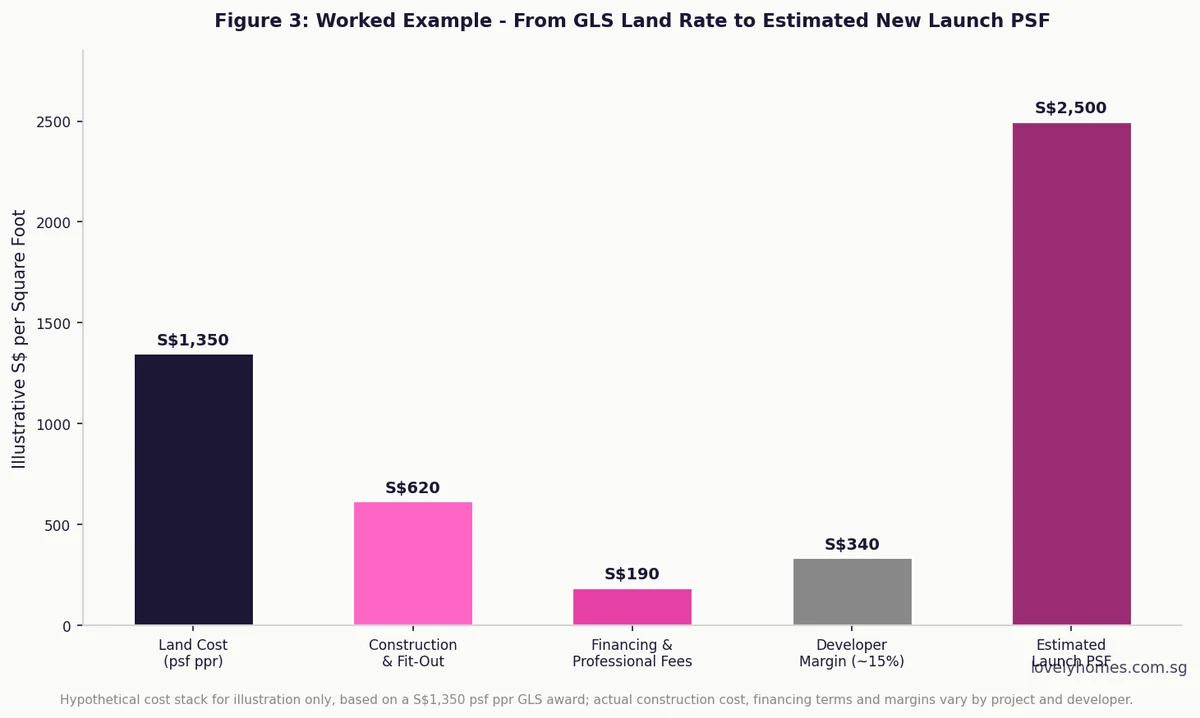
Worked Example — implied launch price for Peck Hay Road

Land cost

At an analyst top bid of S$1,700 psf ppr × 290,000 sq ft GFA = approximately S$493 million in land outlay alone.

Construction and finance

Indicative all-in construction cost on a CCR plot of this density: S$650–700 psf GFA, including main contract, M&E and superstructure. Finance cost over a 36-month build (taking BBR + 1.5%): S$120–140 psf GFA. Marketing, professional fees and provision for ABSD remission risk: S$80–100 psf GFA.

Indicative breakeven and launch

  • Land cost: S$1,700 psf ppr
  • Construction + M&E: S$675 psf GFA
  • Finance + soft costs: S$130 psf GFA
  • Marketing + ABSD provision: S$90 psf GFA
  • Indicative breakeven: ~S$2,595 psf
  • Indicative launch price (12% developer margin): ~S$2,900–3,100 psf
  • Aggressive assumption launch (CCR premium scenario): S$3,200–3,500 psf for select stacks

Translation: a 700 sq ft two-bedder on Peck Hay Road would launch at S$2.0M–S$2.4M; a 1,200 sq ft three-bedder at S$3.5M–S$4.2M.

What this means for buyers

For homebuyers, the immediate signal is that CCR new-launch pricing in 2027–2028 will sit comfortably above the S$2,800 psf threshold. Owner-occupiers prioritising location over per-square-foot value should monitor both tenders closely; pricing pressure from the post-tender comparable will affect every unsold inventory across Newton-Scotts and Great World. Buyers stretching into 4-bedroom inventory should budget for absolute prices in the S$5M+ range.

For investors, the picture is more nuanced. Rental yields in the CCR continue to sit at 3.0–3.5% gross — comfortably above CCR mortgage rates of 3.0–3.3%, but the price-rental gap has widened. The Peck Hay Road launch in particular will likely target the high-net-worth owner-occupier and affluent local-investor segment rather than yield buyers.

What this means for developers and the GLS programme

Developers face an unusually well-supplied 1H2026 programme, with the 4,575-unit Confirmed List sitting alongside the 1H2026 Reserve List. The strategic implication is that successful developers will be those with demonstrable execution speed — the ABSD-remission deadline forces full sell-through within five years of land acquisition, and a 470-unit launch needs to clear in a market where 2025 absorption rates were 60–80% in the first quarter of launch.

For the GLS programme itself, the Peck Hay Road and River Valley Green (Parcel C) tenders are the political bellwether — strong bids will validate the elevated supply schedule, while a soft set would invite questions about whether 4,575 units in one half-year is calibrated to actual demand.

What might come next

Three forward-looking watchpoints. First, both tender closes are within a fortnight of each other (11 and 18 June) — meaning the Peck Hay Road result will be a real-time read for the River Valley Green (Parcel C) bidder field. Second, three more 1H2026 sites remain on the Confirmed List for tender close in 2H2026 (Bayshore Drive among them, closing 15 July 2026). Third, the 2H2026 GLS programme will be announced around mid-June, and its scale will be cross-read against the Peck Hay / RVG-C clearance levels.

Summary table — Peck Hay Road vs River Valley Green (Parcel C) at a glance

Attribute Peck Hay Road River Valley Green (Parcel C)
Site area ~5,500 m² (0.55 ha) ~11,516 m²
Plot ratio 4.9 3.5
Maximum GFA ~26,950 m² ~40,300 m²
Indicative units ~315 ~470
Lease 99 years 99 years
Tender closes 11 June 2026, 12 noon 18 June 2026, 12 noon
Expected bidders 6–8 4–6
Analyst top bid S$1,650–1,750 psf ppr ~S$1,600 psf ppr
Implied launch S$3,200–3,500 psf (top stacks) S$2,950–3,150 psf

Frequently Asked Questions

What is a Government Land Sales (GLS) tender?

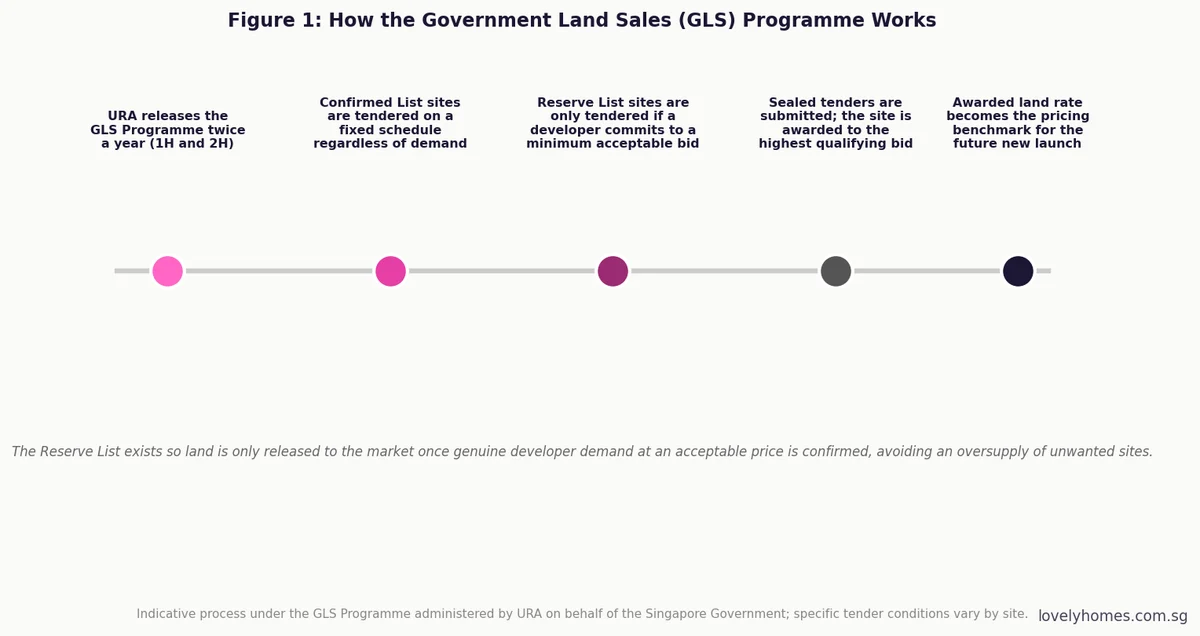
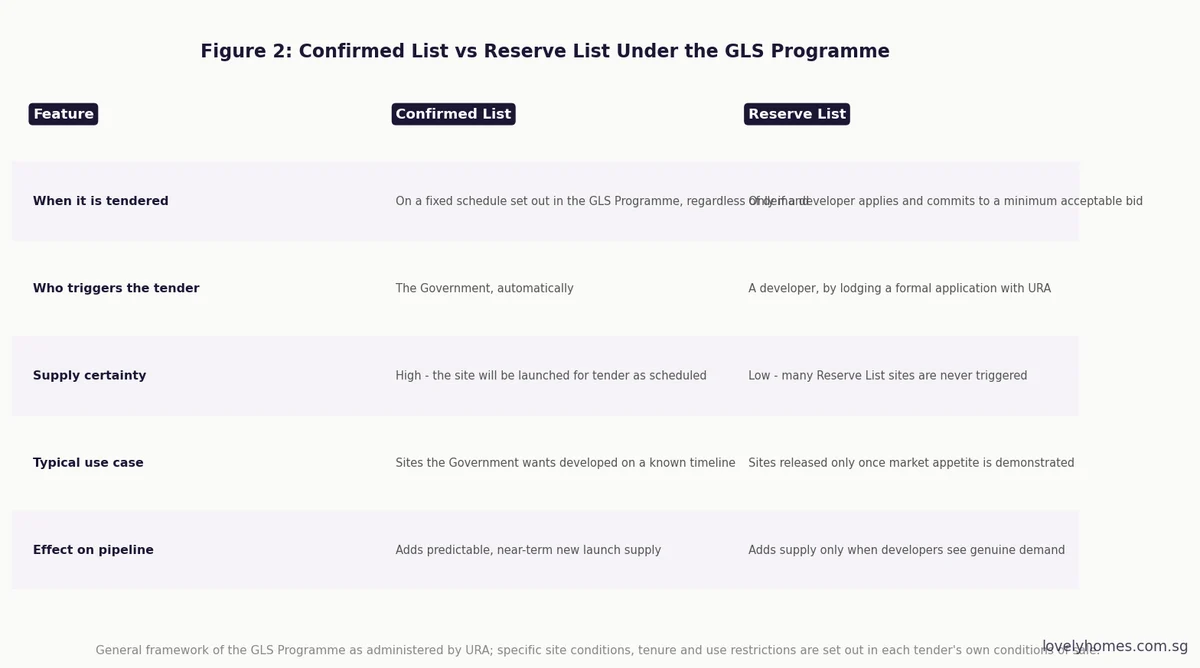
A GLS tender is the process by which the State of Singapore, through URA, sells residential, commercial or mixed-use land for private development. The Confirmed List is the headline programme — sites are launched on a fixed schedule. The Reserve List requires a developer to trigger a tender by submitting a minimum-price commitment.

Why are Peck Hay Road and River Valley Green Parcel C significant?

Both sites are inside Singapore's Core Central Region (District 9), where new-launch supply has been historically tight relative to demand. The combined ~785 units is a meaningful addition to a region that has seen no major Confirmed-List residential launch since 2024. They are also part of an unusually large 1H2026 Confirmed List (4,575 units, 50% above decade average).

What does "psf ppr" mean?

Per square foot per plot ratio — a normalised measure of land cost. It divides the tendered land price by the maximum permissible gross floor area (GFA), so two sites with different plot ratios can be compared on like-for-like terms.

How is the launch price calculated from the land bid?

Add construction cost (~S$650–700 psf GFA in 2026), financing cost over the build period (~S$120–140 psf GFA), marketing and ABSD-remission provisioning (~S$80–100 psf GFA), and a developer margin (10–15%). For a top bid at S$1,700 psf ppr, this implies a launch price band of roughly S$2,900–3,100 psf, with selected stacks pricing higher.

When are these condominiums likely to launch for sale?

If both tenders are awarded in late June 2026, the typical land-to-launch timeline is 12–18 months for design, planning approvals and showflat construction. Indicative public launch dates: Peck Hay Road in late 2027 to early 2028; River Valley Green (Parcel C) in early 2028.

Will the elevated 1H2026 Confirmed List supply cool prices?

The supply pipeline is materially larger than the past decade average, but the bulk of these units will reach launch only in 2027–2028. Q1 2026 PPI rose 0.9%; the supply-led cooling, if it materialises, is more likely to show in 2027 transaction volumes and asking-price moderation than in any near-term quarterly print.

Disclaimer. This article is editorial commentary based on publicly available URA media releases (pr26-28, 09 April 2026) and analyst commentary published by EdgeProp Singapore, Stacked Homes, The Edge Singapore, 99.co Insider, ERA research desk and Cushman & Wakefield. Forward-looking bid bands and launch pricing are estimates only, not guarantees. Verify current tender details on the URA website and the One-Stop Developer Portal. Engage a licensed property professional and a Singapore-qualified solicitor before committing to any transaction.

Foreigner Property Buyer Singapore 2026: What You Can Buy, ABSD Rates & Residential Property Act Rules

Foreigner Property Buyer Singapore 2026: What You Can Buy, ABSD Rates & Residential Property Act Rules

Foreigner Property Buyer Singapore 2026: What You Can Buy, ABSD Rates & Residential Property Act Rules

The rule set that governs every non-Singaporean residential transaction — from condominium purchases at standard rates to landed property approvals through the Land Dealings Approval Unit.

Quick Answer — Foreigner Buying in Singapore in 30 seconds

  • A "foreigner" for property purposes is anyone who is not a Singapore Citizen (SC), Singapore Permanent Resident (SPR), or a Singapore-incorporated entity wholly-owned by SCs/SPRs.
  • Foreigners can freely buy strata-titled condominium and apartment units, certain commercial / industrial property, and privatised executive condominiums (ECs that are at least 10 years old).
  • Foreigners cannot buy HDB BTO flats, HDB resale flats, or new (≤10y) executive condominiums under any circumstance.
  • Landed residential property requires written approval from the Land Dealings Approval Unit (LDAU) under the Residential Property Act, with limited exceptions in Sentosa Cove.
  • Additional Buyer's Stamb Duty (ABSD) for foreigners is currently 60% of dutiable price (Apr 2023 cooling measures), payable to IRAS within 14 days of executing the OTP.
  • Five FTA-treaty nationalities — United States, Iceland, Liechtenstein, Norway, Switzerland — are taxed at the same ABSD rate as Singapore Citizens (0%/20%/30%) under their respective Free Trade Agreements.
  • Buyer's Stamp Duty (BSD) at the standard tiered rate (1–6%) applies on top of ABSD; BSD has no foreigner premium.

What "foreigner" means under the Residential Property Act

The Residential Property Act (Cap. 274) is the principal statute governing who may buy and hold residential property in Singapore. Section 4 defines a "foreign person" as any natural person who is not a Singapore Citizen and not a Singapore Permanent Resident, or any company / society / partnership / association that is not wholly Singapore-owned. The Act's policy objective, set out in its 1973 origins and reaffirmed at every cooling-measures cycle since, is to keep landed residential property as predominantly Singaporean ownership while permitting foreigners to participate in the strata-titled, apartment, and condominium segments.

The Ministry of National Development (MND), through the Singapore Land Authority (SLA) and the Land Dealings Approval Unit (LDAU), administers the Act. Buyer status is checked at every conveyancing transaction — your solicitor will request the buyer's NRIC, FIN or passport, and the Inland Revenue Authority of Singapore (IRAS) cross-verifies that information at the BSD/ABSD stamping stage.

Foreigner property buyer Singapore 2026 hero — pink sunset over Singapore skyline
Foreigner Property Buyer Singapore 2026 — every rule, rate and approval explained.

What can a foreigner actually buy in Singapore?

The matrix below summarises the position as at 03 May 2026. The colour-coding maps to three regimes: green (allowed without prior approval, subject to ABSD), amber (allowed with LDAU approval), and red (not allowed at all).

Foreigner property purchase matrix Singapore 2026 — what is allowed and what needs LDAU approval
Figure 1 — What foreigners can and cannot buy in Singapore (2026 matrix). LDAU approval typically takes 4–8 weeks.

The free-purchase segment

The simplest path for a foreigner is the strata-titled condominium or apartment market. Any project on a private-title development (i.e. not under HDB) is open to foreign buyers without LDAU approval, subject only to the standard BSD and the foreigner-rate ABSD. This is by far the largest segment by transaction volume — over 95% of foreigner private residential transactions in 2025 fell into this bucket.

Privatised executive condominiums

Executive condominiums begin life as a hybrid public-private flat with a 10-year Minimum Occupation Period and citizenship restrictions. After year 11 (when the EC is fully "privatised"), it is treated like any private condominium and may be bought by foreigners. Examples in 2025–2026 included The Topiary (privatised 2023), Privé (2025) and Lush Acres (2025) — all then opened to foreign buyers in the resale market.

The LDAU-approved segment

Landed residential property — terrace houses, semi-detached houses, bungalows, and good-class bungalows — is restricted under the Act. A foreigner who wants to buy a landed dwelling must apply to the LDAU under section 25 of the Act. The application form (LD-1) is filed via the SLA e-services portal, accompanied by a CV, a statement of funds, and a justification of why the applicant should be permitted. Approvals are typically granted only to foreigners who have made "exceptional economic contributions to Singapore" — a high bar, applied case-by-case.

The Sentosa Cove exception

Sentosa Cove is the one geographic carve-out: foreigners can apply to LDAU for landed property in Sentosa Cove on a quicker, more permissive basis (typically 4–6 weeks), provided the property is for owner-occupation. Sentosa Cove approvals do not require "exceptional contributions" — they are granted on largely fit-and-proper-person grounds.

The hard prohibitions

HDB flats — both BTO and resale — are entirely closed to foreigners. The HDB framework is built around Singapore Citizen and SPR family nuclei; the only path for a foreigner to occupy an HDB flat is as a tenant (with the host SC/SPR's sub-letting permission) or as a non-citizen spouse on a joint application (where the SC/SPR family nucleus carries the eligibility). New executive condominiums (within their 10-year MOP) are similarly closed, since they are tied to the EC eligibility framework.

ABSD — the dominant cost for foreign buyers

Additional Buyer's Stamp Duty was introduced in December 2011 as a cooling measure. It is layered on top of the standard Buyer's Stamp Duty, and the foreigner rate has been ratcheted upward at every subsequent cooling-measures cycle: 10% (2011), 15% (2013), 20% (2018), 30% (2021), and 60% (April 2023, the current rate).

ABSD rates by buyer profile Singapore 2026 — citizens, PRs, foreigners and entities
Figure 2 — ABSD by buyer profile in Singapore (2026). Foreigners pay 60%; FTA nationalities pay the SC rate.

FTA-treaty exemption — the five nationalities

Singapore's Free Trade Agreements with the United States (USSFTA), Iceland, Liechtenstein, Norway, and Switzerland (the EFTA states) include Most-Favoured-Nation clauses on tax-on-property that effectively bind Singapore to charge those nationalities at the Singapore Citizen ABSD rate. So a US national buying their first Singapore residential property pays 0% ABSD, the same as an SC. A US national buying a second pays 20% (same as an SC second-property rate). The buyer claims the exemption by producing their passport and a Letter of Confirmation (or completed FTA-exempt declaration form) at the e-stamping stage; the solicitor stamps at the SC rate on that basis.

Other foreigners — 60% flat

Every other foreigner — regardless of property count, age, residency duration, or marital status — pays the 60% flat ABSD rate. The rate applies from the very first private property purchase. There is no "remission for marriage" available for two foreigners marrying each other (unlike SC + SC couples who can claim ABSD remission on their first matrimonial home).

Married-to-an-SC remission

A foreigner married to a Singapore Citizen can buy their first matrimonial home jointly with the SC spouse and claim the ABSD Remission for Married Couples — provided the property is jointly purchased, neither party already owns residential property, and they live in the property as their matrimonial home. This is the most-used path for foreign spouses to acquire Singapore residential property at the 0% ABSD rate.

Worked Example — Ms Lim, foreign buyer of a S$2M condo

Buyer profile

Ms Lim is a 32-year-old Indonesian national who works in Singapore on an Employment Pass. She is buying a S$2,000,000 strata-titled three-bedroom condominium in District 9 as her first Singapore property, in her sole name (not married to an SC), with a 75% LTV bank loan. She is not from a FTA-treaty country, so the foreigner ABSD rate of 60% applies.

Stamp duty calculation

  • BSD on S$2,000,000 (tiered): 1% × first S$180,000 + 2% × next S$180,000 + 3% × next S$640,000 + 4% × next S$500,000 + 5% × next S$500,000 = S$64,600.
  • ABSD at 60% × S$2,000,000 = S$1,200,000.
  • Total stamp duty = S$1,264,600, payable to IRAS within 14 days of OTP exercise.

Cash and CPF needed

  • Cash 5% downpayment: S$100,000 (Employment Pass holders cannot use CPF).
  • Cash balance 20% downpayment: S$400,000 (no CPF for non-PRs).
  • BSD + ABSD: S$1,264,600 (cash to IRAS within 14 days).
  • Conveyancing legal fees + disbursements (incl. GST): ≈ S$5,500.
  • Mortgage stamp duty (capped): S$500.

Total acquisition cost

Headline price + stamp duty + legal = S$3,270,600. Bank loan = S$1,500,000; cash + CPF leg = S$1,770,600. Effectively, Ms Lim brings S$1,770,600 in cash to the table on a S$2M asset — the ABSD alone is the largest line item, exceeding the 25% cash-and-CPF downpayment.

Foreigner property buyer Singapore 2026 worked example — S$2M condo with 60% ABSD
Figure 3 — Foreigner buyer S$2M condo cost stack. ABSD at 60% is the dominant line.

The LDAU application — landed property approval in detail

Foreigners targeting landed property must clear LDAU approval before completion. The application is governed by section 25 of the Residential Property Act and processed by the Land Dealings (Approval) Unit within SLA. The applicant submits Form LD-1 with supporting documents — passport, residence history in Singapore (a minimum of 5 years is typical), tax-resident status, evidence of economic contribution (employment, investment, business operations), and a statement of family ties to Singapore. The committee evaluates each application on its individual merits; approvals are not appealable, though re-applications after a substantive change in circumstances are accepted.

For Sentosa Cove specifically, the application is processed on a fast-track within 4–6 weeks; outside Sentosa Cove, expect 8–16 weeks. Approvals come with conditions: the property must be used as the foreigner's sole residence; the property cannot be sold within 5 years; and the property cannot be rented out without LDAU's further approval.

Beyond ABSD — what foreign buyers also pay

Stamp duty is the largest line, but foreign buyers should plan for several other costs. Property tax is charged at the higher non-owner-occupier rate (12–36%) if the foreigner does not occupy the property — a meaningful uplift over the 0–32% owner-occupier scale. Rental income is taxable at the non-resident rate (24% flat, withholding deducted at the agent level). And on eventual disposal, while Singapore does not levy capital gains tax, the Seller's Stamp Duty (12%/8%/4% of price within 1/2/3 years of purchase) applies to all sellers regardless of citizenship.

Comparison — Singapore vs Hong Kong vs Australia for foreign buyers

Hong Kong applies a flat 15% Buyer's Stamp Duty on non-permanent-resident buyers (cut from 30% in late 2024) — substantially lower than Singapore's 60% ABSD. Australia's Foreign Investment Review Board (FIRB) regime allows foreigners to buy only newly-constructed dwellings, with a stamp-duty foreign-buyer surcharge ranging 7–8% across the states. New Zealand effectively bans foreign residential purchases entirely (Overseas Investment Amendment Act 2018). On any global comparison, Singapore's ABSD-60 sits at the top end of the "allowed but heavily taxed" spectrum.

Why Singapore taxes foreign residential buyers so heavily

The official policy rationale, repeated by the Ministry of Finance at the April 2023 announcement, is that residential property prices in Singapore have risen faster than incomes, that foreign demand has historically been a meaningful contributor to that pressure (~9% of private new sales pre-2023), and that the cooling measures aim to keep housing affordable for citizens first. The 60% rate has materially compressed foreign demand since April 2023 — foreign buyers fell from ~9% of private new sales pre-cooling to under 4% by Q1 2026 (URA data).

What might come next

The 60% rate has been consistently cited by industry bodies as the principal headwind on the prime CCR market (where foreign demand was concentrated), and the FTA-exempt-nationality list has periodically been raised as either too narrow or in need of recalibration. A March 2026 Bloomberg report flagged that policy reviewers had begun examining whether to extend FTA-style preferential treatment to additional treaty partners, although the Ministry of Finance has made no announcement to date. Any future reduction in the foreigner ABSD rate (or expansion of the FTA-exempt list) would be a material market signal — particularly for the CCR.

Summary table — foreign buyer rules at a glance

Property type Foreigner rule Approval needed? ABSD rate
HDB BTO / resale flat Not allowed
New EC (≤10y MOP) Not allowed
Privatised EC (≥10y) Allowed None 60% (or SC rate for FTA-5)
Strata condo / apartment Allowed None 60% (or SC rate for FTA-5)
Landed in Sentosa Cove Allowed with LDAU 4–6 weeks 60% (or SC rate for FTA-5)
Other landed property Allowed with LDAU 8–16 weeks 60% (or SC rate for FTA-5)
Vacant residential land Allowed with LDAU Yes 65% (entity rate often applies)
Commercial / industrial Allowed None (some industrial restrictions) 0% (no ABSD on commercial)

Frequently Asked Questions

Am I a foreigner if I hold an Employment Pass or S Pass?

Yes. For Residential Property Act purposes, the binary distinction is Singapore Citizen / Singapore Permanent Resident vs everyone else. Holders of EP, S Pass, Dependant's Pass, Long-Term Visit Pass, Student Pass, or any other work or visit pass are foreigners and pay the 60% ABSD rate (unless from one of the five FTA-treaty nationalities).

Can I get the FTA exemption if I'm a US-Indonesian dual national?

Generally yes — the FTA exemption attaches to nationality, not residence. As long as you can produce a valid US passport at the e-stamping stage, your solicitor can stamp at the Singapore Citizen ABSD rate (0% on first property, 20% on second, etc.). The same applies to dual nationals of Iceland, Liechtenstein, Norway and Switzerland. The exemption is not extended to dual nationals of any other country.

Can a foreigner take a Singapore bank loan to buy property here?

Yes, subject to the standard MAS Loan-to-Value (LTV) framework — typically up to 75% LTV for first private property (with TDSR at 55% of monthly income, stress-tested at 4.0% pa). Foreigners cannot use CPF (no Ordinary Account), so the 25% downpayment plus all stamp duty must come from cash. Some banks impose an internal LTV cap of 70% for foreigners regardless of MAS rules.

Will I become a Singapore Permanent Resident faster if I buy property here?

No. Property ownership is not a criterion in the SPR application process administered by the Immigration & Checkpoints Authority (ICA). SPR applications are evaluated on age, qualifications, employment, length of residency, family ties, and economic contribution. Owning Singapore residential property may signal commitment in a borderline case but does not change the formal eligibility framework.

Can a foreigner sell within a year and still pay only 60% ABSD?

The 60% ABSD applies on purchase. On selling within 1, 2, or 3 years of purchase, the Seller's Stamp Duty (SSD) of 12%, 8%, or 4% on the disposal price applies — irrespective of citizenship. So a foreigner who buys at S$2M with 60% ABSD and sells within a year for S$2.1M owes the original S$1.2M ABSD plus another S$252,000 SSD. Practically, foreign buyers should plan for a 4-year minimum hold to avoid SSD entirely.

Are there any "hidden" foreigner restrictions in commercial property?

Commercial property (Grade A office, retail, hotel, etc.) is broadly open to foreigners and entities, with no ABSD. Industrial property carries some Singapore-ownership requirements imposed by JTC for industrial leases, and certain industrial-zoned freehold land is restricted by the Residential Property Act if it includes any residential component. Always verify the property's zoning (URA Master Plan) and the seller's leasehold conditions before signing the OTP.

What happens if a foreigner inherits HDB or landed Singapore property?

Inheritance is treated separately. A foreigner who inherits a Singapore HDB flat must dispose of it within 6 months of probate (HDB rule); a foreigner who inherits landed property must obtain LDAU's approval to retain the property, failing which the property must be disposed of within 12 months. ABSD does not apply on inheritance because no transfer for value is taking place.

Disclaimer. This article is general guidance only and is not legal, tax or immigration advice. Foreigner property rules in Singapore — including ABSD rates, LDAU policy and FTA-exemption nationalities — change with cooling-measures and treaty-revision cycles; readers should verify the current position with the Singapore Land Authority (SLA) and the Land Dealings (Approval) Unit, the Inland Revenue Authority of Singapore (IRAS), the Ministry of National Development (MND), and the Monetary Authority of Singapore (MAS). Engage a Singapore-qualified solicitor before signing any OTP. Worked figures use indicative published rates as at 03 May 2026.

Conveyancing Process Singapore 2026: OTP, S&P Agreement, Legal Fees & Key Timelines

Conveyancing Process Singapore 2026: OTP, S&P Agreement, Legal Fees & Key Timelines

Conveyancing Process Singapore 2026: OTP, S&P Agreement, Legal Fees & Key Timelines

The legal mechanics that turn an Option to Purchase into your set of keys — by step, by date, and by SGD figure.

Quick Answer — Conveyancing Singapore 2026 in 30 seconds

  • Conveyancing is the regulated legal process that transfers Singapore property title from seller to buyer; it is conducted by lawyers admitted to the Singapore Bar.
  • For a typical resale condo, the timeline runs 8–10 weeks from OTP grant to completion. New launches follow the staggered Progressive Payment Scheme over 36–40 months.
  • The buyer pays a 1% option fee on Day 0 and a 4% top-up on OTP exercise (typically Day 14), together making up the standard 5% booking deposit.
  • Buyer's Stamp Duty (BSD) and Additional Buyer's Stamp Duty (ABSD), if any, must be paid to IRAS within 14 days of OTP exercise (or 30 days if executed overseas).
  • Indicative legal fees and disbursements for a resale condo are around S$3,500–S$4,200 inclusive of 9% GST; CPF panel rates apply if you are using CPF Ordinary Account funds.
  • Completion typically happens 8–10 weeks after OTP grant, when the buyer pays the balance 95% (loan + CPF + cash), the lawyer hands over the title deed, and keys are exchanged.
  • HDB resale conveyancing follows a parallel HDB-Resale-Portal process, with HDB acting as solicitor for one or both parties and a fixed 8-week official timeline once the resale application is accepted.

What is conveyancing, and who runs it?

Conveyancing is the legal work involved in transferring ownership of immovable property — in Singapore's case, residential, commercial, or industrial land — from one party to another. It is regulated under the Conveyancing and Law of Property Act and the Conveyancing and Law of Property (Conveyancing) Rules. Only a Singapore-qualified lawyer (an advocate and solicitor on the Roll, holding a current practising certificate from the Singapore Institute of Legal Education) may conduct private-property conveyancing for a buyer or seller.

Three parties matter to the timeline. The seller's solicitor handles the title, encumbrances, and statutory declarations on the property. The buyer's solicitor (often the same firm appointed by the bank as the mortgagee's solicitor) handles searches, requisitions, the apportionment of property tax, and the lodgement of the new instrument of transfer. The financier — your home-loan bank or HDB — controls the loan disbursement timing, which is why mortgage acceptance must align with completion to the day. For HDB resale, HDB itself runs the conveyancing for the flat, with parties having the option to engage private solicitors instead.

Conveyancing Process Singapore 2026 hero — pink sunset over Singapore skyline
Conveyancing Process Singapore 2026 — every fee, deadline and signature explained.

The 10 stages of a resale condominium conveyancing

The standard resale-condo path runs from OTP grant to completion in roughly 60–70 days. Each stage has either a contractual deadline (under the OTP) or a statutory deadline (under the Stamp Duties Act, the Land Titles Act, or the relevant CPF Housing rules). Missing any of them can break the chain or trigger penalty interest.

Conveyancing timeline Singapore — OTP grant to completion 8 to 10 weeks
Figure 1 — Resale condominium conveyancing timeline. Day 0 OTP; Day 14 exercise; Day 60–70 completion.

Stage 1 — Option to Purchase (Day 0)

The OTP is a short contract granted by the seller to the buyer in consideration of a 1% option fee (computed on the agreed sale price). It locks the seller in for the option period (commonly 14 days) and gives the buyer an exclusive right to exercise the option at the stated price. If the buyer does not exercise within the option period, the option lapses and the 1% is forfeited to the seller.

Stage 2 — Engaging your conveyancing lawyer (Day 1–7)

The buyer should engage a CPF-panel conveyancing solicitor immediately after granting the OTP — most banks require their appointed firm to also act for the buyer (joint representation) so that the mortgage disbursement aligns with completion. Get a written fee proposal that lists professional fees, GST, and itemised disbursements (caveat lodgement, title search, requisitions, postage). Section 1.5 below shows the typical fee stack.

Stage 3 — Exercise of OTP (Day 14)

To exercise, the buyer signs the acceptance copy of the OTP and delivers it together with the 4% balance deposit to the seller's solicitor. From that moment, the OTP becomes a binding contract for sale. The 14-day stamp-duty clock (BSD/ABSD) starts on the day the document is signed. IRAS must receive payment within 14 days for documents executed in Singapore, or within 30 days if executed overseas.

Stage 4 — Caveat lodgement (Day 15–20)

The buyer's solicitor lodges a caveat at the Singapore Land Authority (SLA) registering the buyer's contractual interest. The caveat protects the buyer's position against later inconsistent dealings — e.g. if the seller tries to grant a fresh option to a third party. Caveat fees are nominal (~S$65) but the lodgement is mandatory in market practice.

Stage 5 — Title searches and legal requisitions (Day 18–35)

The buyer's solicitor then conducts a slate of searches and sends requisitions to the relevant statutory boards. Standard items include: SLA title search; URA road-line clearance and conservation status; LTA road-reserve and MRT easement check; bankruptcy and litigation searches against the seller; pest and structural-defect declarations; outstanding property-tax position with IRAS. The seller's solicitor must reply to requisitions within the OTP-stipulated period (usually within 14 days of receipt).

Stage 6 — Mortgage and CPF processing (Day 15–40)

In parallel, the buyer's mortgage banker issues a Letter of Offer or Facility Letter, which the buyer accepts. The buyer then submits a CPF Housing Application via the my cpf portal if Ordinary Account monies will be used; CPF Board cross-verifies the buyer's remaining withdrawal limit and checks that the property has at least 30 years of lease remaining at the buyer's 95th birthday (full CPF use) or 20 years (capped use).

Stage 7 — Statement of Account and apportionment (Day 45–55)

Roughly two weeks before completion, the seller's solicitor circulates a Statement of Account that itemises the property-tax apportionment, MCST maintenance fee apportionment, and any reimbursable services (water, electricity meter readings). The buyer's solicitor verifies these against the original quarterly tax notice and the latest MCST fee voucher.

Stage 8 — Final inspection (Day 56–60)

The buyer (and their solicitor) physically inspect the unit one to two days before completion to confirm the property is delivered in the agreed condition (vacant possession; furniture removed unless inventoried; defects from the time of OTP made good). Any unrectified items can be negotiated as a price retention or a written undertaking from the seller.

Stage 9 — Completion (Day 60–70)

On completion day, all parties (or their solicitors) gather (often at the buyer's solicitor's office or by document exchange via the Conveyancing Money Service for cashless settlement). The buyer's solicitor releases the loan, CPF, and cash balance to the seller's solicitor; the seller's solicitor hands over the keys, the duplicate certificate of title (or the CSC for unregistered land), the building plan, the maintenance fee receipts, and the warranty cards. Title transfer is registered at SLA shortly thereafter.

Stage 10 — Post-completion (Week 10+)

After completion, the buyer's solicitor lodges the Instrument of Transfer with SLA, releases the discharge of the seller's mortgage, and closes the file with a final completion report. The buyer registers as the new owner with the MCST, IRAS, and the utility authorities; the buyer can then occupy the property as the registered proprietor.

Legal fees and disbursements — what you actually pay

Singapore conveyancing fees were liberalised in 2007 — there is no longer a statutory fee scale. CPF Board, however, maintains a panel of solicitors who agree to charge concessionary fees for buyers using CPF funds; most retail buyers fall under this panel. Typical 2026 indicative fees for a resale condo at the S$1.5M mark, including disbursements but excluding GST, are shown below.

Conveyancing legal fees Singapore 2026 — resale condo S$1.5M fee breakdown
Figure 2 — Conveyancing legal fees and disbursements for a S$1.5M resale condominium. Indicative; specific firms vary.

Reading the fee stack

The conveyancing legal fee itself (S$2,500–S$3,000 on a S$1.5M condo on the CPF panel) is the largest line. Mortgage stamp duty is a fixed S$500 cap under the Stamp Duties Act for any single mortgage instrument. Title search, caveat lodgement, and bankruptcy searches are SLA / official-registry fees passed through at cost. The 9% GST applies to the professional fees portion (and to most disbursements that are not pure statutory fees).

HDB resale legal fees

If both parties use HDB to act on the resale, HDB charges a flat scaled fee (~S$15 per S$10,000 of the price for a 4-room flat, with a minimum), inclusive of standard searches. Engaging private solicitors is also permitted; private-firm pricing for an HDB resale typically sits at S$1,800–S$2,500 plus disbursements.

Worked Example — Mr Tan's S$1.5M Tampines condo

Buyer profile

Mr Tan, 36, Singapore Citizen, single, first private property. He is buying a 99-year leasehold three-bedroom condominium in Tampines for S$1,500,000 with a 75% LTV bank loan, paying 5% in cash and 20% from CPF Ordinary Account. He grants the OTP on Saturday 4 May 2026 and is targeting completion within 70 days.

Cash and CPF needed at each stage

  • Day 0 (OTP grant): 1% option fee in cash = S$15,000.
  • Day 14 (OTP exercise): 4% top-up in cash = S$60,000, bringing the booking deposit to 5% / S$75,000. BSD on S$1.5M = S$44,600 payable to IRAS within 14 days. ABSD = nil (first SC property).
  • Day 14–60 (CPF and loan processing): CPF Housing Application submitted; CPF Board approves up to S$300,000 from OA towards the 25% downpayment.
  • Day 60–70 (completion): Bank disburses 75% loan = S$1,125,000; CPF releases S$300,000; Mr Tan tops up the cash balance and pays legal fees and disbursements ≈ S$4,200.

Pure cash leg

Option fee + exercise top-up + BSD + minimum 5% cash + legal fees ≈ S$198,800. The CPF leg is a further S$300,000 from OA. The bank leg is S$1,125,000. Total acquisition cost: S$1,548,800 excluding mortgage stamp duty (capped at S$500).

Conveyancing cash needed Singapore 2026 — first-time buyer S$1.5M condo cost stack
Figure 3 — Cash and CPF needed on completion. The cash leg dominates Day 0–14; CPF and bank funds dominate Day 60.

Conveyancing for new launches — the Progressive Payment Scheme

For new-launch private residential property bought directly from a developer, the conveyancing follows the Progressive Payment Scheme (PPS) instead of a single-completion model. The buyer signs a Sale & Purchase Agreement after exercising the OTP, and the price is paid in instalments tied to construction milestones — 5% on grant, 15% on signing of the S&P, 10% on foundation completion, and so on, ending with the final 15% on Temporary Occupation Permit (TOP) and 15% on Certificate of Statutory Completion (CSC). The legal fee schedule is similar but spread across three to four years.

Deferred Payment Scheme (DPS) — only at developer's discretion

Some developers offer a Deferred Payment Scheme on completed-and-unsold inventory, where the buyer pays 20% on signing, 80% on completion (typically up to 36 months later), with no progress payments in between. DPS units typically carry a 4–6% premium on price; conveyancing legal fees are largely the same as PPS but the cash-flow profile is back-loaded.

Common pitfalls and how to avoid them

Singapore conveyancing is procedurally rigorous, but four issues account for the bulk of disputes. First, the BSD/ABSD 14-day deadline is unforgiving — IRAS imposes penalty surcharges of 5% per month (capped at 4 times the duty) for late stamping, regardless of the buyer's reason. Second, requisition replies that flag a road reserve, a building-line set-back, or a heritage conservation overlay can materially affect the property value; insist that your solicitor extracts the URA reply in full before completion. Third, the seller's solicitor occasionally tries to insist on unauthorised retention amounts at completion (for "defects to be repaired") — these must be agreed in writing in the OTP, otherwise the buyer is entitled to insist on payment in full. Fourth, mortgage timing slippage is the single most common cause of completion delay; chase the bank's acceptance, valuation, and disbursement at every step.

What the process means for you

For most retail buyers, the conveyancing process feels invisible — you grant an OTP, you sign acceptance, and seventy days later you collect keys. But the costs you do not see (statutory fees, requisition turnaround, lawyers' cross-checking) are the difference between a clean transfer and a litigation-prone one. Two practical recommendations follow. First, choose a solicitor on your bank's and CPF's panel — joint representation halves the legal fee and removes one moving part. Second, build a 14-day cash buffer beyond your stamp-duty cheque so the IRAS deadline is never the gating event.

Comparison — Singapore vs Hong Kong vs UK conveyancing

Singapore's conveyancing model sits between Hong Kong's (similar OTP-and-completion structure but with shorter timelines and no CPF equivalent) and the UK's (chain-based exchange-and-completion with a longer search phase and more dependencies on local-authority replies). Singapore's integrated SLA electronic title system and CPF-panel solicitor regime keep retail conveyancing among the most predictable globally — typical 8–10 weeks compared with 12–16 weeks in the UK.

What might come next — digital conveyancing and e-completion

SLA and the Ministry of Law have signalled phased adoption of electronic title transfers and CPF Money Service-style digital settlement to compress the post-exercise timeline. The Conveyancing Money Service (CMS) is already used widely for cashless settlement; further digitalisation of caveat lodgement and bankruptcy searches in 2026–2027 may shave 1–2 weeks off the standard 10-week timeline. Industry conversations have also raised the prospect of a fully digital OTP for resale transactions, mirroring the existing digital S&P for new launches; if implemented, this would be the most material change to retail conveyancing in over a decade.

Summary table — Conveyancing fees, deadlines and parties at a glance

Stage Trigger Fee / Cost Statutory Deadline
OTP grant Seller signs OTP 1% of price (cash)
OTP exercise Buyer signs acceptance 4% top-up (cash) 14 days from OTP grant
BSD & ABSD Stamp Duties Act BSD ≈ 3–4% (tiered); ABSD up to 65% 14 days from execution
Caveat lodgement Buyer's solicitor at SLA ~S$65 Practice norm: within 7 days
Mortgage acceptance Bank Letter of Offer Stamp duty capped S$500 Per Letter of Offer
CPF approval my cpf portal S$80 processing Before completion
Statement of Account Seller's solicitor ~14 days before completion
Final inspection Buyer 1–2 days before completion
Completion All parties Balance 95% paid Per OTP (typ. 8–10 weeks)
Title registration Buyer's solicitor at SLA ~S$140 After completion

Frequently Asked Questions

Can I do my own conveyancing in Singapore?

Practically, no. Conveyancing of registered land in Singapore must be handled by a Singapore-qualified solicitor with a current practising certificate; the SLA, CPF Board and most banks will not accept lodgements or releases without a solicitor's involvement. Self-representation is theoretically possible for an all-cash purchase between two individuals, but you will still need a solicitor for the SLA caveat and instrument of transfer.

How long do I have to pay BSD and ABSD?

Within 14 days of the date the OTP is exercised (the "date of execution" of the document), if executed in Singapore. Within 30 days if executed overseas. IRAS imposes a penalty of 5% of the unpaid duty per month (subject to a cap of 4 times the duty) for late stamping. Pay early — your solicitor can stamp electronically through e-Stamping the same day.

What is the difference between an OTP and a Sale & Purchase Agreement?

An OTP is a unilateral contract granted by the seller in consideration of the option fee — it gives the buyer a time-limited right to enter into a binding sale. The S&P (or, in resale practice, the exercised OTP itself) is the binding bilateral contract for sale. For new-launch developer sales, a separate S&P document is signed within 3 weeks of OTP exercise.

Can I rescind after exercising the OTP?

Once exercised, the OTP becomes a binding contract for sale. Rescission requires either a contractual right under the OTP (rare; usually a financing-out clause), a mutual termination agreement with the seller, or a court order. Otherwise, the seller can sue for specific performance or for the lost deposit plus damages. Treat OTP exercise as a point of no return.

Who chooses the conveyancing solicitor — buyer, bank, or CPF?

The buyer formally appoints the solicitor, but the appointment must be acceptable to the bank (the mortgagee's solicitor) and to CPF Board (if CPF funds are used). The simplest path is to appoint a firm that sits on both your bank's panel and CPF's panel, so the same firm represents you, the bank, and CPF — this is "joint representation" and roughly halves the legal fee.

What does "completion" actually involve on the day?

Completion is the simultaneous exchange of money and title. The buyer's solicitor releases the bank loan, CPF disbursement, and the buyer's cash balance to the seller's solicitor through the Conveyancing Money Service. The seller's solicitor releases the duplicate certificate of title, the original Building Plan, the keys, the security cards, and any warranty documents. Title registration with SLA is lodged shortly after.

What happens if my mortgage is delayed at completion?

Late completion attracts default interest under the OTP — typically 8% per annum on the outstanding balance — running from the contractual completion date until actual completion. If the delay extends beyond a contractually defined "long stop" (commonly 14–28 days), the seller may rescind and sue for damages. Always insist that your bank's Letter of Offer is dated at least 30 days before completion.

Disclaimer. This article is general guidance only and is not legal, financial or tax advice. Conveyancing rules, fees, deadlines and statutory rates change; readers should verify the current position with the Singapore Land Authority (SLA), the Inland Revenue Authority of Singapore (IRAS), the Central Provident Fund Board (CPF), the Monetary Authority of Singapore (MAS), and the Singapore Statutes Online for the latest text of the Conveyancing and Law of Property Act and the Stamp Duties Act. Engage a practising Singapore solicitor and a licensed mortgage broker before committing to any transaction. Worked figures use indicative published rates as at 03 May 2026.

Translate »