HDB Ethnic Integration Policy Singapore 2026: Block Quotas, Neighbourhood Limits and SPR Rules Explained
Quick Answer
- The HDB Ethnic Integration Policy (EIP) caps the proportion of each ethnic group allowed in an HDB block and neighbourhood to promote racial harmony.
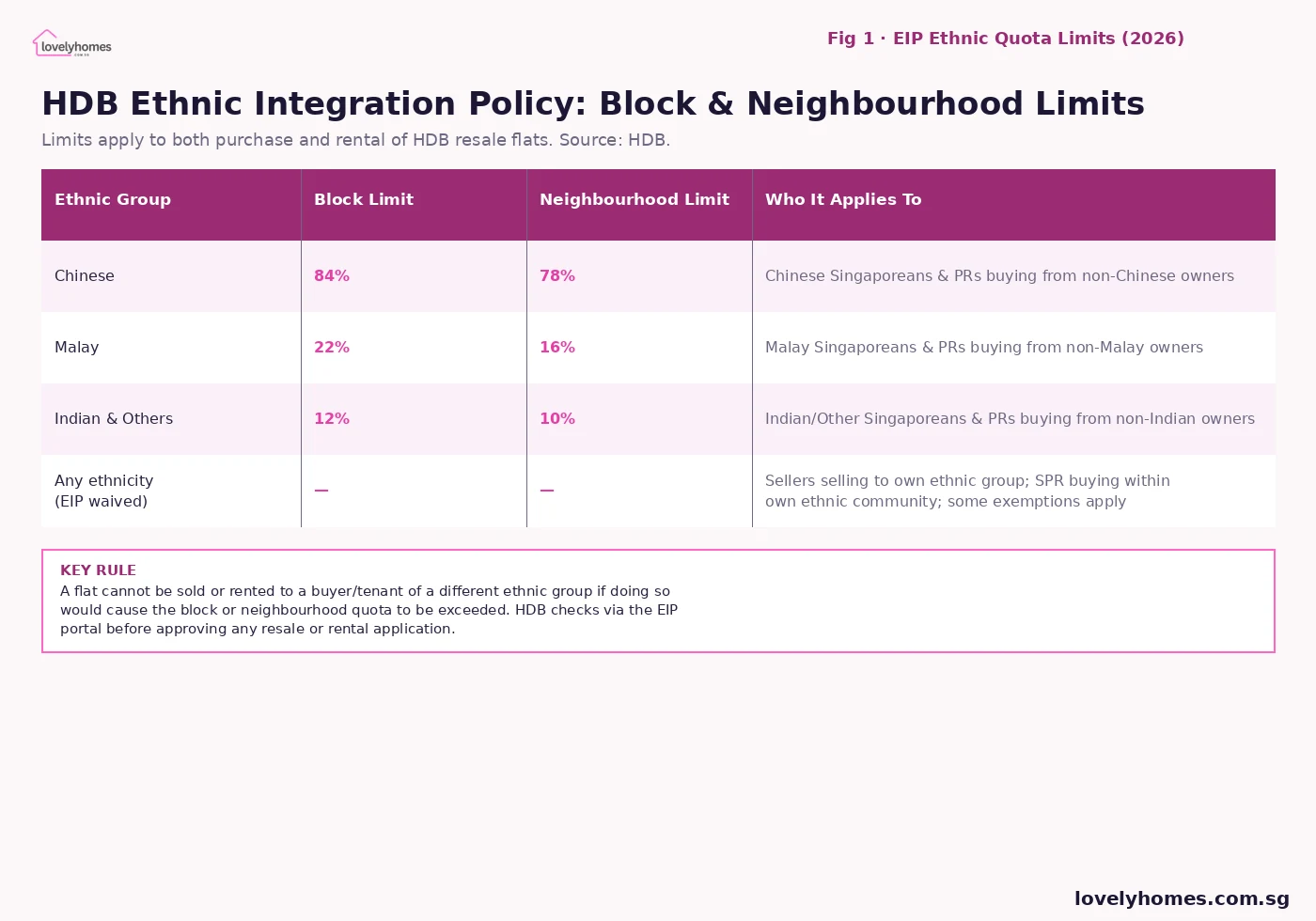
- Chinese buyers face a 84% block / 78% neighbourhood limit; Malay buyers 22% block / 16% neighbourhood; Indian and Others 12% block / 10% neighbourhood.
- If a block or neighbourhood has already hit its ethnic quota for your group, you cannot buy that flat , regardless of price or seller agreement.
- Singapore Permanent Residents (SPRs) count under their registered race and face an additional 8% SPR community cap per block.
- The EIP applies to HDB resale flat purchases and rentals of whole units; it does not apply to BTO sales or commercial premises.
- Sellers who sell to a buyer of the same ethnic group are exempt from the quota check.
- Check any block’s EIP headroom for free at hdb.gov.sg → e-Services → EIP / SPR Enquiry before making an offer.
- Violations are not fined but rather the HDB application is simply rejected , the buyer must find a different flat.
What Is the Ethnic Integration Policy?
The Ethnic Integration Policy, commonly abbreviated EIP, is a Government-administered quota system that controls the ethnic composition of HDB resale flats at the level of individual blocks and planning neighbourhood areas. It was introduced in 1989 by the Ministry of National Development (MND) and administered by the Housing & Development Board (HDB) with the explicit goal of preventing ethnic enclaves from forming in public housing estates.
Before the EIP existed, certain blocks and estates had become almost entirely monoethnic , a legacy of voluntary clustering and the earlier resettle-and-rehouse programmes of the 1960s–70s. The Government concluded that such enclaves risked weakening the inter-racial bonds that Singapore depends on for social cohesion, and the EIP was the structural remedy: no block or neighbourhood may exceed defined ethnic proportions, measured as a share of total residential units.
The policy is purely demand-side. It does not tell sellers whom they may approach or what price to charge; it simply means that HDB will only approve the resale transaction if the buyer’s ethnic group is still within quota in the block and neighbourhood in question. If the quota is full for that group, the application is declined , and the flat remains on the market until a buyer from an under-quota group steps in, or until the overall block mix shifts as other owners move out.
The Quota Numbers: Block vs Neighbourhood
HDB measures EIP compliance at two geographic levels, and both must be within limit for a transaction to proceed. A buyer’s application will be rejected if either the block quota or the neighbourhood quota is breached , even if only one is at the ceiling.
As at 2026, the limits are:
| Ethnic Group | Block Limit | Neighbourhood Limit | Rationale |
|---|---|---|---|
| Chinese | 84% | 78% | Reflects Chinese share of Singapore population (~74% SC + SPR combined) |
| Malay | 22% | 16% | Malay population ~13%; buffer above national share to allow normal movement |
| Indian & Others | 12% | 10% | Indian population ~9%; others ~4%; combined buffer limit |
| Same-group sale | Exempt | Exempt | Selling to own ethnic group does not affect the quota; no check required |
Neighbourhoods in HDB terminology typically correspond to HDB town or planning zones within a town , for instance, Tampines as a neighbourhood encompasses multiple blocks. A block hitting 84% Chinese while the neighbourhood sits at 70% is still blocked (the block ceiling is breached). Both must clear simultaneously.
Who the EIP Applies To , and Who It Does Not
The EIP applies to every resale HDB flat transaction where the buyer and seller are of different ethnic groups. This covers the vast majority of open-market resale transactions. The following categories are exempt from the quota check:
- Sales where the buyer and seller share the same registered ethnic group (the most common exemption).
- HDB BTO (Build-To-Order) flat sales , the EIP only applies to the resale market, not new flat allocations from HDB.
- Transfers within immediate family (inheritance, gifts, adding or removing a co-owner on the same flat) , these are not resale transactions.
- Short-term room rentals (renting out individual bedrooms, not the whole flat) , the EIP does not restrict room rental.
The EIP does apply to the rental of entire flats to tenants of a different ethnic group. A landlord must verify that approving a new tenant would not cause the block or neighbourhood quota to be exceeded before submitting the rental application to HDB.
How SPRs Are Treated Under the EIP
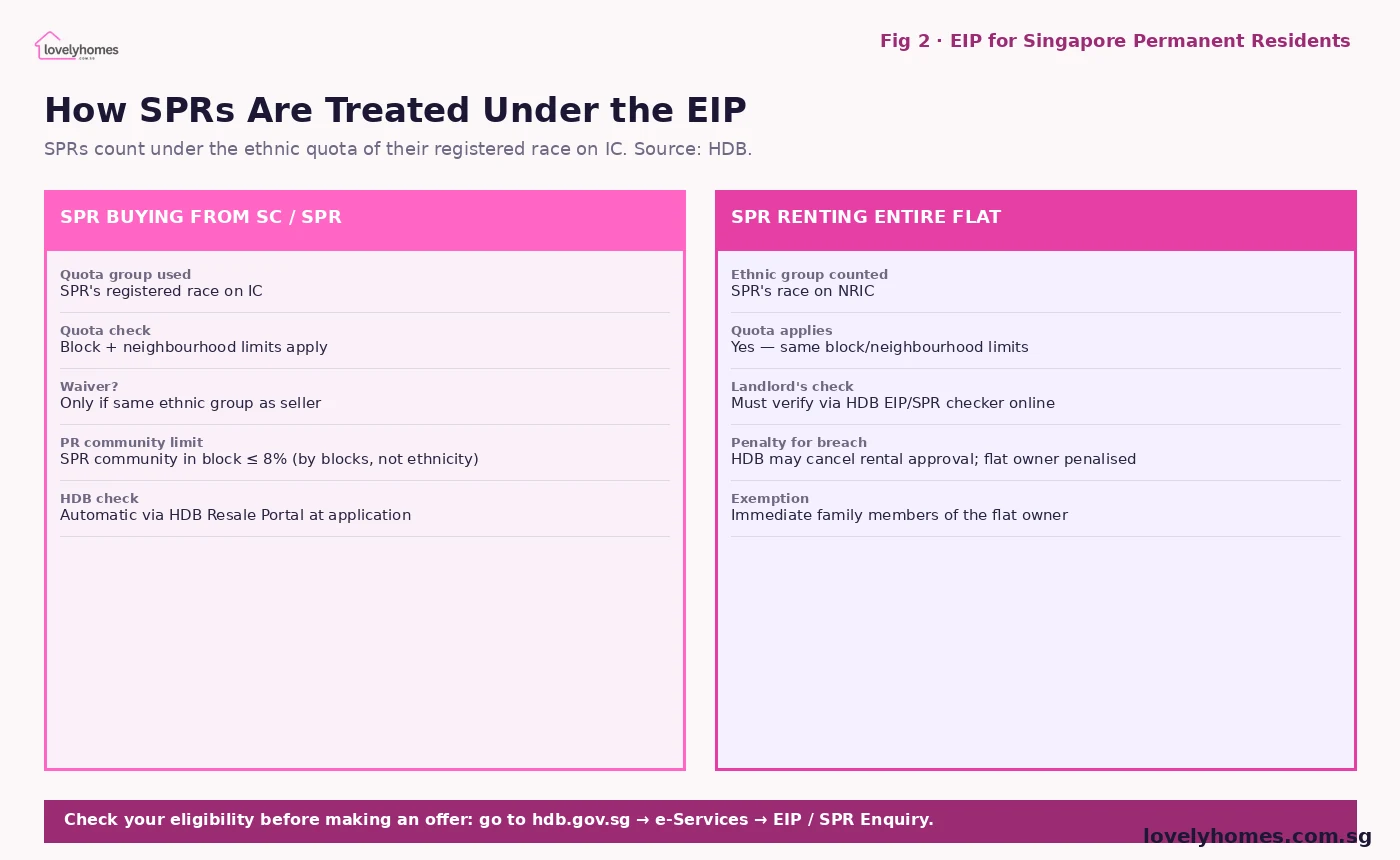
Singapore Permanent Residents are counted under their registered race as it appears on their NRIC or Re-entry Permit. A Malaysian-Chinese SPR counts as Chinese; a Malaysian-Indian SPR counts as Indian. SPRs have no special exemption from the ethnic quota , they are subject to the same block and neighbourhood limits as Singapore Citizens of the same ethnic group.
In addition to the standard ethnic quota, HDB imposes a separate SPR community cap of 8% per block. This means that even if the ethnic quota for a particular group has headroom, the transaction will still be rejected if the proportion of SPR households in the block has already reached 8%. The 8% cap is computed across all ethnicities combined , it is not per-ethnicity.
How to Check the EIP Before Making an Offer
HDB provides a free online tool , the EIP / SPR Enquiry , accessible via the HDB website’s e-Services portal. Any member of the public can enter a block number and street name to see the current EIP status for all three ethnic groups and the SPR community quota. The tool shows whether the block and neighbourhood are within limit, at limit, or exceeding the limit for each group.
This check is essential for buyers and their property agents to conduct before submitting an Offer to Purchase or Option to Purchase, because:
- Once an OTP is exercised and the buyer has paid the 1% option fee and 4% exercise consideration (totalling 5% of purchase price), the buyer has contractual obligations to proceed. Discovering an EIP block only after this stage causes financial loss.
- Real estate agents have a professional obligation under the CEA Code of Ethics to verify EIP status before advising clients to submit an offer on a flat.
- HDB’s Resale Portal will flag an EIP breach at the point of HDB application, but this is after OTP exercise and typically 2–3 weeks into the process.
As a rule of thumb, run the EIP check as the very first step , before viewing arrangements, before price negotiations, and certainly before signing any document.
What Happens When a Block Is at Quota?
A block “at quota” means the current proportion of flats occupied by that ethnic group has reached or exceeded the ceiling. In practice, blocks rarely sit exactly at 84% or 22% , the numbers shift continuously as owners move out and in. A block that is at quota today may have a vacancy next month when a household of the same ethnic group moves out.
For buyers who find their preferred flat in a quota-full block, the realistic options are:
- Search for comparable flats in the same estate or town where the block still has headroom for their ethnic group.
- If the seller is of the same ethnic group as the buyer, the transaction is exempt from the quota check , this is the most direct route if matching-group sellers exist in the block.
- Wait , quota positions change over time, though this is rarely a practical strategy when the buyer has a fixed moving timeline.
Worked Example: EIP in Action
Scenario A , Blocked Purchase
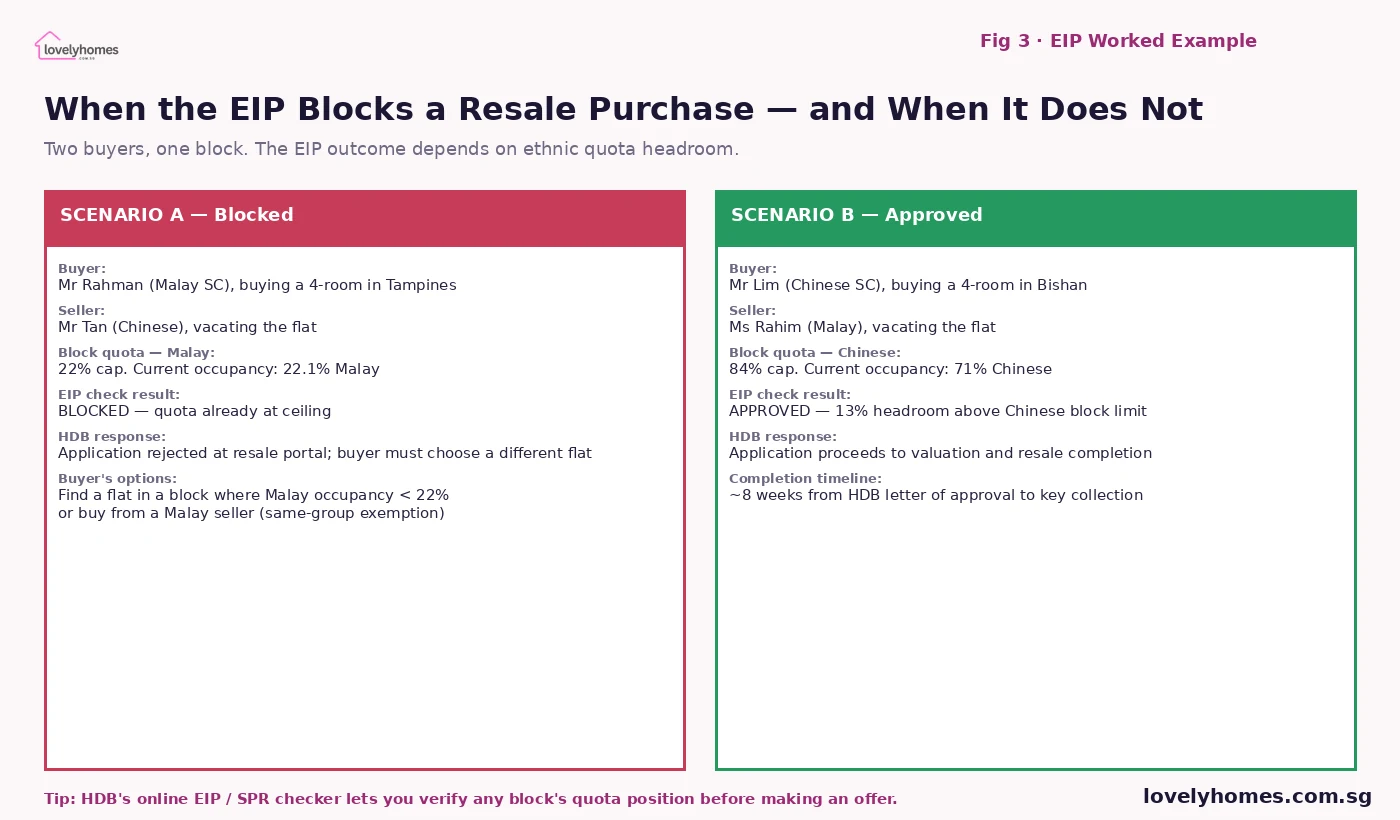
Mr Rahman is a Malay Singapore Citizen looking to buy a 4-room flat in Tampines from Mr Tan (Chinese). He finds a well-priced unit, negotiates terms, and is about to exercise the OTP when his property agent runs the EIP check. The block has 22.1% Malay occupancy , just above the 22% ceiling. HDB’s system would reject the application. Mr Rahman’s options: find a different flat in a block with Malay headroom, or seek a seller who is Malay (same-group, exempt from quota).
Scenario B , Approved Purchase
Ms Lim is a Chinese SC buying from Ms Rahim (Malay) in Bishan. The block has 71% Chinese occupancy , 13 percentage points below the 84% ceiling. The neighbourhood Chinese occupancy is 65% , 13 points below the 78% ceiling. Both checks pass. HDB approves the application, and the parties proceed to completion, typically 8 weeks from HDB’s letter of approval to key collection.
Historical Context: Why Singapore Chose a Quota System
The EIP has its roots in the 1964 race riots and the post-separation social engineering that characterised Singapore’s early decades. By the late 1980s, data showed that voluntary ethnic clustering in HDB estates had resumed , not at pre-independence levels, but enough to alarm planners concerned about long-term social cohesion. The Government concluded that without a structural mechanism, market forces would gradually re-segregate the housing stock even within the same HDB town.
Critics of the EIP , including some academics and civil society commentators , have argued that it can trap Malay and Indian sellers in blocks that have reached quota, forcing them to sell to buyers of the same ethnicity (often a smaller pool) at potentially lower prices. HDB has acknowledged these concerns in occasional policy reviews but has maintained that the social stability benefits outweigh the market distortions. The quotas have been adjusted several times since 1989; the current figures were last revised in 2010.
What This Means for Buyers and Investors
For buyers, the EIP is a hard constraint that must be baked into property search strategy. It is not a legal technicality to be negotiated around , HDB’s system enforces it automatically at the application stage. Missing this check is one of the most avoidable sources of OTP-related financial loss.
For property investors holding resale HDB flats as rental assets, the EIP also caps the pool of permissible tenants (whole-unit rentals are quota-subject), which can slow leasing in tight-quota blocks. Savvy investors check the EIP status of a block not just when buying but periodically during holding , a block drifting towards quota limits the exit pool too.
What Might Come Next
Periodic academic discussions have raised the question of whether the EIP thresholds should be adjusted to better reflect Singapore’s current demographic composition , the 2020 census showed the Chinese share of the resident population had declined slightly to around 74% while the Malay and Indian shares held broadly steady. The current 84% Chinese block ceiling was last revised in 2010 and arguably has more room than needed for the Chinese community. A recalibration could give Malay and Indian buyers slightly more flexibility at the margin.
There is also ongoing discussion about whether a digital, real-time EIP dashboard , beyond the current per-block lookup tool , could be integrated into property listing platforms to surface quota status directly alongside price and size. This would reduce the risk of buyers only discovering quota blocks during the due diligence phase.
Frequently Asked Questions
Can a seller refuse to sell to a buyer of a different ethnicity to avoid the EIP?
Technically, private negotiations are between buyer and seller and a seller may choose not to accept any offer for any reason. However, in practice, sellers list broadly and are simply informed by their agents that an OTP to a buyer whose ethnic group is at quota in that block will not be approved by HDB , so neither party wastes time pursuing a transaction that will fail at the HDB portal stage. The EIP is not a discrimination right; it is an administrative approval gate.
Does the EIP apply when I buy from my own ethnic group?
No. The quota check is only triggered when the buyer’s ethnic group differs from the seller’s. If a Chinese buyer buys from a Chinese seller, no EIP check applies, and the transaction proceeds as long as all other HDB eligibility criteria are met. Same-group transactions cannot cause the quota to rise because the total count of that ethnic group in the block remains unchanged (one household out, one in).
What is the SPR community cap and how does it interact with the ethnic quota?
The SPR community cap is an 8% limit on the proportion of all SPR households (of any ethnicity combined) in any single HDB block. It operates independently of the ethnic quota. This means a Malay SPR purchasing a flat in a block that is within the Malay ethnic quota could still be rejected if the block’s SPR community proportion is at or above 8%. Both the ethnic quota and the SPR community cap must be within limits for the application to succeed.
Does the EIP affect new BTO flat applications?
No. BTO flats are allocated by HDB via the ballot system, and EIP quotas do not apply to new flat sales. The EIP is solely a resale-market mechanism. When BTO flat owners later wish to sell on the open resale market (typically after the 5-year Minimum Occupation Period), the EIP will apply to the new buyer at that point in time.
What if I am of mixed ethnicity , which quota applies to me?
HDB uses the ethnic group as it appears on your Singapore identity documents (NRIC). For persons of mixed heritage, this is typically the ethnic group that was registered at birth under the Registration of Births and Deaths Act. You cannot choose which quota applies to you based on your heritage alone , the NRIC ethnic group is what counts. If you believe your registered ethnicity is incorrect, you would need to approach ICA (Immigration and Checkpoints Authority) to rectify this separately.
Can a landlord rent to any tenant regardless of EIP?
No. When a landlord rents out a whole HDB flat to tenants of a different ethnic group, HDB checks the EIP and SPR community cap at the time of the rental application. If approving the tenancy would breach the quota, HDB will not approve the rental. Landlords are responsible for checking before entering into a tenancy agreement. Renting out individual rooms (not the entire flat) is not subject to the EIP.
How often do blocks hit their quota ceiling?
There is no published aggregate figure from HDB on how many blocks are at quota at any given time, but industry practitioners report that certain mature estates (Bishan, Toa Payoh, Queenstown) with older Chinese-majority compositions can periodically see Chinese quotas at the ceiling in particular blocks. Malay-majority blocks in towns like Bedok, Tampines, or Geylang may reach the Malay ceiling in some sub-blocks. It varies significantly by block and by time of year. The online EIP checker is the authoritative real-time source.
Related Articles
- HDB Resale Procedure Singapore 2026: HFE Letter, OTP, Resale Portal & Key Collection
- Option to Purchase Singapore 2026: How OTP, Exercise Windows and Stamp Duties Actually Work
- HDB Million-Dollar Flats Singapore 2026: Where, Why, and Whether One Is Worth Buying
- HDB Income Ceiling Singapore 2026: EHG, BTO Eligibility and Flat-Type Rules
- HDB Grants Singapore 2026: EHG, CPF Housing Grant, Proximity Grant and Step-Up Grant
- Upgrading from HDB to Private Property Singapore 2026: The Complete 7-Stage Roadmap
Disclaimer: This article is for general informational purposes only and does not constitute legal, financial, or property advice. EIP limits are set by HDB and may be revised. Always verify the current quota position using HDB’s official EIP / SPR Enquiry tool at hdb.gov.sg before making any offer on a resale flat. For advice specific to your circumstances, consult a licensed property agent registered with the Council for Estate Agencies (CEA) or a qualified property lawyer.
Supporting graphics
Original article illustrations are available below.