A 5-room flat at 153B Bedok South Road (Bedok South Horizon) sold for S$1.45 million (S$1,192 psf) on 27 August 2026, the highest price ever paid for a 5-room flat in Bedok.
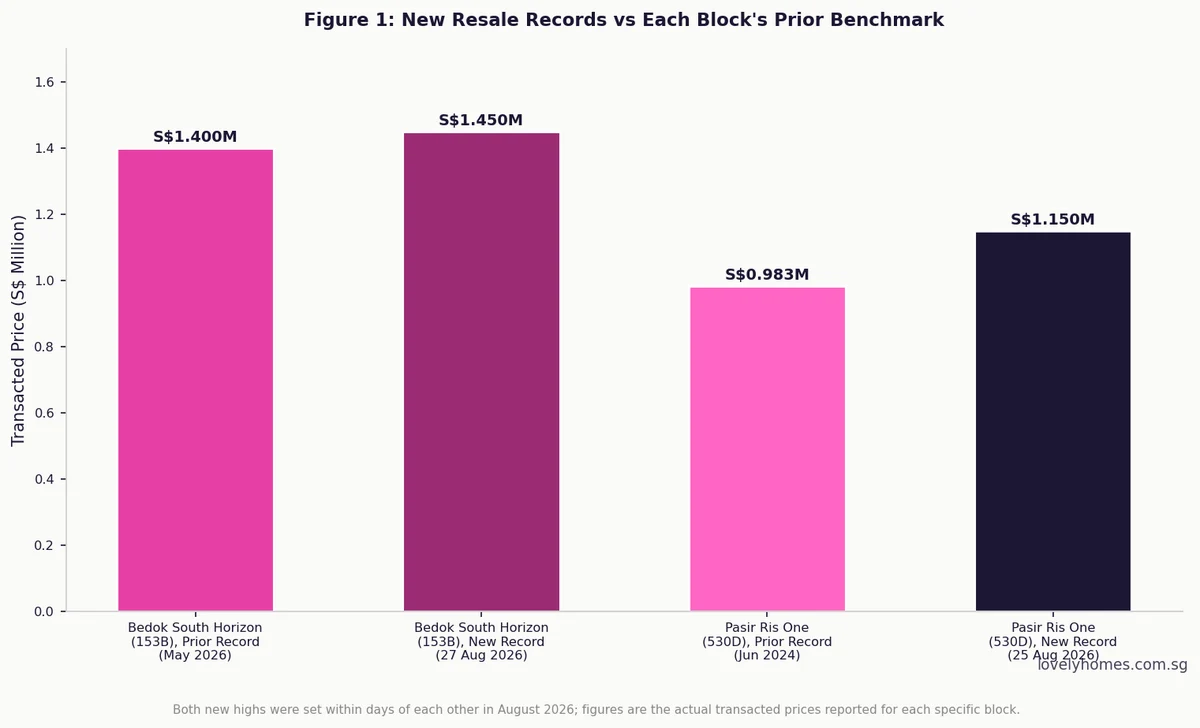
Two days earlier, on 25 August 2026, a 5-room Design, Build and Sell Scheme (DBSS) unit at 530D Pasir Ris Drive 1 (Pasir Ris One) sold for S$1.15 million (S$1,018 psf), beating the block’s prior 5-room record by S$167,000.
This is the second record that block 153B has produced in a single quarter; a unit in the same block sold for S$1.4 million in May 2026.
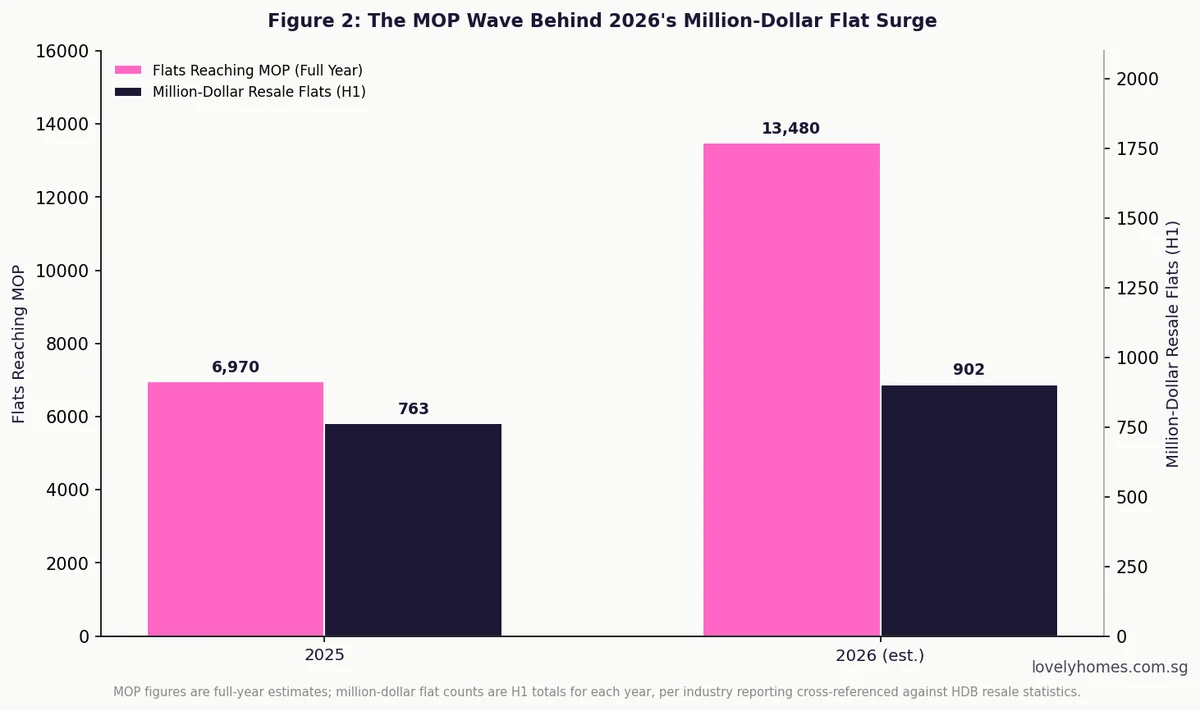
Both records land amid an unusually large Minimum Occupation Period (MOP) wave: an estimated 13,480 flats are expected to reach MOP in 2026, nearly double the roughly 6,970 in 2025.
Neither Bedok nor Pasir Ris is among the towns with the heaviest concentration of 2026 MOP completions, which are centred on Punggol, Tampines, Toa Payoh and Queenstown, making these two records more localised than estate-wide.
The removal of the 15-month wait-out period for private property owners buying a non-subsidised resale flat, announced 28 July 2026, reportedly saw enquiries for HDB flats above S$1 million jump 154% the following week.
Singapore’s most expensive HDB resale flat to date remains a 5-room unit at City Vue @ Henderson in Bukit Merah, which changed hands for S$1.728 million (S$1,421 psf) in April 2026.
Two Records, Two Estates, Days Apart
Singapore’s HDB resale market produced two fresh benchmark transactions in the space of a single week in late August 2026, in two towns that rarely feature in the usual million-dollar-flat headlines dominated by Toa Payoh, Bukit Merah and Queenstown. On 25 August, a 1,130 sqft 5-room Design, Build and Sell Scheme (DBSS) unit at 530D Pasir Ris Drive 1, part of the Pasir Ris One development, sold for S$1.15 million, working out to S$1,018 per square foot. Two days later, on 27 August, a larger 1,216 sqft 5-room flat at 153B Bedok South Road, within the Bedok South Horizon estate, sold for S$1.45 million, or S$1,192 per square foot, the highest price ever recorded for a 5-room flat in Bedok.
Figure 1: Both new resale records compared against each block’s prior benchmark.
153B Bedok South Road: A Second Record in a Single Quarter
What makes the Bedok South Horizon sale notable is not just the price itself, but that it is the second record-breaking sale the same block has produced within a single quarter. The previous benchmark at 153B was set only in May 2026, when a unit on a similar floor sold for S$1.4 million, itself a new high at the time. The neighbouring block, 153C Bedok South Road, has also contributed three further record-setting 5-room transactions between May and July 2026, changing hands at prices between S$1.28 million and S$1.38 million. The estate sits at the junction of Bedok South Road and Upper East Coast Road, within walking distance of the upcoming Bedok South MRT station on the Thomson-East Coast Line, which is due to open by the end of 2026, a connectivity upgrade that appears to be feeding directly into buyer willingness to pay.
Asking prices at the block have already moved to reflect the new benchmark: current listings at 153B run as high as S$1,518,888 (S$1,249 psf), with a unit at neighbouring 152C listed at S$1,438,888 (S$1,183 psf) and marketed on its unblocked views and newly-MOP status. Sellers at Bedok South Horizon appear to be treating S$1.45 million as a floor for negotiations rather than a ceiling, though whether buyers are actually willing to pay these asking prices remains to be seen in the coming weeks.
530D Pasir Ris Drive 1: A DBSS Rarity Breaks Its Own Ceiling
Pasir Ris One is one of only 13 Design, Build and Sell Scheme (DBSS) projects ever built in Singapore before the scheme was discontinued in 2011, a status that makes its flats a relatively scarce resale category in their own right. Completed in 2015 with 447 units, the development sits directly next to Pasir Ris MRT station, White Sands shopping mall and Pasir Ris Park. The new S$1.15 million transaction surpasses the block’s previous 5-room record of S$982,800, set in June 2024, by S$167,000, a jump that illustrates just how much unit-specific factors matter: a similarly sized ground-floor unit in the very same block changed hands for only S$920,000 in the same month, S$230,000 less than the record-setting unit, reflecting the premium buyers are willing to pay for a higher floor and better facing within an identical block.
Even with this new high, Pasir Ris’ overall priciest HDB resale transaction remains an executive maisonette at Block 531 Pasir Ris Drive 1, which fetched S$1.26 million (S$786 psf) in March 2026; the new 5-room record commands a higher price per square foot but still falls short of that unit’s total quantum.
Why the Records Are Landing Now: the 2026 MOP Wave
Both sales sit against the backdrop of an unusually large wave of flats reaching their Minimum Occupation Period (MOP) in 2026, estimated at around 13,480 flats, nearly double the roughly 6,970 units that reached MOP in 2025. Much of this new supply is concentrated in towns such as Punggol, Tampines, Toa Payoh and Queenstown, rather than Bedok or Pasir Ris, which suggests the Bedok and Pasir Ris records are a more localised phenomenon: relatively new, long-lease flats within these two specific estates testing how much buyers are willing to pay, rather than evidence of an estate-wide surge.
Separately, the removal of the 15-month wait-out period that previously applied to private property owners buying a non-subsidised HDB resale flat, announced on 28 July 2026, appears to have added fresh demand at the upper end of the resale market: enquiries for HDB flats priced above S$1 million reportedly jumped 154% in the week following the change. Taken together, these two records are part of a much larger surge in million-dollar HDB transactions: 902 resale flats crossed the million-dollar mark in the first half of 2026 alone, already ahead of the 763 recorded over the same period in 2025, putting 2026 on a pace that could challenge the full-year record of 1,594 million-dollar transactions set in 2025.
Figure 2: The MOP wave behind 2026’s million-dollar flat surge.
Summary: The Two Records at a Glance
Detail
Bedok South Horizon
Pasir Ris One
Address
153B Bedok South Road
530D Pasir Ris Drive 1
Sale date
27 August 2026
25 August 2026
Price
S$1.45 million (S$1,192 psf)
S$1.15 million (S$1,018 psf)
Flat size
1,216 sqft, 5-room
1,130 sqft, 5-room (DBSS)
Prior block record
S$1.4 million (May 2026)
S$982,800 (June 2024)
Margin over prior record
+S$50,000
+S$167,200
Why This Matters for Buyers, Sellers and Nearby Owners
For owners in the immediate vicinity of either block, these transactions offer a genuine, if narrow, data point on what a well-located, higher-floor unit can now fetch, though it is worth being cautious about assuming the same premium applies to a lower floor, a different facing, or a different block within the same estate, given how much the Pasir Ris comparison between a top unit and a ground-floor unit in the same block illustrates that spread. For buyers, both records are a reminder that headline million-dollar transactions remain concentrated in specific, often newer or better-located blocks, rather than reflecting an estate-wide repricing, so a nearby listing at a similar asking price should still be evaluated on its own floor, facing, renovation condition and remaining lease. For the market more broadly, the fact that these two records emerged from towns outside the heaviest 2026 MOP concentration suggests demand for well-located, well-connected resale flats remains resilient even where new supply is not especially abundant.
What Might Come Next
The following is informed speculation, not confirmed policy. Given how quickly asking prices at 153B Bedok South Horizon have already moved above the new S$1.45 million benchmark, it is plausible that at least one further transaction at or above this level follows in the coming months if a buyer is found at these asking levels, though this is speculative. Similarly, at Pasir Ris One, it remains to be seen whether wider listings across the development adjust upward to reflect the new S$1.15 million benchmark, or whether this proves to be an isolated, unit-specific outcome; the current gap between recent asking prices and the new record suggests the market has not yet fully repriced as at this writing.
Frequently Asked Questions
What is a DBSS flat, and why does it matter for the Pasir Ris One sale?
Design, Build and Sell Scheme (DBSS) flats were built by private developers on HDB land under a scheme discontinued in 2011; only 13 such projects were ever built, making them a scarce resale category, which supports stronger pricing for well-located examples like Pasir Ris One.
Does this mean HDB flats in Bedok and Pasir Ris are now all worth over a million dollars?
No. Both records are specific to a single well-located, higher-floor unit within one block; a nearby flat with a different floor, facing or lease profile should not be assumed to command the same price.
What is Singapore’s highest-ever HDB resale price?
A 5-room unit at City Vue @ Henderson in Bukit Merah, which sold for S$1.728 million (S$1,421 psf) in April 2026, remains the record; neither the Bedok nor the Pasir Ris sale comes close to this figure.
What is the MOP wave, and why is it relevant here?
An estimated 13,480 HDB flats are expected to reach their Minimum Occupation Period in 2026, nearly double 2025’s figure, broadening the pool of relatively new, long-lease resale flats coming onto the market, though this wave is concentrated in different towns from Bedok and Pasir Ris.
Why did HDB resale enquiries above S$1 million jump in mid-2026?
The removal of the 15-month wait-out period for private property owners buying a non-subsidised resale flat, announced 28 July 2026, reportedly saw enquiries for HDB flats above S$1 million rise 154% in the following week.
Is the overall HDB resale market still rising as fast as these records suggest?
Not necessarily. The HDB Resale Price Index recorded its first quarterly decline since Q2 2019 in Q1 2026, even as a narrow band of premium transactions continued to set fresh records, showing the two trends can coexist.
Where can I check current HDB resale transaction prices myself?
HDB publishes resale transaction data, including price, floor level range and remaining lease, through its official resale flat prices e-service, which is the most reliable source for verifying any specific block or estate.
Disclaimer: This article is for general informational purposes only and does not constitute property investment advice. Transaction prices and market figures are drawn from publicly reported resale transactions and industry commentary current as at the time of writing and are subject to revision. Always verify current transaction data via the Housing and Development Board (HDB) resale portal before making any decision.
Quick Answer: Real Estate Crowdfunding in Singapore
Real estate crowdfunding (also called fractional property investment) lets multiple investors pool capital, often from as little as a few thousand dollars, to collectively own a share of a property through a platform, rather than buying a whole property outright.
Most platforms use a Special Purpose Vehicle (SPV) that holds legal title to the property; investors buy shares or notes in the SPV rather than the property itself, and receive a pro-rata share of rental income and any capital gain on sale.
Platforms offering this in Singapore are generally regulated activity under the Securities and Futures Act (SFA), and typically need a Capital Markets Services (CMS) licence from the Monetary Authority of Singapore (MAS), or must operate under a specific exemption.
Buyer’s Stamp Duty (BSD) and Additional Buyer’s Stamp Duty (ABSD) generally do not apply in the same way as a direct purchase, since investors are typically buying shares in an SPV rather than the property directly, though this depends on the exact structure used.
CPF savings cannot be used for these investments, and they are not covered by any deposit protection scheme, unlike a bank savings account.
Key risks include illiquidity (no ready secondary market to exit early), platform risk (the platform operator itself could face financial difficulty), concentration risk (your money is tied to one or a few specific properties, not a diversified portfolio), and the usual property market risks of vacancy and price decline.
Compared with an SGX-listed REIT, crowdfunding platforms are far less liquid and typically carry higher platform-specific risk, but may offer exposure to a specific property or asset class a REIT does not hold.
What Is Real Estate Crowdfunding?
Real estate crowdfunding, sometimes marketed as fractional property investment or fractional ownership, is a model that allows a group of investors to collectively fund the purchase of a property, or a share in one, through an online platform. Rather than a single buyer taking on the full purchase price, legal responsibilities and risk of an entire property, the investment is broken into smaller units that individual investors can buy into, often starting from a few thousand Singapore dollars rather than the hundreds of thousands typically required for direct property ownership. The properties involved can range from commercial units and shophouses to residential developments, and increasingly include overseas properties marketed to Singapore-based investors seeking geographic diversification.
The appeal is straightforward: it lowers the capital barrier to property investment, allows diversification across several smaller stakes instead of one large illiquid asset, and removes much of the hands-on landlord responsibility, since the platform or its appointed manager typically handles leasing, maintenance and tenant management. The trade-offs, covered in detail below, are just as important to understand before committing capital.
Figure 1: The general structure behind a typical real estate crowdfunding or fractional ownership deal.
How the Investment Structure Typically Works
Most platforms operating in this space in Singapore use a Special Purpose Vehicle (SPV), typically a private company set up specifically to hold legal title to one property or a small portfolio. Investors do not buy the property directly; instead, they subscribe for shares or debt notes issued by the SPV, with the size of their stake determining their proportional entitlement to rental income and, eventually, sale proceeds. Some platforms use a trust structure instead of a company, with investors holding units in the trust, but the underlying logic is the same: your legal relationship is with the investment vehicle, not directly with the physical property.
Because investors are buying securities (shares, notes or trust units) rather than directly acquiring real property, this activity generally falls within the scope of the Securities and Futures Act (SFA), administered by MAS. A platform facilitating this kind of offering typically needs to hold a Capital Markets Services (CMS) licence covering the relevant regulated activity (such as dealing in capital markets products, or providing a fund management or crowdfunding service), or rely on a specific regulatory exemption. Before investing through any platform, it is worth checking the MAS Financial Institutions Directory to confirm the platform, or the entity actually making the offer, holds the appropriate licence or exemption, since operating an unlicensed regulated activity is itself a red flag about the platform’s legitimacy.
Rental Income, Fees and Exit Mechanics
While the property is held, rental income collected from tenants is typically distributed to investors pro-rata to their shareholding, usually on a monthly or quarterly basis, after deducting property-level expenses (maintenance, property tax, insurance) and the platform’s management or asset management fee. Fee structures vary by platform but commonly include an upfront placement or acquisition fee (often a percentage of the amount raised), an ongoing annual asset management fee, and a performance or disposal fee taken from any capital gain when the property is eventually sold. These fees compound over the holding period and should be read carefully in the offer document, since they directly reduce net returns to investors.
Exiting an investment before the property is sold is usually the hardest part of this model. Unlike an SGX-listed REIT, which can be bought or sold within seconds during market hours, most real estate crowdfunding platforms offer little to no secondary market for investors wanting to sell their stake early. Some platforms operate an internal matching board where investors can list their shares for other users to buy, but this is generally thin, uncertain and may only execute at a discount, if at all. Investors should treat capital committed to these platforms as locked in until the underlying property is sold, which is typically planned for a specific holding period (often three to seven years) set out at the time of the offering, though actual timing depends on market conditions and platform decisions.
Figure 2: How real estate crowdfunding compares with direct ownership and an SGX-listed REIT across key features.
Crowdfunding vs REIT vs Direct Ownership
The closest, more familiar comparison for most Singapore investors is a Real Estate Investment Trust (REIT) listed on the SGX. A REIT pools capital from many investors into a professionally managed portfolio of income-producing properties, is highly liquid since units trade daily on the exchange, and is regulated under both MAS’s REIT framework and SGX’s listing rules, which impose ongoing disclosure and governance obligations far more extensive than most private crowdfunding platforms. The trade-off is that REIT investors have no say over which specific properties are bought or sold, since that sits entirely with the REIT manager, and returns reflect a diversified portfolio rather than a single asset’s performance.
Direct property ownership sits at the other end of the spectrum: full control, the ability to use CPF savings (subject to the usual Housing scheme rules for eligible properties), and the potential to occupy the property yourself, but requiring substantially more capital, exposure to Buyer’s Stamp Duty and, where applicable, Additional Buyer’s Stamp Duty, and far lower liquidity than a REIT. Real estate crowdfunding sits in between: lower capital requirements than direct ownership, but far less liquid than a REIT, with returns concentrated in one or a handful of specific assets rather than spread across a large portfolio, and less regulatory scrutiny than a listed REIT typically faces.
Tax Treatment for Individual Investors
Rental income distributions received by an individual investor through a crowdfunding SPV are generally treated as taxable income in Singapore, and should be declared accordingly, though the exact tax character (rental income versus dividend, depending on how the SPV is structured and how distributions are made) can affect the specific treatment, so investors should check the platform’s tax guidance or consult a tax adviser. Singapore does not impose a general capital gains tax, so a gain made on eventual sale of the underlying property, and distributed to investors, is not typically taxed as a capital gain in the investor’s hands, though gains could be treated as taxable income if the activity is considered a trade rather than a passive investment. Investors in overseas property crowdfunding deals should also be aware that the source country may impose its own withholding tax on rental income or capital gains before amounts are distributed back to Singapore-based investors.
Key Risks to Understand Before Investing
Illiquidity: capital is generally locked in for the planned holding period, with little to no reliable way to exit early.
Platform risk: if the platform operator itself becomes insolvent or ceases operations, the process for investors to recover their interest in the underlying SPV can become complicated and drawn out, even if the property itself retains value.
Concentration risk: unlike a REIT’s diversified portfolio, a crowdfunding investment is usually tied to one specific property, so a single vacancy, tenant default or local market downturn has an outsized impact on returns.
No CPF usage and no deposit protection: these are not eligible for CPF Housing scheme use, and are not covered by the Singapore Deposit Insurance Scheme that protects bank deposits.
Regulatory and cross-border risk: for overseas property deals, investors take on foreign legal, currency and tax risk on top of the platform and property risk, and enforcement of investor rights in a foreign jurisdiction can be far harder than for a Singapore-based asset.
Return projections are not guarantees: illustrative yield and capital gain figures shown in marketing material are projections, not promises, and actual rental income and sale prices depend on real market conditions at the time.
Summary: Real Estate Crowdfunding Facts at a Glance
Question
Short Answer
What do I actually own?
Shares, notes or units in an SPV/trust that holds the property, not the property directly.
Can I use CPF?
No, CPF Housing scheme rules do not apply to these investments.
Does BSD/ABSD apply?
Generally not to the investor directly, since they are buying securities, not the property itself.
Is my capital protected?
No deposit protection scheme applies; capital is at risk like any investment.
Who regulates these platforms?
MAS, typically requiring a Capital Markets Services licence or applicable exemption.
How liquid is my investment?
Generally illiquid; expect to hold until the property is sold.
Worked Example: A S$10,000 Fractional Investment
Profile: Mr Lim invests S$10,000 through a platform into an SPV holding a share of a commercial property, on a planned 5-year holding period, with an illustrative projected rental yield of 5.5% per annum.
Step 1 – Annual rental distribution: at a projected 5.5% yield, Mr Lim’s illustrative annual rental distribution before platform fees is S$550.
Step 2 – Cumulative rental income over 5 years: assuming a broadly stable yield, total rental distributions over the holding period come to approximately S$2,750 before fees and tax.
Step 3 – Exit sale: at the end of the 5-year period, the property is sold and Mr Lim’s proportional share of the sale proceeds reflects his original S$10,000 stake plus an illustrative 12% capital gain, for an exit value of approximately S$11,200.
Total illustrative return: S$2,750 (rental income) + S$1,200 (capital gain) = S$3,950 over 5 years on a S$10,000 investment, before platform fees and applicable tax, an illustrative total return of roughly 39.5% or about 7% per annum non-compounded. This is a hypothetical scenario only; actual rental income and exit price depend entirely on the specific property, tenancy and market conditions, and could be lower, including a partial or full loss of capital.
Figure 3: Illustrative breakdown of the worked example above.
Why This Matters for Singapore Investors
Real estate crowdfunding fills a genuine gap for investors who want direct property exposure without the capital outlay, stamp duty and hands-on management that direct ownership demands, and who find a REIT’s fully diversified, professionally managed portfolio less appealing than backing a specific asset they can evaluate themselves. This makes the model attractive as a smaller, satellite allocation within a broader portfolio, rather than a core holding, particularly given the illiquidity and concentration risk involved. Investors should size any allocation to these platforms accordingly, treat published yield and capital gain projections as estimates rather than guarantees, and do the same due diligence on the platform’s regulatory standing and track record that they would apply to any other unlisted investment.
What Might Come Next
The following is informed speculation, not confirmed policy. As MAS continues to refine its regulatory approach to digital and fractionalised investment products, including ongoing work on tokenised assets and digital securities more broadly, it is plausible that clearer, more standardised rules specific to real estate crowdfunding platforms could develop over time, potentially including enhanced disclosure or secondary market requirements to address the liquidity gap. Growing investor appetite for smaller-ticket, diversified property exposure may also encourage more platforms to explore semi-liquid structures, such as periodic redemption windows, though no such standard has become widespread in Singapore as at this writing.
Frequently Asked Questions
Is real estate crowdfunding regulated in Singapore?
Yes, generally. Because investors are typically buying shares, notes or units in an SPV or trust, this usually falls under the Securities and Futures Act, and the platform or offering entity typically needs a Capital Markets Services licence from MAS, or must rely on a specific exemption. Always verify a platform’s regulatory status before investing.
Can I use my CPF Ordinary Account savings for this?
No. CPF Housing scheme rules only apply to direct purchases of eligible residential property, not to shares, notes or units in a crowdfunding SPV or trust.
What happens to my investment if the platform shuts down?
This depends on how the SPV or trust is structured and where legal title sits. In a well-structured deal, the property is held by an SPV independent of the platform operator, so investors retain their interest even if the platform ceases operations, though the practical process of managing the asset and eventually exiting can become far more complicated. This is exactly why checking the legal structure and platform track record before investing matters.
How is this different from buying an SGX-listed REIT?
A REIT holds a diversified portfolio of properties, is highly liquid since units trade daily on the exchange, and is subject to extensive MAS and SGX disclosure requirements. Crowdfunding platforms typically expose you to one or a handful of specific properties, are far less liquid, and generally carry less standardised regulatory scrutiny than a listed REIT.
Do I pay Buyer’s Stamp Duty on a crowdfunded investment?
Generally no, because the investor is typically buying securities in an SPV rather than acquiring the property directly. However, the exact stamp duty treatment depends on the specific legal structure of each deal, so this should be confirmed in the offer document or with a tax adviser.
Can I sell my stake before the property is sold?
Usually only with difficulty. Most platforms do not offer a robust secondary market, so investors should generally plan to hold until the underlying property is sold at the end of the planned holding period, rather than assuming they can exit on demand.
Is rental income from these investments taxable?
Generally yes, distributions of rental income to individual investors are treated as taxable income in Singapore, though the precise characterisation can depend on the SPV structure. Singapore does not have a general capital gains tax, so a distributed capital gain on sale is not usually taxed as such, though this should always be confirmed for your specific situation.
Disclaimer: This article is for general informational purposes only and is not financial or investment advice. Real estate crowdfunding and fractional property investment carry capital risk, including possible loss of the amount invested, and are not covered by any deposit protection scheme. Always verify a platform’s regulatory status with the Monetary Authority of Singapore (MAS), read the full offer document, and seek independent financial advice before investing.
Conveyancing is the legal process of transferring property ownership from seller to buyer; in Singapore it is governed by the Conveyancing and Law of Property Act (Cap. 61) and conducted by licensed solicitors registered with the Law Society of Singapore.
For private residential property, the buyer and seller each engage their own solicitors; for HDB resale flats, HDB’s in-house legal team handles the registration, though buyers may seek independent advice.
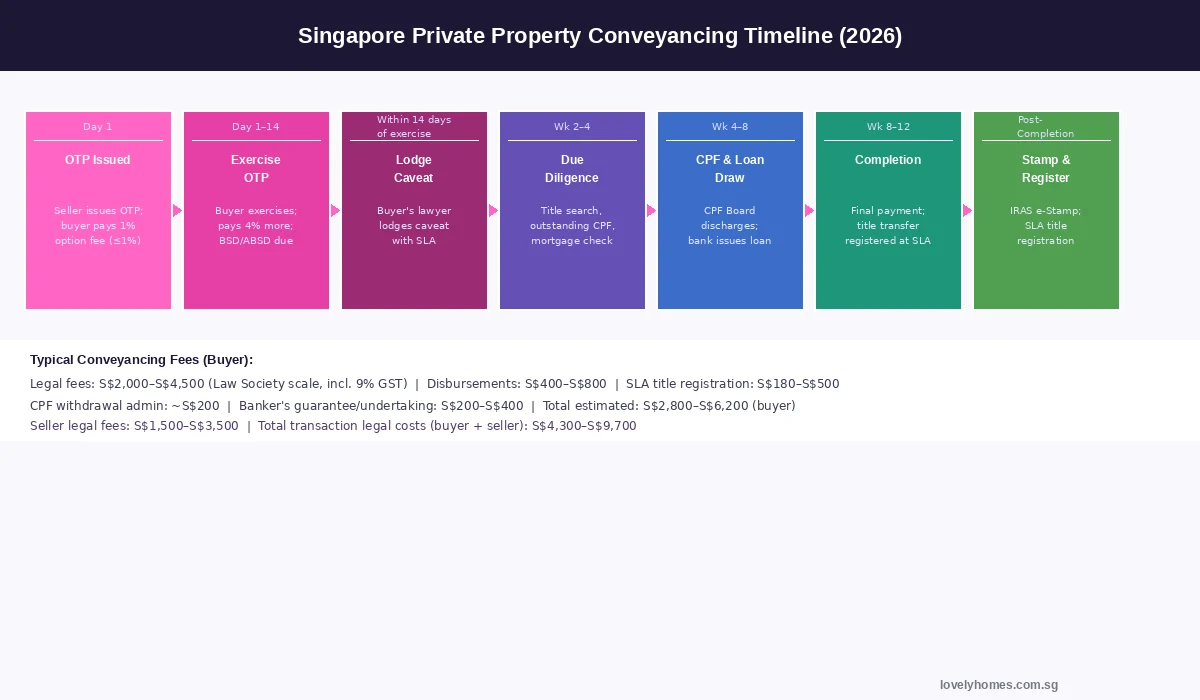
The typical private property conveyancing timeline is 8 to 12 weeks from OTP exercise to completion (key collection); the full process from OTP issue to keys is typically 10 to 14 weeks.
Buyer’s legal fees follow the Law Society conveyancing fee scale: approximately S$2,800–S$6,200 all-in (legal fees plus disbursements plus 9% GST) for most residential transactions.
A caveat must be lodged with the Singapore Land Authority (SLA) within 14 days of exercising the OTP to protect the buyer’s interest against subsequent encumbrances.
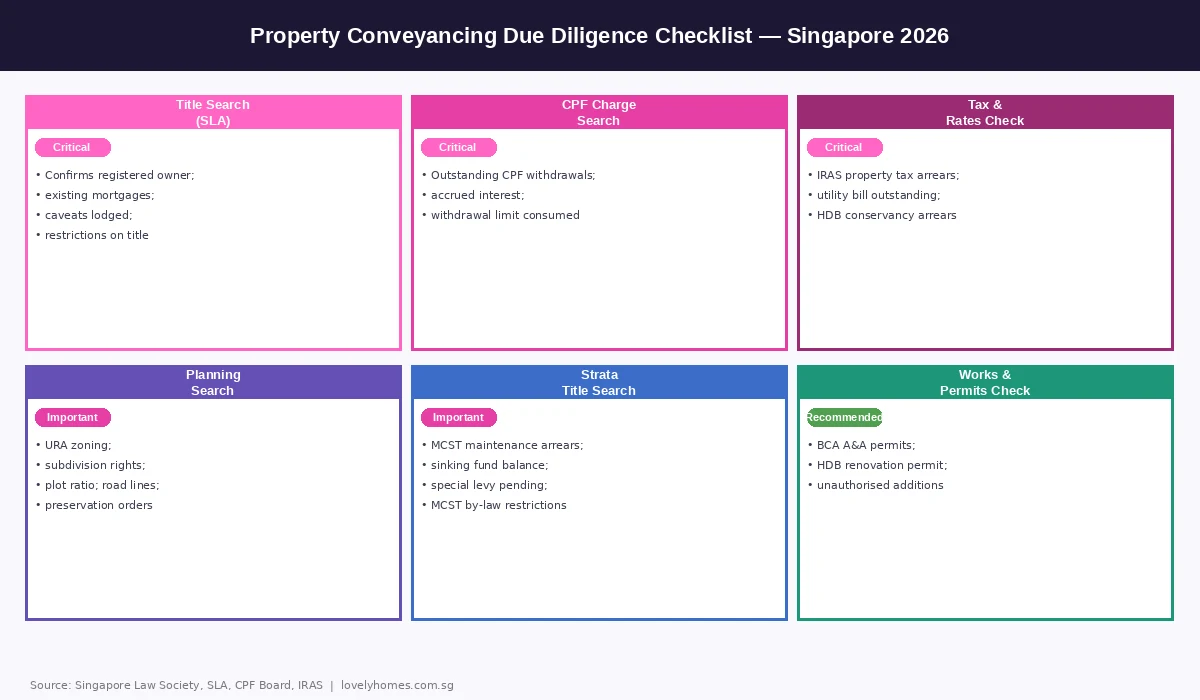
Due diligence searches — title search, CPF charge search, property tax check, URA planning search — are essential and typically cost S$400–S$800 total; your solicitor will conduct these on your behalf.
Stamp duty (BSD and ABSD) is payable to IRAS within 14 days of signing the OTP or sale and purchase agreement, whichever is earlier.
What Is Property Conveyancing?
Property conveyancing is the legal transfer of ownership of real property from one party to another. In Singapore, every residential and commercial property transaction — whether a resale private condominium, a HDB flat, a landed house, or a strata office unit — involves a conveyancing process governed primarily by the Conveyancing and Law of Property Act (Cap. 61) and the Land Titles Act (Cap. 157). The process encompasses drafting and reviewing the sale and purchase agreement, conducting due diligence searches on the title, managing stamp duty compliance, coordinating the drawdown of housing loans and CPF funds, lodging the transfer instrument with the Singapore Land Authority (SLA), and completing the financial settlement between the parties.
Conveyancing in Singapore is performed by advocates and solicitors who are members of the Law Society of Singapore. The Law Society publishes a non-binding conveyancing fee scale — the Conveyancing Scale — which most firms use as a guide, though fees are ultimately negotiable. Many law firms offer fixed conveyancing packages for straightforward residential transactions.
Unlike some jurisdictions where buyers can conveyance themselves (“DIY conveyancing”), Singapore does not permit this for property transactions where a mortgage is involved or where CPF funds are used. Even for cash purchases, the complexity of SLA registration and due diligence searches makes engaging a solicitor strongly advisable.
The Conveyancing Process for Private Residential Property
Figure 1: Singapore Private Property Conveyancing Timeline — From OTP to Title Registration (2026)
Step 1 — Option to Purchase (OTP)
The conveyancing process begins when the seller grants the buyer an Option to Purchase. In Singapore, the OTP for private residential property is typically drafted on the standard Law Society option form (or a developer’s standard form for new launches). The buyer pays the seller an option fee, usually 1% of the agreed purchase price, to secure the OTP. The OTP grants the buyer an exclusive right to purchase the property within the option period — typically 14 calendar days, though parties may agree on a longer period (often up to 21 days for resale private property).
During the option period, the buyer should immediately instruct a solicitor, who will commence preliminary due diligence and advise on any issues. The seller’s solicitor will simultaneously prepare the draft Sale and Purchase Agreement (SPA) or the standard transfer documentation.
Step 2 — Exercising the OTP and Paying Stamp Duty
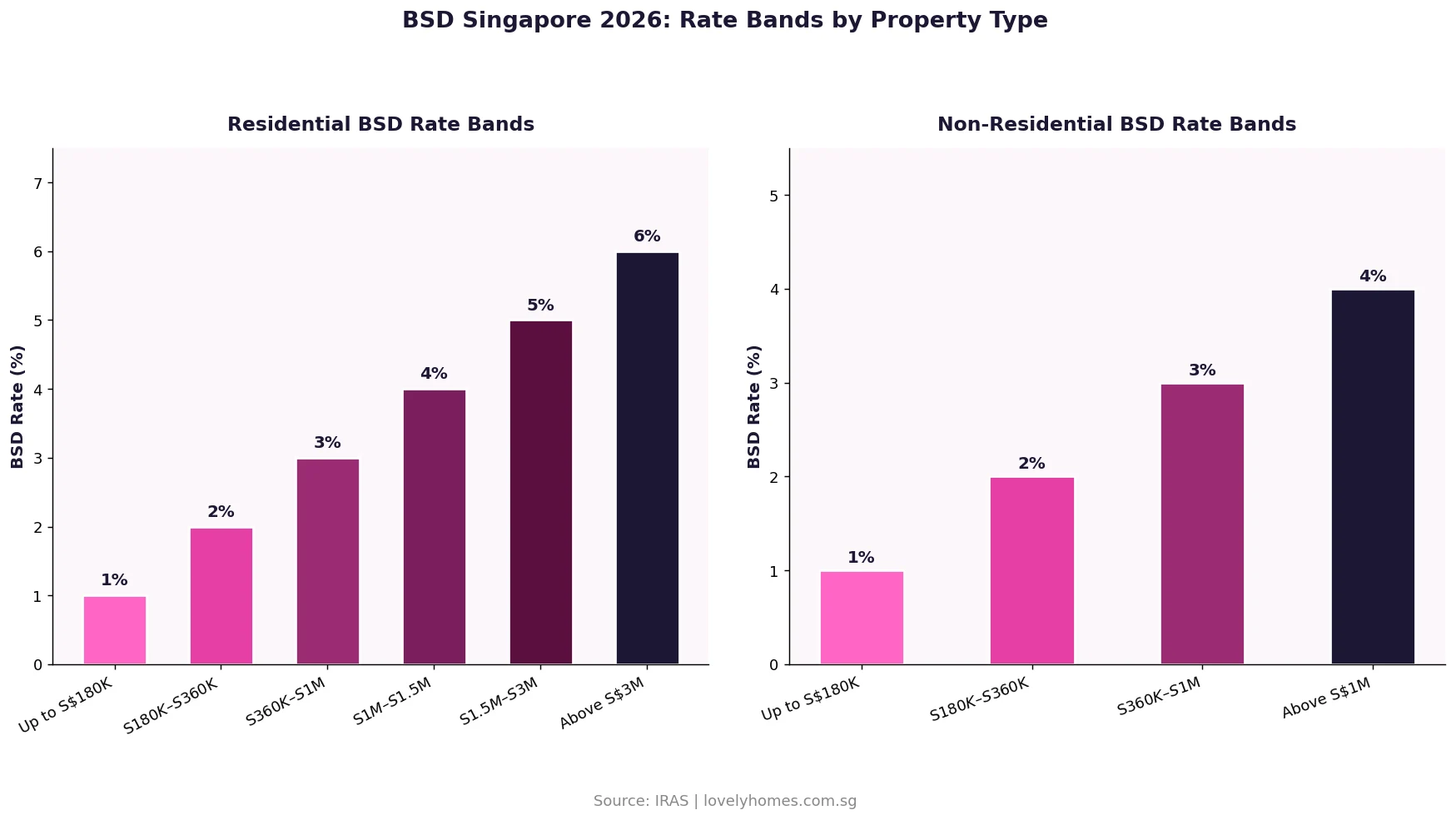
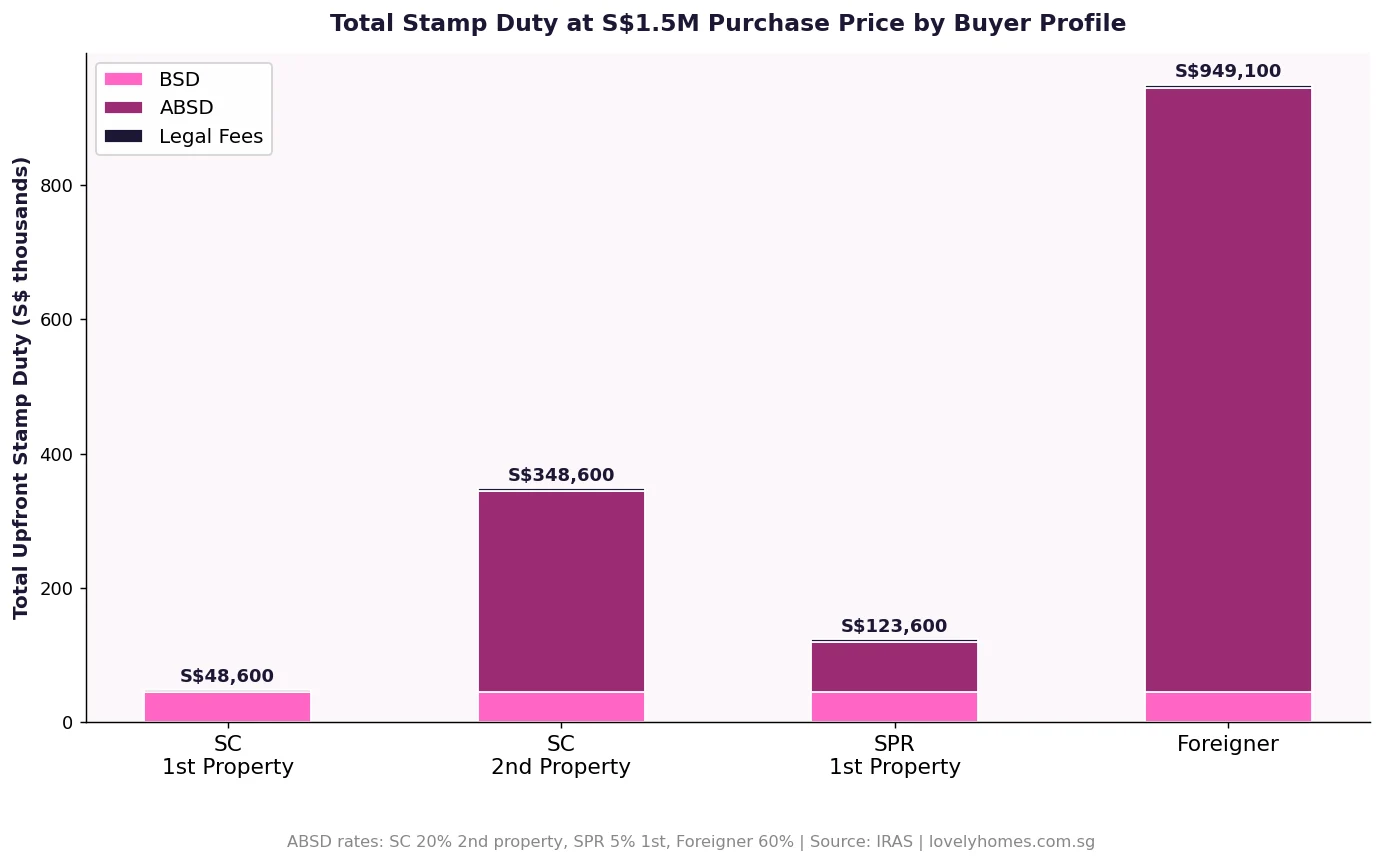
To exercise the OTP, the buyer signs the acceptance copy and pays the option exercise fee (typically the balance of the downpayment component, often 4% of the purchase price, making a total of 5% paid before the loan drawdown). The signed OTP or SPA is returned to the seller’s solicitor. Buyer’s Stamp Duty (BSD) is payable to IRAS within 14 days of the date of the OTP exercise (or the date of the SPA, whichever is earlier). BSD is calculated progressively: 1% on the first S$180,000; 2% on the next S$180,000; 3% on the next S$640,000; 4% on the next S$500,000; 5% on amounts from S$1.5 million to S$3 million; and 6% on any amount above S$3 million. Additional Buyer’s Stamp Duty (ABSD) is also payable within 14 days if applicable (e.g., 20% for SC purchasing a second property, or 60% for foreigners).
BSD and ABSD are paid via the IRAS e-Stamping portal. Your solicitor will handle this on your behalf.
Step 3 — Lodging the Caveat
Within 14 days of exercising the OTP, the buyer’s solicitor lodges a caveat against the property at SLA. The caveat is a legal notice that the buyer has an interest in the property; it prevents the seller from dealing with the property in a manner inconsistent with the buyer’s right (for example, granting a second mortgage or selling to another party). The caveat lodgement fee at SLA is S$64.45 (as of 2026). If a caveat is not lodged in time and the seller creates a subsequent encumbrance, the buyer’s interest may be defeated. Prompt lodgement is therefore a critical step.
Step 4 — Due Diligence Searches
Figure 3: Property Conveyancing Due Diligence Checklist — Critical, Important and Recommended Searches
While the administrative processes proceed, the buyer’s solicitor conducts a suite of due diligence searches:
Title search (SLA): Confirms the seller is the registered proprietor, discloses any existing mortgages, caveats, charges, or restrictions encumbering the title. A property with an undischarged mortgage requires the seller to use the sale proceeds to redeem the mortgage before or on completion. A property with a CPF charge requires the seller to refund their CPF OA withdrawals (plus accrued interest at 2.5% p.a.) to CPF Board upon sale.
CPF charge search (CPF Board): Reveals the total CPF funds withdrawn by the seller and the accrued interest, which must be refunded to the seller’s CPF OA on completion. This affects the net proceeds the seller receives and can have implications for the buyer if the outstanding CPF refund approaches or exceeds the sale price.
Property tax search (IRAS): Confirms whether any property tax, conservancy charges (for HDB), or MCST contributions are in arrears. Unpaid property tax is a charge on the property that runs with the land; the buyer’s solicitor will require that all arrears are cleared before completion.
URA planning search: Reveals the zoning and planning parameters for the property — whether it is zoned residential, the gross plot ratio, road line plans (which may affect the usable area or value), and any preservation or conservation status. For landed property buyers in particular, this search is indispensable to understand development potential.
Strata title search (for condominiums and strata-titled properties): Discloses outstanding MCST maintenance contributions, sinking fund balance, any special levies, and MCST by-law restrictions that may affect the buyer’s use and enjoyment.
Step 5 — CPF Withdrawal and Loan Drawdown
If the buyer is using CPF OA funds, the buyer’s solicitor applies to the CPF Board to approve the withdrawal. CPF Board charges a flat administrative fee of approximately S$200 for the initial drawdown. CPF OA funds can only be applied up to the Valuation Limit (the lower of the purchase price and the property’s assessed valuation) and subject to the Withdrawal Limit (Valuation Limit plus accrued interest, capped at age-related rules). If the buyer is using a bank loan, the bank’s solicitor (who may be the same firm, or a separate firm in a situation of conflict) issues a Solicitor’s Undertaking to the buyer’s solicitor confirming the bank will release the loan proceeds on completion. For HDB loans, HDB directly disburses the loan at the Second Appointment.
Step 6 — Completion
Completion is the point at which the sale is finalised. The buyer pays the outstanding balance of the purchase price (calculated as the purchase price less the 5% option fee already paid, less the loan amount, less CPF OA applied, minus the seller’s CPF refund and outstanding mortgage amounts). Funds are transferred between solicitors via lawyers’ account. The seller delivers vacant possession (unless a tenancy is being taken subject to an existing tenancy) and hands over keys, title documents, and relevant warranties or maintenance manuals. On the same day, the transfer instrument is lodged with SLA for registration, which typically takes one to three working days. Once registered, the buyer is the legal owner of the property.
Step 7 — Post-Completion
After completion, the buyer’s solicitor ensures the title registration is updated at SLA and delivers the original title documents to the buyer (or the bank, if a mortgage is taken). IRAS is notified of the change in ownership for property tax purposes. The buyer should update their residential address with relevant authorities (ICA, IRAS, CPF, banks) and arrange for fire insurance (compulsory for HDB; advisable for private property) and home contents insurance. For condominium buyers, the MCST should be notified of the change in ownership so maintenance fee invoices are redirected.
Conveyancing Fees — What You Pay
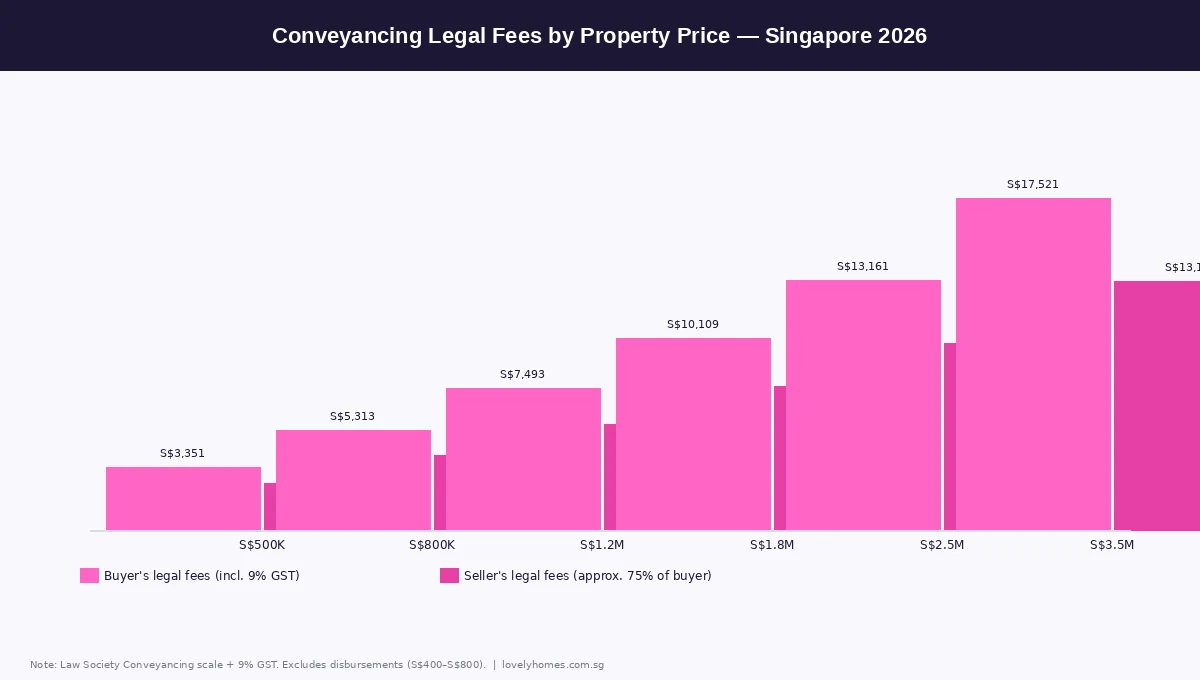
Figure 2: Conveyancing Legal Fees by Property Price — Buyer and Seller Comparison, Singapore 2026
The Law Society of Singapore publishes a recommended conveyancing fee scale. The scale applies to the purchase price (or the valuation, whichever is higher). The scale rates are: 0.75% on the first S$30,000; 0.70% on the next S$30,000; 0.60% on the next S$940,000; and 0.40% on any amount above S$1,000,000. These are before GST at 9%. In practice, most law firms offer fixed-fee packages for residential conveyancing, particularly for transactions below S$3 million, so the actual fee quoted may be somewhat below or above the scale for a given transaction.
Disbursements are additional and cover the out-of-pocket expenses incurred by your solicitor on your behalf: SLA lodgement fees (caveat S$64.45, transfer S$180–S$500 depending on value), title search fees (S$8–S$20 per search type), planning search (S$130), CPF Board fees (~S$200), stamp duty (paid to IRAS on your behalf), court filing fees (if relevant), and photocopying and postage. Total disbursements for a standard residential transaction typically range from S$400 to S$800.
For reference, at a purchase price of S$1,200,000, the Law Society scale fee (pre-GST) is approximately S$7,850; at S$1,800,000 it is approximately S$10,250; and at S$2,500,000 it is approximately S$13,250. Adding 9% GST and disbursements, the total buyer’s legal cost at S$1,200,000 is approximately S$8,960–S$9,300; at S$1,800,000 approximately S$11,500–S$11,900. Seller’s legal fees are typically 70–80% of the buyer’s, as the seller’s work is somewhat less involved (no loan drawdown, no CPF application).
Summary — Conveyancing Fees and Disbursements
Item
Who Pays
Typical Cost
Notes
Buyer’s legal fees
Buyer
S$2,000–S$8,000+
Law Society scale + 9% GST; depends on price
Seller’s legal fees
Seller
S$1,500–S$6,000+
Approx. 70–80% of buyer’s scale; varies
SLA caveat lodgement
Buyer
S$64.45
Payable at lodgement; buyer’s solicitor handles
SLA title registration
Buyer
S$180–S$500
Based on property value; scales up
Title / property search fees
Buyer (mainly)
S$50–S$300
Multiple searches; included in disbursements
URA planning search
Buyer
S$130
Essential for landed and larger transactions
CPF Board admin fee
Buyer
~S$200
For CPF OA drawdown; once-off on first property
Bank undertaking fee
Buyer
S$200–S$400
Issued by buyer’s solicitor to bank/HDB
Total (buyer) — S$1.2M property
Buyer
~S$3,500–S$9,500
Varies widely by firm and fixed-package deals
HDB Resale Conveyancing — Simplified Process
HDB resale flat conveyancing follows a slightly different path. HDB’s in-house legal team handles the registration of the title transfer, the CPF charge, and the HDB mortgage (if using an HDB loan). Buyers and sellers do not need to engage private solicitors for the straightforward conveyancing work; instead, they submit documents and instructions through HDB’s online Resale Portal. HDB charges an administrative fee (S$80–S$640 depending on flat size) for the processing.
However, buyers are strongly recommended to engage a private solicitor for independent advice if: the transaction involves a sub-sale (selling before TOP); there is a tenancy in place; the seller is a deceased estate; there are disputes or negotiations over conditions of sale; or significant COV is involved. Private solicitors for HDB resale typically charge S$500–S$1,500 for an advisory role, as they are not doing the formal registration work.
Worked Example — Mr and Mrs Ng, D15 Condo Purchase
Scenario
Mr and Mrs Ng are Singapore Citizens purchasing a 2-bedroom resale condominium in District 15 (Marine Parade) for S$1,480,000. They are using a bank loan (LTV 75%) and CPF OA funds. They engage Solicitor A for S$3,800 (fixed package, incl. disbursements, excl. stamp duty).
OTP issued: 1 August 2026. OTP exercised: 12 August 2026 (day 11 — within 14 days). BSD paid via IRAS e-Stamping: 14 August 2026 (2 days after exercise — within 14 days). Caveat lodged by Solicitor A: 14 August 2026. Title search, CPF charge search, tax search, planning search: 15–22 August 2026. CPF Board application for OA withdrawal: 18 August 2026 (approx. 10–14 working days to approve). Bank loan letter of offer signed: 16 August 2026. Completion date agreed: 14 October 2026 (9 weeks from exercise). SLA title registration: 15 October 2026. Keys collected: 14 October 2026.
Note on Solicitor Selection
Mr and Mrs Ng obtained three quotes. Fixed-package fees ranged from S$2,800 to S$4,500 (all-in excluding stamp duty). They chose a mid-range firm with a dedicated property department, having verified the solicitor’s practising certificate on the Law Society’s Find a Lawyer portal. They explicitly confirmed the scope: quote covered caveat lodgement, full title and search suite, CPF application, SPA review, completion, and SLA registration.
Why This Matters — Conveyancing Protects Your Largest Asset
A residential property is typically the largest single purchase a Singapore household makes. The conveyancing process exists to ensure that the buyer receives a clean, unencumbered title and that the transfer is legally effective and registered. Without proper due diligence, a buyer risks inheriting the seller’s outstanding debts (which run with the property as charges), discovering zoning restrictions that prevent intended use, or finding undisclosed encumbrances that reduce the property’s value or mortgageability.
Singapore’s Torrens title system (introduced via the Land Titles Act) provides strong protection once a title is registered. Under the indefeasibility principle, a bona fide purchaser for value who registers their interest cannot have it set aside by a prior unregistered interest — provided the buyer did not have notice of the prior interest. This underscores the importance of lodging the caveat promptly (to protect against subsequent encumbrances) and completing the registration quickly after completion.
Compared to many other jurisdictions, Singapore conveyancing is relatively streamlined. The electronic SLA system (e-lodgement), IRAS e-Stamping, and CPF’s online disbursement system mean that most steps can be completed electronically with minimal paper. The entire process from exercising the OTP to title registration is typically accomplished within 10 to 14 weeks for a standard resale private property transaction.
What Might Come Next
The legal profession in Singapore has been steadily adopting technology to streamline conveyancing. The Law Society’s conveyancing platform and the SLA’s online systems have already reduced turnaround times substantially. Discussions around further digitisation — including electronic signatures for sale and purchase agreements and blockchain-based title registration — are ongoing at the industry level. It is possible that completion timelines could be compressed further in coming years as digital systems mature. For buyers, this means quicker certainty of title; for sellers, faster receipt of proceeds. These developments will not change the fundamental due diligence requirements, which remain the buyer’s best protection.
Frequently Asked Questions
Do I need a solicitor for an HDB resale flat purchase?
Strictly speaking, you do not need to engage a private solicitor for an HDB resale flat, because HDB’s in-house legal team handles the formal conveyancing work (including registration of the title transfer, HDB mortgage, and CPF charge). Both buyer and seller transact through HDB’s Resale Portal. However, many buyers choose to engage a private solicitor for independent advice, particularly where there is a complex situation such as a divorce, estate matter, dispute over conditions, or significant COV. Private solicitors for HDB resale typically charge S$500–S$1,500 for an advisory role.
Can I use the same solicitor as the seller to save money?
In Singapore, the same firm can act for both buyer and seller in a property transaction only in limited circumstances — where there is no conflict of interest and both parties give informed consent. In practice, most law firms will not act for both parties in a residential property transaction due to the inherent conflicts (particularly around price negotiation and title defects). If you are a buyer, you should engage your own solicitor to ensure your interests are protected independently. For HDB resale, this question does not arise as HDB handles the formal work centrally.
What happens if the seller cannot discharge their mortgage before completion?
If the seller has an existing mortgage over the property, their solicitor will coordinate with the mortgagee bank to discharge the mortgage upon completion using the sale proceeds. The seller’s net proceeds are calculated as: sale price minus outstanding mortgage redemption amount minus CPF refund obligation minus legal fees and agent commission. If the outstanding mortgage and CPF obligations together exceed the sale price (a situation of “negative equity”), the seller must make up the shortfall in cash before completion can proceed. Your solicitor will conduct a title search to identify the seller’s outstanding mortgage early in the process so that these issues are identified promptly.
What is a completion account and how is it calculated?
A completion account is a financial statement prepared by the solicitors shortly before completion, setting out exactly how much money needs to change hands on the day of completion. For the buyer, it shows the balance purchase price (after deducting the option fee already paid, the loan drawdown, and CPF funds applied), plus any adjustments for property tax (apportioned to the date of completion — the buyer takes on property tax from the completion date onwards). For the seller, it shows the sale proceeds net of the outstanding mortgage redemption, CPF refund, legal fees, and agent commission. Both solicitors agree the completion account before completion takes place.
How long does a new launch (direct developer purchase) conveyancing take?
A new launch (developer sale under the Housing Developers Rules) follows a different timeline from a resale purchase. The buyer and developer sign the Sale and Purchase Agreement within 3 weeks of the Option Date. BSD is payable within 14 days of execution. Progress payments are then disbursed by the buyer’s bank to the developer’s solicitor as construction milestones are reached, under the Standard Payment Scheme. The completion of the transaction occurs upon issuance of the Temporary Occupation Permit (TOP) and Vacant Possession; the buyer’s solicitor coordinates the drawdown of the final tranche, registration of the mortgage, and title transfer. This process can span several years from the OTP to final completion if the project is under construction.
What is the difference between a caveat and a mortgage in terms of protecting my interest?
A caveat is a notice lodged with SLA that alerts anyone searching the title to the fact that you have a claim or interest in the property. It does not in itself transfer title; it merely protects your position while the full transfer is being processed. A mortgage, by contrast, is a legal charge over the property granted to the lender as security for the loan; it is registered and remains on the title until the loan is fully repaid. As a buyer, your solicitor lodges a caveat immediately after you exercise the OTP to protect your interest before completion; once the title is registered in your name, the caveat is automatically removed and replaced by your registered title.
What should I check about my solicitor before engaging them?
Verify that the solicitor holds a valid practising certificate on the Law Society’s Find a Lawyer portal. Check that the firm has a dedicated property or conveyancing practice, not just a general litigation firm. Ask for a clear written quote covering the full scope: draft SPA review, caveat lodgement, all standard searches, CPF application, bank coordination, completion, and SLA registration — so there are no surprise additional charges. Confirm whether the quote is inclusive of all disbursements or whether disbursements are quoted separately. Enquire about the solicitor’s availability and response times, as property transactions are time-sensitive.
Disclaimer: This article is for general information only and does not constitute legal or financial advice. Conveyancing fees, SLA charges, and stamp duty rates are subject to change. Always engage a licensed advocate and solicitor registered with the Law Society of Singapore for advice on your specific transaction. Verify the latest IRAS stamp duty rules at iras.gov.sg, SLA procedures at sla.gov.sg, and CPF Board requirements at cpf.gov.sg.
Price: BTO flats are sold at subsidised prices, typically 30–60% below comparable resale flats. A 4-room BTO in Tampines may be priced around S$380,000, versus S$680,000 or more on the resale market.
Wait time: BTO construction takes 4–5 years from selection to key collection for standard flats; 5–6 years for PLH Plus/Prime flats. Resale flats can be occupied within 8–12 weeks of exercising the OTP.
Grants: Both BTO and resale buyers can access the Enhanced Housing Grant (EHG) of up to S$120,000. Resale buyers additionally qualify for the Family Grant (up to S$50,000) and Proximity Housing Grant (PHG) of up to S$30,000.
Minimum Occupation Period (MOP): Standard BTO and resale flats have a 5-year MOP. Plus and Prime (PLH) flats carry a 10-year MOP with permanent restrictions on subletting the entire flat.
Location: BTO projects are often in non-mature estates (Tengah, Woodlands, Punggol, Sembawang), while resale gives access to mature estates (Bishan, Queenstown, Tampines, Toa Payoh) immediately.
Resale Levy: If you previously received a housing subsidy and buy a second subsidised flat (including BTO), you pay a Resale Levy of S$15,000–S$55,000 depending on the previous flat type.
CPF Housing Grants are credited directly to your CPF OA and reduce the loan quantum needed — they do not affect your cash outlay directly.
For most first-timer families earning under S$7,000/month, BTO in a non-mature estate offers the best financial outcome. Above S$7,000/month, resale with grants becomes competitive, especially for families needing immediate occupancy.
I. The Choice Every HDB Buyer Faces
Every year, tens of thousands of Singapore households face the same decision: apply for a new HDB Build-to-Order (BTO) flat, or buy an existing HDB resale flat on the open market? It is not a simple question. The financial stakes are large — the price gap between a subsidised BTO and a comparable resale flat in the same town can run to several hundred thousand dollars — and the practical consequences (particularly the 4-to-5-year wait for BTO keys) can affect life decisions around marriage, children, and career.
This guide compares BTO and resale across five critical dimensions: price, wait time, grants, location options, and MOP rules. It concludes with a worked example showing the total lifetime cost of each option for a typical young couple, and a decision framework for choosing which path suits your situation.
II. BTO Flats: Subsidised Pricing and the Ballot
The HDB Build-to-Order (BTO) programme offers new flats directly from HDB at heavily subsidised prices. As of 2026, HDB launches BTO exercises roughly six times per year, each offering several thousand units across multiple towns. Buyers apply through the HDB Flat Portal during the exercise window, and successful applicants are balloted for a queue number. Higher queue numbers wait longer for flat selection, and lower-demand towns naturally move faster.
BTO eligibility at a glance
To apply for a BTO flat, you must meet HDB’s eligibility criteria. At minimum, at least one applicant must be a Singapore Citizen; co-applicants may be SPR. The household must meet the income ceiling: S$14,000 per month for families; S$7,000 for singles applying under the Single Singapore Citizen scheme (applicable only for 2-room Flexi flats in non-mature estates). You must not own any other residential property at the time of application, and must not have previously received two housing subsidies.
Plus and Prime classification
Since the PLH (Plus/Prime Location Public Housing) model was introduced in late 2021 and subsequently evolved into the Plus/Prime classification under the HDB Redesign in 2024, certain BTO flats in well-connected or central locations carry additional restrictions: a 10-year MOP (versus the standard 5 years), permanent restrictions on subletting the entire flat after the MOP, and eligibility restrictions requiring all owners to be Singapore Citizens at the time of resale. These restrictions are designed to keep Plus/Prime flats within reach of genuine owner-occupiers rather than investors. Buyers of Plus/Prime flats should understand these constraints fully before applying — the restrictions run with the flat permanently.
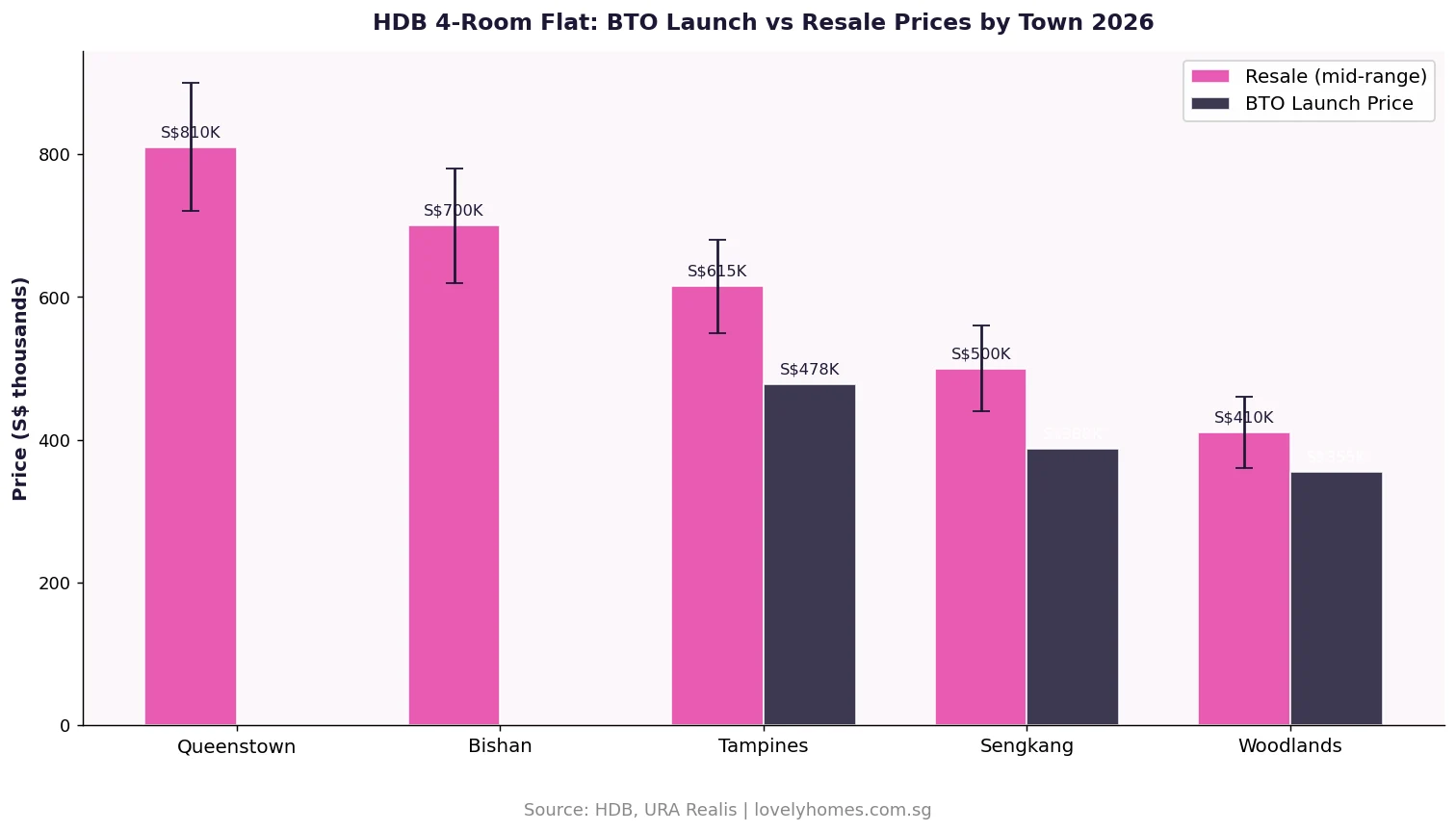
Figure 4: BTO versus resale 4-room flat prices by town, 2026. The resale premium over BTO ranges from 55% (Tampines) to over 77% (Queenstown). Subsidised BTO pricing is set by HDB based on location, flat type, and market conditions — the effective subsidy has grown as resale prices have risen faster than BTO selling prices over the past five years.
III. Resale HDB Flats: Market Pricing and Immediate Occupancy
An HDB resale flat is purchased from its existing owner at a price set by negotiation. Unlike BTO, there is no income ceiling for resale (except where grants are being claimed: the EHG income ceiling is S$9,000/month for families). The transaction follows the private-market model: you find a flat, agree a price, sign an Option to Purchase, and complete the sale through the HDB Resale Portal within a few months. There is no ballot, no construction wait, and no uncertainty about which specific flat you will receive — what you inspect is what you buy.
Cash Over Valuation (COV)
When the agreed purchase price exceeds HDB’s assessed market valuation, the excess is called Cash Over Valuation (COV). COV must be paid in cash — it cannot be financed by an HDB loan, a bank loan, or CPF. COV has been a significant factor in buoyant markets; in H1 2026, median COV for resale 4-room flats in mature estates ran between S$20,000 and S$60,000. Buyers must budget for COV in addition to the standard downpayment. For a flat where the valuation is S$650,000 but the agreed price is S$690,000, the COV of S$40,000 must be in cash — on top of the minimum 5% cash downpayment requirement for bank loans.
HDB Loan vs bank loan for resale
Resale buyers can use either an HDB concessionary loan or a bank loan. The HDB loan offers a rate of 2.6% per annum (pegged at 0.1% above the prevailing CPF OA interest rate), requires no minimum cash downpayment (the entire downpayment can come from CPF OA), and has no income ceiling for the loan itself. Bank loans offer potentially lower rates in favourable interest rate environments, but require a minimum 5% cash downpayment and are subject to the stricter TDSR and LTV limits administered by MAS.
IV. The Price Gap: What You Actually Pay
The BTO subsidy is the most powerful financial argument for the BTO route. HDB sets BTO selling prices with reference to market comparable values, then applies a subsidy — meaning a BTO flat is always priced below what an equivalent resale flat in the same estate trades for. The gap is typically widest in mature estates (where BTO supply is limited and resale demand is high) and narrowest in new towns (Tengah, Punggol) where BTO and resale prices are closer because resale supply in those towns is itself thin.
For a 4-room flat in Tampines in 2026, a comparable BTO selling price would be around S$380,000, while resale 4-room transactions in the same town run at S$650,000–S$720,000. The gap of approximately S$300,000 represents the subsidy, though buyers must deduct any grants received (which reduce both the effective BTO price and, for resale, the net resale cost). The counter-argument from resale buyers is that the S$300,000 premium purchases approximately 4–5 years of immediate occupancy — time that has significant economic value if you are currently renting or living with parents.
V. Wait Time: The Most Practical Differentiator
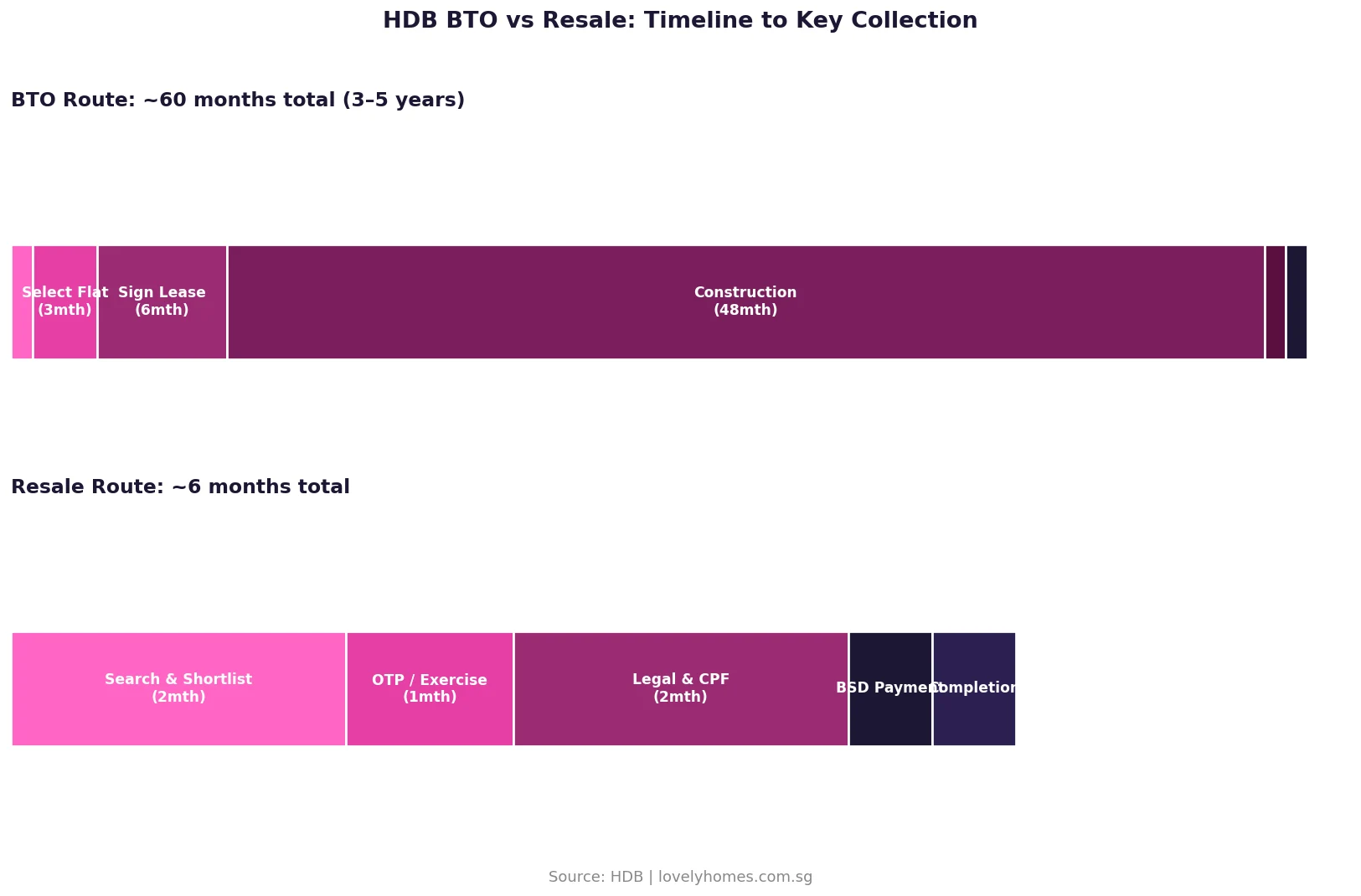
Figure 5: Timeline to key collection — BTO versus resale. A standard BTO buyer waits an average of 54 months (4.5 years) from HFE application to keys. A resale buyer, whether using an HDB or bank loan, typically collects keys within 4 to 5 months of starting the search. For families with a time-sensitive need — a child starting school, an expiring rental lease, or ageing parents — resale’s speed advantage is decisive.
The wait for a BTO flat is the single biggest practical obstacle for many buyers. From the time you submit your HFE Letter application to the time you collect keys for a new BTO flat, the typical elapsed time is 50–60 months for a standard flat and 60–72 months for a Plus or Prime flat. During this period, most buyers continue renting or living with family — at a cost. A young couple renting a 2-bedroom unit at S$2,500/month for 5 years pays S$150,000 in rent, which meaningfully erodes the financial advantage of the BTO subsidy.
Resale, by contrast, can move very quickly. From first viewing to key collection, a motivated buyer can complete a resale transaction in as little as 10 weeks — though 4 to 5 months is more typical when you account for finding the right flat, negotiating, and completing the HDB administrative process. For families with children already enrolled in nearby schools, or who need to accommodate elderly parents immediately, this speed premium is often worth more than the price differential.
VI. Housing Grants: Who Gets What
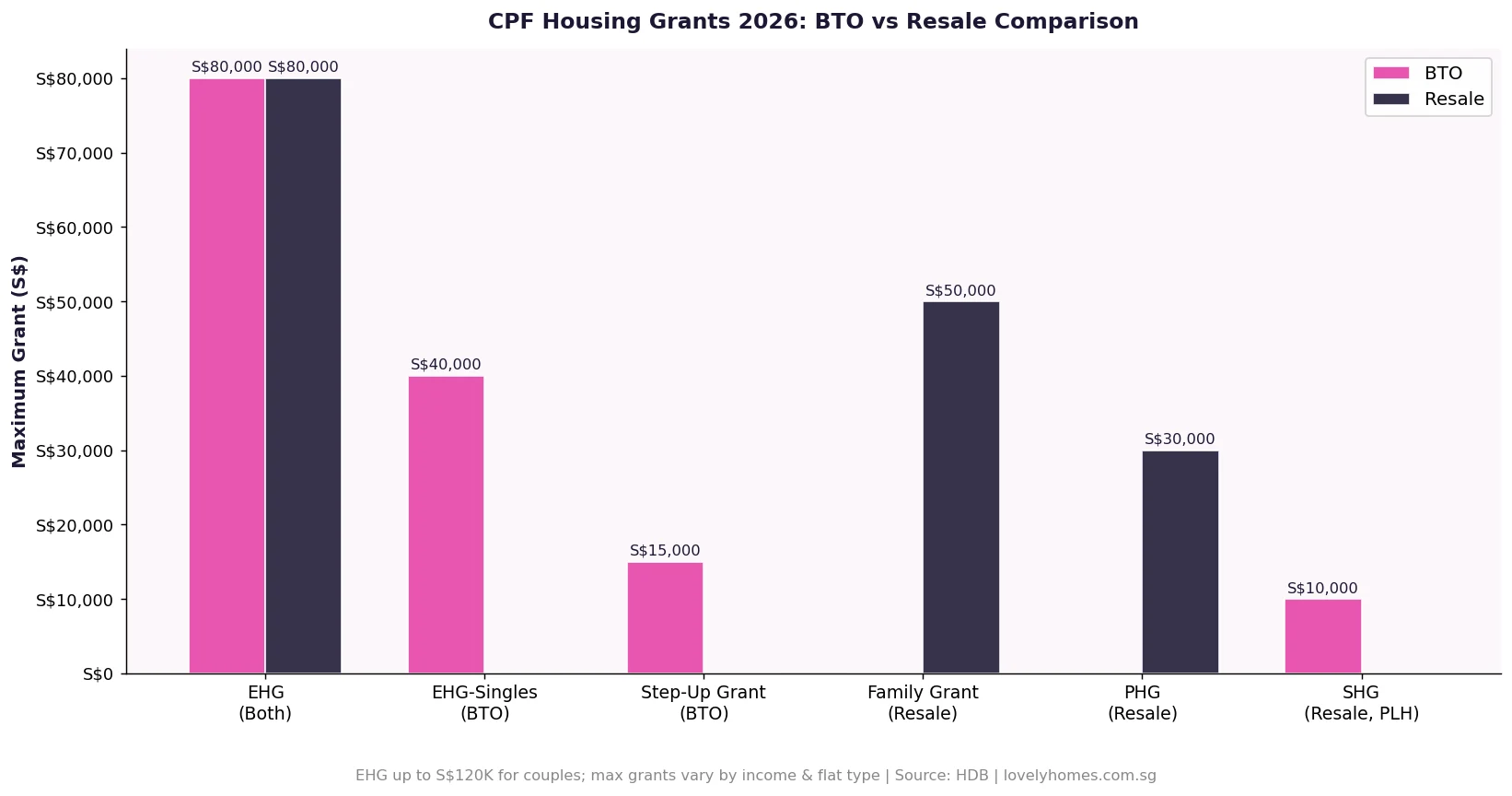
Figure 6: CPF Housing Grants available to BTO and resale buyers in 2026. Both routes offer the Enhanced Housing Grant (EHG) of up to S$120,000 for eligible first-timers. Resale buyers additionally qualify for the Family Grant (up to S$50,000) and the Proximity Housing Grant (PHG, up to S$30,000) — neither of which is available for BTO. All grants are credited to the buyer’s CPF OA and reduce the loan quantum needed.
The Enhanced Housing Grant (EHG) is available to first-timer families earning S$9,000/month or less (up to S$4,500 for singles). The maximum EHG is S$120,000, tapering to S$5,000 for households earning S$8,501–S$9,000. It is available for both BTO and resale flats. All grants are credited to the CPF OA of the buyers, reducing the loan and monthly repayments.
Resale buyers have access to two additional grants that BTO buyers cannot claim. The Family Grant (S$50,000 for a family of at least one SC buying their first resale flat) and the Step-Up CPF Housing Grant (S$15,000, for second-timer families moving from a 2-room Flexi to a larger resale flat). The Proximity Housing Grant (PHG) of up to S$30,000 is available to resale buyers living within 4 km of their parents or vice versa. PHG is also available for BTO flats located near parents under the Married Child Priority Scheme but as a grant only for resale.
The combined maximum grant package for a resale buyer (EHG S$120,000 + Family Grant S$50,000 + PHG S$30,000) is S$200,000 — substantially more than the maximum available to a BTO buyer. However, the BTO subsidy embedded in the lower selling price typically exceeds even the largest resale grant package for comparable flats.
VII. BTO vs Resale: Side-by-Side Summary
Factor
BTO Flat
Resale HDB
Price level
Subsidised (30–60% below resale)
Open market (higher)
Wait time
4–6 years (incl. construction)
8–16 weeks
Location choice
Limited to launched projects (often non-mature estates)
Any town, any flat
Condition
Brand new, with defect warranty
Existing condition (may need renovation)
EHG grant
Up to S$120,000
Up to S$120,000
Family Grant
Not applicable
Up to S$50,000
PHG grant
Not applicable (separate MCPS scheme)
Up to S$30,000
COV
Not applicable
Possible — must be paid in cash
MOP
5 years (standard); 10 years (Plus/Prime)
5 years (standard); 10 years (PLH resale)
CPF usage
From selection and loan disbursement
From key collection
Renovation cost
Full renovation needed from scratch
May only need refresh
Resale Levy risk
Yes, if previously subsidised flat owned
Yes, if previously subsidised flat owned
VIII. Worked Example — Mr & Mrs Goh: BTO versus Resale in Tampines
Scenario: SC married couple, combined income S$8,500/month, first HDB purchase, targeting Tampines 4-room
Option A — BTO (standard, non-PLH):
Selling price: S$385,000. EHG: S$30,000 (income S$8,500/month, tapering scale). Net price after EHG: S$355,000. HDB loan at 2.6% 25yr on S$355,000 = S$1,609/month. MSR = 1,609/8,500 = 18.9% — well under 30% cap. Cash outlay: BSD S$5,550, legal ~S$1,500, total cash ~S$7,050. CPF downpayment: nil required for HDB loan (but couple choose to put S$35,500 CPF as 10% voluntary DP to reduce loan). Wait: 4.5 years. Interim: renting a 2BR at S$2,200/month = S$118,800 in rent over 54 months. True total cost at year 5: S$355,000 (loan) + S$118,800 (rent) + S$7,050 (cash) = S$480,850 — noting the flat is worth around S$650,000 at key collection (estimated).
Option B — Resale (mature estate, Tampines):
Purchase price: S$690,000. HDB valuation: S$660,000. COV: S$30,000 cash. EHG: S$30,000. Family Grant: S$50,000. Net loan: S$690,000 – S$30,000 (EHG OA) – S$50,000 (Family Grant OA) = S$610,000. HDB loan 80% on S$660,000 valuation = S$528,000; excess S$82,000 (= S$610,000 – S$528,000) financed by CPF OA. Monthly repayment at 2.6% 25yr on S$528,000 = S$2,391/month. MSR = 2,391/8,500 = 28.1% — just under 30% cap. Cash outlay: COV S$30,000 + BSD S$14,100 + legal S$2,500 = S$46,600. No rent during wait. True total cost at year 5: Loan serviced over 5 years ~S$143,460 (principal + interest); remaining principal ~S$489,000; total cash spent S$46,600 + S$143,460 = S$190,060 — but the flat is already worth S$690,000+ from day 1.
Verdict: For the Goh family, BTO saves approximately S$305,000 in purchase price but requires S$118,800 in rent and 4.5 years of waiting. The net financial advantage of BTO is approximately S$186,000 — significant but not overwhelming when accounting for the lifestyle and timing cost. If Mrs Goh is pregnant, or they need to move out of their current living situation, the calculus shifts toward resale.
IX. The Decision Framework: Which Should You Choose?
Choose BTO if you:
Can wait 4–5 years (ideally newly married, no children yet)
Have a lower income (EHG tapering makes BTO far cheaper)
Are flexible on location and willing to consider non-mature estates
Want a brand-new flat with developer defect warranty
Plan to customise the entire interior from scratch
Choose Resale if you:
Need to move within 6 months (rental expiry, child’s school enrolment)
Must live near parents (PHG + family proximity requirements)
Need a specific mature estate (schools, amenities, elderly parents nearby)
Are a second-timer and need immediate move-up
Have a higher income and the larger grant package bridges the cost gap
X. What May Change: BTO Supply and Policy Outlook
The government’s ramp-up to approximately 100,000 BTO units delivered between 2022 and 2025 has been maintained, with 2025 and 2026 exercises continuing at a pace of roughly 20,000–22,000 units per year. HDB has been strategic about including more BTO exercises in mature estates to meet demand from couples who might otherwise default to resale. The introduction of the 2022 Ballot Category (first-timer families receive two ballots versus one for others) has improved first-timer success rates. However, mature-estate BTO flat supply remains structurally tight given limited land availability.
Resale prices rose modestly through H1 2026, with the HDB Resale Price Index at 202.7 in Q2 2026 — a slight decline of 0.3% QoQ from Q1 2026 (203.0), suggesting the market is cooling at the margins. The government has no stated plans to remove or significantly loosen BTO eligibility criteria, and the Plus/Prime framework is likely to persist. Buyers who have been in the BTO queue since 2022–2023 are beginning to receive their keys in 2026–2027, which may add a modest wave of secondary market supply as some of them sell or upgrade.
XI. Frequently Asked Questions
Can a Singapore Permanent Resident (SPR) apply for a BTO flat?
SPRs cannot apply for a BTO flat on their own. However, an SPR can co-apply with a Singapore Citizen spouse (or parent, sibling, or child under the Public Scheme), provided at least one applicant is an SC. The SC must be the primary applicant. Under the Fiancé/Fiancée Scheme, an SC engaged to an SPR may apply, but the SPR must obtain SC status within six months of key collection. SPRs buying HDB resale flats on their own (without an SC co-applicant) are permitted, but they do not qualify for CPF Housing Grants and must use the Resale application only.
What is the Resale Levy and does it apply to me?
The Resale Levy applies to second-timer households who have previously received a direct subsidy (i.e., a first subsidised BTO or SBF flat), and who are now buying a second subsidised flat (another BTO or an EC from the developer). If you sold your first subsidised flat, HDB deducts the levy from the proceeds of that sale. If you still own it (e.g., you’re buying a concurrent BTO), the levy is paid in cash. The levy amount depends on your first flat type: S$15,000 for a 2-room Flexi, S$30,000 for a 3-room, S$40,000 for a 4-room, S$45,000 for a 5-room or 3Gen, and S$55,000 for an executive flat. Resale Levy does NOT apply if you are buying a resale flat — it only applies to purchases of new subsidised flats from HDB or a developer (EC).
Can I rent out my BTO or resale HDB flat before the MOP ends?
You cannot sublet the entire flat before the MOP expires. However, you may rent out individual bedrooms (not the entire flat) from the date of key collection, subject to HDB’s approval and prevailing subletting guidelines. HDB requires that you (the owner) continue to occupy the flat as your registered address and that the total number of occupants (including tenants) does not exceed the flat’s approved occupancy limit. For a 4-room flat, HDB generally permits renting out up to 3 bedrooms as long as the owner remains in residence. Overseas income earners who are temporarily overseas may apply to HDB for a subletting waiver under specific conditions. Violation of subletting rules is a serious offence — HDB can compulsorily acquire the flat.
How does the Enhanced Housing Grant (EHG) work for resale versus BTO?
The EHG is income-tested: the full S$120,000 is available to households earning S$1,500/month or less; it tapers down to S$5,000 for households earning S$8,501–S$9,000/month. The EHG quantum is identical whether you are buying a BTO or resale flat. It is credited to your CPF OA, from which it is then used toward the purchase price, reducing the loan amount. For BTO, the grant is applied at the time of booking; for resale, it is released at the completion appointment. Critically, for resale, the EHG cannot be used to pay Cash Over Valuation — only the base price (up to the valuation) can be funded from CPF. The COV above valuation is always cash.
What is the ballot priority system for BTO and how do I improve my chances?
HDB’s ballot priority system gives different numbers of ballot chances to different applicant categories. First-timer families applying under the Public Scheme receive two ballot chances per exercise; second-timers receive one. Married Child Priority Scheme (MCPS) applicants who want to live near parents receive an additional ballot. Applicants who have not been successful in three or more exercises may apply for the Married Child Priority Enhanced Ballot, which provides a higher ballot queue number priority. The Parenthood Priority Scheme (PPS) reserves a portion of units (up to 30%) for first-timer married couples with at least one Singapore Citizen child. To maximise your chances, apply in exercises with lower demand-to-supply ratios (typically non-mature estates), apply early to accumulate ballot count, and use all available priority schemes for which you qualify.
Is it possible to use both an HDB loan and a bank loan for the same purchase?
No. You must choose either an HDB concessionary loan or a bank loan — you cannot combine the two for the same property. The distinction matters because they have different LTV limits (HDB: 80% of valuation; bank: 75% on first property), different minimum cash requirements (HDB: zero; bank: minimum 5% cash), and different stress-test rules. You can switch from an HDB loan to a bank loan at any point during the loan tenure (refinancing), but you cannot revert back to an HDB loan once you have switched. The inability to return to the HDB loan is a significant consideration: bank loans, while potentially cheaper in low-interest environments, expose you fully to rate movements, whereas the HDB rate is effectively pegged to the CPF OA rate, which has historically been more stable.
Can I buy a private property while waiting for my BTO to complete?
Yes, with conditions. During the BTO construction period (before key collection), you may purchase private residential property — the MOP does not begin until keys are collected. However, if you own private property at the time of BTO key collection, HDB requires you to dispose of the private property within six months of collecting the BTO keys. If you fail to do so, you are in breach of HDB’s conditions, which can result in compulsory acquisition of the BTO flat. Note also that buying private property before BTO key collection means you will owe ABSD on the private property (since you are treated as already owning the BTO under the Agreement for Lease). The ABSD is 20% for an SC’s second property. Planning your property ladder while in the BTO queue requires careful sequencing with a property lawyer.
Disclaimer: This article is produced by LovelyHomes Editorial and is accurate as at 19 August 2026. HDB eligibility conditions, grant amounts, BTO selling prices, MOP rules, and loan parameters are subject to change at HDB’s and MAS’s discretion. All figures are illustrative and based on published data from HDB, MAS, CPF Board, and IRAS. Nothing in this article constitutes legal, financial, or property advice. Buyers should verify all information directly with HDB and engage a CEA-registered property agent and a licensed conveyancing solicitor for their specific transaction.
Whether you have just collected the keys to your new HDB flat, completed your MOP and are preparing to resell, or are refreshing a resale condo ahead of moving in, a renovation in Singapore involves navigating a specific set of rules, permits, and cost benchmarks that every homeowner should understand before engaging a contractor. Get it wrong, and you risk fines from HDB, stop-work orders from the Building and Construction Authority (BCA), or a renovation that looks impressive but adds little resale value.
This guide covers the full landscape of Singapore property renovation in 2026: HDB rules and what needs approval, BCA permits for structural work, realistic cost ranges by flat type and scope, the HDB Renovation Loan, timelines to plan around, and an evidence-based look at which renovation types deliver the strongest return on investment (ROI) at resale.
Quick Answer — Singapore Renovation 2026 at a Glance
HDB renovations require an HDB-registered contractor and — for certain works — advance written approval from HDB.
Structural works (hacking beams, columns, load-bearing walls) are prohibited in HDB flats regardless of approval status.
BCA permits are required for additions and alterations to private property that affect the building structure, external appearance, or gross floor area.
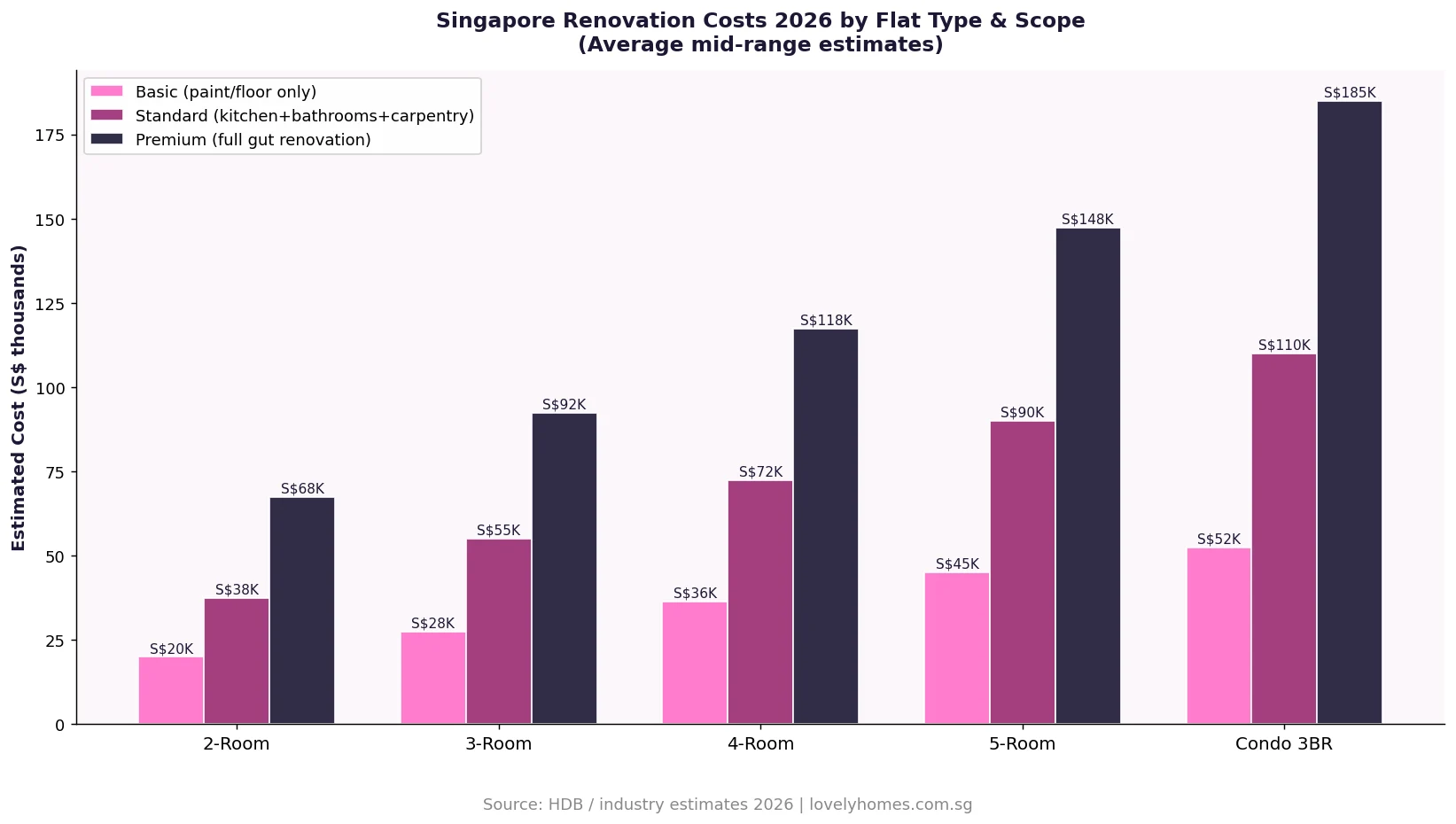
Costs range from S$18,000 for a basic 2-room HDB refresh to S$185,000+ for a premium condo 3-bedroom renovation.
Renovation Loan: up to S$30,000 for HDB flat owners, at interest rates from 5.5%–6.5% p.a. (check with your bank).
Duration: typically 8–16 weeks for a full flat; carpentry lead times of 6–10 weeks are the most common schedule bottleneck.
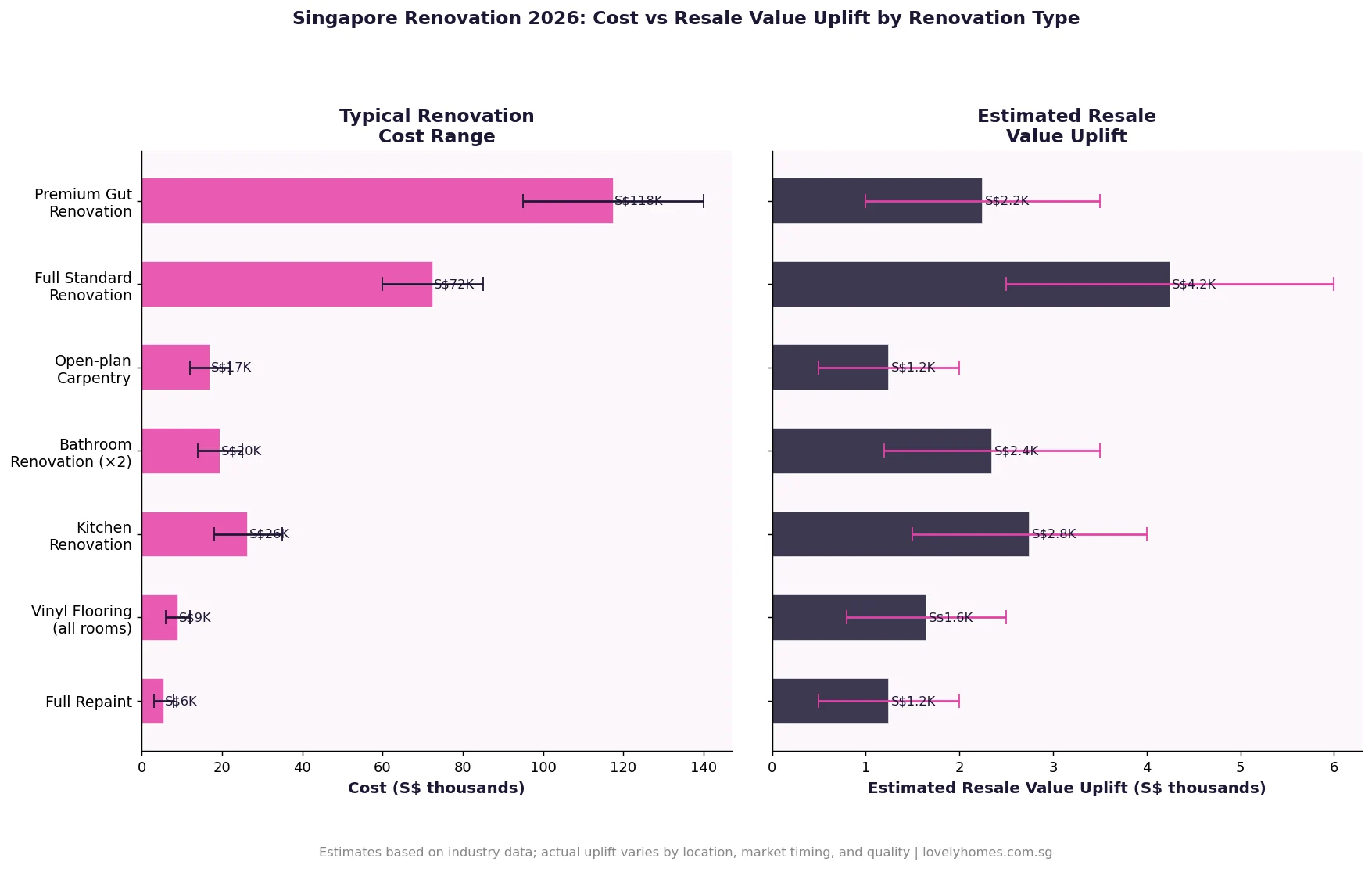
Best ROI renovations (by resale uplift relative to cost): kitchen refacing, bathroom remodelling, flooring replacement, and a fresh full repaint.
HDB Renovation Rules: What You Need to Know
HDB renovation rules exist to protect the structural integrity of blocks, ensure the safety of residents above and below, maintain the external facade of the estate, and prevent noise and disruption beyond acceptable hours. The rules apply regardless of whether you own a BTO flat, a resale flat, or a Design, Build and Sell Scheme (DBSS) flat.
The core requirements are:
Use an HDB-registered renovation contractor. All HDB renovation work must be carried out by a contractor on HDB’s approved register. Working with an unregistered contractor voids your rights under any HDB dispute resolution process and may result in fines. You can verify registration at the HDB renovation portal.
Submit a Renovation Permit application through your contractor’s HDB-registered account before commencing works that require approval.
Work hours: Monday–Friday 9:00 am–6:00 pm; Saturday 9:00 am–1:00 pm. No renovation work on Sundays or public holidays.
Inform your neighbours at least 3 working days before renovation commences (HDB policy; many MCSTs have their own protocols for private condos).
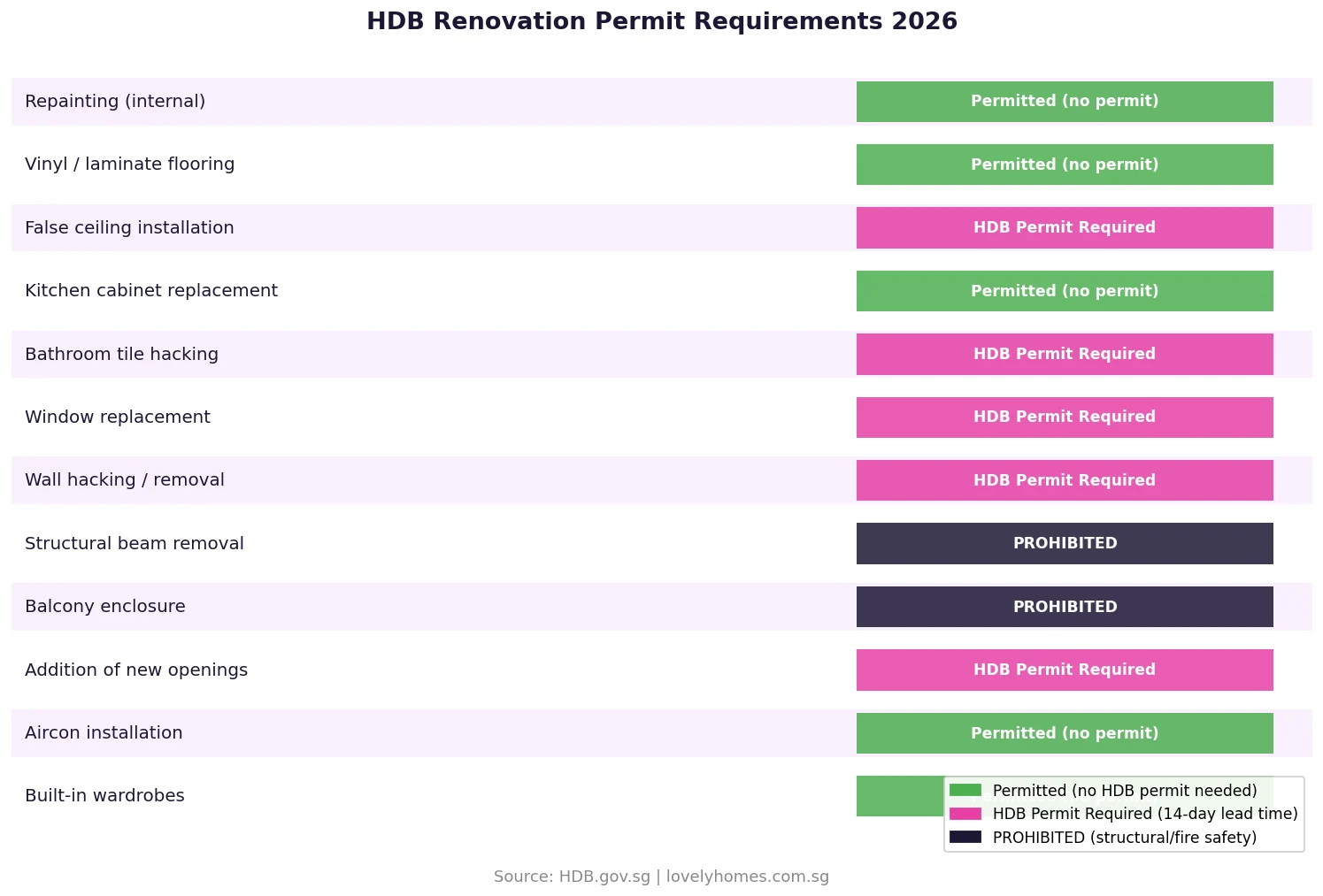
Figure 1: HDB renovation works categorised by permit requirement: no permit needed (pink), HDB permit required (orange), and prohibited (navy).
Renovation Type
HDB Rule
Notes
Painting (walls, ceilings)
No permit needed
Any colour; no structural impact
Wallpaper / wall panels
No permit needed
Must not damage structural surfaces
Built-in carpentry (wardrobes, TV console)
No permit needed
Contractor must be HDB-registered
Kitchen cabinets / countertops
No permit needed
Replacing like-for-like; plumbing changes need permit
Flooring (overlay, no hacking)
No permit needed
Vinyl overlay on tiles — no hacking needed
Flooring (hacking and relaying tiles)
HDB Permit Required
Submit via contractor’s account before starting
Bathroom fittings (sink, WC, shower screen)
No permit for like-for-like
Moving waste pipes = permit required
Hacking non-structural internal walls
HDB Permit Required
HDB confirms wall classification first
Hacking structural walls / beams / columns
Prohibited
No exceptions — structural integrity risk
Window grille installation / replacement
HDB Permit Required
Must meet HDB bar-spacing standards
Air-conditioning installations
No permit for standard split units
Outdoor unit placement must comply with HDB guidelines
Electrical rewiring (minor)
No permit; must use licensed electrician
SP PowerGrid licence required for main panel work
BCA Permits for Private Property Renovation
For private property (condominiums, landed homes, commercial units), the Building and Construction Authority (BCA) administers the approvals framework under the Building Control Act. Unlike HDB rules, which regulate the use of approved contractors and specific work types, BCA permits focus on structural safety, gross floor area, and external facade changes.
Works that typically require a BCA permit (Addition and Alteration, or A&A works) include:
Any structural alteration (adding or removing load-bearing elements, changing structural openings)
Extensions that increase gross floor area (GFA)
Changes to the external facade or roof of landed property
Swimming pool installations at landed property
Major electrical or mechanical system upgrades in commercial units
For condominium owners, all renovation work must also comply with the Management Corporation Strata Title (MCST) by-laws. Most MCSTs require homeowners to submit renovation plans and obtain written MCST approval before any work begins, and to pay a renovation deposit (typically S$1,000–S$5,000) refunded upon satisfactory completion without damage to common areas.
Renovation Costs by Flat Type and Scope
Renovation costs in Singapore vary enormously depending on the size of the unit, the scope of works, and the finish level targeted. The figures below reflect market rates as at mid-2026 based on indicative quotations from HDB-registered contractors. They exclude furniture, electrical appliances, and curtains, which are typically supplied separately.
Figure 2: Estimated renovation cost ranges (S$) by flat type and renovation scope — Basic (mainly cosmetic), Standard (full wet works and carpentry), and Premium (bespoke finishes throughout).
Property Type
Basic Renovation (S$)
Standard Renovation (S$)
Premium Renovation (S$)
HDB 2-Room (35–45 sqm)
18,000–25,000
30,000–45,000
50,000–70,000
HDB 3-Room (65–75 sqm)
25,000–35,000
45,000–60,000
70,000–100,000
HDB 4-Room (90–100 sqm)
32,000–42,000
58,000–75,000
95,000–130,000
HDB 5-Room / EA (110–145 sqm)
40,000–55,000
72,000–95,000
120,000–160,000
Condo 2-Bedroom (65–80 sqm)
35,000–50,000
65,000–85,000
110,000–150,000
Condo 3-Bedroom (90–120 sqm)
48,000–65,000
85,000–115,000
150,000–220,000
What the tiers mean:
Basic renovation covers repainting, vinyl flooring overlay (no hacking), replacement of bathroom fittings and kitchen tap/sink, and basic built-in storage in one or two rooms. Typically 8–10 weeks to complete.
Standard renovation includes full hacking and retiling of bathrooms and kitchen, installation of full kitchen cabinetry with solid surface countertop, carpentry throughout all bedrooms, feature wall treatment in living room, false ceiling with LED lighting, and air-conditioning installation. Typically 12–16 weeks.
Premium renovation encompasses all standard works plus imported tiles, bespoke joinery with soft-close mechanisms and premium hardware, kitchen island, walk-in wardrobe, feature wall with natural stone or specialty panels, smart home integration, and designer sanitary ware. 16–20 weeks or more.
The HDB Renovation Loan
HDB flat owners who need financing for their renovation can apply for an HDB Renovation Loan through participating financial institutions. Key terms as at August 2026:
Maximum loan amount: S$30,000 (or 6 months’ gross household income, whichever is lower)
Eligibility: HDB flat owners; at least one applicant must be a Singapore Citizen or Permanent Resident; flat must be under the applicant’s name
Loan tenor: up to 5 years
Interest rate: typically 5.5%–6.5% p.a. (fixed or floating; compare rates across OCBC, UOB, DBS, Standard Chartered)
Monthly repayment example: S$30,000 at 6% p.a. over 5 years = approximately S$580/month
Approved works: must be used for renovation works carried out by HDB-registered contractors; loan funds disbursed directly to the contractor after works inspection
Private property owners can use personal loans or renovation loans offered by banks (not HDB), which typically allow borrowing up to 6× monthly income, up to S$30,000, at broadly similar interest rates.
Renovation ROI: Which Works Add the Most Value at Resale
Not all renovation dollars are created equal. A premium renovation that costs S$150,000 does not necessarily add S$150,000 to your resale price — and in the HDB resale market especially, over-renovating above the neighbourhood price ceiling can result in negative ROI, where the renovation cost exceeds the premium buyers are willing to pay.
Figure 3: Estimated resale ROI range and typical cost by renovation type. The dot on each range bar indicates the midpoint ROI. A fresh full repaint often delivers the highest ROI relative to cost.
General principles that hold across the Singapore resale market:
Kitchens and bathrooms sell flats. Buyers consistently rank clean, functional kitchens and bathrooms as the top priority. A bathroom remodel at S$15,000–S$20,000 typically commands a premium of S$15,000–S$30,000 or more in the HDB resale market, making it one of the highest-ROI renovations in absolute terms.
Repainting is the highest-ROI cosmetic upgrade. A full repaint of a 4-room flat costs S$2,500–S$4,500 and can lift perceived value by 5%–12% by making the flat feel newer and well-maintained. At S$550,000 resale, a 5% uplift = S$27,500 on a S$4,000 spend.
Flooring matters. Replacing old mosaic tiles with vinyl plank flooring (S$8,000–S$12,000) upgrades the look of the entire flat and appeals strongly to younger buyers. ROI of 8%–18% relative to cost is commonly observed.
Over-specified kitchens rarely pay back. A Häfele full-imported kitchen at S$45,000 in a S$450,000 flat is unlikely to recover its cost. Buyers in that price bracket expect a functional kitchen, not a luxury one.
Open-plan conversions (hacking the wall between kitchen and living room) are high-risk. They require HDB permit approval, add S$15,000–S$25,000 in costs, and appeal to a subset of buyers. If your buyer prefers a separate kitchen (common among families with elderly members), the conversion may reduce marketability.
Worked Example: Ms Tan — selling her Bishan 4-Room HDB flat after MOP
Ms Tan’s 4-room flat is 12 years old. She purchased it at S$370,000 and is targeting a resale at S$720,000. Market comparables show recently transacted flats in her block at S$700,000–S$740,000 — a standard finish range.
Renovation plan (standard scope, targeting resale within 3 months):
Full repaint (4 rooms + common areas): S$3,800
Bathroom retiling and new fittings (2 bathrooms): S$22,000
Kitchen hacking, retiling, new cabinets with quartz countertop: S$28,000
Vinyl plank flooring (bedrooms and living room): S$9,500
False ceiling with LED downlights (living and dining): S$5,200
Minor carpentry (master bedroom built-in wardrobe): S$6,500
Total renovation cost: S$75,000
Resale outcome: After renovation, the flat transacted at S$735,000 — S$35,000 above the pre-renovation comparable median. Net renovation benefit = S$35,000 uplift at an outlay of S$75,000. However, the renovation also allowed Ms Tan to sell at top-of-market speed (16 days on the market vs. average 45 days for unrenovated flats in her block), reducing holding costs and the risk of a prolonged sale at a lower price.
Renovation Loan used: Ms Tan borrowed S$30,000 via UOB Renovation Loan at 6.0% over 3 years (S$913/month), repaid fully on completion of the sale. Total interest paid = approximately S$2,860.
Renovation Timelines and Planning Tips
Renovation projects in Singapore typically follow this sequence:
Week 1–2: Hacking (tiles, walls where permitted). Noisiest phase — schedule within HDB allowed hours.
Week 12–14: Air-conditioning, light fittings, final touches, snag inspection.
The single most reliable way to compress the schedule is to finalise your carpentry design before the main contractor starts hacking, so fabrication can begin in parallel. Many homeowners also run a parallel procurement track for appliances (ovens, hobs, refrigerators) so delivery aligns with carpentry installation.
Choosing a Renovation Contractor
For HDB flats, all renovation works must be carried out by a contractor registered with HDB. You can search HDB’s renovation contractor directory on the HDB InfoWEB. When shortlisting, ask each contractor for:
Proof of HDB registration (registration number and expiry date)
A full itemised quotation — not a lump-sum figure
References from at least two recent projects in a similar flat type
Their renovation permit application timeline and workflow
Avoid contractors who ask for more than 20%–30% upfront, cannot provide an itemised quotation, or pressure you to sign before the permit is approved.
What Might Change for Renovations in 2026–2027
HDB has been progressively tightening rules around noise levels and renovation hours in high-density estates. In 2025, HDB trialled a decibel monitoring pilot in selected blocks in Punggol and Tengah to identify repeat hacking offenders. Industry observers expect these monitoring standards to be formalised and extended to all HDB towns by 2027, potentially shortening permitted hacking hours or requiring noise-dampening shrouding for heavy hacking works. Homeowners planning major renovations should factor this into their contractor selection — asking specifically about noise control practices.
BCA is also reviewing the A&A permit threshold for landed property additions, with proposed changes to streamline minor facade alterations for terrace and semi-detached homes. These changes are expected to reduce permit processing times from 6–8 weeks to 2–3 weeks for qualifying minor works.
Frequently Asked Questions
Can I start renovation immediately after collecting HDB flat keys?
Not immediately. Your HDB-registered contractor must first obtain the required Renovation Permit(s) from HDB before any chargeable works can begin. The permit application is submitted online by your contractor and typically approved within 3–5 working days for standard works. Painting and minor non-permit works (such as installing curtain rods or shelf brackets) can begin while the permit is pending. Hacking, tiling, and any structural involvement must wait for permit approval.
What happens if I carry out unauthorised renovation works in my HDB flat?
HDB takes unauthorised renovation seriously. Depending on the nature of the breach, penalties can range from written warnings and mandatory rectification (at the owner’s cost) to fines of up to S$5,000 under the Housing and Development Act. For structural breaches — such as hacking a structural wall — HDB may require the owner to engage a Professional Engineer (PE) to assess and remediate the damage at the owner’s full expense, which can easily run to S$30,000–S$80,000. HDB also maintains records of renovation violations, which can affect future applications for flat-related approvals.
Do I need MCST approval for my condo renovation?
Yes. Almost all condo MCSTs require prior written approval before any renovation works begin. The standard process is: submit your renovation plans and contractor details to the managing agent; pay a renovation deposit (S$1,000–S$5,000, refundable); receive written approval specifying permitted hours, noise restrictions, and waste disposal requirements. Works that affect the common property — changing external windows, modifying air-conditioning compressor locations, altering plumbing stacks — typically require additional MCST approval and may need a BCA permit as well.
Can I claim renovation costs against income tax?
No. Renovation costs for your owner-occupied residential property are not deductible for personal income tax purposes in Singapore. However, if you own the property as a rental investment and incur renovation costs to maintain the property in its income-earning condition, those costs may be deductible against rental income under IRAS’s rules for rental expense deductions. Capital expenditure that improves the property beyond its original condition is not deductible; revenue expenditure on repairs and maintenance is. Consult a tax professional or refer to the IRAS rental expense guide for the applicable distinction.
What is the maximum I can borrow on an HDB Renovation Loan?
As at August 2026, the maximum HDB Renovation Loan is S$30,000 or six times your monthly household income, whichever is lower. For a household with a combined income of S$6,000/month, the income cap is S$36,000 — so the S$30,000 cap applies. The loan must be used exclusively for renovation works carried out by an HDB-registered contractor and supported by invoices. The bank disburses funds directly to the contractor, not to you. Applications are processed by participating banks (DBS, OCBC, UOB, Standard Chartered, and others); compare interest rates as they vary by institution and promotion.
How long do I have to complete renovation after collecting BTO keys?
HDB does not set a strict deadline for completing renovation after key collection, but the Renovation Permit has a validity period (typically one year from issuance, extendable). Practically, most BTO buyers complete their renovation within 3–6 months of key collection. If your renovation will take significantly longer — for example, because you are waiting for a customised furniture lead time — ensure your contractor extends the permit validity before it lapses. A lapsed permit means all subsequent work is technically unauthorised until a new permit is obtained.
Disclaimer: This article provides general guidance only and does not constitute professional legal, financial, or construction advice. HDB renovation rules, BCA permit requirements, and renovation loan terms change from time to time. Always verify current HDB rules at hdb.gov.sg, BCA permit requirements at bca.gov.sg, and IRAS rental expense deduction rules at iras.gov.sg before committing to any renovation programme. Renovation costs are indicative estimates; obtain written quotations from at least three HDB-registered contractors before committing.
Buyer’s Stamp Duty (BSD) is the tax every property buyer in Singapore pays at the point of purchase — whether you are buying a Housing Development Board (HDB) flat, a private condominium, a landed home, an industrial unit, or a commercial shophouse. Unlike the Additional Buyer’s Stamp Duty (ABSD), which is an extra layer applied selectively based on citizenship and property count, BSD applies to every single property transaction in Singapore without exception.
This guide covers everything you need to know about BSD in 2026: the full six-band residential rate table, the non-residential rate table, how BSD is calculated on the higher of purchase price or market value, key exemptions and remissions, how BSD interacts with ABSD and the Seller’s Stamp Duty (SSD), and a fully worked example with all arithmetic shown. All figures reflect rates in force as at 18 August 2026. Always verify current rates on the IRAS BSD page.
Quick Answer — BSD at a Glance
Who pays: every buyer of any Singapore property (residential, commercial, industrial, or land).
Residential BSD bands (2026): 1% → 2% → 3% → 4% → 5% → 6% across six progressive bands up to the full purchase price.
New 6% band (from 15 February 2023): applies to the portion of purchase price above S$3,000,000 for residential property only.
Non-residential BSD: four bands capped at 4% (no 5% or 6% tier).
Basis: higher of the purchase price or the market value of the property.
Deadline: payable within 14 days of signing the Option to Purchase (OTP) or Sale and Purchase Agreement (S&P).
Payment method: cash (CPF OA can be used to reimburse after stamping for residential property).
BSD is separate from ABSD: ABSD is an additional layer; BSD is always owed regardless of how many properties you own.
What is BSD and Why Does It Exist?
BSD is a transaction tax administered by the Inland Revenue Authority of Singapore (IRAS). It is governed by the Stamp Duties Act (Cap 312) and applies to instruments executed in Singapore for the transfer, conveyance, or assignment of immovable property. The duty has existed in some form since Singapore’s colonial era; the current progressive residential rate structure, expanded to six bands in February 2023, reflects the Government’s stated intent to make the tax more equitable — those buying higher-value properties pay a proportionally higher effective rate.
BSD is not a wealth tax, a capital gains tax, or a cooling measure. It is a revenue-raising duty applied proportionately to the transaction value. The proceeds go to the Consolidated Fund. Because BSD is a cost of entry rather than a deterrent (unlike ABSD), it does not vary by citizenship, residency status, or the number of properties owned.
Residential BSD Rate Table 2026
The residential BSD applies to the purchase of any residential property — HDB flats, private apartments and condominiums, Executive Condominiums (ECs), landed homes, and strata-titled mixed-use units classified as residential. The six progressive bands are applied to successive slices of the purchase price:
Figure 1: Residential BSD rate bands (1%–6%, six tiers) compared with non-residential BSD bands (1%–4%, four tiers).
Purchase Price (Residential)
BSD Rate
Maximum BSD on Band
First S$180,000
1%
S$1,800
Next S$180,000 (S$180,001–S$360,000)
2%
S$3,600
Next S$640,000 (S$360,001–S$1,000,000)
3%
S$19,200
Next S$500,000 (S$1,000,001–S$1,500,000)
4%
S$20,000
Next S$1,500,000 (S$1,500,001–S$3,000,000)
5%
S$75,000
Remainder above S$3,000,000
6%
No cap
The cumulative BSD on a S$3,000,000 residential property is S$1,800 + S$3,600 + S$19,200 + S$20,000 + S$75,000 = S$119,600, for an effective rate of 3.99%. Every additional dollar above S$3M is taxed at the marginal rate of 6%.
BSD Dollar Amounts and Effective Rates by Purchase Price
The progressive structure means the effective BSD rate rises as the purchase price increases, but always remains below the top marginal rate. The chart below maps BSD payable and the effective rate across the price spectrum most Singapore buyers encounter:
Figure 2: BSD payable (bar, left axis) and effective BSD rate (line, right axis) at purchase prices from S$500,000 to S$5,000,000.
S$3,000,000 at the 6% threshold: BSD = S$119,600 (effective 3.99%)
S$5,000,000 GCB or penthouse: BSD = S$239,600 (effective 4.79%)
Non-Residential BSD Rate Table 2026
Commercial shophouses, office units, retail space, industrial factories and warehouses, and land not classified as residential all attract BSD under the non-residential rate table. Importantly, the non-residential scale tops out at 4% — there is no 5% or 6% tier regardless of purchase price. This makes high-value commercial property transactions proportionally cheaper to stamp than equivalent-value residential purchases.
Purchase Price (Non-Residential)
BSD Rate
Maximum BSD on Band
First S$180,000
1%
S$1,800
Next S$180,000 (S$180,001–S$360,000)
2%
S$3,600
Next S$640,000 (S$360,001–S$1,000,000)
3%
S$19,200
Remainder above S$1,000,000
4%
No cap
A commercial shophouse purchased at S$5,000,000 would attract BSD of S$1,800 + S$3,600 + S$19,200 + (S$4,000,000 × 4%) = S$184,600 (effective 3.69%), compared with S$239,600 (effective 4.79%) for a S$5,000,000 residential property. The saving of S$55,000 partially explains why some investors prefer commercial real estate for their second and subsequent property purchases — they also avoid ABSD, which does not apply to commercial and industrial property.
How BSD Is Calculated: The Higher-of Rule
BSD is assessed on the higher of the purchase price agreed between buyer and seller, or the market value of the property as determined by IRAS. In practice:
For resale properties, IRAS may compare the transacted price against its own valuation database. If IRAS determines the property was acquired at below market value (for example, between related parties), BSD will be assessed on the higher market value figure.
For new launch properties (buying directly from a developer), the developer’s sale price is typically the basis, since it is an arm’s-length commercial transaction.
For transfers between related parties (spouses, parents and children, companies and directors), IRAS almost always applies market value rather than the consideration stated in the instrument.
This means a gift of property — even if the stated consideration is S$1 — is still subject to BSD on the full market value. There is no gift exemption from BSD for related parties.
BSD and ABSD: How They Interact
BSD and ABSD are separate levies, calculated independently, and payable together at stamping. They share the same 14-day deadline and the same payment mechanism. The key interaction points are:
Both apply to the same price basis (higher of purchase price or market value), so your BSD and ABSD are calculated on the same figure.
ABSD is a remittable tax in some scenarios (upgrader remission, married couple remission); BSD is generally not remittable except in the specific exemptions listed below.
BSD cannot be paid from CPF at the point of stamping, but ABSD also cannot. Both must be paid in cash first; CPF OA funds can then be drawn for BSD reimbursement (for residential property) after the stamping receipt is obtained.
Figure 3: Total stamp duties (BSD + ABSD) payable at S$1,500,000 for four buyer profiles — highlighting how ABSD multiplies the cost for second-property buyers and foreigners.
BSD Exemptions and Remissions
There are a small number of circumstances in which BSD does not apply or is reduced:
Compulsory acquisition by the Government: where the State acquires your property under the Land Acquisition Act, no BSD is payable on the acquisition instrument.
Transfers consequent on divorce: court-ordered transfers of matrimonial property between divorcing spouses are exempt from BSD under Section 22A of the Stamp Duties Act.
Transfers by will or intestacy: property passing on death to a beneficiary is not subject to BSD (estate duty was abolished in 2008; stamp duty on death transfers is also not applicable).
Registered charities: certain transfers to or from registered charities may attract remission under IRAS administrative concessions.
HDB upgrading schemes: transfers under specific HDB Housing and Development Board upgrading or SERS (Selective En-bloc Redevelopment Scheme) arrangements may receive administrative remissions.
Note: the Free Trade Agreement (FTA) national treatment that reduces ABSD for US, Swiss, and Icelandic/Norwegian/Liechtenstein nationals does not reduce BSD — BSD is a universal baseline tax unaffected by FTA provisions.
BSD Payment: Deadlines, Methods and Penalties
BSD must be paid within 14 calendar days from the date the instrument of transfer is signed (or the OTP is exercised, for resale properties). For new launch purchases, the trigger date is typically the date of the Sale and Purchase Agreement.
Payment is made through the IRAS e-Stamping portal (stamp.iras.gov.sg). Your conveyancing lawyer normally handles this on your behalf, drawing the funds from your conveyancing account. The IRAS system generates a stamping certificate confirming duty paid, which must be produced at lodgement of the title transfer.
Late payment of BSD attracts a penalty of up to four times the unpaid BSD, at IRAS’s discretion. Penalties are typically lower for short delays with no prior history, but the risk of even a few days’ delay is significant given the multiplier. Most buyers avoid this entirely by ensuring sufficient funds are deposited with their law firm well before the 14-day deadline.
Worked Example: Mr and Mrs Chong — Singapore Citizens, purchasing a S$2,200,000 resale condominium in District 11 as their first property
Next S$700,000 × 5% = S$35,000 (S$1,500,001 to S$2,200,000)
Total BSD = S$79,600 (effective rate: 3.62%)
ABSD: Singapore Citizens buying their first property pay 0% ABSD. Total ABSD = S$0.
Other upfront costs: legal fees ~S$5,500; CPF OA contribution towards BSD ~S$79,600 (drawn after stamping); bank loan at 75% LTV = S$1,650,000; cash downpayment 5% = S$110,000; CPF/cash combined downpayment 25% = S$550,000.
Total stamp duty: S$79,600. Payable within 14 days of OTP exercise via IRAS e-Stamping. Conveyancing lawyers collect from the buyer’s conveyancing account before lodging caveat at SLA.
BSD History: The Introduction of the 6% Band
BSD existed for decades with a simpler three-band structure (1%/2%/3%). In February 2018, the Government added a fourth band at 4% for the portion above S$1,000,000. The most recent change came on 15 February 2023, when the Government announced — as part of the same package that doubled ABSD for foreigners — two new residential BSD bands: 5% on the slice between S$1,500,001 and S$3,000,000, and 6% on the remainder above S$3,000,000. Non-residential BSD gained a 4% top band (above S$1,000,000) at the same time, replacing the old 3% cap.
The stated rationale was to make Singapore’s property transaction taxes more progressive, ensuring that buyers of very high-value properties — typically ultra-high-net-worth individuals — contribute proportionally more to government revenue. The 6% residential band had an immediate and visible impact on the Singapore prime property market, narrowing price growth in the above-S$3M segment relative to the mass-market OCR in 2023 and 2024.
What BSD Means for Buyers in 2026
BSD is a non-negotiable cost of property ownership in Singapore. Unlike ABSD, there is no strategy to avoid it — it applies regardless of citizenship, residency, or investment structure. The practical implications for different buyer groups are:
First-time HDB buyers: BSD on a S$400,000–S$700,000 flat is S$7,600–S$15,100 (effective 1.9%–2.2%) — meaningful but manageable relative to the total purchase.
Mass-market condo buyers (OCR, S$1.0M–S$1.8M): BSD of S$24,600–S$59,600 (effective 2.46%–3.31%). At S$1.5M, BSD alone is S$44,600 — a material addition to the downpayment and ABSD budget.
Mid-tier condo buyers (RCR, S$2M–S$3M): BSD of S$69,600–S$119,600 (effective 3.48%–3.99%). The 5% band adds significantly to the cost of buying at this tier versus five years ago.
Prime/luxury buyers (CCR, above S$3M): BSD plus the 6% tier means a S$5M property attracts S$239,600 in BSD alone. For foreigners, adding 60% ABSD (S$3,000,000) makes the total stamp duty S$3,239,600 — larger than most properties’ downpayments.
What Might Come Next for BSD
BSD rates have been raised three times since 2018. Each time, the Government has cited the need for a more progressive transaction tax and used the change as part of a broader property cooling package. As Singapore’s private residential market has remained resilient through 2026 — with URA’s Q2 2026 private residential price index showing continued but moderating growth — there is no immediate indication that the six-band structure will be revised upward in the near term.
However, if the above-S$3M luxury segment sees renewed price acceleration or if foreign buying volumes rise materially despite the 60% ABSD, the Government may consider further raising the 6% BSD band (to 7% or higher) or narrowing the threshold above which it applies. Buyers purchasing above S$3M should factor in the possibility that BSD could rise further if market conditions shift, though no such change is signalled as at August 2026.
Frequently Asked Questions
Is BSD payable on a HDB flat purchase?
Yes. BSD applies to every property purchase in Singapore, including HDB resale flats and new BTO flat purchases from HDB. The same six-band residential rate table applies. For a typical 4-room resale HDB flat at S$550,000, BSD would be S$10,600 (effective rate 1.93%). HDB does not provide a BSD exemption; however, first-time eligible buyers purchasing an HDB flat with an HDB loan may use their CPF Ordinary Account to reimburse BSD after paying it in cash.
Do I pay BSD when buying a commercial shophouse or industrial unit?
Yes, but under the non-residential rate table, which caps at 4%. A commercial shophouse at S$3,000,000 attracts BSD of S$1,800 + S$3,600 + S$19,200 + (S$2,000,000 × 4%) = S$104,600 (effective 3.49%). Crucially, commercial and industrial property purchases do not attract ABSD, making them attractive to investors seeking a second or third property without the 20%–60% ABSD surcharge. BSD still applies at these non-residential rates.
Can I use CPF to pay BSD?
Not directly at the point of payment. BSD (and ABSD) must be paid in cash first, within 14 days of the instrument being signed. However, after stamping is complete and you have obtained the stamping certificate, you can apply to use your CPF Ordinary Account to reimburse the BSD paid — but only for residential property, and subject to the CPF withdrawal limits for your age and the remaining lease of the property. Your conveyancing lawyer will typically handle the CPF reimbursement application as part of the completion process.
What is the BSD on a S$1,800,000 private condominium?
Using the six-band residential table: 1% × S$180,000 = S$1,800; 2% × S$180,000 = S$3,600; 3% × S$640,000 = S$19,200; 4% × S$500,000 = S$20,000; 5% × S$300,000 (from S$1,500,001 to S$1,800,000) = S$15,000. Total BSD = S$59,600 (effective rate 3.31%). If you are a Singapore Citizen buying this as your second property, ABSD of 20% × S$1,800,000 = S$360,000 would also be payable, bringing total stamp duty to S$419,600.
Is BSD payable on a new launch condominium?
Yes. BSD is payable on the Sale and Purchase Agreement (S&P) for a new launch. The 14-day clock starts from the date the S&P is signed (usually within two weeks of exercising the OTP). The purchase price stated in the S&P is the BSD basis. If the developer grants a rebate (for example, a furniture voucher or partial stamp duty absorption), the rebated consideration — not the headline price — forms the BSD basis, provided the rebate is properly reflected in the S&P. Always check your S&P carefully with your conveyancing lawyer to ensure the stamped consideration accurately reflects the true price paid.
How does BSD apply to en-bloc sale proceeds?
In an en-bloc (collective sale), it is the developer buying the site who pays BSD, not the individual subsidiary proprietors (owners) who are selling. The developer pays BSD on the collective sale price (land price plus any differential premium) under the non-residential rate table (since the transaction is land, not a completed residential unit). Individual owners receive their proceeds net of the collective sale committee’s costs; no BSD is payable by the outgoing owners on their sale.
What happens if I miss the 14-day BSD payment deadline?
IRAS imposes penalties for late stamping of up to four times the unpaid BSD. In practice, IRAS has discretion over the penalty level. A short delay for a first-time offence may attract a smaller penalty, but there is no guaranteed grace period. If you realise the deadline will be missed, you or your lawyer should contact IRAS proactively before the deadline to explain the circumstances. Voluntary disclosure before IRAS pursues the matter typically results in lower penalties. The risk of any late payment is that the unstamped instrument is inadmissible as evidence in Singapore courts, which can complicate title transfer proceedings.
Disclaimer: This article is for general information only and does not constitute legal, tax, or financial advice. BSD rates, bands, and remission rules are set by IRAS and may change. Always verify current BSD rates on the IRAS BSD page and consult a licensed conveyancing lawyer before entering into any property transaction. CPF withdrawal rules are governed by the CPF Board; refer to cpf.gov.sg for the latest guidance.