HDB Resale Price Records June 2026: Bidadari 3-Room Flat Hits S$945,000 — Singapore’s New All-Time Record

HDB Resale Price Records June 2026: Bidadari 3-Room Flat Hits S$945,000 — Singapore’s New All-Time Record

Quick Answer: Key Takeaways

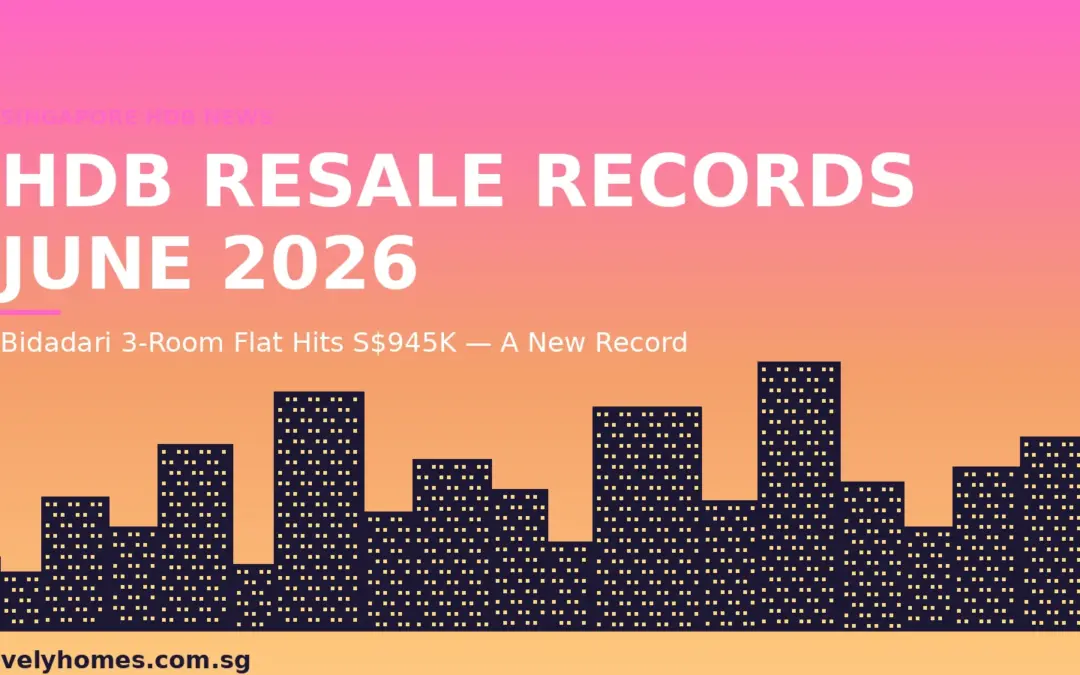
  • A 3-room HDB resale flat at 118A Alkaff Crescent, Bidadari sold for S$945,000 in June 2026 — a new all-time record for 3-room HDB resale flats in Singapore.
  • The flat is on the 16th–18th floor, spans approximately 72 sqm, achieved S$1,219 psf, and has a remaining lease of approximately 93 years 6 months.
  • This surpasses the previous record of S$930,000 set in October 2025 (also at Alkaff Crescent, Bidadari).
  • Bidadari commands a structural premium driven by its park integration, Woodleigh MRT access, and comparatively newer lease commencing from 2019.
  • Singapore’s overall HDB resale market remains active in mid-2026, with million-dollar HDB transactions continuing at pace.
  • The record does not mean all 3-room flats are heading there — location, floor, lease, and estate quality are the primary valuation drivers.

Bidadari 3-Room Flat Breaks S$945,000 Record — June 2026

Singapore’s HDB resale market registered another record in June 2026: a 3-room flat at 118A Alkaff Crescent in the Bidadari estate changed hands at S$945,000, the highest transacted price ever recorded for a 3-room HDB resale flat in Singapore. The unit sits on the 16th to 18th floor, has a floor area of approximately 72 sqm (775 sqft), and achieved a price per square foot of S$1,219. With the lease commencing in 2019, the remaining lease at transaction is approximately 93 years and 6 months — among the longest available in the HDB resale market, which is itself a key pricing driver.

The transaction surpasses the previous 3-room record of S$930,000, transacted in October 2025 at 115C Alkaff Crescent — also in Bidadari, and also on a high floor. The fact that both records come from the same estate is not a coincidence.

Why Bidadari Commands a Premium

Bidadari was Singapore’s most ambitious HDB estate design project in a generation. Developed as part of the Bidadari Masterplan by HDB and URA, the estate integrates an 11-hectare Heritage Lake, the 10-hectare Bidadari Park, a network of park connectors, and a biodiversity corner into a residential development that was always intended to feel different from standard HDB estates. The flats — BTO from approximately 2016 to 2019 in multiple phases — only entered the resale market from around 2022 onwards (after the 5-year Minimum Occupation Period).

Key structural reasons for Bidadari’s premium:

  • New lease, long remaining tenure: BTO flats built from 2016–2019 have leases starting then, meaning buyers in 2026 receive approximately 90–93 years of remaining lease — more than almost anywhere else in the resale market, where mature-estate flats commonly carry 60–75 years of remaining lease.
  • Woodleigh MRT (NE Line): Direct MRT access to the city and Dhoby Ghaut interchange within approximately 10 minutes.
  • Park integration: The park, lake, and heritage biodiversity corner are physical amenities baked into the masterplan — not afterthoughts. Buyers pay for this.
  • School catchment: Cedar Girls’ Secondary School, Woodleigh Primary School, and proximity to MacPherson are among the school catchments residents cite.
  • Limited supply: Bidadari was a single-phase estate — HDB does not develop more land there. Once the original BTO batches are fully occupied and past MOP, supply is capped.

Context: HDB Resale Price Records in Singapore 2026

The S$945,000 Bidadari 3-room transaction sits within a broader 2026 narrative of continued HDB resale price pressure in select estates. Singapore’s million-dollar HDB transaction count — flats transacting above S$1 million — has remained elevated since the post-pandemic 2021–2022 surge, though the rate of new records has moderated as buyers absorb the impact of ABSD increases and interest rate adjustments.

  • Million-dollar HDB transactions continue to occur primarily in Bishan, Queenstown, Toa Payoh, Buona Vista, and Central for large flat types.
  • Bidadari has emerged as the standout performer for smaller flat types (3-room and 4-room), where its premium lease and park access translate into record psf figures.
  • Towns with very short remaining leases (below 60 years) are seeing growing price bifurcation — buyers have become acutely lease-aware since TDSR and CPF withdrawal rules tightened the cost of buying short-lease flats.
  • The HDB resale price index for 2H 2025 rose approximately 2.6% according to HDB flash data, and the market remains seller-favoured in premium estates.

What This Means for Buyers

If you are a first-time buyer targeting an affordable 3-room resale flat, Bidadari is now firmly out of range for most standard grant stacks. A S$945,000 resale flat requires substantial cash and CPF — buyers would need balances well above the S$800,000 level at which most bank valuations on 3-rooms settle, with any gap above valuation payable in cash. A buyer with strong CPF savings and Family Grant eligibility can still structure a purchase — the long remaining lease makes CPF usage efficient compared to older stock.

For upgraders and investors, the Bidadari record confirms that premium HDB locations with newer leases increasingly behave like a sub-segment of their own — the S$1,200+ psf that Bidadari 3-room units now command exceeds the psf of many suburban OCR freehold condos purchased in the early 2010s.

Perspective check: A S$945,000 3-room HDB flat is extraordinary, but should be read as a record for a specific product type (high-floor, premium estate, newer lease) — not an indicator of where Singapore’s median 3-room flat trades. The vast majority of 3-room resale transactions in 2026 occur between S$350,000 and S$550,000 in mature towns.

HDB Resale Trends to Watch in 2H 2026

  • URA Q2 2026 Flash Estimates: Not yet released as of 1 July 2026. When released, these will clarify whether the overall market continued to appreciate or moderate in April–June 2026.
  • Interest rate trajectory: SORA-based mortgage rates have been influenced by US Federal Reserve policy. Any easing supports higher sustainable prices; tightening would dampen buyer capacity.
  • MOP releases from 2021–2022 BTO exercises: A significant number of BTO flats from 2021–2022 will reach their 5-year MOP from 2026 onwards, adding resale supply in newer estates including Tengah, Tampines, and Kallang/Whampoa.
  • Policy risk: Singapore’s government has historically moved quickly to cool the property market when transaction volumes and prices exceed policy comfort levels.

Frequently Asked Questions

Can I use CPF to buy a high-price HDB resale flat like those in Bidadari?

Yes, CPF can be used to purchase any HDB resale flat, including those at S$900,000+. However, the CPF Valuation Limit applies: you can only use CPF up to the assessed valuation of the flat (not the transacted price, if it is higher). For a S$945,000 transaction where the bank values the flat at S$900,000, your CPF usage is capped at S$900,000 combined (inclusive of BSD). The gap between transacted price and valuation must be paid in cash.

Why are Bidadari flats so expensive compared to nearby mature estates?

Bidadari’s premium over comparable mature estates (e.g., Toa Payoh or MacPherson) reflects the combination of new lease (93–95 years remaining vs. 60–75 in nearby mature towns), exceptional park and MRT integration, and scarcity of supply. Toa Payoh 3-room flats on high floors typically transact at S$600,000–S$750,000 — Bidadari commands a 25–35% premium. Buyers are pricing in 20–30 extra years of lease and the park lifestyle premium, both broadly rational given how the Singapore HDB market values lease longevity.

Are there more record-breaking transactions likely in Bidadari?

It is plausible, though not certain. Bidadari’s highest-floor units in the most sought-after blocks are a finite pool. As each generation of owners hits MOP and selectively sells, the next wave of premium transactions will depend on whether buyer demand remains strong enough to absorb these prices. Given the 90+ year leases running to 2112–2115, demand from younger, longer-horizon buyers is likely to remain robust in the near term.

Related Articles

Disclaimer

This article is for general information only and does not constitute financial or property advice. Transaction data is sourced from publicly available HDB resale records. Remaining lease and floor information are indicative based on published reports. Always verify current data with the Housing & Development Board (HDB) before any property transaction. Consult a licensed financial adviser and a licensed conveyancing solicitor for advice specific to your circumstances.
×Click anywhere to close

Singapore REITs vs Direct Property Investment 2026: Where S$200,000 Works Harder

Singapore REITs vs Direct Property Investment 2026: Where S$200,000 Works Harder

When a Singapore investor with S$200,000 sits down to think about property exposure, the choice is rarely abstract. They can buy a stake in 20 to 80 institutionally-managed Singapore properties through the SGX-listed S-REIT universe — getting a 5.5% to 8.0% distribution yield, daily liquidity, and zero ABSD friction. Or they can put the same capital down on an OCR 1-bedroom condo with a 75% LTV bank loan, capturing the gearing-amplified capital appreciation but absorbing transaction taxes, vacancy risk, and the labour of being a landlord. This guide quantifies both paths in 2026 numbers, with a side-by-side worked example, an 11-row structural comparison, and a sector-level look at where the S-REIT yield band sits today.

Quick Answer

  • S-REITs deliver a 5.5% to 8.0% distribution yield in 2026 and trade on SGX with T+2 settlement.
  • Direct property in Singapore yields 2.5% to 4.0% gross rental and 4 to 6 weeks to transact.
  • S-REIT distributions to individual unitholders are tax-free; rental income is taxed at the marginal rate.
  • S-REITs are capped at 50% gearing (MAS Property Funds Code); residential mortgages allow up to 75% LTV.
  • Direct property carries BSD 1% to 6%, ABSD 5% to 60%, plus property tax, MCST, vacancy and refurbishment cost.
  • On a S$200,000 allocation, a 6.5% S-REIT portfolio nets ~S$12,800 a year vs ~S$8,300 on a S$650k OCR 1BR (5% cash + 25% down).
  • S-REITs lose to direct property only on capital-appreciation leverage and control over tenant + rent.
Singapore REITs vs direct property investment 2026 hero
LovelyHomes — S-REITs vs direct property: structural differences that change the answer in 2026.

What is an S-REIT?

A Singapore REIT is a publicly-listed trust that holds a portfolio of income-producing real estate and is required by MAS regulation to distribute at least 90% of its taxable income to unitholders annually. In return, the REIT itself pays no corporate tax on that distributed income. The Singapore S-REIT market dates back to 2002 (CapitaLand Mall Trust, the first listing) and has grown to over 40 names spanning industrial, retail, office, hospitality, healthcare, and data-centre real estate.

S-REITs are governed by MAS’ Code on Collective Investment Schemes — Property Funds Appendix 6, which caps aggregate leverage at 50% of deposited property and limits permitted investments. The Code was tightened in 2020 (raising the gearing cap from 45% during COVID-stress) and reviewed in 2025 with no further structural change.

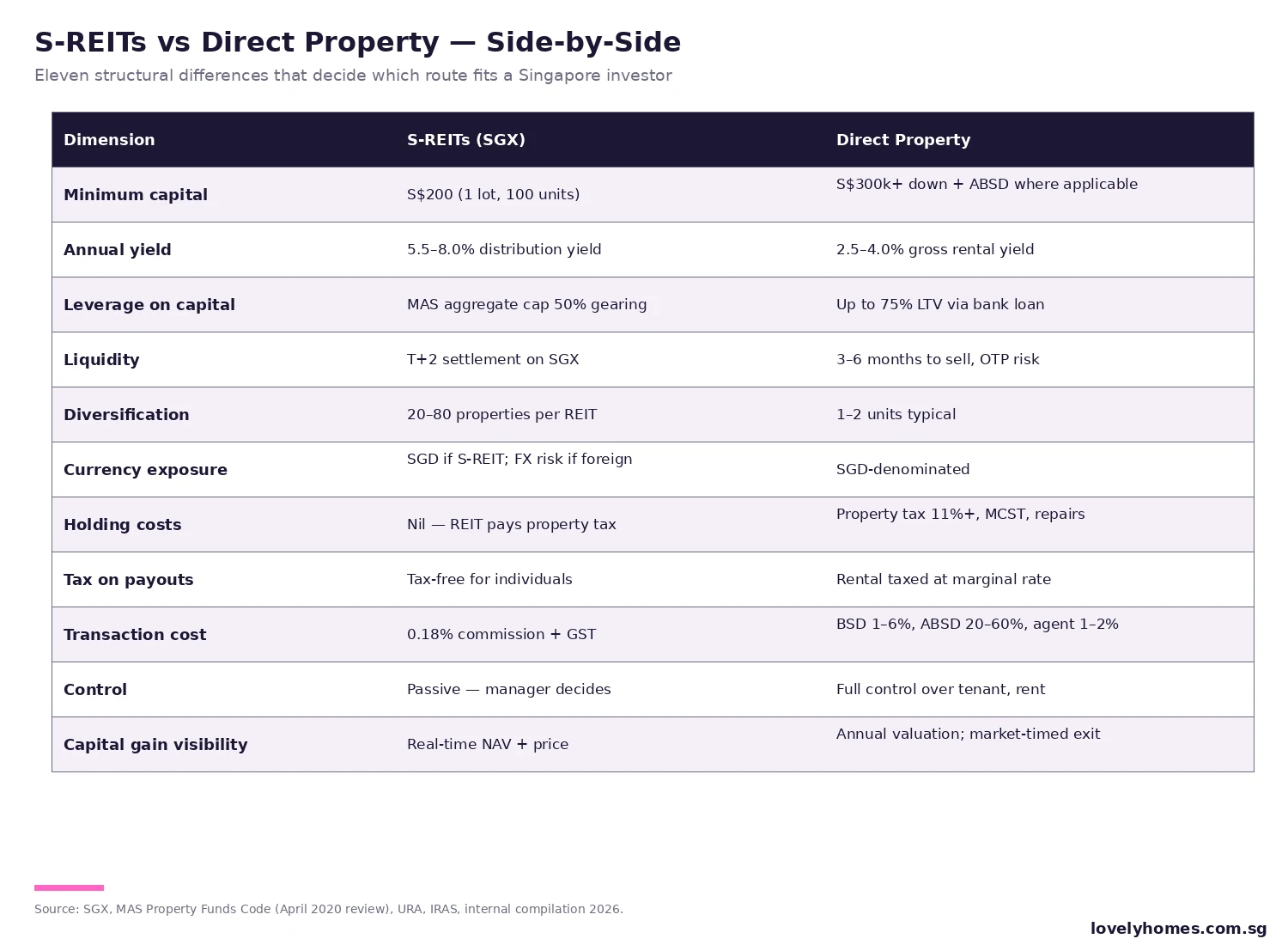
The 11-row comparison

S-REITs vs direct property comparison matrix Singapore 2026
Figure 1: structural comparison across capital, yield, leverage, tax, liquidity, control.

Where each route wins

S-REITs win on: minimum capital (S$200 vs S$250,000 down), yield (~6.5% vs ~3.5%), liquidity (T+2 vs months), diversification (one ticker = 20+ properties), tax (distributions are tax-free for individuals), and zero transaction friction (no ABSD, no property tax to manage, no MCST).

Direct property wins on: leverage (75% LTV vs 50% REIT gearing — the investor’s own gearing on top), capital-appreciation magnification (a 10% price gain on S$650k = S$65k against S$200k cash put down, a 32.5% return on capital), control (you choose tenants and rent), and historical capital growth (residential property prices have outpaced REIT NAV growth since 2010).

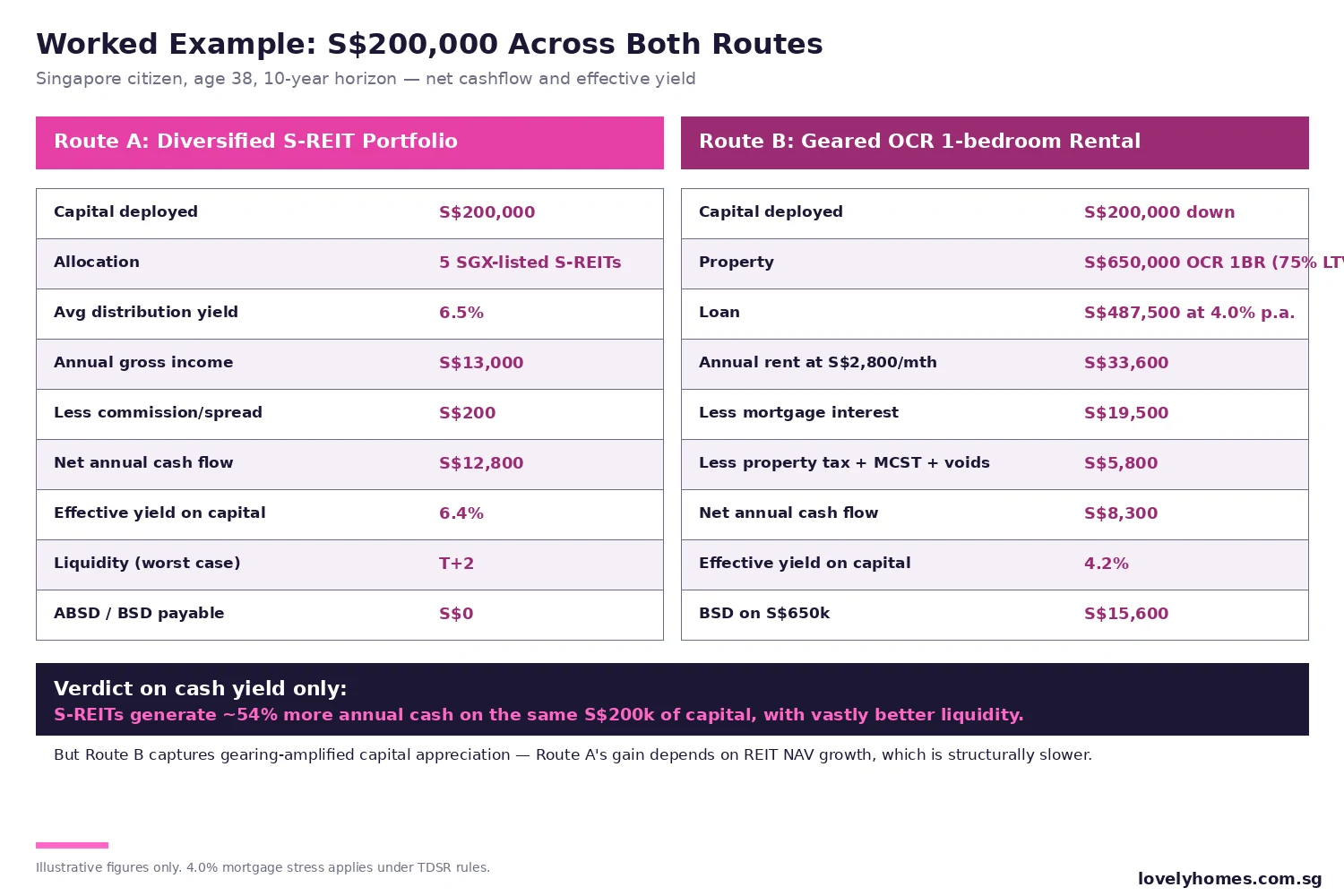
Worked Example: S$200,000 across both routes

S$200k REIT portfolio vs OCR 1BR rental yield Singapore 2026
Figure 2: side-by-side cash-flow comparison — S-REIT portfolio vs geared OCR 1-bed rental.

Route A — Diversified S-REIT portfolio. Investor allocates the full S$200,000 across five names: a logistics REIT (S$50k), a suburban-retail REIT (S$40k), an office REIT (S$40k), a healthcare REIT (S$35k), and a hospitality REIT (S$35k). Weighted average distribution yield: 6.5%. Annual distribution income: S$13,000. Less commission and bid-ask spread (~0.18% per round trip): S$200. Net annual cash flow: S$12,800. Effective yield on capital: 6.4%. No ABSD, no BSD, no property tax payable by the investor.

Route B — OCR 1-bedroom rental, 75% LTV. Investor uses S$200,000 across down-payment (S$162,500) plus BSD (S$15,600) plus legal/admin (~S$3,000) to acquire a S$650,000 OCR 1BR. Loan: S$487,500 at 4.0% interest p.a. (TDSR-stress rate). Annual mortgage interest: ~S$19,500. Annual rent at S$2,800/month: S$33,600. Less property tax (10% on annual value, AV ~S$24,000 = S$2,400), MCST + sinking-fund (~S$2,400), vacancy + repairs (~S$1,000): S$5,800 in holding costs. Net annual cash flow: S$33,600 − S$19,500 − S$5,800 = S$8,300. Effective yield on capital (S$200,000): 4.2%.

Headline verdict (cash yield only): S-REITs generate ~54% more annual cash on the same S$200,000 of capital, with vastly better liquidity. But Route B captures gearing-amplified capital appreciation — Route A’s gain depends on REIT NAV growth, which is structurally slower than residential capital growth in Singapore.

Capital appreciation — the gearing question

The most important hidden number in any property-vs-REIT comparison is gearing-amplified return. If the OCR 1BR’s value rises by 4% over a year, the property is worth S$676,000 — a S$26,000 capital gain. On the S$200,000 capital deployed, that is a 13% return on capital in a year, on top of the 4.2% rental yield. Total return: ~17.2%.

If the same year sees the S-REIT portfolio appreciate by 4% in unit price, the gain is S$8,000 on S$200,000 — a 4% return on capital, plus the 6.4% distribution. Total return: ~10.4%.

Note the asymmetry runs the other way too: a 4% decline in property value is a 13% loss on capital (before the rent helps offset). REIT-price declines hurt unit price by the same percentage but the loss on capital scales 1:1, not 3:1. Direct property is structurally a higher-volatility, higher-leverage instrument.

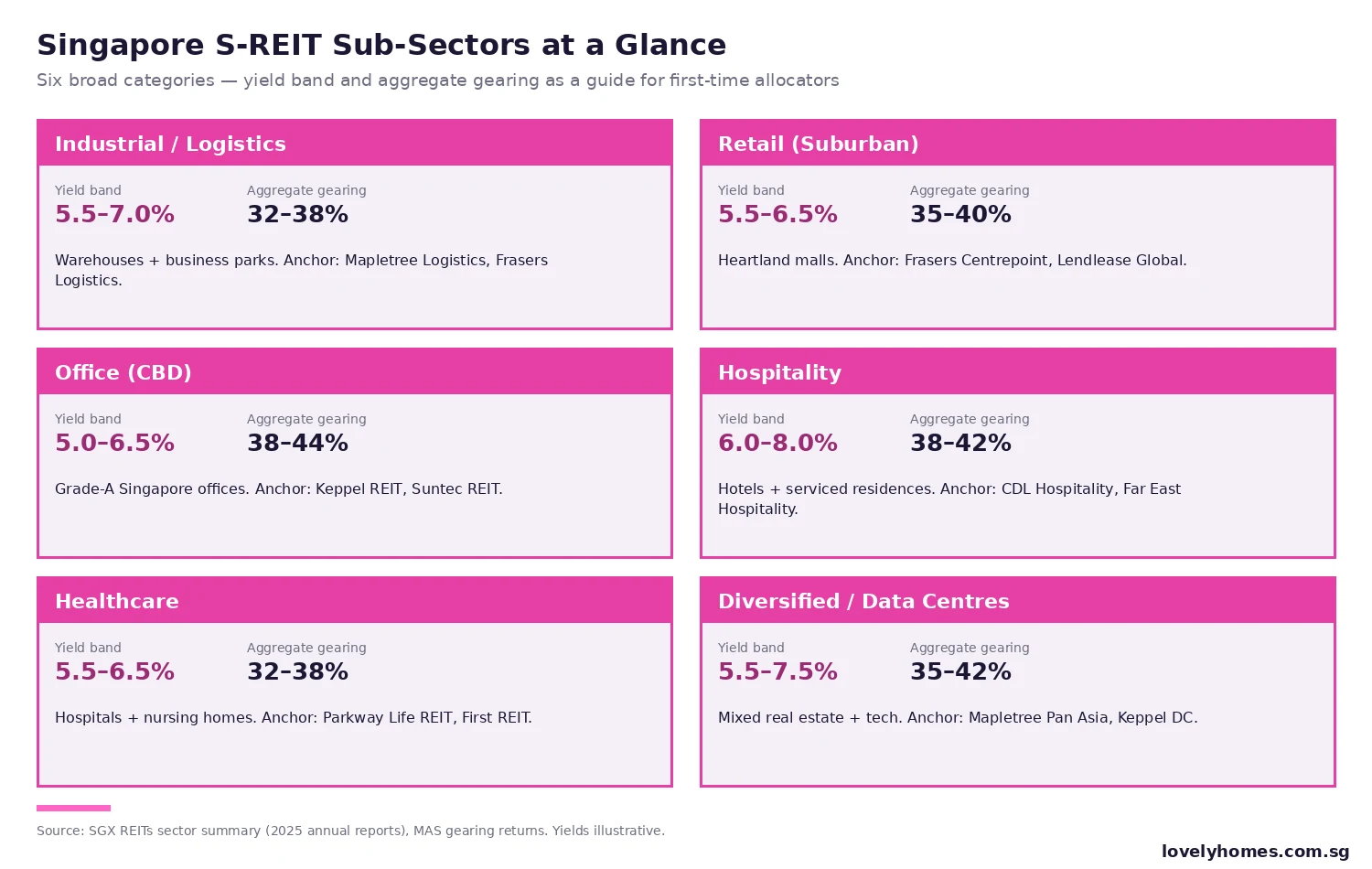
The S-REIT sector landscape in 2026

S-REIT sector overview Singapore 2026 yield gearing
Figure 3: six S-REIT sub-sectors with 2026 yield-band and aggregate-gearing snapshot.

Industrial / Logistics S-REITs sit in the 5.5% to 7.0% yield band, with gearing typically 32% to 38%. Demand is supported by warehouse rents and data-centre conversions. Suburban retail REITs trade at 5.5% to 6.5% on stable heartland-mall footfall — these are the closest REIT analogue to residential rental income (long lease, defensive demand). Office REITs sit at 5.0% to 6.5% with higher gearing (38% to 44%); CBD vacancy improvements through 2025 have anchored yields. Hospitality REITs are more cyclical at 6.0% to 8.0%; tourist-arrival recovery and weekend leisure demand are the swing factors. Healthcare REITs (5.5% to 6.5%) are the most defensive and have the lowest gearing. Diversified / data-centre REITs span 5.5% to 7.5% depending on their tech-asset weighting.

Summary table — when to choose which route

Investor Profile Recommended Route Reasoning
First-time investor, S$10k to S$50k S-REITs Diversified exposure at low minimum, tax-free distributions, no ABSD risk.
Cash-yield-focused, S$200k+, no ABSD remission S-REITs Higher net cash on capital, no transaction friction, daily liquidity.
First-property buyer, owner-occupier Direct property Owner-occupier route attracts no ABSD; CPF can be deployed; capital-appreciation leverage substantial.
Long-horizon (10+ year), comfortable with leverage Direct property + small S-REIT sleeve Capture 75% LTV gearing while keeping liquid REIT exposure for diversification.
Foreigner or PR with ABSD friction S-REITs Avoid 30% to 60% ABSD; participate in Singapore real-estate returns through SGX.
Income-replacement near retirement S-REITs Steady tax-free distributions, no landlord obligations, easy estate planning.
Existing landlord seeking tax efficiency Hybrid Keep one well-located unit; rotate excess capital into S-REIT sleeve to reduce ABSD on additional residential.

What this means for you

The choice between S-REITs and direct property in Singapore is rarely binary — most professional investors run both. The honest framing is: if you do not need leverage, S-REITs deliver more cash yield with vastly less administrative burden. If you can deploy 75% LTV with discipline and you accept the volatility, direct property captures more of the long-run upside through gearing on a positively-trending asset class. ABSD changes the maths sharply: a Singapore citizen second-property buyer pays 20% ABSD on the entire purchase price, eroding ~3 years of expected rental yield in a single transaction. For PRs (30%) and foreigners (60%), ABSD essentially kills the direct-property arithmetic against a tax-free S-REIT distribution.

What might come next

MAS’ 2025 Property Funds Code review confirmed the 50% gearing cap with no immediate plan to lower or raise it. Looking ahead to 2027, three trends matter: (1) data-centre exposure within S-REIT portfolios is rising as developers convert older industrial space, (2) healthcare S-REITs may re-rate as Singapore’s ageing demographics push nursing-home demand, and (3) the SGX REIT ETF universe is consolidating — making one-ticker diversification cheaper than picking five names. On the direct-property side, the OCR 1BR yield band is unlikely to expand materially: completed unit supply is heavy (Faber Residence, LyndenWoods, Tengah Garden, Pinery, Vela Bay all delivering 2027 to 2029), but rental demand remains structurally underpinned by foreign-talent inflows and family decoupling.

FAQ

Can I use CPF to buy S-REITs?

Yes, partially. CPF Investment Scheme (CPFIS) allows up to 35% of investible CPF OA savings to be invested in approved S-REITs (the rest stays in OA earning 2.5%). Use the CPFIS-OA route for stable, established REITs; speculative or new listings are not on the approved list. The mechanics: open a CPFIS account at a participating bank, transfer eligible OA funds into it, and trade S-REITs through that account.

Are S-REIT distributions really tax-free?

For Singapore-resident individual unitholders, yes — distributions from Singapore-listed REITs holding Singapore real estate are tax-free. Two exceptions: distributions arising from non-property income (e.g. interest) may be taxed, and unitholders who hold REIT units through a corporate vehicle face corporate tax. Foreign-resident individuals may be subject to a 10% withholding tax on certain distributions; check the latest IRAS guidance.

What is the minimum to buy an S-REIT?

One lot equals 100 units. With S-REIT unit prices in 2026 ranging S$0.40 to S$3.00, the minimum is roughly S$40 to S$300. Some brokers offer fractional / odd-lot trading on SGX which lets you buy fewer than 100 units, though commissions are slightly higher per unit at small sizes.

How does ABSD interact with my decision?

ABSD applies to direct residential property at 0% (first-time SC), 20% (SC second), 30% (SC third+; PR first; foreigner discount), 60% (foreigner second), or other tier rates. ABSD does NOT apply to S-REIT purchases at any tier — the trust itself pays property tax on its assets, but the unitholder pays no transaction stamp duty beyond a small share-transfer duty (capped at S$10 per transaction historically). For PR and foreign buyers, this single difference often decides the route.

Is the 50% S-REIT gearing cap a problem?

Not for unitholders directly — it is the REIT’s own balance-sheet leverage. The cap caps the manager’s ability to add debt-funded acquisitions, which slows growth in expansionary cycles. Unitholders should focus on aggregate-gearing trends across their portfolio (target average 35% to 40% as a sleep-well number), interest-coverage ratios (≥3x is comfortable), and weighted-average debt maturity (target ≥3 years).

Do S-REITs ever cut distributions?

Yes — distributions move with portfolio income. Hospitality REITs cut distributions sharply in 2020 to 2021 during the pandemic-driven travel collapse. Office REITs cut distributions in 2024 when CBD vacancy rose. Healthcare and industrial REITs were materially less volatile. Diversification across sub-sectors is the standard mitigation, and the 2020 crisis showed REIT distributions are more resilient than developer-share dividends but more volatile than direct rental income from a fully-tenanted unit.

If I already own one residential unit, should I still consider direct property?

It depends on your tax bracket and ABSD friction. A Singapore citizen second-property buyer pays 20% ABSD on the full price — that is roughly 5 years of net rental yield wiped out before the first rent cheque arrives. The case for a second residential unit improves materially if the buyer plans to live in it (no ABSD), is decoupling on a marriage event (s.33A IRAS rules require care), or is buying for a long-horizon family hold rather than yield. For PRs (30%) and foreigners (60%), ABSD friction is generally prohibitive against an equivalent S-REIT sleeve.

Related Articles

Disclaimer

This article is general guidance for Singapore investors weighing S-REIT exposure against direct residential property. S-REIT regulation sits with MAS via the Code on Collective Investment Schemes; market data is published by SGX; tax rules sit with IRAS. Yields and prices in worked examples are illustrative and based on April 2026 market levels. Consult a licensed financial adviser for advice tailored to your circumstances.

Tags: S-REITs, Singapore REITs, property investment, rental yield, ABSD, OCR 1BR, gearing, leverage, MAS Property Funds Code, SGX, CPF Investment Scheme, distribution yield, REIT sectors, hospitality REIT, office REIT, industrial REIT, healthcare REIT.

Translate »