Singapore Leasehold vs Freehold Property Guide 2026: Price Premiums, CPF Rules and What to Buy

Singapore Leasehold vs Freehold Property Guide 2026: Price Premiums, CPF Rules and What to Buy

Quick Answer: Leasehold vs Freehold at a Glance

  • Three tenure types exist in Singapore: freehold (ownership in perpetuity), 999-year leasehold (effectively freehold for practical purposes), and 99-year leasehold (the most common for new private residential launches and HDB flats).
  • Freehold costs more upfront: industry figures show freehold non-landed condominiums typically command a 8–18% price premium over comparable 99-year leasehold properties in the same district, depending on location and age.
  • HDB flats are always leasehold: all HDB flats are on 99-year leases from the date of construction. You cannot own an HDB flat on a freehold basis.
  • CPF rules differ by remaining lease: properties with fewer than 60 years remaining on the lease attract CPF usage restrictions. Below 20 years, no CPF can be used at all.
  • Financing is affected at low lease terms: HDB loans are not available for flats with under 20 years remaining; bank financing is restricted for properties with short leases relative to the buyer’s age.
  • Lease decay is real but gradual: price discounts due to a short remaining lease are most pronounced below 60 years and accelerate sharply below 30 years. Above 60 years, the market generally treats leasehold and freehold as broadly equivalent in terms of financing and CPF eligibility.
  • En bloc potential favours leasehold: older 99-year leasehold properties in prime locations can be attractive candidates for collective sale (en bloc), which can deliver a premium to market value. Freehold sites are also acquired for en bloc but at different pricing dynamics.
  • For most owner-occupiers, tenure is secondary to location and price: a well-located 99-year flat in a mature estate typically outperforms a poorly-located freehold property over any reasonable holding period.

Understanding Singapore’s Property Tenure System

Singapore’s property tenure system is rooted in English land law and is administered by the Singapore Land Authority (SLA). Three forms of tenure exist for private residential property: freehold, 999-year leasehold, and 99-year leasehold.

Freehold means the land is owned absolutely by the titleholder, with no fixed expiry date. In law, freehold land reverts to the state only if the owner dies intestate with no heirs. As at 2026, approximately 30% of Singapore’s private residential properties are freehold or 999-year leasehold. Many of these are older developments in central districts such as D9, D10, D11 and D15, as well as Conservation Areas where the government has preserved the historical character of the built environment.

999-year leasehold is a colonial-era form of tenure that was commonly granted before the 1960s. For all practical purposes, a 999-year lease is indistinguishable from freehold in terms of financing, CPF eligibility and market pricing. A buyer today purchasing a 999-year leasehold property with, say, 940 years remaining will never face any lease-related constraints in their lifetime or those of their descendants.

99-year leasehold is the dominant tenure for most of Singapore’s private residential land released under the Government Land Sales (GLS) programme since the 1970s. New condominium launches on GLS sites are therefore almost always 99-year leasehold, as are all HDB flats and Executive Condominiums (ECs). The 99-year clock starts from the date the lease is issued by the state, which is typically close to the TOP date for new launches.

Freehold vs 99-year leasehold price premium by district Singapore 2026 D9 D10 D15 D19
Figure 1: Freehold price premium over comparable 99-year leasehold condominiums by district in 2026. The premium is highest in mass-market and OCR districts where leasehold supply dominates and freehold alternatives are scarce, and lower in CCR districts where both tenure types are abundant.

CPF Rules: How Remaining Lease Affects What You Can Use

The CPF Board applies a set of rules that link your eligibility to use Ordinary Account (OA) savings for a property purchase to the remaining lease of that property. These rules were tightened progressively in 2019 and remain in force as at August 2026.

The overarching principle is that the remaining lease at the time of purchase must be able to cover the youngest buyer to age 95. This is applied as follows. If the remaining lease is 60 years or more, the CPF Board imposes no restriction on OA usage — you can use your CPF OA to fund the downpayment, the loan repayments, and other allowable costs up to the Valuation Limit. This applies to the overwhelming majority of new launches and most resale condominiums less than 39 years old.

Where the remaining lease is between 20 and 59 years, the CPF OA usage is prorated. The formula is: CPF limit as a percentage of the property value equals the remaining lease divided by the reference lease of 95 minus the youngest buyer’s age. For example, a buyer aged 35 purchasing a property with 50 years remaining can use CPF up to: 50/(95-35) = 50/60 = 83.3% of the purchase price or valuation. Below 20 years of remaining lease, CPF cannot be used at all for the property purchase.

CPF withdrawal eligibility by remaining lease Singapore 2026 buyer aged 35 prorated above 60 years
Figure 2: CPF OA withdrawal eligibility as a percentage of purchase price by remaining lease for a buyer aged 35. Full CPF access requires at least 60 years remaining. Below 20 years, no CPF can be used. Prorated access applies in between.

Financing: How Banks Treat Leasehold Properties

Banks in Singapore apply their own lending policies on top of MAS LTV rules when assessing loans for leasehold properties. The key constraint is loan tenure: most banks require the loan to be repaid before the property lease expires, subject to a minimum remaining lease at loan maturity. In practice, this means:

For a 99-year leasehold condominium with, say, 78 years remaining, a buyer aged 35 applying for a 30-year loan would leave 48 years on the lease after the loan is repaid — which is generally acceptable. However, for a property with 45 years remaining, the same 30-year loan would leave only 15 years of lease, below what many banks consider adequate security. Banks will typically reduce the loan tenure or the quantum in such cases, effectively requiring a larger downpayment.

HDB concessionary loans impose additional restrictions: HDB does not provide loans for flats with fewer than 20 years remaining on the lease. For flats between 20 and 59 years remaining, HDB’s loan quantum is also subject to the CPF prorating rules described above.

Price Premiums and Investment Considerations

The freehold premium in Singapore is real but contested. Freehold land is inherently scarce — the government does not release new freehold GLS sites — so older freehold developments hold a structural scarcity premium. In central districts (D9, D10, D11), where many freehold developments are Conservation properties or legacy buildings, the premium can be modest (8–11%) because the buildings themselves are ageing and require capital expenditure. In more suburban districts (D15, D19, D20), the premium can be higher (14–18%) because freehold alternatives are genuinely rare, so the scarcity commands a broader bid.

However, from a total-returns perspective, many studies of Singapore residential prices over the past two decades have found that well-located 99-year leasehold condominiums have outperformed freehold properties in absolute terms. This is because 99-year leasehold GLS sites are typically well-planned with good transport connectivity, while freehold developments are often older, built to lower gross floor area ratios, and lacking modern amenity standards. Location, connectivity and project quality tend to outweigh tenure over a 5–10 year holding period for a typical owner-occupier.

For investors with longer time horizons or en bloc aspirations, the calculus changes. An older 99-year leasehold development on a large freehold-equivalent plot in a prime location can attract collective sale interest as the lease erodes. En bloc collective sales can deliver 20–40% premiums above individual market value in some cases, depending on the development baseline rate, plot ratio uplift and prevailing land demand. Freehold developments are not immune to en bloc pressure — many freehold sites have been collectively sold in Singapore — but the pricing dynamics and developer appetite differ.

Freehold vs 99-year leasehold private non-landed price index Singapore 2016 to 2026 URA
Figure 3: Illustrative private non-landed residential price index for freehold and 99-year leasehold properties in Singapore (2016 = 100), based on URA REALIS transactional data and industry analysis. Both tenure types have appreciated meaningfully; leasehold indices reflect greater volume from new GLS supply cycles.

Summary Comparison: Freehold vs 99-Year Leasehold (2026)

Factor Freehold / 999-Year 99-Year Leasehold
Upfront price 8–18% premium in most districts Lower entry price; dominant in GLS pipeline
CPF eligibility Full CPF access (no restriction) Full access if 60+ years remain; prorated 20–59 years; none below 20 years
Bank financing Standard LTV/TDSR apply; full tenure flexibility Loan tenure constrained by remaining lease at maturity
En bloc potential Developer interest; pricing dynamics differ Higher en bloc momentum as lease erodes in prime locations
State acquisition risk Compulsory acquisition at market value; no lease expiry Lease expires; building must be returned to state at end of lease
Supply scarcity High; no new freehold GLS sites released Abundant; most new launches are 99-year leasehold
HDB flats Not available — HDB flats are always leasehold All HDB flats are 99-year leasehold
Short-term returns (5–10 yr) Strong; location and scarcity underpin value Often comparable or superior for well-located GLS projects

Worked Example: Comparing a Freehold and Leasehold Purchase in District 15

Mr and Mrs Lim, Singapore Citizens in their early 40s, are considering two units in the East Coast area. Option A is a freehold two-bedroom condominium unit priced at S$1,480,000 in a 30-year-old development. Option B is a 99-year leasehold two-bedroom unit in a newer development (15 years old, 84 years remaining lease) priced at S$1,260,000. Both offer similar floor areas and are within 500 metres of each other.

Upfront costs — Option A (Freehold):
Purchase price: S$1,480,000.
BSD: S$42,600.
ABSD: Nil (first private property for both SCs).
Bank loan (75% LTV): S$1,110,000. Cash downpayment (5%): S$74,000. CPF downpayment: S$296,000.
Legal fees: ~S$3,800.
Total upfront: approximately S$420,400 (cash S$74,000 + CPF S$296,000 + BSD/legal S$46,400 in cash or CPF).

Upfront costs — Option B (99-year, 84 years remaining):
Purchase price: S$1,260,000.
BSD: S$35,600.
ABSD: Nil.
Bank loan (75% LTV): S$945,000. Cash downpayment (5%): S$63,000. CPF downpayment: S$252,000.
Legal fees: ~S$3,500.
CPF eligibility: 84 years remaining is well above 60-year threshold — full CPF access. PASS.
Total upfront: approximately S$354,100 (cash S$63,000 + CPF S$252,000 + BSD/legal S$39,100).

Monthly commitment comparison:
Option A at 3.5% over 30 years: ~S$4,984/month.
Option B at 3.5% over 30 years: ~S$4,241/month.
Monthly saving with Option B: ~S$743.

Price break-even analysis:
To justify the S$220,000 price premium for the freehold unit, Mr and Mrs Lim need Option A to outperform Option B by that margin over their holding period. Over 10 years at 1.5% per annum additional appreciation on the freehold unit, the gap closes to approximately S$168,000 — not quite closing the premium. Over 15 years at 2% per annum additional appreciation, the premium is essentially erased. The conclusion: the freehold premium is not guaranteed to be recovered within a typical 10-year holding period, particularly for an older building with higher maintenance costs.

Why This Matters: Tenure, Policy and Long-Term Wealth

Singapore’s approach to land tenure reflects a deliberate policy choice by the state to retain long-term control over land use and redevelopment. By issuing 99-year leases for most GLS land, the government retains the ability to reconfigure land use as Singapore’s needs evolve over generations, without compensating landowners for the underlying land value. This is a fundamental structural reality of the Singapore property market: unlike most Western countries, there is a finite duration to most private property ownership.

For wealth planning purposes, the key implication is that freehold property can be held across multiple generations without the complication of lease expiry, whereas 99-year leasehold property is ultimately a depreciating asset whose residual value approaches zero as the lease nears expiry. In practice, almost no privately-held 99-year leasehold development in Singapore has yet reached lease expiry — the oldest leases date from the 1960s and are still in the 30–40 years remaining range. As more leases approach the 30-year and below threshold, the market will price in lease decay more aggressively, and both the CPF restrictions and financing limitations will affect a larger proportion of resale transactions.

What Might Come Next: Leasehold Policy Outlook

The government has signalled, through periodic Parliamentary responses, that there is no plan to introduce a blanket lease extension programme similar to that of Hong Kong (where the government offered 50-year lease renewals in 1997). HDB’s Voluntary Early Redevelopment Scheme (VERS) and the legacy SERS programme are the primary mechanisms for addressing ageing flats, but both are selective and not available to all estates. This means buyers of older HDB resale flats with under 60 years remaining should not plan their financial returns around the assumption of a lease extension.

For private properties, individual freehold extensions of 99-year leasehold land are theoretically available from SLA but are rare and expensive (typically at market rate for the additional lease years, often hundreds of thousands of dollars per unit). The practical mechanism for older 99-year leasehold private developments is en bloc collective sale to a developer who will clear and redevelop the site. This has historically delivered meaningful premiums to unit holders, but is contingent on 80% consent from the MCST, market appetite, and urban planning parameters.

Frequently Asked Questions

Is a 999-year leasehold property the same as freehold for practical purposes?

For all practical purposes, yes. A 999-year leasehold property is treated identically to a freehold property by banks, the CPF Board, and the market. The lease term is so long that no buyer, lender or regulator needs to factor in lease decay. In valuation practice, 999-year leasehold and freehold properties are assessed as equivalent, and you will not face CPF restrictions or financing limitations based on the tenure type. The only theoretical distinction is that a freehold titleholder owns the land absolutely, whereas a 999-year leaseholder has a lease from the state.

Can I use CPF to buy an old HDB flat with fewer than 60 years remaining?

Yes, but with a prorated limit. If the remaining lease is between 20 and 59 years, your CPF usage is capped at (remaining lease / (95 minus your age)) as a percentage of the purchase price or valuation. For example, a buyer aged 40 purchasing an HDB flat with 45 years remaining can use CPF up to 45/(95-40) = 81.8% of value. If the remaining lease is below 20 years, no CPF can be used at all. Note that HDB’s concessionary loan is also unavailable for flats with under 20 years remaining. These restrictions are designed to ensure CPF savings are used for assets that will cover the buyer into retirement.

Does lease tenure affect ABSD or BSD calculations?

No. ABSD and BSD are computed on the purchase price or market value, whichever is higher, with no adjustment for lease tenure. A freehold property and a 99-year leasehold property of identical value attract the same BSD and ABSD. However, the fact that freehold properties typically command a higher price than comparable leasehold properties will result in higher absolute BSD and ABSD liabilities for freehold purchases. The tenure itself has no direct bearing on the stamp duty rate applied by IRAS.

If I buy a 99-year leasehold property and the lease expires, what happens?

At the end of the lease, ownership of the land and all structures on it reverts to the state at no cost. The property owner receives no compensation for the land value. In practice, this scenario is unlikely to affect most current owners: the vast majority of 99-year leasehold developments in Singapore were launched from the 1970s onwards, meaning the earliest leases will not expire until the 2070s. Long before expiry, the government or MCST will typically facilitate SERS, VERS or en bloc redevelopment. However, buyers of units in developments with, say, 30–40 years remaining should factor the eventual reversion into their financial planning.

Is buying freehold always a better investment than 99-year leasehold?

Not necessarily. Investment returns in Singapore property are driven primarily by location, connectivity, supply-demand dynamics and unit quality, not tenure alone. Many well-located 99-year leasehold condominiums near MRT stations in mature estates have delivered stronger total returns over 10–15 year holding periods than freehold counterparts in less accessible locations. The freehold premium may or may not be recovered depending on holding period, rental income and capital appreciation. For most owner-occupiers with a 5–15 year horizon, the tenure decision is secondary to buying a well-located, well-priced property that meets their lifestyle needs.

What is the VERS and how does it apply to HDB owners?

The Voluntary Early Redevelopment Scheme (VERS) is an HDB programme that allows residents of selected older HDB estates to vote on whether to return their flats to HDB in exchange for compensation, earlier than the lease expiry date. VERS is selective — not all estates are eligible — and requires a high proportion of residents to agree. Unlike the older SERS programme, which offered direct replacement flats, VERS compensation is monetary and the form and quantum of assistance for alternative housing are still being finalised by HDB. As at August 2026, VERS has not been rolled out to any estate on a full basis. Buyers of older HDB resale flats should not factor VERS payouts into their financial planning with certainty.

Related Articles

Disclaimer

This article is for general information and educational purposes only and does not constitute financial, legal or property advice. Tenure rules, CPF eligibility, financing conditions, and government policies are subject to change. Price premiums and market observations are indicative and based on industry data; they do not constitute a guarantee of future performance. Always consult a licensed financial adviser, conveyancing solicitor and the relevant government agencies before making any property purchase decision. Official sources: Singapore Land Authority (sla.gov.sg), CPF Board (cpf.gov.sg), HDB (hdb.gov.sg), URA (ura.gov.sg).
Singapore HDB Lease Decay Guide 2026: CPF Limits, Pricing Impact and What to Do

Singapore HDB Lease Decay Guide 2026: CPF Limits, Pricing Impact and What to Do

Quick Answer

HDB flats are sold on 99-year leases. As the remaining lease shortens, CPF withdrawal limits decrease, bank financing becomes more restricted, and resale prices face steeper discounts. The key threshold for CPF is whether remaining lease covers the youngest buyer to age 95. Below 20 years remaining, CPF and HDB loans are not available at all. Understanding these thresholds before buying a resale flat can save you from a financing shortfall.

Every HDB flat in Singapore comes with a 99-year lease. On the day a flat is built, it has 99 years remaining. Each passing year reduces that number by one. This slow reduction is what property professionals call lease decay, and it has real, measurable effects on what you can borrow, how much CPF you can use, and what your flat will eventually sell for.

Most first-time HDB buyers focus on location, floor level, and facing. Lease decay is an afterthought. But for resale flat buyers, where flats may already be 20, 30, or 40 years old, understanding the financing thresholds and price trajectory tied to remaining lease can be the difference between a sound purchase and an expensive mistake.

This guide explains the mechanics, the numbers, and the decisions.

1. What Is HDB Lease Decay?

HDB flats are not freehold. When you buy a flat from HDB or on the resale market, you are purchasing the right to occupy that unit for the remaining duration of its 99-year lease. Once the lease expires, the flat reverts to HDB and the owner receives no compensation.

Lease decay is simply the passage of time reducing that remaining term. A flat built in 1985 began with 99 years from 1985. In 2026, it has approximately 58 years remaining. By 2050, it will have 34 years remaining. This trajectory is fixed, predictable, and unlike market value fluctuations, it cannot be reversed.

The effects of lease decay fall into three broad categories:

  • CPF withdrawal limits: CPF Board rules restrict how much OA savings you can use based on the flat’s remaining lease at the point of purchase.
  • Financing limits: Both HDB concessionary loans and bank mortgages have maximum loan tenures tied to remaining lease, and loans are unavailable below certain thresholds.
  • Resale price: Buyers who cannot use CPF or obtain standard financing will pay less, reducing market demand and price relative to newer flats.

2. How Remaining Lease Affects CPF Usage

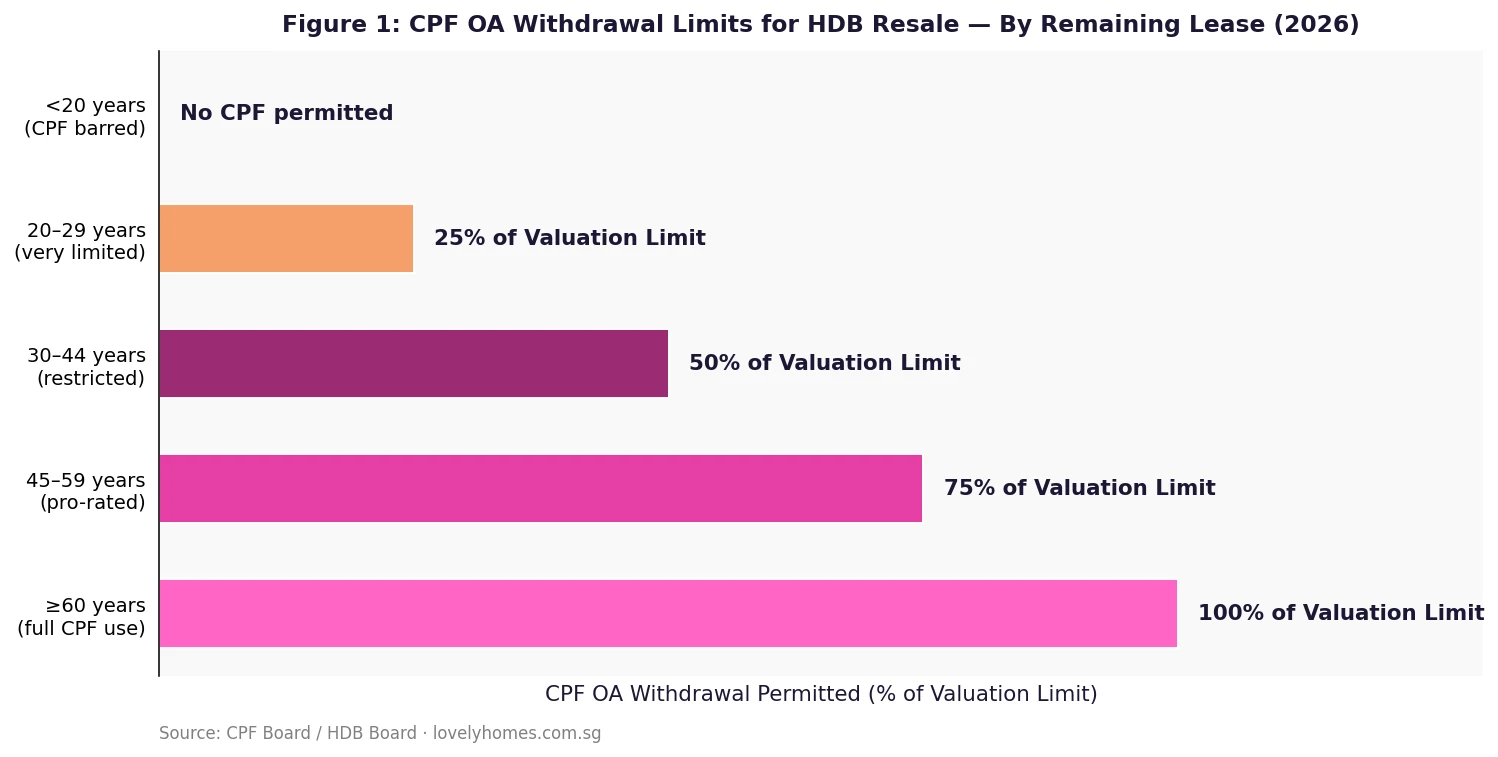
CPF Board applies a straightforward test: can the flat’s remaining lease cover the youngest buyer in the transaction to at least age 95? The answer determines how much OA savings can be used.

The 95-Year Coverage Test

Add the youngest buyer’s current age to the flat’s remaining lease at the point of purchase. If this sum is 95 or more, the buyer can use their full CPF OA savings (up to the Valuation Limit, which is the lower of purchase price and valuation).

If the sum is below 95 but the remaining lease is at least 20 years, CPF usage is allowed but capped. The cap is calculated as:

CPF Limit = Purchase Price x (Remaining Lease) / (95 minus Youngest Buyer’s Age)

If the remaining lease is below 20 years, CPF cannot be used for the purchase at all.

Condition CPF OA Usage
Buyer age + remaining lease ≥ 95 Full CPF OA usable (up to Valuation Limit)
Buyer age + remaining lease < 95, but remaining lease ≥ 20 years Prorated CPF: Purchase Price × Remaining Lease ÷ (95 − Buyer Age)
Remaining lease < 20 years No CPF withdrawal allowed
CPF OA withdrawal limits for HDB resale flats by remaining lease Singapore 2026
Figure 1: CPF OA withdrawal limit as a percentage of purchase price for a 35-year-old buyer, across different remaining lease lengths. The prorated zone begins when remaining lease falls below 60 years for this buyer (95 minus 35 = 60).

Why This Matters in Practice

Most Singaporean homebuyers rely heavily on CPF for the downpayment and mortgage servicing. If CPF is prorated or unavailable, you must substitute cash. For a $500,000 flat where CPF is capped at 70% of the purchase price, you would need an extra $150,000 in cash compared to buying a flat where full CPF applies.

3. HDB Loan and Bank Financing Limits

HDB Concessionary Loan

HDB’s concessionary loan (currently at 2.6% per annum as of 2026, pegged to CPF OA rate plus 0.1%) is available only if the flat’s remaining lease is at least 20 years. The maximum loan tenure under an HDB loan is 25 years, subject to the following conditions:

  • Remaining lease must cover at least 20 years.
  • Loan tenure cannot exceed the remaining lease minus 5 years.
  • Buyer’s age plus loan tenure cannot exceed 65 years (for HDB loans).

Bank Mortgages

Banks generally follow similar rules but may apply stricter criteria. For a flat with fewer than 30 years remaining lease, many banks will decline to extend a mortgage at all. For flats with 30 to 60 years remaining, the maximum loan tenure is typically the remaining lease minus 5 years or 30 years, whichever is lower. The shorter tenure means higher monthly instalments for the same loan amount.

Remaining Lease HDB Loan Bank Loan
75 years and above Up to 25 years Up to 30 years (standard)
50 to 74 years Up to 25 years (if age permits) Up to 25 to 30 years (lender-dependent)
30 to 49 years Up to 25 years (if age permits) Restricted; many banks decline
20 to 29 years Tenure = lease minus 5 years (max 25) Very limited; most banks decline
Below 20 years Not available Not available

4. How Remaining Lease Affects Resale Price

The financing constraints described above directly translate into price pressure. When fewer buyers can use CPF or access a standard loan, effective demand for the flat shrinks. Sellers must price at levels accessible to cash-heavy buyers, who expect a discount for taking on more risk and using more of their own capital.

Academic research and market experience suggest the following broad discount pattern relative to comparable newer flats in the same estate:

Remaining Lease Typical Price Discount vs Newer Flats Key Financing Issue
75 to 99 years Minimal (<5%) None; full CPF and financing available
60 to 74 years 5 to 15% CPF prorated for younger buyers; bank tenure starting to shorten
40 to 59 years 15 to 30% CPF significantly prorated for most buyers; bank loan tenure shortened
20 to 39 years 30 to 50% CPF severely limited; most buyers need substantial cash
Below 20 years 50% or more No CPF; no HDB or bank loan; cash purchase only

These are broad market observations, not guarantees. Individual flats can trade above or below these ranges depending on specific location, renovation quality, floor level, and the general property cycle.

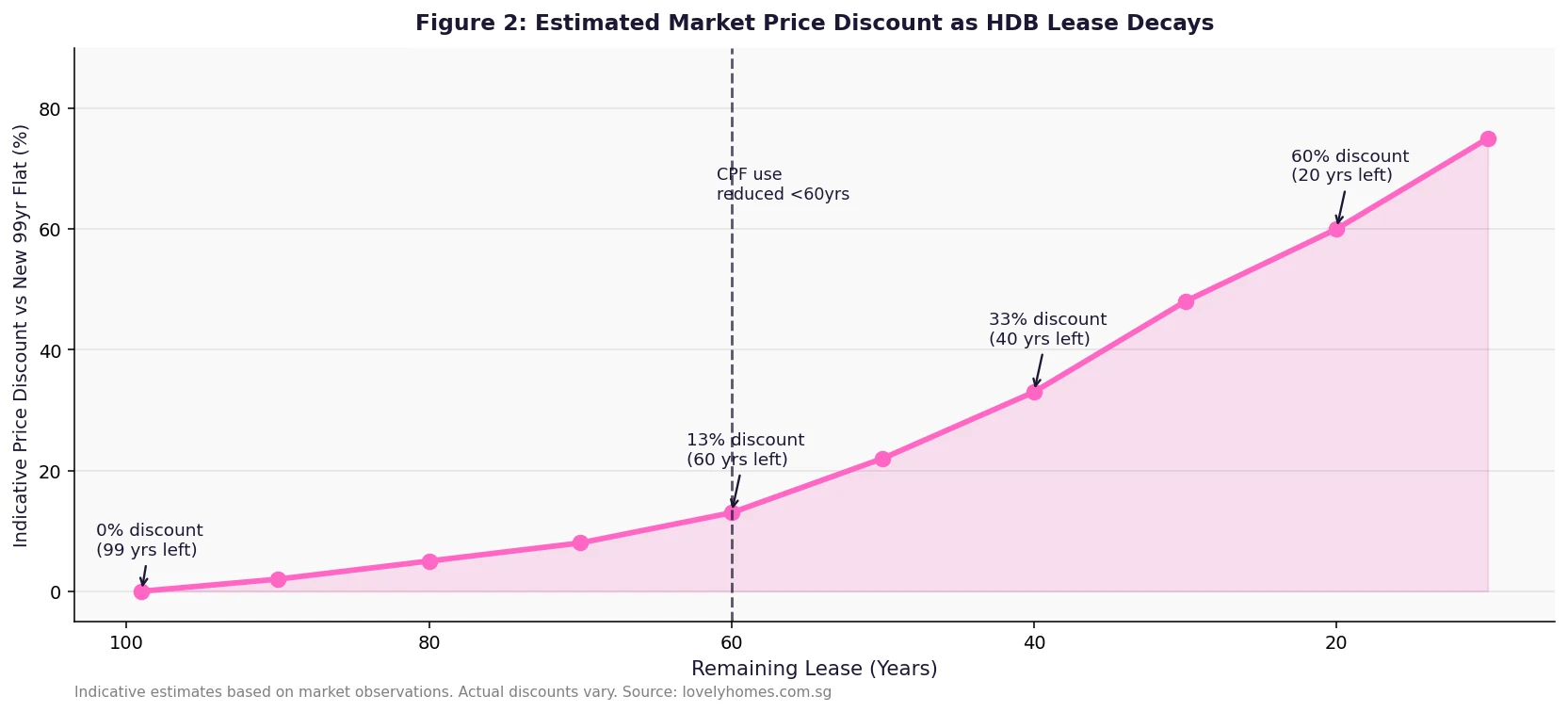
HDB lease decay price discount curve remaining lease years Singapore 2026
Figure 2: Illustrative price discount curve as remaining HDB lease shortens. The discount accelerates at the key financing thresholds (60 years, 40 years, 20 years).

5. Key Milestones on a 99-Year Lease

Understanding where a flat sits on its lease timeline helps buyers and sellers set realistic expectations.

Flat Age Remaining Lease Key Event or Implication
0 to 10 years 89 to 99 years New or near-new; full financing and CPF; MOP may still be running
10 to 30 years 69 to 89 years Peak resale years; prime window for SERS consideration by HDB
30 to 40 years 59 to 69 years SERS window closing; CPF starting to be prorated for buyers aged 30+
40 to 55 years 44 to 59 years CPF prorated for most buyers; bank tenure shortening; price discount emerging
55 to 75 years 24 to 44 years Significant CPF proration; bank financing very restricted; steeper price discount
79 to 80 years 19 to 20 years Critical threshold: CPF and HDB loan limits hit; below 20 years means cash only
Above 80 years Below 19 years No CPF; no loans; very limited buyer pool; deep price discount
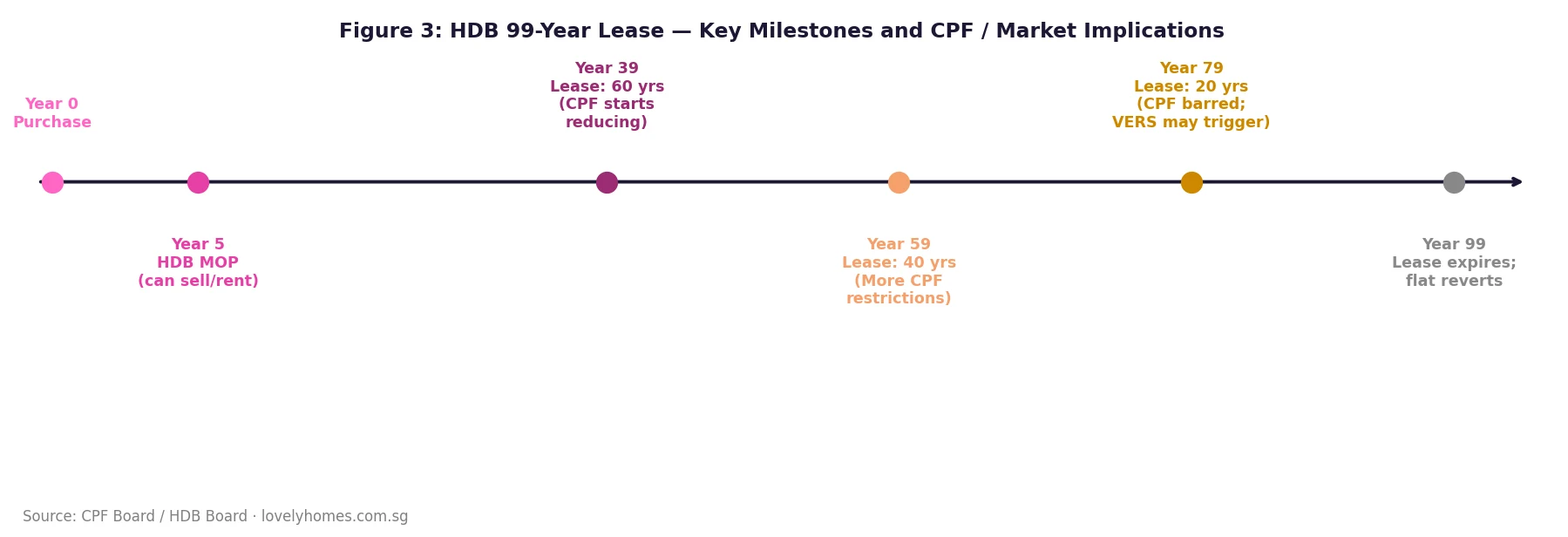
HDB 99 year lease key milestones CPF and market implications timeline 2026
Figure 3: Key milestones across a HDB flat’s 99-year lease, showing how CPF eligibility, financing availability, and resale market dynamics shift over time.

6. Worked Example

Scenario: Sarah, aged 38, buying a resale 4-room flat with 52 years remaining lease, priced at S$560,000

Step 1: CPF eligibility test

Buyer age + remaining lease = 38 + 52 = 90

90 < 95, so CPF is prorated. Remaining lease (52 years) is above the 20-year floor, so some CPF is available.

Step 2: Calculate CPF cap

CPF Limit = S$560,000 × 52 ÷ (95 − 38)

= S$560,000 × 52 ÷ 57

= S$560,000 × 0.912

= S$510,700 maximum CPF (as a cap, not the amount in her account)

Step 3: HDB loan eligibility

Maximum loan tenure = min(52 − 5, 25) = min(47, 25) = 25 years

Age check: 38 + 25 = 63 ≤ 65. HDB loan is available.

Sarah can take an HDB loan for up to 25 years, making her monthly repayments manageable.

Step 4: Practical takeaway

Sarah can still buy this flat with CPF and an HDB loan. However, her CPF is capped at S$510,700 rather than the full S$560,000. The S$49,300 shortfall must come from cash savings, on top of the standard 10% minimum cash downpayment required by HDB. This is manageable but illustrates why lease decay matters even for flats with 50+ years remaining.

Contrast: Michael, aged 50, eyeing a S$350,000 flat with 18 years remaining lease

CPF test: 18 years < 20 years. No CPF allowed.

HDB loan: Remaining lease below 20 years. No HDB loan available.

Bank loan: Most banks will not lend. Very unlikely to get a mortgage.

Michael would need S$350,000 in cash plus stamp duty and legal costs. While the flat appears cheap, the full cash requirement means this is only viable for buyers with substantial liquid savings and an investment horizon that does not depend on resale proceeds in their retirement years.

7. Should You Buy a Short-Lease Flat?

There is no universal answer, but the following framework helps most buyers:

When a short-lease flat can work

  • You have substantial cash savings and do not need CPF or a mortgage loan.
  • You plan to use it for rental income and your yield calculation accounts for the cash outlay.
  • You intend to live in it yourself for 10 to 15 years and are not counting on significant resale proceeds.
  • The price discount is large enough that even a further decline in value still represents value for your purpose.

When to be cautious

  • You are relying on CPF OA savings for the downpayment and mortgage servicing.
  • You intend to sell and upgrade later: a short-lease flat may not fetch enough to fund an upgrade.
  • You are close to retirement and plan to use the flat’s value as part of your retirement funding.
  • You have limited cash savings beyond what you are putting into the purchase.

Note on SERS: The Selective En bloc Redevelopment Scheme (SERS) can dramatically change the calculus for older flats. However, SERS is selective and not guaranteed. Do not purchase a short-lease flat purely on the expectation of SERS selection. HDB has progressively noted that SERS will become less common as land constraints increase.

8. Frequently Asked Questions

What happens to a HDB flat when the 99-year lease expires?

When the lease expires, the flat reverts to HDB and owners receive no compensation. This is why remaining lease matters so much, particularly for buyers who plan to hold the flat into their older years or use it as a retirement asset.

Can I use CPF to buy a HDB flat with 50 years remaining lease?

Yes, but CPF will likely be prorated. For a 40-year-old buyer, 40 + 50 = 90, which is below 95. The CPF cap = Purchase Price × 50 ÷ (95 − 40) = 50/55 = about 91% of purchase price. The remaining 9% must come from cash.

Can I get a HDB loan for a flat with 25 years remaining lease?

Yes, if the remaining lease is at least 20 years. The maximum tenure is the lesser of 25 years or (remaining lease minus 5 years). For 25 years remaining, max tenure is 20 years. Your age plus loan tenure cannot exceed 65 years under an HDB loan.

Do older HDB flats sell for less?

Generally yes, especially once remaining lease falls below 60 years. The main driver is that financing and CPF become restricted for most buyers, reducing demand. Flats with 40 to 59 years remaining may trade at a 15 to 30% discount versus comparable newer flats in the same estate. Below 20 years, the buyer pool shrinks to cash purchasers only.

What is SERS and how does it affect lease decay?

The Selective En bloc Redevelopment Scheme (SERS) allows HDB to redevelop certain older estates, giving affected owners generous compensation and priority to buy a new replacement flat. SERS effectively resets the lease for affected owners. However, SERS is selective and applies to a small minority of estates; it should not be assumed when buying an older flat.

How do I find out how many years are left on a HDB flat’s lease?

The remaining lease for any HDB flat is shown on the HDB Resale Portal listing. You can also check via the Singapore Land Authority’s INLIS portal. The lease commencement date is stated in the flat’s title, and remaining lease is calculated from that date to today.

Disclaimer: This article is for general informational purposes only and does not constitute financial, legal, or property advice. CPF rules, HDB loan policies, and financing conditions may change. Verify all figures with CPF Board, HDB, and your bank before making any purchase decision. LovelyHomes accepts no liability for reliance on the information published here.

City Plaza En Bloc 2026: S$970 Million Collective Sale Launches After Three Attempts

City Plaza En Bloc 2026: S$970 Million Collective Sale Launches After Three Attempts

Quick Answer: City Plaza Collective Sale 2026 — Key Facts

  • Site: City Plaza, a freehold mixed-use development at Geylang Road and Tanjong Katong Road, District 14 (Rest of Central Region).
  • Guide price: S$970 million — approximately S$6,852 per sq ft of land area based on 141,503 sq ft site.
  • Third attempt: Previous bids in 2018 (S$1.05B, 53% consent) and 2021 (S$970M, 79.3% consent) fell short of the 80% threshold. The 2026 attempt is the first to cross 80%.
  • Tender: Public tender launched 11 August 2026; closing date 13 October 2026.
  • Current zoning: Commercial (URA Master Plan 2025, GPR 3.0) — no ABSD payable on acquisition.
  • Potential redevelopment: Written Outline Advice from URA supports a residential-led mixed-use redevelopment with commercial uses on the first storey — approximately 450 units in a 19-storey block.
  • Location: Approximately 300m from Paya Lebar MRT Interchange (East-West and Circle lines), adjacent to Paya Lebar Quarter and PLQ Mall.
  • Market context: Recent Paya Lebar area resale transactions range from approximately S$2,000 to S$2,360 psf; industry estimates suggest a future development could target S$3,000 psf or above.

I. Singapore’s En Bloc Market — City Plaza Breaks the Deadlock

Singapore’s collective sale (en bloc) market received a significant signal on 11 August 2026 when the owners of City Plaza, a freehold mixed-use development at Geylang Road and Tanjong Katong Road in District 14, launched a public tender at a guide price of S$970 million. This is the third collective sale attempt by the same building in eight years — and the first to successfully gather the 80% owner consent required under the Land Titles (Strata) Act to proceed to a public tender.

The launch marks a meaningful development for Singapore’s en bloc cycle. The successful crossing of the 80% consent threshold — after falling short in 2018 at 53% and coming within 0.7% of the threshold in 2021 at 79.3% — demonstrates the sustained pressure on property owners in well-located, aging commercial and mixed-use buildings to realise their land value through collective action.

City Plaza en bloc 2026 collective sale price history comparison Paya Lebar area PSF benchmarks chart
Figure 1: City Plaza Collective Sale — Three Attempts Compared and Paya Lebar Area Price Benchmarks (Source: URA, public records, industry estimates)

II. What Makes City Plaza Attractive to Developers

City Plaza occupies a 141,503 sq ft freehold site fronting Geylang Road and Tanjong Katong Road — an unusual positioning for a commercial strata title in the city fringe. At S$970 million, the land rate translates to approximately S$6,852 psf of land area, or approximately S$6,488 per sq ft per plot ratio assuming the GPR 3.0 under the URA Master Plan 2025 is maintained. These figures compress further if URA permits a higher GFA under Written Outline Advice — which has already been obtained ahead of the tender launch.

The Written Outline Advice from URA supports in principle the redevelopment of the site into a residential-led mixed-use development with commercial uses on the first storey. This guidance — while not a planning permission — signals URA’s receptivity to the redevelopment direction and removes a significant uncertainty for prospective bidders. A high-rise block of up to 19 storeys could potentially yield approximately 450 residential units based on an average unit size of around 85 sqm.

Under the current commercial zoning, no Additional Buyer’s Stamp Duty is payable on acquisition — a distinct advantage compared to residential en bloc sites, where developers face ABSD at 40% of the purchase price for any residential component. The ABSD saving on a S$970 million commercial acquisition is approximately S$388 million compared to an equivalent residential-zoned purchase. Industry figures indicate this structural advantage meaningfully improves the developer’s land cost economics and underpins developer appetite for commercially-zoned city-fringe en bloc sites.

The site is approximately 300 metres from Paya Lebar MRT Interchange, served by both the East-West Line and the Circle Line — making it one of the best-connected city-fringe locations in Singapore. It sits directly opposite Paya Lebar Quarter (PLQ), one of Singapore’s most successful mixed-use urban regeneration projects, and is adjacent to PLQ Mall, SingPost Centre and Kinex.

III. En Bloc Context — What Owners Receive

For City Plaza’s unit owners, the S$970 million collective sale price translates into individual payouts that vary by unit size and share value, but is understood to substantially exceed what owners could achieve by selling individual commercial units on the resale market. The 2021 attempt at the same guide price came within 0.7% of the required consent, ultimately failing because a small group of minority owners chose not to sign. The 2026 breakthrough suggests a shift in owner consensus, likely driven by the prolonged period of stagnant commercial unit values and rising maintenance obligations in the aging building.

Under the Land Titles (Strata) Act, minority owners who did not consent cannot block the tender once 80% consent is obtained. If the tender results in a successful bid, the sale proceeds to the Strata Titles Boards, which adjudicates any objection from minority owners on grounds of financial loss or failure to meet the good faith requirement. In practice, STB objections that meet the legal threshold for dismissal are resolved and the collective sale proceeds.

IV. Market Context — What Can the Site Achieve?

The Paya Lebar area has seen considerable residential price appreciation. Katong Regency, a freehold development above Kinex mall launched in 2012 at approximately S$1,608 psf, has recorded resale transactions crossing S$2,000 psf in recent years. Park Place Residences at PLQ, a 99-year leasehold development completed in 2019, recorded a two-bedroom unit at approximately S$2,359 psf in July 2026 based on caveats lodged.

Industry estimates — based on prevailing land costs, construction cost inflation and the freehold tenure premium — suggest that a new residential development on the City Plaza site could target launch prices of approximately S$3,000 psf or higher, subject to market conditions at the time of launch. At S$3,000 psf and an average unit size of approximately 915 sq ft, an average unit price would be approximately S$2.74 million, firmly in the luxury city-fringe segment that has shown resilience in Singapore’s post-cooling-measure environment. Any launch is unlikely before 2028–2029 given planning approvals and construction lead times.

Item Detail
Site name City Plaza, Geylang Road / Tanjong Katong Road, District 14
Tenure Freehold
Site area 141,503 sq ft (approx. 13,150 sqm)
Current zoning Commercial, GPR 3.0 (URA Master Plan 2025)
Guide price S$970 million (~S$6,852 psf land)
ABSD on acquisition None (commercial zoning)
Consent level Approximately 81% — above 80% statutory threshold
Tender launch 11 August 2026
Tender close 13 October 2026
URA Written Outline Advice Obtained — supports residential-led mixed-use redevelopment
Estimated units ~450 residential units (avg 85 sqm, up to 19 storeys)

V. What This Means for Singapore’s En Bloc Market

City Plaza’s successful 80% consent is a market signal. Singapore’s collective sale market was subdued from 2018 onward, following cooling measures that raised developer ABSD and sharpened the cost of land banking. The years 2020–2022 saw very few successful en bloc transactions. The period from 2024 onwards has seen a gradual recovery — the Berlayar Drive GLS tender award in August 2026, Lakeside Towers’ ongoing third-attempt collective sale, and now City Plaza’s launch all point to renewed developer appetite for well-located, accessible sites where the land-to-selling-price spread remains viable.

The commercial-zoning ABSD advantage is likely to attract interest from developers who can value both the residential upside and the retained commercial component on the first storey. For property owners in adjacent aging mixed-use developments — particularly in District 14, District 15 and the Geylang/Aljunied corridor — City Plaza’s progress is a data point worth watching. A successful tender close at or near S$970 million would crystallise comparable land values for neighbouring sites and could catalyse further collective sale attempts in the Paya Lebar precinct.

VI. What Might Come Next

The tender closes on 13 October 2026. If a bid at or above the reserve price is received, the collective sale committee will evaluate bids and, subject to conditions, submit the sale agreement to the Strata Titles Boards for approval. The STB process typically takes three to six months, after which the sale completes. Planning approval for the residential-led redevelopment would follow, with construction unlikely to begin before 2028 at the earliest.

If the tender closes without a qualifying bid — a possibility given rising construction costs and the prevailing interest rate environment — the committee may re-launch at a revised price, or the collective sale agreement will lapse. In that scenario, City Plaza’s owners would face the prospect of a fourth attempt, or continued ownership of an aging commercial development in an otherwise improving district.

VII. Frequently Asked Questions

Do minority owners who did not consent to the City Plaza collective sale have any recourse?

Yes. Minority owners who did not consent may file an objection with the Strata Titles Boards within the prescribed period after the collective sale agreement is lodged. The STB will consider objections on two grounds: whether the transaction is in good faith (having regard to the sale price, method of distribution and apportionment of proceeds), and whether the sale will result in the minority owners receiving less than they would from an individual sale of their unit. If neither ground is established, the STB approves the sale and minority owners are bound by it on the same terms as consenting owners. Objections based solely on personal attachment to the property are not valid grounds under the Land Titles (Strata) Act.

No ABSD on acquisition — does the developer pay no stamp duty at all?

The developer still pays Buyer’s Stamp Duty (BSD) on the acquisition at the standard tiered rates. On a S$970 million transaction, the BSD payable is approximately S$57.4 million. What the developer does not face is Additional Buyer’s Stamp Duty (ABSD) at 40% that would apply to a residential en bloc acquisition. For a S$970M deal, the ABSD saving versus a residential-zoned site is approximately S$388 million — a very material figure that significantly improves the developer’s land cost economics and effective land rate.

What happens to existing commercial tenants at City Plaza?

Existing commercial tenants will have their leases managed through the collective sale and completion process. The terms of any existing leases are disclosed to bidders as part of the tender documentation. Tenants typically receive formal notice of the collective sale and are bound by their lease agreements, which may include break clauses triggered by the property owner’s decision to redevelop. In most city-fringe mixed-use en bloc deals, tenant vacation occurs 12–18 months after tender award.

Could URA reject the residential-led redevelopment of City Plaza?

The Written Outline Advice from URA supports in principle a residential-led mixed-use redevelopment — an important, though non-binding, indicator of URA’s planning intent. Written Outline Advice signals that the redevelopment direction aligns with the URA Master Plan and planning guidelines, but it is not a planning permission. A formal planning application must be submitted and approved before development begins. Approval is generally anticipated given the Written Outline Advice, but remains subject to specific technical conditions at the detailed stage.

How does this compare to the Berlayar Drive GLS tender award in August 2026?

The Berlayar Drive GLS award (URA pr26-61, 7 August 2026) involved a 99-year leasehold Government Land Sales site along the Greater Southern Waterfront, awarded for approximately S$2.128 billion (S$14,243 per sqm GFA) for a residential development. City Plaza differs in several respects: it is a freehold site (versus 99-year leasehold), it involves a private collective sale (not a GLS), and the commercial zoning eliminates ABSD on acquisition. The two transactions are not directly comparable on a per-sqm basis, but both signal active developer interest in well-located Singapore sites in mid-2026.

Disclaimer: This article is intended as general information only. It does not constitute investment, legal or financial advice. All figures relating to potential redevelopment yields, unit prices, developer costs and market projections are industry estimates for illustrative purposes only, subject to market conditions and regulatory approvals. The collective sale tender outcome is unknown at time of publication. Always conduct independent due diligence and consult licensed professionals before making any property investment decision. Source data cross-referenced against URA publications (ura.gov.sg) and public caveats data.

Singapore Rental Yield Guide 2026: How to Calculate, Compare and Maximise Returns

Singapore Rental Yield Guide 2026: How to Calculate, Compare and Maximise Returns

Quick Answer — Singapore Rental Yield 2026 at a glance

  • Gross rental yield is annual rental income as a percentage of the property purchase price.
  • In Q2 2026, Singapore’s gross rental yields average 2.6%–3.8% for private condominiums and 3.5%–4.5% for HDB flats, depending on flat type, region, and bedroom count.
  • Net yield — after property tax, maintenance, agent commission, and vacancy — is typically 0.8–1.5 percentage points lower than gross yield.
  • HDB flat rents are subject to Minimum Occupation Period (MOP): 5 years for standard BTO/resale; 10 years for Plus/Prime BTO categories. Renting before MOP completion is not permitted.
  • Private property owners face no MOP restriction for renting; a property tax of 12% on the Annual Value (AV) applies to non-owner-occupied residential properties in 2026.
  • The URA Rental Index peaked in Q3 2023 (approximately 143.9, base Q4 2019=100) and has since moderated to around 137 in Q2 2026 — broadly in line with pre-2022 tightening.
  • The Seller’s Stamp Duty (SSD) holding period of up to 3 years means that investors buying today should plan for a hold of at least 3 years to avoid SSD on any future sale.
  • Foreigners buying residential property in Singapore face a 60% ABSD — making the maths of rental yield coverage particularly challenging versus alternative markets.

What Is Rental Yield?

Rental yield measures the annual rental income generated by a property investment as a percentage of its purchase price (or current market value). It is the primary metric used by Singapore property investors to evaluate and compare rental investment options. There are two forms of rental yield in common use:

Gross Rental Yield: Annual rent divided by purchase price, expressed as a percentage. If a condominium unit purchased for S$1,500,000 rents for S$5,000 per month, the gross yield is (S$5,000 × 12) / S$1,500,000 = 4.0%. This is the figure most commonly cited in property listings and market reports.

Net Rental Yield: Annual rent minus all recurring costs (property tax, maintenance fees, insurance, agent commission, and an allowance for vacancy) divided by purchase price. Net yield is a more accurate measure of actual investment return, though it requires reliable cost estimates that vary by property type and management style.

The difference between gross and net yield in Singapore is substantial — typically 0.8–1.5 percentage points — because of the progressive property tax structure for non-owner-occupied properties, which IRAS administers at rates of 12% of the Annual Value (AV) in 2026, plus maintenance fees that can range from S$200 to S$800+ per month for private condominiums.

Singapore gross rental yield by property type and region Q2 2026
Figure 1: Gross rental yields by property type and region, Singapore Q2 2026. HDB flats consistently yield higher gross returns than private condominiums, reflecting their lower purchase price relative to rental income.

Singapore Rental Yields by Property Type and Region (Q2 2026)

Rental yields in Singapore vary considerably by property type, region, bedroom count, and the age of the unit. The following data, drawn from URA and HDB’s transaction databases for Q2 2026, provides a reference point. Individual units will differ based on renovation quality, floor level, view, and proximity to MRT stations.

Property Type CCR (Core Central) RCR (Rest of Central) OCR (Outside Central) Typical Monthly Rent Range
1-Bedroom Condo 3.2% 3.5% 3.8% S$2,800–S$4,500
2-Bedroom Condo 2.9% 3.2% 3.5% S$3,500–S$6,500
3-Bedroom Condo 2.6% 2.9% 3.2% S$5,000–S$10,000
HDB 3-Room Flat 4.5% 4.2% 3.9% S$1,800–S$2,800
HDB 4-Room Flat 4.1% 3.8% 3.5% S$2,200–S$3,500
HDB 5-Room / Executive 3.7% 3.5% 3.2% S$2,800–S$4,500

Source: URA rental caveats; HDB rental statistics; LovelyHomes analysis, Q2 2026. Gross yield = (annual rent / purchase price) × 100%. HDB yield calculated against resale market price.

From Gross to Net: The Cost of Singapore Rental Property

Gross yield figures can be misleading because they do not account for the significant costs associated with owning a rental property in Singapore. To illustrate, consider a 2-bedroom condominium in the OCR with a gross yield of 3.8%.

Singapore net rental yield waterfall gross to net 2BR OCR condo 2026
Figure 2: From gross to net rental yield for a 2-bedroom OCR condominium, Singapore 2026. Each cost item reduces the effective return; net yield is typically 2.3%–2.7% for this property type.
Cost Item Annual Amount (est.) Yield Impact Notes
Gross Rental Income S$57,000 +3.80% S$4,750/mth avg, 2BR OCR condo, S$1.5M purchase price
Property Tax (IRAS, non-owner-occupied) -S$5,250 -0.35% 12% of AV; AV typically 60–65% of annual market rent
Maintenance Fees (MCST) -S$3,000 -0.20% S$250/mth; varies by condo and unit size
Agent Commission (lease) -S$2,375 -0.16% Approx. half month’s rent per year (1 month per 2yr lease)
Fire Insurance + Home Content -S$600 -0.04% Standard fire insurance and contents cover
Vacancy Allowance (1 mth/yr) -S$4,750 -0.32% Realistic allowance; Singapore vacancy periods average 3–6 wks between tenancies
Net Rental Yield S$41,025 ~2.73% Before mortgage payments; does not include capital gains

At 2.73% net yield, the rental income does not come close to covering a typical mortgage on a S$1.5M property. At 3.5% interest over 25 years with 25% down (loan S$1,125,000), monthly repayments are approximately S$5,630, or S$67,560 per year — far in excess of the S$41,025 net rental income. Singapore rental property is primarily a capital appreciation play, not a cash-flow positive investment. This is a critical distinction that separates Singapore’s market structure from higher-yield markets such as the United Kingdom, Australia, or the United States.

Singapore Rental Market Trends: 2019 to 2026

Singapore’s rental market has undergone one of its most dramatic cycles in recent history. Following the COVID-19 pandemic disruption of 2020–2021 (when rents briefly dipped as expatriate populations contracted), a near-perfect storm of supply constraint and demand resurgence drove rents sharply higher from late 2021 through 2023. The causes were multi-layered: the surge of foreign direct investment into Singapore post-pandemic; the delayed pipeline of new completions (construction was disrupted from 2020–2022 due to worker shortages and supply-chain issues); the sharp increase in foreigners and professionals relocating to Singapore; and the general recovery in travel and business activity.

The URA Private Residential Rental Index rose from a base of approximately 100 (Q4 2019) to a peak of approximately 143.9 in Q3 2023 — a 44% increase in just four years. Since then, rents have moderated as new condominium completions (deferred from 2021–2022) have come to market, and as some of the post-pandemic expatriate surge has stabilised. By Q2 2026, the index stood at approximately 137 — still some 37% above pre-pandemic levels, but off the peak.

Singapore residential rental index URA 2019 to 2026 historical trend
Figure 3: URA Private Residential Rental Index, Q4 2019 to Q2 2026. Rents have moderated from the 2023 peak but remain approximately 37% above pre-pandemic levels.

HDB Renting Rules You Must Understand

For HDB flat owners, renting out the flat (or rooms in it) is subject to specific rules administered by HDB. Understanding these rules is essential before factoring rental income into any financial projection:

  • Minimum Occupation Period (MOP): Standard BTO and resale flats — 5 years from key collection or date of resale completion. Plus and Prime category BTO flats (launched from 2024) — 10 years. During the MOP, the flat cannot be rented out in full. Renting individual rooms (subletting) IS permitted during MOP for flats with 3 rooms or more, subject to HDB’s approval and occupancy limits.
  • Whole-Flat Rental: After the MOP, eligible flat owners may rent out the entire flat with HDB’s approval. Approval is granted online via HDB e-Services and is valid for up to 3 years, renewable.
  • Occupancy Limits: HDB sets the maximum number of occupants (including owners and tenants) based on flat type: 4 persons for 1- and 2-room flats; 6 persons for 3-room and larger flats. This restricts the co-living / room-rental model that works in private properties.
  • Tenant Eligibility: Non-citizen tenants may only occupy an HDB flat if they hold a valid Singapore work pass, student pass, or long-term visit pass issued by the Immigration and Checkpoints Authority (ICA). Tourists and short-stay visitors cannot legally reside in an HDB flat.
  • Minimum Tenancy Period: HDB-approved tenancies must have a minimum duration of 6 months. Short-term rentals (Airbnb-style) are strictly prohibited in HDB flats and in most private residential properties.

Worked Example: Evaluating a Buy-to-Let Investment, OCR 2-Bedroom Condo

Mr Soh, a Singapore Citizen, considers purchasing a 2-bedroom, 700 sq ft condominium in Tampines (OCR) for S$1,350,000 as a buy-to-let investment. He already owns his primary residence (an HDB flat, fully paid). Here is the financial analysis:

Item Amount Notes
Purchase Price S$1,350,000 New launch, 99yr leasehold, District 18
ABSD (SC, 2nd property) S$270,000 20% of S$1.35M — the largest upfront cost
BSD S$34,600 BSD tiers: 1%/2%/3%/4%/5%/6%
Legal Fees S$3,500 Conveyancing, registration
Down Payment (25% cash+CPF) S$337,500 Min 5% cash (S$67,500) + 20% cash/CPF (S$270,000)
Bank Loan (75%, 25yr, 3.5%) S$1,012,500 Monthly repayment: S$5,073/mth; TDSR 46.1% on S$11,000/mth
Gross Rental Income (est.) S$4,200/mth S$50,400/yr; gross yield 3.7%
Net Rental Income (after costs) S$2,750/mth After property tax S$370/mth, MCST S$250/mth, vacancy, agent
Monthly Cash Deficit (mortgage minus net rent) -S$2,323/mth S$5,073 mortgage minus S$2,750 net rent
Breakeven Capital Gain Required ~S$355,000 To cover ABSD + carrying costs over 10yr hold (excl. SSD if held 3yr+)

The analysis illustrates why a 20% ABSD fundamentally changes the investment calculus for SC second-property buyers. Mr Soh must fund S$270,000 in ABSD from cash or CPF (CPF can be used for ABSD payment, unlike renovation). Combined with the monthly cash deficit of S$2,323, his total out-of-pocket cost over a 10-year hold is approximately S$556,000 (ABSD + BSD + legal + cumulative cash deficit) before accounting for any capital appreciation. At 2.5% annual price growth, his S$1.35M property would be worth approximately S$1.73M after 10 years — a S$380,000 gain, insufficient to cover costs on its own. He would need approximately 3.5–4% annual capital appreciation to break even on a pure financial basis. This is achievable in Singapore’s historical context (OCR prices rose approximately 40% over 2015–2025) but is never guaranteed.

What This Means for Investors in 2026

Singapore remains one of Asia’s most liquid, transparent, and legally secure property markets — which is why institutional and high-net-worth investors continue to allocate capital here despite the high ABSD. For individual investors, however, the combination of a 20% ABSD for second properties (citizens) and the relatively low net yields (2–3% for private property) means that rental income alone cannot justify the investment. The case for buy-to-let in Singapore in 2026 rests primarily on:

  • Capital preservation: Singapore property has historically held or gained value in SGD terms over multi-decade horizons.
  • SGD appreciation: For foreign investors, Singapore dollar appreciation may add 1–3% annually to total return when measured in home currency.
  • Limited supply: Land scarcity and GLS (Government Land Sales) supply controls act as a long-term floor on prices in prime and central locations.
  • Liquidity: The secondary market for Singapore property is deep — you can exit within weeks if needed, unlike in many comparable Asian cities.

What Might Come Next: Rental Market Outlook H2 2026 and Beyond

Industry observers broadly expect Singapore rents to remain range-bound in 2026. The new supply pipeline — roughly 8,000–9,000 private completions expected across 2026–2027 — will continue to moderate rents from the 2023 peak, particularly in the OCR where the bulk of new launches are located. However, a firm floor is provided by strong employment fundamentals, Singapore’s continued attractiveness as a global financial centre, and the government’s preference for managed rather than extreme market fluctuations. HDB rental volumes have also been rising as more flats come out of MOP from the 2019–2021 BTO cohort. The net effect: investors should plan for flat-to-modest rental growth in 2026, with a more meaningful recovery possible from 2027 onwards if global economic conditions support continued expatriate inflows.

Frequently Asked Questions

What is a good rental yield in Singapore?

In the Singapore context, a gross rental yield of 3.5%–4.5% is considered reasonable for HDB flats, and 3.0%–3.8% for private condominiums. For private property, net yields of 2.0%–2.5% are typical after accounting for property tax, maintenance, and vacancy. Yields above 4% gross for private property are generally only achievable for smaller units (1-bedroom) in the OCR, and should be benchmarked carefully against the purchase price used in the calculation.

Can foreigners buy Singapore property for rental income?

Yes, but the 60% Additional Buyer’s Stamp Duty (ABSD) payable by foreigners on any residential property makes the yield arithmetic extremely challenging. A foreigner buying a S$1.5M property pays S$900,000 in ABSD alone — requiring many decades of rental income (even at high yields) to recoup that stamp duty cost. Most foreigners who invest in Singapore property are motivated by capital preservation, SGD exposure, or long-term residency considerations rather than near-term yield.

How is property tax calculated for a rental property?

IRAS calculates property tax based on the property’s Annual Value (AV) — the estimated annual rent if the property were rented out on the open market. For non-owner-occupied residential properties (i.e., rental or investment properties), the tax rate in 2026 is a flat 12% of AV. The AV is typically set at around 60–70% of the actual annual rent you charge, as it represents the market consensus rent rather than a premium rent. For example, if you rent a condo at S$5,000/month, IRAS may set the AV at around S$3,600/month (S$43,200/year), and property tax would be approximately S$5,184/year (12% of S$43,200). IRAS reviews AVs periodically and adjusts them as market rents change.

Can I rent out my HDB flat while still living in Singapore?

After completing the MOP, you can rent out your entire HDB flat while you reside elsewhere in Singapore (or abroad). However, you must first obtain HDB’s approval via the e-Services portal. If you rent out your flat, you will no longer qualify for the owner-occupier property tax rate on that flat — the non-owner-occupied rate of 12% AV will apply. Additionally, if you rent out your HDB flat while holding a private residential property, you should check HDB’s latest eligibility criteria as rules around simultaneous flat ownership and rental are reviewed periodically.

What are the typical void periods (vacancy) for Singapore rental properties?

Industry experience suggests that the average void period between tenancies in Singapore is approximately 3–6 weeks for well-maintained, well-priced units. This translates to roughly 1 month’s vacancy per year on average — the assumption used in standard yield calculations. In practice, units close to MRT stations in the OCR and central-region condominiums targeted at working professionals tend to lease quickly (sometimes within a week of listing). Larger units (4+ bedrooms) in less accessible locations may face longer void periods of 2–3 months. Budgeting for 1 month’s vacancy per year is a conservative but reasonable benchmark.

Should I use a property agent to find a tenant?

Using a CEA-registered property agent to market and screen your rental unit significantly reduces the time to find a qualified tenant and lowers the risk of problematic tenancies. The standard agent commission for a new tenancy in Singapore is 1 month’s rent for a 2-year lease (typically split between landlord’s and tenant’s agents). You may also negotiate a lower fee for renewals. Given that a poor tenant can result in rent arrears, property damage, or disputes costing significantly more than the agency fee, most landlords find professional tenant screening worthwhile, particularly for higher-value units.

What happens if a tenant stops paying rent?

If a tenant defaults on rent, the landlord’s primary remedies under Singapore law include: (1) serving a demand letter for the outstanding amount; (2) applying to the Small Claims Tribunal (SCT) for claims up to S$20,000 without a lawyer; (3) initiating distress proceedings to seize and sell the tenant’s belongings up to the value of arrears; or (4) commencing civil action in the Magistrates’ Court or District Court for larger amounts. Singapore’s legal system offers relatively efficient remedies for landlord-tenant disputes. The standard tenancy agreement should include a clause requiring a security deposit (typically 1–2 months’ rent), which provides a buffer against initial non-payment.

Related Articles

Disclaimer

This article is for general informational purposes only and does not constitute investment, financial, or legal advice. Rental yield figures are estimates based on available market data and may not reflect the performance of any specific property. All investment decisions carry risk; past performance is not indicative of future results. Property tax rates, ABSD, and HDB rules are subject to change by IRAS, MAS, and HDB respectively. Always consult a licensed financial adviser, a CEA-registered property agent, or legal counsel before making any property investment decision. Official sources: URA (ura.gov.sg), HDB (hdb.gov.sg), IRAS (iras.gov.sg), MAS (mas.gov.sg).

Singapore Investment Sales H1 2026: What S$31 Billion Tells Us About the Market

Singapore Investment Sales H1 2026: What S$31 Billion Tells Us About the Market

⚡ Quick Answer — Singapore Investment Sales H1 2026

  • Singapore real estate investment sales reached S$31.1 billion in H1 2026 (Knight Frank) or S$35.2 billion (Cushman & Wakefield), depending on methodology and scope.
  • Q2 2026 alone: S$15.1 billion — nearly triple Q2 2025’s S$5.95 billion.
  • Commercial deals led, making up 50.7% of H1 volume (C&W). The standout: CICT’s S$3.9 billion Paragon acquisition and IOI Properties’ S$2.48 billion purchase of Asia Square Tower 2.
  • Residential land sales: S$5.3 billion in Q2, including five GLS awards worth S$3.2 billion and the S$880 million Loyang Valley en-bloc — the largest residential collective sale since late 2025.
  • Industrial sales fell 80.8% quarter-on-quarter in Q2, attributed to the absence of large portfolio trades rather than structural weakness.
  • Full-year outlook: Cushman & Wakefield projects a new all-time record (above the 2017 high of S$36.8 billion). Knight Frank forecasts S$40 billion, matching 2025’s record year.

The numbers are striking. In the first six months of 2026, Singapore’s real estate investment market registered the kind of deal flow that makes global allocators take notice. Knight Frank Singapore tallied S$31.1 billion in total investment sales — the cumulative value of all significant real estate transactions that closed in the first and second quarters. Cushman & Wakefield, using a slightly broader scope that includes more portfolio deals, placed the figure at S$35.2 billion.

Either way, the pace is exceptional. The second quarter alone — April through June 2026 — delivered S$15.1 billion in deals, roughly flat with the S$16.1 billion recorded in the first quarter and nearly three times the S$5.95 billion transacted in Q2 2025. Two transactions, both in the commercial sector, account for much of that acceleration: CapitaLand Integrated Commercial Trust’s S$3.9 billion acquisition of Paragon on Orchard Road, and IOI Properties Group’s S$2.48 billion purchase of Asia Square Tower 2 in Marina Bay.

But behind the headline sits a more nuanced picture — one where industrial investment sales collapsed 80.8% quarter-on-quarter, luxury residential demand softened, and the commercial surge rests on a narrow base of mega-deals. This guide unpacks what Singapore’s H1 2026 investment sales data actually says about the state of the market, what it means for residential buyers tracking new launch pipelines, and what the second half of the year is likely to bring.

Singapore investment sales by sector H1 2026 bar chart comparing commercial residential hospitality industrial
Figure 1: Singapore Investment Sales by Sector — H1 2026 vs H1 2025 (S$ billion). Commercial assets led with S$17.8 billion, or 50.7% of total H1 2026 volume. Source: Cushman & Wakefield, Knight Frank (Jul 2026).

The Two Deals That Built the Commercial Boom

Commercial assets — offices, malls, mixed-use developments — contributed 50.7% of H1 2026 investment sales volume by Cushman & Wakefield’s measure, or roughly S$17.8 billion. That marks the third consecutive quarter in which commercial transactions have dominated the mix. The shift is structural, not seasonal: Singapore office and retail property yield spreads have climbed back above pre-pandemic levels, while borrowing costs on commercial real estate loans have eased alongside the Singapore Overnight Rate Average (SORA), giving institutional buyers a more attractive entry equation than at any point since 2021.

The standout transactions were the simultaneous CICT deals. On 20 April 2026, CapitaLand Integrated Commercial Trust announced the acquisition of Paragon, the freehold luxury retail mall at 290 Orchard Road, for S$3.9 billion, financed in part by the divestment of Asia Square Tower 2 for S$2.476 billion to Malaysia-listed IOI Properties Group. Together, the two deals totalled S$6.37 billion — more than 40% of Q2’s entire investment sales volume.

Strip out Paragon and Asia Square Tower 2, and Q2’s remaining volume falls to roughly S$9 billion — still robust by historical standards, but the picture is more evenly spread across sectors. Other notable commercial closings in the quarter included White Sands mall in Pasir Ris, divested by Frasers Centrepoint Trust for S$467 million; i12 Katong mall acquired by Altallo Holdings for S$372 million; and Link REIT’s disposal of Swing By at Thomson Plaza for S$250 million.

Prime office market conditions underpinned the confidence behind the Asia Square Tower 2 pricing. The S$2.476 billion transaction implies values of roughly S$30,000–33,000 per square metre — placing Singapore’s core CBD in the same global tier as London’s West End and Midtown Manhattan for trophy office assets. Tight CBD Grade A supply and sustained tenant demand from financial services and technology firms support the premium.

Residential Land — GLS and En-Bloc Activity

Residential investment, the second largest category by Q2 volume, registered S$5.3 billion in transactions for the quarter, according to Knight Frank. Government Land Sales (GLS) formed the backbone: five private residential sites and one Executive Condominium (EC) site were awarded for a combined S$3.2 billion. Sites at Bayshore Drive and Hougang Central remain closely watched — analyst estimates from Knight Frank suggest top bids could exceed S$2 billion for the Bayshore Drive parcel alone, reflecting developer confidence in long-term demand along the East Coast corridor.

The sole residential collective sale of Q2 — Loyang Valley in Pasir Ris — was purchased by a SingHaiyi Group-led consortium for S$880 million in April 2026. The deal, struck at roughly S$721 per square foot per plot ratio (psf ppr) on the site area, is the largest residential collective sale since October 2025, when a UOL Group, Singapore Land Group and CapitaLand Development consortium acquired Thomson View for S$810 million.

The aggregate residential land sales figure — combining GLS awards and en-bloc sites — already stood at approximately 78% of full-year 2025’s total by end-June. Cushman & Wakefield expects 2026’s full-year residential land sales to exceed 2025’s level, reflecting the depth of developer appetite to replenish land banks ahead of anticipated demand from the 13,480 HDB flats expected to reach their Minimum Occupation Period (MOP) in 2026 — nearly double the 2025 figure.

Singapore real estate investment sales quarterly trend Q1 2024 to Q2 2026 bar chart showing acceleration in H1 2026
Figure 2: Singapore Real Estate Investment Sales — Quarterly Trend, Q1 2024 to Q2 2026. H1 2026 total: S$31.1 billion (Knight Frank). Source: Knight Frank Singapore (Jul 2026).

Hotels and Hospitality — Quiet Institutional Confidence

The living and hospitality sector contributed S$1.2 billion to Q2 2026 investment sales, according to Knight Frank. That is a modest sum relative to commercial and residential activity, but the quality of the transactions signals sustained institutional interest in Singapore hotel assets as a defensive, recurring-income play.

The largest deal was the Crowne Plaza Changi Airport, a 575-key hotel adjacent to Terminal 3, which changed hands for S$500 million — implying S$869,565 per key. The buyer was a joint venture between OUE Limited and Japanese financial services company Tokyo Century Corporation. Analysts noted that the per-key pricing reflects optimism around asset enhancement, with the new owners expected to undertake significant upgrades ahead of repositioning in the post-Changi Terminal 5 development era.

Two further hotel deals bookended the quarter. CapitaLand Ascott Trust divested Robertson House by The Crest Collection, a 336-room luxury property on Unity Street, for S$360 million (S$1.07 million per key). Separately, the 272-room Orchid Hotel on Tras Link was acquired for S$273 million, implying S$1.004 million per key. The clustering of hotel transactions above S$1 million per key — once rare in Singapore — underscores how the city-state’s appeal as a regional meetings and high-net-worth tourism hub has repriced the sector.

Industrial — The Quarter’s Soft Spot

Singapore’s industrial investment market stood out for the wrong reasons in Q2 2026. By Knight Frank’s measure, industrial investment sales fell 80.8% quarter-on-quarter to S$643.7 million. Savills put the decline at 85.7% quarter-on-quarter, to S$469 million. Either way, the contraction was severe.

Market participants attribute the decline to the absence of large portfolio trades rather than any structural retreat from industrial assets. Cushman & Wakefield noted that a steady wave of industrial en-bloc activity continued in the first half as a whole, citing the collective sale of Kewalram House — a 99-year leasehold private industrial property in Bukit Merah — to Soon Hock Enterprise Holding for S$120.51 million in March 2026. Industrial en-bloc sales are driven by developers acquiring sites to replenish their strata industrial land banks, a trend that Cushman & Wakefield expects to continue through H2 2026.

Looking ahead, the industrial sector is expected to rebound as portfolio trades — which tend to be lumpy and irregular — re-emerge. Singapore’s industrial property market benefits from structural tailwinds including data-centre demand, life-science cluster growth at one-north and Tuas, and continued logistics expansion at Jurong.

Singapore H1 2026 Investment Sales — At a Glance

Sector H1 2026 Volume Key Driver(s) Q2 Change (YoY)
Commercial S$17.8b (C&W) Paragon S$3.9b; Asia Square Tower 2 S$2.48b +238% (commercial sector)
Residential (land) S$8.5b+ (est.) 5 GLS sites + 1 EC = S$3.2b Q2; Loyang Valley en-bloc S$880m +~60% (land sales)
Hotels & Hospitality S$2.4b (est.) Crowne Plaza Changi S$500m; Robertson House S$360m Stable
Industrial S$1.8b (est.) Kewalram House en-bloc S$120.51m (Q1); Q2 activity muted –81% QoQ in Q2
Total (Knight Frank) S$31.1b Q1: S$16.1b + Q2: S$15.1b +154% vs H1 2025
Total (C&W broader scope) S$35.2b Includes more portfolio and partial-stake deals

Worked Example: What S$31 Billion Means for a Residential Buyer at Bayshore

The connection between institutional investment sales and the residential buyer looking at a new launch might seem abstract. Here is a concrete illustration of how surging land values flow through to future condo pricing.

Knight Frank’s Alice Tan has noted that developer appetite for the Bayshore Drive GLS site — part of the 2H 2026 Confirmed List — could see top bids exceed S$2 billion. Taking an indicative land cost of S$900–1,000 psf per plot ratio (psf ppr) based on comparable recent awards and the site’s estimated gross plot ratio, and applying a typical developer margin of 15–20% over all-in cost (land + construction + marketing), an indicative launch price of S$2,200–2,600 psf is reasonable for a 99-year leasehold project in that corridor.

Consider Mr and Mrs Lim, a Singapore PR couple (both 35 years old), joint income S$18,000 per month, no existing property, looking at a 2-bedroom unit at Bayshore:

  • Purchase price: S$2.5 million (at S$2,400 psf for ~1,040 sq ft)
  • Buyer’s Stamp Duty (BSD): S$94,600 (standard tiers: 1%–5% on S$2.5m)
  • ABSD (PR first property): 5% × S$2.5m = S$125,000
  • Total stamp duty: S$219,600 (cash only — BSD cannot be paid from CPF for non-HDB purchases; ABSD also cash)
  • Downpayment (25% min, bank LTV 75%): S$625,000 (5% OTP cash S$125,000 + 20% CPF/cash S$500,000)
  • Loan: S$1,875,000 over 25 years at 3.5% all-in — monthly repayment ≈ S$9,370
  • TDSR check: S$9,370 / S$18,000 = 52.1% — within the 55% TDSR limit ✓

The S$219,600 stamp duty burden is directly a function of the investment market cycle that pushed land costs — and hence future PSF — to this level. This is why tracking institutional investment sales is not just an exercise for institutional players: it is a leading indicator for future residential pricing, particularly in new launches on GLS land.

Top Singapore investment transactions H1 2026 horizontal bar chart Paragon Asia Square Tower 2 Loyang Valley hotel deals
Figure 3: Top Investment Transactions in Singapore — H1 2026. The Paragon and Asia Square Tower 2 deals alone account for more than 40% of Q2’s total volume. Source: Knight Frank, Cushman & Wakefield, Savills (Jul 2026).

Why Singapore’s Investment Sales Surge Matters

Singapore regularly tops global transparency indices — Jones Lang LaSalle’s Global Real Estate Transparency Index and the URA’s comprehensive transaction data make it one of the most legible property markets in the world. When institutional capital crowds in at this scale, it reinforces several dynamics that affect every market participant:

Price floors for prime assets. The S$30,000–33,000 per sqm implied by the Asia Square Tower 2 deal sets a reference point for future CBD office transactions. Tenants negotiating leases, developers bidding for adjacent sites, and banks writing commercial mortgage valuations will all price off this benchmark for years.

GLS land cost inflation. Commercial and residential investment prices do not operate in entirely separate worlds. When Bayshore Drive attracts bids at S$900+ psf ppr, it signals that developers expect future residential sales prices to support that land cost — and by extension, to deliver units at prices that exclude buyers with limited capital or high stamp duty burdens.

S-REIT restructuring signals sector conviction. When CICT simultaneously sells Asia Square Tower 2 and buys Paragon — arguably trading grade-A office for prime-grade freehold retail on Singapore’s most prestigious street — it signals a long-term view about retail resilience and office commoditisation. Investors holding S-REIT units, or tracking property investment strategy, should read this as a signal of where institutional conviction lies for the next cycle.

Peer comparison: Hong Kong’s commercial investment market has been suppressed by capital controls, vacancy concerns and geopolitical risk. Australia’s office market is navigating a post-pandemic hybrid-work recalibration. By contrast, Singapore’s stable regulatory environment, improving interest rate outlook and full office return-to-office culture make it the clearest commercial property investment story in the region.

What Might Come Next — H2 2026 Outlook

Savills Singapore lifted its full-year 2026 investment sales forecast to S$55–60 billion after H1 performance — a 50% upgrade from its earlier S$35–40 billion target. That implies a further S$20–25 billion of deals in H2. Even the more conservative Knight Frank targets S$40 billion for the full year, matching 2025’s record.

Cushman & Wakefield projects full-year 2026 to surpass the 2017 record of S$36.8 billion, which would mark Singapore’s strongest year ever by their data series. The firm anticipates H2 activity to broaden beyond commercial, with improvements especially in industrial, retail and private residential. Shaun Poh, C&W’s head of capital markets for Singapore, pointed to easing financing costs, limited new supply, and healthy leasing fundamentals as the supportive trio.

The key risk variables to watch: the US Federal Reserve’s rate trajectory (any re-acceleration of inflation could reverse SORA’s decline and reprice commercial loan spreads); whether MAS calibrates cooling measures in response to surging land values; and whether geopolitical developments — which C&W flagged as a continuing uncertainty — materially affect cross-border capital flows into Singapore.

For residential buyers, the most practical H2 signal is the Bayshore Drive GLS tender closing. Its awarded land price will set the template for new-launch pricing in that district for the next two to three years. Check our GLS & Land Sales coverage as results are announced.

Frequently Asked Questions

What counts as an “investment sale” in Singapore’s real estate market?

Investment sales in the context tracked by Knight Frank, Cushman & Wakefield and Savills refer to significant real estate transactions typically above S$10 million, encompassing institutional and commercial-grade deals: en-bloc (collective sale) residential sites, GLS tender awards to developers, the sale of commercial buildings (offices, malls, mixed-use developments), hotel transactions, and large industrial portfolio deals. They exclude individual unit transactions — a family buying a condominium apartment, for example, is not counted here. The metric is used as a leading indicator of developer and institutional investor confidence in the market.

Why did commercial investment sales surge so sharply in H1 2026?

Three factors converged. First, the Singapore Overnight Rate Average (SORA) eased from its 2023–2024 peaks, lowering the all-in cost of commercial real estate financing to roughly 3–4% — well below comparable rates in Australia or the UK. Second, tight CBD office and prime retail supply gave institutional buyers confidence that occupancy and rents would support the price paid. Third, Singapore-listed REITs (S-REITs) underwent significant portfolio restructuring, recycling capital from lower-conviction assets into trophy properties — the CICT Paragon-and-Asia-Square-Tower-2 transaction is the clearest illustration. Together, these factors created a rare alignment of cheap money, willing sellers and confident buyers.

How do surging investment sales affect residential property prices?

The transmission mechanism runs primarily through land costs. When developers compete aggressively for GLS sites — bidding in anticipation of future unit prices — they embed high land costs into their financial models. Higher land cost per psf ppr translates into higher new-launch selling prices, since developers target a minimum internal rate of return. Buyers tracking investment sales data can use GLS tender results as a forward guide to future new-launch pricing in specific districts or corridors. The Singapore private property market H2 2026 outlook covers this linkage in detail.

What does the Loyang Valley en-bloc signal for collective sales activity?

Loyang Valley’s S$880 million collective sale — the largest residential en-bloc since Thomson View (S$810 million, October 2025) — signals that developer appetite for large residential sites in the Outside Central Region (OCR) remains strong, provided the land price makes financial sense relative to anticipated new-launch prices. The deal is particularly notable because Pasir Ris, while not a traditional luxury address, benefits from the upcoming Cross Island Line connectivity and sustained upgrader demand. For homeowners in older OCR condominiums, the transaction confirms that the en-bloc market is not dead — but realistic pricing is essential. With H1 2026 residential land sales already at 78% of full-year 2025 levels, the pipeline for H2 looks active.

Why did industrial investment sales fall so sharply in Q2 2026?

The 80.8% quarter-on-quarter decline in Q2 industrial investment sales, to S$643.7 million, is primarily statistical rather than structural. Industrial deals — particularly the large portfolio trades that can move the needle by S$500 million or more in a single transaction — are lumpy and irregular. The absence of any such trade in Q2 dragged the headline number down sharply. Underneath that, the underlying en-bloc and single-asset industrial market continues to function: Cushman & Wakefield noted a rebound in industrial collective sales in H1 as a whole, driven by developers replenishing strata industrial land banks. Long-term demand from data centres, life-science facilities and logistics remains intact.

Will 2026 break Singapore’s all-time investment sales record?

Cushman & Wakefield believes it will, projecting full-year 2026 to surpass their 2017 record of S$36.8 billion. Knight Frank is more measured, forecasting S$40 billion for the full year — matching 2025’s record by their data series. Savills, the most bullish, raised its full-year forecast to S$55–60 billion, implying a further S$20–25 billion of deals in H2. The wide range between forecasts reflects both methodological differences and genuine uncertainty about whether a second wave of mega-deals materialises. The base case for a record year appears solid; the exact number depends on whether another Paragon-scale transaction closes before December.

Related Articles


Disclaimer: This article is for general informational purposes only and does not constitute financial, investment or legal advice. Investment sales data cited is sourced from third-party research published by Knight Frank Singapore, Cushman & Wakefield Singapore and Savills Singapore in July 2026; figures may differ across firms due to differing scope and methodology. Property market conditions are subject to change. Before making any property investment or transaction decision, consult a licensed real estate professional, qualified financial adviser and legal counsel. Official transaction data is available from the Urban Redevelopment Authority (URA).

Singapore Private Property Market Outlook H2 2026: Prices, Trends and What Comes Next

Singapore Private Property Market Outlook H2 2026: Prices, Trends and What Comes Next

Quick Answer — Singapore Private Property Market Outlook H2 2026

  • URA Q2 2026 flash estimate: the Private Residential Price Index (PPI) rose 0.4% quarter-on-quarter in Q2 2026, continuing a measured upward trend from the Q3 2024 trough.
  • Transaction volumes recovered in Q2 2026: an estimated 2,750 new launch units and 4,180 resale units transacted — both up modestly from Q1 2026.
  • Prices by region: OCR (Outside Central Region) commands the highest absolute PPI at 201.2 (Q1 2009 = 100) and the strongest growth, driven by large-scale launches in the Rest of Region corridor.
  • ABSD remains the dominant constraint on investment demand — 20% for SC second purchases, 60% for foreigners. This has kept speculative buying at bay despite the price recovery.
  • Interest rates: 3-month SORA was approximately 2.80–3.10% as at August 2026. Bank mortgage rates for new loans ranged from 2.90% to 3.40% fixed. Rates appear to be stabilising.
  • H2 2026 outlook: modest positive growth of 1–3% for the full year 2026 is the central scenario, barring a global macro shock. New launch supply is moderate, and genuine homebuyer demand remains stable.
  • Key risk: a renewed US Federal Reserve tightening cycle, a sharper-than-expected China slowdown, or MAS-imposed macro-prudential tightening could reverse the trajectory.

Where the Market Stands: H1 2026 in Review

Singapore’s private residential property market entered 2026 on cautious footing, still digesting the macro repricing of 2023–2024 when mortgage rates rose sharply following global central bank tightening. The URA’s Private Residential Price Index — the broadest official measure of market prices, compiled from caveats lodged with the Singapore Land Authority (SLA) and published quarterly — posted its 25 July 2026 flash estimate showing the overall PPI at 186.5 for Q2 2026, up 0.4% from Q1 2026’s 185.7.

That headline figure masks divergent regional trajectories. OCR prices (201.2) have remained the most buoyant, reflecting strong demand from HDB upgraders who monetised their resale flats in the preceding two years of elevated HDB prices. CCR (Core Central Region) prices (172.0) remained more subdued, constrained by the 60% ABSD on foreigners that has dramatically reduced ultra-luxury demand from non-residents since April 2023. RCR (Rest of Central Region) was the focus of major new-launch activity in H1 2026, including the Berlayar Drive GLS site awarded in August 2026 at a record S$1,515 psf ppr.

URA private residential price index by region Q1 2024 to Q2 2026
Figure 1: URA Private Residential Price Index by Region — Q1 2024 to Q2 2026. Source: URA Q2 2026 Flash Estimate (25 July 2026) — LovelyHomes 2026

New Launch vs Resale: Who Is Buying?

One of the defining features of Singapore’s post-2023 market has been the relative health of the resale segment versus the new launch segment. Resale transactions, which typically range from 4,000 to 4,700 units per quarter, have been anchored by genuine owner-occupiers and HDB upgraders. New launch transactions, which dipped to roughly 1,980 units in Q3 2024 at the height of rate anxiety, have since recovered to an estimated 2,750 units in Q2 2026 as developers brought a pipeline of well-located projects to market and buyers returned at prices that had stabilised.

The recovery in new launches is partly attributable to the slate of GLS (Government Land Sales) sites tendered between 2022 and 2024, which are now reaching their launch window. Berlayar Drive (HL-GuocoLand JV, 415 units, indicative ASP S$2,630–S$2,716 psf) and Holland Plain (499 units) are among the RCR pipelines expected to launch in H2 2026, contributing to a new launch supply of approximately 9,000–10,000 units for the full year — broadly in line with the 5-year average.

Singapore private property transaction volumes new launch vs resale 2024 to 2026
Figure 2: Singapore Private Property Transactions — New Launch vs Resale, Q1 2024 to Q2 2026. Source: URA REALIS — LovelyHomes 2026

Prices by Region: CCR, RCR, and OCR Compared

The three URA planning regions tell different stories about Singapore’s property market in H1 2026.

Core Central Region (CCR): Districts 9, 10, 11 and the Downtown Core, Orchard Road, and Marina Bay precincts. The CCR median new launch PSF reached approximately S$2,960 in H1 2026, up from S$2,780 in FY 2024 — a 6.5% gain over 18 months. This recovery has been driven primarily by Singaporean buyers and permanent residents, as the 60% ABSD on foreigners effectively removed a significant demand segment from 27 April 2023 onwards. Ultra-luxury units priced above S$10M remain a specialist market with patchy transactional volume.

Rest of Central Region (RCR): Districts 1–4 (excluding parts of the Downtown Core), Buona Vista, Holland Village, Queenstown, and the fringe areas. RCR median PSF reached approximately S$2,290 in H1 2026, up 7.5% from S$2,130 in FY 2024. The RCR has been the focal point of major new launch activity: multiple large sites awarded through the GLS programme between 2022 and 2024 are now entering the sales market, supporting pricing at the S$2,200–S$2,700 psf range depending on location and specification.

Outside Central Region (OCR): The mass-market heartland comprising the rest of Singapore. OCR median PSF reached approximately S$1,740 in H1 2026, up 7.4% from S$1,620 in FY 2024. This outperformance reflects the broadest base of demand — HDB upgraders, young families, and first-time private property buyers who qualify for the 0% ABSD on their first purchase — and the healthy take-up of large OCR developments launched in 2025–2026.

Singapore private residential median PSF by region FY2024 vs H1 2026
Figure 3: Singapore Private Residential Median PSF by Region — FY 2024 vs H1 2026. Source: URA REALIS, LovelyHomes Research 2026

Interest Rates and Mortgage Costs: What Buyers Face Now

The mortgage cost environment has improved materially from the peak of late 2023, when variable-rate loans crossed 4.5% and spooked many prospective buyers back to the sidelines. As at August 2026, 3-month SORA (the Singapore Overnight Rate Average, the benchmark for floating-rate mortgages administered by MAS) stood at approximately 2.80–3.10%. Fixed-rate mortgage packages from major banks — DBS, OCBC, UOB — ranged from 2.90% to 3.40% for a 2-year lock-in, depending on the loan quantum and LTV ratio.

MAS continues to stress-test mortgage borrowers at a floor of 4% per annum under the TDSR framework, meaning borrowers must qualify for repayments at 4% regardless of the actual rate contracted. For a S$1.5M loan over 25 years, this implies a qualifying instalment of S$7,975/month, requiring a minimum gross monthly income of approximately S$14,500 (at 55% TDSR with no other debts). By comparison, at the actual contracted rate of 3.10%, the actual monthly instalment would be S$7,181 — S$794/month lower than the qualifying threshold.

What the ABSD Framework Means for H2 2026 Demand

Singapore’s Additional Buyer’s Stamp Duty (ABSD) structure, administered by IRAS, remains the most powerful demand-management instrument in the market. The rates as at August 2026:

Buyer Profile 1st Residential Property 2nd Residential Property 3rd and Beyond
Singapore Citizen (SC) 0% 20% 30%
Singapore PR 5% 30% 35%
Foreigner (individual) 60% 60% 60%
Entity (corporate) 65% 65% 65%

The 60% ABSD on foreigners, doubled from 30% in April 2023, has effectively segmented the CCR luxury market. Projects targeting international buyers must now compete almost exclusively for the Singaporean and PR pool, who face ABSD of 0% (first property SC) or 5% (first property PR). This structural shift has reduced speculative foreign investment demand but has not impaired genuine owner-occupier and long-hold investor demand from domestic buyers.

SC upgraders — the backbone of RCR and OCR demand — face a 20% ABSD on their second property (their upgrade target) unless they sell their first property first. The ABSD remission scheme for SC-SC married couples provides a remission of up to 20% ABSD on a second property if the first is sold within 6 months of the second purchase (for resale) or 6 months from key collection (for new launches). This 6-month sale-and-buy-back window remains the primary mechanism allowing SC upgraders to transact without a permanent ABSD cost.

Worked Example: SC Couple Upgrading from HDB to Condo in H2 2026

Scenario: Mr and Mrs Lim, SC-SC, upgrading from Bishan HDB to an OCR condo

  • Current property: 5-room Bishan HDB (purchased 2017 at S$490k), MOP cleared Jun 2022, current market value S$750k. Outstanding HDB loan S$160k. CPF used: S$200k principal + S$52k accrued interest = S$252k refund to CPF on sale. Net cash from sale: S$750k – S$160k loan – S$252k CPF – S$7.5k agent – S$3k legal = S$327.5k.
  • Target property: New launch OCR 3-bedroom, S$1.65M (OCR mid-market, indicative Q3 2026 launch)
  • BSD on S$1.65M: 1%×S$180k + 2%×S$180k + 3%×S$640k + 4%×S$500k + 5%×S$150k = S$1,800 + S$3,600 + S$19,200 + S$20,000 + S$7,500 = S$52,100
  • ABSD: 20% on S$1.65M = S$330,000 upfront (to be remitted if HDB sold within 6 months of key collection)
  • ABSD remission strategy: Sign new launch SPA → apply for ABSD remission → sell HDB within 6 months of keys → ABSD refunded (less S$1 admin). This requires bridging S$330k for the interim period.
  • Loan: Bank loan 75% LTV = S$1,237,500; at 3.1% p.a., 25yr = S$5,953/month
  • TDSR (at 4% floor): qualifying instalment S$6,596/month; required income S$11,993 (55% TDSR). Combined gross S$14,000 — passes ✓
  • Net cash required at exercise: 5% cash downpayment S$82,500 + 20% CPF/cash S$330,000 + ABSD S$330,000 + BSD S$52,100 + legal ~S$4,000 = S$798,600 (of which S$330k ABSD is refunded ~6 months later)

Key insight: The ABSD remission scheme works for upgraders with the liquidity to bridge the S$330k upfront payment for 6 months. The net effective additional outlay (BSD + downpayment above CPF refund) is manageable for a household with the S$327.5k net HDB sale proceeds available.

Why This Matters: Singapore Property in the Regional Context

Singapore’s residential property market is structurally undersupplied relative to population growth and household formation. The resident population grew by approximately 1.1% in 2025 (SingStat) and new private housing completions in 2024–2026 have run at roughly 9,000–10,000 units per year — broadly matching the formation of approximately 22,000 new households annually when combined with the HDB pipeline.

Singapore’s property market also functions as a store of value and a safe-harbour asset within the Southeast Asian region. Compared with other regional markets — where property rights enforcement, currency stability, and rule of law are less certain — Singapore’s legal framework administered by the Singapore Land Authority (SLA), the Ministry of National Development (MND), and the courts provides institutional confidence that continues to attract long-term capital even at a post-60%-ABSD adjusted yield.

Gross rental yields on Singapore private condos run at approximately 3.5–4.2% in the OCR and 2.8–3.5% in the CCR as of mid-2026 (URA rental data). These yields are below the 10-year risk-free rate proxy of approximately 3.2–3.4% (10-year Singapore Government Securities yield as at August 2026) on a gross basis, but buyers typically factor in capital appreciation expectations and the broader diversification value of a Singapore-domiciled hard asset.

H2 2026 Outlook: What Might Come Next

These forward-looking observations represent our editorial assessment as at 8 August 2026, not investment advice. They are based on publicly available data from URA, MAS, and industry research. Markets can and do move in ways that confound near-term forecasts.

Central scenario — modest appreciation continuing: If SORA continues its gradual decline toward 2.5% by year-end, bank mortgage rates should settle at 2.7–3.0%, reducing the monthly servicing burden and expanding the pool of qualifying buyers. In this environment, a full-year 2026 PPI increase of 1–3% is plausible, consistent with the trajectory of the first two quarters.

Upside scenario — GLS pipeline drives launch momentum: A successful launch calendar for major H2 2026 projects (Berlayar Drive, Holland Plain, and several OCR sites) could push new launch transaction volumes toward 12,000–13,000 units for the full year — above the recent run rate — and put mild upward pressure on pricing, particularly in the RCR where land costs are high.

Downside scenario — macro shock resets buyer sentiment: A renewed US Federal Reserve tightening cycle, a sharper-than-expected Chinese economic slowdown, or an unexpected macro-prudential intervention by MAS (such as a TDSR reduction or LTV tightening) could reverse sentiment quickly. Buyers considering a purchase should stress-test their finances at a 4.5–5% mortgage rate before committing, not at today’s contracted rate.

Summary: Key Metrics at a Glance — Singapore Private Property H1 2026

Metric CCR RCR OCR Overall
URA PPI (Q2 2026, base Q1 2009=100) 172.0 183.7 201.2 186.5
PPI change (Q1 to Q2 2026) +0.5% +0.7% +0.6% +0.4%
Median new launch PSF (H1 2026) S$2,960 S$2,290 S$1,740
New launch volume (Q2 2026 est.) ~350 ~900 ~1,500 ~2,750
Resale volume (Q2 2026 est.) ~620 ~1,100 ~2,460 ~4,180
ABSD (SC, first property) 0% 0% 0% 0%
ABSD (SC, second property) 20% 20% 20% 20%
3-month SORA (Aug 2026 est.) 2.80–3.10%
Typical bank fixed rate (2yr) 2.90–3.40%

Frequently Asked Questions

Is now a good time to buy a private property in Singapore?

This is a question of personal financial circumstances rather than market timing. The URA PPI has shown measured appreciation of 0.3–0.7% per quarter through H1 2026 — not a rapid run-up, but a steady grind upward. Interest rates have moderated from their 2023 peak, and mortgage qualifying costs have declined. For buyers with a long holding horizon of 10 years or more, a genuine owner-occupier need, and the financial capacity to service the loan comfortably at a 4–5% stress rate, today’s conditions are more supportive than they were in late 2023. For investors seeking yield, gross yields of 3.5–4.2% in the OCR are barely above the risk-free rate, so pure yield plays require careful underwriting. Buyers should not rely on capital appreciation alone as a justification for purchasing at current price levels.

Will prices fall in H2 2026?

A significant price correction in H2 2026 is not our central scenario. Singapore’s property market is characterised by tight supply management through the GLS programme, strong domestic demand from a growing resident population, and a buyer demographic anchored by genuine homeowners rather than speculative investors (a function of the ABSD structure). However, prices are not immune to a global macro shock. The key downside risks are: (1) a renewed US Federal Reserve tightening cycle pushing SORA back above 3.5%, which would increase monthly mortgage costs materially; (2) a sharp China slowdown reducing capital flows into Singapore; or (3) unexpected macro-prudential tightening by MAS. None of these risks is our base case, but prudent buyers should stress-test their finances against them.

What is the URA PPI and how is it calculated?

The URA Private Residential Property Price Index is Singapore’s official quarterly measure of private residential property price movements, published by the Urban Redevelopment Authority. It is calculated based on caveats lodged at the Singapore Land Authority (SLA), which represent actual transacted prices. The index uses a hedonic regression methodology that controls for property characteristics — floor area, storey, age, district, and property type — to isolate the pure price change. The base period is Q1 2009 = 100. The flash estimate is released approximately 4 weeks after quarter-end (the Q2 2026 flash was released 25 July 2026) and is based on approximately 50–70% of caveats lodged. The final figure is released approximately 4 weeks later and may differ marginally from the flash.

How does SORA affect my mortgage rate?

SORA (Singapore Overnight Rate Average) is the benchmark rate administered by MAS for Singapore-dollar floating-rate loans, replacing SIBOR from 2024. Most bank variable-rate mortgages are priced as SORA + a spread: a typical product in August 2026 might be 3-month compounded SORA (approximately 2.85%) plus a bank spread of 0.75–1.00%, giving an all-in rate of 3.60–3.85%. When SORA falls, your variable-rate monthly instalment falls in the next review period (usually quarterly). Fixed-rate packages (2.90–3.40% for a 2-year lock-in in August 2026) provide certainty but do not benefit from SORA declines during the lock-in period, and incur a clawback (typically 1–1.5% of the outstanding loan) if you refinance early.

Should I buy in CCR, RCR, or OCR for investment purposes?

Each sub-market serves a different investment thesis. CCR offers prestige, international linkages, and access to the luxury tenant pool — but yields are typically 2.8–3.5% gross and the 60% ABSD on foreigners has structurally reduced the buyer pool for resale. RCR offers a middle ground: improving infrastructure (Greater Southern Waterfront, upcoming MRT connections), a strong upgrader demand base, and mid-range yields of 3.2–3.8% gross. OCR offers the broadest buyer pool, the strongest rental absorption from the HDB upgrader demographic, gross yields of 3.5–4.2%, and — crucially — the largest pool of future liquidity as more HDB upgraders monetise their resale flats. For a pure capital appreciation play over 5–10 years, industry figures indicate OCR has outperformed on a percentage basis since 2015. For a rental income play, OCR also leads on yield. CCR remains most relevant for buyers seeking a prestige primary residence or access to ultra-luxury capital appreciation in a supply-constrained luxury district.

What new launches should I watch in H2 2026?

Based on developer GLS award timelines and typical construction-to-sales periods, the following projects are expected to launch or progress in H2 2026: the HL-GuocoLand joint venture development at Berlayar Drive (RCR, ~415 units, indicative ASP S$2,630–S$2,716 psf, Telok Blangah area); the YTL-Woh Hup development at Holland Plain (RCR, ~499 units, Holland Village precinct); and several OCR sites from the 2023–2024 GLS Confirmed List that have entered their sales window. The Little India conservation cluster at Chitty Road (awarded to YK Land at S$35.3M for long-stay serviced apartments or strata landed housing) is likely a niche product rather than a standard residential launch. Buyers should track developer announcements via URA’s developer launch portal and sales bookings records.

Related Articles

Disclaimer

This article is for general informational and editorial purposes only. Nothing in this article constitutes investment advice, financial advice, or a recommendation to buy or sell any property or financial product. Property prices, rental yields, interest rates, and government policy cited are as at 8 August 2026 and are subject to change. Past performance of property prices is not indicative of future performance. Market outlook statements are editorial judgements, not forecasts. Always engage a licensed financial adviser, a licensed property agent (CEA-registered), and a qualified mortgage broker before making any property purchase decision. Refer to URA (ura.gov.sg), MAS (mas.gov.sg), IRAS (iras.gov.sg), SingStat (singstat.gov.sg), and SLA (sla.gov.sg) for authoritative data.

Translate »