
Updated 20 Sep 2026. This guide has been rebuilt around a worked rental budget. Earlier unsupported yield rankings, price forecasts and incorrect financing examples have been removed.
A Singapore property investment should pass two separate tests: can you fund the purchase without weakening your household, and can you carry the home when the rent disappoints? A promising gross yield answers neither question on its own.
This guide focuses on an individual buying a completed private condominium to rent out. It is a comparison method, not a recommendation to buy a particular district. HDB flats, executive condominiums, landed homes, commercial property and company or trust purchases need their own eligibility and tax analysis.
Compare buying the rental home with keeping your flexibility
Start with the alternative you would actually choose. If you already have a suitable home, buying another property commits money that could otherwise remain available for family needs or a diversified investment plan. If you are choosing your own home, the value of living there belongs in the decision too. Do not compare an investment condo with an owner-occupied flat using rental yield alone.
Write down when the money might be needed: a child starting school, care for a parent, retirement or a move overseas. A property sale has costs and an uncertain timetable. A plan that requires a quick sale at a higher price is fragile even if its monthly budget looks comfortable.
Check eligibility before doing the return calculation
If your household has an HDB flat, check its applicable minimum occupation period and retention rules first. CEA explains that owners, spouses and authorised occupiers cannot acquire local or overseas private residential property during the MOP. Paying ABSD does not remove that restriction. After MOP, confirm your household’s right to retain the flat and any rental permissions separately.
Also separate the number of residential properties you own from the number of outstanding housing loans. The former affects ABSD; the latter is a key input to bank loan limits. A debt-free existing home still counts for ABSD.
A S$1.5 million condo: the money needed before rent arrives
Our hypothetical buyer is a Singapore Citizen who owns one fully paid private home and retains it. The second condo costs S$1.5 million, equal to its market valuation. Assume a bank approves a 75% loan, the buyer meets all eligibility and income tests, and there is no remission. No CPF is used in this example, so the figures show cash funding clearly. These are teaching assumptions, not listings, market rents or loan offers.
| Item | Amount |
|---|---|
| Purchase price | S$1,500,000 |
| Assumed bank loan, 75% | S$1,125,000 |
| Purchase equity, 25% | S$375,000 |
| Buyer’s Stamp Duty | S$44,600 |
| ABSD, 20% for this second-property buyer | S$300,000 |
| Equity plus both stamp duties | S$719,600 |
| Assumed legal, valuation and fitting-out allowance | S$40,000 |
| Separate reserve retained by buyer | S$60,000 |
| Total cash allocated, including the reserve | S$819,600 |
The BSD bands effective from 15 February 2023 produce S$1,800 + S$3,600 + S$19,200 + S$20,000 = S$44,600. The ABSD rate depends on the buyer and existing property interests. Changing the ownership profile can change the budget substantially.
In real purchases, CPF may fund eligible housing costs, including stamp duties subject to scheme conditions. Do not treat an OA balance as unrestricted cash. Confirm the usable amount and payment or reimbursement timetable before signing. Our cash-only assumption is a modelling choice, not a rule that ABSD must always be paid permanently from cash.
What a 3.6% gross yield leaves after expenses
Assume rent of S$4,500 a month, with one month empty each year. We have not verified this rent for any property. Replace it with evidence for a comparable unit, taking account of size, condition, furnishings and tenancy terms. An advertised rent is an asking price.
| Item | Annual amount |
|---|---|
| Rent if occupied for all 12 months | S$54,000 |
| Less one vacant month | S$4,500 |
| Rent collected over 11 months | S$49,500 |
| Maintenance allowance | S$4,800 |
| Property tax on assumed Annual Value of S$42,000 | S$6,000 |
| Letting, repairs and insurance allowance | S$6,000 |
| Net operating income before financing and income tax | S$32,700 |
The headline gross yield is S$54,000 / S$1.5 million = 3.6%. The net operating yield in this example is S$32,700 / S$1.5 million = 2.18%. Including BSD and ABSD in the denominator reduces that measure to about 1.77%, even before the S$40,000 allowance. These are different measures, so always label the denominator.
The property-tax calculation uses IRAS non-owner-occupier residential rates effective from 1 January 2024: S$30,000 at 12% plus S$12,000 at 20%. Annual Value is a separate IRAS assessment, not simply the rent in this example. Check the actual assessment and applicable reliefs. Rental income tax is a separate calculation; the table is not a tax return or a list of allowable deductions.
Stress-test the monthly top-up
Assume the S$1.125 million loan is repaid monthly over 25 years. At an illustrative constant rate of 3.5%, the repayment is about S$5,632 a month, or S$67,584 a year. Against S$32,700 net operating income, the household must provide about S$34,884 a year, before income tax and unexpected works.
This cash shortfall is not the same as an investment loss: the instalments include principal that reduces the debt. Conversely, principal repayment does not make the cash available for groceries, school costs or another emergency. Keep an amortisation schedule beside the cash-flow budget.
| Scenario | Household top-up before income tax |
|---|---|
| 3.5% interest; one vacant month | About S$34,884 |
| 4.5% interest; one vacant month | About S$42,337 |
| 4.5% interest; three vacant months | About S$51,337 |
The last row collects nine months of rent and keeps the S$16,800 operating-cost assumptions unchanged. The S$60,000 reserve is only about 1.17 times that annual shortfall, before a major repair or income tax. It is not a comfortable reserve merely because it is a large round number.
These rates are scenarios, not current quotations. The bank’s regulatory affordability assessment is separate. MoneySense explains bank LTV limits and the 55% TDSR threshold. Approval does not establish that the top-up fits your childcare, insurance, retirement savings and other commitments.
Allow for a disappointing exit
A 10% fall from S$1.5 million is S$150,000. That equals 40% of the original S$375,000 purchase equity before considering debt repayment, rent, tax and transaction expenses. Leverage magnifies price changes in both directions.
Residential SSD depends on the acquisition date and holding period. Purchases from 4 July 2025 have a four-year schedule. In the second year the rate is 12%; an illustrative S$1.35 million disposal with an equal market value would mean S$162,000 SSD if no exemption applies. Ask your lawyer to establish the exact dates before agreeing a sale.
On exit, deduct the remaining mortgage, sale expenses and applicable taxes. If CPF was used, obtain the actual refund requirement too. IRAS says capital gains are generally not taxable, but gains from trading in property may be taxable. “No capital gains tax” is not a promise that every property profit is tax-free.
What would make this purchase worth investigating?
- The household can meet the stressed top-up without consuming its separate emergency fund.
- The rent is supported by comparable evidence, not a salesperson’s target.
- The actual unit has a usable layout, acceptable noise and maintenance condition, and practical routes for the intended tenants.
- The purchase still makes sense without a forecast price increase, new MRT uplift or en bloc windfall.
- You understand what keeping the S$819,600 allocation flexible would let the household do instead. That alternative has its own return and inflation risks; do not assume a guaranteed competing yield.
If the answer depends on every favourable assumption occurring together, consider a lower purchase price, less borrowing, a different home or postponing the purchase. For the transaction sequence, use our private condo buying guide; for the rules behind the funding calculation, see our cooling-measures guide.
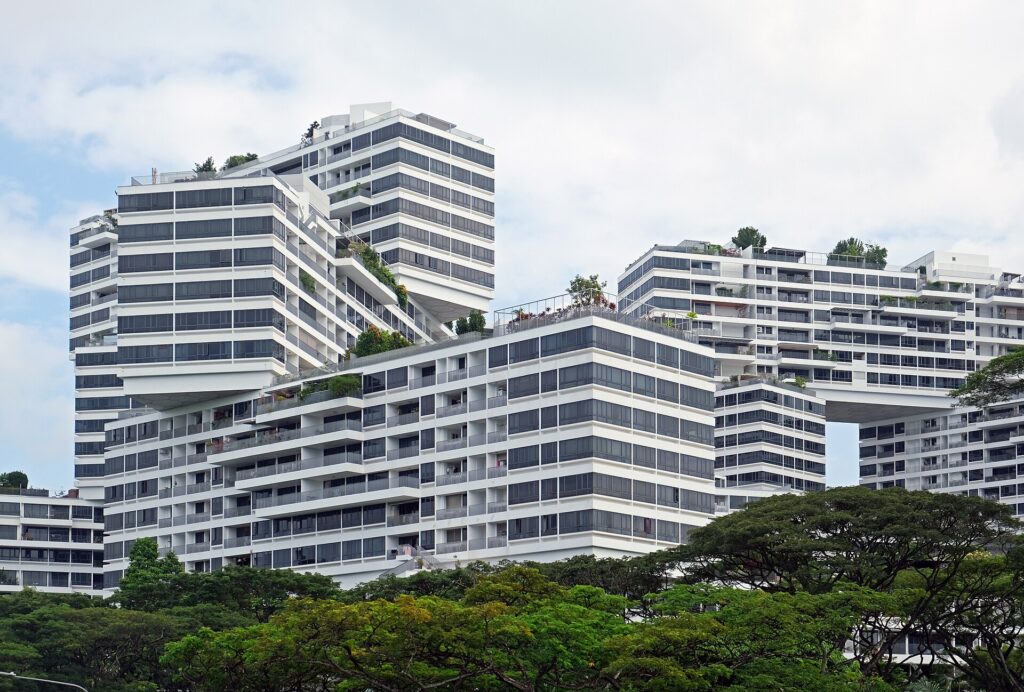
Sources and method: official sources linked at the relevant claims, checked 20 September 2026. Hypothetical inputs and monthly amortisation calculations are stated above. This is editorial self-review, not an inspection, valuation, bank approval or personal financial advice. Featured photograph: The Interlace, 10 January 2026, by kallerna, Wikimedia Commons, CC BY-SA 4.0. Resized; illustrates residential property, not the example’s price or rent.
