
Updated 20 Sep 2026. Corrected CPF funding, loan-count rules, SSD scope, remission eligibility and the worked purchase budget. Unsupported policy forecasts and the inaccurate historical timeline have been removed.
Singapore property cooling measures affect different stages of a purchase. ABSD changes the entry cost; loan limits affect funding and repayments; SSD can make an early exit expensive. Work through them separately. Paying one tax does not establish eligibility to buy or guarantee a loan.
This guide covers ordinary individual residential buyers. Developers, companies, trusts, transfers between family members and unusual ownership arrangements require separate advice. It is a current buyer checklist, not a complete history of every measure.
ABSD: start with the owners and their existing interests
| Buyer | First / second / third or later property |
|---|---|
| Singapore Citizen | 0% / 20% / 30% |
| Singapore Permanent Resident | 5% / 30% / 35% |
| Foreign individual | 60% / 60% / 60% |
IRAS assesses ABSD using the higher of price and market value. An interest held jointly or partly can count. For joint buyers, the highest applicable rate generally applies before remission. The relevant acquisition date is ordinarily the earliest applicable executed acceptance of the OTP or sale agreement, not key collection.
A qualifying married couple with at least one Singapore Citizen spouse, buying jointly in their names only and with neither owning a residential property, can receive full ABSD remission. A Singapore Citizen and PR first-home couple is therefore not automatically left paying 5%.
For a qualifying replacement-home couple, the second-property remission has additional conditions. These include ownership limits at purchase, sale of the first property within six months of buying a completed replacement, or within six months of the earlier TOP/CSC for a replacement bought uncompleted, and a refund application within six months of the first property’s sale. Both spouses must remain married with unchanged ownership of the second home and must not acquire another residential property in between. Check IRAS’s complete conditions and whether its automatic-refund process applies. Budget the tax upfront; an expected refund is not spendable cash.
FTA remission also matters: nationals and permanent residents of Iceland, Liechtenstein, Norway and Switzerland, and US nationals, can receive Singapore Citizen stamp-duty treatment. That does not give every foreign buyer zero ABSD or confer housing eligibility.
Can CPF pay ABSD?
ABSD is not categorically cash-only. IRAS expressly allows CPF funding subject to the housing schemes’ conditions. Your usable CPF, property and transaction arrangements matter. Confirm with CPF Board and your lawyer what can be released in time, what must first be paid in cash, and whether reimbursement is needed.
CPF housing limits depend on the property, loan and remaining lease. A shorter lease can reduce usable CPF; the OA balance shown in your account is not itself a spending approval. Keep a dated cash/CPF schedule for the deposit, tax, completion and emergency reserve.
IRAS stamping deadlines generally allow 14 days after signing in Singapore, or 30 days after receipt in Singapore when signed overseas, without penalty. Have your lawyer identify the chargeable document and exact deadline, including any electronic-document rules. A pending CPF arrangement should not be treated as an extension.
SSD: use the correct acquisition cohort
| Holding period at disposal | 11 Mar 2017 to 3 Jul 2025 purchase | Purchase from 4 Jul 2025 |
|---|---|---|
| Up to 1 year | 12% | 16% |
| Over 1, up to 2 years | 8% | 12% |
| Over 2, up to 3 years | 4% | 8% |
| Over 3, up to 4 years | None | 4% |
| Over 4 years | None | None |
The IRAS SSD schedule applies to the higher of the sale price or market value. Earlier acquisition cohorts have their own schedules, so “all purchases before July 2025 use three years” is inaccurate. Exact acquisition and disposal dates, part interests, inheritance and exemptions can change the result.
There is also no blanket rule that HDB flats can never attract SSD. IRAS specifically discusses SERS replacement flats, where MOP may have been met but a disposal can still fall within the SSD period measured from the Agreement for Lease. Check both regimes.
Bank LTV: property count and loan count are different
| Outstanding housing loans | LTV ceiling | Minimum cash contribution |
|---|---|---|
| None | 75% or 55% | 5% at 75% LTV; 10% at 55% LTV |
| One | 45% or 25% | 25% |
| Two or more | 35% or 15% | 25% |
The MoneySense bank-loan table uses outstanding housing loans. The lower ceiling applies when the loan exceeds 30 years (25 years for an HDB flat) or extends beyond age 65. These are ceilings, not entitlements; income, valuation and bank assessment can reduce the loan further. For a price above valuation, budget the excess separately.
HDB loans have their own rules. HDB currently states a maximum 75% LTV for complete resale applications received from 20 August 2024 and new-flat applications from the October 2024 sales exercise. For resale, the base is the lower of price or value, with further lease and credit-assessment conditions. A second HDB loan can be available subject to conditions; it is not the same thing as concurrently having a second bank mortgage.
TDSR and MSR: assess the payment, not just the deposit
For bank-financed purchases, TDSR generally limits total monthly debt obligations to 55% of gross monthly income. MSR caps the housing repayment at 30% for HDB flats and ECs where the applicable MOP has not expired. Do not assume every EC has the same MOP or import a private-condo calculation into an HDB purchase.
Under the official interest-floor announcement, banks assess residential property loans using the higher of a 4% floor or the loan’s thereafter rate, subject to the rules for the transaction. Four per cent is a floor, not an unconditional fixed assessment rate. HDB instead uses the higher of its 3% floor and prevailing housing-loan rate to calculate eligible loan amounts. The regulatory TDSR framework is not the HDB concessionary-loan calculation.
A second property does not always mean a 45% loan
Take a hypothetical Singapore Citizen retaining one private home, buying a S$1.5 million condo with an equal valuation. Compare two situations. Assume the higher LTV ceiling is available, no remission, and sufficient assessed income. Neither column is a bank offer.
| Item | Existing home has no housing loan | One housing loan remains |
|---|---|---|
| Maximum assumed new loan | S$1,125,000 (75%) | S$675,000 (45%) |
| Purchase price less new loan | S$375,000 | S$825,000 |
| Minimum cash within that contribution | S$75,000 (5%) | S$375,000 (25%) |
| BSD | S$44,600 | S$44,600 |
| ABSD | S$300,000 | S$300,000 |
| Contribution plus both duties | S$719,600 | S$1,169,600 |
The minimum cash row is part of the purchase contribution, not an extra cost. Tax funding and CPF eligibility must be worked out separately. BSD is calculated using IRAS residential bands: 1% of S$180,000, 2% of S$180,000, 3% of S$640,000 and 4% of S$500,000.
For the S$1.125 million loan over 25 years, a 4% assessment assumption gives about S$5,938 a month. With no other debt, simple division by 55% gives about S$10,797 gross monthly income. That is only an illustration: a higher thereafter rate, other debts, variable-income adjustments or the bank’s assessment can require more. In the second column, the existing mortgage also belongs in TDSR.
HDB eligibility remains a separate check
Do not rely on this article’s former claim that the private-property wait-out rule was removed in August 2024. Use the current category-specific conditions. HDB’s current couples-and-families guidance distinguishes non-subsidised resale unclassified/Standard flats from subsidised purchases and resale Plus/Prime flats. For the former route, it states that an existing private residential interest must be disposed of within six months of completing the flat purchase. Its other routes, and eligibility for an HDB loan, retain relevant 30-month private-property disposal conditions. Household eligibility and grant conditions still apply; obtain an HFE letter before committing.
MOP restrictions also operate independently: an HDB owner, spouse or authorised occupier cannot acquire local or overseas private residential property during the flat’s MOP. Do not sign for a new launch during MOP on the assumption that its later completion date solves the problem.
Before accepting an OTP
- List every buyer, their relevant status and existing residential interests.
- Confirm eligibility, the correct tax date and any remission in writing.
- Get a bank assessment that accounts for existing loans, tenure, age and other debts.
- Match cash and permitted CPF to the actual payment dates.
- Keep a reserve after the purchase, including a scenario with lower income or an early sale.
For a household cash-flow test after purchase, see our property investment guide. For the transaction sequence, see our private condo buying process.
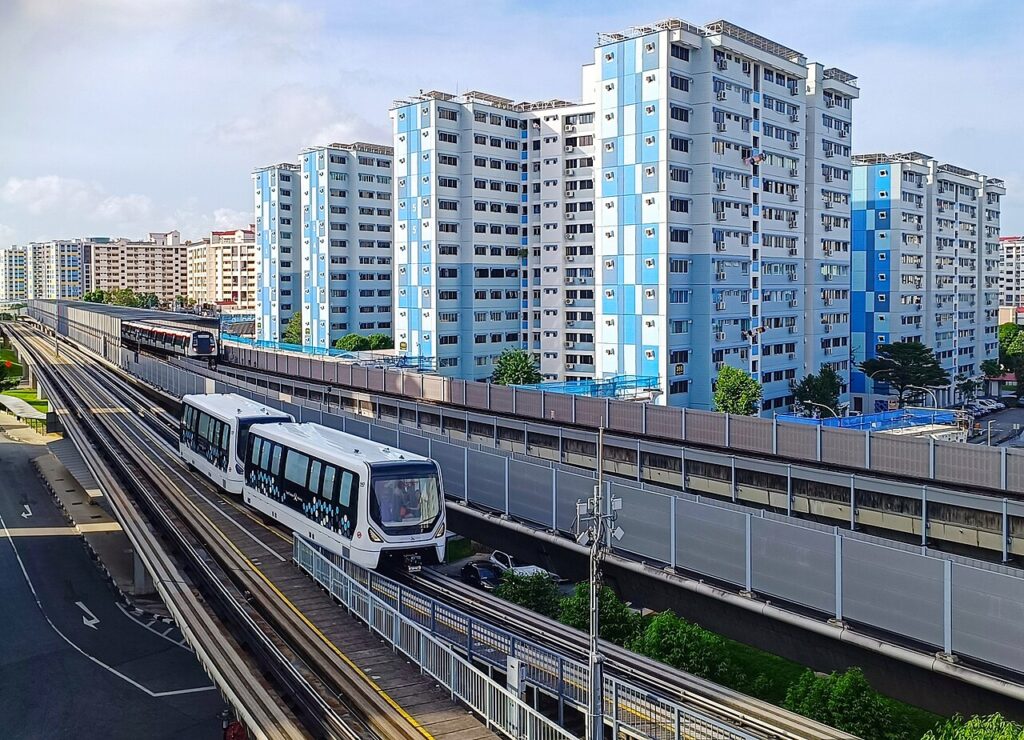
Sources and method: primary guidance linked above, checked 20 September 2026. The examples are hypothetical, with no claim of a bank approval or professional advice for an individual transaction. Historical source passages are used only for their stated effective dates; current HDB eligibility was checked separately. Featured photograph: Choa Chu Kang HDB blocks, photographed in 2025 by 33Loading, Wikimedia Commons, CC BY-SA 4.0. Resized; residential context.
