
Updated 27 Sep 2026. Before buying a condo, turn the estate’s charges into a payment calendar. A monthly maintenance figure will not tell you whether a second car can park there, how much cash is tied up in a moving deposit or when the next quarterly bill falls due.
This guide focuses on parking, move-in arrangements and the timing of estate payments. For comparing the maintenance charges of two specific units, use our maintenance-fee comparison guide. No charges below are quotations for an actual development.
Obtain the unit’s documents before building the budget
Ask the seller or managing agent for the current contribution notice, parking rules and charges, moving application, deposit terms and any approved payment changes. Have your conveyancing lawyer confirm the outstanding-account position and which charges the sale contract assigns to you. A seller’s recent payment receipt is useful, but does not answer every question about the next bill.
Section 38 of the Building (Strata Management) Act 2004 requires management and sinking funds. Check whether the quoted contribution includes both funds. Then list separately charged services and deposits rather than assuming the maintenance payment covers everything your household will use.
Write the billing period beside each figure. A quarterly invoice of $1,350 is a $450 monthly budgeting equivalent, but it still requires $1,350 when that invoice is payable. Putting aside $450 in the month you receive it is not enough if no reserve has been accumulated.
Check parking availability before its price
For a household with two vehicles, the first question is whether both can be accommodated under the actual rules. Request a written answer on eligibility, allocation, waiting lists and any limits on the number or type of vehicles. Do not assume a second access card creates a right to a second space.
Parking is one of the subjects for which a management corporation may make by-laws under section 32(3)(d). Section 32(3A) separately addresses by-laws for common-property parking lots with fixed EV chargers. Those provisions do not establish a standard parking price or promise that a particular buyer will receive a space.
| Parking issue | What to verify |
|---|---|
| First and second vehicle | Eligibility, application process, current charge, billing period and any waiting list. |
| Vehicle access | Height and size limits, route to the lot, access hours and registration requirements. |
| Visitors and caregivers | Permitted stays, registration, fees and arrangements for regular visits. |
| Electric vehicle | Charger availability, charging and idle fees, booking rules and whether access is shared. |
| Temporary alternative | Verified availability and full cost elsewhere, plus the actual route to your home. |
Walk the route you would use with groceries, a child or someone with limited mobility. Check ramps, lift access and weather exposure. An apparently modest parking saving may be a poor trade if the alternative creates a daily journey your household cannot comfortably manage. No walking times or access conditions should be assumed from a map alone.
Separate charges from refundable deposits
A charge pays for a service or permission. A refundable deposit ties up cash until the return conditions are met. Both need funding, but they should not be added together and described as permanent expenditure.
For a moving or renovation deposit, ask who receives it, what evidence of payment is provided, what can be deducted and when the balance is returned. Confirm the inspection and refund process before booking a mover. Do not promise a contractor access simply because you have collected the keys.
The following hypothetical calendar assumes all amounts include any applicable tax and are payable by the buyer. It excludes mortgage payments, property tax, utilities, insurance, renovation and household spending.
| Item | Assumed amount | Treatment |
|---|---|---|
| Quarterly bill | $1,350 | Recurring, due at the start of the quarter. |
| Second-car charge | $120 monthly | Recurring, assuming approval and availability. |
| Moving deposit | $1,000 | Refundable in full only if the assumed conditions are met. |
| Move-in administration | $80 | One-off, non-refundable in this example. |
If all four first payments fall due together, the cash needed is $2,550: $1,350 + $120 + $1,000 + $80. Regular annual charges are $6,840, calculated as four quarterly contributions plus twelve parking payments. Including the one-off $80 charge, first-year spending is $6,920, assuming unchanged charges and full deposit return. The $1,000 deposit is additional cash tied up temporarily, not another $1,000 of spending.
If the deposit has not returned before the next contribution is due, both sums must remain funded. If part is validly deducted, that portion becomes a cost. A household cash calendar should show the expected refund as a separate receipt, with an allowance for uncertainty.
Make the decision using the complete monthly commitment
Add verified estate charges to your mortgage, utilities, insurance, applicable property tax and chosen repair reserve. Keep irregular bills visible at their actual dates. A landlord should also establish which expenses remain theirs under the tenancy rather than assuming every estate charge can be passed to the tenant.
If parking arrangements are unresolved and a second vehicle is essential, settle that point before treating the home as suitable. Alternatives include choosing a different development, reducing the vehicle requirement or using a genuinely available outside space. Compare the cost and daily inconvenience of each, without treating a waiting list as confirmed parking.
Sources and correction note
Sections 32 and 38 were read in the current Singapore Statutes Online version on 27 September 2026. The cash calendar is LovelyHomes editorial analysis with hypothetical amounts. This revision removes unsupported market fee ranges, invented sinking-fund percentages, inaccurate voting and tribunal claims, and an unverified buyer story from the earlier guide.
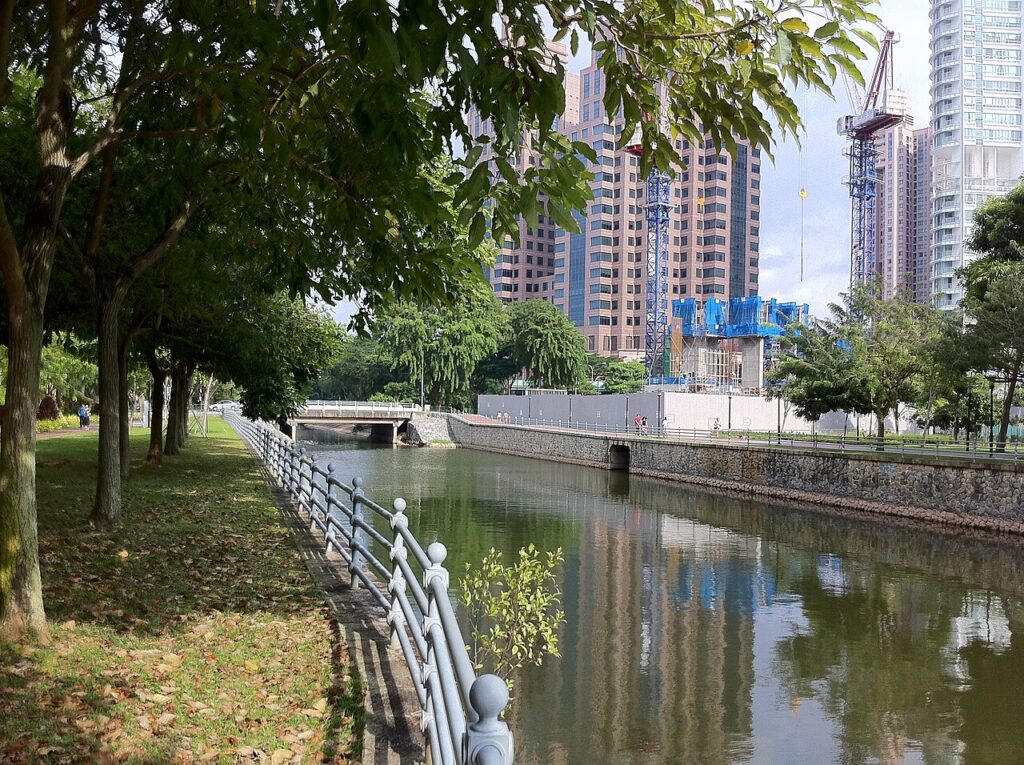
Featured photograph: Robertson Quay, 31 July 2011, by Bryanmackinnon, via Wikimedia Commons (https://commons.wikimedia.org/wiki/File:Robertson_Quay,_Singapore_-_20110731.jpg), CC BY-SA 3.0 (https://creativecommons.org/licenses/by-sa/3.0/), resized. Archive neighbourhood context; no parking availability or fees are attributed to the pictured buildings.
Need a brochure, price list or professional introduction?
Planning your next property purchase? Contact Lin Xuan at 82222556 or Ade at 81888871 to request a project’s full brochure and latest available price list, discuss a viewing, or ask for introductions to bankers who can help you compare home-loan rates and packages to find the best available option for your needs.
WhatsApp Lin Xuan | WhatsApp Ade. Please include the project name and your question. Brochures, prices and unit availability are subject to developer confirmation; loan eligibility, rates and approval are determined by the bank.
Lin Xuan: ONG LIN XUAN, CEA registration R069812H. Ade: CHUA MUAY MUAY (ADE CHUA), CEA registration R014252F. ERA REALTY NETWORK PTE LTD, estate agent licence L3002382K. If you need legal advice, contact Lin Xuan or Ade and we can introduce you to property lawyers.