
Updated 13 September 2026. When two condos fit your purchase budget, the lower maintenance fee is only the start of the comparison. Check what the bill includes, which services your household will use and whether another payment is already on the way.
This guide focuses on comparing the recurring cost of owning specific units. For the deeper question of whether a development has enough money for future works, use our condo sinking fund guide.
What are you paying the MCST for?
The management corporation, commonly called the MCST, manages the common property on behalf of the owners. Contributions go into a management fund for recurring expenses and a sinking fund for longer-term expenditure. A managing agent may handle administration, but the agent and the MCST are not interchangeable. BCA explains the framework in its strata-management guides, starting with Concept of Strata Living.
Think of the invoice as one part of your ownership budget. Do not assume it pays for repairs to your own appliances, renovations inside the apartment, your household utilities or your personal insurance needs. Ask who is responsible for any particular defect rather than relying only on whether it appears inside or outside the unit.
Ask for the exact unit’s bill
A listing’s “S$400 maintenance” could mean a monthly budget figure, one portion of a bill or an outdated estimate. Before comparing it with another property, obtain a dated contribution notice and settle these points:
- Does the figure cover both the management and sinking funds?
- Is it per month, per quarter or per share value?
- Does it include any applicable tax and separately billed charges?
- Has a new rate been approved, and when does it start?
- Is an additional contribution already payable or approved for a later date?
Owners generally contribute in proportion to their lot’s share value, subject to the applicable statutory exceptions. Use the unit’s actual share value and the authorised contribution rate. Dividing the estate budget equally by its number of apartments can give the wrong answer. See sections 39 to 41 of the Building (Strata Management) Act 2004.
Worked comparison: the cheaper monthly fee can cost more this year
The two homes below are hypothetical. They are not quotations for named developments or a claim about typical Singapore fees. Assume each stated quarterly figure includes both funds and all applicable taxes, with no other recurring charges.
| Cost item | Condo A | Condo B |
|---|---|---|
| Quarterly contribution for the unit | S$1,080 | S$1,440 |
| Monthly equivalent for budgeting | S$360 | S$480 |
| Regular contributions over 12 months | S$4,320 | S$5,760 |
| Additional contribution assumed payable by buyer in year one | S$3,000 | S$0 |
| Year-one cash requirement | S$7,320 | S$5,760 |
Condo A’s recurring fee is S$120 a month lower, but its first-year cash requirement is S$1,560 higher. That does not make Condo A the worse purchase. The extra payment might fund necessary work that will then be complete, while Condo B may face costs not yet approved.
If regular fees stayed unchanged for five years and these were the only additional contributions, the totals would be S$24,600 for A and S$28,800 for B. A would cost S$4,200 less over that period. Those assumptions are deliberately restrictive: they show why your holding period matters, not what either property’s future bills will be.
Keep payment dates alongside annual totals. In this example A’s S$3,000 levy is a cash payment when due; spreading it over five years in a comparison does not give you five years to pay it. Have your lawyer confirm who bears an actual levy and how the sale contract deals with it.
Check whether the extra services matter to your household
Suppose a condo on your shortlist costs S$120 more each month. That is S$1,440 a year. Decide what you receive for the difference rather than assuming more facilities always mean better value.
- Exercise: will you use the gym or pool often enough to replace spending elsewhere? Check equipment, opening hours and access rules.
- Children and visitors: are play areas and visitor arrangements useful in practice? Check booking restrictions and any additional charges.
- Work and sleep: consider facility noise, delivery access and where people gather relative to the unit.
- Mobility: inspect the route from the entrance or car park to the lift and front door. A long or awkward route remains inconvenient even in a well-equipped estate.
- Time: visit at a time relevant to your routine before deciding whether the shared spaces are comfortable to use.
A buyer who will rarely use the facilities may reasonably prefer a simpler development. Another household may value having them downstairs. Neither conclusion can be drawn from the number of facilities in a brochure alone.
Why a low sinking-fund contribution is not automatically a saving
There is no blanket statutory rule that the sinking fund must receive at least 10% of the management-fund budget. Section 39 requires the management corporation to determine reasonable and necessary contributions for its actual or expected liabilities. A familiar percentage is not a substitute for a works plan.
Ask what the current fee is meant to fund. If lifts, waterproofing or other major works are approaching, the useful evidence is the condition assessment, expected cost, available funds and collection timetable. Do not infer that a small fund is inadequate, or a large fund sufficient, without checking those commitments. Our sinking-fund cash example shows how to compare them.
Also ask about disruption. Fully funded works can still mean restricted access, noise or facility closures. Own-stay buyers should consider daily routines; landlords should assess any effect on the unit’s letting plan without assuming every fee increase can immediately be passed to a tenant.
What can change after you buy?
The contribution you see today is not a lifetime price guarantee. BCA’s guidance explains that contributions are decided or reviewed at a general meeting and that additional collections can be needed for major or unforeseen expenditure. Review the approved budget, recent minutes and effective dates, not just the last amount paid by the seller.
For a new launch, distinguish a sales-stage estimate from the contribution notice that will apply when payment starts. Ask what the estimate includes and obtain the relevant contractual payment terms. Do not assume a projected low fee will remain unchanged as the estate becomes fully occupied and its maintenance needs develop.
Voting rules depend on the resolution and voting procedure. Avoid the assumption that every decision is simply a vote weighted by share value. Owners can consult BCA’s guide to general meetings when considering a proposal.
Resolve arrears and outstanding levies before completion
Do not rely on a verbal promise that the unit’s account is clear. Section 47 provides a written application process, including for prospective purchasers, to obtain specified information, inspect records and request a certificate for the lot, subject to the prescribed fee. Section 40 includes potential joint liability for outstanding contributions, subject to section 47’s certificate provisions. Have your conveyancing lawyer handle the certificate, arrears and contractual allocation of charges.
The practical questions are: what is unpaid, what has been approved but is not yet due, who pays each item under the contract, and what happens if a new notice arrives before completion? Keep the answers in the purchase records.
After purchase, a disagreement about management is not a reason to assume you can stop paying. Late contributions can attract interest and recovery action. Raise a documented query and use the appropriate dispute process; ask for legal advice where liability or enforcement is contested.
A short comparison sheet to keep with your shortlist
| Record | Why it matters |
|---|---|
| Current contribution notice and share value | Establishes the amount, basis and payment period. |
| Approved changes and additional contributions | Identifies payments missing from the advertised monthly fee. |
| Accounts, budget and relevant meeting minutes | Connects the bill with services, works and funding decisions. |
| Facilities and by-laws relevant to your routine | Tests whether the services justify the cost for your household. |
| Lawyer’s completion checks | Clarifies arrears, certificates and allocation between buyer and seller. |
Add maintenance to your mortgage, property tax, insurance and private repair budget. Investors should also include it when calculating rental yield after expenses. The right comparison is the cost and usefulness of the home over your intended stay, with enough cash for the bills that arrive first.
Editorial correction, 13 September 2026: this article removes unsupported market fee ranges, the claimed 10% statutory sinking-fund minimum and oversimplified statements about council fines, voting and sale arrears. All comparison amounts are hypothetical. It is a desk-researched buyer guide, not an inspection of a named development.
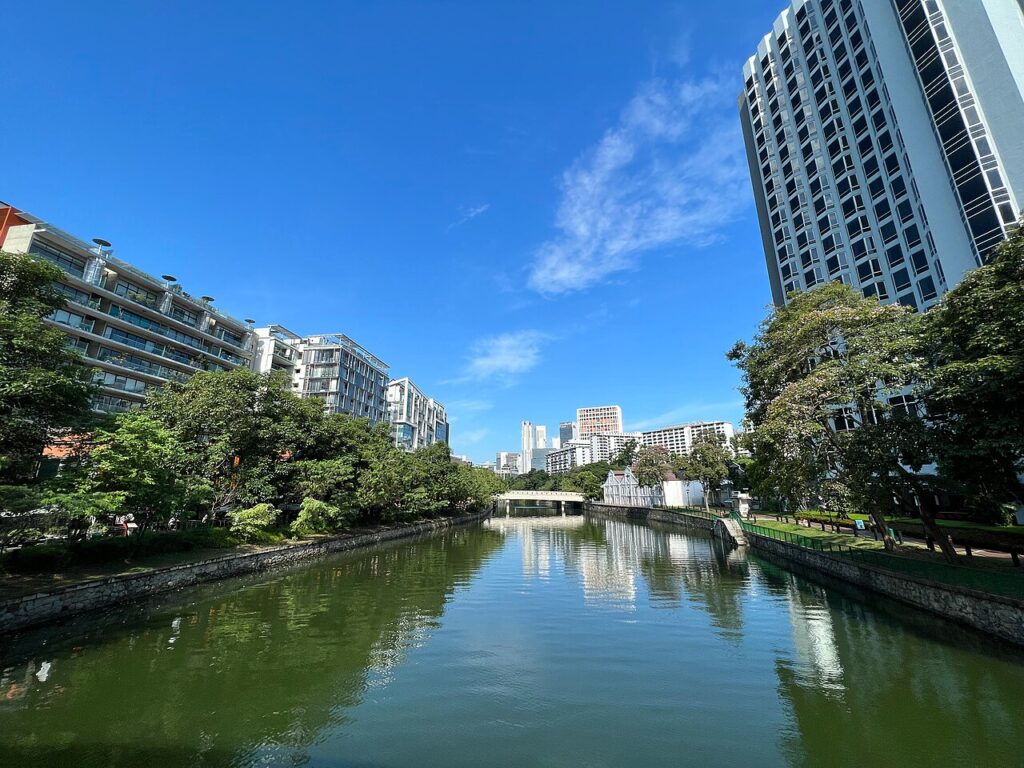
Featured photograph: Singapore River at Robertson Quay, photographed in 2022 by Wzhkevin, via Wikimedia Commons, CC BY-SA 4.0. Archive neighbourhood photograph; the buildings shown are not Condo A or Condo B and no claim is made about their fees or condition.
