
Updated 13 September 2026. Your Singapore property-tax bill depends on the property’s Annual Value and whether you qualify for owner-occupier rates. It is not calculated directly from the purchase price, your mortgage payment or a single percentage of your actual rent.
For 2026, qualifying owner-occupied HDB flats receive a 15% property-tax rebate. Qualifying owner-occupied private homes receive 10%, capped at S$500. These are 2026 rebates, not a permanent reduction in the rate tables.
Start with three items on your tax bill
- Annual Value, or AV. This is the assessed rental value used in the calculation.
- Tax status. Owner-occupier and non-owner-occupier rates differ substantially.
- The assessment period and adjustments. A rebate, change in occupation or revised assessment can affect the amount payable.
Before buying, ask for the current assessment and work through the status you will qualify for after completion. The seller’s bill may reflect their personal occupation of the property. It is not automatically your future bill.
What does Annual Value mean?
IRAS estimates the gross annual rent a property could command, excluding furniture, furnishings and maintenance fees. Comparable market rents matter; AV is not necessarily the rent in your particular lease. There is no universal rule that it equals 60% or 70% of actual rent. IRAS explains how Annual Value is assessed.
A property can have an AV even when nobody rents it. Paying cash for the home, having a large mortgage or leaving it empty does not make its assessed rental value disappear. Do not subtract your loan payment from AV when calculating property tax.
Use the actual notice for the effective date of an adjustment. IRAS reviews AVs annually, and physical changes can also lead to revisions. Do not assume every change takes effect only on 1 January.
Owner-occupier property-tax rates for 2026
The following ordinary residential owner-occupier bands have applied since 1 January 2025. Each rate applies only to the slice of AV in that band, not the whole assessment. Source: IRAS property-tax rate tables.
| Slice of Annual Value | Rate on that slice |
|---|---|
| First S$12,000 | 0% |
| Above S$12,000 to S$40,000 | 4% |
| Above S$40,000 to S$50,000 | 6% |
| Above S$50,000 to S$75,000 | 10% |
| Above S$75,000 to S$85,000 | 14% |
| Above S$85,000 to S$100,000 | 20% |
| Above S$100,000 to S$140,000 | 26% |
| Above S$140,000 | 32% |
Non-owner-occupier rates
These ordinary residential bands have applied since 1 January 2024. Use the appropriate status rather than assuming every landlord pays 12%.
| Slice of Annual Value | Rate on that slice |
|---|---|
| First S$30,000 | 12% |
| Above S$30,000 to S$45,000 | 20% |
| Above S$45,000 to S$60,000 | 28% |
| Above S$60,000 | 36% |
How the 2026 rebates affect the bill
IRAS automatically applies a 15% rebate for qualifying owner-occupied HDB flats and a 10% rebate, capped at S$500, for qualifying owner-occupied private residential properties. The non-owner-occupier bill does not receive these owner-occupier rebates. See the official 2026 rebate announcement.
Apply the progressive bands first and then calculate the rebate. For a private home, the rebate cannot exceed S$500 even when 10% of the pre-rebate tax would be larger. Do not assume the same rebate will be available in 2027.
Worked examples: follow the AV through the bands
These examples assume the stated status and AV apply for the full year. They do not estimate the AV of a particular flat or condo, and they exclude mid-year adjustments, arrears and penalties.
Example 1: owner-occupied HDB flat with S$36,000 AV
The first S$12,000 is taxed at 0%. The remaining S$24,000 is taxed at 4%, giving S$960 before rebate. The 2026 HDB rebate is S$144, so the illustrative annual bill is S$816.
Example 2: the same S$45,000 AV under two occupation scenarios
| Calculation | Owner-occupied | Not owner-occupied |
|---|---|---|
| Progressive tax | S$28,000 × 4% + S$5,000 × 6% = S$1,420 | S$30,000 × 12% + S$15,000 × 20% = S$6,600 |
| 2026 owner-occupier rebate | S$142 | Not applicable |
| Illustrative annual amount | S$1,278 | S$6,600 |
The difference is S$5,322 a year in this example. This is why an investor should not copy an owner-occupier seller’s tax expense into a rental budget. For an actual change of use during the year, check IRAS’s assessment and dates instead of applying either full-year figure blindly.
Who qualifies for owner-occupier rates?
You must own and live in the home. Only one property can receive the concession; a married couple can receive it for only one property between them, even if each owns and occupies a different home. Letting bedrooms while continuing to live there can still qualify. Letting the whole home while living elsewhere does not. Family members living there without the owner do not by themselves establish entitlement. See IRAS’s owner-occupier eligibility and application guidance.
Rates can be applied automatically in qualifying purchase situations, so not every buyer has to make a separate application. Check your assessment. If you qualify but are charged non-owner-occupier rates, use IRAS’s application process; if you will not live there, notify IRAS rather than relying on an automatic concession.
A gap between tenants does not automatically restore owner-occupier rates. If you actually move back after a whole-property lease, apply on the basis of your real occupation and retain supporting evidence.
Property tax and rental income tax are different bills
Property tax concerns the property and its AV. Income tax on rental income is a separate calculation involving taxable receipts and permitted deductions. A home producing no rental income can still incur property tax.
Do not treat mortgage principal as a rental-income deduction. Eligible individual landlords may use the 15% deemed-expense method plus qualifying mortgage interest, or actual allowable expenses, subject to conditions. Read IRAS’s rental-income rules. Our rental yield guide shows why operating profit, taxable income and cash after loan repayments can differ.
What to do if the Annual Value looks wrong
Check the valuation notice, property particulars and comparable rental evidence. If objecting to a new valuation notice, the usual deadline is 30 days from its date. Where no new notice was issued, IRAS also provides a route to object to that year’s valuation list by 31 December. Tax remains payable while the objection is considered. Follow IRAS’s objection procedure.
Make the explanation specific. A calculation based on the wrong floor area or unsuitable comparables is more useful to investigate than simply saying the bill is higher than expected. Keep copies of the notice, supporting records and submission. A successful objection should not be assumed when planning cash reserves.
Pay the assessed bill and plan ahead
The annual 2026 property-tax payment was due on 31 January 2026. If checking your position later in the year, review the current balance and any instalment arrangement in myTax Portal, rather than treating that date as a future deadline. IRAS’s 2026 property-tax bill guidance covers payment and assistance options.
Before a purchase, ask your conveyancing adviser to explain any completion apportionment and budget your continuing liability separately. For an investment property, enter the assessed non-owner-occupier tax in your annual operating budget. For an own-stay home, include property tax alongside mortgage payments, insurance and maintenance costs when testing affordability.
A buyer’s final checks
- Obtain the current AV and tax assessment rather than estimating from the sale price.
- Confirm whether your intended occupation qualifies for the concession.
- Apply progressive bands to each slice of AV, then the applicable 2026 rebate.
- Check effective dates where the assessment or occupation changes.
- Keep property tax, stamp duties and rental income tax as separate budget items.
Editorial correction, 13 September 2026: this article replaces outdated owner-occupier bands and incorrect worked examples. At S$36,000 AV, full-year owner-occupier tax is S$960 before the applicable 2026 rebate. At S$45,000 AV, full-year non-owner-occupier tax is S$6,600. It also corrects the earlier implication that renting a bedroom necessarily removes owner-occupier eligibility.
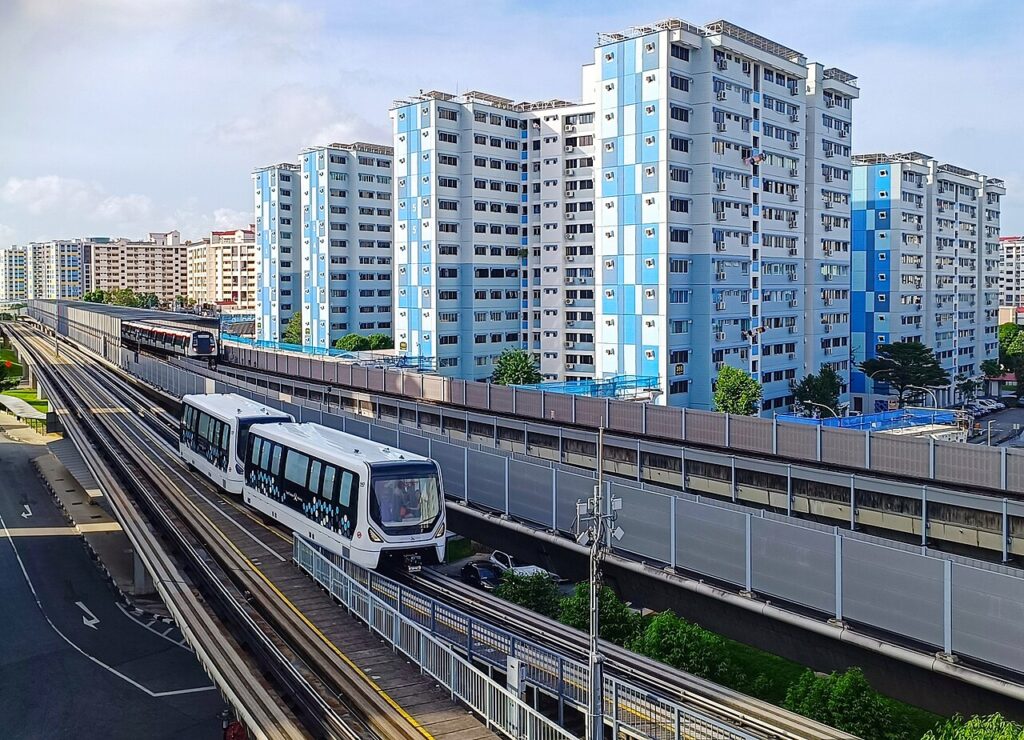
Featured photograph: HDB homes in Choa Chu Kang, photographed in 2025 by 33Loading, via Wikimedia Commons, CC BY-SA 4.0. The photograph illustrates residential housing; no tax assessment is asserted for the homes shown.
