HDB Resale Market Q2 2026: Price Index Falls -0.3% as Million-Dollar Flat Sales Hit Record High
Singapore’s HDB resale market delivered a paradox in the second quarter of 2026: prices fell for the second consecutive quarter, yet million-dollar flat transactions hit their highest-ever quarterly count. Understanding both trends, and what sits beneath them, is essential for any buyer, seller, or investor making decisions in the second half of 2026.
This analysis draws on HDB’s official Q2 2026 public housing data (published 24 July 2026) and URA’s Q2 2026 real estate statistics to give you a ground-level view of where the market stands and where it is heading.
Quick Answer — HDB Resale Q2 2026 at a Glance
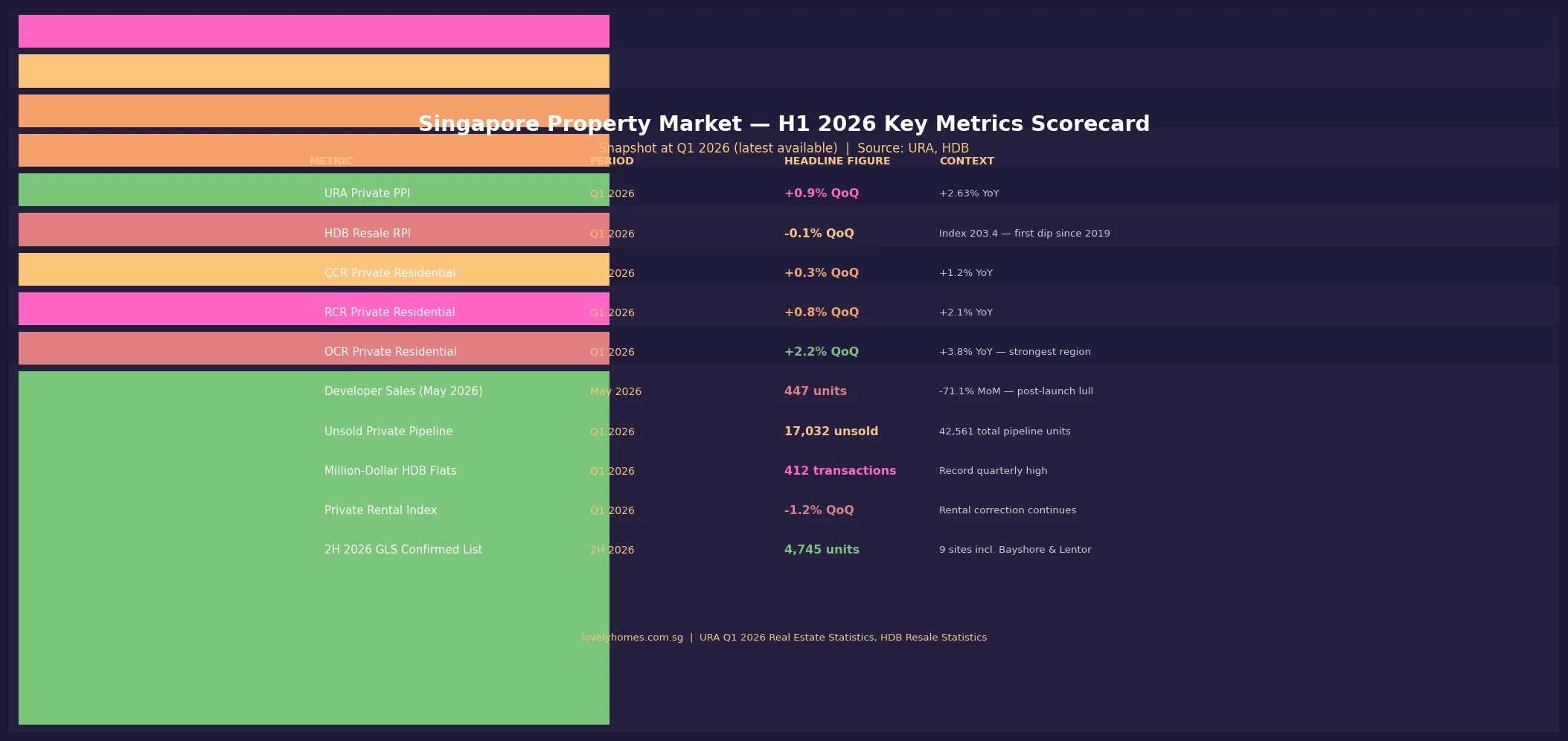
- HDB Resale Price Index (RPI): 202.7 — a decrease of 0.3% QoQ (second consecutive quarterly decline)
- Total resale transactions Q2 2026: 6,396 units — up 1.8% from Q1’s 6,285
- Million-dollar flat sales Q2 2026: 491 transactions — a new quarterly record, up 19.5% QoQ
- Average price of million-dollar flats: S$1,147,216 — down slightly (-0.3%) from Q1
- Share of million-dollar flats in total resale: 7.7% (up from 6.5% in Q1)
- Top towns by volume: Jurong West, Punggol, Sengkang, Tampines, Woodlands
- BTO supply in 2026: approximately 19,600 flats planned across three sales exercises
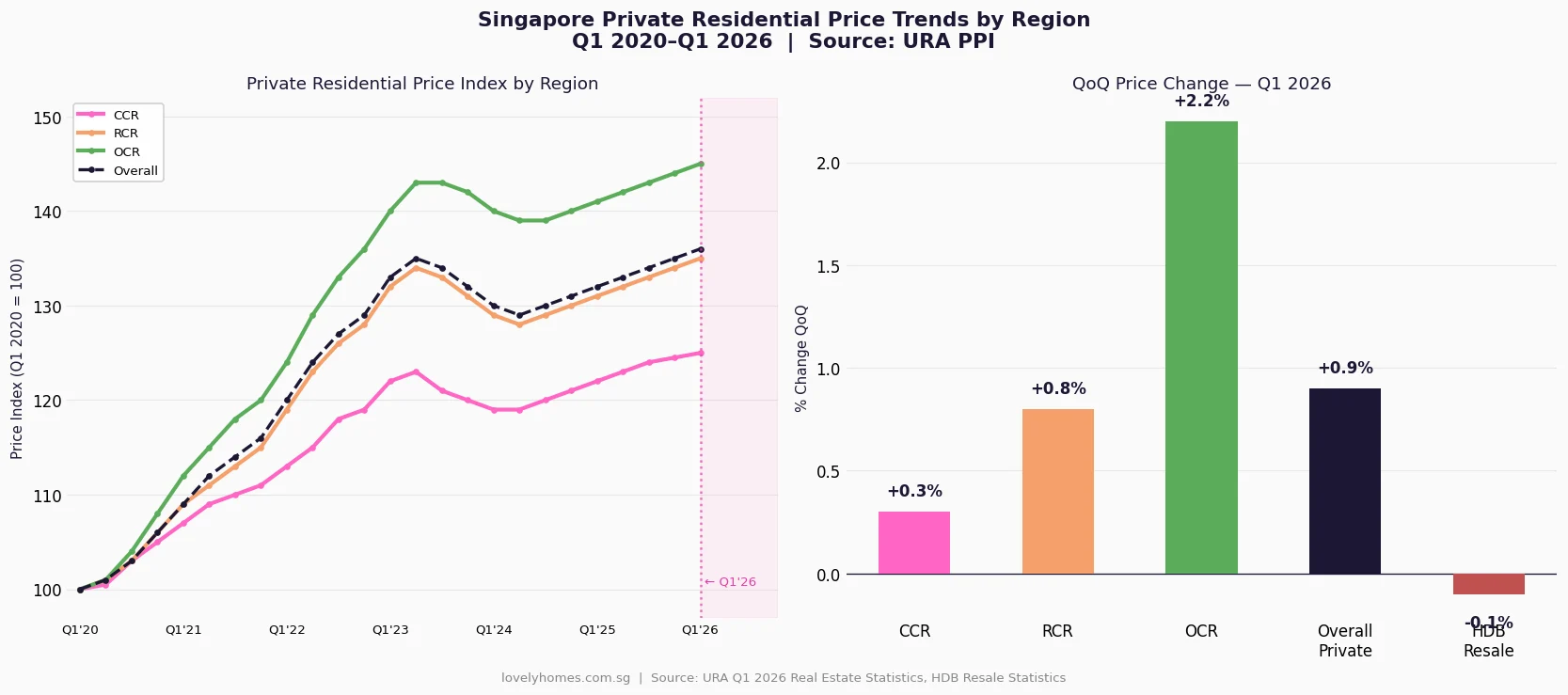
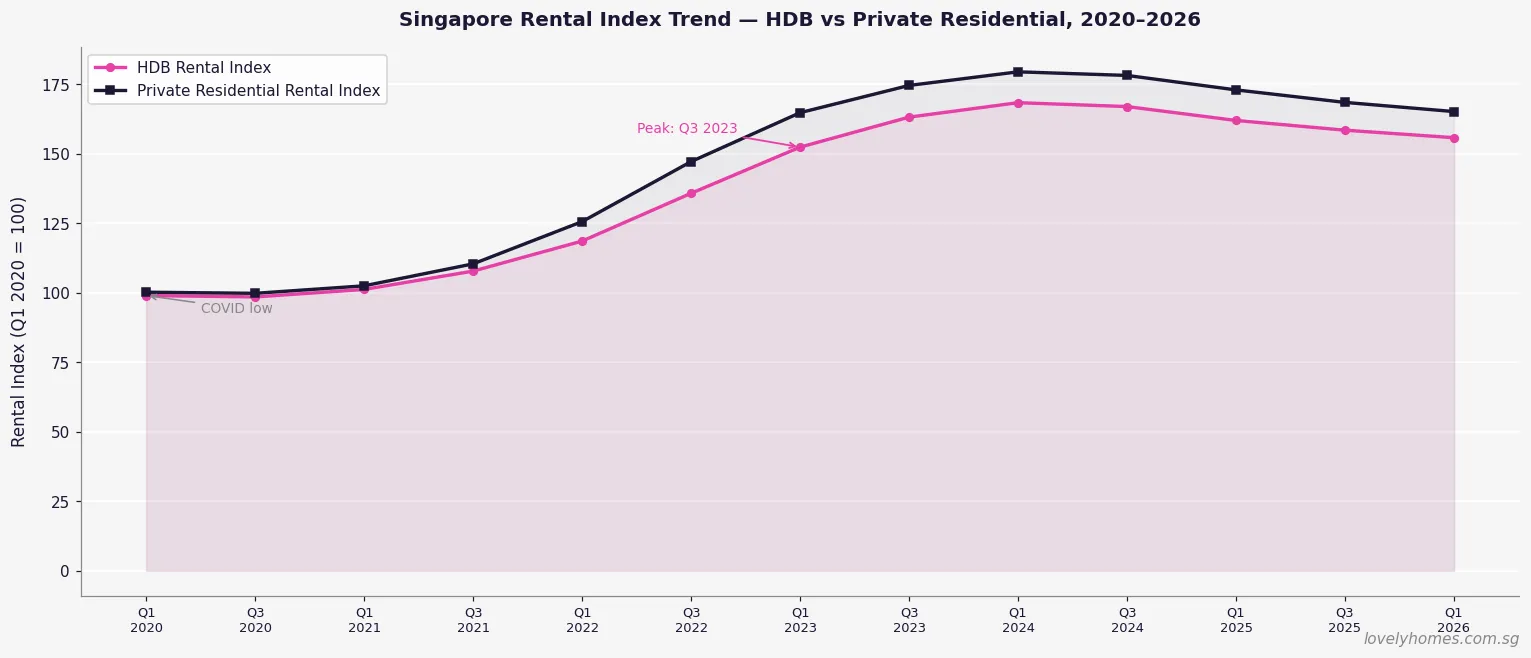
- Private residential comparison: overall private PPI +0.5% QoQ (landed +2.5%; most non-landed segments flat or negative)
The Resale Price Index: Two Consecutive Quarterly Declines
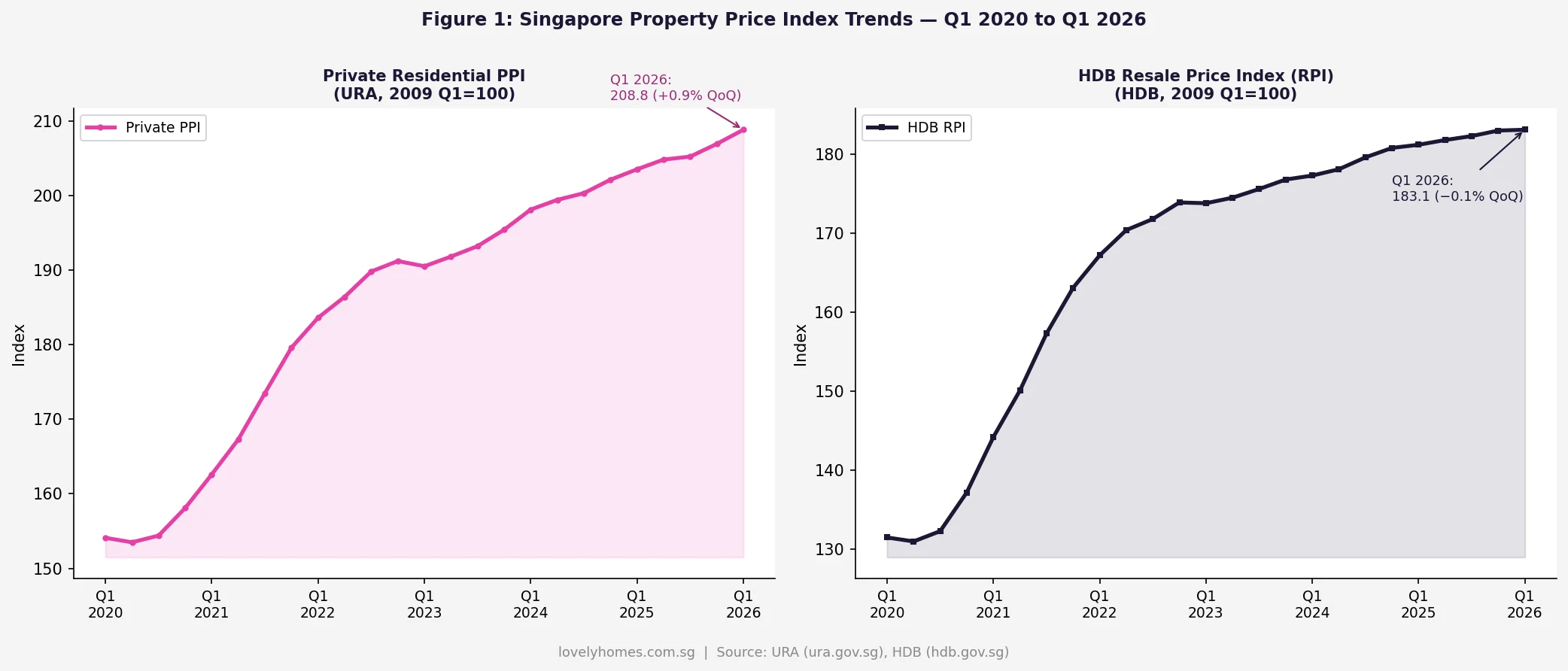
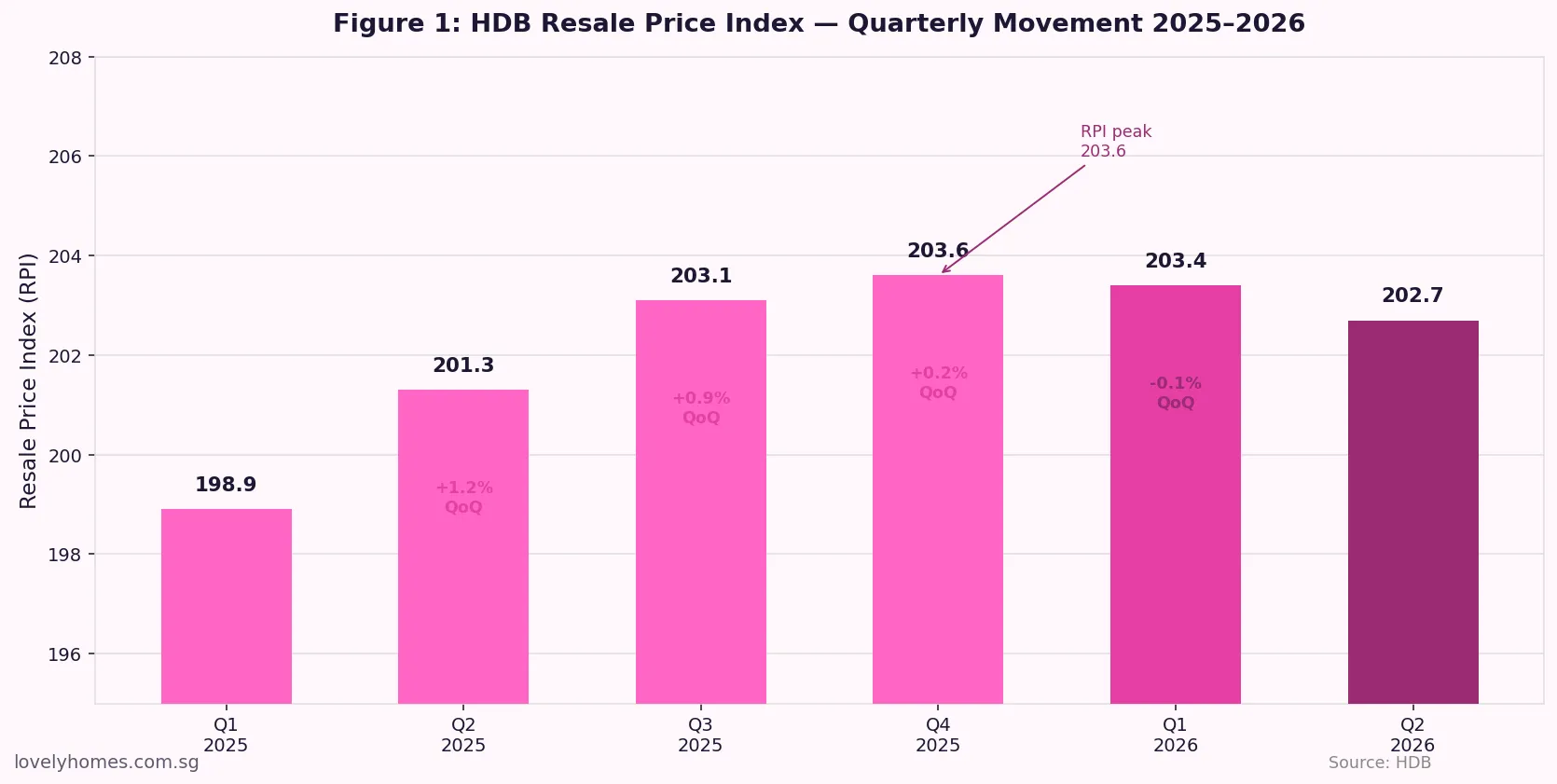
The HDB Resale Price Index for Q2 2026 came in at 202.7 — a decrease of 0.3% from 203.4 in Q1 2026. This follows a 0.1% decline in Q1 2026 from the Q4 2025 peak of 203.6. Taken together, the RPI has now shed 0.9 index points, or 0.44%, from its peak.
To put that in perspective: the RPI has not entered a sustained downward correction. The peak reached in Q4 2025 followed one of the strongest recovery runs in the HDB resale market’s history. Over the calendar year 2025, the RPI rose from 198.9 to 203.6 — a gain of 4.7 index points, or roughly 2.4%. The current two-quarter softening represents a very modest retracement, not a crash.
What is driving the softness? Two structural factors are at play. First, a significant volume of BTO flats completed in 2022 and 2023 are reaching their five-year Minimum Occupation Period (MOP) and flowing onto the resale market as sellers who bought at subsidised prices look to cash out. This supply pressure is most visible in the OCR and newer estates. Second, affordability constraints are biting: the TDSR and MSR frameworks cap borrowing, and rising resale prices over 2024 and 2025 mean that fewer first-time buyers can stretch to larger or better-located flats.
Million-Dollar Flat Sales: A Record That Needs Context
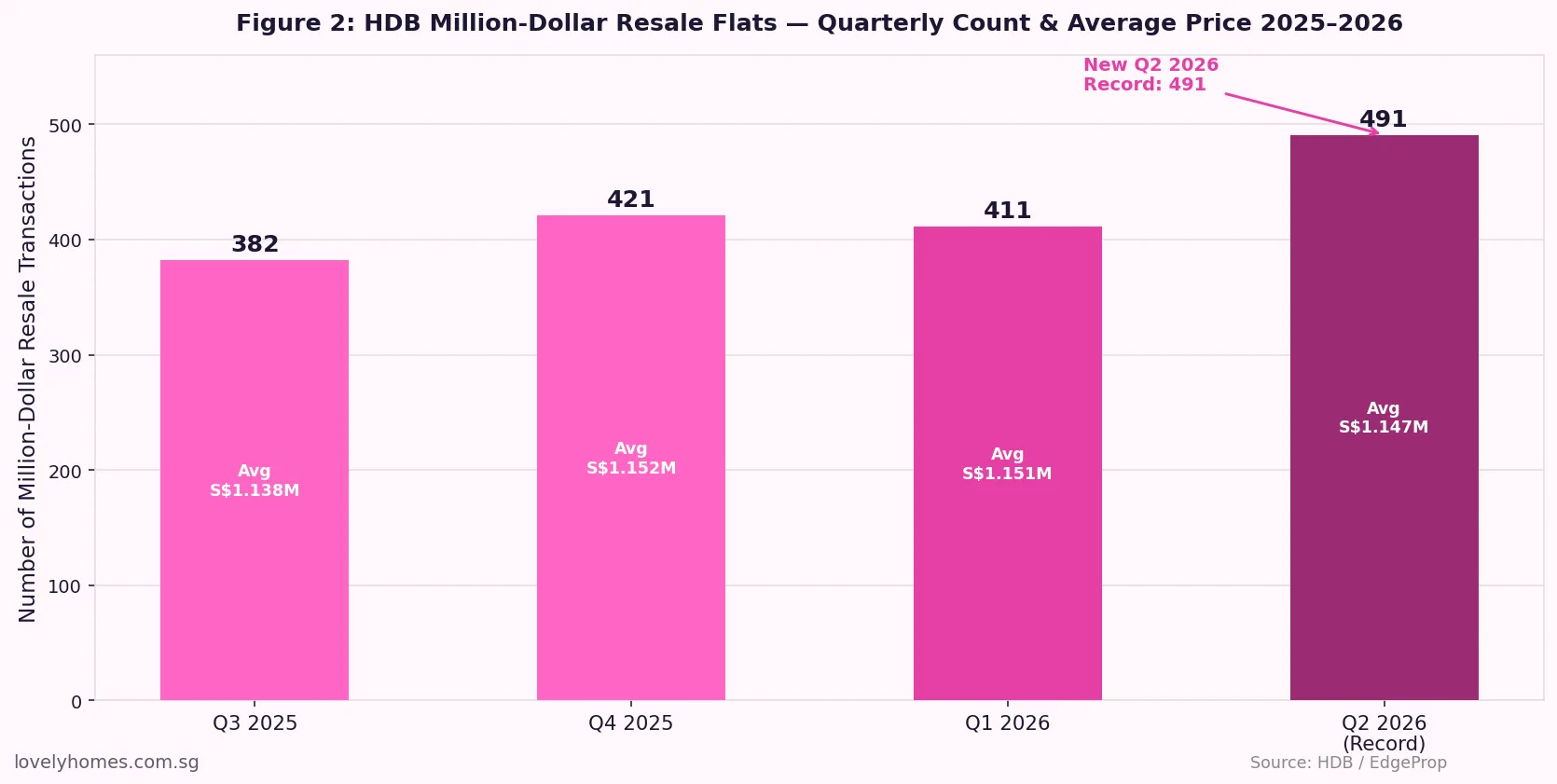
The headline that grabbed attention in Q2 2026 was the record 491 million-dollar resale transactions — up from 411 in Q1 2026 and well above the previous quarterly record. At first glance, a falling RPI alongside a record number of million-dollar sales seems contradictory. The explanation lies in market segmentation.
The HDB resale market is not one market — it is several markets stacked on top of each other. Larger flat types (five-room and executive) in prime or sought-after locations (Bishan, Queenstown, Toa Payoh, Buona Vista, Kallang) have continued to command strong prices because demand from asset-rich buyers or upgraders downsizing from private property remains robust. These are precisely the buyers most likely to cross the million-dollar threshold. Meanwhile, the broader market — four-room and below, in the OCR towns — experienced the softening that pulled the aggregate RPI downward.
The average price of million-dollar flats softened marginally, from S$1,150,651 in Q1 2026 to S$1,147,216 in Q2 2026. This 0.3% decline in average price, alongside a 19.5% surge in volume, confirms that more flats crossed the million-dollar mark at prices just above the threshold rather than the upper end of the premium segment rising sharply.
Transaction Volume and Top Towns
At 6,396 resale transactions, Q2 2026 volume rose 1.8% from Q1’s 6,285 — a modest quarter-on-quarter improvement that nonetheless keeps the annual run rate above 25,000 transactions for the second year running. Volume held up despite the price softening, suggesting that buyers who had been waiting on the sidelines returned once prices began to moderate.
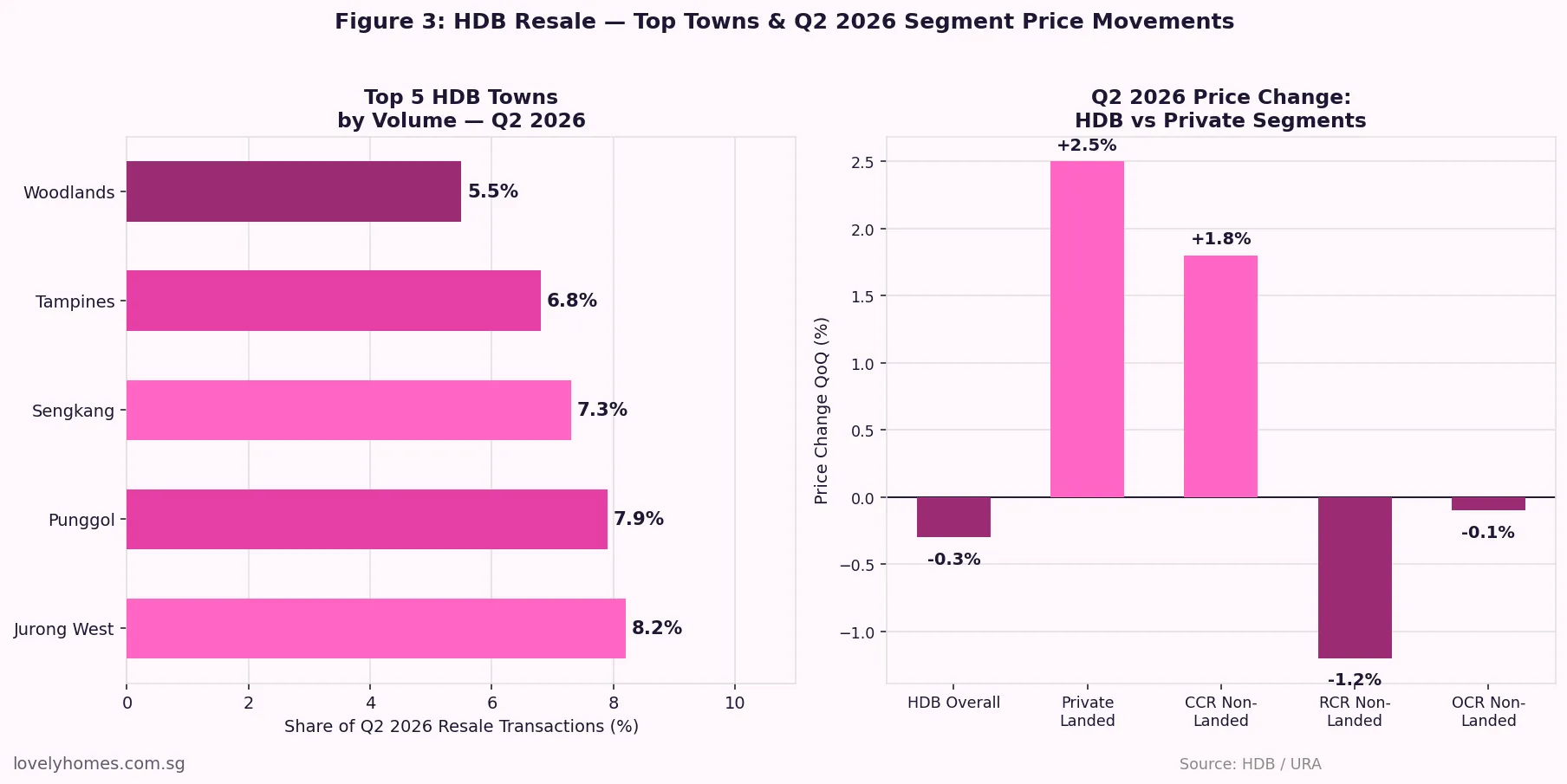
The top five HDB towns by resale volume in Q2 2026 were Jurong West, Punggol, Sengkang, Tampines, and Woodlands, collectively accounting for 35.7% of all transactions. These are predominantly OCR towns characterised by high BTO supply, relatively younger flat stock coming off MOP, and strong demand from first-time buyers priced out of the central region. Their dominance in volume statistics helps explain the RPI softness: OCR transactions, which skew lower in absolute price, are pulling the aggregate index down even as CCR and prime RCR transactions remain strong.
HDB vs Private Residential: A Tale of Two Markets
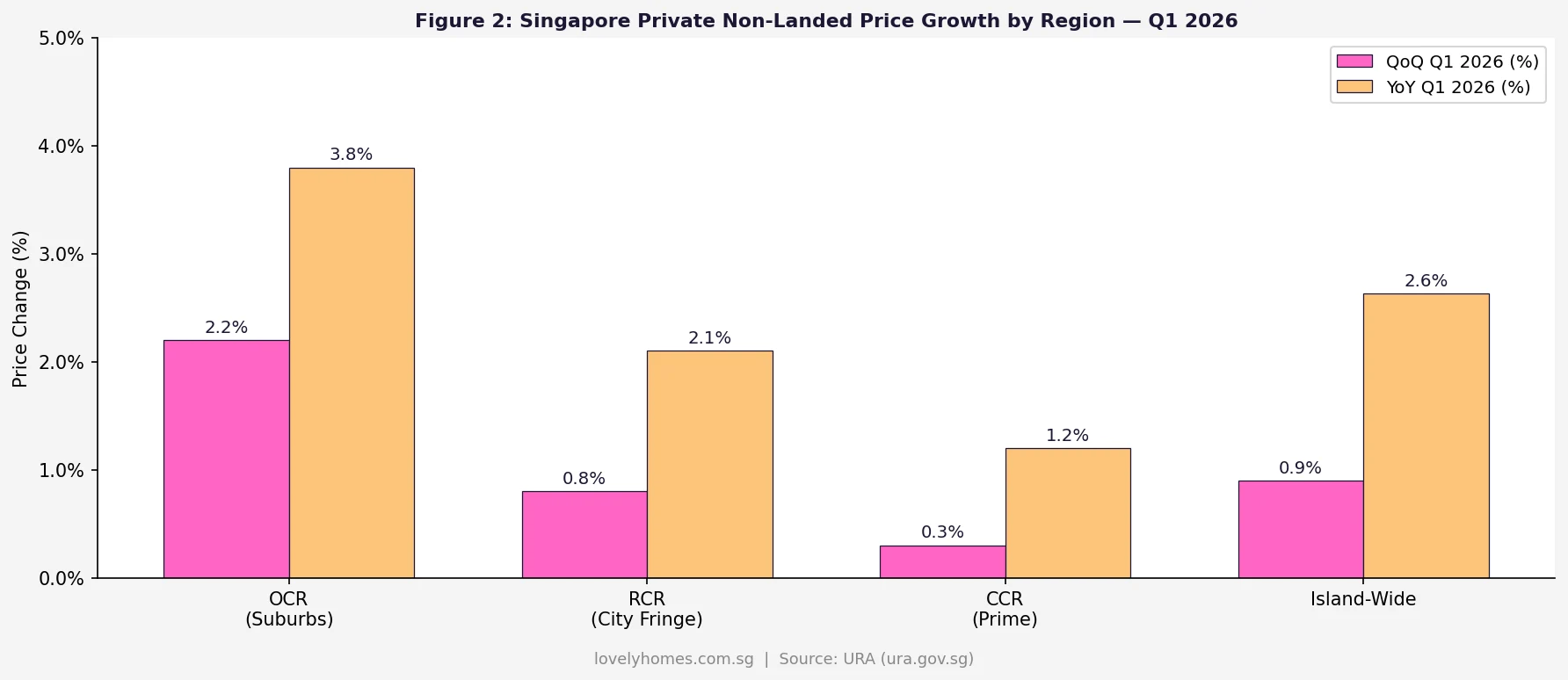
Comparing the HDB resale market with private residential in Q2 2026 reveals an interesting divergence. The overall private residential Property Price Index rose 0.5% QoQ — apparently stronger than HDB’s -0.3%. But the private sector figure masks sharp segmentation of its own.
| Segment | Q2 2026 QoQ Price Change | Context |
|---|---|---|
| HDB Resale (overall) | -0.3% | Second consecutive quarterly decline; OCR BTO supply overhang |
| Private Landed | +2.5% | Strong demand, very limited supply; reversal of Q1’s -0.4% |
| Private Non-Landed CCR | +1.8% | Foreign and high-net-worth demand; luxury segment resilient despite 60% ABSD |
| Private Non-Landed RCR | -1.2% | Mass-market competition from HDB and OCR condos; supply from recent completions |
| Private Non-Landed OCR | -0.1% | Broadly flat; same supply pressures as HDB but mitigated by upgrader demand |
| Private Residential Rental | +0.7% | Rental market recovering after sharp corrections in 2024; vacancy 6.4% |
The private market’s +0.5% aggregate figure is heavily influenced by the landed segment’s 2.5% bounce and CCR’s 1.8% gain — segments where supply is tightest and buyers are least price-sensitive. The HDB market’s softness reflects the same affordability pressure visible in RCR and OCR private condos. In this sense, the two markets are telling the same story: the upper end holds, the mid-to-mass market moderates.
BTO Supply Pipeline: The Structural Overhang
HDB plans to launch approximately 19,600 BTO flats in 2026 across three sales exercises (February, June, and October). Of these, over 4,000 units are expected to have waiting times of under three years — a deliberate policy response to the BTO queue bottleneck that stretched to five years or longer for some estates during the COVID disruption years of 2020 to 2022.
The medium-term implication for the resale market is straightforward. The cohort of flats built in 2021 to 2023 — many of which were bought as emergency “market rate” BTO applications during the queue crisis — will reach MOP in the period from 2026 to 2028. This flow of supply is expected to maintain moderate price pressure on resale HDB, particularly in the OCR, for at least the next two years. Sellers in these estates who bought at subsidised BTO prices with a relatively short wait will still profit handsomely; buyers entering the resale market should expect continued modest price softening, which actually works in their favour.
Worked Example: Buying a Million-Dollar 5-Room Flat in Bishan
Mrs Rahman, a Singapore Citizen, is purchasing a 35-year-old 5-room flat in Bishan from an upgrader for S$1,100,000. She is 42, has an HDB loan eligibility (HLE), and plans to use a bank loan. Her husband’s gross monthly income is S$9,500; hers is S$5,500. Here is how the numbers work:
- Purchase price: S$1,100,000
- BSD: S$31,100 (1% on first S$180K + 2% on next S$180K + 3% on next S$640K + 4% on next S$100K)
- ABSD: Nil (first residential property for both, Singapore Citizens)
- Bank loan (75% LTV): S$825,000 — bank stress-test rate 4.0%, 25-year tenure, monthly instalment S$4,358
- MSR check (HDB rule): S$4,358 / S$15,000 = 29.1% (below 30% MSR cap — PASS)
- TDSR check: S$4,358 / S$15,000 = 29.1% (below 55% TDSR cap — PASS)
- Downpayment (25%): S$275,000 — minimum 5% cash (S$55,000) + balance CPF OA (S$220,000)
- Total upfront costs: S$275,000 (DP) + S$31,100 (BSD) + legal S$4,500 = S$310,600
- CPF caveat: Flat has 65 years remaining. CPF usage is not restricted (above 60-year threshold). If the flat were below 60 years remaining, CPF withdrawal would be prorated.
The transaction qualifies comfortably, but it is worth noting that the S$55,000 minimum cash requirement must come from the buyer’s own savings — no CPF OA funds can substitute for this tranche. This is the single most common stumbling block for buyers stretching to the million-dollar segment.
What This Means for Buyers and Sellers
For buyers: the two-quarter price softening in the HDB resale market is a genuine opportunity window, particularly in the OCR. Estate towns such as Punggol, Sengkang, and Woodlands that dominate volume figures are seeing the largest supply overhang — which means the most negotiating headroom. Buyers should still model their TDSR and MSR carefully using stressed interest rates (4.0%+), and should factor in the CPF accrued interest obligation that will need to be refunded on eventual resale. Read our TDSR and MSR complete guide before applying for any bank loan.
For sellers: if you are considering selling a resale HDB flat, Q3 and Q4 2026 may prove to be better windows than Q3 2027, when additional BTO MOP supply is expected to hit the market. Volume in the S$800K–S$1.1M segment remains strong, and the million-dollar record demonstrates that premium flats in desirable locations are still attracting robust demand. Price your property accurately against recent comparables — the days of 20% premiums over asking are gone for most estates.
What Might Come Next
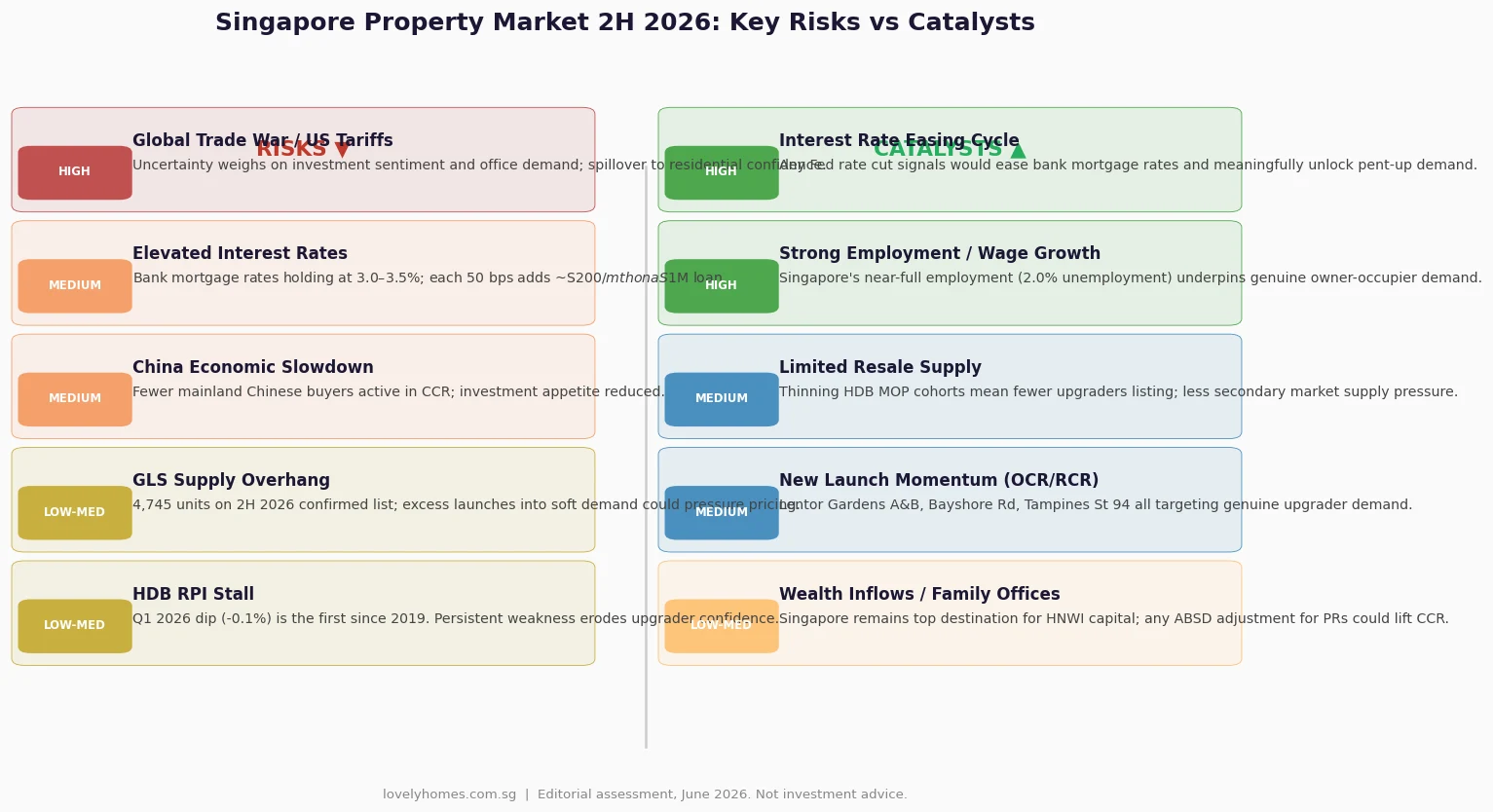
The trajectory for the second half of 2026 is moderately bearish for the HDB resale RPI in the near term, with a stabilisation expected in 2027 as the BTO MOP supply overhang begins to thin. Several external factors could shift this scenario: a sharper-than-expected global slowdown that prompts interest rate cuts could ease monthly instalment burdens and re-energise demand; conversely, any re-acceleration of inflation would force rates higher and squeeze affordability further. The October 2026 BTO launch will be closely watched — if demand for short-wait-time flats is strong, it may absorb some of the pressure from the resale pipeline. The Government has reiterated its commitment to maintaining a high and steady supply of public housing and has ruled out rolling back cooling measures in the current environment.
FAQ: Is the HDB resale market in a downturn?
Not in any structural sense. Two consecutive quarterly declines of -0.1% and -0.3% amount to a combined drop of approximately 0.44% from the Q4 2025 peak. By comparison, the market rose roughly 2.4% over all of 2025. This is a modest price correction, not a market collapse. Volume remains healthy at over 6,300 transactions per quarter. The correction is supply-driven and concentrated in the OCR, not a sign of deteriorating demand fundamentals.
FAQ: Why are million-dollar HDB flat sales at a record if prices are falling?
Market segmentation is the answer. The HDB resale market covers everything from three-room flats in Woodlands at S$300,000 to five-room executive flats in Queenstown at S$1.3 million. The aggregate RPI captures the average across all flat types and locations. When OCR volume dominates (as it does), the aggregate index is pulled lower even if the premium segment (large flats in mature, central estates) is holding or rising. In Q2 2026, 7.7% of all resale transactions crossed the million-dollar mark — which is itself a record share.
FAQ: Should I buy HDB resale now or wait for prices to fall further?
Timing the market is notoriously difficult, and the answer depends heavily on your personal circumstances. If you need housing now, the current softening is a reasonable entry point — particularly in high-supply OCR towns where negotiating headroom is greatest. If you are buying primarily as an investment and can afford to wait, there may be slightly more supply-driven softening to come over the next two to three quarters. What you should absolutely not do is wait indefinitely: HDB public housing exists to provide affordable, stable homes, and the risk of waiting for a lower price while interest rates, inflation, or policy changes shift the goalposts is real.
FAQ: Does the falling HDB RPI mean private property is a better buy?
Not necessarily. Private non-landed prices in the RCR fell 1.2% in Q2 2026 — worse than HDB’s -0.3%. OCR private condos were broadly flat. The landed segment rose 2.5%, but that is accessible only to Singapore Citizens and Permanent Residents with significant capital. HDB resale remains considerably cheaper on a per-square-foot basis than comparable private alternatives and carries no ABSD for first-time citizen buyers. The comparison depends on your profile, budget, and long-term plans.
FAQ: How does the BTO supply pipeline affect resale prices?
When BTO flats reach their five-year Minimum Occupation Period, sellers who bought them at subsidised prices enter the resale market. Since their entry cost is far below market, they can price competitively and still generate a healthy profit. This supply pressure — particularly in the OCR towns where BTO volume was highest during 2021 to 2023 — is the primary structural driver of the current price softening. The pressure should begin to ease in 2028 to 2029 as that cohort thins out.
FAQ: What is the outlook for HDB resale in H2 2026?
Industry watchers broadly expect the RPI to remain range-bound in the region of 200 to 203, with a possible further quarter or two of marginal declines before stabilising. Volume is expected to hold up, driven by the steady flow of owner-occupier demand and upgraders. Million-dollar flat transactions are likely to maintain elevated levels given the structural shift in the share of larger, well-located flats trading at or above that threshold. Any government intervention — whether additional cooling measures or stimulus — would materially change this outlook.
Related Articles
- Singapore TDSR and MSR Borrowing Limits Guide 2026
- HDB Resale Flat Buying Guide 2026
- HDB Minimum Occupation Period (MOP) Guide 2026
- HDB Lease Decay Guide 2026: CPF Limits and Pricing Impact
- HDB Plus and Prime Classification Guide 2026
- ABSD Singapore 2026: Complete Guide
- Leasehold vs Freehold Property Guide 2026
Disclaimer: This analysis is for general information only and is not financial or investment advice. Property prices can rise and fall. All figures are drawn from HDB and URA official releases (July 2026) and third-party research. Always verify current data on hdb.gov.sg and ura.gov.sg, and consult a licensed property agent or financial adviser before making any property decision.