
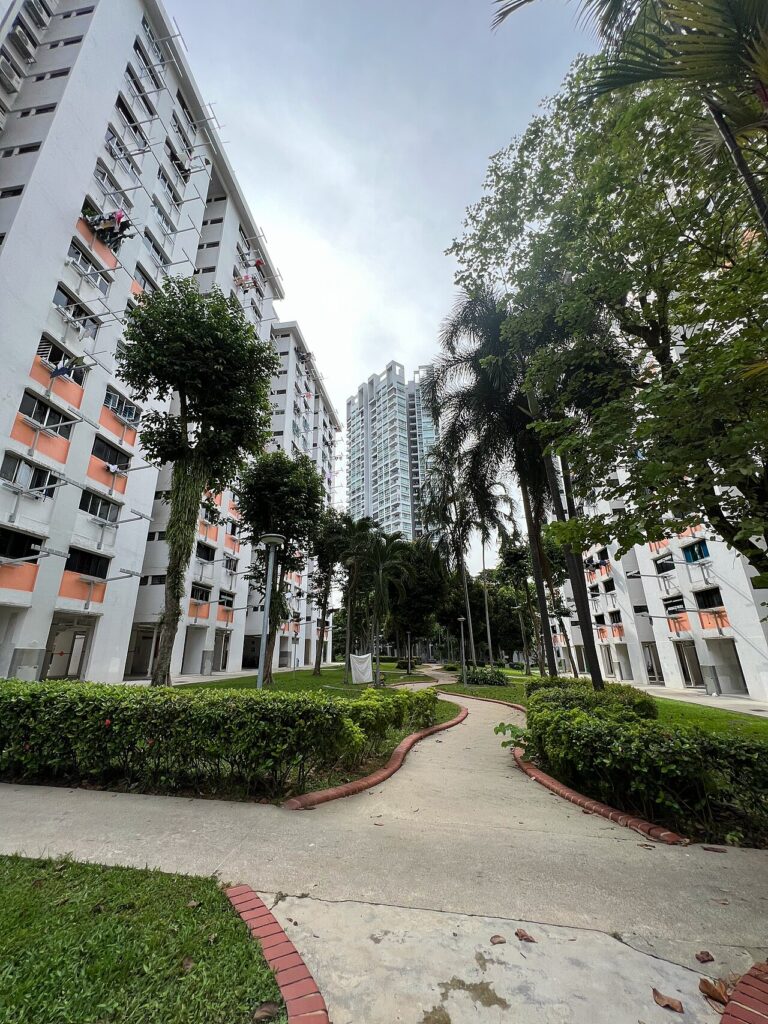
Quick Answer , HDB Resale Singapore 2026: Key Takeaways
- Who can buy: Singapore Citizens (SC) and Permanent Residents (PR) forming an eligible family nucleus or joining an SC under the Joint Singles Scheme.
- No income ceiling for eligibility , but grants (EHG up to S$80,000 for families) require household income ≤ S$14,000/mth.
- Market price, no HDB price control: HDB resale flats are sold at negotiated market prices; Cash Over Valuation (COV) is common in mature estates.
- HFE letter mandatory since May 2023: All buyers must obtain a valid HDB Flat Eligibility (HFE) letter before submitting any Option to Purchase (OTP).
- HDB Loan: 2.6% p.a., up to 80% LTV (capped at assessed monthly instalment ≤ 30% MSR); Bank Loan: up to 75% LTV, market rate ~3–4% p.a.
- Resale prices: The HDB Resale Price Index (RPI) hit 216.3 in Q1 2026 , up 41% since Q1 2021, with growth moderating to +0.9% QoQ in Q1 2026.
- Process: HFE letter → flat search → OTP (21-day validity) → resale flat application → HDB appointment → completion (typically 8–12 weeks total).
- MOP: 5 years from key collection before you can sell, rent out entire flat, or buy a private property (10 years for Plus/Prime classification flats bought from HDB directly , not applicable to resale).
HDB resale flats form the backbone of Singapore’s housing market. With over 1.1 million flats across 24 towns and estates, the HDB resale market gives buyers immediate access to established neighbourhoods , complete with MRT stations, schools, hawker centres, and community infrastructure , without the multi-year wait of a Build-To-Order (BTO) exercise.
In 2025, approximately 29,000 HDB resale transactions were completed, a volume broadly consistent with the five-year average. Prices have risen sharply since 2021 , the Resale Price Index surged 41% between Q1 2021 and Q1 2026 , but the pace of growth has eased considerably. Understanding how to navigate the resale market in 2026 requires clarity on eligibility rules, grant quantum, financing limits, and the sequencing of each step in the purchase process.
This guide covers every dimension of Singapore HDB resale , whether you are a first-time buyer seeking a mature estate flat, an upgrader buying a five-room in a choice location, or a seller assessing the right time to exit.
Who Can Buy an HDB Resale Flat in Singapore?
HDB resale eligibility is governed by the Housing and Development Act (Cap 129) and administered by the Housing and Development Board. The core requirement is that at least one buyer must be a Singapore Citizen, and the buyers must form a qualifying family nucleus. The main eligibility schemes are:
Public Scheme: The most common scheme, open to SCs or SPRs who are married, engaged, or are parent-and-child pairs, siblings, or orphans. At least one SC or SPR is required; if all applicants are SCs, an unrestricted range of unit types and sizes is available. SPR-only families may purchase 3-room or larger resale flats in non-mature towns and estates.
Single Singapore Citizen (SSC) Scheme: SCs aged 35 and above who are single, divorced, or widowed may purchase a 2-room Flexi to 5-room resale flat anywhere in Singapore. This scheme was introduced to support housing access for non-family-nucleus applicants.
Joint Singles Scheme (JSS): Two or more SCs aged 35 and above who are not related may co-purchase an HDB resale flat (3-room or smaller) together.
Non-Citizen Spouse Scheme: A lone SC married to a non-citizen (non-SPR) may purchase a resale flat if the couple does not already own private property.
Fiancé/Fiancée Scheme: Engaged couples may purchase a resale flat before marriage, provided they marry within three months of key collection and register their marriage with HDB.
Importantly, there is no income ceiling to purchase an HDB resale flat , the income limits only affect grant eligibility. This contrasts with BTO where the household income ceiling of S$14,000/mth (or S$21,000/mth for larger flat types) applies to eligibility itself.
Buyers who currently own private property , locally or overseas , generally cannot purchase an HDB resale flat while retaining that private property. SCs and SPRs who own private property may buy an HDB resale flat only after disposing of the private property, with a six-month window to complete the disposal.
HDB Resale Valuation and Cash Over Valuation (COV)
Unlike BTO flats whose prices are set by HDB, resale flat prices are negotiated freely between buyer and seller. HDB appoints an approved valuer to assess the flat’s market value at the point of the resale application; the valuation is typically commissioned two to three weeks after the OTP is exercised.
If the agreed price exceeds the assessed valuation, the difference , the Cash Over Valuation (COV) , must be paid entirely in cash. CPF Ordinary Account funds and housing loans can only cover up to the assessed valuation. COV has ranged from zero to over S$100,000 depending on location, flat type, floor level, facing, and the overall market temperature. In the current market (Q1 2026), median COV in mature estates such as Toa Payoh, Bishan, and Queenstown typically ranges between S$20,000 and S$60,000.
As a practical matter, buyers should budget for potential COV as part of upfront cash requirements, especially when competing for flats in highly sought-after precincts. Sellers should price with awareness that excessive COV requests can deter buyers, who must source that cash component from personal savings, not CPF.
Housing Grants for HDB Resale Flats 2026
The Singapore government offers a generous portfolio of grants to subsidise HDB resale purchases. These are administered by HDB and credited either to the buyer’s CPF Ordinary Account or disbursed as cash at completion.
Enhanced CPF Housing Grant (EHG): The flagship resale grant, available to both first-time families and first-time singles. For first-time families, the EHG ranges from S$25,000 (household income S$10,501–S$12,000/mth) to S$80,000 (household income not exceeding S$3,000/mth). For first-time singles, the quantum is half the family rate at the same income band. The EHG is credited to the buyer’s CPF OA and applied against the purchase price. Critically, the EHG is available regardless of which town, flat type, or remaining lease the resale flat has, provided the flat’s remaining lease covers the youngest buyer to at least age 95.
Proximity Housing Grant (PHG): Introduced in 2015, the PHG rewards buyers who purchase close to their parents or children. Families receive S$30,000 if they purchase within the same town or within 4 km of their parents/children; S$20,000 if within 4 km only. Singles receive S$15,000 (same town or 4 km) or S$10,000 (4 km only). The PHG is credited as cash and disbursed at completion.
Step-Up CPF Housing Grant: Available to second-time buyers who previously lived in a 2-room BTO flat (Standard or Plus in non-mature estates) and are upgrading to a 4-room or smaller resale flat in a non-mature town. The quantum is S$15,000, credited to CPF OA.
CPF Housing Grant for Resale Flats: Applicable under certain conditions for buyers who already received grants under the old AHG/SHG framework before it was superseded by the EHG in 2019. New buyers from 2019 onwards are assessed under the EHG regime instead.
Financing Your HDB Resale Purchase
Two financing options are available: the HDB Concessionary Loan and a bank housing loan. The choice has permanent consequences , once you take a bank loan for the current or a prior flat, you cannot subsequently revert to the HDB loan for a future purchase.
The HDB Concessionary Loan carries a rate of 2.6% per annum (0.1 percentage point above the CPF OA rate of 2.5%), fixed by HDB and reviewed quarterly. Its key advantages are stability, a higher LTV limit of 80% (versus 75% for bank loans), and the absence of a mandatory cash down-payment , the full 20% downpayment can be paid from CPF OA. The Mortgage Servicing Ratio (MSR) cap of 30% of gross monthly income applies to both HDB and bank loans on HDB flats.
A bank loan is subject to market rates, which in Q1 2026 range from approximately 3.0–3.8% p.a. depending on loan package type (fixed or floating). The LTV is capped at 75%, and a minimum 5% cash downpayment is mandatory (the remaining 20% of the purchase price can be met with CPF). If you have an outstanding housing loan on any property, the LTV ceiling drops further and TDSR (Total Debt Servicing Ratio, 55% of gross income) applies in addition to MSR.
The HDB Flat Eligibility (HFE) Letter , mandatory since May 2023 , consolidates in a single document the buyer’s eligibility to purchase a resale flat, the CPF housing grants they are entitled to, and the HDB Concessionary Loan quantum they may borrow. The HFE letter is valid for six months and must be obtained before the seller issues any OTP.
HDB Resale vs HDB BTO vs EC , Quick Comparison
| Parameter | HDB Resale | HDB BTO | Executive Condo (EC) |
|---|---|---|---|
| Price control | Market-driven; COV possible | Subsidised by HDB; below market | Market-driven; no subsidy |
| Wait time | Immediate (8–12 wks completion) | 3–5 years wait | 3–4 years (new) or immediate (resale) |
| Income ceiling | None (grants require ≤S$14,000) | S$14,000/mth (most types) | S$16,000/mth (new EC) |
| Grants available | EHG (up to S$80k) + PHG (up to S$30k) | EHG (up to S$80k) | AHG/FHG (EC-specific; limited) |
| MOP | 5 years from key collection | 5 years (Standard); 10 years (Plus/Prime) | 5 years (after TOP) for sale; 10 years for privatisation |
| Foreigners | SC/SPR only | SC only (as at least one applicant) | SC/SPR only (new EC); anyone after 10 years |
| CPF usage | OA up to VL (Valuation Limit) | OA up to VL | OA up to VL |
The HDB Resale Process Step by Step
The HDB resale process follows a defined sequence governed by HDB’s administrative procedures. From first search to key collection typically spans eight to twelve weeks.
Step 1 , Apply for HFE Letter: Before any flat viewing or negotiation, both buyers must apply jointly for the HDB Flat Eligibility (HFE) letter via the HDB Flat Portal. HDB reviews CPF balances, existing property ownership, and loan history; processing takes five to ten business days. The HFE letter confirms grant entitlements and maximum loan quantum.
Step 2 , Flat Search and Negotiation: Use HDB’s ResaleFlatListings portal or engage a CEA-registered salesperson. Review transaction data on HDB’s website to calibrate a fair offer. Agree price, preferred completion date, and any fixtures to be included. Sellers and buyers can transact without agents under HDB’s direct registration option.
Step 3 , Option to Purchase (OTP): The seller issues an OTP valid for 21 calendar days. The buyer pays the Option fee (≤ S$1,000 for flats priced ≤ S$500,000; ≤ S$2,000 for flats > S$500,000). Within the 21-day window, the buyer decides to exercise by paying the Exercise fee (deducted from the purchase price) and submitting the resale flat application.
Step 4 , Resale Flat Application: Both buyer and seller submit separate portions of the application on HDB’s portal. HDB processes the application, appoints a valuer, and reviews grant eligibility , typically two to three weeks. An Approval-in-Principle (AIP) or Approval letter follows.
Step 5 , HDB Resale Appointment: Both parties attend a scheduled appointment at HDB Hub or via online portal. Documents are signed, CPF withdrawals authorised, and completion legalities confirmed. Stamp duty (BSD) is payable within 14 days of the OTP exercise date.
Step 6 , Completion and Key Collection: On the agreed completion date, HDB transfers the title and the buyer collects the keys. The five-year MOP clock starts from this date.
Worked Example: Mr & Mrs Chan , Tampines 4-Room Resale
Scenario: Mr & Mrs Chan, both Singapore Citizens, joint gross monthly income S$9,200. First-time buyers. Purchasing a 4-room resale flat in Tampines (mature estate), agreed price S$720,000. Mrs Chan’s parents live in Tampines , PHG proximity within 4 km applies. Couple plans to take HDB Concessionary Loan.
Grant entitlement (HFE letter):
EHG (income S$9,001–S$10,500 band): S$35,000 (credited to CPF OA)
PHG (parents within 4 km): S$20,000 (cash disbursed at completion)
Total grants: S$55,000
Stamp duty:
BSD on S$720,000: first S$180k × 1% = S$1,800 + next S$180k × 2% = S$3,600 + remaining S$360k × 3% = S$10,800 = S$16,200 BSD
ABSD: nil (SC purchasing first residential property)
Financing:
HDB Concessionary Loan (LTV 80%): S$720,000 × 80% = S$576,000 loan
Monthly instalment @ 2.6% p.a., 25-year tenure: ≈ S$2,607/mth
MSR: S$2,607 ÷ S$9,200 = 28.3% , PASS (≤30%)
Downpayment (20% = S$144,000):
EHG S$35,000 credited to CPF OA; assume existing CPF OA S$85,000 each (combined S$170,000 + S$35,000 = S$205,000 available in CPF)
S$144,000 covered entirely from CPF OA , no cash downpayment required
Cash upfront (items payable in cash):
BSD S$16,200 (can pay from CPF or cash) + Legal fees ~S$2,500 + Survey fee S$290 + Option Exercise fee ~S$2,000 = ~S$21,000 (most payable from CPF)
PHG cash grant of S$20,000 received at completion partially offsets out-of-pocket costs
Why HDB Resale Prices Matter for Buyers and Sellers in 2026
The HDB Resale Price Index at 216.3 as of Q1 2026 reflects a market that has absorbed significant price appreciation over five years but is now settling into a slower growth phase. The pace of quarterly increase has decelerated from over 3% QoQ at the 2021–2022 peak to under 1% by Q1 2026. This matters for buyers in two ways: the fear of missing out that drove frantic bidding and record COV payments in 2022 has eased, but asking prices remain structurally elevated.
The emergence of million-dollar HDB flats , a rare phenomenon before 2021, now recorded in the hundreds annually , reflects both genuine scarcity of prime-location resale stock and the wider anchor effects of elevated private market pricing. Buyers in mature estates such as Queenstown, Bishan, Bukit Merah, Toa Payoh, and Clementi should model their budget around prices that remain 35–50% above 2019 levels.
For sellers, the moderation in price growth means that extraordinary COV premiums of S$100,000 or more are harder to sustain outside genuinely irreplaceable locations. A well-priced flat at or near valuation with a clean transaction history and a remaining lease comfortably above 65 years will still attract competitive offers.
What Might Come Next , HDB Resale Outlook for H2 2026
The following is analytical perspective, not financial advice. Readers should form their own view and seek professional guidance where appropriate.
Several structural factors point to continued price resilience in the HDB resale market through 2026. BTO supply , while improving, with HDB targeting 19,600 new flats for the year , cannot satisfy immediate demand from buyers with pressing housing timelines. The June 2026 BTO exercise covers 6,900 flats across Ang Mo Kio, Bishan, Bukit Merah, Sembawang, and Woodlands, with application windows opening around 11 June 2026 , but successful applicants will wait three to five years for keys, sustaining demand for resale units throughout that period.
Interest rate policy adds a counterweight. HDB’s concessionary loan rate of 2.6% has remained stable, but bank loan rates at 3–4% represent a meaningful servicing cost for buyers who do not qualify for or prefer not to use the HDB loan. Any prolonged period of elevated rates compresses affordability and exerts a modest downward pressure on resale prices, particularly in less sought-after non-mature estates. The MAS Financial Stability Review 2025 noted the property market as resilient but flagged household debt-servicing burdens as a risk to monitor.
The government’s supply-side response , including the BTO Plus and Prime frameworks and the 2H2026 GLS programme releasing approximately 9,200 new private units , will take several years to materialise as completed stock. In the near term, the HDB resale market is likely to remain a seller’s market in mature estates and a more balanced market in non-mature towns.
Frequently Asked Questions , HDB Resale Singapore 2026
Can I buy an HDB resale flat if I already own a private property?
Generally, no , SCs and SPRs who own a private residential property (local or overseas) are not permitted to purchase an HDB flat without first disposing of the private property. However, there is a six-month disposal window: you may purchase the HDB resale flat first and dispose of the private property within six months of the HDB flat’s completion date. Failure to comply results in HDB taking action under the Housing and Development Act. Note that even if disposal is completed within the window, the Additional Buyer’s Stamp Duty (ABSD) for the HDB purchase is not subject to the standard married-couple remission scheme that applies to private property purchases , the HDB flat is treated as a separate stamp duty regime.
What is the MOP for HDB resale flats, and does it apply to Plus/Prime resale flats too?
The standard Minimum Occupation Period (MOP) for all HDB resale flats is five years from the date of key collection (or the date HDB records as the start of the owner’s occupation). The extended ten-year MOP for Plus and Prime classification flats applies only to flats purchased directly from HDB under a BTO exercise , it does not attach to resale transactions of those flat types. This means a buyer purchasing a Plus or Prime flat on the resale market is subject only to the standard five-year MOP, not the extended ten-year restriction. The PLH resale conditions (sub-sale restrictions and clawback) also do not carry forward to resale purchasers of Plus/Prime flats.
What happens if the agreed resale price is below HDB’s valuation?
If the agreed purchase price is below the HDB-assessed valuation, the buyer benefits , the housing loan amount can still be based on up to 80% of the assessed valuation, giving the buyer access to the same maximum loan quantum as if they had paid valuation. CPF usage is also capped at the assessed valuation (or the Withdrawal Limit, whichever applies), so a below-valuation purchase stretches the buyer’s CPF further. There is no penalty or restriction on transacting below valuation, and sellers sometimes accept below-valuation prices in a slower market or when they need to transact quickly.
How is the Enhanced CPF Housing Grant (EHG) calculated for joint buyers with different nationalities?
For mixed-nationality couples (one SC, one SPR), the grant computation uses the average gross monthly income of both applicants. The same grant table applies. However, SPR-only households are not eligible for the EHG , at least one applicant must be a Singapore Citizen for the EHG to apply. Where one buyer earns significantly more than the other, the blended average income can push the couple into a lower grant tier than the lower-earning partner’s income alone would suggest, so the computational basis of the HFE letter should be reviewed carefully before finalising the purchase decision.
Can I use CPF to pay the Cash Over Valuation (COV) on an HDB resale flat?
No. COV , the amount by which an agreed resale price exceeds HDB’s assessed valuation , must be paid entirely in cash. CPF Ordinary Account funds and housing loan proceeds can only be applied up to the assessed valuation of the flat. This is a hard rule under the CPF Act and the Housing and Development Act. Buyers in competitive markets must therefore budget for COV as a pure cash outlay, separate from the CPF-funded downpayment and the loan amount. Sellers often know this constraint and price accordingly, using COV as a market-clearing mechanism in high-demand areas.
What are the stamp duties payable when buying an HDB resale flat?
Buyer’s Stamp Duty (BSD) applies to all HDB resale purchases. The BSD rate schedule (effective 15 February 2023) is: first S$180,000 at 1%; next S$180,000 at 2%; next S$640,000 at 3%; next S$500,000 at 4%; next S$1,500,000 at 5%; amounts above S$3,000,000 at 6%. For a flat purchased at S$600,000, the BSD works out to S$13,200 (S$1,800 + S$3,600 + S$7,800). Additional Buyer’s Stamp Duty (ABSD) is nil for Singapore Citizens purchasing their first residential property. SPRs purchasing their first property pay 5% ABSD; SPRs purchasing a second property pay 30% ABSD. BSD must be paid within 14 days of exercising the OTP. It can be paid from CPF OA funds if sufficient balance is available.
Related Articles on LovelyHomes
- ABSD Singapore 2026: Complete Guide to Additional Buyer’s Stamp Duty
- Singapore Stamp Duty Complete Guide 2026: BSD, ABSD, SSD and ACD Explained
- Singapore CPF Property Withdrawal Limits 2026: OA Valuation Limit and Accrued Interest
- First-Time Property Buyer Guide Singapore 2026: HDB, EC and Condo Explained
- Singapore HDB BTO Guide 2026: Eligibility, Grants, Step-by-Step Process and Prices
- Singapore Bridging Loan Guide 2026: How to Bridge the Gap Between Selling and Buying
- Singapore Property Selling Guide 2026: How to Sell Your HDB, Condo or Landed Property
Disclaimer
This article is for general informational purposes only and does not constitute financial, legal, or property advice. HDB policies, grant eligibility criteria, loan limits, stamp duty rates, and market statistics are subject to change by the Housing and Development Board, the Inland Revenue Authority of Singapore (IRAS), the Monetary Authority of Singapore (MAS), and the CPF Board. Readers should verify all figures directly with HDB at www.hdb.gov.sg, IRAS at www.iras.gov.sg, and consult a licensed property salesperson registered with the Council for Estate Agencies (CEA) and/or a licensed financial adviser before making any property transaction decision. Property investment carries risk; past price performance does not guarantee future returns.
Supporting graphics
Original article illustrations are available below.
- Figure 1: Singapore HDB Resale Price Ranges by Flat Type, Q1 2026 (indicative OCR prices; CCR/mature estate premiums apply). Source: HDB, URA REALIS.
- Figure 2: HDB Resale Grants 2026 , EHG and PHG quantum by household income tier. EHG up to S$80,000 for families; PHG up to S$30,000. Source: HDB.
- Figure 3: Singapore HDB Resale Price Index (RPI) Q1 2021 to Q1 2026 , 41% cumulative growth; pace moderating to +0.9% QoQ by Q1 2026. Source: HDB Resale Statistics.


