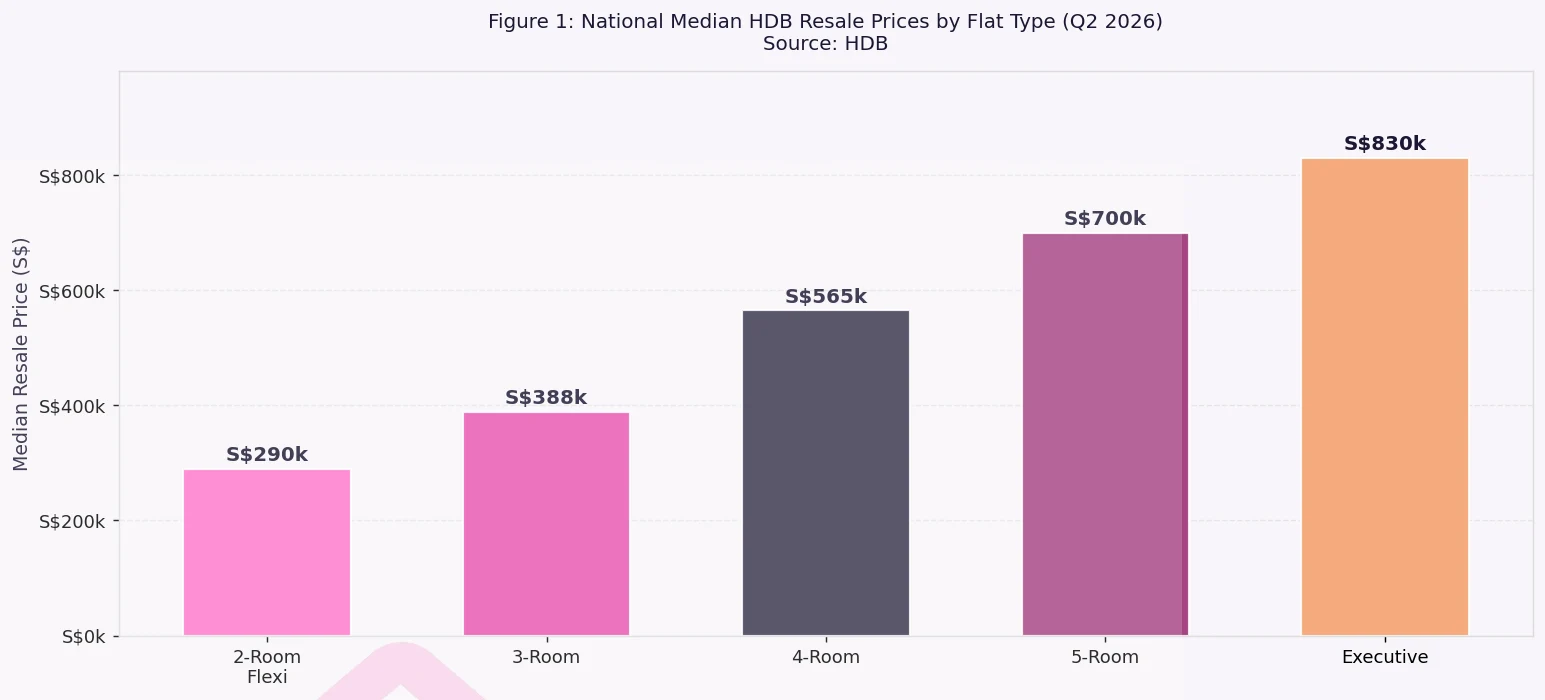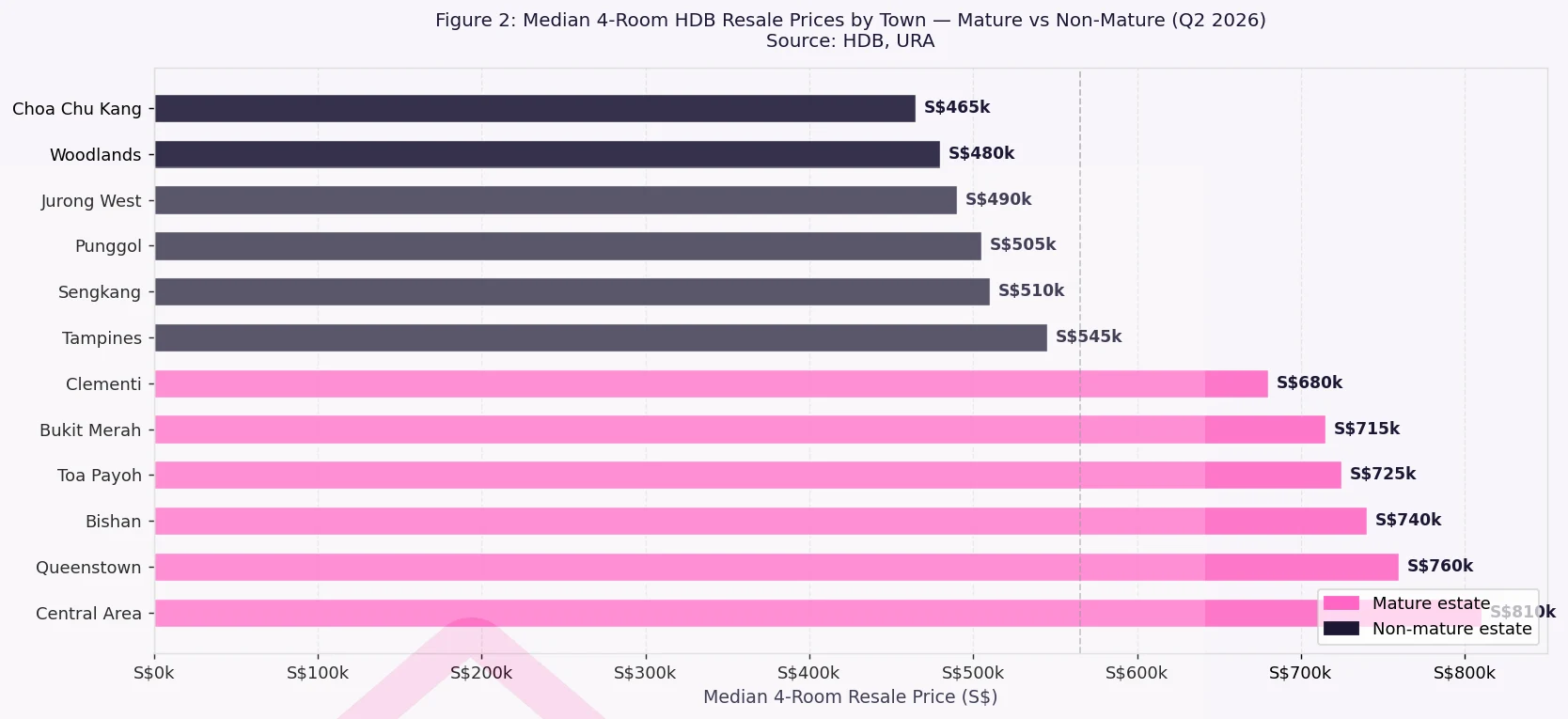
- The national median HDB resale price for a 4-room flat in Q2 2026 is approximately S$565,000 , but individual towns range from S$465k to over S$800k.
- Mature estates (Bishan, Queenstown, Toa Payoh) command a 30–60% premium over non-mature estates (Woodlands, Jurong West) for the same flat type.
- You do not pay BSD or ABSD on the first property as a Singapore Citizen buying an HDB resale flat; however, BSD still applies and is computed on the purchase price.
- Cash Over Valuation (COV) is the amount you pay above the official HDB valuation. COV cannot be financed by a bank or HDB loan , it must be paid in cash.
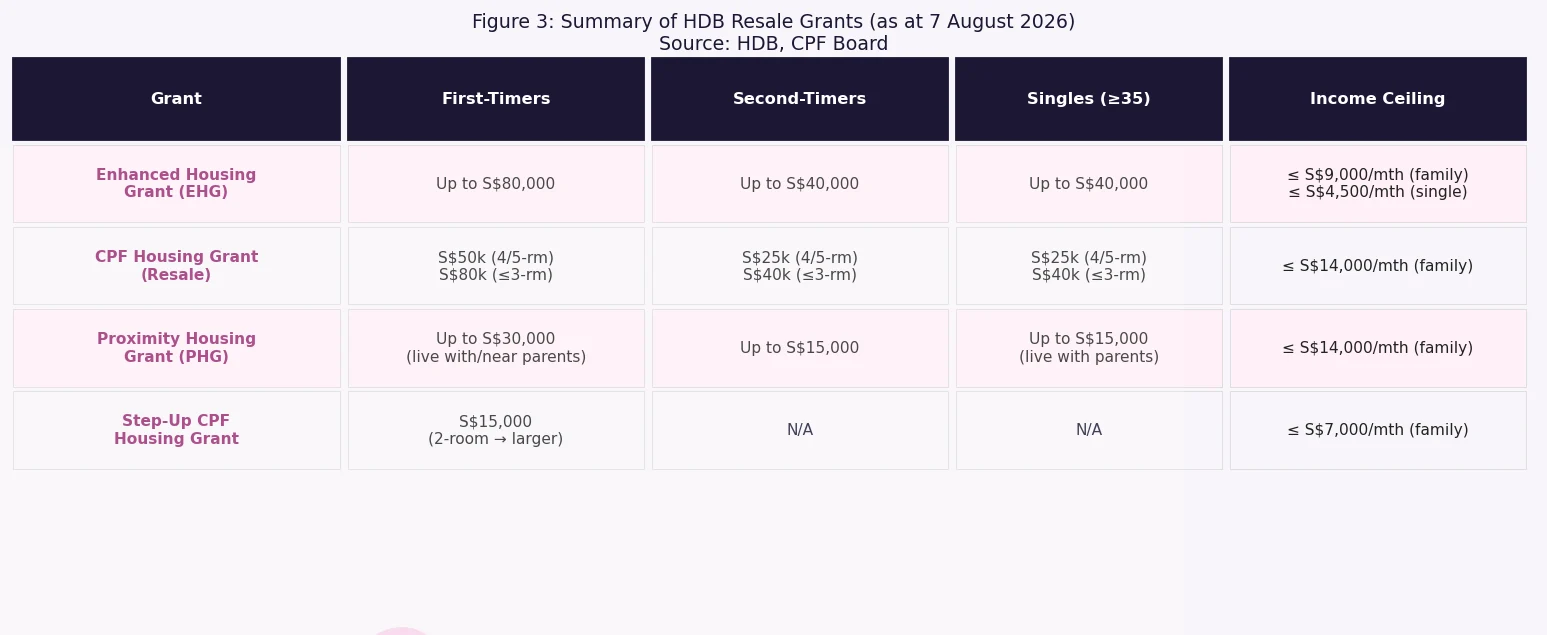
- First-timer families can receive up to S$80,000 via the Enhanced Housing Grant (EHG) for a resale flat purchase, plus additional amounts via the CPF Housing Grant and Proximity Housing Grant (PHG).
- You need a valid HDB Flat Eligibility (HFE) Letter before making an offer on a resale flat. The letter takes 21 working days to process and is valid for 6 months.
- The resale market has no balloting: you find a flat, negotiate with the seller, agree a price, and exercise the Option to Purchase (OTP). HDB approval follows.
- HDB resale flats are all on 99-year leases. Flats with fewer than 60 years remaining have restricted CPF use, and those below 30 years cannot use CPF at all.
- The HDB Resale Price Index (RPI) rose approximately 4.2% in 2025 and is on track for 3–5% growth in 2026, driven by demand from upgraders and the dwindling BTO supply pipeline.
- Comparing resale against BTO: resale is faster (can move in within 8–12 weeks of OTP exercise), costs more upfront, but benefits from immediate location and can be grant-subsidised up to a similar net cost as a BTO in some scenarios.
What the HDB Resale Market Is , and How It Works
The HDB resale market is Singapore’s secondary market for public housing flats. Unlike Build-To-Order (BTO) launches , where HDB acts as developer, sets the price, and buyers ballot for units , in the resale market, individual flat owners sell directly to buyers at market-determined prices. HDB plays a regulatory and financing role but does not set the transaction price.
The resale market is administered by the Housing and Development Board (HDB), established under the Housing and Development Act. All resale transactions must be processed through HDB’s Resale Portal. The CPF Housing Grants for resale flats are funded by the Central Provident Fund Board and disbursed to buyers through the CPF Ordinary Account mechanism.
In 2025, approximately 27,000 HDB resale transactions were completed , representing a market of around S$18–20 billion by value. Resale flat demand comes primarily from three groups: couples or singles not eligible for BTO (e.g. second-timers or non-first-timers), buyers who need a specific location unavailable in current BTO launches, and buyers who want to move in quickly rather than wait 3–5 years for BTO construction.
HDB Resale Prices by Flat Type , National Medians (Q2 2026)
Prices vary substantially by flat type, estate maturity, proximity to MRT stations, and specific floor level and facing. The national medians shown above represent a starting point; individual units within a single block can differ by 5–20% based on these sub-factors. As a general rule, units above the 10th floor command a premium, and units facing north-south (avoiding the afternoon west sun) are preferred in most estates.
| Flat Type | Typical Gross Floor Area | National Median (Q2 2026) | Mature Estate Range | Non-Mature Estate Range |
|---|---|---|---|---|
| 2-Room Flexi | 36–45 sqm | S$290,000 | S$320k–S$420k | S$240k–S$290k |
| 3-Room | 60–65 sqm | S$388,000 | S$430k–S$580k | S$310k–S$380k |
| 4-Room | 90–105 sqm | S$565,000 | S$660k–S$810k | S$455k–S$550k |
| 5-Room | 110–130 sqm | S$700,000 | S$780k–S$960k | S$560k–S$680k |
| Executive | 130–145 sqm | S$830,000 | S$870k–S$1.05M | S$690k–S$820k |
HDB Resale Prices by Town: Where You Pay the Most (and Least)
Town-by-town price variation is the most significant factor for a resale buyer. “Mature estates” are HDB’s classification for townships established before 1985, with well-developed amenities, denser MRT networks, and established community infrastructure. Non-mature estates are newer developments, typically further from the city but often newer in construction. From 1 August 2024, HDB replaced the “mature/non-mature” classification with Standard, Plus and Prime flat types for new BTO launches , but the older classification remains widely understood and used for resale comparisons.
At the top of the price ladder, Central Area, Queenstown and Bishan consistently see 4-room resale flats transact above S$700,000 , and million-dollar transactions are now routine in these locations. The Central Area in particular regularly records transactions above S$900,000 for 4-room units, reflecting proximity to the CBD, excellent MRT connectivity and mature amenities. At the lower end, Woodlands, Choa Chu Kang and Jurong West offer 4-room resale flats in the S$460,000–S$490,000 range , representing meaningful value for buyers whose workplace location gives them flexibility.
The “million-dollar flat” phenomenon , HDB resale units transacting at S$1M or more , has become more widespread. In 2025, over 1,000 million-dollar HDB resale transactions were recorded, up from approximately 470 in 2024. These are concentrated in mature estates with remaining leases of 60+ years and premium floor levels.
Understanding Cash Over Valuation (COV)
The HDB valuation is an official independent valuation conducted by HDB after a buyer and seller agree on a price and the OTP is exercised. The valuation can come in at, above, or below the agreed transaction price. When the transaction price exceeds the valuation, the difference is called Cash Over Valuation (COV).
COV is important because it cannot be financed. Neither an HDB concessionary loan nor a bank loan can cover the COV component , it must be paid entirely in cash at the point of completion, in addition to any required cash down payment. In a hot resale market, sellers in prime locations routinely demand COV ranging from S$10,000 to S$80,000 or more. Buyers should budget explicitly for COV when evaluating resale flat affordability.
Conversely, if the valuation comes in higher than the agreed price (negative COV or “under-valuation”), the buyer benefits: they pay the agreed lower price, but CPF and loan calculations are based on the higher valuation , effectively giving the buyer additional CPF and loan headroom.
Grants Available for HDB Resale Buyers
Singapore’s system of housing grants for resale buyers is substantial and materially reduces the effective cost for eligible purchasers. The four main grants are the Enhanced Housing Grant (EHG), CPF Housing Grant (CHG), Proximity Housing Grant (PHG), and Step-Up CPF Housing Grant. All grants are disbursed via the CPF Board and applied at completion , they reduce the CPF outlay required, not the headline transaction price.
The Enhanced Housing Grant (EHG), administered by HDB and introduced in September 2019, is the most generous: eligible first-timer families with a monthly household income of S$9,000 or below receive up to S$80,000 (income S$1,500–S$3,000 bracket) on a sliding scale. Singles aged 35 and above purchasing a resale flat alone can receive up to S$40,000. The EHG is means-tested, income-capped, and subject to a flat usage period of 5 years (Standard) or 10 years (Plus/Prime , though these classifications apply mainly to BTO purchases). The income ceiling for EHG for families is S$9,000 per month; for joint-income singles, S$4,500 each.
The CPF Housing Grant (CHG) provides S$50,000 for first-timer families buying a 4-room or larger resale flat (or S$80,000 for 3-room or smaller), with income ceiling S$14,000. Second-timers receive half these amounts. The Proximity Housing Grant (PHG) adds up to S$30,000 for families who buy a resale flat to live with or near their parents , one of the few grants explicitly tied to family proximity rather than income alone. The Step-Up CPF Housing Grant of S$15,000 applies to second-timer families living in a 2-room Flexi flat purchased under the Parenthood Priority Scheme who are upgrading to a larger flat.
The HDB Resale Process: From HFE to Keys
The HDB resale process is structured and well-documented, but has several stages where timing and preparation matter:
- Apply for HFE Letter (21 working days): The HDB Flat Eligibility (HFE) letter, administered by HDB, confirms your eligibility to buy an HDB flat, the grants you qualify for, and the loan amount HDB will offer. Without a valid HFE letter, you cannot submit a resale application. The letter is valid for 6 months.
- Arrange financing: Decide between an HDB concessionary loan (2.6% p.a. as at August 2026, up to 80% LTV) or a bank loan (market rates, up to 75% LTV). Obtain an HDB Loan Eligibility (HLE) letter or a bank’s Letter of Offer.
- Find a flat and negotiate: Check listings, visit units, and negotiate a price with the seller. Check the resale transacted prices for comparable units on the HDB website.
- Exercise Option to Purchase (OTP): Pay S$1 to receive the OTP, then pay 1% of the purchase price (or S$1,000, whichever is higher) within 21 days to exercise it. The exercise fee counts toward the purchase price.
- Submit resale application: Both buyer and seller submit their portions within 7 days of OTP exercise via the HDB Resale Portal.
- HDB valuation and endorsement: HDB conducts the valuation. The transaction is endorsed once all conditions are met.
- Completion: Typically 8–10 weeks from resale application submission. At completion, you pay remaining cash, CPF funds are released, and you receive the keys.
HDB Resale vs BTO: A Direct Comparison
| Factor | HDB Resale | HDB BTO |
|---|---|---|
| Price | Market-determined; typically higher | HDB-subsidised; below market |
| Waiting time | 8–12 weeks to move in | 3–5 years construction wait |
| Location availability | Any existing town | Limited to current BTO sites |
| Grants | EHG, CHG, PHG , up to ~S$160k combined | EHG, AHG , up to ~S$80k |
| MOP | 5 years (Standard); 10 years (Plus/Prime) | 5 years (Standard); 10 years (Plus/Prime) |
| Flat condition | Existing; may need renovation | Brand new; standard fitting |
| Lease remaining | Varies (check before buying) | Full 99-year lease from launch |
| Income ceiling | S$14,000/mth (family) for grants | S$14,000/mth (family); S$16,000 for EC |
| Eligibility | First and second-timers (different grant amounts) | First-timers prioritised via ballot |
Worked Example: Mr and Mrs Lee Buy a Toa Payoh 4-Room Resale
Mr and Mrs Lee are a Singapore Citizen couple, both aged 30, with a combined monthly income of S$8,500. They are first-timers and wish to buy a resale 4-room flat in Toa Payoh to be near Mrs Lee’s parents (within 4km). The agreed transaction price is S$720,000 and HDB’s valuation is S$700,000 , meaning COV of S$20,000.
| Item | Amount | Notes |
|---|---|---|
| Purchase price | S$720,000 | Agreed with seller |
| HDB valuation | S$700,000 | COV = S$20,000 (cash only) |
| EHG (income S$8,500, first-timer) | S$30,000 | Sliding scale; disbursed via CPF |
| CPF Housing Grant (4-room) | S$50,000 | First-timer family grant |
| Proximity Housing Grant (PHG) | S$20,000 | Living within 4km of parents |
| Total Grants | S$100,000 | All disbursed via CPF Board |
| Net effective purchase price | S$620,000 | After grants |
| HDB loan (2.6%, 25yr, 80% LTV on S$700k val) | S$560,000 | Monthly: S$2,527/mth; MSR 29.7% ✓ (within 30%) |
| BSD (IRAS tiers on S$720k) | S$16,200 | Must be paid in cash |
| Cash required at completion | ≈ S$56,200 | COV S$20k + BSD S$16.2k + 5% cash downpayment S$36k less grants applied = residual |
The Lees’ monthly instalment of S$2,527 represents a Mortgage Servicing Ratio (MSR) of 29.7% of their combined income , within the HDB 30% MSR cap. The TDSR is also well within the 55% MAS ceiling. The combined grants of S$100,000 materially reduce the effective cost of a flat that would otherwise represent 2026 open-market value of S$720,000.
What Might Come Next for HDB Resale Prices
Several forces shape the HDB resale market’s near-term outlook. On the demand side, the pipeline of BTO flats completing their 5-year MOP is expected to generate increased upgrade activity from 2026 to 2028, as the large cohort of BTO buyers from 2021–2023 work through their MOP periods. These upgraders typically sell their HDB flats into the resale market before buying private property , which simultaneously increases resale supply and, because sellers often use proceeds to fund private purchases, sustains resale prices.
On the supply side, HDB has ramped up BTO launches in 2024–2025, with a focus on standard estates. As these complete in 2028–2030, they will add inventory to towns like Tengah, Tampines North, and Kallang-Whampoa , which could moderate price growth in specific estates while sustaining demand in genuinely constrained mature locations. The HDB Resale Price Index, administered by HDB and published quarterly alongside URA’s private residential data, is the benchmark to watch.
Related Articles
- Singapore HDB Eligibility Guide 2026: Who Can Buy an HDB Flat?
- Singapore HDB BTO Ballot Guide 2026
- ABSD Singapore 2026: Complete Guide to Additional Buyer’s Stamp Duty
- CPF Property Guide 2026: Using Your OA to Buy in Singapore
- Singapore MOP Guide 2026: Minimum Occupation Period Rules Explained
- Singapore HDB Downsizing Guide 2026
Frequently Asked Questions
Do I need to pay ABSD when buying a resale HDB flat?
If you are a Singapore Citizen buying your first property, no ABSD applies. If you are a Singapore Citizen buying a second property (including a resale HDB flat as a second home), ABSD of 20% applies on the purchase price. Singapore Permanent Residents pay 5% ABSD on their first property and 30% on subsequent properties. Foreigners cannot purchase new or resale HDB flats at all. Buyer’s Stamp Duty (BSD) applies to all HDB resale transactions regardless of buyer profile , computed at IRAS’s tiered rates on the purchase price.
How is the HDB resale flat valuation determined, and who pays for it?
After the buyer exercises the Option to Purchase (OTP) and both parties submit the resale application, HDB engages a private valuer from its panel to conduct the official valuation. The cost of the valuation is borne by the buyer and is typically S$120–S$150 for HDB flats. The valuation reflects the estimated open-market value of the flat based on comparable transactions in the same estate and flat type. If the agreed transaction price exceeds the valuation, the difference (COV) must be paid in cash by the buyer. If the valuation exceeds the agreed price, the buyer benefits from a larger CPF and loan base , a scenario more common in slower market conditions.
Can I use both an HDB loan and CPF grants together?
Yes. HDB concessionary loans and CPF housing grants are separate mechanisms that can be used together. The CPF grants (EHG, CHG, PHG) are credited to your CPF Ordinary Account (OA) and can be used toward the purchase price , effectively reducing the cash or loan amount required. The HDB loan provides up to 80% of the official valuation at 2.6% p.a. (as at August 2026). You can therefore combine: grants (reducing your effective purchase cost) + HDB loan (funding up to 80% of valuation) + CPF OA savings (for down payment and monthly instalments). The 5% minimum cash down payment rule applies only to bank loans; HDB loans allow a full CPF-funded down payment above the 5% mark.
What is a million-dollar HDB flat and should I be concerned?
A “million-dollar HDB flat” is a resale flat that transacts at S$1 million or more. Over 1,000 such transactions occurred in 2025, primarily in mature estates like Toa Payoh, Queenstown, Bishan and the Central Area, for premium upper-floor 5-room and executive units with long remaining leases. These represent the thin upper tail of the resale market , the vast majority of resale transactions occur well below S$1 million. If you are a typical resale buyer in a non-mature estate, you are unlikely to encounter million-dollar pricing. However, million-dollar transactions do exert an anchoring effect on valuations in nearby blocks, so their existence can affect COV expectations even in mid-tier estates.
What happens if I buy a resale flat with fewer than 60 years of lease remaining?
Your CPF usage will be restricted if the flat’s remaining lease does not cover the youngest buyer to age 95 (full CPF use) or age 80 (pro-rated CPF use). Additionally, HDB concessionary loans require the flat’s remaining lease to cover the youngest buyer for the full loan tenure , typically 25 years. Flats with fewer than 30 years of lease remaining cannot use CPF at all and are very difficult to finance. These restrictions significantly reduce the buyer pool on future resale, potentially compressing the price you can achieve when you eventually sell. HDB publishes remaining lease data for all resale flats on its Resale Portal; always check this figure before making an offer.
Can I own an HDB flat and a private property at the same time?
During the HDB MOP (5 years for Standard flats, 10 years for Plus/Prime), you cannot own any private residential property in Singapore or overseas. After MOP, you may purchase private property without having to sell your HDB flat first , but doing so as a Singapore Citizen will trigger ABSD of 20% on the private property purchase price (as the HDB flat counts as a first property). Some families “decouple” , transferring the HDB flat to one spouse’s sole ownership so the other spouse can purchase private property as a “first property” with no ABSD. This strategy involves legal, stamp duty and CPF considerations and should be discussed with a conveyancing solicitor.
Disclaimer
This article is for general informational purposes only and does not constitute property, legal, tax or financial advice. Prices, grant amounts, income ceilings, loan rates, and government policies are based on publicly available data as at 7 August 2026 and may change. Verify current rules with HDB (hdb.gov.sg), CPF Board (cpf.gov.sg), IRAS (iras.gov.sg) and MAS (mas.gov.sg) before making any property decision. Engage a licensed property agent (CEA-registered) and solicitor where appropriate.
Supporting graphics
Original article illustrations are available below.
- Figure 1: National median HDB resale prices by flat type, Q2 2026. 4-room median: S$565,000. Source: HDB.
- Figure 2: Median 4-room HDB resale prices by town, Q2 2026. Mature estates command a 30–60% premium over non-mature equivalents. Source: HDB, URA.
- Figure 3: Summary of HDB resale grants for eligible buyers as at 7 August 2026. Source: HDB, CPF Board.