Singapore HDB Resale Buying Process Guide 2026: Step-by-Step from HFE to Keys

Singapore HDB Resale Buying Process Guide 2026: Step-by-Step from HFE to Keys

Quick Answer: HDB Resale Buying Process 2026

  • 10 steps from eligibility check to key collection — typically 8–12 weeks end to end.
  • HFE Letter first — apply for the HDB Flat Eligibility letter before searching; it covers loan eligibility, CPF grants, and flat eligibility in one application.
  • Option to Purchase (OTP) — option fee S$1–S$1,000; 21 calendar days to exercise; exercise fee S$1–S$5,000.
  • Resale application must be submitted by both buyer and seller within 7 days of OTP exercise.
  • COV (Cash-Over-Valuation) — if you agree to pay above HDB’s valuation, the excess is cash only; CPF cannot cover it.
  • CPF grants available: EHG (up to S$80K), Family Grant (up to S$80K), Proximity Housing Grant (up to S$30K) — stackable, subject to income ceilings.
  • Administering bodies: HDB (eligibility, valuation, approval), MAS (bank loans), IRAS (BSD).

Buying an HDB Resale Flat in 2026: What Has Changed

Purchasing an HDB resale flat remains one of the most common property transactions in Singapore — approximately 27,000–30,000 resale transactions occur each year. But the process has undergone material changes since 2021, most notably the introduction of the HDB Flat Eligibility (HFE) Letter in May 2023 (replacing the prior HDB Loan Eligibility letter and CPF Housing Grant eligibility check with a single, combined application), and the 15-month wait-out period for private property owners effective 30 September 2022.

This guide walks you through every step — from confirming eligibility to collecting your keys — using the current process as at July 2026. It covers who can buy, how to finance the purchase, what grants are available, how to navigate the OTP and resale application, and what costs to budget for.

HDB resale buying process 10 steps Singapore 2026 — from eligibility check to key collection
Figure 1: The 10-step HDB resale buying process in Singapore, 2026. Typical timeline: 8–12 weeks from OTP exercise to key collection. Source: HDB.

Step 1: Confirm Your Eligibility

Before anything else, you must verify that you and your co-applicant (if any) meet HDB’s eligibility criteria for purchasing a resale flat. The key conditions are:

Citizenship: At least one applicant must be a Singapore Citizen. A Permanent Resident may co-apply, but cannot purchase alone. Singapore Citizens who already own an HDB flat may only purchase a second HDB flat if they dispose of the first within 6 months of completing the resale purchase — they cannot hold two HDB flats simultaneously.

Minimum Occupation Period (MOP): If either applicant currently owns an HDB flat, that flat must have fulfilled its MOP (typically 5 years from date of possession for standard HDB flats; 10 years for Prime or Plus classification flats) before a resale purchase can proceed.

15-Month Wait-Out Period: If either applicant currently owns, or has within the preceding 15 months disposed of, a private residential property, they must wait at least 15 months from the date of disposal before they can purchase an HDB resale flat. This measure was introduced on 30 September 2022 and applies strictly — there are very limited exemptions.

Income ceiling: There is no income ceiling for the purchase of an HDB resale flat itself. Income ceilings apply only to grant eligibility (EHG: S$9,000 household/S$4,500 single; Family Grant: S$14,000; PHG: S$14,000) and HDB loan eligibility (S$14,000 household for concessionary loan).

Step 2: Apply for the HFE Letter

The HDB Flat Eligibility (HFE) Letter, introduced in May 2023, is the single most important document you will obtain before starting your flat search. It is issued by HDB and tells you: (a) whether you are eligible to buy an HDB flat; (b) how much HDB loan you qualify for; and (c) which CPF housing grants you are eligible for and in what amounts.

You apply for the HFE Letter via the HDB Flat Portal (homes.hdb.gov.sg). Processing typically takes 21 business days for HDB loan applicants and about 14 business days if you are seeking a bank loan. The HFE Letter is valid for 6 months from the date of issue. If you plan to take a bank loan rather than an HDB loan, you should also obtain an In-Principle Approval (IPA) from your preferred bank before making an offer — banks do not issue IPAs until after you have the HFE Letter for HDB resale transactions.

HDB strongly recommends — and estate agents have been instructed — that buyers obtain the HFE Letter before signing any OTP. Signing an OTP without a valid HFE Letter exposes you to the risk of being unable to complete the transaction if your financing falls through.

Step 3: Search and Negotiate

HDB resale transactions take place primarily through the HDB Resale Portal (resale.hdb.gov.sg), where sellers list their flats, and through licensed property agents on platforms such as PropertyGuru, 99.co, and the EdgeProp portal. Unlike the BTO process, there is no ballot — you negotiate directly with the seller and agree on a price. HDB does not prescribe or cap resale prices, which are determined entirely by market forces.

Once you identify a flat, check the HDB Resale Price data (available on the HDB and URA websites) to understand recent comparable transactions. Pay attention to the Cash-Over-Valuation (COV) — if you agree to pay more than HDB’s valuation, the excess must be paid in cash only. CPF cannot fund COV. As at July 2026, the median COV in mature estates has been running at S$20,000–S$60,000 depending on flat type and floor level.

CPF housing grants HDB resale buyers 2026 — EHG Family Grant PHG stacked bar chart by buyer profile
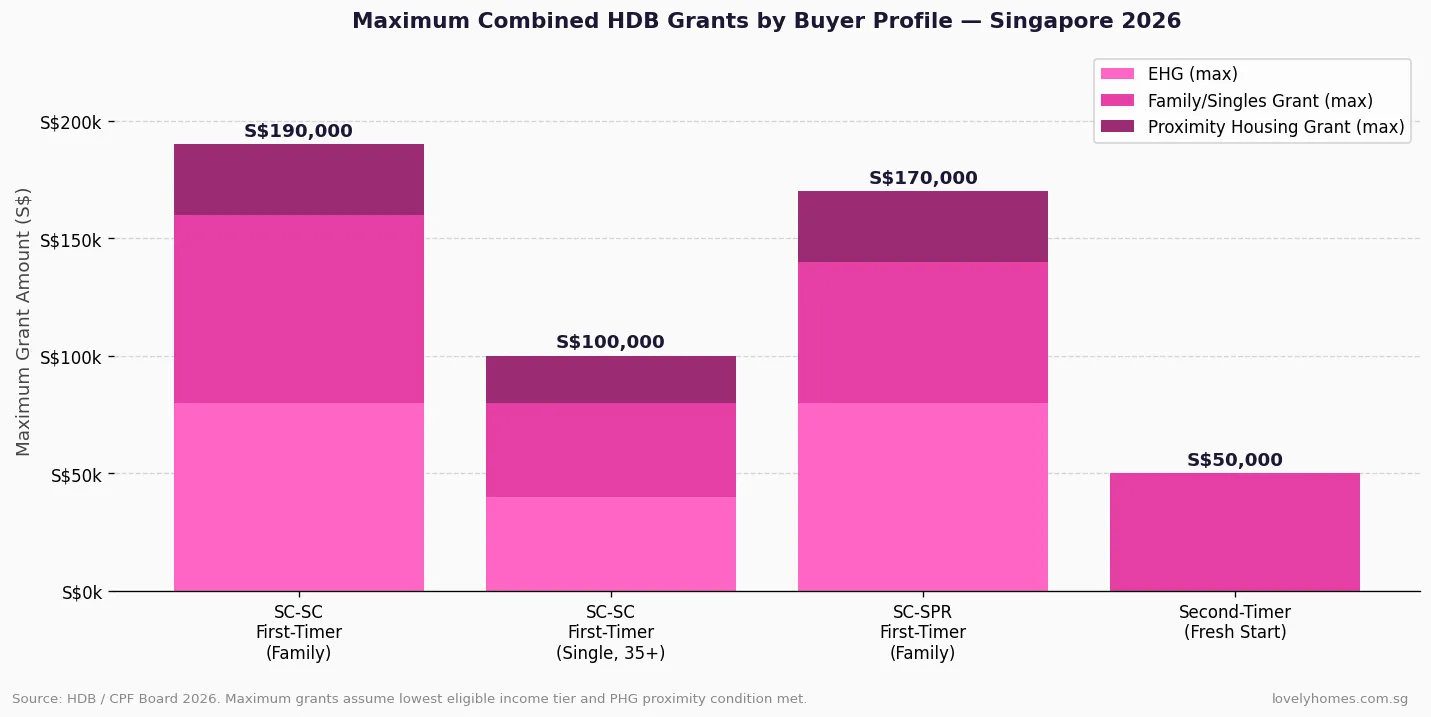
Figure 2: CPF Housing Grants available for HDB resale buyers by buyer profile (2026). EHG = Enhanced CPF Housing Grant; FG = Family Grant; PHG = Proximity Housing Grant. Source: HDB / CPF Board.

CPF Housing Grants for HDB Resale

HDB resale buyers — particularly first-timers — may be eligible for generous CPF Housing Grants that substantially reduce their effective purchase price. These grants are paid into your CPF Ordinary Account and deducted from the purchase price at completion, reducing the amount you need to borrow.

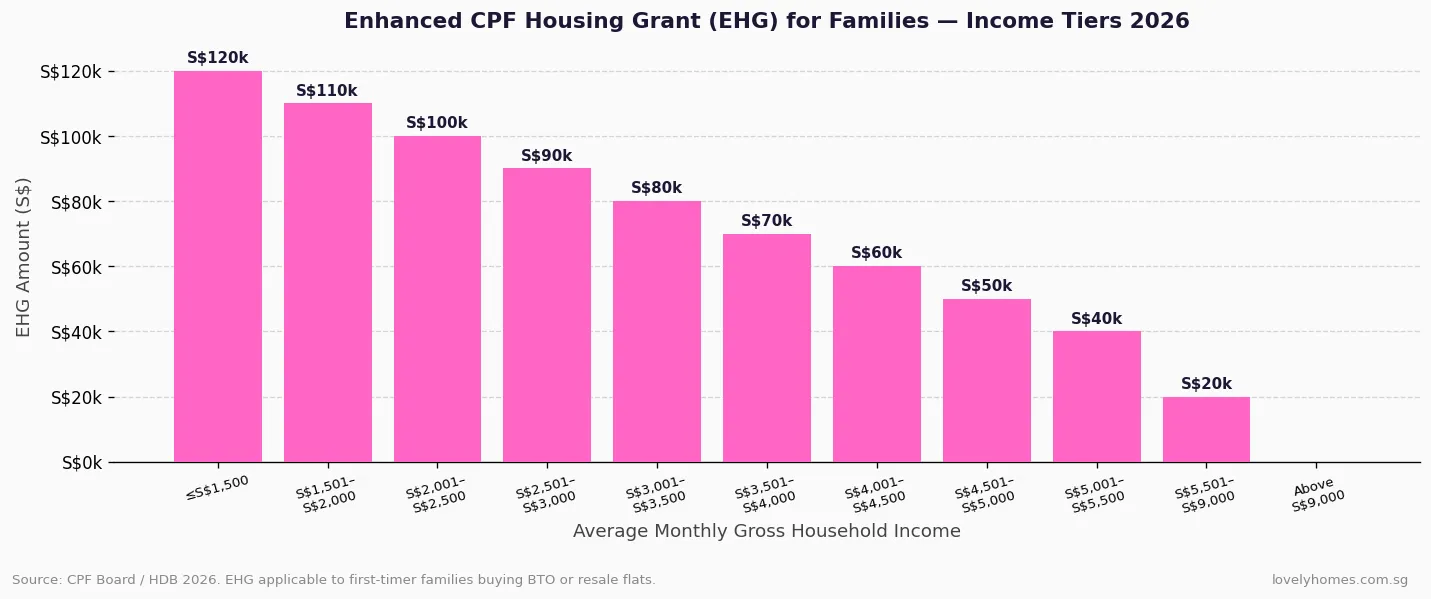
The Enhanced CPF Housing Grant (EHG) is the most substantial: up to S$80,000 for eligible couples (household income ≤S$9,000/month) and up to S$40,000 for singles (income ≤S$4,500/month). The EHG tapers based on income — households earning S$9,000 receive no EHG, while those earning S$1,500 or below receive the full amount. The Family Grant (up to S$80,000 for SC-SC couple buying a 4-room or smaller resale flat) and the Proximity Housing Grant (PHG) (up to S$30,000 if buying within 4km of parents or children, or S$20,000 if buying in the same town) are stackable on top of the EHG, subject to their respective income ceilings of S$14,000 household income.

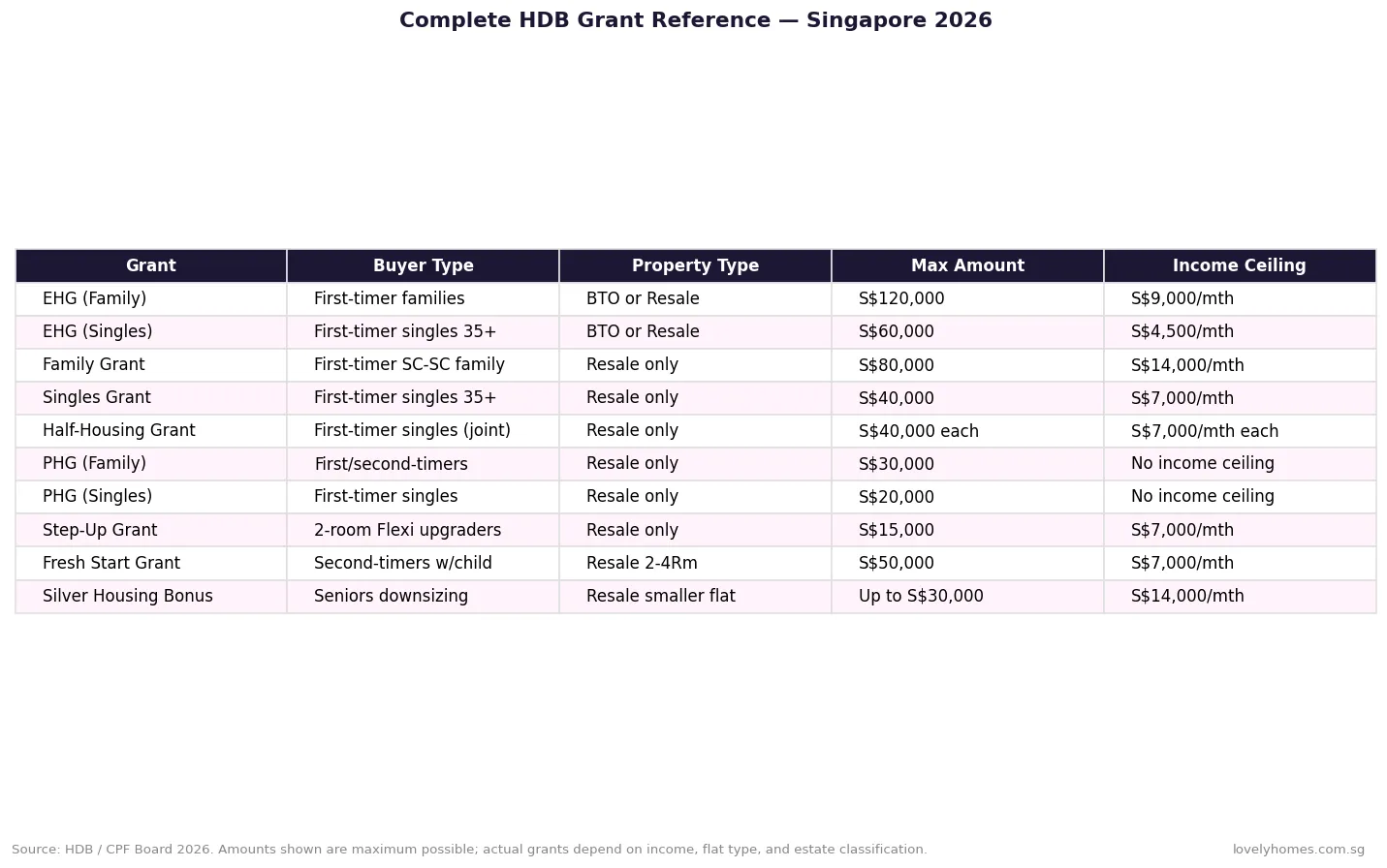
CPF Housing Grants for HDB Resale Buyers — Maximum Amounts (2026)
Grant Max (SC-SC Couple) Max (SC-SPR Couple) Max (SC Single) Income Ceiling Stackable?
Enhanced CPF Housing Grant (EHG) S$80,000 S$60,000 S$40,000 S$9,000/mth (couple); S$4,500 (single) Yes
Family Grant (FG) S$80,000 (4-room or smaller) S$50,000 S$14,000/mth Yes
Proximity Housing Grant (PHG) S$30,000 (same town) / S$20,000 (4km) S$30,000 / S$20,000 S$15,000 / S$10,000 S$14,000/mth Yes
Step-Up CPF Housing Grant S$15,000 (2nd-timer buying 2-room) S$7,000/mth Limited

Steps 4–6: OTP, Exercise, and Resale Application

Once you and the seller agree on a price, the seller grants you an Option to Purchase (OTP). This is a standardised HDB document (not a private OTP — HDB prescribes the form). The option fee is negotiable between S$1 and S$1,000; this sum is paid to the seller at this stage. You then have 21 calendar days to decide whether to exercise the option.

To exercise the OTP, you pay the seller the exercise fee (negotiable between S$1 and S$5,000, less the option fee already paid). You should appoint an HDB-accredited solicitor at this point — HDB-approved conveyancing firms handle the legal transfer and ensure all conditions are met for a valid resale application. Note that the solicitor fees for an HDB resale are regulated and relatively modest compared to private residential conveyancing.

After exercising the OTP, both the buyer and the seller must each independently submit their portions of the HDB Resale Application via the HDB Resale Portal within 7 days of the OTP exercise date. The application is rejected if either party fails to submit within this window — there are no extensions. The buyer’s portion covers loan details, CPF usage, grant applications, and identity verification; the seller’s portion covers their existing loan redemption, CPF refund computation, and property condition declaration.

Steps 7–10: Valuation, Approval, and Key Collection

After both parties submit, HDB appoints an independent valuer. The valuation report is typically issued within 5–10 business days. If the agreed resale price exceeds the valuation, the difference is the COV — the buyer must pay this entirely in cash. CPF cannot cover COV. If the resale price is at or below valuation, there is no COV issue and the full price can be funded by CPF and/or loan.

HDB then reviews the application — checking buyer and seller eligibility, loan amounts, CPF usage, and grant amounts — and issues its approval in principle (also known as the Letter of Offer for HDB loans, or confirmation of grant disbursement). This review takes approximately 4–6 weeks. Once approved, HDB sets a resale completion appointment (usually 3–5 weeks later), at which both buyer and seller sign the final transfer documents, the seller’s outstanding loan is redeemed, CPF principal and accrued interest are refunded to the seller’s CPF account, and the buyer’s grants are applied to reduce the purchase price.

At completion, the buyer pays the remaining purchase price (after deducting CPF, loan, and grants), and keys are handed over. The HDB MOP clock begins on the date of resale completion, not the date of OTP or application.

HDB resale total upfront costs 2026 — downpayment BSD legal fees by price band bar chart
Figure 3: HDB resale total upfront costs for a Singapore Citizen first-time buyer using HDB loan (80% LTV), by price band. BSD = Buyer’s Stamp Duty. Source: HDB, IRAS.

Worked Example: The Tan Family Buying a 4-Room Resale in Tampines

Mr and Mrs Tan are both Singapore Citizens, both first-timers, with a combined gross monthly income of S$7,200. They wish to buy a 4-room resale flat in Tampines. They identify a unit at S$650,000 — the HDB valuation comes in at S$630,000, meaning COV of S$20,000 in cash.

Grants: EHG: household income S$7,200 → approximately S$45,000. Family Grant (SC couple, 4-room resale): S$80,000. PHG (buying in same town as Mrs Tan’s parents): S$30,000. Total grants: S$155,000.

Financing: HDB Loan (at valuation S$630,000); HDB Loan LTV 80% = S$504,000. Monthly repayment at HDB concessionary rate 2.60% p.a. over 25 years: approximately S$2,287/month. MSR check: S$2,287 / S$7,200 = 31.8% — slightly above the 30% MSR. The loan tenure would need to be extended to 27 years to reduce the monthly payment to S$2,147 (29.8%, within MSR).

Cash required: 20% downpayment on S$630,000 = S$126,000 (CPF/cash); COV S$20,000 cash; BSD on S$650,000: first S$180K × 1% + next S$180K × 2% + balance S$290K × 3% = S$1,800 + S$3,600 + S$8,700 = S$14,100 BSD (payable from CPF); Legal fees ~S$2,500. After grants of S$155,000 applied to purchase price, effective loan reduces further. Total cash required on completion day: approximately S$20,000 COV + S$2,500 legal = S$22,500 cash. The downpayment and BSD can be funded entirely from CPF OA.

HDB Resale Buying Process: Summary Checklist

10-Step HDB Resale Buying Process — Summary for 2026
Step Action Key Deadline Portal / Body
1 Confirm eligibility (MOP, citizenship, WOP) Before everything else HDB / self-check
2 Apply for HFE Letter ~2–3 weeks processing homes.hdb.gov.sg
3 Search, view flats, check RPI and COV HFE valid 6 months resale.hdb.gov.sg / portals
4 Receive OTP from seller; pay option fee OTP valid 21 days HDB standard form
5 Exercise OTP; appoint solicitor Within 21 days of OTP HDB-accredited law firm
6 Both parties submit Resale Application Within 7 days of OTP exercise resale.hdb.gov.sg
7 HDB valuation issued ~5–10 business days HDB-appointed valuer
8 HDB resale approval ~4–6 weeks HDB
9 Completion appointment: sign & pay ~3–5 weeks after approval HDB Hub / solicitor
10 Key collection; MOP clock starts Completion date HDB

Why the HFE Letter Changed the Process

Before May 2023, buyers had to separately apply for an HDB Loan Eligibility (HLE) letter (for loan quantum) and individually check grant eligibility through the CPF Board. These were separate processes with separate documentation requirements. The HFE Letter consolidated all three determinations — eligibility to buy, loan quantum, and grant amounts — into a single application with Myinfo integration that pre-populates most fields from government databases. This has reduced the administrative burden significantly and means that by the time a buyer reaches Step 3 (searching for a flat), they already have a comprehensive view of their purchasing power.

The practical implication is that the HFE Letter has become the de facto pre-qualification document for HDB resale transactions. Sellers and their agents increasingly request to see it before entertaining an offer — much like how banks request an IPA before accepting a purchase offer in private transactions. Buyers who have not yet obtained their HFE Letter are at a disadvantage in competitive situations.

What Might Change: HDB Resale in 2H 2026

This section is analytical and speculative; it does not represent government policy.

HDB resale prices fell by 0.3% in Q2 2026 — the second consecutive quarterly decline. Volumes were also down approximately 10% year-on-year. The moderation has been attributed to a combination of the 15-month wait-out period (removing a significant pool of upgrader demand), the large cohort of BTO completions in 2025–2026, and higher mortgage rates. If the moderation continues through 2H 2026, there may be political pressure to consider relaxations such as easing the wait-out period for specific buyer segments or adjusting the EC income ceiling to divert some demand from the resale market. These are speculative — HDB has not signalled any imminent changes. Full Q2 2026 resale transaction data is expected from HDB around 23 July 2026.

Frequently Asked Questions

Do I need to sell my current HDB flat before buying a resale?

You cannot own two HDB flats simultaneously (with limited exceptions for concurrent subletting). If you own an HDB flat and wish to buy a resale flat, you must either sell the existing flat within 6 months of the new resale completion, or ensure the existing flat’s MOP has been met and proceed under HDB’s approved conditions. Singapore Citizens who own a private property and wish to buy an HDB resale must also comply with the 15-month wait-out period from the date of disposing of the private property.

What is Cash-Over-Valuation (COV) and how much should I budget?

COV is the difference between the agreed resale price and HDB’s valuation of the flat. It must be paid entirely in cash — it cannot be covered by CPF, grants, or loans. As at mid-2026, COV in mature estates such as Tampines, Bishan, and Toa Payoh typically ranges from S$20,000 to S$80,000 for 4-room and 5-room flats, with premium units (high floors, well-maintained, near MRT) attracting COV at the upper end or beyond. In non-mature estates, COV is generally lower or even nil. Budget at least S$20,000–S$40,000 in liquid cash specifically for potential COV when considering a mature estate purchase.

Can I use CPF to pay BSD for an HDB resale flat?

Yes. Buyer’s Stamp Duty for an HDB resale flat can be paid from your CPF Ordinary Account. The BSD is assessed on the higher of the purchase price or valuation. For a flat priced at S$650,000 (with valuation at S$630,000), BSD is assessed on S$650,000: 1% on first S$180,000 + 2% on next S$180,000 + 3% on balance S$290,000 = S$14,100. This amount can be deducted from your CPF OA balance and paid directly to IRAS by your conveyancing solicitor. Note that Additional BSD (ABSD) does not apply to most HDB resale purchases by first-time buyers.

My HFE Letter has expired. Can I still exercise the OTP?

No — a valid HFE Letter is required at the point of submitting the HDB Resale Application (Step 6). If your HFE Letter expires before you submit the application, you will need to apply for a fresh one. The HFE Letter is valid for 6 months from the date of issue. Given that the HDB resale process from HFE application to key collection can take 3–6 months in total, it is best to time your HFE application so it remains valid through to at least the expected date of resale application submission. If you expect to search for a flat for several months, consider applying for the HFE Letter approximately 2–3 months before you plan to make serious offers.

Is a property agent required to buy an HDB resale flat?

No. HDB’s resale portal (resale.hdb.gov.sg) is designed to allow buyers and sellers to transact directly without agents. HDB provides standard OTP forms, step-by-step guided submissions, and appointment scheduling through the portal. That said, many buyers choose to engage a licensed property agent for negotiation support, flat search assistance, and procedural guidance — particularly first-timers unfamiliar with the process. If you engage an agent, ensure they hold a valid CEA practitioner licence. Agent commission for a buyer is negotiable; it is often 1% of the purchase price, sometimes waived or subsidised by the co-broking arrangement with the seller’s agent.

What happens if I back out after exercising the OTP?

Once you exercise the OTP, you are legally bound to complete the purchase on the agreed terms. If you withdraw after exercising, the seller is entitled to forfeit your option and exercise fees and may seek further damages depending on the circumstances. Unlike private residential transactions (which involve a more complex contractual structure under the Sale and Purchase Agreement), HDB resale OTPs are relatively straightforward — but the principle of contractual commitment applies equally. If you are genuinely uncertain about proceeding, it is better to let the OTP lapse (forfeiting only the option fee of up to S$1,000) rather than exercise it and then withdraw.

Related Articles

Disclaimer

This article is for general informational purposes and does not constitute legal, financial, or professional advice. HDB eligibility rules, CPF grant amounts, loan limits, and stamp duty rates are subject to change. All figures cited are accurate as at 3 July 2026. Readers should verify current rules with HDB (hdb.gov.sg), IRAS (iras.gov.sg), MAS (mas.gov.sg), and the CPF Board (cpf.gov.sg) before making any decisions. LovelyHomes is not a licensed property agent, financial adviser, or legal practitioner.

Singapore HDB Downpayment Guide 2026: How Much Cash Do You Need?

Singapore HDB Downpayment Guide 2026: How Much Cash Do You Need?

Buying an HDB flat in Singapore involves one of the most consequential financial decisions most households will ever make — yet the mechanics of the downpayment are frequently misunderstood. How much cash do you actually need on completion day? How much can come from your CPF? Does it matter whether you take an HDB loan or a bank loan? The answers to these questions determine not just how much you need to have saved, but also how quickly you can buy and how you should be managing your CPF Ordinary Account in the months before applying.

This guide walks through the 2026 HDB downpayment rules in full — the minimum sums, the loan-to-value limits, the CPF rules, and the practical implications of choosing between an HDB concessionary loan and a bank mortgage. All figures reflect the rules administered by the Housing & Development Board (HDB) and the Monetary Authority of Singapore (MAS) as at July 2026.

Quick Answer — HDB Downpayment Singapore 2026

  • With an HDB loan (LTV 90%): minimum downpayment is 10%, payable entirely from CPF OA or cash — no mandatory cash component.
  • With a bank loan (LTV 75%): minimum downpayment is 25%, of which at least 5% must be in cash; the remaining 20% can come from CPF OA or cash.
  • If you have an existing HDB loan or any other outstanding home loan, your LTV drops further — down to 45%–55% depending on the loan count.
  • HDB loan interest is currently 2.60% per annum (0.10% above the CPF OA rate). Bank rates in 2026 range roughly 2.30%–3.20% depending on the package.
  • CPF can be used to pay both the downpayment and the monthly instalments, subject to the CPF accrued interest rule on eventual sale.
  • The HDB Flat Eligibility (HFE) letter replaces the former HDB Loan Eligibility (HLE) letter and the in-principle approval (IPA); you must obtain it before applying for any flat, BTO or resale.
  • For resale flats, you must also obtain a valuation from a licensed appraiser; your CPF and loan quantum are pegged to the lower of price or valuation.
  • The Minimum Occupation Period (MOP) for Standard flats is 5 years from keys; selling within MOP incurs claw-back of CPF-funded downpayment and grants.

Understanding Loan-to-Value (LTV) for HDB Flats

The Loan-to-Value ratio is the maximum proportion of a property’s purchase price (or valuation, whichever is lower) that a lender is permitted to finance through a loan. For HDB flats in Singapore, the LTV is governed by different rules depending on whether you borrow from HDB directly or from a commercial bank — and whether you have any existing outstanding home loans.

The HDB concessionary loan — available only to Singapore Citizens and, in some cases, PRs buying eligible HDB flats — offers a maximum LTV of 90%. This means you need to fund only 10% of the purchase price from your own resources. The bank loan, regulated by MAS, has a maximum LTV of 75% for a first housing loan. This means a 25% downpayment is required, with a hard cash floor of 5%.

Critically, these LTV limits apply to the lower of purchase price or valuation. If you are buying a resale HDB flat at S$650,000 but the HDB-appointed valuer values it at S$620,000, your loan will be calculated on S$620,000 — and the S$30,000 difference (called Cash Over Valuation, or COV) must be paid entirely in cash.

HDB loan vs bank loan comparison LTV downpayment cash CPF Singapore 2026
Figure 1: HDB concessionary loan vs bank loan — key differences in LTV, downpayment, cash requirement, and interest rate. Source: HDB, MAS (July 2026).

How Much Cash Do You Actually Need?

This is the question most first-time buyers ask first — and the answer depends entirely on your loan choice.

HDB Loan — Minimum Cash: S$0

If you qualify for and take an HDB concessionary loan, the 10% downpayment can come entirely from your CPF Ordinary Account (OA). There is no mandatory cash component. This is the key practical advantage of the HDB loan for buyers who may not have significant liquid savings but have been building CPF through employment.

However, “no mandatory cash” does not mean no cash at all. You will still need to pay BSD (Buyer’s Stamp Duty) — typically S$4,800–S$11,800 for a resale HDB flat priced below S$500,000 — and legal fees of around S$1,500–S$2,500. Both of these can be paid from CPF OA. If there is a Cash Over Valuation component, that must be paid in cash.

Bank Loan — Minimum Cash: 5% of Purchase Price

With a bank mortgage, MAS rules require that at least 5% of the purchase price be paid in cash — not CPF. For a S$600,000 flat, that is S$30,000 in cash. The remaining 20% of the downpayment (S$120,000) can come from CPF OA or cash. The cash floor exists because MAS wants borrowers to have genuine liquidity at stake, not just paper CPF balances.

In practice this means the bank loan path is only viable if you either have sufficient CPF OA savings to cover the 20% CPF component, or you have cash savings sufficient to cover more than the 5% minimum. Many first-time buyers who have not built up their CPF OA (for example, recent graduates or self-employed individuals with irregular CPF contributions) find the HDB loan more accessible for this reason.

CPF and the Downpayment — What You Need to Know

CPF Ordinary Account savings are the primary vehicle for funding an HDB flat downpayment in Singapore. As at July 2026, the CPF OA earns interest at 2.50% per annum (with an additional 1% on the first S$20,000 for members below 55). You can withdraw from your CPF OA to fund the downpayment on any eligible HDB property, subject to two key rules:

1. Valuation Limit: CPF can only be used up to the valuation of the property. If you paid COV above the valuation, that premium cannot be funded by CPF. It must come from cash.

2. Accrued Interest Obligation: All CPF used for property (including the downpayment) must be returned to your CPF account when you sell, together with accrued interest at 2.5% per annum compounded. This is sometimes called the “CPF accrued interest” and it can significantly reduce your net cash proceeds on eventual sale — particularly if you hold for many years. It is not a penalty, but it can feel like one if you have not accounted for it in your financial planning.

HDB downpayment cash and CPF required by purchase price 2026
Figure 2: Cash and CPF required for the downpayment across common HDB resale price points, comparing HDB loan (LTV 90%, no cash required) and bank loan (LTV 75%, min 5% cash). Source: HDB, MAS; calculations by LovelyHomes.

HDB Loan Eligibility — The HFE Letter

Since 9 May 2023, HDB replaced both the HDB Loan Eligibility (HLE) letter and the separate bank in-principle approval step with a single document: the HDB Flat Eligibility (HFE) letter. The HFE letter confirms three things simultaneously: (a) whether you are eligible to buy an HDB flat, (b) the CPF housing grants you qualify for, and (c) the HDB concessionary loan quantum you are eligible for.

You must have a valid HFE letter before applying for any BTO exercise or before submitting a resale application. The HFE letter is applied for through the HDB website using your Singpass. Assessment considers your household income, existing property holdings, outstanding loans, and citizenship status.

If you plan to take a bank loan instead, you will still need to obtain an HFE letter confirming your flat-buying eligibility, plus separately obtain an In-Principle Approval (IPA) from your chosen bank confirming the loan quantum they will offer. Most banks provide an IPA within two to three working days.

The Minimum Occupation Period and Your CPF

The Minimum Occupation Period (MOP) for Standard HDB flats — including the vast majority of BTO projects launched before 2024 — is five years from the date of physical possession of the keys. If you sell within the MOP, all CPF used for the purchase (downpayment, instalments) plus accrued interest must be refunded to your CPF OA, which can wipe out a significant portion of your sale proceeds. For Plus and Prime flats launched under the new classification framework, the MOP is 10 years.

This MOP interacts with your downpayment decision in a practical way: the more CPF you use for the downpayment, the higher your CPF accrued interest obligation grows with each passing year — meaning the longer you hold, the larger the CPF refund you owe. Some financially sophisticated buyers manage this by paying more cash upfront (even if not required to) in order to reduce their CPF drawdown and therefore their eventual CPF refund obligation.

Worked Example — 4-Room Resale Flat in Tampines, S$650,000

The Tan couple (both SCs) are buying a 4-room resale HDB flat in Tampines for S$650,000. HDB valuation: S$635,000. COV: S$15,000 (must be paid in cash). Combined income: S$7,800/month. They have S$130,000 in CPF OA combined and S$35,000 in savings.

Option A — HDB Concessionary Loan (LTV 90%)
Loan quantum: 90% × S$635,000 (valuation) = S$571,500
Downpayment (10%): S$63,500 — payable from CPF OA
COV (cash only): S$15,000
BSD on S$650,000: S$1,800 + S$3,600 + S$16,950 = S$12,750 (payable CPF or cash)
Legal fees: approximately S$2,000 (payable CPF)
Total cash needed on completion: S$15,000 (COV only, if BSD and legal paid from CPF)
Monthly repayment at 2.60% over 25 years: approximately S$2,584
MSR check (30%): S$7,800 × 30% = S$2,340 — repayment S$2,584 exceeds MSR threshold, so loan tenor must be extended or CPF/cash prepayment considered, or loan quantum adjusted

Option B — Bank Loan (LTV 75%)
Loan quantum: 75% × S$635,000 = S$476,250
Downpayment (25%): S$158,750
Cash component (min 5% of S$650,000): S$32,500 cash
CPF component (balance): S$126,250 from CPF OA
COV: S$15,000 cash
BSD: S$12,750 (CPF or cash)
Total cash needed: S$32,500 + S$15,000 = S$47,500 minimum
Monthly repayment at 2.50% over 25 years: approximately S$2,138
MSR check: S$2,138 / S$7,800 = 27.4% — PASS (below 30%)

The Tan couple’s decision: Option A requires only S$15,000 cash but the monthly repayment slightly stresses the MSR limit. A 30-year loan tenor reduces the monthly payment to about S$2,280, which passes. Option B requires S$47,500 cash upfront — more than their savings buffer — but results in a lower monthly repayment. Given their CPF savings, Option B works if they are comfortable with a tighter cash position at completion. Most buyers in this situation choose Option A for its lower cash requirement.

HDB monthly repayment and total interest comparison HDB loan vs bank loan 2026
Figure 3: Monthly repayment and total interest payable over 20 and 25-year loan tenors for a S$650,000 HDB resale flat — comparing HDB concessionary loan (2.60%), bank loan low scenario (2.35%), and bank loan high scenario (3.00%). Source: LovelyHomes calculations.

HDB Loan or Bank Loan — What Matters for Your Decision

The choice between HDB and bank is not simply about interest rates. Several factors determine which is better for your specific situation. If you have limited cash savings and strong CPF, the HDB loan’s zero-cash-downpayment requirement is a decisive advantage. If you have substantial cash and want to reduce your total interest cost (and expect interest rates to remain low), the bank loan’s lower starting rate can be appealing — though the fixed-rate advantage over the HDB rate has narrowed significantly since 2022.

One important consideration in 2026 is that fixed-rate bank mortgage packages have come down from their 2023–2024 peaks, with the best promotional fixed-rate packages now available at around 2.20%–2.35% for the first two years. By contrast, the HDB loan rate of 2.60% has been stable and will remain at 0.10% above the CPF OA rate unless the Government changes the CPF OA rate — which it has not done since 2008. If you expect interest rates to fall further, floating-rate bank packages may outperform the HDB rate from 2027 onward. If you value certainty, the HDB rate’s long-term stability is valuable.

A third path — starting with an HDB loan, then refinancing to a bank loan after the MOP — is also possible. HDB permits borrowers to repay the HDB loan in full and switch to a bank loan at any time. There is no penalty for early repayment of the HDB concessionary loan, which gives buyers flexibility.

What Might Change — Downpayment Policy Outlook

The MAS Macroprudential Policy Review and HDB supply-demand management have been the primary levers for adjusting property accessibility rules. In 2022–2023, the Government adjusted LTV and MSR/TDSR parameters as part of the broader property cooling framework. As at July 2026, there is no official signal of any imminent change to the LTV, MSR, or downpayment rules for HDB flats. However, the upcoming release of the Full Q2 2026 HDB resale statistics (expected around 23 July 2026) will provide a clearer picture of whether the sequential price declines seen in Q1 and Q2 2026 prompt any policy review. A further softening of the resale market might create space for a modest easing of downpayment requirements — but this is speculative.

Summary — HDB Downpayment at a Glance, 2026

Item HDB Loan Bank Loan
Max LTV 90% 75%
Minimum downpayment 10% 25%
Mandatory cash component None Min 5%
CPF OA usable Yes — up to 10% Yes — up to 20%
Interest rate (July 2026) 2.60% p.a. ~2.30%–3.20% p.a.
MSR cap (monthly repayment) 30% of gross income 30% of gross income
Eligibility letter required HFE letter (via HDB) HFE letter + bank IPA
Who can use SC (some SPR) buying eligible HDB All eligible buyers

Frequently Asked Questions

Can I use my CPF Special Account (SA) for the HDB downpayment?

No. Only the CPF Ordinary Account (OA) can be used for property purchases, including the downpayment and monthly mortgage repayments. CPF Special Account (SA) and MediSave Account funds are not permitted for property payments. This is an important distinction — some buyers conflate their total CPF balance with what is available for property, but only the OA balance is accessible for this purpose.

What is Cash Over Valuation (COV) and how does it affect my downpayment?

COV is the amount you pay above the HDB-appointed valuation for a resale flat. For example, if you agree to pay S$680,000 for a flat valued at S$650,000, the COV is S$30,000. COV must always be paid entirely in cash — it cannot be funded by CPF or a bank loan. This is in addition to your regular downpayment and is one reason why buying a resale flat at a significant premium to valuation can demand more cash than buyers anticipate. In the current (mid-2026) market, COV has moderated from the peaks seen in 2022–2023, but still occurs frequently for popular mature-estate resale flats.

Does the MSR limit apply if my spouse is not employed?

Yes. The Mortgage Servicing Ratio (MSR) limit of 30% applies to the combined gross monthly income of all applicants on the HDB application. If your spouse is not employed, their income is counted as S$0, which means only your individual income is used to calculate the MSR threshold. This can significantly reduce the loan quantum you are eligible for, and may require you to extend the loan tenor to bring the monthly repayment within the 30% limit. Borrowers relying on a single income should calculate their maximum eligible loan quantum carefully before making an offer.

What happens if I switch from an HDB loan to a bank loan mid-mortgage?

You can refinance from an HDB concessionary loan to a bank loan at any time — HDB charges no early repayment penalty. However, once you switch to a bank loan, you cannot switch back to an HDB concessionary loan. This is a one-way door, so the decision deserves careful consideration. When refinancing, you will need to ensure the bank’s IPA covers the outstanding loan balance, and you should account for legal/administrative costs of refinancing (typically S$2,000–S$3,000 in conveyancing and valuation fees). Banks sometimes offer cashback promotions on refinancing that offset these costs.

Can CPF grants be used as part of the downpayment?

Yes. CPF housing grants (such as the Enhanced CPF Housing Grant, Family Grant, and Proximity Housing Grant for eligible resale flat buyers) are credited directly to your CPF OA and can be applied toward the downpayment and purchase price. This effectively reduces the CPF savings you need to have pre-existing in your account before the purchase. However, grants are credited only after the resale application is approved by HDB — they are not available to fund the initial Option exercise fee or the initial downpayment tranche. For BTO buyers, grants are applied at key collection. The maximum combined grant for an eligible first-timer SC couple buying a resale flat can reach S$190,000.

What if my CPF OA balance is not enough to cover the downpayment?

If your CPF OA balance falls short of the required downpayment, the shortfall must be made up in cash. For HDB loan buyers, the 10% downpayment can be a mix of CPF OA and cash — there is no restriction on using cash for this portion. For bank loan buyers, you must still ensure the 5% mandatory cash component is in cash, but any additional downpayment shortfall can also be funded by cash. If your combined CPF OA and cash are insufficient to cover the full downpayment, you may need to negotiate a lower purchase price, seek a higher grant, or delay your purchase until your CPF OA balance has grown sufficiently.

Related Articles

Disclaimer

This article is produced by LovelyHomes for general information purposes only and does not constitute financial, legal, or mortgage advice. HDB loan eligibility, CPF rules, LTV limits, and interest rates are subject to change by the Housing & Development Board, Monetary Authority of Singapore, and Central Provident Fund Board. Readers should verify all current rules and figures directly at hdb.gov.sg, cpf.gov.sg, and mas.gov.sg, and should obtain independent financial and mortgage advice before making any purchase decision.

Singapore Home Mortgage Guide 2026: Fixed vs Floating, SORA Rates and How to Choose

Singapore Home Mortgage Guide 2026: Fixed vs Floating, SORA Rates and How to Choose

Quick Answer: Singapore Home Mortgage Guide 2026

  • Best SORA-linked floating rates start from 1.27% p.a. as of June 2026 — down from a peak of ~3.65% in mid-2023.
  • Fixed rates (2-year) range from 2.45%–2.75% p.a. — offering payment certainty at a higher starting cost.
  • The HDB concessionary loan rate stands at 2.6% p.a. — pegged to CPF OA rate + 0.1%, available for HDB flat purchases only.
  • Bank loans allow LTV up to 75% on a first property; HDB loans allow up to 80% LTV.
  • TDSR (Total Debt Servicing Ratio) cap is 55% of gross monthly income; MSR (Mortgage Servicing Ratio) cap of 30% applies additionally to HDB and EC loans.
  • MAS stress-tests TDSR calculations at a floor of 4% regardless of the actual contractual rate.
  • Refinancing can save S$8,000–S$20,000 over two years for a S$700,000-plus loan at current spreads.
  • Lock-in periods of 2–3 years are standard; early full redemption penalty is typically 1.5% of outstanding loan.

What Is a Singapore Home Mortgage?

A home mortgage (or home loan) is a secured loan extended by a financial institution to help you finance the purchase of a residential property in Singapore. The property itself serves as collateral: if you default on repayments, the lender has the right to repossess and sell the property to recover the outstanding debt.

In Singapore, home mortgages are regulated by the Monetary Authority of Singapore (MAS), which sets the framework governing lending limits, stress tests, and debt servicing ratios for all licensed banks and finance companies. HDB separately administers its own concessionary loan programme for eligible flat buyers under different terms to bank loans. Every borrower in Singapore — whether buying an HDB flat, executive condominium, or private property — is subject to MAS’s property cooling measures, including the Loan-to-Value (LTV) limits and the Total Debt Servicing Ratio (TDSR) framework.

HDB Concessionary Loan vs Bank Loan: Which Should You Choose?

The first decision any Singapore property buyer faces is whether to finance through the HDB concessionary loan (available for eligible HDB flat buyers) or through a bank loan (available for both HDB and private property). The two options differ substantially on rate, eligibility, flexibility, and long-term cost.

The HDB concessionary loan charges interest at 2.6% p.a. — a rate pegged by policy to the CPF Ordinary Account (OA) interest rate of 2.5% plus 0.1%. This rate has remained unchanged since 1999 despite global interest rate cycles, though it can theoretically be revised if CPF OA rates change. Bank loans, by contrast, track market interest rates: as Singapore Overnight Rate Average (SORA) has fallen from 3.65% in late 2023 to 1.07% in June 2026, floating bank rates have fallen correspondingly to 1.27%–1.95% p.a., making them significantly cheaper than the HDB loan at current market conditions.

However, the HDB loan offers important advantages for risk-averse buyers: there is no lock-in period, no early redemption penalty, and the rate — while higher today — provides stability if global interest rates rise again. The HDB loan also allows a higher LTV of 80% (versus 75% for bank loans), reducing the upfront cash required.

One critical constraint: once you switch from an HDB loan to a bank loan, you cannot switch back. This makes the initial decision consequential.

HDB concessionary loan vs bank loan comparison table Singapore 2026 — LTV rates TDSR MSR features
Figure 1: HDB Concessionary Loan vs Bank Loan — 10 key feature comparison for Singapore property buyers (2026). Click to enlarge.

Understanding SORA: Singapore’s Mortgage Benchmark Rate

Since October 2021, Singapore banks have migrated their floating-rate home loans from the old SIBOR (Singapore Interbank Offered Rate) and SOR (Swap Offer Rate) benchmarks to SORA — the Singapore Overnight Rate Average administered by MAS. SORA is computed daily as the volume-weighted average rate of unsecured overnight interbank SGD transactions brokered in Singapore.

Home loans today are typically priced at a spread over the 3-Month Compounded SORA — for example, “3M SORA + 0.80% p.a.” A 3-Month Compounded SORA of 1.07% plus a 0.80% spread produces an effective rate of 1.87% p.a. The spread varies by bank, product, and loan size, but typically ranges from 0.20% to 0.90% p.a. for competitive packages in June 2026.

SORA fell sharply from its peak of approximately 3.65% in Q3 2023 as the US Federal Reserve paused and then cut rates, and as Singapore’s monetary policy stance eased. By June 2026, 3-Month Compounded SORA stands at approximately 1.07%, close to pre-2022 levels. Most analyst forecasts see SORA remaining between 0.7% and 1.5% through the second half of 2026, though any renewed global inflationary pressure could reverse this trajectory.

SORA 3-month compounded rate trend Singapore 2021 to June 2026 mortgage benchmark chart
Figure 2: 3-Month Compounded SORA — Quarterly Average, Q1 2021 to June 2026. The HDB concessionary loan rate of 2.6% is shown for reference. Source: MAS. Click to enlarge.

Fixed vs Floating Rate Mortgages in 2026

The choice between a fixed rate and a SORA-linked floating rate is the central strategic decision for most Singapore borrowers in 2026. Both options are currently available from major banks, and the decision hinges on your risk tolerance, cash flow needs, and view on where interest rates will move.

A floating SORA-linked rate adjusts with market conditions — if SORA falls further, your monthly instalment decreases; if it rises, it increases. In June 2026, best floating rates begin at 1.27% p.a., making them substantially cheaper than fixed alternatives. A fixed-rate package locks in a specified rate for 2–3 years, providing certainty on monthly payments regardless of what SORA does. June 2026 fixed rates range from 2.45% to 2.75% p.a. for 2-year fixed terms — a premium over floating rates, but offering protection against rate hikes.

Given that SORA is already low and forecasts suggest it will stay subdued through 2026, many financial advisers in Singapore currently favour floating packages for their immediate cost savings. However, borrowers should note: if MAS’s monetary policy stance tightens or if US rates rise unexpectedly, SORA could climb quickly. A hybrid approach — taking a shorter fixed term for certainty, then reassessing at repricing — is a common strategy for 2026.

Current Mortgage Rate Landscape in Singapore (June 2026)

As at June 2026, competition among banks for Singapore mortgage business remains intense, and indicative best rates are broadly as follows. Note that all packages require the borrower to meet eligibility criteria (income, property type, loan quantum), and rates are subject to change. Always obtain an In-Principle Approval (IPA) and compare offers from at least three banks before committing.

Rate Type Indicative Rate (Jun 2026) Lock-in Period Notes
SORA Floating (best) ~1.27% p.a. (3M SORA + ~0.20%) None / 1 year Rates move quarterly with SORA resets
SORA Floating (typical) ~1.50%–1.95% p.a. 1–2 years Spread 0.43%–0.88% over 3M SORA
2-Year Fixed ~2.45%–2.65% p.a. 2 years Converts to floating after lock-in
3-Year Fixed ~2.60%–2.75% p.a. 3 years Longer certainty; higher early exit penalty
HDB Concessionary Loan 2.6% p.a. No lock-in HDB flat buyers only; SC/SC-PR eligible

Key Mortgage Terms Decoded

Loan-to-Value (LTV) Ratio: The maximum percentage of the property’s purchase price or valuation (whichever is lower) that a lender will finance. Under MAS rules, a first bank loan allows up to 75% LTV for a 30-year term; a second outstanding loan reduces this to 45%, and third-or-subsequent loans to 35%.

Total Debt Servicing Ratio (TDSR): MAS caps the total monthly debt obligations (all loans, including car loans, personal loans, and the new mortgage) at 55% of gross monthly income. Banks stress-test the TDSR at 4% to ensure the loan remains serviceable if rates rise. If your TDSR exceeds 55% at the 4% floor rate, the bank will not approve the full loan amount requested.

Mortgage Servicing Ratio (MSR): An additional cap of 30% of gross monthly income that applies specifically to bank loans used to purchase HDB flats and executive condominiums. MSR is calculated on the actual loan rate.

Lock-in Period: A period during which you cannot fully repay or refinance the loan without incurring a penalty — typically 1.5% of the outstanding loan amount. Partial prepayments of up to a certain amount (often S$30,000–S$50,000 per year) may be allowed penalty-free even during lock-in, depending on the package.

Spread: The margin above SORA that the bank adds to arrive at the actual loan rate. For example, 3M SORA + 0.80% spread = effective rate. The spread is fixed for the life of the package (unlike the SORA component, which floats).

Repricing vs Refinancing: Repricing means switching to a different rate package offered by the same bank — usually possible at the end of a lock-in period, with a modest administrative fee (S$500–S$1,500). Refinancing means moving the entire loan to a different bank — typically saves more but involves legal fees (S$2,000–S$3,500), valuation fees, and a minimum loan quantum (usually S$200,000 or above).

Singapore mortgage total interest cost and monthly repayment comparison 1.27% 2% 2.65% 3% rate scenarios S$800K loan 25 years
Figure 3: Total interest over 25 years and monthly repayment — S$800,000 loan at four rate scenarios. Rate differences compound substantially over the loan term. Source: LovelyHomes calculation. Click to enlarge.

Refinancing vs Repricing: When to Switch

Refinancing — moving your mortgage from one bank to another — is one of the most effective ways Singapore property owners can reduce their borrowing costs over time. Most financial advisers recommend reviewing your home loan at least every 2–3 years, and particularly as your lock-in period expires.

The typical break-even calculation for refinancing involves comparing the projected interest savings over the next 2 years against the one-time costs: legal fees (S$2,000–S$3,500), valuation fees (S$300–S$500), and any cashback that was received from the existing bank and may need to be returned on early exit. As a rule of thumb, refinancing makes economic sense when the annual interest saving exceeds S$3,000–S$4,000 — typically achievable on loans of S$500,000 and above where the rate differential is 0.3% or more.

Repricing with the same bank is lower-cost and requires no legal or valuation work, making it attractive for smaller loan balances or where the new rate from your existing bank is competitive. Some banks now offer online repricing portals that complete the process in days without the need to submit income documents again.

Worked Example: The Choo Family — Choosing a Mortgage Package for an S$1.35M Condo

Marcus and Lin Choo are a Singapore Citizen couple with a combined gross monthly income of S$12,000, purchasing their first property — a 3-bedroom resale condominium in the OCR at S$1,350,000. This is their only residential property (no ABSD payable as first-purchase SC couple).

BSD calculation: 1% on first S$180,000 = S$1,800 + 2% on next S$180,000 = S$3,600 + 3% on next S$640,000 = S$19,200 + 4% on remaining S$350,000 = S$14,000. Total BSD = S$38,600 (payable from CPF OA).

Bank loan at 75% LTV: S$1,350,000 × 75% = S$1,012,500. Cash/CPF down payment required: S$337,500.

Option A — SORA floating at 1.27% p.a.: Monthly instalment ≈ S$3,940 (25yr, 300 months). TDSR: S$3,940 / S$12,000 = 32.8% — PASS (well within 55%). MAS stress test at 4%: monthly ≈ S$5,338; TDSR 44.5% — PASS.

Option B — 2-year fixed at 2.65% p.a.: Monthly instalment ≈ S$4,616 (25yr). TDSR: 38.5% — PASS. Monthly difference vs Option A: S$676/mth (S$16,224 over 2 years at current rates).

Decision: The Choos chose Option A (SORA floating) for the immediate S$676/mth saving. They note that if SORA rises to 2.5% (making their rate ~3.3%), the monthly payment would increase to approximately S$5,103/mth (TDSR 42.5% — still within limits). They set aside S$800/mth as a rate-rise buffer in a high-yield savings account.

Refinancing plan: At month 24, the Choos will review rates and consider refinancing to whichever bank offers the best package. Estimated legal fees if they refinance: S$2,500; break-even requires saving more than S$1,250/yr in interest — achievable if any bank offers a rate more than 0.13% lower than their renewal rate.

What This Means for Singapore Borrowers in 2026

The current rate environment represents a meaningful turning point for Singapore’s property financing landscape. After three years of elevated SORA rates that squeezed buyer affordability and contributed to a slowdown in the mid-price condo market, SORA at 1.07% marks a return to conditions last seen before the 2022 global rate-tightening cycle. For existing variable-rate borrowers, monthly instalments have already fallen materially from their 2023–2024 peaks — providing direct cash-flow relief and improving property investment yields.

For new buyers, low SORA rates increase the maximum loan quantum that passes the TDSR stress test, effectively expanding the pool of properties buyers can afford. The concern, however, is that easier financing conditions could feed further price growth — particularly in the OCR segment where demand remains robust and new supply is limited outside of GLS launches.

International peer comparison: SORA’s current 1.07% level is low by historical standards but is not out of line with broader Asia-Pacific trends. Australia’s RBA cash rate remains elevated at ~3.85%, while Hong Kong’s HIBOR has also eased but remains above Singapore levels. Singapore borrowers currently enjoy some of the most competitive mortgage rates in Asia.

What Might Come Next

Most analysts expect SORA to remain in the 0.7%–1.5% range through the remainder of 2026, supported by continued easing from the US Federal Reserve and MAS’s own exchange-rate-based monetary policy stance. A key risk is renewed US inflation — if the Fed pauses or reverses cuts, SORA could drift upwards. However, Singapore’s property market cooling measures (ABSD, TDSR, LTV limits) are designed to prevent mortgage stress even in rising-rate scenarios.

On the lending side, banks are actively competing for mortgage originations, and rate packages may become even more attractive in the second half of 2026 as lenders fight for market share. Borrowers who are out of lock-in — or approaching the end of their lock-in periods — should actively benchmark their current rates against the market before auto-repricing kicks in, as default repricing rates are typically less competitive than the best new-customer packages.

Frequently Asked Questions: Singapore Home Mortgage Guide 2026

Can I use CPF Ordinary Account funds to pay my monthly mortgage instalment?

Yes. CPF OA savings can be used to service monthly mortgage instalments on both HDB flats and private properties, subject to property-specific limits. For HDB flats, you can use CPF OA up to the Valuation Limit (the lower of the purchase price or the HDB valuation). For private properties, CPF OA usage is subject to the Valuation Limit and the Withdrawal Limit (typically 120% of the Valuation Limit for properties with remaining lease of at least 60 years). Note that CPF funds used incur accrued interest at 2.5% p.a., which must be refunded to your CPF account on the sale of the property.

What is the difference between an IPA and an AIP?

An In-Principle Approval (IPA), sometimes called an Approval-in-Principle (AIP), is a conditional commitment from a bank indicating how much they are willing to lend you based on a preliminary assessment of your income, credit history, and existing obligations. An IPA is not a formal loan offer and does not guarantee final loan approval (which is subject to a satisfactory property valuation and final income verification). Nevertheless, having an IPA before making an offer to purchase gives you confidence in your borrowing power and demonstrates seriousness to sellers. Most banks issue IPAs within 1–3 working days, and they are typically valid for 30–90 days.

What happens if my bank’s valuation comes in below the purchase price I agreed to pay?

If the bank’s valuation is lower than the agreed purchase price, your loan quantum is based on the lower valuation figure — not the price you agreed to pay. The shortfall (often called a “Cash-over-Valuation” or COV for HDB, or a valuation gap for private property) must be paid in cash and cannot be financed by the bank or from CPF. For example, if you agree to pay S$1.5M but the bank values the property at S$1.45M, the 75% LTV bank loan is S$1,087,500 (75% of S$1.45M), and you must fund the S$50,000 valuation gap in cash, plus your down payment. This is why checking property valuation before exercising the OTP is an important part of the buying process.

Can I take a home loan if I am a Singapore Permanent Resident or foreigner?

Singapore Permanent Residents (PRs) can take bank home loans for private properties and, under certain conditions, for HDB resale flats (subject to eligibility and the 5% deposit requirement). PRs are not eligible for the HDB concessionary loan. Foreign nationals (non-PRs) can take bank loans for approved private residential properties but are subject to significantly higher ABSD rates (60% as at June 2026) that effectively price most foreigners out of residential property investment. All borrowers — including PRs and foreigners — are subject to MAS’s TDSR framework and LTV limits for any property financing in Singapore.

What is the penalty for selling or refinancing during the lock-in period?

Early full redemption during a lock-in period typically attracts a penalty of 1.5% of the outstanding loan amount at the time of redemption. On a S$900,000 outstanding balance, this equates to S$13,500. Some packages allow partial prepayments of up to S$30,000–S$50,000 per year without penalty during lock-in. Banks sometimes also claw back any cashback or legal fee subsidies they paid at the time of the original loan. Before refinancing, always calculate the total cost of exit (penalty + clawback + new legal fees) against the projected savings from the new rate to determine the true break-even period.

Is the HDB concessionary loan better than a bank loan in 2026?

At current SORA levels (1.07% as of June 2026), bank floating rates of 1.27%–1.95% are materially below the HDB concessionary loan rate of 2.6% p.a., making bank loans financially more attractive in the short term. Over a S$500,000 loan at 25 years, the interest saving from a 1.5% bank rate versus 2.6% (HDB) is approximately S$67,000–S$80,000 in total interest. However, the HDB loan offers rate certainty, no lock-in, and a higher LTV (80% vs 75%), and is the only option if you cannot meet the bank’s income documentation requirements or if the interest rate environment changes materially. Risk-averse buyers — particularly first-timers with tight cash flows — may still prefer the simplicity and stability of the HDB loan despite the current rate disadvantage.

How does the TDSR stress test at 4% affect how much I can borrow?

MAS requires banks to compute your TDSR using a minimum rate of 4% (or the actual contractual rate if higher) when assessing whether your total monthly debt obligations stay within 55% of gross monthly income. This means even if your actual loan rate is 1.5%, the bank calculates affordability as if you were paying at 4%. On a S$1,000,000 loan at 25 years and 4%, the theoretical monthly instalment is approximately S$5,278. If your gross monthly income is S$10,000 and you have no other debts, your maximum monthly instalment under TDSR is S$5,500 (55% × S$10,000) — which barely passes. This stress test prevents borrowers from over-leveraging at low rates only to face distress if rates normalise upwards.

Disclaimer: This article is produced by LovelyHomes Editorial for informational and educational purposes only. It does not constitute financial, legal, or mortgage advice. Interest rates, TDSR limits, LTV ratios, and CPF policies described are indicative as at June 2026 and are subject to change by MAS, HDB, CPF Board, and IRAS without notice. Loan quantum, eligibility, and monthly repayment figures used in examples are illustrative only — actual figures will depend on your specific financial profile, credit history, property type, and the bank’s assessment. Always consult a licensed mortgage broker or your bank’s mortgage specialist, and refer to MAS, HDB, and CPF Board official sources before making any financing decisions.
×

Click anywhere outside to close

Singapore TDSR Guide 2026: Total Debt Servicing Ratio Explained

Singapore TDSR Guide 2026: Total Debt Servicing Ratio Explained

⚡ Quick Answer: TDSR Singapore 2026

  • TDSR stands for Total Debt Servicing Ratio — a MAS rule capping all monthly debt repayments at 55% of gross monthly income.
  • All debts count: mortgage, car loan, personal loan, student loan, credit line, renovation loan — every obligation.
  • HDB and EC buyers face two limits: TDSR 55% (all debts) and MSR 30% (the HDB/EC mortgage alone).
  • Gross income is used, including CPF. Variable income (commission, bonuses) is typically haircut by 30%.
  • TDSR was reduced from 60% to 55% on 30 September 2022 — the tightening that cooled the 2022 market.
  • Banks stress-test at a slightly higher rate than your actual rate to ensure you can cope with rate rises.
  • Exceeding 55% = loan declined — no exceptions under MAS Notice 645 for residential property loans.

What Is TDSR and Why Did MAS Introduce It?

The Total Debt Servicing Ratio (TDSR) is a financial prudential measure introduced by the Monetary Authority of Singapore (MAS) on 29 June 2013 under MAS Notice 645. It requires every MAS-regulated financial institution in Singapore to verify that a borrower’s aggregate monthly debt obligations — across all loans, not just the new mortgage — do not exceed 55% of gross monthly income before extending a property loan.

The policy was created in response to a prolonged low-interest-rate environment that was encouraging households to borrow heavily for property. Without TDSR, a borrower could theoretically obtain a mortgage even if their total monthly repayments consumed 80% or more of their income. TDSR closed that gap by introducing a single universal ceiling enforced across all lenders simultaneously.

On 30 September 2022, MAS tightened the TDSR from 60% to its current 55%, as part of a package of property cooling measures. This 5-percentage-point reduction effectively cut maximum loan sizes by approximately 8-10% and is credited with contributing to the slower price growth seen in 2023 through 2025.

TDSR breakdown: example monthly debt obligations versus MAS 55% cap, Singapore 2026
Figure 1: Illustrative household with S$10,000 gross monthly income. The bars show how individual debts each consume a share of income, and how the 55% TDSR ceiling constrains the total. Source: MAS Notice 645; illustration by LovelyHomes.

How TDSR Is Calculated

The TDSR formula is:

TDSR = Total Monthly Debt Obligations ÷ Gross Monthly Income × 100
Must be ≤ 55% for a residential property loan to be approved under MAS Notice 645.

Gross monthly income includes fixed salary (before CPF deduction), allowances, and discounted variable pay. Variable components — commissions, overtime, bonuses, rental income — are typically reduced by 30% (i.e., the bank counts only 70% of such income). Self-employed borrowers must provide at least two years of IRAS Notices of Assessment; the bank uses the lower of the two-year average or the latest year’s net trade income, often with a further haircut.

Total monthly debt obligations covers: the proposed new property mortgage (at the bank’s applicable stress-test rate, which may be 0.5%–1% above your actual rate), all existing property loans, car hire purchase instalments, personal loan repayments, student loan repayments, credit card minimum payments (typically 5% of outstanding balance per month), and renovation loans.

If you own another property with an outstanding mortgage, that entire monthly repayment is included in your TDSR calculation for any new loan application. This is the key reason why owning multiple properties progressively reduces your borrowable amount on each subsequent purchase.

TDSR affordability chart: maximum property price by gross monthly income, Singapore 2026
Figure 2: Maximum property price at TDSR 55% with no other debts, 30-year bank loan at 3.2% p.a., 75% LTV. The chart shows the affordability ceiling for clean-balance-sheet borrowers. Source: LovelyHomes calculation.

TDSR for Different Property Types

The TDSR framework applies to all property loans extended by MAS-regulated financial institutions, but the practical constraints differ by property type:

Private residential (condominiums, apartments, landed homes): TDSR 55% applies. There is no separate MSR restriction. LTV starts at 75% for a first property, falling to 45% and 35% for second and subsequent properties respectively.

HDB resale flats (bank loan): Both TDSR 55% and MSR 30% apply simultaneously. MSR requires that the monthly HDB mortgage payment alone must not exceed 30% of gross income. MSR is usually the binding constraint for most HDB buyers since 30% is typically hit before the 55% TDSR ceiling.

HDB resale flats (HDB loan): The HDB Concessionary Loan is administered by HDB, not subject to MAS Notice 645 in the same way, but HDB applies its own 30% MSR equivalent. The HDB loan rate is pegged at 0.1% above the CPF OA rate, currently 2.6% per annum (effective 1 January 2026).

Executive Condominiums: Both TDSR 55% and MSR 30% apply at point of purchase. After the five-year mark, once an EC is privatised, resale buyers are only subject to TDSR (no MSR restriction).

Commercial and industrial property: TDSR applies but MAS sets the cap for non-residential property loans at 60% — a more lenient threshold than the 55% residential cap.

TDSR vs MSR comparison table — Total Debt Servicing Ratio vs Mortgage Servicing Ratio Singapore 2026
Figure 3: TDSR vs MSR side-by-side across eight dimensions. For HDB and EC buyers, both ratios apply simultaneously — the more restrictive constraint governs. Source: MAS Notice 645, MAS Notice 632; LovelyHomes.

TDSR and MSR — Summary Table

Loan / Property Type TDSR Cap MSR Cap LTV (1st Prop.) Notes
Private condo / landed (1st property) 55% None 75% 5% cash + CPF for balance of DP
Private condo / landed (2nd property) 55% None 45% 25% cash mandatory downpayment
Private condo / landed (3rd+ property) 55% None 35% 25% cash mandatory downpayment
HDB resale flat (bank loan) 55% 30% 75% Both caps apply; MSR typically binds first
HDB resale flat (HDB loan) N/A 30% 80% No cash DP required; CPF OA used
Executive Condominium (at launch) 55% 30% 75% 5% cash booking fee; MSR applies
Commercial / industrial property 60% None Up to 70% Higher TDSR cap for non-residential loans

Worked Example: Mr and Mrs Ong Buy Their First Private Condo

Mr and Mrs Ong are a Singapore Citizen couple. Combined gross monthly income: S$12,000 (Mr Ong S$7,500 fixed; Mrs Ong S$4,500, of which S$2,000 is commission).

Existing debts: car hire purchase S$850 per month; personal loan S$300 per month.

Target property: OCR 3-bedroom condo at S$1,500,000. Bank loan 75% LTV = S$1,125,000 over 30 years at 3.2% p.a. Monthly repayment: approximately S$4,862.

Income adjustment: Mrs Ong’s S$2,000 commission is haircut by 30% (bank counts S$1,400). Qualifying income = S$7,500 + S$2,500 fixed + S$1,400 variable = S$11,400 per month.

TDSR calculation: Total obligations = S$4,862 (new mortgage) + S$850 (car) + S$300 (personal) = S$6,012 per month. TDSR = S$6,012 ÷ S$11,400 = 52.7% — below the 55% cap. Loan approved (subject to credit assessment and valuation).

Sensitivity: If the Ongs wished to buy at S$1,700,000 instead (loan S$1,275,000, repayment ~S$5,517), total obligations would rise to S$6,667, giving TDSR = 58.5% — which exceeds 55%. The S$1,700,000 purchase would be declined unless they clear the car loan (saving S$850/mth) or increase their qualifying income.

Lesson: A single car loan can cost you S$200,000+ in purchasing power. Clearing non-housing debts before applying for a mortgage is one of the most effective ways to maximise your TDSR headroom.

Why TDSR Matters: Singapore in Global Context

Singapore’s TDSR framework is widely regarded as one of the most comprehensive income-based mortgage controls in the Asia-Pacific region. Countries like Australia and the UK use similar debt-to-income concepts in their macroprudential toolkits, but Singapore’s version is legally binding on all lenders — there is no discretion to override it for high-net-worth clients or particularly creditworthy borrowers.

The practical effect is a structurally cautious mortgage market. Singapore mortgage arrears remain among the lowest in Asia, and the 2022 cooling measures (which included the TDSR tightening) contributed to a soft-landing scenario rather than a sharp price correction. For buyers, this means the market is protected from speculative excess, but also that stretching to buy at the top of your affordability range carries real interest-rate risk if rates rise post-purchase.

What Might Change in TDSR Policy

MAS reviews the TDSR threshold as part of its broader macroprudential toolkit, typically alongside reviews of LTV limits and stamp duty rates. With the 3-month compounded SORA having eased to approximately 1.0% in early 2026, some market observers have speculated whether MAS might loosen the TDSR to 60% if sustained rate normalisation persists. However, as at June 2026, no public consultation or announcement has been made. Prospective buyers should plan all financing decisions on the current 55% threshold and not rely on any anticipated easing.

Frequently Asked Questions

Does CPF count as income in the TDSR formula?

The gross monthly income used in TDSR is your gross salary before CPF deduction. CPF contributions are not separately added — they are already implicit in the gross figure. However, CPF OA contributions do help service the mortgage (reducing your cash outlay), which gives HDB buyers and those using CPF for loan repayment meaningful payment relief even though the income figure itself is unchanged in the TDSR calculation.

Can I exclude a loan that will be fully paid in six months?

Some banks will exclude short-term residual debt (typically fewer than 6 to 12 months remaining) from the TDSR calculation at their discretion, since such obligations will not affect long-term serviceability. Policies differ by bank. If your car loan has only a few months left, it is worth asking your mortgage banker whether it will be included. Alternatively, fully clearing the loan before applying can improve your TDSR ratio — and often has an outsized positive impact on your maximum loan quantum.

What if my TDSR exceeds 55%?

A bank is required under MAS Notice 645 to decline your application if TDSR exceeds 55%. There is no exception or waiver for residential property loans. Your options are to: (a) make a larger downpayment to reduce the loan amount and therefore the monthly mortgage obligation; (b) clear existing debts before applying; (c) choose a lower-priced property; or (d) add a co-borrower whose income improves the combined TDSR, provided that person’s debts do not make things worse.

How is TDSR calculated for the self-employed?

Banks require at least two years of IRAS Notices of Assessment and, for incorporated businesses, audited or signed financial statements. Qualifying income is typically the lower of the two-year average or the most recent year’s net trade income. Many banks apply an additional haircut of 20–30% on top of this. Self-employed borrowers should expect their qualifying income to be assessed conservatively, which reduces their maximum mortgage relative to a salaried employee with the same stated earnings.

Does TDSR apply when I refinance?

Yes. Refinancing is a new loan application and must satisfy TDSR at the time of application. If your financial circumstances have changed since your original purchase — new debts, a drop in income — you may find you fail the current TDSR test even if you passed it years ago. This is an important practical risk for borrowers on fixed-rate packages coming up for repricing who intend to switch lenders.

Is TDSR the same as DSCR?

No. TDSR is a consumer-lending rule for individuals applying for property loans in Singapore. DSCR (Debt Service Coverage Ratio) is a commercial-lending metric used for corporate or commercial real estate loans; it measures whether a property’s net operating income covers its debt service. A residential buy-to-let investor is subject to TDSR on the individual borrower side; a developer or company owning commercial property typically uses the DSCR framework instead.

Joint purchase — is TDSR calculated on combined income?

Yes. Joint borrowers’ incomes are pooled and their debts are also pooled. This generally allows a couple to qualify for a much larger loan than either could secure individually. However, if one co-borrower carries significant debts (a large car loan, for instance), those debts also enter the combined TDSR calculation and reduce the joint loan quantum. Both parties will need to provide full income and liability documentation.

Related Articles


Disclaimer: This article is for general informational purposes only and does not constitute financial, tax, or legal advice. TDSR rules and MAS policies are subject to change without notice. All borrowers should seek independent advice from a licensed financial adviser or mortgage broker, and verify current rules directly with the Monetary Authority of Singapore at mas.gov.sg and the Housing & Development Board at hdb.gov.sg.

Singapore HDB Room Rental Guide 2026: Complete Guide to Renting Out Your HDB Room

Singapore HDB Room Rental Guide 2026: Complete Guide to Renting Out Your HDB Room

Quick Answer: HDB Room Rental Singapore 2026

  • No MOP required — you can rent out a room in your HDB flat immediately after taking possession; the Minimum Occupation Period applies only to whole-flat subletting.
  • HDB portal approval is required before any tenancy starts, including room rentals to non-citizens.
  • Non-Citizen Quota (NCQ): only 8% of flats in a neighbourhood and 11% in any block may house non-citizen, non-Malaysian tenants at any one time.
  • Malaysian citizens are NCQ-exempt — they may rent from any eligible HDB flat owner regardless of the quota.
  • Minimum tenancy is 6 months; maximum is 2 years per tenancy agreement (renewable).
  • Maximum occupancy for a 4-room or larger flat is 6 unrelated persons across all rooms.
  • All rental income is taxable under the Income Tax Act 1947; deductible expenses include mortgage interest, property tax, and maintenance fees.
  • IRAS filing deadline is 15 April each year for the preceding year’s rental income.

What Is HDB Room Rental and Who Administers It?

Renting out a room in your Housing Development Board (HDB) flat is one of the most tax-efficient ways to generate supplementary income in Singapore. Unlike renting out the entire flat — which requires the flat to have cleared its Minimum Occupation Period (MOP) — room rental has no MOP prerequisite. You can begin renting a spare bedroom the day after you collect your keys, provided you register the tenancy through the HDB e-Service portal and comply with the occupancy and quota rules administered by HDB.

HDB oversees room rental under the Housing and Development Act 1959 (Cap 129) and associated policies. The Inland Revenue Authority of Singapore (IRAS) governs the tax treatment of rental income under the Income Tax Act 1947. Both agencies updated their guidelines in 2024–2025; this guide reflects the rules as at June 2026.

Room rental is distinct from whole-flat subletting, which requires MOP clearance and a distinct approval process. For subletting of the entire flat, refer to our HDB Subletting Guide 2026.

HDB room rental eligibility matrix Singapore 2026 who can rent to whom
Figure 1: HDB room rental eligibility and tenant rules across citizenship categories — including the NCQ.

HDB Room Rental Eligibility Rules

To rent out a room in your HDB flat, you must be a registered owner who satisfies all of the following conditions:

  • Flat ownership: You must be a registered owner of the flat (joint or sole). Tenants of HDB flats cannot sublet rooms.
  • Residency: At least one owner must continue to reside in the flat during the rental period. You cannot rent out all bedrooms and vacate — that constitutes whole-flat subletting and requires separate approval.
  • No MOP restriction for room rental: Unlike whole-flat subletting, there is no MOP period to serve before renting a room. This applies to BTO, resale, and DBSS flats.
  • Citizen/PR ownership: Only Singapore Citizens and Singapore Permanent Residents may own HDB flats.

Who Can Be Your Tenant?

Eligible tenants include Singapore Citizens, Singapore Permanent Residents, and non-citizens holding long-term passes such as Employment Passes (EP), S Passes, Work Permits (WP), Long-Term Visit Passes (LTVP), Student Passes, and Dependent’s Passes. Short-term visitors and tourists are not eligible. Non-citizens are subject to the Non-Citizen Quota (NCQ) — with the important exception that Malaysian citizens are NCQ-exempt.

Before commencing any tenancy with a non-citizen tenant, verify that NCQ slots are available for your block and neighbourhood, then register the tenancy on the HDB e-Service portal. Tenancies with Citizens and PRs do not require quota checks but must still be registered.

The Non-Citizen Quota (NCQ): How It Works

Non-Citizen Quota NCQ HDB room rental Singapore 8 percent neighbourhood 11 percent block
Figure 2: The NCQ caps — 8% neighbourhood, 11% block — apply to all non-citizen, non-Malaysian tenants in HDB room rentals.

The Non-Citizen Quota was introduced by HDB to maintain social integration in public housing estates and prevent over-concentration of foreign nationals in any single block or neighbourhood. Under the NCQ:

  • No more than 8% of all HDB flats in a neighbourhood may be occupied by non-citizen, non-Malaysian tenants at the same time.
  • No more than 11% of all HDB flats in any single block may be occupied by non-citizen, non-Malaysian tenants at the same time.

If either limit is reached, no new tenancy with a non-citizen, non-Malaysian tenant may commence in that neighbourhood or block until an existing occupancy clears. Malaysian citizens are entirely exempt from the NCQ. You can check real-time NCQ availability using the HDB NCQ portal.

Tenancy Duration and Registration

Each room rental tenancy must have a minimum duration of 6 months and a maximum of 2 years per agreement. Tenancies of less than 6 months — including Airbnb-style arrangements — are strictly prohibited and may result in compounding or flat confiscation. Registration is completed online via the HDB e-Service portal within 7 days of the tenancy start date.

Maximum Occupancy Limits

Flat Type Max. Occupants (All Rooms Combined) Notes
1-Room / 2-Room 4 unrelated persons Including the flat owner(s)
3-Room 6 unrelated persons Including the flat owner(s)
4-Room and above 6 unrelated persons Including the flat owner(s)
Executive / DBSS 6 unrelated persons Including the flat owner(s)
Studio Apartment Not eligible for room rental Intended for elderly residents only

The occupancy cap includes the flat owner(s) and all residents. A 4-room flat with two owner-occupiers can therefore accommodate at most 4 additional persons as tenants across all rooms.

Rental Income Tax: What You Must Declare to IRAS

All rental income from HDB room rental is assessable income under the Income Tax Act 1947 administered by IRAS. There are no exemptions for small amounts or casual arrangements. IRAS allows a range of deductible expenses that significantly reduce your net taxable rental income.

HDB room rental income tax deductibles net taxable Singapore 2026
Figure 3: Gross rental income versus allowable deductibles and the net taxable position at three common rent levels.

What Is Taxable?

Your gross rental income includes all amounts received from tenants: monthly rent, any lump-sum advance payment, and reimbursements for utilities or services. Security deposits are not income when received but become income if forfeited.

Allowable Deductions

Deductible Expense Basis Notes
Mortgage interest Actual interest portion of HDB or bank loan payments Principal repayment is NOT deductible
Property tax Annual property tax paid to IRAS Deductible in full as a cost of letting
Maintenance and conservancy charges Monthly S&CC paid to Town Council Pro-rated to rental period if flat was partly vacant
Repairs and maintenance Revenue repairs to restore lettable condition Capital improvements are NOT deductible
Insurance premiums Fire/content insurance attributable to the rental Home Protection Scheme premiums are NOT deductible
Agent commission Fees to a licensed estate agent for securing the tenancy Deductible in full in the year paid

The net rental income is added to your other income and taxed at Singapore’s progressive personal income tax rates (0% on the first S$20,000 of chargeable income, up to 24% above S$1,000,000 effective from YA 2024).

When and How to File

Rental income must be declared annually in your income tax return via IRAS’s myTax Portal. The filing deadline is 15 April of the following year. Retain receipts and tenancy agreements for at least 5 years as IRAS may audit rental declarations.

Worked Example: The Tan Family, Tampines 4-Room

Mr and Mrs Tan are Singapore Citizens who own a 4-room HDB flat in Tampines. They have one spare room and decide to rent it to a Malaysian work-pass holder at S$1,500 per month from 1 April 2026.

Step 1 — Eligibility: No MOP required. NCQ check: Malaysian citizens are NCQ-exempt. HDB portal registration completed 29 March 2026.

Income calculation (Year of Assessment 2027, calendar year 2026):

  • Gross rental income: S$1,500 x 9 months (Apr–Dec 2026) = S$13,500
  • Mortgage interest (annual S$8,400, pro-rated 9/12): S$6,300
  • Property tax (annual S$720, pro-rated 9/12): S$540
  • Maintenance fees (S&CC S$56 x 9 months): S$504
  • Total allowable deductions: S$7,344
  • Net taxable rental income: S$13,500 minus S$7,344 = S$6,156

Tax impact: Mr Tan earns S$72,000/yr. Adding S$6,156 raises chargeable income to approximately S$78,156. Marginal rate: 7% (S$40K–S$80K band). Incremental tax: approximately S$431. Net monthly cash after all costs and taxes: approximately S$1,014/month.

Why HDB Room Rental Matters for Flat Owners

Singapore has one of the highest rates of homeownership in the world — roughly 90% of residents live in public housing. Room rental offers a way to monetise a spare bedroom without the complexity of selling or refinancing. Industry figures show median room rents ranging from S$900/month in non-mature estates to S$2,200/month in central areas as at early 2026. With Singapore’s economy drawing a continued influx of international professionals, demand for affordable HDB rooms is expected to remain resilient.

For retirees, room rental income can supplement CPF LIFE payouts and reduce dependence on drawing down CPF savings. The Silver Housing Bonus (SHB) scheme, administered by HDB, provides additional cash bonuses of up to S$30,000 for elderly flat owners who right-size to smaller flats.

What Might Come Next: Future Policy Considerations

This section is editorial speculation and does not constitute confirmed government policy.

Short-term rental platforms such as Airbnb remain prohibited in HDB flats, and HDB is expected to continue enforcing this restriction. IRAS is rolling out auto-assessment for rental income by 2027, cross-checking declared rental income against HDB portal tenancy registrations. Flat owners who have not been filing rental income should consider voluntary disclosure via IRAS’s myTax Portal before automated enforcement begins. The NCQ thresholds of 8% and 11% have remained unchanged since 2012 and selective adjustments in newer estates with lower foreign-national density remain a possibility, though no change has been signalled as at June 2026.

Frequently Asked Questions

Can I rent out my HDB room before completing the Minimum Occupation Period?

Yes. The MOP restriction applies only to renting out the entire flat (whole-flat subletting), not to individual rooms. Room rental may commence immediately after the flat is handed over to you, subject to HDB portal registration and compliance with tenant eligibility and NCQ rules. If you are in the MOP period, you must continue to reside in the flat.

My block’s Non-Citizen Quota is full. Can I still rent to my Malaysian colleague?

Yes. Malaysian citizens are entirely exempt from the Non-Citizen Quota. The NCQ applies only to non-citizens who are not Malaysian. Your Malaysian colleague does not count toward the 8% neighbourhood or 11% block quota regardless of the pass type they hold. You can proceed with registration on the HDB portal without a quota check for Malaysian tenants.

Does HDB rental income affect my CPF contributions?

No. Rental income from HDB room rental is not employment income and is not subject to CPF contributions. It is, however, assessable income under the Income Tax Act and must be declared to IRAS. CPF voluntary top-up contributions remain available regardless of whether you earn rental income.

What happens if I rent out my room without registering on the HDB portal?

Renting out a room without HDB portal registration is a breach of the HDB lease. Consequences include a formal warning and compounding fine of up to S$5,000 per breach. Repeated or serious violations can result in HDB compulsorily acquiring the flat at HDB’s assessed valuation, which may be below open-market value. HDB conducts enforcement raids and acts on complaints from neighbours and town councils.

Can I deduct renovation costs or furniture purchases against rental income?

Generally, no. IRAS distinguishes between capital expenditure (acquiring or improving an asset) and revenue expenditure (maintaining the asset in its existing condition). Only revenue repairs are deductible. Furniture purchases are capital in nature and are not deductible. For specific situations, seek advice from a qualified tax practitioner or consult IRAS’s e-Tax Guide on rental income at iras.gov.sg.

How do I calculate the deductible mortgage interest for a joint HDB loan?

For an HDB concessionary loan, your annual statement from HDB shows the principal and interest breakdown for each repayment. Add up the interest components paid during the calendar year — this is your deductible amount. For a bank loan, your bank provides an annual loan statement. If you jointly own the flat, each co-owner may only deduct interest in proportion to their ownership share.

Can I rent a room to a family member who is a foreigner?

Yes, provided the family member holds an eligible pass (EP, S Pass, WP, LTVP, DP, Student Pass) and the NCQ is not exhausted for your block and neighbourhood (unless the family member is Malaysian). You still need to register the tenancy on the HDB portal. Close family ties do not create any exemption from HDB’s room rental registration requirements, though there is no restriction on the commercial terms of the tenancy.

Related Articles

Disclaimer

This article is produced by the LovelyHomes Editorial Team for general information purposes only. It is not legal, tax, or financial advice. HDB rules and IRAS tax regulations are updated periodically; always verify current requirements on hdb.gov.sg and iras.gov.sg before entering into any tenancy agreement. For personalised tax advice, consult a qualified tax practitioner.

Translate »