When you decide to buy an HDB resale flat in Singapore, you may encounter an unusual hurdle that has no equivalent in most other housing markets: your ethnicity matters. The Ethnic Integration Policy (EIP), administered by the Housing & Development Board (HDB) since 1 March 1989, sets maximum proportions for each of Singapore’s three broad ethnic categories , Chinese, Malay, and Indian & Others , at both the block and neighbourhood level. If the sale of a flat would push the proportion of your ethnic group beyond the designated quota, HDB will not approve the transaction.
Understanding the EIP , how it works, who it affects, when a block is quota-full, and how the related Singapore Permanent Resident (SPR) Quota interacts with it , is essential for any resale HDB buyer, seller, or property professional in 2026.
- The EIP sets maximum ethnic proportions at two levels: the block (individual HDB building) and the neighbourhood (surrounding precinct).
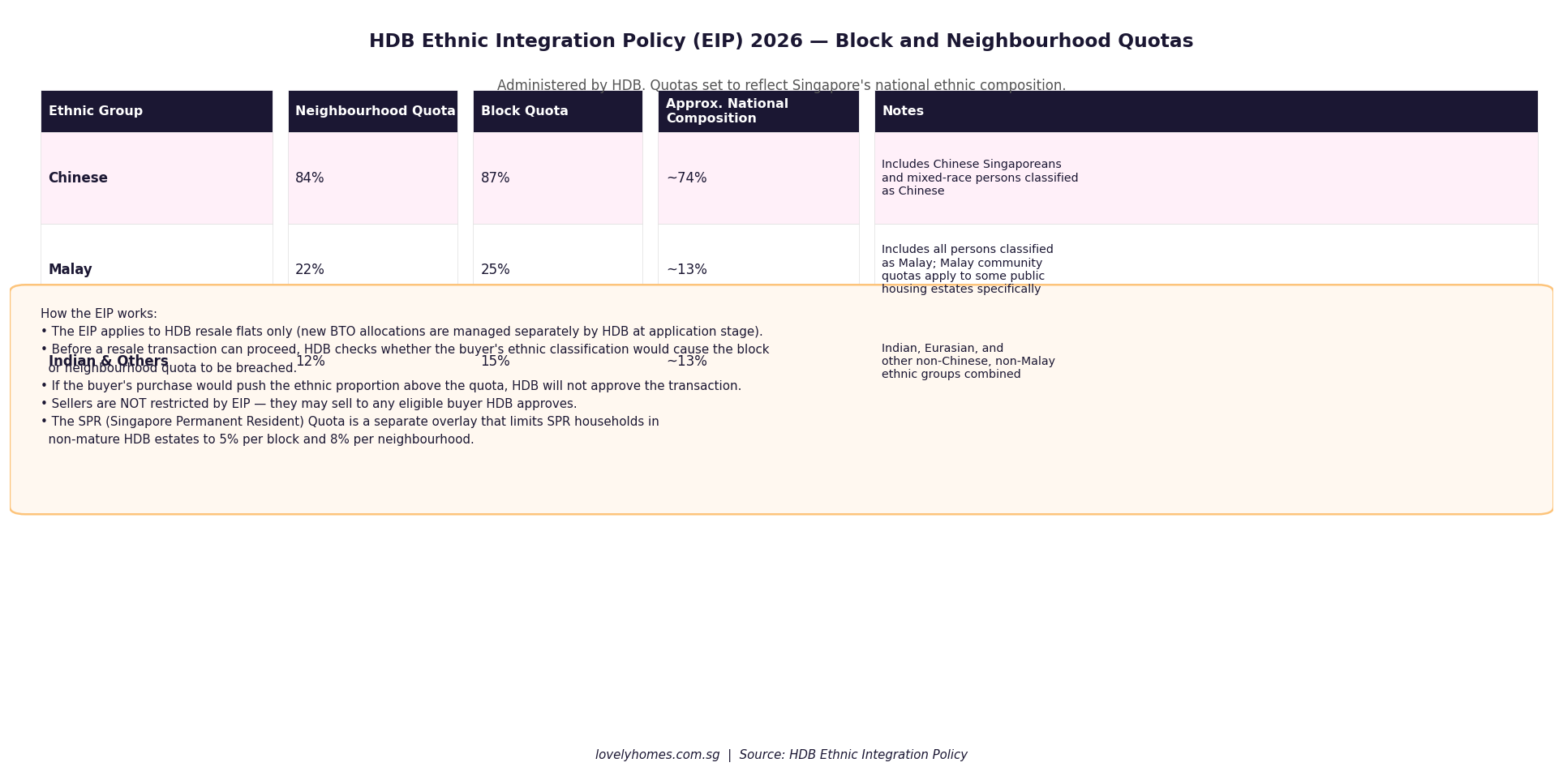
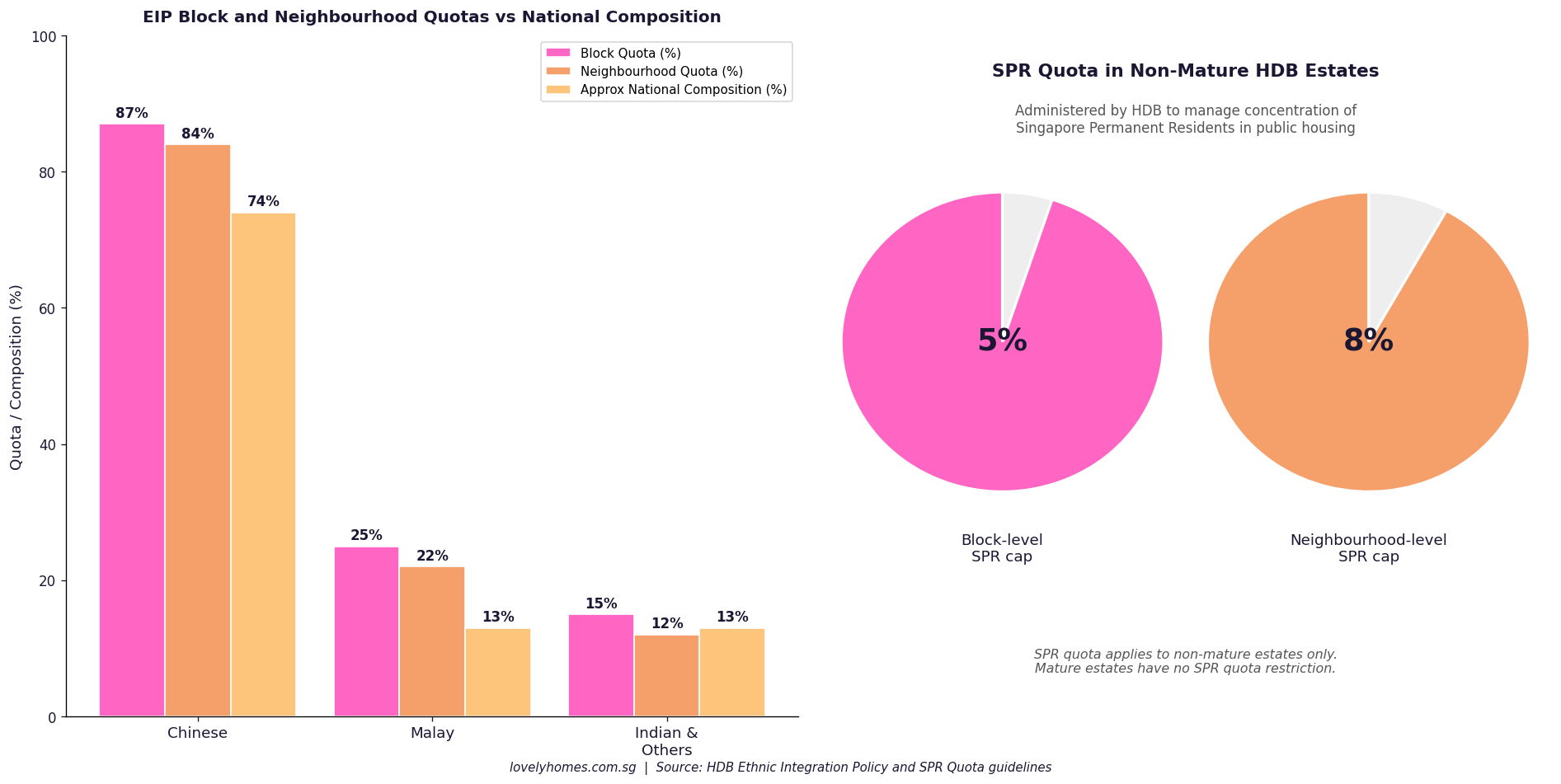
- Current quotas: Chinese up to 87% (block) / 84% (neighbourhood); Malay up to 25% (block) / 22% (neighbourhood); Indian & Others up to 15% (block) / 12% (neighbourhood).
- EIP applies only to HDB resale transactions , not to new BTO flat applications, which are managed separately.
- A buyer whose ethnic group has exceeded the block or neighbourhood quota cannot purchase a resale flat in that block or neighbourhood until the proportion drops back below the limit.
- The SPR Quota is a separate restriction: SPR households are limited to 5% of units in any block and 8% in any neighbourhood in non-mature HDB estates.
- Sellers can sell to any ethnically eligible buyer , the EIP restricts buyers, not sellers.
- A flat in a quota-full block may be priced lower than comparable units in non-restricted blocks, as the pool of eligible buyers is smaller.
- You can check whether a specific block is EIP- or SPR-quota-full using HDB’s online e-service before making an offer.
What Is the Ethnic Integration Policy?
The EIP was introduced by the Singapore government in 1989, during a period when natural market forces were producing ethnic concentration in certain HDB estates , reversing the government’s longstanding policy of distributing ethnic groups evenly across public housing. Before 1989, resale transaction patterns had allowed Chinese Singaporeans to cluster in newer, higher-demand estates, while Malay and Indian households remained concentrated in older estates. The EIP was HDB’s mechanism to enforce ethnic integration as a social policy objective, reflecting Singapore’s commitment to multiracialism as a founding principle of the nation.
The policy is administered by HDB under the Housing and Development Act. HDB sets the quota limits and updates them periodically (though they have been broadly stable for many years) based on Singapore’s national ethnic composition as measured by the Department of Statistics Singapore (SingStat).
EIP Block and Neighbourhood Quotas , The Numbers
The current EIP quotas are set above the national composition to give headroom for natural movement while still preventing concentration. A block is considered quota-full for a particular ethnic group when adding one more household of that group would breach the block-level cap. At that point, only buyers of a different ethnic group (or mixed-race buyers whose reported ethnicity is in a different category) can purchase units in that block until existing residents move out and reduce the proportion.
The two-tier system (block + neighbourhood) means a buyer might face no restriction at the neighbourhood level but encounter a quota-full block , or vice versa. Both must be satisfied before HDB will approve the transaction.
| Ethnic Group | Block Quota | Neighbourhood Quota | Who Is Counted |
|---|---|---|---|
| Chinese | 87% | 84% | SC and SPR registered as Chinese |
| Malay | 25% | 22% | SC and SPR registered as Malay |
| Indian & Others | 15% | 12% | SC and SPR registered as Indian, Eurasian, or Others |
| SPR Households (non-mature estates) | 5% | 8% | SPR-only households (no SC members) , non-mature estates only |
Who Is Affected and How?
The SPR Quota , A Separate Overlay
The Singapore Permanent Resident (SPR) Quota was introduced in 2010 and is a distinct policy from the EIP, though both are administered by HDB. The SPR Quota limits SPR-only households to 5% of units in a block and 8% in a neighbourhood, but only in non-mature HDB estates. Mature estates , broadly, estates established before 1990, such as Toa Payoh, Ang Mo Kio, and Queenstown , are exempt from the SPR Quota.
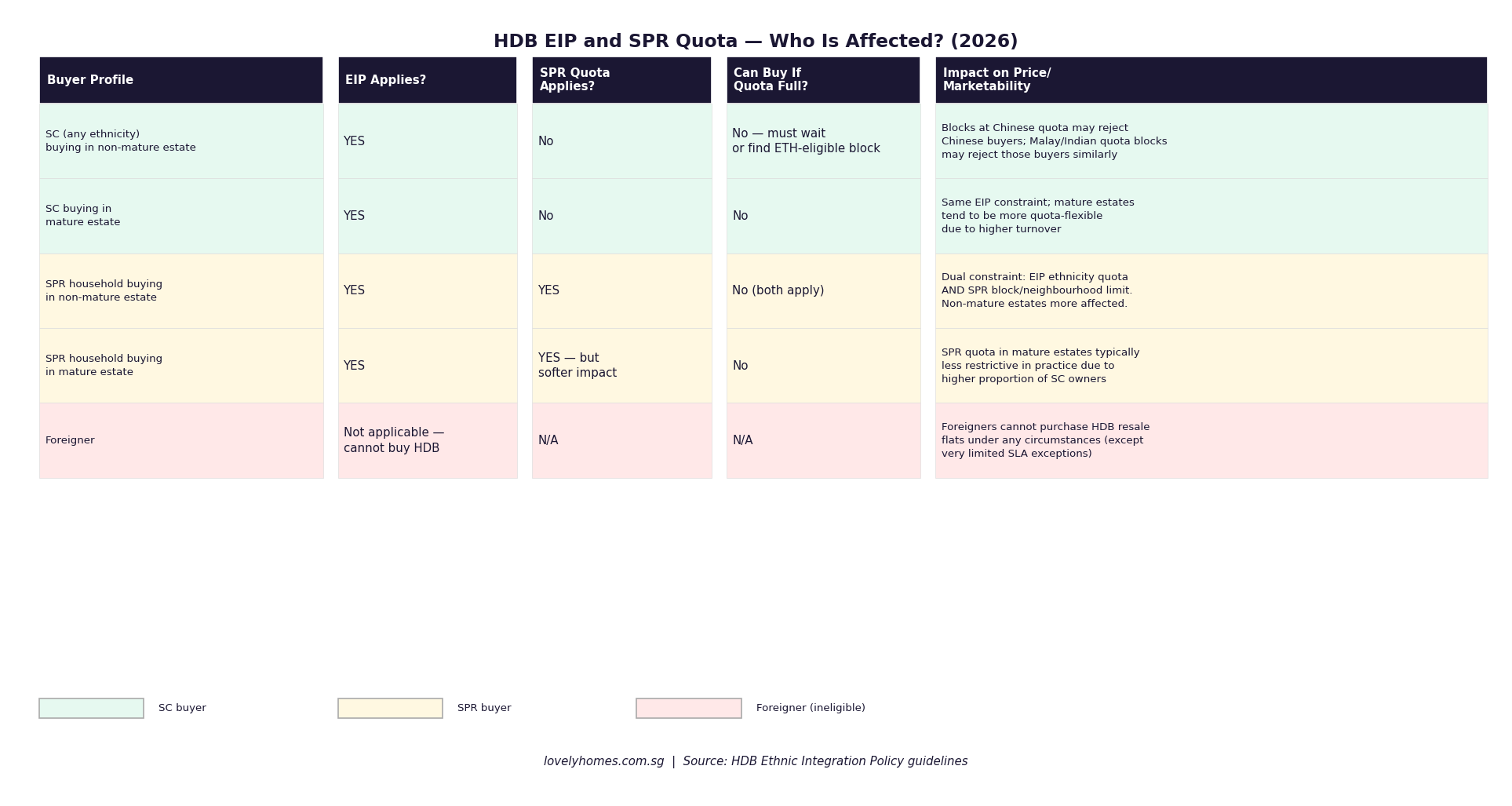
A household qualifies as “SPR-only” (i.e., subject to the SPR quota) if all owners and occupants are SPRs with no Singapore Citizens. Households that include at least one SC are not counted against the SPR Quota, even if the flat is primarily purchased by an SPR. This means an SC-SPR couple is exempt from the SPR Quota (though they still face the EIP ethnic quota for the SPR’s ethnicity classification).
How to Check EIP and SPR Quota Status Online
HDB provides a free e-service on its website that allows prospective buyers to check the EIP and SPR Quota status of a specific block before making an offer. The tool requires the block number and the buyer’s IC number (or similar identifier). It returns a clear indication of whether the buyer’s ethnic group is eligible to purchase in that block and neighbourhood at the time of enquiry. This check should be the first thing any resale buyer does after identifying a property of interest , before arranging viewings, making verbal offers, or paying any booking fees.
Note that quota status is dynamic: a block that is quota-full today may become eligible again in weeks if a unit in the over-represented ethnic group is sold to a buyer of a different ethnicity. Conversely, a block that is eligible today may become quota-full by the time you complete your Option to Purchase exercise.
Worked Example: The Ramanan Family , Indian SPR Couple in Punggol
Mr and Mrs Ramanan are a married couple of Indian ethnicity holding Singapore Permanent Residence. They wish to purchase a 4-room resale flat in Punggol, which is a non-mature estate. Before viewing, they check HDB’s e-service.
- EIP check , Indian & Others quota: HDB’s e-service shows the specific block they are interested in has an Indian & Others proportion of 12% at block level , within the 15% block quota. They are eligible.
- SPR Quota check: The same block has an SPR-only household proportion of 6.2% , above the 5% block cap. The Ramanan family, as an SPR-only household, cannot purchase in this block despite passing the EIP ethnicity check.
- Resolution: Mr and Mrs Ramanan check an adjacent block in the same neighbourhood. That block has an SPR-only proportion of 3.8% and an Indian & Others proportion of 11.4% , both within limits. They proceed to make an offer on a unit there.
This example illustrates how the SPR Quota can be the binding constraint even when ethnicity is not an issue, and why checking both quotas before viewing is essential for SPR buyers in non-mature estates.
Impact on Flat Prices: When a Block Is Quota-Full
When a block is quota-full for the dominant ethnic group (typically Chinese), the pool of eligible buyers shrinks significantly , sometimes to just two or three per cent of potential buyers. This reduced marketability can suppress prices for those units relative to comparable flats in non-restricted blocks. Sellers may accept lower offers because their buyer pool is smaller. Conversely, buyers who happen to be of the rarer ethnicity eligible to purchase in a quota-full block may find better value in those units.
Industry observation suggests that the price discount for a flat in a quota-full Chinese block (where only Malay and Indian & Others buyers are eligible) can range from 3% to 8% below comparable non-restricted flats, depending on the estate and flat type. This is not an official figure from HDB or any regulator , it reflects observed transacted price trends , and buyers should form their own view.
EIP and New Launches (BTO Flats)
The EIP as described above applies to resale transactions. For new BTO flats, HDB manages ethnic integration differently: at the allocation stage, HDB applies similar ethnic proportion targets when assigning balloted flats to successful applicants. Buyers do not interact with the EIP directly when applying for a BTO flat , HDB handles the integration mechanically during the allocation process. Once allocated, the flat is subject to the standard Minimum Occupation Period (MOP) of five years before it can be sold on the resale market, at which point the EIP would apply to the buyer in the resale transaction.
What Might Come Next
The EIP has remained broadly unchanged since 1989, though quota levels have been adjusted marginally over the decades in line with shifting national demographic compositions. As Singapore’s population continues to evolve , with a declining Chinese majority share and growing Indian community share in newer cohorts , HDB may review quota levels periodically. The introduction of the SPR Quota in 2010 reflects the government’s willingness to add new layers to the integration framework as housing market dynamics shift. Whether the EIP will be extended or modified to address new demographic realities (such as multiracial households whose classification is more complex) is a policy question that HDB and the Ministry of National Development (MND) are best placed to address.
Frequently Asked Questions
Does the EIP apply if I am buying a new BTO flat directly from HDB?
Not in the same direct way. When you apply for a BTO flat, you do not check EIP quota status yourself , HDB manages ethnic integration during the allocation process administratively. However, the result is functionally similar: HDB ensures that no single ethnic group exceeds the policy proportions in any block. For resale flats, the responsibility shifts to the buyer to check EIP eligibility before making an offer. This is one of the key differences between the BTO and resale processes.
What happens if the block becomes quota-full after I make my offer but before HDB approval?
HDB assesses EIP eligibility at the point of resale application submission, not at the time of the initial offer. If the block became quota-full between your offer and your application, HDB may decline the transaction. This is why solicitors and experienced buyers recommend submitting the HDB resale application as quickly as possible after exercising the OTP. The window between OTP exercise and HDB approval submission is typically one to four weeks, during which quota status can change if another transaction is approved first.
Can a mixed-race (Eurasian or multiracial) buyer choose which ethnic category to use for EIP purposes?
No. Ethnic classification in Singapore follows the IC (identity card) classification, which is assigned at birth and follows the father’s ethnicity for Singapore Citizens. Mixed-race individuals may carry a dual classification in some circumstances, but for HDB and EIP purposes, the primary classification on their NRIC is used. If a buyer feels their classification is incorrect or outdated, they should first seek to update it with the Immigration & Checkpoints Authority (ICA) before applying to purchase a resale flat.
If I am an SC married to a foreigner, which ethnicity is counted for EIP?
For an SC-foreigner household, the flat ownership is registered in the SC’s name (foreigners cannot own HDB flats). The EIP is therefore assessed based on the SC’s ethnicity. The foreign spouse is listed as an approved occupant but not as an owner. This means the EIP constraint tracks the SC, not the foreigner’s nationality or ethnicity.
Does the SPR Quota apply if my household has one SC and one SPR?
No. The SPR Quota only applies to households where all registered owners and occupants are SPRs , i.e., there is no SC in the household. A household with at least one SC member is exempt from the SPR Quota (though the EIP ethnic quota still applies based on the SC’s ethnicity). This distinction is important for SC-SPR couples planning to buy in a non-mature estate.
Are there any exemptions to the EIP for certain types of buyers?
There are limited circumstances where HDB may grant an EIP exemption, but these are rare and not publicly detailed. Elderly Singaporeans wishing to live near family members, or specific compassionate cases, may apply for HDB’s consideration. In practice, the EIP is enforced consistently and buyers should not assume an exemption will be granted. The practical solution for most buyers facing a quota-full block is to expand their search to nearby blocks or different neighbourhoods where their ethnic group has quota space.
Can an SPR couple buy in a mature estate without facing the SPR Quota?
Yes. Mature estates (broadly, those established before 1990) are exempt from the SPR Quota. An SPR-only household can purchase a resale flat in a mature estate such as Toa Payoh, Queenstown, Ang Mo Kio, Bedok, or Clementi without the SPR Quota constraint. They would, however, still be subject to the standard EIP ethnic quota for the owner’s ethnicity. This makes mature estate resale flats generally more accessible for SPR buyers, though they typically command higher prices than comparable flats in non-mature estates.
Related Articles
- HDB BTO vs Resale Flat 2026: Complete Comparison
- Singapore HDB Resale Market Guide 2026
- Singapore First-Timer Home Buyer Complete Guide 2026
- Singapore HDB CPF Housing Grants Guide 2026 (if available)
- Singapore HDB CPF Housing Grants Guide 2026
- Singapore Property Due Diligence Guide 2026
- Singapore HDB Inheritance and Transfer Guide 2026
Disclaimer: This article is produced for general informational purposes only and does not constitute legal, financial, or property advice. Ethnic Integration Policy quotas, SPR Quota limits, and HDB eligibility rules are administered by the Housing & Development Board and are subject to periodic review. Always verify current EIP and SPR Quota status for a specific block using HDB’s e-service at www.hdb.gov.sg before making any property purchase decisions. For personalised advice on your specific circumstances, consult a CEA-registered property salesperson or solicitor.
Supporting graphics
Original article illustrations are available below.
- Figure 1: EIP Block and Neighbourhood Quotas (2026) versus approximate national ethnic composition. Source: HDB Ethnic Integration Policy guidelines; SingStat population data.
- Figure 2: Matrix showing how the EIP and SPR Quota affect different buyer profiles in 2026. Source: LovelyHomes editorial based on HDB guidelines.
- Figure 3: SPR Quota limits for non-mature HDB estates: 5% per block and 8% per neighbourhood. The SPR Quota is separate from and additional to the EIP ethnic quotas. Source: HDB Singapore.