Singapore HDB Upgrader Guide 2026: Steps, Costs, ABSD Remission and Timing

Singapore HDB Upgrader Guide 2026: Steps, Costs, ABSD Remission and Timing

HDB upgrader — the Singaporean who has served their Minimum Occupation Period, built up equity in their flat, and now wants to step up to a private condo or a larger resale flat — is one of the most financially significant actors in Singapore’s property market. For many families, this is the single largest financial decision of their lives: timing it correctly can mean saving S$300,000 in ABSD; getting it wrong can mean paying that sum in full, in cash, within 14 days. This guide walks through every step, cost, rule, and strategy for the Singapore HDB upgrader in 2026.

Quick Answer — HDB upgrader essentials

  • MOP requirement: You must complete the 5-year Minimum Occupation Period on your HDB flat before selling it or buying a private residential property.
  • Three upgrade paths: Bigger HDB resale (no ABSD), Executive Condo EC (no ABSD, income ceiling S$16,000), or private condo (ABSD 20% if buying before selling).
  • ABSD remission window: If you buy a private condo before selling your HDB, you pay ABSD 20% upfront — but IRAS will refund it if you sell your HDB within 6 months of the private OTP date.
  • Financial pressure point: ABSD on a S$1.5M condo is S$300,000 cash — ring-fenced before the 14-day ABSD payment deadline.
  • CPF accrued interest: Budget for the CPF principal + accrued interest refund on HDB sale — this reduces your immediate cash payout but returns money to your CPF OA.
  • TDSR impact: Buying before selling your HDB means your HDB loan is still on your record for TDSR purposes — get the stress test done early.

Who Is the HDB Upgrader?

The HDB upgrader broadly refers to a Singapore household that currently owns an HDB flat (BTO or resale) and plans to move to a higher-value property — either a bigger or better-located HDB resale flat, an Executive Condominium (EC), or a private condominium or landed property. The upgrade motivation is typically a combination of changing family needs (growing household size, desire for better facilities), improved household income over time, and investment considerations (private property appreciates differently from HDB).

In 2026, upgrader demand remains a significant driver of both the HDB resale market and the new private launch market. The typical upgrader profile is a dual-income Singapore Citizen couple in their mid-30s to mid-40s, with a paid-down HDB flat carrying S$300,000–S$600,000 in equity, and combined income sufficient to pass the Total Debt Servicing Ratio (TDSR) stress test for a S$1.2M–S$2M condominium.

HDB upgrade pathways 2026 comparison — bigger HDB resale, executive condo EC, or private condo
Figure 1: Three HDB Upgrade Pathways Compared — Bigger HDB Resale, EC, and Private Condo (Source: HDB, MAS, IRAS 2026)

Step 1 — Check Your MOP Status

The Minimum Occupation Period (MOP) is the first gate every HDB upgrader must pass. You must have physically occupied your flat for the full MOP period before you can sell it on the open market or purchase a private residential property.

MOP durations in 2026 depend on flat classification. Standard BTO and resale HDB flats (both mature and non-mature estates) carry a 5-year MOP from the date the keys are collected. Plus and Prime classification flats introduced under the new framework carry a 10-year MOP. Executive Condominiums are HDB-administered at purchase and carry a 5-year MOP for resale; they are fully privatised after 10 years.

The MOP clock begins from the date of key collection (for BTO) or completion (for resale). It runs continuously regardless of whether you remain in the flat or rent it out (in some cases). Partial absence — such as working overseas — may pause the MOP clock, and you must reconfirm your MOP status with HDB before proceeding.

MOP Warning for Plus/Prime Flat Buyers: If you purchased a Plus or Prime classification BTO flat (launched from the August 2023 exercise onwards), your MOP is 10 years, not 5 years. Buyers who purchased these flats in 2023–2024 will not be able to upgrade to private property until 2033–2034 at the earliest. Factor this extended lock-up into your long-term planning.

Step 2 — Choose Your Upgrade Path

Once MOP is confirmed, you have three main upgrade paths. Each carries different ABSD treatment, financing rules, income restrictions, and flexibility.

Path A: Bigger HDB Resale Flat. The most financially conservative option. Upgrading from a 3-room to a 5-room or executive flat in a different estate carries no ABSD (you are not buying a second property — you are buying another HDB flat while selling the first). You can use an HDB housing loan (LTV 80%) and may qualify for the Step-Up CPF Housing Grant (up to S$15,000 for second-timers buying a 4-room or smaller resale flat). The downside is that HDB resale flats do not appreciate in the same way as private property and cannot be rented out without restriction.

Path B: Executive Condominium (EC). An EC sits between public and private housing. At launch, it is sold by a developer under HDB rules — meaning no ABSD at purchase (it is treated as a first-timer residential property). You must divest your existing HDB flat within 6 months of EC completion (TOP), otherwise penalties apply. The household income ceiling is S$16,000/month. After 5 years from TOP, you can sell on the open market to Singapore Citizens and PRs; after 10 years, it is fully privatised and can be sold to foreigners. Bank financing only — no HDB loan for EC.

Path C: Private Condominium or Landed Property. The most expensive and financially demanding path. If you buy a private property before selling your HDB flat, you are technically holding two residential properties simultaneously — triggering ABSD of 20% for Singapore Citizens. You have two sub-options: sell your HDB first (safer, no ABSD, but you need interim accommodation), or buy first and claim the ABSD remission by selling within the 6-month window.

HDB to condo upgrade cost breakdown 2026 — ABSD S$300,000 cash, downpayment, BSD, legal fees for S$1.5M condo
Figure 2: Cost Breakdown for Upgrading to Private Condo S$1.5M — SC Couple (2nd Property) (Source: IRAS, MAS 2026)

The ABSD Remission Strategy — Buy First, Sell Later

The most common upgrader strategy for those targeting private property is the “buy first, sell later” approach using the ABSD remission for married couples (where at least one spouse is a Singapore Citizen). Under this framework:

  • You sign the OTP for the private property and pay ABSD 20% (for SC) within 14 days of OTP date — in cash.
  • You simultaneously list and market your HDB flat for sale.
  • You must complete the sale of your HDB flat within 6 months of the private property OTP date (not completion date).
  • Within 6 months of HDB sale completion (and within the original 6-month window), you file for the ABSD remission with IRAS.
  • If approved, IRAS refunds the full ABSD paid, with no interest (i.e., you have effectively loaned the Government S$300,000 interest-free for up to 6–12 months).

The risk is liquidity: you need S$300,000+ in ready cash to pay the ABSD at the 14-day deadline. If you cannot sell your HDB within 6 months — due to market conditions, a slow transaction, or a buyer who defaults — the ABSD is not refunded. Some upgraders bridge the gap with a bridging loan, but these are expensive (typically prime + 1–2%) and have their own TDSR implications.

HDB upgrader timeline Singapore 2026 — MOP, OTP, HDB sale, ABSD remission 6-month window
Figure 3: HDB-to-Condo Upgrade Timeline — Key Milestones and the Critical 6-Month ABSD Remission Window (Source: IRAS, HDB 2026)

Summary: Upgrade Path Comparison at a Glance

Factor Bigger HDB Resale Executive Condo (EC) Private Condo
ABSD None (HDB-to-HDB, sell first) None at purchase 20% SC if buying before selling HDB; refundable if HDB sold within 6 months
Financing HDB loan (80% LTV) or bank Bank loan only Bank loan only
Income Ceiling None for resale; S$14,000 for BTO S$16,000/month None
MOP to Sell New Property 5 years (10 for Plus/Prime) 5 years (privatised at 10 years) No MOP (private property)
CPF OA Usable? Yes (HDB and bank loans) Yes (bank loan) Yes (up to Valuation Limit)
Rental Flexibility Restricted — HDB rules apply Restricted pre-privatisation Full rental freedom
Typical Price Range S$350K–S$800K S$900K–S$1.6M S$1.2M–S$3M+

Financial Planning for the Upgrade

Beyond the ABSD, upgraders must plan for a cluster of costs that come together at roughly the same time. A disciplined approach models each of the following:

CPF accrued interest on HDB sale proceeds: Your CPF principal withdrawn for the HDB flat, plus 2.5% p.a. compounded interest for every year you held it, must be refunded to your CPF OA from the HDB sale proceeds. On a S$350,000 CPF withdrawal held for 8 years, accrued interest is approximately S$78,000 — meaning S$428,000 goes back to CPF, not to your cash pocket (though it is available for the condo purchase).

TDSR with two loans: If you buy the condo before selling your HDB, both your HDB loan instalment and the projected condo loan instalment are counted in your TDSR. On a combined income of S$15,000/month, the 55% TDSR cap allows maximum total monthly debt obligations of S$8,250. If your HDB instalment is S$1,500 and the projected condo instalment is S$5,800, your combined TDSR is 48.7% — within limits. Lenders will also stress-test the condo loan at a higher rate (currently 4%), so run this calculation carefully.

6-month bridging period cash buffer: Between paying the private property ABSD, the downpayment, and waiting for the HDB sale to complete and CPF refund to process, upgraders need a substantial cash buffer. Industry guidance suggests setting aside at least 12 months of combined mortgage payments plus the full ABSD amount as liquid savings before signing the private OTP.

Worked Example: The Lim Family’s Upgrade

Profile: Mr and Mrs Lim, SC couple, combined income S$14,500/month. Own a 4-room Punggol BTO flat (keys August 2020), CPF OA balance: Mr S$182,000, Mrs S$145,000. Cash savings: S$380,000. Target: OCR 3-bedroom condo at S$1.55M.

MOP check: Keys August 2020 → MOP satisfied August 2025 ✓

BSD on S$1.55M: S$46,600 (from CPF OA) ✓

ABSD (SC 2nd property): S$310,000 — must be paid in cash at OTP

Downpayment: Bank loan 75% LTV = S$1,162,500 loan. Remaining 25% = S$387,500. Min cash 5% = S$77,500. Balance from CPF = S$310,000

Cash required at OTP: ABSD S$310,000 + option fee 1% S$15,500 = S$325,500 cash within 14 days of OTP

TDSR check: Projected condo instalment at 3.5% over 25yr = S$5,802/mth. HDB instalment still on record: S$1,340/mth. Combined S$7,142/mth ÷ S$14,500 = 49.3% ✓ (under 55%)

HDB sale (6 months after OTP): Sold for S$760,000. CPF refund: S$319,000 (principal) + S$38,000 (accrued 5.5yr at 2.5%) = S$357,000 to CPF OA. Outstanding HDB loan: S$368,000. Net cash from HDB sale: S$760,000 − S$368,000 − S$357,000 (CPF) − S$8,000 (legal/misc) = S$27,000 net cash

ABSD remission: IRAS refunds S$310,000 ABSD within ~10 weeks of HDB sale completion ✓

Net position post-transaction: S$27,000 new cash + S$310,000 ABSD refund + S$357,000 new CPF OA balance → strong CPF position for condo loan repayments; minimal cash surplus (S$337,000 pre-condo closing costs from HDB cash + ABSD refund)

Common Mistakes HDB Upgraders Make

Forgetting ABSD is cash: The single most common error. Buyers who have set aside the full downpayment in CPF but do not have liquid cash for the ABSD face a crisis at the 14-day deadline. No lender will advance ABSD as part of the mortgage; no CPF withdrawal is permitted for ABSD.

Not accounting for the CPF refund: Many upgraders estimate their HDB “profit” as sale price minus outstanding loan, forgetting that a large CPF principal and accrued interest amount must first be returned to CPF. This can reduce cash-in-hand from the HDB sale by S$200,000–S$450,000 depending on how long the flat was owned and how much CPF was used.

Missing the 6-month window: If the HDB sale process hits delays — a buyer who withdraws, a bank valuation dispute, or an HDB resale application processing delay — the 6-month window can expire. Once it does, the ABSD is not refunded. Upgraders should list the HDB flat immediately after signing the private OTP, price it competitively, and have legal conveyancing engaged in parallel.

Underestimating TDSR exposure: Some upgraders are surprised when their bank pre-approval does not cover the desired loan quantum because the HDB loan is still reflected in their TDSR. Always get a fresh In-Principle Approval (IPA) with both loans in scope before signing the private OTP.

What Might Come Next for HDB Upgraders

Singapore’s cooling measures framework has not changed since April 2023, and upgrader ABSD at 20% represents the base cost of accessing private property while still holding an HDB flat. The Government has shown no appetite for relaxing this rate in the near term, given its explicit goal of moderating speculative demand from HDB-to-private upgraders. Any future relaxation would likely be preceded by a sustained period of flat or declining private property prices.

The emergence of Plus and Prime HDB classification flats, with 10-year MOPs and restrictions on renting out to non-family members, has already created a two-tier HDB resale market. Upgraders who purchased Plus or Prime flats in 2023–2024 face a much longer lock-up, and their upgrading flexibility will be significantly constrained until the early-to-mid 2030s. The long-term impact of this policy on upgrader dynamics is still playing out.

Frequently Asked Questions About HDB Upgrading

Do I have to sell my HDB flat before buying a private condo to avoid ABSD?

You do not have to sell first, but if you buy before selling, you will pay ABSD 20% (SC) or 30% (PR) upfront in cash. The ABSD remission framework allows you to claim a full refund if you sell your HDB within 6 months of signing the private OTP. The “sell first” approach avoids the ABSD cash outlay entirely but means you need temporary housing between HDB completion and condo handover (which can be 2–4 years for new launches). Most upgraders choose “buy first, sell within 6 months” to avoid the gap, provided they have sufficient cash for the ABSD.

Can I use my HDB flat’s rental income to help with the TDSR for the condo loan?

Yes — but only if you have HDB’s approval to sublet the flat and you can provide documented rental income. Lenders typically apply a haircut of 30% to rental income when calculating TDSR (i.e., only 70% of gross rental income is counted as qualifying income). If your HDB flat generates S$2,500/month in verified rental income, S$1,750 may be added to your income base for TDSR purposes. Note that owner-occupiers on MOP cannot legally sublet their entire flat until MOP is completed, so this applies primarily to upgraders who have already completed MOP and chosen to rent out their HDB while purchasing a condo.

What happens if I fail to sell my HDB within 6 months and miss the ABSD remission?

If you do not sell your HDB within 6 months of the private OTP date, you forfeit the ABSD remission permanently. The S$300,000+ ABSD you paid in cash is retained by IRAS — it cannot be recovered. This is a catastrophic financial outcome for most households. To mitigate this risk: price your HDB competitively from day one, engage conveyancing lawyers for both transactions simultaneously, and do not accept a buyer for the HDB who requires more than 8–10 weeks to complete. If you are approaching the 5-month mark and the HDB has not sold, consider drastically reducing the asking price or seeking legal advice on options.

Is an EC a good upgrade target compared to a private condo?

An EC offers a unique value proposition: you buy at a price typically S$200,000–S$500,000 below a comparable private condo in the same location, with the same physical quality (developer-built to private standards). The trade-off is the HDB ownership conditions for the first 5–10 years — no subletting to foreigners, must divest HDB within 6 months of EC TOP, and income ceiling of S$16,000. For upgraders who meet the income ceiling and are comfortable with the constraints, ECs have historically outperformed many private condo segments in capital appreciation after privatisation at 10 years. However, ECs are only available as new launches — there is currently no resale EC from a developer; the secondary market is for existing privatised ECs sold by owners.

Can both spouses use their CPF OA for the condo purchase even if they are selling the HDB?

Yes. Once the HDB sale is completed, CPF refunds (principal + accrued interest) are credited back to each owner’s CPF OA in proportion to their respective CPF usage on the flat. Those refreshed CPF OA balances can then be applied to the condo purchase — for downpayment, monthly loan repayments, and BSD — subject to the condo’s own Valuation Limit. Many upgraders rely on this CPF “recycling” to fund a significant portion of the condo downpayment after the ABSD remission is returned to their bank account.

What is the Seller’s Stamp Duty (SSD) impact when upgrading?

Seller’s Stamp Duty applies to private residential properties sold within 3 years of purchase — at 12% (Year 1), 8% (Year 2), or 4% (Year 3). HDB flats are exempt from SSD. For most HDB upgraders, SSD is not relevant to the HDB sale (no SSD applies). SSD would only become relevant if you later sold the private condo within 3 years of purchase — which is an important consideration for upgraders who buy a new-launch condo that is still under construction. If market conditions deteriorate and you needed to exit quickly, SSD could cost S$180,000+ on a S$1.5M condo sold in Year 1.

Related Articles

Disclaimer: This article is for general informational purposes only and does not constitute financial, legal, or property advice. ABSD rates, MOP rules, CPF withdrawal limits, and TDSR/MSR parameters are set by the Government and may change. All figures reflect the framework as at 3 July 2026. Readers should verify current rules with HDB, IRAS, and CPF Board, and consult a licensed financial adviser and property solicitor before proceeding with any upgrade transaction. LovelyHomes does not provide financial, legal, or property advisory services.

Singapore CPF for Property Guide 2026: How to Use Your OA, Valuation Limits and Accrued Interest Explained

Singapore CPF for Property Guide 2026: How to Use Your OA, Valuation Limits and Accrued Interest Explained

CPF for property Singapore — your Central Provident Fund Ordinary Account (CPF OA) is almost certainly your largest source of savings, and the rules governing how you can use it to buy a home are among the most misunderstood in Singapore’s property landscape. Buyers regularly assume they can use CPF for everything from their Additional Buyer’s Stamp Duty (ABSD) to their renovation bills — and are caught short at completion. Others sell a flat and are alarmed to see how much accrued interest has accumulated in their CPF ledger. This guide explains every rule, limit, and quirk in plain English.

Quick Answer — CPF for property at a glance

  • CPF OA can be used for downpayment, monthly loan instalments, Buyer’s Stamp Duty, and legal fees.
  • CPF OA cannot be used for ABSD (cash only), Cash Over Valuation, option fee, agent commission, or renovation.
  • Valuation Limit (VL): You may use CPF up to the purchase price or market value, whichever is lower.
  • Beyond VL: CPF can be used up to 120% of VL — but only if you have set aside the Full Retirement Sum (FRS).
  • Accrued interest rate: 2.5% p.a. compounded on all CPF withdrawn for property. On sale, principal + accrued interest is refunded to your CPF OA — it does not vanish.
  • Lease rule: Property must have at least 30 years’ remaining lease for CPF to be used; graduated limits apply between 30 and 60 years.
  • For the latest rules, check CPF Board’s official housing page.

What Is the CPF Ordinary Account and Why Is It Used for Property?

The CPF is Singapore’s mandatory social security savings scheme. Every employed Singapore Citizen and Permanent Resident contributes a percentage of their monthly wages into three accounts: the Ordinary Account (OA), Special Account (SA), and MediSave Account (MA). For most working-age Singaporeans, the OA accumulates the largest balance over time — and it earns a minimum guaranteed interest of 2.5% per annum, with an additional 1% on the first S$60,000 of combined CPF balances (with a cap of S$20,000 for OA).

The Government allows the OA to be used for housing because property ownership is a central pillar of Singapore’s social compact. By permitting CPF OA usage, the scheme effectively unlocks decades of compulsory savings for the single largest purchase most households will ever make. The trade-off is that money withdrawn from CPF for property must eventually be returned — with interest — to the account so it remains available for retirement.

CPF OA property usage table 2026 — can vs cannot pay: downpayment, BSD, ABSD cash only
Figure 1: CPF OA Usage for Property — What You Can and Cannot Pay (Source: CPF Board, IRAS 2026)

What Can You Use CPF OA For?

Your CPF OA balance can be applied to the following property-related expenses in 2026:

Downpayment: For an HDB flat purchased using an HDB loan, the minimum cash downpayment is 10% of the purchase price; the remaining 10% of the required 20% downpayment can come from CPF OA. For bank-financed purchases (HDB or private), the minimum cash downpayment is 5% of the purchase price (for loans up to 75% LTV), with the remaining 20% payable from CPF OA or cash.

Monthly loan repayments: Both HDB housing loan instalments and bank mortgage instalments can be paid from your CPF OA. HDB loans deduct directly via GIRO from your CPF OA. For bank loans, you must submit a CPF housing withdrawal application.

Buyer’s Stamp Duty (BSD): BSD can be paid from CPF OA — this is often overlooked by first-time buyers. At current rates, BSD on a S$600,000 HDB flat is approximately S$11,400, all of which can come from OA.

Legal and conveyancing fees: Solicitor fees for the purchase transaction are claimable from CPF OA, subject to the Valuation Limit rule.

What Cannot Be Paid with CPF OA?

Additional Buyer’s Stamp Duty (ABSD) is the most significant item. Regardless of how large your CPF OA balance is, 100% of your ABSD liability must be paid in cash. At 20% for a Singapore Citizen purchasing a second residential property, this means a cash outlay of S$320,000 on a S$1.6M condo — before any other costs. Buyers who have not ring-fenced this amount routinely find themselves in difficulty at the 14-day ABSD payment deadline.

Cash Over Valuation (COV) in the HDB resale market is another cash-only item. Where a buyer agrees to pay above the HDB assessed value, the excess (COV) cannot be financed by either HDB loan or CPF.

Option fees, booking fees, good faith deposits — the initial 1% OTP fee and any booking deposit for new launches must be paid in cash. CPF cannot be applied until the formal sales process is completed.

The Valuation Limit: How Much CPF Can You Use?

The Valuation Limit (VL) is the core rule governing total CPF usage on any single property. It is defined as the purchase price or the market value at the time of purchase, whichever is lower. You may use your CPF OA (and that of any co-owner or joint purchaser) to pay for the property purchase up to this limit.

Once cumulative CPF withdrawals (principal) reach the VL, no further CPF can be withdrawn for that property — unless you qualify for the 120% Valuation Limit extension.

To use CPF beyond the VL (up to 120% VL), the following conditions must be met:

  • The property must have a remaining lease of at least 60 years.
  • The property must have sufficient remaining lease to cover the youngest buyer to age 95.
  • The buyer must have set aside or be setting aside the Full Retirement Sum (FRS) in their CPF SA and OA combined (S$213,000 as at 1 January 2026).
CPF valuation limit and remaining lease eligibility rules 2026 — HDB and private property
Figure 2: CPF Valuation Limit & Lease Eligibility Rules — Singapore 2026 (Source: CPF Board, HDB)

The Lease Rule: Remaining Lease and Age

CPF usage for property is not just limited by the VL — it is also constrained by the remaining lease of the property, particularly relevant for resale HDB flats with shorter tenures.

The general framework is: the property’s remaining lease, at the time of purchase, must be sufficient to cover the youngest buyer to age 95. Where the remaining lease falls short of 60 years, a pro-rated withdrawal limit applies. The formula used is: (Remaining Lease / 65 years) × Valuation Limit. Below 30 years of remaining lease, CPF cannot be used at all.

In practical terms, most buyers of resale HDB flats in mature estates should verify remaining lease carefully. A 50-year-old flat with 49 years remaining means the youngest buyer must be under 46 to receive full CPF access. This has become increasingly relevant as older HDB estates approach their tipping points.

CPF Accrued Interest: The Most Misunderstood Rule

When you use CPF OA to buy a property, CPF Board tracks how much you have withdrawn. It then charges accrued interest on that amount at 2.5% per annum, compounded annually — the same rate your OA would have earned had the money remained in your account. The accrued interest accumulates throughout your period of ownership.

When you sell the property, the net sale proceeds must first be used to refund CPF the principal withdrawn plus all accrued interest. This refund goes back into your CPF OA — it is not a tax, fine, or fee. You are simply returning money to your own retirement savings with the interest it would have earned. The cash you receive after CPF refund, outstanding loan repayment, and transaction costs is your actual cash profit.

Many sellers are surprised by how large the CPF accrued interest sum is after 10–15 years of ownership. A S$150,000 CPF withdrawal grows to approximately S$191,000 after 10 years and S$244,000 after 20 years at 2.5% p.a. — meaning S$94,000 in accrued interest over 20 years returns to your CPF OA on sale.

CPF accrued interest chart 2026 — S$150,000 at 2.5% per annum over 0 to 25 years
Figure 3: CPF Accrued Interest Growth — S$150,000 OA Withdrawal at 2.5% p.a. Compounded (Source: CPF Board formula)

Summary: CPF Rules at a Glance

Rule / Limit What It Means Key Number (2026) Source
Minimum Cash Downpayment (HDB Loan) 10% of purchase price must be in cash; balance of 10% from CPF OA 10% cash HDB
Minimum Cash Downpayment (Bank Loan) 5% cash; next 20% from CPF OA or cash 5% cash MAS / CPF Board
Valuation Limit (VL) Total CPF withdrawable capped at lower of purchase price or market value 100% VL CPF Board
Beyond VL (120% cap) Additional CPF use if FRS met and lease ≥ 60 years 120% VL CPF Board
Minimum Remaining Lease Below 30 years: no CPF use; 30–59 years: pro-rated 30 years CPF Board
Accrued Interest Rate 2.5% p.a. compounded on all OA withdrawals for housing 2.5% p.a. CPF Board
ABSD Not payable via CPF — 100% cash Cash only IRAS
CPF Refund on Sale Principal + accrued interest refunded to CPF OA from sale proceeds Mandatory CPF Board

Worked Example: CPF in Action for a Resale HDB Purchase

The Tans — SC couple, combined income S$8,500/month, buying a 4-room resale flat in Tampines

Purchase price: S$640,000 | HDB valuation: S$625,000 | COV: S$15,000

Financing: HDB housing loan (LTV 80%) = S$500,000 loan; 20% downpayment = S$128,000

  • Minimum cash downpayment (10%): S$64,000 in cash
  • Remaining downpayment (10%): S$64,000 from CPF OA ✓
  • COV S$15,000: Cash only (cannot use CPF) ✓
  • BSD on S$640,000: S$12,600 — payable from CPF OA ✓
  • Legal fees (est.): S$2,800 — payable from CPF OA ✓
  • Total CPF used at purchase: S$64,000 + S$12,600 + S$2,800 = S$79,400
  • Monthly instalment at HDB loan 2.60% over 25 years: S$2,275/month (MSR 26.8% ✓ under 30%)

After 8 years (selling):

  • CPF principal withdrawn (downpayment + instalment contributions): S$218,000 (estimated)
  • Accrued interest at 2.5% p.a. over 8 years: approx. S$24,500
  • CPF refund required: S$242,500 (back into CPF OA — not a loss)
  • Outstanding HDB loan at sale: ~S$384,000
  • If sale price = S$780,000: Net cash after CPF refund + loan repayment: ~S$153,500

Why CPF Accrued Interest Is Not a Penalty

A common misconception is that CPF accrued interest represents a hidden cost of home ownership. It does not. The 2.5% p.a. accrued interest is precisely the return your OA would have earned had you not withdrawn the funds. When you sell and refund CPF, the money returns to your retirement account — meaning you have effectively used the property as an alternative vehicle for your CPF savings during the period of ownership.

The practical implication is that sellers should model their net cash position including the CPF refund, rather than treating the refund as pure cost. In a rising market, property appreciation typically far outstrips the accrued interest — the effective “cost” of using CPF is simply the opportunity cost of not having that money in your OA earning 2.5%. For most Singaporeans buying in a rising market, this is an excellent trade.

Where accrued interest does matter more acutely is for sellers in a flat or declining market, or for sellers who have held for a very long time at low appreciation. A 20-year hold with heavy CPF usage and modest appreciation can result in a smaller-than-expected cash payout — with the “profit” largely returned to CPF. This is not a loss, but it shapes the seller’s immediate liquidity position.

What Might Come Next for CPF and Property

CPF housing rules have been periodically tightened since the 2016 Enhanced Retirement Sum (ERS) framework was introduced. The Government’s stated trajectory is to gradually raise the retirement sums (BRS, FRS, ERS) each year by approximately 3.5%, which in turn raises the bar for the 120% VL extension. By 2030, the FRS is projected to exceed S$250,000, meaning buyers relying on the 120% rule will need substantially more CPF savings set aside.

There is ongoing policy discussion about the tension between property as a retirement asset and CPF as a retirement savings vehicle. The Retirement and Re-employment Act framework and the silver housing bonus schemes suggest the Government is nudging older Singaporeans to unlock property equity for retirement rather than relying on CPF alone. Buyers today should factor in that CPF usage rules may tighten further for properties with shorter remaining leases as the HDB lease decay issue becomes more pronounced in the 2030s and 2040s.

Frequently Asked Questions About CPF and Property

Can I use CPF to pay my ABSD?

No. The Additional Buyer’s Stamp Duty (ABSD) must be paid entirely in cash, regardless of how large your CPF OA balance is. IRAS has never permitted CPF to be used for ABSD since the duty was introduced in 2011. This is one of the most commonly misunderstood rules in Singapore property finance. If you are a Singapore Citizen buying a second property, you must have the full ABSD amount (currently 20% of purchase price) available in cash at the 14-day payment deadline after signing the Option to Purchase.

What happens to my CPF if I sell at a loss?

Even if you sell at a loss, you are still required to refund your CPF the principal withdrawn plus accrued interest — up to the available sale proceeds. If the net sale proceeds after repaying the outstanding loan are insufficient to cover the full CPF refund, you refund whatever is available. Any shortfall in the CPF refund does not need to be made up from your other savings — it is simply not refunded. However, this scenario (selling for less than you owe CPF + loan) is a genuine financial risk that buyers should model before purchasing.

Can I use my spouse’s CPF OA to buy property if they are not a co-owner?

No. Only registered co-owners of the property may use their CPF OA for that property. However, you can add a family member as a co-owner to allow their CPF to be used, subject to HDB and MAS eligibility rules. For private property, there is no prohibition on adding a spouse or family member as a co-owner, though stamp duty and legal implications should be reviewed with a solicitor. You cannot use someone else’s CPF even with their written consent unless they are a co-owner on the title.

Does buying a property with CPF affect my CPF LIFE annuity payout?

Indirectly, yes. Because CPF OA withdrawn for property (plus accrued interest) is refunded to CPF on sale, the funds that return to your account can then be transferred to the Retirement Account (RA) when you turn 55, boosting your CPF LIFE payout. However, if your property has not been sold by retirement age and you have drawn down heavily from OA, your CPF LIFE baseline payout may be lower if you have not independently met the Full Retirement Sum. The key planning point is to not assume that housing CPF withdrawals have no retirement impact — model your retirement savings position including expected CPF refund on eventual sale.

I bought an HDB flat and later upgraded to a private condo. Can I transfer remaining CPF usage from the HDB to the condo?

No. Your CPF housing withdrawals are tracked per property. When you sell the HDB flat, the CPF principal and accrued interest are refunded to your OA. Those funds are then available as fresh OA balance to be applied to the purchase of your next property. However, you do not “carry over” any unused CPF limit from the HDB flat — you start fresh with the new property’s own Valuation Limit. The refunded CPF balance effectively becomes available capital you can redeploy toward the condo’s downpayment and loan repayments.

Is there a limit on how much CPF I can use each month for loan repayments?

There is no separate monthly CPF withdrawal cap beyond the overall Valuation Limit rule. As long as your cumulative withdrawals (downpayment + BSD + legal fees + cumulative monthly instalments) have not reached the VL (or 120% VL if applicable), you may continue to pay monthly instalments from CPF OA. Once you hit the VL, all subsequent instalments must be paid in cash. For most buyers with moderate remaining OA balances or mid-priced properties, VL exhaustion typically occurs somewhere between 10 and 20 years of ownership — and only then does the monthly cash commitment escalate.

Can foreigners or PRs use CPF for property in Singapore?

Singapore Permanent Residents (PRs) contribute to CPF and may use their CPF OA to purchase HDB resale flats and private property, subject to the same VL, lease, and ABSD rules as Singapore Citizens. PRs face a 5% ABSD on their first residential property purchase (versus 0% for SC first property), which must be paid in cash. Foreigners are not CPF contributors and therefore have no CPF OA to access. All property acquisition costs for foreigners — downpayment, BSD, ABSD at 60%, legal fees — must be funded from cash or offshore financing.

Related Articles

Disclaimer: This article is for general informational purposes only. CPF housing rules, valuation limits, and retirement sum thresholds are updated periodically by the CPF Board and may change after the publication date of this article. All figures reflect the framework as at 3 July 2026. Readers should verify current rules at cpf.gov.sg and consult a licensed financial adviser or HDB-appointed solicitor before making any property purchase or CPF withdrawal decision. LovelyHomes does not provide financial or legal advice.

URA Q2 2026 Flash Estimates: Singapore Private Home Prices Rise +0.5%, CCR Leads as RCR and OCR Soften

URA Q2 2026 Flash Estimates: Singapore Private Home Prices Rise +0.5%, CCR Leads as RCR and OCR Soften

The Urban Redevelopment Authority (URA) released the flash estimate for the private residential property price index for 2nd Quarter 2026 on 1 July 2026. The headline number — a +0.5% quarter-on-quarter (QoQ) increase — represents a notable deceleration from the +0.9% recorded in Q1 2026, and is driven by diverging performances across market segments: the Core Central Region (CCR) surging, while the Rest of Central Region (RCR) and the Outside Central Region (OCR) softened on a quarterly basis.

Quick Answer — Key Numbers

  • Overall PPI: +0.5% QoQ in Q2 2026 (vs +0.9% in Q1 2026).
  • Non-landed (overall): -0.1% QoQ (vs +1.3% in Q1 2026).
  • Core Central Region (CCR): +2.0% QoQ — the strongest performing segment.
  • Rest of Central Region (RCR): -1.4% QoQ — the weakest performing segment.
  • Outside Central Region (OCR): -0.2% QoQ (vs +2.2% in Q1 2026).
  • Landed properties: +2.6% QoQ — a sharp reversal from -0.4% in Q1 2026.
  • Transaction volume: 5,420 units (up to mid-June 2026) — broadly comparable to 5,413 in Q1 2026.
  • Full-year 2026 GLS Confirmed List: 9,320 units — over 50% above the 10-year annual average.
  • Full Q2 2026 real estate statistics are due from URA on 24 July 2026.

The Q2 2026 Flash Estimate in Context

Flash estimates are preliminary figures compiled by URA based on stamp duty data and developer sales data from 1 April 2026 to mid-June 2026. They are inherently incomplete — the final figures released on 24 July 2026 will incorporate the full quarter’s transactions and typically differ by a modest margin from the flash estimate. URA cautions that “the public is advised to interpret the flash estimates with caution.”

With that caveat noted, the Q2 2026 flash estimate signals a meaningful shift in the composition of price growth. After a broad-based Q1 2026 rally — where OCR non-landed prices surged +2.2% and the overall index rose +0.9% — Q2 2026 shows the market rotating: luxury and landed properties strengthened, while mass-market and mid-tier segments gave back some of Q1’s gains.

Segment-by-Segment Analysis

URA private residential property price change Q1 vs Q2 2026 flash estimate CCR RCR OCR landed Singapore
Figure 1: Quarter-on-quarter price change by market segment — Q1 2026 actual vs Q2 2026 flash estimate. Source: URA Real Estate Statistics Flash Estimate, 1 July 2026.

Core Central Region (CCR) — +2.0% QoQ: The prime districts (Districts 1–4 and 9–11) outperformed all other segments in Q2 2026. The CCR had been relatively subdued in Q1 2026 (+0.6% QoQ) as the 60% ABSD for foreigners continued to dampen overseas buyer interest. The Q2 2026 rebound suggests domestic high-net-worth and upgrader demand — supported by declining SORA rates from their 2023–2024 peaks — is reasserting itself. The CCR also benefits from limited new supply relative to other segments. This is consistent with the observed trend of luxury landed and GCB (Good Class Bungalow) transactions picking up in the first half of 2026.

Rest of Central Region (RCR) — -1.4% QoQ: The RCR — covering areas such as Toa Payoh, Bishan, Tiong Bahru, and Queenstown — recorded the sharpest quarterly decline. This is likely a partial correction after strong new launch activity in prior quarters pushed RCR prices higher. As developers digested existing inventory and new launch momentum slowed, transacted prices softened. The RCR remains well above its Q1 2025 levels on a year-on-year basis.

Outside Central Region (OCR) — -0.2% QoQ: The OCR, which includes suburban regions such as Jurong, Tampines, Sengkang, and Punggol, saw a modest dip after its strong Q1 2026 performance (+2.2% QoQ). This retreat is consistent with the broader pattern of HDB upgrader demand normalising as the pool of HDB households completing the five-year MOP works through the system. Developer sales volumes in the OCR remained healthy, but headline prices moderated.

Landed properties — +2.6% QoQ: Landed homes (terraced houses, semi-detached, bungalows, and Good Class Bungalows) posted the strongest quarterly gain and reversed the -0.4% QoQ decline recorded in Q1 2026. Landed supply is structurally limited — only Singapore Citizens can purchase most landed property — and demand from citizens seeking generational family homes has remained firm. The combination of limited new landed supply, declining mortgage rates, and resilient household wealth among long-tenured Singapore Citizens supported this rebound.

Segment Q1 2026 QoQ Q2 2026 QoQ (Flash) Key Driver
Overall PPI +0.9% +0.5% Deceleration; landed and CCR offset OCR/RCR softening
Non-landed (all) +1.3% -0.1% RCR and OCR drag outweigh CCR gain
CCR (Core Central) +0.6% +2.0% Luxury demand, declining rates, domestic upgrader activity
RCR (Rest of Central) +0.8% -1.4% Post-launch correction; new supply absorption
OCR (Outside Central) +2.2% -0.2% HDB upgrader normalisation; MOP pipeline moderating
Landed -0.4% +2.6% Structural scarcity, SC-only demand, rate environment

Transaction Volume: Stable Demand

Sale transaction volume in Q2 2026 stood at approximately 5,420 units (up to mid-June 2026), compared to 5,413 in Q1 2026. URA describes this as “broadly comparable,” indicating that buyer activity has not meaningfully contracted despite the overall price deceleration. This stable transaction count, combined with decelerating prices, is consistent with a market that is finding equilibrium rather than declining.

Supply Pipeline: Government Accelerating Delivery

URA 2026 GLS confirmed list 9320 units and quarterly private residential transaction volume Singapore
Figure 2: Left — 2026 GLS Confirmed List units by half-year. Right — quarterly private residential sale transaction volume Q1 2025 to Q2 2026 (partial). Source: URA Real Estate Statistics; GLS Programme announcements 2026.

The government is maintaining a deliberate high supply stance. In 2H2026, a further 4,745 private residential units will be launched under the Confirmed List, bringing the full-year 2026 Confirmed List total to 9,320 units — over 50% higher than the past 10-year annual average of approximately 6,200 units per year. Including Executive Condominiums, approximately 61,000 private residential units are expected to be completed over the coming years, a significant pipeline that URA believes will ensure housing demand is met and price stability is maintained.

This supply commitment is a significant policy signal. It suggests the government does not intend to ease supply constraints even as price growth moderates, reinforcing the view that the cooling measures and ABSD framework are working as intended — slowing speculation without triggering price declines.

What This Means for Buyers, Sellers, and Investors

For buyers, the Q2 2026 data offers a nuanced picture. The mass market (OCR) and mid-tier (RCR) segments are showing mild softening — suggesting that patient buyers may find slightly better negotiating conditions in these segments than they did in Q1 2026. The CCR and landed markets, however, are moving in the opposite direction: buyers in these segments should not expect discounts. The high supply pipeline is a medium-term comfort: completions over the next few years should provide genuine choice and prevent runaway price inflation. However, the pipeline has not yet translated into meaningful price softening, suggesting underlying demand remains robust.

For sellers, the Q2 data does not indicate a price collapse. Year-on-year growth remains positive across all segments, and the overall PPI is still trending upward, albeit modestly. Sellers in well-positioned OCR and RCR projects who have held for several years remain in a strong position. The SSD framework (12%/8%/4%/NIL for years 1–4) means that sellers who purchased in 2024 or later face significant exit costs if selling within the SSD window.

For investors, the data reinforces the divergence between segments. CCR and landed are the standout performers in Q2 2026. The 60% foreigner ABSD remains a barrier for non-resident investors, but for Singapore Citizens with the means to invest in CCR or landed property, Q2 2026 shows meaningful appreciation. For OCR investors, the combination of high supply, modest price growth, and stable rental yields suggests a more measured outlook for capital appreciation over the near term.

What Might Come Next: Full Q2 Data on 24 July 2026

The flash estimate is compiled on approximately 75% of the full quarter’s transactions. The final figures, due 24 July 2026, will incorporate the complete Q2 2026 transaction set and may revise the initial numbers upward or downward. Historically, flash-to-final revisions for the Singapore private residential PPI have been small (typically within 0.2–0.4 percentage points). Analysts and market participants will also be watching for the detailed breakdown by property type, floor area, and specific district — context that flash estimates do not provide.

Beyond the Q3 2026 data, the key macro variables are: MAS exchange rate management and global trade uncertainty (the July 2026 economic environment remains “highly uncertain” per URA’s own framing), Federal Reserve policy direction, the HDB resale market trajectory (which feeds upgrader demand for OCR private condos), and developer launch volumes in 2H2026. The 2H2026 GLS Confirmed List launches, if absorbed at decent pricing, will provide a fresh read on developer confidence and buyer appetite going into 2027.

Frequently Asked Questions

What is the URA Private Residential Property Price Index (PPI)?

The URA PPI is a quarterly index compiled by the Urban Redevelopment Authority tracking changes in private residential property prices in Singapore. It covers all non-landed private residential transactions (apartments and condominiums) across the CCR, RCR, and OCR, as well as landed residential properties (terraced houses, semi-detached, bungalows). The index uses a hedonic regression methodology to control for changes in the quality mix of transactions, so a change in the PPI reflects a genuine price change rather than a change in the type of units sold. The full methodology is available on the URA website.

Why did CCR outperform while RCR and OCR declined in Q2 2026?

The divergence reflects two distinct demand drivers. CCR demand is primarily driven by domestic high-net-worth buyers, ultra-high-net-worth families, and some foreign buyers (despite the 60% ABSD). This cohort is less interest-rate sensitive and more influenced by portfolio diversification and lifestyle considerations. The CCR has also had limited new supply recently. RCR and OCR demand, by contrast, is driven more by the upgrader segment — HDB families completing their MOP and seeking private homes. This segment is more price-sensitive, and after a strong Q1 2026 driven by several new launch openings, some cooling was natural as those launches digested inventory.

Does the +0.5% QoQ increase mean property prices are still rising?

On a quarter-on-quarter basis, yes — the overall index still increased by 0.5% in Q2 2026. The PPI has not declined. Year-on-year growth (Q2 2025 vs Q2 2026) will be clearer when the full Q2 2025 data is confirmed as the base. The deceleration from +0.9% in Q1 2026 to +0.5% in Q2 2026 is meaningful but not alarming in the context of Singapore’s historical property cycle. As context: the index fell sharply in 2022 after cooling measures were introduced, and the recovery from 2023 onward has been gradual and measured.

What impact does the 9,320-unit GLS pipeline have on prices?

Supply additions work with a lag — land sold today typically enters the market as completed units two to four years later. The 9,320-unit 2026 GLS Confirmed List, together with the broader 61,000-unit pipeline of completions expected over the coming years, should exert a moderating influence on prices over the medium term. However, if economic conditions remain supportive and demand is sustained, large supply additions may simply be absorbed without sharp price declines. Singapore’s housing demand is underpinned by population growth, household formation, and the continued desire for private homeownership among its relatively affluent resident population.

When will the full Q2 2026 real estate statistics be released?

URA will release the full set of Q2 2026 real estate statistics, including the finalised PPI, rental index, number of units in the pipeline, and detailed transaction data by district and property type, on 24 July 2026. This release will also cover the private rental market, development pipeline, and unsold inventory. LovelyHomes will update this article and publish additional analysis once the full data is available.

Related Articles

Disclaimer: This article is produced for general informational and editorial commentary purposes only and does not constitute financial, investment, or property advice. Property market statistics, index values, and GLS programme details are sourced from URA’s official releases. Flash estimates are preliminary and subject to revision on 24 July 2026. LovelyHomes is not responsible for investment decisions made on the basis of this commentary. Always consult licensed financial advisers and CEA-registered property salespersons before making property purchase or investment decisions. Primary source: URA press release, 1 July 2026.

Singapore HDB Ethnic Integration Policy (EIP) 2026: Quotas, SPR Limits and How It Affects Your Flat Purchase

Singapore HDB Ethnic Integration Policy (EIP) 2026: Quotas, SPR Limits and How It Affects Your Flat Purchase

When you decide to buy an HDB resale flat in Singapore, you may encounter an unusual hurdle that has no equivalent in most other housing markets: your ethnicity matters. The Ethnic Integration Policy (EIP), administered by the Housing & Development Board (HDB) since 1 March 1989, sets maximum proportions for each of Singapore’s three broad ethnic categories — Chinese, Malay, and Indian & Others — at both the block and neighbourhood level. If the sale of a flat would push the proportion of your ethnic group beyond the designated quota, HDB will not approve the transaction.

Understanding the EIP — how it works, who it affects, when a block is quota-full, and how the related Singapore Permanent Resident (SPR) Quota interacts with it — is essential for any resale HDB buyer, seller, or property professional in 2026.

Quick Answer — Key Takeaways

  • The EIP sets maximum ethnic proportions at two levels: the block (individual HDB building) and the neighbourhood (surrounding precinct).
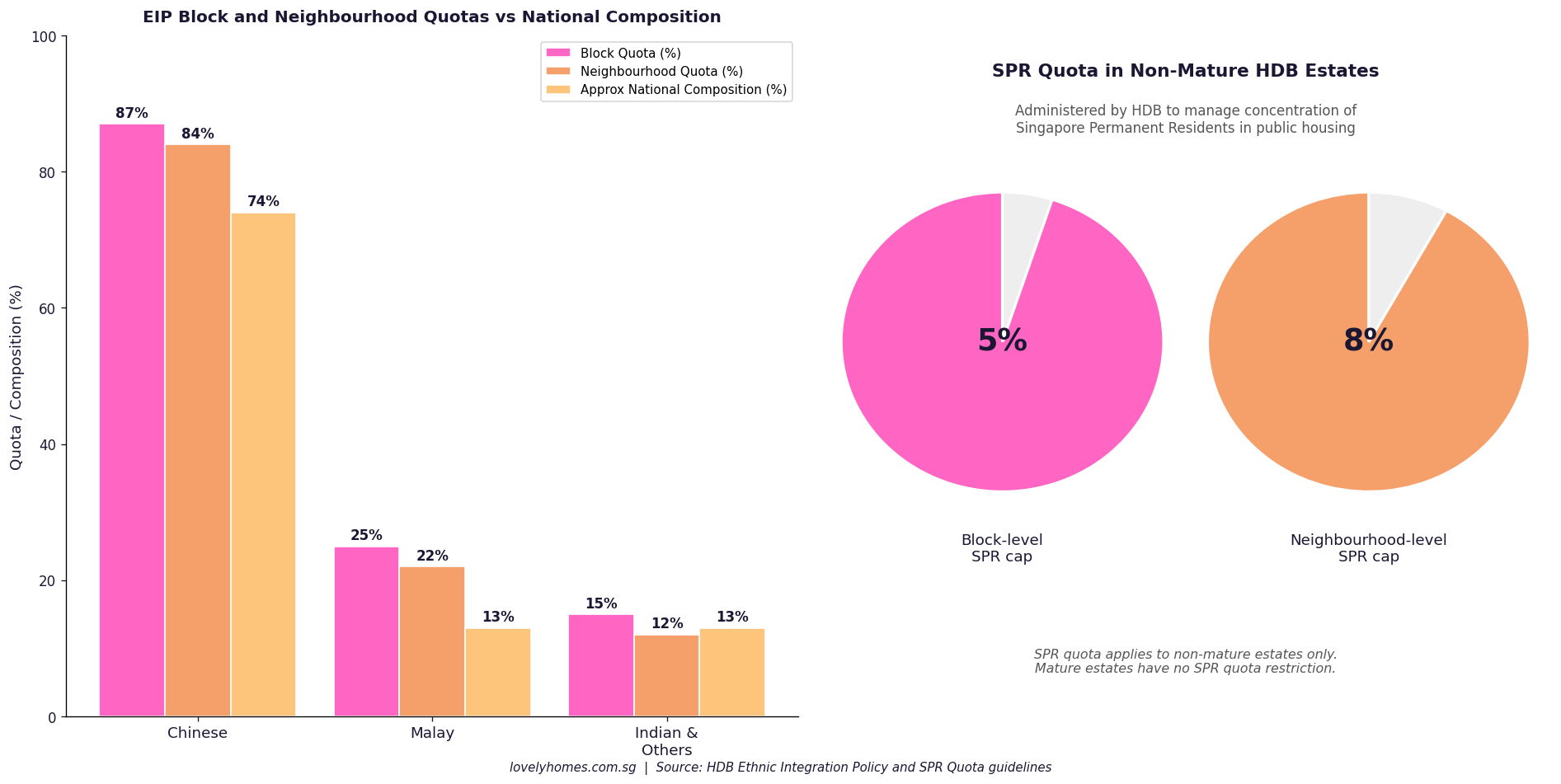
  • Current quotas: Chinese up to 87% (block) / 84% (neighbourhood); Malay up to 25% (block) / 22% (neighbourhood); Indian & Others up to 15% (block) / 12% (neighbourhood).
  • EIP applies only to HDB resale transactions — not to new BTO flat applications, which are managed separately.
  • A buyer whose ethnic group has exceeded the block or neighbourhood quota cannot purchase a resale flat in that block or neighbourhood until the proportion drops back below the limit.
  • The SPR Quota is a separate restriction: SPR households are limited to 5% of units in any block and 8% in any neighbourhood in non-mature HDB estates.
  • Sellers can sell to any ethnically eligible buyer — the EIP restricts buyers, not sellers.
  • A flat in a quota-full block may be priced lower than comparable units in non-restricted blocks, as the pool of eligible buyers is smaller.
  • You can check whether a specific block is EIP- or SPR-quota-full using HDB’s online e-service before making an offer.

What Is the Ethnic Integration Policy?

The EIP was introduced by the Singapore government in 1989, during a period when natural market forces were producing ethnic concentration in certain HDB estates — reversing the government’s longstanding policy of distributing ethnic groups evenly across public housing. Before 1989, resale transaction patterns had allowed Chinese Singaporeans to cluster in newer, higher-demand estates, while Malay and Indian households remained concentrated in older estates. The EIP was HDB’s mechanism to enforce ethnic integration as a social policy objective, reflecting Singapore’s commitment to multiracialism as a founding principle of the nation.

The policy is administered by HDB under the Housing and Development Act. HDB sets the quota limits and updates them periodically (though they have been broadly stable for many years) based on Singapore’s national ethnic composition as measured by the Department of Statistics Singapore (SingStat).

EIP Block and Neighbourhood Quotas — The Numbers
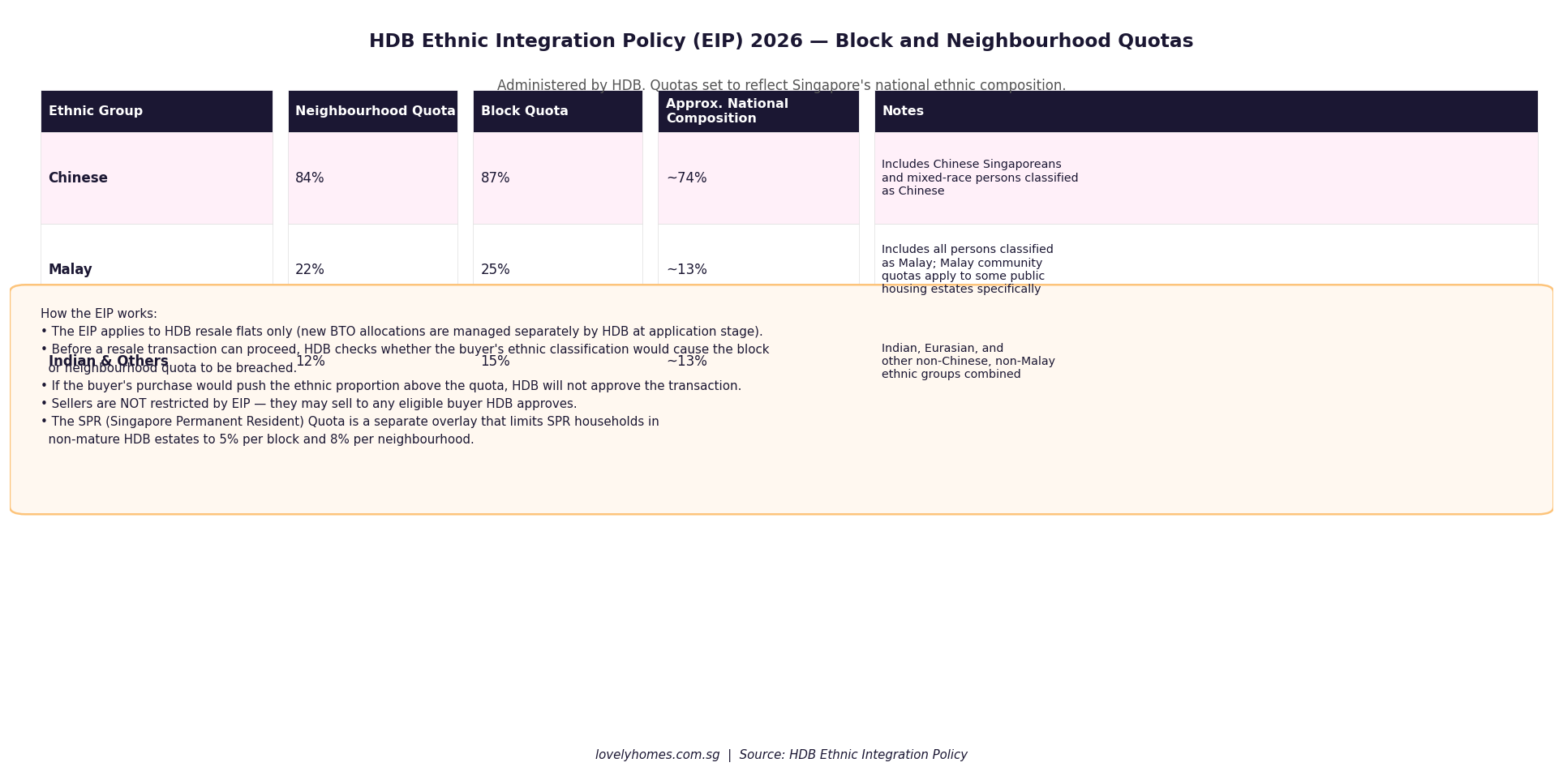
HDB Ethnic Integration Policy 2026 block and neighbourhood quotas for Chinese Malay Indian Singapore
Figure 1: EIP Block and Neighbourhood Quotas (2026) versus approximate national ethnic composition. Source: HDB Ethnic Integration Policy guidelines; SingStat population data.

The current EIP quotas are set above the national composition to give headroom for natural movement while still preventing concentration. A block is considered quota-full for a particular ethnic group when adding one more household of that group would breach the block-level cap. At that point, only buyers of a different ethnic group (or mixed-race buyers whose reported ethnicity is in a different category) can purchase units in that block until existing residents move out and reduce the proportion.

The two-tier system (block + neighbourhood) means a buyer might face no restriction at the neighbourhood level but encounter a quota-full block — or vice versa. Both must be satisfied before HDB will approve the transaction.

Ethnic Group Block Quota Neighbourhood Quota Who Is Counted
Chinese 87% 84% SC and SPR registered as Chinese
Malay 25% 22% SC and SPR registered as Malay
Indian & Others 15% 12% SC and SPR registered as Indian, Eurasian, or Others
SPR Households (non-mature estates) 5% 8% SPR-only households (no SC members) — non-mature estates only

Who Is Affected and How?

HDB EIP and SPR Quota buyer eligibility matrix 2026 — SC SPR foreigner affected or not
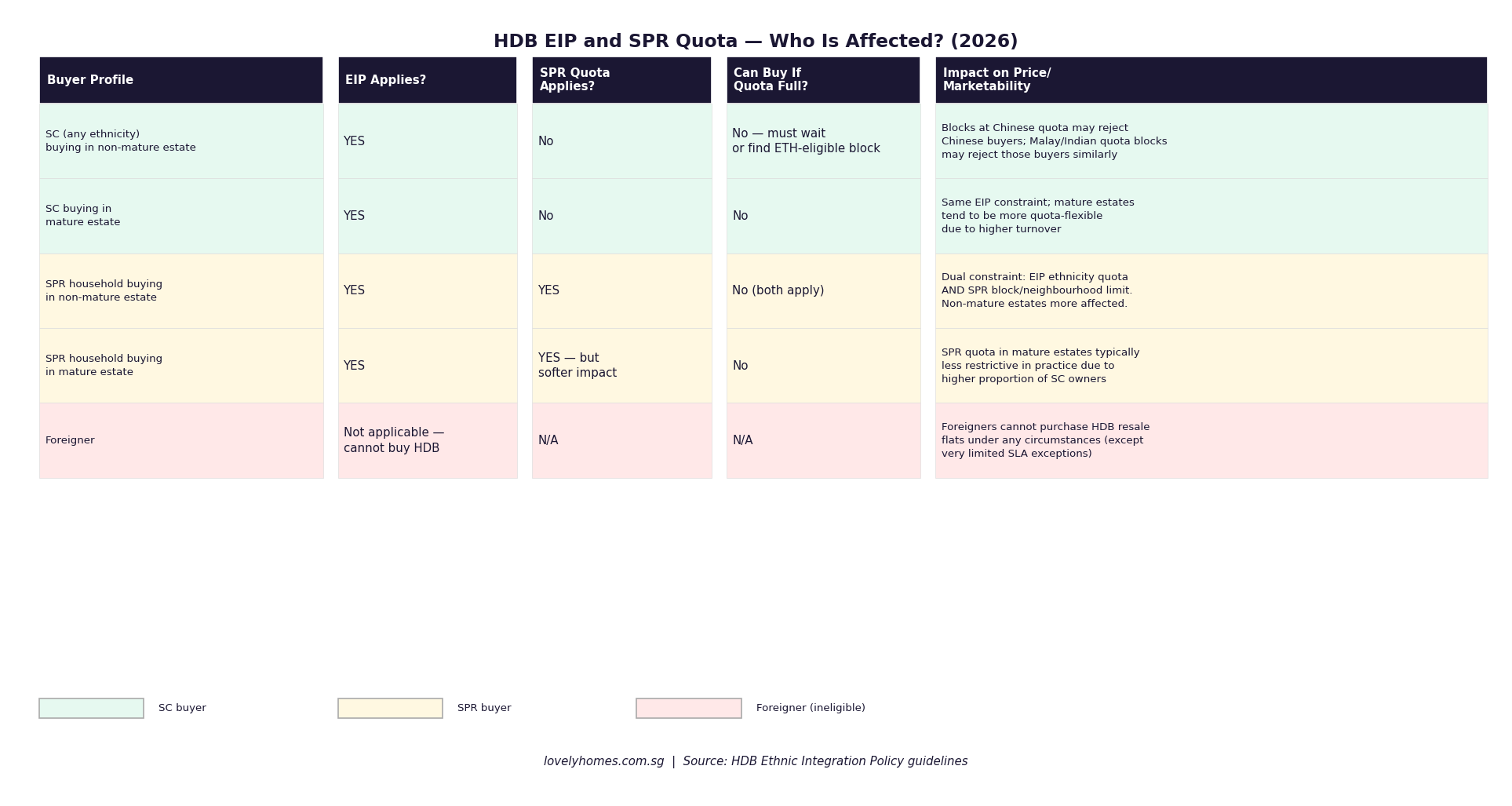
Figure 2: Matrix showing how the EIP and SPR Quota affect different buyer profiles in 2026. Source: LovelyHomes editorial based on HDB guidelines.

The SPR Quota — A Separate Overlay

HDB SPR Quota 2026 — 5% block and 8% neighbourhood cap for Singapore Permanent Residents non-mature estates
Figure 3: SPR Quota limits for non-mature HDB estates: 5% per block and 8% per neighbourhood. The SPR Quota is separate from and additional to the EIP ethnic quotas. Source: HDB Singapore.

The Singapore Permanent Resident (SPR) Quota was introduced in 2010 and is a distinct policy from the EIP, though both are administered by HDB. The SPR Quota limits SPR-only households to 5% of units in a block and 8% in a neighbourhood, but only in non-mature HDB estates. Mature estates — broadly, estates established before 1990, such as Toa Payoh, Ang Mo Kio, and Queenstown — are exempt from the SPR Quota.

A household qualifies as “SPR-only” (i.e., subject to the SPR quota) if all owners and occupants are SPRs with no Singapore Citizens. Households that include at least one SC are not counted against the SPR Quota, even if the flat is primarily purchased by an SPR. This means an SC-SPR couple is exempt from the SPR Quota (though they still face the EIP ethnic quota for the SPR’s ethnicity classification).

How to Check EIP and SPR Quota Status Online

HDB provides a free e-service on its website that allows prospective buyers to check the EIP and SPR Quota status of a specific block before making an offer. The tool requires the block number and the buyer’s IC number (or similar identifier). It returns a clear indication of whether the buyer’s ethnic group is eligible to purchase in that block and neighbourhood at the time of enquiry. This check should be the first thing any resale buyer does after identifying a property of interest — before arranging viewings, making verbal offers, or paying any booking fees.

Note that quota status is dynamic: a block that is quota-full today may become eligible again in weeks if a unit in the over-represented ethnic group is sold to a buyer of a different ethnicity. Conversely, a block that is eligible today may become quota-full by the time you complete your Option to Purchase exercise.

Worked Example: The Ramanan Family — Indian SPR Couple in Punggol

Mr and Mrs Ramanan are a married couple of Indian ethnicity holding Singapore Permanent Residence. They wish to purchase a 4-room resale flat in Punggol, which is a non-mature estate. Before viewing, they check HDB’s e-service.

  • EIP check — Indian & Others quota: HDB’s e-service shows the specific block they are interested in has an Indian & Others proportion of 12% at block level — within the 15% block quota. They are eligible.
  • SPR Quota check: The same block has an SPR-only household proportion of 6.2% — above the 5% block cap. The Ramanan family, as an SPR-only household, cannot purchase in this block despite passing the EIP ethnicity check.
  • Resolution: Mr and Mrs Ramanan check an adjacent block in the same neighbourhood. That block has an SPR-only proportion of 3.8% and an Indian & Others proportion of 11.4% — both within limits. They proceed to make an offer on a unit there.

This example illustrates how the SPR Quota can be the binding constraint even when ethnicity is not an issue, and why checking both quotas before viewing is essential for SPR buyers in non-mature estates.

Impact on Flat Prices: When a Block Is Quota-Full

When a block is quota-full for the dominant ethnic group (typically Chinese), the pool of eligible buyers shrinks significantly — sometimes to just two or three per cent of potential buyers. This reduced marketability can suppress prices for those units relative to comparable flats in non-restricted blocks. Sellers may accept lower offers because their buyer pool is smaller. Conversely, buyers who happen to be of the rarer ethnicity eligible to purchase in a quota-full block may find better value in those units.

Industry observation suggests that the price discount for a flat in a quota-full Chinese block (where only Malay and Indian & Others buyers are eligible) can range from 3% to 8% below comparable non-restricted flats, depending on the estate and flat type. This is not an official figure from HDB or any regulator — it reflects observed transacted price trends — and buyers should form their own view.

EIP and New Launches (BTO Flats)

The EIP as described above applies to resale transactions. For new BTO flats, HDB manages ethnic integration differently: at the allocation stage, HDB applies similar ethnic proportion targets when assigning balloted flats to successful applicants. Buyers do not interact with the EIP directly when applying for a BTO flat — HDB handles the integration mechanically during the allocation process. Once allocated, the flat is subject to the standard Minimum Occupation Period (MOP) of five years before it can be sold on the resale market, at which point the EIP would apply to the buyer in the resale transaction.

What Might Come Next

The EIP has remained broadly unchanged since 1989, though quota levels have been adjusted marginally over the decades in line with shifting national demographic compositions. As Singapore’s population continues to evolve — with a declining Chinese majority share and growing Indian community share in newer cohorts — HDB may review quota levels periodically. The introduction of the SPR Quota in 2010 reflects the government’s willingness to add new layers to the integration framework as housing market dynamics shift. Whether the EIP will be extended or modified to address new demographic realities (such as multiracial households whose classification is more complex) is a policy question that HDB and the Ministry of National Development (MND) are best placed to address.

Frequently Asked Questions

Does the EIP apply if I am buying a new BTO flat directly from HDB?

Not in the same direct way. When you apply for a BTO flat, you do not check EIP quota status yourself — HDB manages ethnic integration during the allocation process administratively. However, the result is functionally similar: HDB ensures that no single ethnic group exceeds the policy proportions in any block. For resale flats, the responsibility shifts to the buyer to check EIP eligibility before making an offer. This is one of the key differences between the BTO and resale processes.

What happens if the block becomes quota-full after I make my offer but before HDB approval?

HDB assesses EIP eligibility at the point of resale application submission, not at the time of the initial offer. If the block became quota-full between your offer and your application, HDB may decline the transaction. This is why solicitors and experienced buyers recommend submitting the HDB resale application as quickly as possible after exercising the OTP. The window between OTP exercise and HDB approval submission is typically one to four weeks, during which quota status can change if another transaction is approved first.

Can a mixed-race (Eurasian or multiracial) buyer choose which ethnic category to use for EIP purposes?

No. Ethnic classification in Singapore follows the IC (identity card) classification, which is assigned at birth and follows the father’s ethnicity for Singapore Citizens. Mixed-race individuals may carry a dual classification in some circumstances, but for HDB and EIP purposes, the primary classification on their NRIC is used. If a buyer feels their classification is incorrect or outdated, they should first seek to update it with the Immigration & Checkpoints Authority (ICA) before applying to purchase a resale flat.

If I am an SC married to a foreigner, which ethnicity is counted for EIP?

For an SC-foreigner household, the flat ownership is registered in the SC’s name (foreigners cannot own HDB flats). The EIP is therefore assessed based on the SC’s ethnicity. The foreign spouse is listed as an approved occupant but not as an owner. This means the EIP constraint tracks the SC, not the foreigner’s nationality or ethnicity.

Does the SPR Quota apply if my household has one SC and one SPR?

No. The SPR Quota only applies to households where all registered owners and occupants are SPRs — i.e., there is no SC in the household. A household with at least one SC member is exempt from the SPR Quota (though the EIP ethnic quota still applies based on the SC’s ethnicity). This distinction is important for SC-SPR couples planning to buy in a non-mature estate.

Are there any exemptions to the EIP for certain types of buyers?

There are limited circumstances where HDB may grant an EIP exemption, but these are rare and not publicly detailed. Elderly Singaporeans wishing to live near family members, or specific compassionate cases, may apply for HDB’s consideration. In practice, the EIP is enforced consistently and buyers should not assume an exemption will be granted. The practical solution for most buyers facing a quota-full block is to expand their search to nearby blocks or different neighbourhoods where their ethnic group has quota space.

Can an SPR couple buy in a mature estate without facing the SPR Quota?

Yes. Mature estates (broadly, those established before 1990) are exempt from the SPR Quota. An SPR-only household can purchase a resale flat in a mature estate such as Toa Payoh, Queenstown, Ang Mo Kio, Bedok, or Clementi without the SPR Quota constraint. They would, however, still be subject to the standard EIP ethnic quota for the owner’s ethnicity. This makes mature estate resale flats generally more accessible for SPR buyers, though they typically command higher prices than comparable flats in non-mature estates.

Related Articles

Disclaimer: This article is produced for general informational purposes only and does not constitute legal, financial, or property advice. Ethnic Integration Policy quotas, SPR Quota limits, and HDB eligibility rules are administered by the Housing & Development Board and are subject to periodic review. Always verify current EIP and SPR Quota status for a specific block using HDB’s e-service at www.hdb.gov.sg before making any property purchase decisions. For personalised advice on your specific circumstances, consult a CEA-registered property salesperson or solicitor.
Singapore Condo Buying Process 2026: Step-by-Step from Offer to Keys — OTP, BSD, ABSD and Completion

Singapore Condo Buying Process 2026: Step-by-Step from Offer to Keys — OTP, BSD, ABSD and Completion

Buying a condominium in Singapore is one of the largest financial decisions most households will ever make. Whether you are a first-timer upgrading from an HDB flat, a permanent resident purchasing your first private home, or a foreigner entering Singapore’s property market, the process involves multiple stages, strict regulatory requirements, and substantial upfront costs. This guide walks you through every step — from checking your eligibility and financing to collecting your keys and settling in — so you can proceed with confidence and without surprises.

Quick Answer — Key Takeaways

  • A Singapore condo purchase follows 10 distinct stages: eligibility check → search → offer → OTP → solicitor/valuation → exercise OTP (S&P) → bank loan → requisitions → completion → post-completion.
  • Buyer’s Stamp Duty (BSD) is payable by all buyers; rates run from 1% to 6%, administered by IRAS.
  • Additional Buyer’s Stamp Duty (ABSD) applies to Singapore citizens purchasing a second or subsequent residential property, Singapore Permanent Residents from their first purchase, and all foreigners — rates range from 5% to 65% of the purchase price.
  • The Total Debt Servicing Ratio (TDSR) cap is 55% of gross monthly income; the Mortgage Servicing Ratio (MSR) cap of 30% applies only to HDB loans, not private condo purchases.
  • The minimum cash down payment is 5% of the purchase price (for bank loans); the remainder of the 25% LTV shortfall can come from CPF Ordinary Account funds.
  • Completion of a resale condo typically takes 10–12 weeks after option exercise; a new launch can take 3–5 years to TOP depending on construction progress.
  • Legal fees for a condo purchase typically run S$2,500–S$4,000 for a standard transaction, covering title search, requisitions, and completion.
  • A In-Principle Approval (IPA) from your bank should be obtained before making any offer — it costs nothing and lasts 30 days.

What Is a Condominium in Singapore?

Under Singapore law, a condominium is a privatised residential development governed by the Building Maintenance and Strata Management Act (BMSMA), administered by the Building and Construction Authority (BCA) and the relevant Management Corporation Strata Title (MCST). Condominiums differ from HDB flats in that they are privately built and sold, carry strata titles, are managed by an MCST, and typically feature shared amenities such as a swimming pool, gymnasium, and security. They can be sold on a freehold, 999-year leasehold, or 99-year leasehold basis. The Urban Redevelopment Authority (URA) regulates the development, sale, and advertising of private residential property, while IRAS administers stamp duties.

Step 1 — Check Your Eligibility and Financing

Before viewing a single showflat or property listing, establish your financial position. Singapore’s Monetary Authority of Singapore (MAS) mandates that all residential loans are subject to the Total Debt Servicing Ratio (TDSR) of 55% — meaning all monthly debt obligations (including the proposed mortgage) cannot exceed 55% of gross monthly income. Unlike HDB purchases, private condo purchases are not subject to the 30% Mortgage Servicing Ratio (MSR) cap.

Obtain an In-Principle Approval (IPA) from a bank before making any offer. The IPA is free, takes one to three working days, and tells you the maximum loan quantum, indicative interest rate, and monthly repayment. As at 1 July 2026, Singapore bank SORA-linked packages are pricing at approximately 1.15%–1.35% spread over the 3-Month Compounded SORA (currently around 1.07%), giving effective rates of approximately 2.22%–2.42%. Fixed-rate packages for two-year terms are available at approximately 2.55%–2.80%.

Simultaneously, check your ABSD profile: Are you a Singapore Citizen (SC), Permanent Resident (SPR), or foreigner? How many residential properties do you currently own or have you previously owned? Your ABSD liability — which can add 0% to 65% of the purchase price — will directly affect your cash requirements.

Step 2 — Property Search and Viewings

Search listings on URA’s Real Estate Information System (REALIS) for actual transacted prices, which reflect what buyers actually paid rather than asking prices. For new launches, request access to the developer’s showflat; for resale units, arrange viewings through the seller’s representative. Compare stacks, floor plans, and psf prices across comparable transactions before forming a view on value.

At this stage, commission your own valuation if considering a resale unit — banks will only loan against the lower of the transacted price or the formal valuation. A gap between the two means cash top-up from your own funds.

The 10-Step Buying Process — Visual Overview

Singapore condo buying process 2026 — 10-step timeline from offer to keys
Figure 1: The Singapore condo buying process in 10 steps — from eligibility check to post-completion. Source: LovelyHomes editorial, based on CEA and IRAS guidelines 2026.

Step 3–4 — Making an Offer and the Option to Purchase (OTP)

For a resale condo, the buying process is governed by the Controller of Housing under the Housing Developers (Control and Licensing) Act for new launches, and by common law for resale. In a resale transaction, the buyer and seller agree on a price, and the seller grants the buyer an Option to Purchase (OTP). The buyer pays an option fee (typically 1% of the purchase price), which grants them the exclusive right to buy the property within 14 calendar days. During this 14-day window, the buyer must arrange financing, engage a solicitor, and decide whether to proceed.

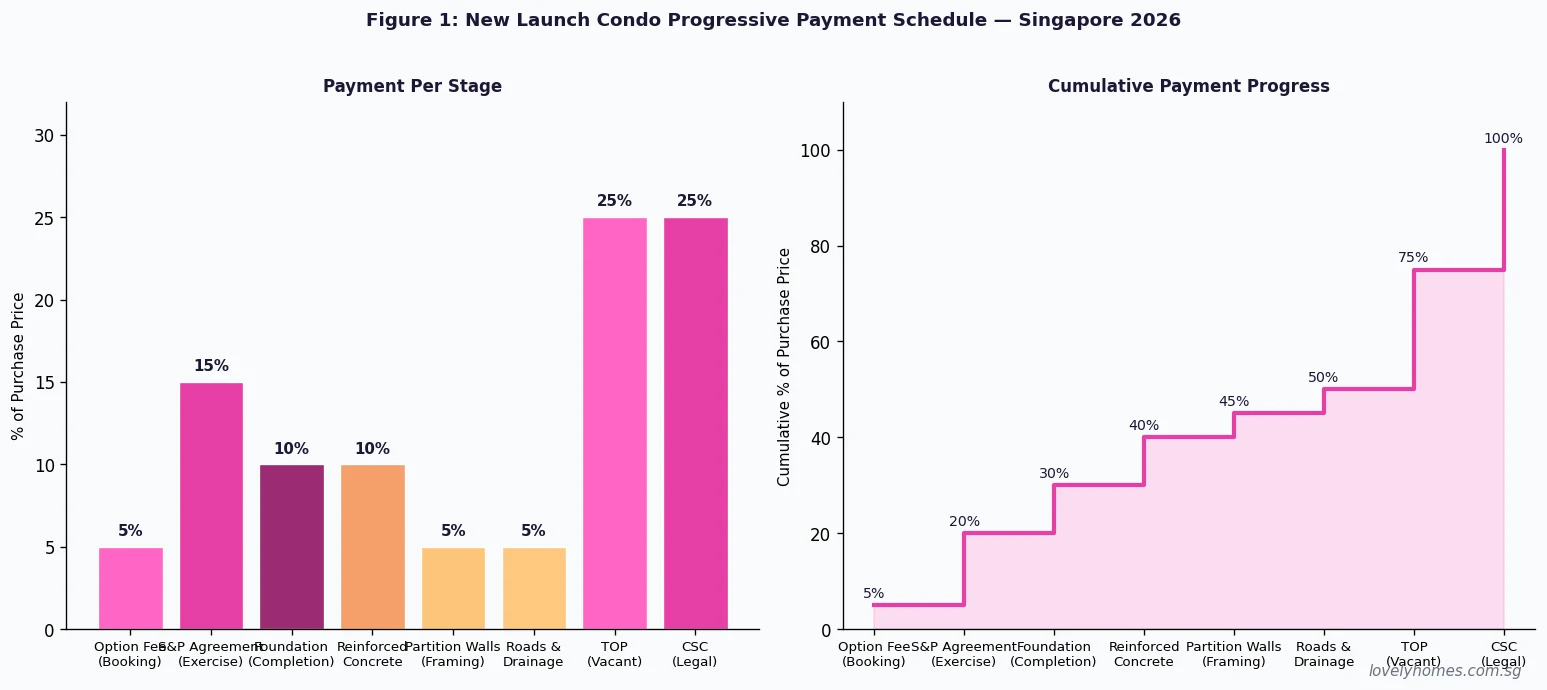
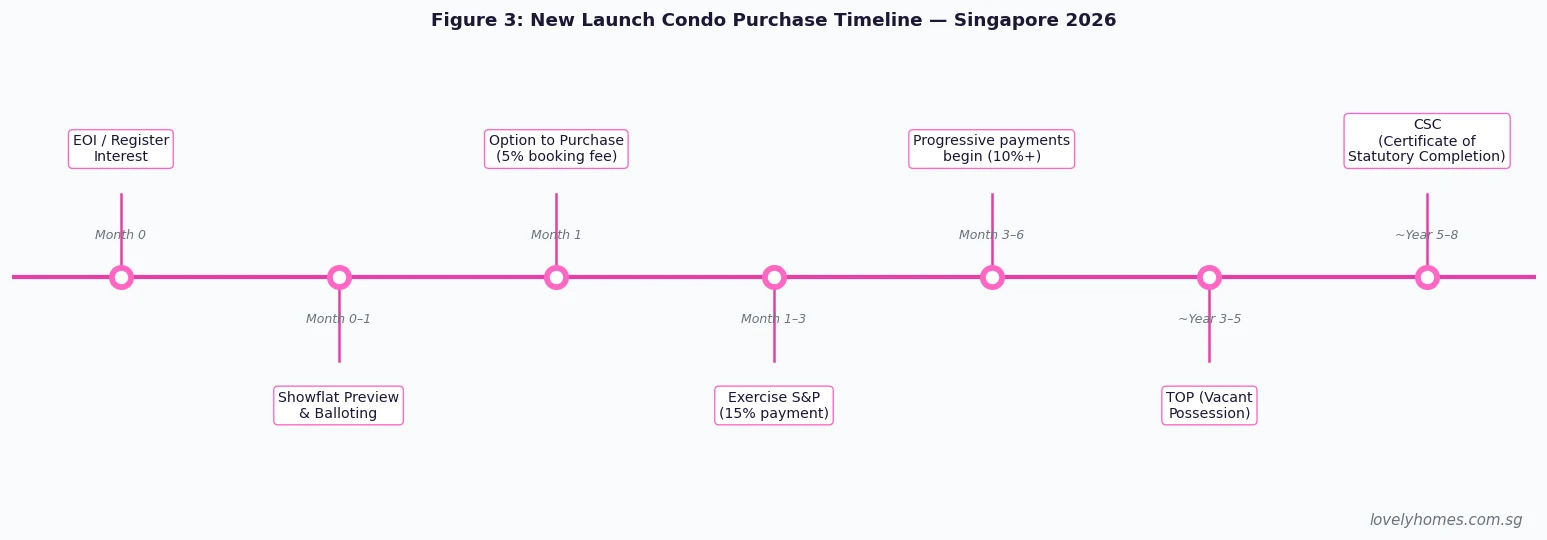
For a new launch, the process differs: buyers register an Expression of Interest (EOI) or join a ballot, attend a showflat, and — if selected — pay a 5% booking fee to receive the Sales & Purchase Agreement (S&P) from the developer. For a new EC (Executive Condominium), additional eligibility rules under HDB guidelines apply.

Step 5–6 — Engaging Your Solicitor and Exercising the OTP

Once you have decided to proceed, engage a solicitor immediately. Your solicitor will conduct a title search via the Singapore Land Authority (SLA) to confirm ownership, identify any caveats or encumbrances (outstanding mortgages, charges, or restrictive covenants), and raise legal requisitions with government agencies. To exercise the OTP, the buyer pays a further 4% of the purchase price (bringing the total deposit to 5%) and receives the signed S&P agreement. The balance of the purchase price is payable on completion, typically 10–12 weeks later for a resale unit.

BSD is payable within 14 days of exercising the OTP (for Singapore-issued documents) and can be paid from CPF Ordinary Account funds. ABSD is payable within 14 days of executing the S&P agreement and must be paid in cash.

Stamp Duty Deep-Dive: BSD and ABSD

Singapore BSD rates 2026 and ABSD rates by buyer profile — condo buying stamp duty guide
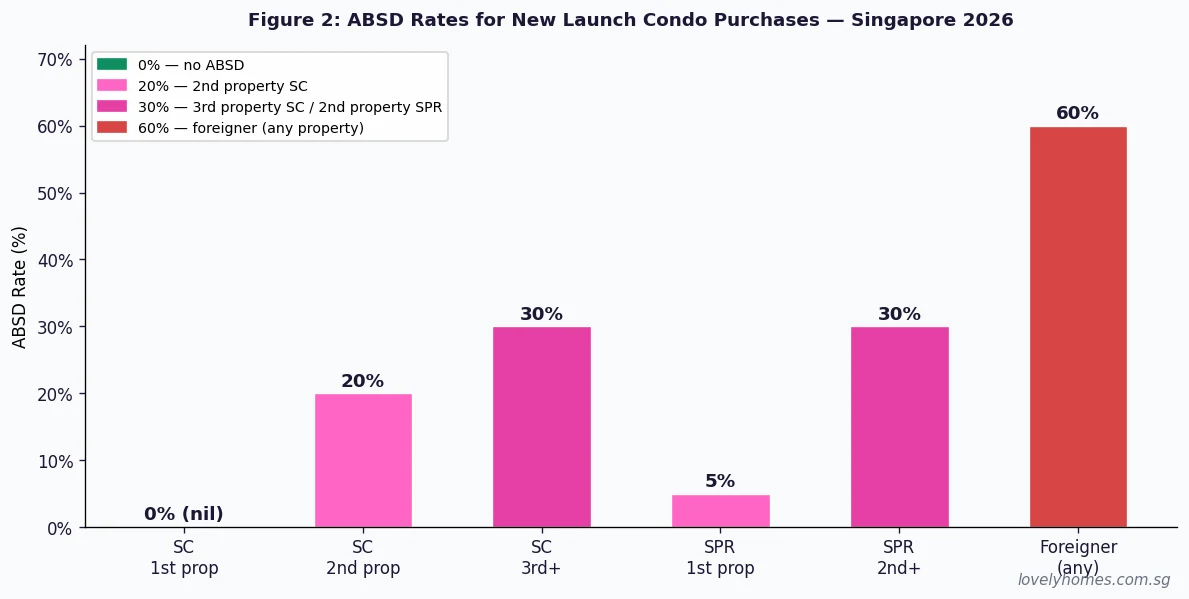
Figure 2: Left — BSD rates by purchase price band (IRAS 2026). Right — ABSD rates by buyer profile (IRAS 2026). SC = Singapore Citizen, SPR = Singapore Permanent Resident.

BSD is levied on all residential property purchases in Singapore, at progressive rates administered by the Inland Revenue Authority of Singapore (IRAS): 1% on the first S$180,000, 2% on the next S$180,000, 3% on the next S$640,000, 4% on the next S$500,000, 5% on the next S$1,500,000, and 6% on amounts above S$3,000,000. On a S$1,600,000 condo, BSD amounts to S$49,600.

ABSD is an additional stamp duty introduced by the government to moderate investment demand. As at 1 July 2026, key ABSD rates are: SC 1st property 0%, SC 2nd 20%, SC 3rd+ 30%; SPR 1st property 5%, SPR 2nd+ 30%; foreigners (all) 60%; entities (all) 65%. ABSD must be settled in cash within 14 days of the date of the instrument — it cannot be paid using CPF funds.

Buyer Profile BSD (S$1.6M) ABSD Rate ABSD Amount Total Stamp Duty
SC — 1st property S$49,600 NIL NIL S$49,600
SC — 2nd property S$49,600 20% S$320,000 S$369,600
SC — 3rd+ property S$49,600 30% S$480,000 S$529,600
SPR — 1st property S$49,600 5% S$80,000 S$129,600
Foreigner — any property S$49,600 60% S$960,000 S$1,009,600

Total Cash Required — Three Buyer Profiles for a S$1.6M Condo

Total cash required to buy a S$1.6M condo Singapore 2026 — SC first property, SC second property, foreigner
Figure 3: Breakdown of total cash required to purchase a S$1,600,000 condominium in Singapore under three buyer profiles (2026). ABSD and down payment assumptions based on MAS LTV framework and IRAS stamp duty rates. Source: LovelyHomes editorial analysis.

Step 7 — Applying for Your Bank Loan

After exercising the OTP, your solicitor notifies the bank to proceed with the formal loan. The bank issues a Letter of Offer (LO), which sets out the loan quantum, interest rate structure, lock-in period (typically two to three years), and prepayment penalty. Review the LO carefully before signing. The Loan-to-Value (LTV) limit for a first housing loan is 75% of the lower of the purchase price and the bank’s valuation; for a second outstanding housing loan, LTV drops to 45%; for a third or subsequent, 35%. These limits are set by MAS and were last revised in September 2022.

Note that CPF Ordinary Account funds can be used to service the monthly instalment and to pay for the BSD — but not for ABSD or cash top-up arising from a valuation gap.

Step 8–9 — Requisitions, Title Search and Completion

Your solicitor will raise legal requisitions with IRAS (property tax status), the Land Transport Authority (road interpretation plan), the Public Utilities Board (water and drainage charges), and other relevant authorities. These take five to ten working days. On completion, the buyer’s solicitor forwards the balance purchase price (net of the deposit already paid) to the seller’s solicitor, who simultaneously releases the title. Your caveat is lodged at SLA on the same day, protecting your interest. Keys are handed over and you become the registered proprietor.

Worked Example: The Teo Family — SC Couple Buying a 2nd Property

Mr and Mrs Teo are Singapore Citizens purchasing a 3-bedroom OCR condo in Tampines at S$1,600,000 as their second residential property. They currently own an HDB flat in Bedok (MOP cleared), which they are retaining. Their combined gross monthly income is S$18,000.

  • BSD: S$49,600 — paid from CPF Ordinary Account.
  • ABSD (20%, 2nd property SC): S$320,000 — paid in cash at signing.
  • Down payment: 55% (LTV 45% for 2nd property) = S$880,000 total equity. Minimum 25% cash = S$400,000; remaining 30% (S$480,000) may come from CPF OA.
  • Bank loan: S$720,000 at 2.35% (2yr fixed); monthly repayment ~S$3,180. TDSR = 17.7% — well below 55% cap.
  • Legal fees: ~S$3,200.
  • Total cash outlay at completion: S$400,000 (cash downpayment) + S$320,000 (ABSD) + S$3,200 (legal) = S$723,200 cash; CPF drawdown S$529,600 (BSD + remaining downpayment).

This example illustrates why a Singapore Citizen buying a second residential property must maintain substantial liquid reserves — ABSD alone accounts for S$320,000 that must be settled in cash.

Why This Matters: Cooling Measures and the Investment Calculus

Singapore’s layered stamp duty framework — BSD plus ABSD plus Seller’s Stamp Duty (SSD) — is a deliberate policy tool that the Ministry of Finance and MAS use to moderate speculative activity and maintain housing affordability. Since April 2023, when ABSD was raised sharply (SC 2nd property from 17% to 20%; foreigner from 30% to 60%), transaction volumes among investment buyers have moderated but have not collapsed. Demand from owner-occupiers and upgraders has remained resilient, underpinned by Singapore’s robust employment market and steady inflow of high-net-worth residents. URA’s Q2 2026 Flash Estimates, released 1 July 2026, show the overall PPI still rising — +0.5% QoQ — even as the market digests the significant supply pipeline of 61,000 units expected to complete over the next few years.

New Launch vs Resale — Which Should You Buy?

New launches offer the ability to select your unit from a plan, benefit from the Progressive Payment Scheme (PPS), and potentially capture price appreciation between the launch date and TOP. However, they carry construction risk, deferred occupation, and you cannot see the exact finished product. Resale condos offer immediate entry, known physical condition, and existing community — but require cash top-up for any valuation gap. A thorough due diligence process, including engaging a structural inspector (approximately S$300–S$600) and reviewing the MCST’s financials, is advisable for resale condos.

What Might Come Next

With 9,320 private residential units on the 2026 GLS Confirmed List — over 50% above the 10-year annual average — supply is rising. URA’s full Q2 2026 data (due 24 July 2026) will clarify whether the modest +0.5% QoQ growth reflects genuine price moderation or a base effect from a particularly strong Q1. Analysts are watching whether the Federal Reserve’s policy trajectory, MAS exchange rate management, and global economic uncertainty will affect the purchasing power of foreign buyers who still face a 60% ABSD threshold. For Singapore Citizens buying within their first property, the outlook remains favourable — ABSD-free access to the market at a time when interest rates are declining from their 2023–2024 peaks.

Frequently Asked Questions

Can I use my CPF to pay ABSD?

No. ABSD must be paid entirely in cash. This distinguishes it from BSD, which can be settled using CPF Ordinary Account funds. ABSD must be paid to IRAS within 14 days of executing the instrument (typically the Sales & Purchase Agreement), so you must have the cash available before signing. This is one reason why financial planners recommend stress-testing your liquidity before committing to a second property purchase.

What happens if the bank valuation is lower than my purchase price?

If the bank’s formal valuation is S$1,550,000 but you are purchasing at S$1,600,000, the bank will only lend against the lower figure. With a 75% LTV, your loan quantum drops to S$1,162,500 instead of S$1,200,000 — meaning you must fund the S$37,500 shortfall from cash or CPF. This is known as a cash over valuation (COV) situation, though HDB uses this term more formally. For private condos, always check comparable transactions on URA REALIS and obtain a preliminary estimate from your bank before committing.

How long does a resale condo purchase take from offer to keys?

From the date the OTP is exercised to legal completion, the typical timeline is 10–12 weeks. The first four weeks involve legal requisitions, title search, and bank processing. Completion is then scheduled between the buyer’s and seller’s solicitors to align with the bank’s disbursement schedule. Delays can arise from outstanding property tax arrears, disputed caveats, or bank processing backlogs during peak periods. Build contingency time into your planning, especially if you need to vacate your current home simultaneously.

Do I need a solicitor, or can I use the developer’s panel firm for a new launch?

For a new launch, the developer’s solicitors handle the S&P agreement on a panel basis, and buyers can use them without engaging separate legal representation — the fee is typically absorbed by the developer. However, it is strongly advisable to engage your own independent solicitor (approximately S$2,500–S$3,500 for a standard new launch transaction) so that someone is specifically acting in your interests, reviewing payment schedules, and flagging any unusual conditions. For resale transactions, you must engage your own solicitor.

Can a foreigner buy any type of condo in Singapore?

Foreigners (non-citizens, non-PRs) may purchase units in private condominiums and apartments in Singapore without restriction, subject to the 60% ABSD. However, foreigners cannot purchase HDB flats, executive condominiums within the first 10 years of completion, or landed residential property (houses, bungalows, semi-detached, or terraced) without prior approval from the Land Dealings Approval Unit (LDAU) under SLA. Approval is rarely granted except in exceptional circumstances of permanent residency or significant economic contribution.

What is the Seller’s Stamp Duty (SSD), and does it affect my purchase?

SSD is payable by the seller, not the buyer — but it affects the seller’s net proceeds and can influence pricing and negotiation. SSD rates are 12% (if sold within 1 year), 8% (within 2 years), 4% (within 3 years), and nil beyond. If you plan to resell within three years, factor SSD into your exit modelling. On a S$1,600,000 condo sold at S$1,750,000 in 18 months, SSD at 8% = S$140,000 — wiping out most of the gross gain.

Is there a minimum occupation period for private condos?

There is no Minimum Occupation Period (MOP) for private condos in the same sense as HDB flats. However, the SSD effectively imposes a three-year hold before selling without penalty. If you purchased using an HDB resale flat that was originally classified under the MOP rules, you would also need to comply with those rules separately before buying the private property (unless you are an SC buying as a 2nd property). Confirm with HDB if any concurrent ownership obligations apply to your specific situation.

Related Articles

Disclaimer: This article is produced for general informational purposes only and does not constitute financial, legal, or investment advice. Property prices, stamp duty rates, LTV limits, TDSR thresholds, and interest rates are subject to change by the relevant Singapore authorities (URA, IRAS, MAS, SLA, HDB, CPF Board). Readers should consult licensed financial advisers, solicitors, and CEA-registered property salespersons before making any property purchase decisions. Always verify current rates directly with IRAS at www.iras.gov.sg and MAS at www.mas.gov.sg.

Translate »