
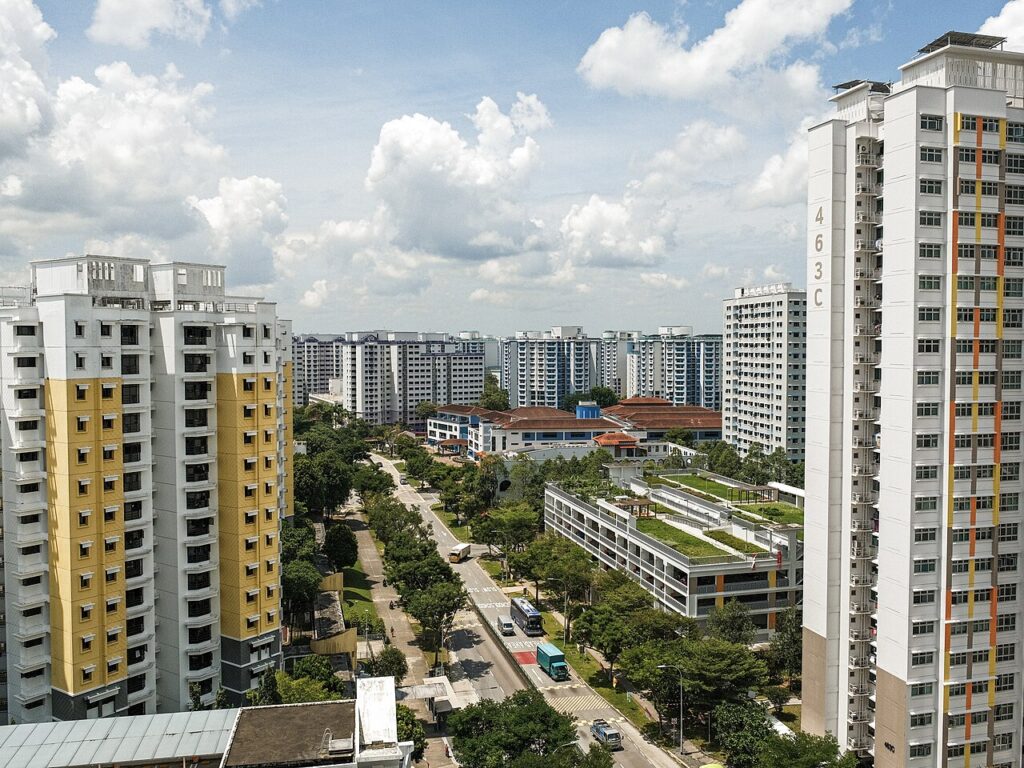
HDB resale prices edged down 0.1% in Q3 2026 while more flats changed hands. That combination does not make every flat cheaper or every seller more negotiable. A buyer still needs to match the selected flat’s lease, condition and recent comparable transactions to a workable budget.
More sales, a small index decline
HDB’s full release of 23 October 2026 puts the Q3 Resale Price Index at 202.5, down 0.1% from Q2. It is the third consecutive quarterly decline, following falls of 0.1% in Q1 and 0.3% in Q2.
Resale volume rose from 6,396 transactions in Q2 to 7,645 in Q3, an increase of 19.5%. Q3 volume was also 5.9% above the 7,221 transactions in Q3 2025. Use the quarterly totals together; a partial-period flash count is not a like-for-like substitute for the completed quarter.
A price index describes market movement. Transaction volume describes activity. Neither is a valuation of the flat you are considering. A rise in activity can coexist with a small price decline, so an increase in sales is not proof that your offer needs to be higher.
Do not price a flat by multiplying the index change
Illustration: 0.1% of a S$700,000 asking price is S$700. Subtracting that amount gives S$699,300, but it does not establish the flat’s value. The national index is not an instruction to discount every listing by the same percentage.
Compare actual transactions for similar flat types, floor areas, storey ranges and remaining leases, keeping the transaction period visible. Then investigate differences in condition and the work required before moving in. An asking price remains a request until buyer and seller agree; the town median is a midpoint across transactions, rather than a quote for your block.
For financing, keep the agreed price and the valuation used for the purchase separate. Our property valuation guide explains why a price gap can affect cash planning. Avoid assuming that a national price decline removes that risk.
The removed wait-out is not a universal eligibility clearance
HDB’s release says the 15-month wait-out for private residential property owners and former owners buying non-subsidised HDB resale flats was removed on 28 July 2026. HDB also says it has not observed a significant increase in prices and the number of resale flats purchased by those groups since the removal.
That observation does not prove why any particular resale price moved. For a buyer, removing that particular wait-out does not establish eligibility for every household, flat, grant or loan. Obtain the HDB Flat Eligibility assessment for your circumstances before treating a shortlisted flat as a purchase you can complete.
Write down who will buy and occupy the flat, the intended funding and the move date. If the household’s circumstances have changed, resolve the assessment before committing to a price. Use our HDB versus condo comparison to organise the different ownership and funding questions.
November supply is no longer an upcoming exercise
HDB’s 4 November launch offered 7,964 flats across seven projects. Applications closed on 11 November. That supply should not be described as a sales exercise still to come, or as completed homes immediately available to a resale buyer.
The next announced exercise is February 2027, with about 4,300 BTO flats and a concurrent SBF offering of about 5,000 flats. HDB encourages prospective applicants to submit their HFE application and all required documents by 15 December 2026. This preparation date is distinct from the future flat-application window. Compare a resale purchase now against the actual waiting and eligibility position, rather than treating either route as a guaranteed allocation.
Compare the cost of two usable homes
A small national index decline is a reason to examine the evidence carefully, rather than assume that the lower asking price is the better purchase. Add the work needed before occupation and keep the funding requirement separate from the total cost.
Consider two hypothetical resale flats that otherwise suit the same household. Flat A costs S$700,000 and needs S$25,000 of essential work. Flat B costs S$715,000 and needs S$8,000. Before duties, fees, financing and other differences, their price-plus-work totals are S$725,000 and S$723,000. B’s higher price still produces a S$2,000 lower total on these assumptions.
| Entry | Flat A | Flat B |
|---|---|---|
| Agreed price | S$700,000 | S$715,000 |
| Assumed loan | S$500,000 | S$510,000 |
| Own funds towards price | S$200,000 | S$205,000 |
| Essential work | S$25,000 | S$8,000 |
| Own funds plus work | S$225,000 | S$213,000 |
The assumed loans are teaching figures, not approvals or borrowing limits. The own-funds entries do not determine how much must be cash or can be eligible CPF. B needs S$5,000 more towards the price but S$17,000 less for the assumed works, giving a S$12,000 lower combined own-funds-and-work requirement. Its larger loan also has to be repaid; that liability has not disappeared from the comparison.
Replace the repair allowances with quotations, and compare the loans over the same tenure and interest-rate assumptions. Add actual duties, legal expenses, moving costs and any temporary accommodation. A home that is ready sooner may reduce disruption, while a cheaper unit may offer a layout worth improving. Neither conclusion comes from the national price index alone.
For sellers, this is also a useful way to assess competing offers and presentation work. Show buyers what is included, the condition of key fittings and realistic occupation arrangements. Do not assume every renovation dollar will return through the selling price. Match the buyer’s alternatives and explain the practical differences.
Make the move workable under a less favourable outcome
Before making an offer, set aside the money needed for the purchase separately from repairs, temporary accommodation and living expenses. Ask what happens if the approved funding is lower or the home needs more work than first expected. The cash and CPF calendar shows why the order of payments matters as much as the total.
For an owner-occupier, test the route to work, school and daily services, and check whether the layout will still work as the household changes. For a seller, choose comparable transactions that a buyer can reasonably substitute for your flat. A market headline is useful context, but specific evidence and realistic completion terms should do the pricing work.
Archive HDB neighbourhood photograph, not a listed flat. HDB flats along Sembawang Drive (photographed 2024). Photo: Brhb25. Source (https://commons.wikimedia.org/wiki/File:HDB_flats_along_Sembawang_Drive.jpg) · CC BY-SA 4.0 (https://creativecommons.org/licenses/by-sa/4.0). Resized and displayed cropped.
Need a brochure, price list or professional introduction?
Contact Lin Xuan at 82222556 or Ade at 81888871 or Benn at 83218774 for the full project brochure, latest available price list, a viewing, or introductions to bankers who can help you compare home-loan rates and packages to find the best available option for your needs. If you need legal advice on a property purchase, sale or tenancy, we can also put you in touch with property lawyers.
WhatsApp Lin Xuan | WhatsApp Ade. Let us know the project or property question you would like help with. Prices and availability are subject to developer confirmation, while loan terms and approval are determined by the bank.
Lin Xuan: ONG LIN XUAN, CEA registration R069812H. Ade: CHUA MUAY MUAY (ADE CHUA), CEA registration R014252F. ERA REALTY NETWORK PTE LTD, estate agent licence L3002382K.
Benn: TAN JUN FENG, BENNEDICT (BENNEDICT TAN), CEA registration R058941E. PROPNEX REALTY PTE. LTD., estate agent licence L3008022J.