Progressive Payment Scheme Singapore 2026: How It Works for New-Launch Condo Buyers

Progressive Payment Scheme Singapore 2026: How It Works for New-Launch Condo Buyers

The Progressive Payment Scheme (PPS) is the default payment structure for new-launch private residential property in Singapore. Under the scheme, you pay a small deposit on booking, incremental tranches as construction reaches each milestone, and the final balance only when the keys are handed over at TOP. This 2026 guide walks through each stage, the CPF and cash flow at every milestone, and the practical cash-flow implications for a typical Singapore buyer.

Quick Answer
  • The Progressive Payment Scheme spreads purchase payments across seven construction milestones, from OTP booking to CSC (final 12-month defect period).
  • On launch day you pay 5% in cash (the Option fee). Within 8 weeks you pay a further 15% on Sale & Purchase signing — of which up to 5% may be from your CPF Ordinary Account.
  • The remaining 80% is drawn progressively from your home loan as construction reaches foundation, walls, ceiling/roof, TOP and CSC.
  • Monthly mortgage payments begin after the first drawdown — not on the day you sign the OTP.
  • PPS is the default for new-launch condominiums. The Deferred Payment Scheme (DPS), where available, pushes the bulk of payments to TOP but typically carries a price premium and stricter eligibility.

What is the Progressive Payment Scheme?

The Progressive Payment Scheme is the payment structure prescribed by the Urban Redevelopment Authority for property sold in the primary market under the Housing Developers (Control and Licensing) Act. Under PPS, the purchase price is paid in incremental tranches timed to construction milestones, rather than in a single lump sum at handover. The structure exists for two reasons: it reduces the buyer’s financing burden during the 3–4 year build period, and it gives the developer progressive cash-flow to fund construction without requiring 100% escrow.

PPS applies to all uncompleted private residential property purchased directly from the developer. For completed-and-TOP-issued stock sold in the primary market, the payment structure is different — typically the full balance is due within 12 weeks of OTP.

The seven PPS milestones

Progressive Payment Scheme — Seven-Stage Timeline 5%OTP (booking fee)15%S&P signing (within 8 weeks)10%Foundation10%Carpark + walls25%Ceiling + roof25%TOP — keys issued10%CSC (within 12 months) Source: URA Progressive Payment Schedule · LovelyHomes editorial lovelyhomes.com.sg

Stage 1 — Option to Purchase (5% in cash)

On launch day, you pay a 5% Option fee to the developer in cash or cashier’s order. This secures your right to purchase the specific unit for a 3-week Option period. During this window, you finalise financing, commission a conveyancing lawyer and decide whether to proceed. If you do not exercise the Option, you forfeit 1.25% of the Option fee (one-quarter of the 5%) and the developer returns the balance 3.75%.

Stage 2 — Sale & Purchase Agreement (15% within 8 weeks)

Within 8 weeks of Option exercise, you sign the Sale & Purchase Agreement and pay a further 15% of the purchase price. A typical split is 5% in additional cash and 10% from CPF Ordinary Account, though this varies by buyer. At this stage, you also pay Buyer’s Stamp Duty and, if applicable, Additional Buyer’s Stamp Duty to IRAS — due within 14 days of S&P signing.

Stage 3 to 5 — Construction-linked draws (45% total)

Once construction reaches each milestone, the developer issues a payment notice. Your home-loan bank draws down against your loan facility to pay the developer directly. Monthly mortgage instalments begin on the bank side after the first drawdown. The three construction-linked milestones are: foundation complete (10%); reinforced concrete framework, carpark and partition walls complete (10%); ceiling, roof and external wall complete with windows installed (25%). Typical elapsed time between Stage 2 and Stage 5 is 24–30 months for a mid-size project.

Stage 6 — TOP and key handover (25%)

When the Temporary Occupation Permit is issued, the developer notifies the buyer. You pay the next 25% tranche and receive the keys. You can now occupy the unit, lease it out, or commission renovation work. The MCST (management corporation strata title) is also constituted at or shortly after this milestone, and your monthly maintenance-fee obligation begins.

Stage 7 — Certificate of Statutory Completion (10%, within 12 months)

The final 10% is held back and released when the Certificate of Statutory Completion is issued — typically within 12 months of TOP. CSC confirms that all building works conform to the approved plans and that the defects-liability period has been honoured. This hold-back is the buyer’s main leverage during the first-year defects period, and you should work through your defects snag list methodically before authorising the final tranche.

How the CPF + cash + loan split actually works

The payment split varies by buyer, but a common structure for a Singapore Citizen first-time buyer is:

Typical PPS Payment Split — SC First-Time Buyer MILESTONE% OF PRICESOURCE 1. OTP (booking)5%Cash / cashier’s order2. S&P signing15%5% cash + 10% CPF OA3. Foundation10%Home loan drawdown4. Carpark / walls10%Home loan drawdown5. Ceiling / roof25%Home loan drawdown6. TOP (keys)25%Home loan drawdown7. CSC10%Home loan drawdown (final) Source: LovelyHomes editorial · rates accurate as at 23 April 2026 lovelyhomes.com.sg

The 5%/15% split at the front of the scheme is not legally fixed — it is the default under URA rules. A buyer with additional CPF headroom may redirect more of Stage 2 from cash to CPF. A buyer with limited CPF but strong cash flow may pay Stage 2 entirely in cash. Your conveyancing lawyer will confirm the precise split on your S&P, and your bank’s mortgage specialist will coordinate the CPF withdrawal application.

Worked example — S$2,000,000 purchase

Consider a Singapore Citizen first-time buyer purchasing a S$2 million new-launch condominium under PPS. Total BSD is S$64,600, ABSD is nil on a first property.

Cash-flow walkthrough — S$2M purchase, SC 1st property
Purchase price: S$2,000,000
Stage 1 (OTP, launch day):
5% cash: S$ 100,000
Stage 2 (S&P, 8 weeks):
5% cash: S$ 100,000
10% CPF OA: S$ 200,000
BSD (paid in 14 days): S$ 64,600 (from cash or CPF)
Upfront total (weeks 0-8):
Cash required: S$ 200,000 – 264,600
CPF required: S$ 200,000 – 264,600
Stages 3-7 (24-48 months):
80% loan drawdown: S$1,600,000 (monthly instalment from first drawdown)
Approx. monthly mortgage at 3.5% / 30 yrs on S$1.6M:
Full-loan equivalent: S$ 7,184 per month
Starts: After Stage 3 first drawdown, scales as loan balance grows

Note two things. First, the BSD payment at Stage 2 is often overlooked in cash-flow planning. A S$2 million purchase carries approximately S$64,600 of BSD due within 14 days of S&P — a buyer who has budgeted only the 5% cash at OTP is likely to be caught short. Second, the monthly mortgage payment ramps up over the construction period: from roughly S$900 per month after Stage 3 (10% of loan drawn) to the full S$7,184 once all drawdowns are complete at TOP.

How monthly mortgage payments scale across milestones

Monthly Mortgage Build-Up — S$1.6M Home Loan, 3.5% p.a., 30 yrs MILESTONELOAN DRAWNMONTHLY INSTALMENT Before Stage 3S$ 0S$ 0Stage 3 (foundation)S$ 200,000~ S$ 898Stage 4 (carpark / walls)S$ 400,000~ S$ 1,796Stage 5 (ceiling / roof)S$ 900,000~ S$ 4,041Stage 6 (TOP)S$ 1,400,000~ S$ 6,286Stage 7 (CSC final)S$ 1,600,000~ S$ 7,184 Source: LovelyHomes editorial · rates accurate as at 23 April 2026 lovelyhomes.com.sg

This ramp is the single most important cash-flow feature of PPS. A buyer who qualifies on the full-loan TDSR check still has a much lighter monthly burden in the first 18–24 months of construction, which can be useful for offsetting stamp duty and renovation savings.

PPS vs Deferred Payment Scheme (DPS)

For completed inventory of some developments — particularly foreign-developer-owned assets and late-cycle unsold stock — developers sometimes offer a Deferred Payment Scheme as an alternative. Under DPS, the buyer pays 20% at OTP and S&P combined, defers the remaining 80% to TOP (or up to 3 years later for completed units), and takes no home-loan drawdowns during the deferral period.

PPS vs DPS — At a glance FEATUREPPS (DEFAULT)DPS (WHERE OFFERED) Who qualifiesAll new-launch buyersUsually completed or late-cycle onlyLaunch-day cash5%5–10%Loan drawdownsStage 3 onwardsBulk deferred to TOP / laterPrice premium over PPSTypically 3–5% higherMonthly mortgage during buildRamps upNil until deferral endsCash-flow benefitSpread over 3-4 yearsConcentrated at TOP Source: LovelyHomes editorial · rates accurate as at 23 April 2026 lovelyhomes.com.sg

DPS improves short-term cash flow at the cost of a slightly higher purchase price. For a buyer expecting a large cash event (bonus, asset sale, parental gift) at TOP, DPS can make sense. For a buyer with steady cash flow through the construction period, PPS is materially cheaper on a total-cost basis.

Common pitfalls to avoid

Pitfall 1 — Budgeting only the 5% at OTP

The 5% OTP is not the upfront cost. You need 20% plus BSD/ABSD in the first 8 weeks. Add renovation, agent, legal and moving costs and you are looking at 22–25% of purchase price in the first 12 weeks, not 5%.

Pitfall 2 — Forgetting BSD is due 14 days after S&P

BSD is not paid at TOP. It is due within 14 days of S&P signing. On a S$2M purchase that is S$64,600 — budgeted separately from the 20% downpayment.

Pitfall 3 — Mixing up loan disbursement schedule with own cash flow

The bank draws your loan on the developer’s notice — you do not pay the developer directly. But the bank’s monthly instalment on the drawn loan balance comes out of your account from the first drawdown.

Pitfall 4 — Releasing the CSC tranche before defects are fixed

The final 10% is your main leverage during the 12-month defects-liability period. Work through the snag list methodically and only authorise CSC release when outstanding defects are resolved or formally noted.

The PPS stamp-duty timing gotcha

Buyer’s Stamp Duty and Additional Buyer’s Stamp Duty are payable within 14 days of the dutiable instrument. For a new-launch PPS purchase, the dutiable instrument is the Sale & Purchase Agreement signed at Stage 2 — not the Option to Purchase signed at Stage 1. This timing nuance matters for three reasons.

First, you have a measurable planning window — roughly 10 weeks from launch day — to assemble the cash to pay both the Stage 2 downpayment and the stamp duty. Second, the ABSD exemption application window (for married couples claiming spousal ABSD remission, for example) opens at the S&P stage, not at OTP. Third, if the government announces a cooling-measure change between OTP and S&P, the stamp-duty rate that applies is the rate in force on the S&P date, not the OTP date. This has historically been a source of significant buyer anxiety during cooling-measure cycles.

Frequently asked questions

1. Do all new-launch private condominiums in Singapore follow PPS?

Yes. PPS is the default payment structure prescribed by URA for uncompleted private residential property sold in the primary market. Deferred Payment Scheme alternatives are available only for completed or late-cycle inventory at the developer’s discretion.

2. When does my monthly mortgage payment start?

Your monthly mortgage payment starts after the first loan drawdown — typically at Stage 3 (foundation complete), which is usually 6–12 months after S&P signing. Until the first drawdown, you pay no mortgage instalment.

3. Can I pay the whole purchase price upfront?

No. URA rules require the developer to collect payment against milestones under PPS, and a lump-sum upfront payment is not permitted on a new-launch uncompleted unit. You can, of course, make an agreed partial pre-payment on your home loan at any time once the loan has been drawn.

4. What happens if I cannot meet a progress-payment milestone?

Your loan facility covers the milestone drawdowns automatically — the bank pays the developer against your loan balance. The mortgage instalment comes out of your bank account monthly. A genuine default scenario would only arise if your monthly cash flow cannot service the mortgage instalment. Speak to your bank immediately if this looks likely; options typically include a short-term restructure or, in extreme cases, a resale exit.

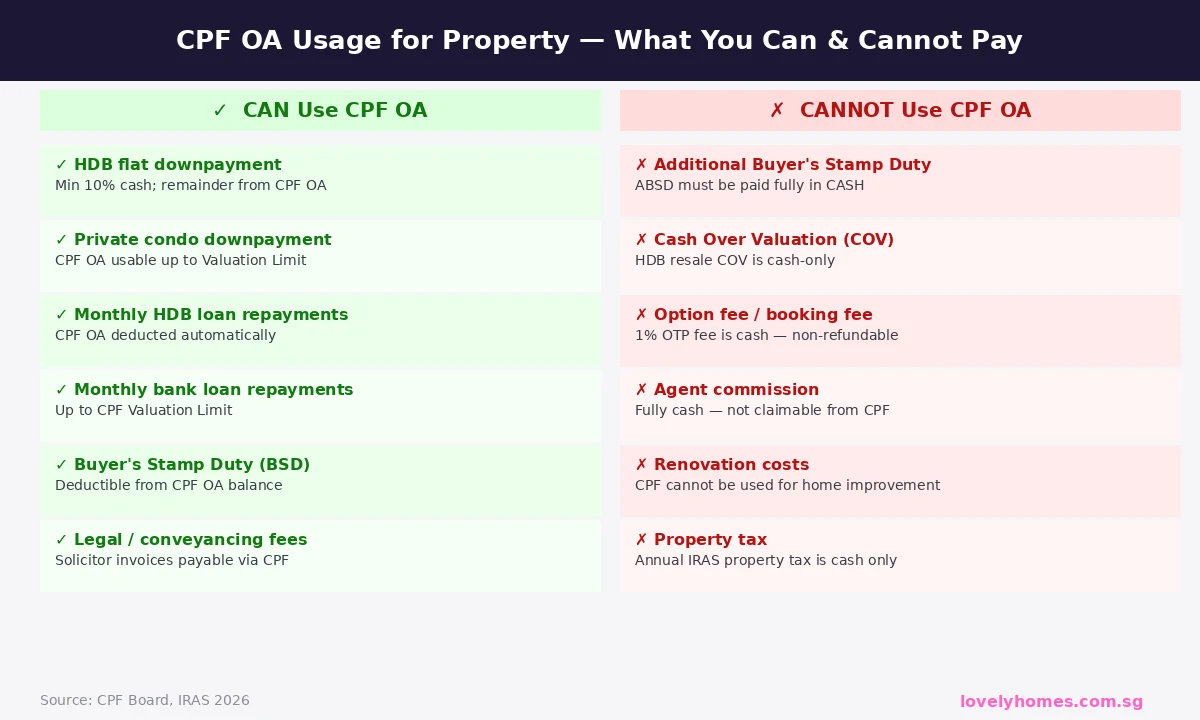
5. Can I use CPF for the 5% OTP booking fee?

No. The 5% OTP must be paid in cash or cashier’s order. CPF can be used from Stage 2 onwards, subject to the Valuation Limit and Withdrawal Limit framework.

6. When is ABSD payable under PPS?

ABSD (and BSD) is payable within 14 days of signing the Sale & Purchase Agreement at Stage 2, not at OTP. Budget the stamp duty separately from the Stage 2 downpayment.

7. What is the Option fee forfeiture if I do not exercise the OTP?

One-quarter of the 5% Option fee — 1.25% of the purchase price — is forfeited to the developer. The remaining 3.75% is returned within a reasonable period. This is the standard URA-prescribed position and cannot be waived.

8. Does PPS apply to Executive Condominiums?

Yes. Executive Condominiums follow the same PPS milestones as private condominiums. The main EC-specific difference is eligibility and resale-restriction rules on the buyer side, not on the payment-schedule side.

9. Does PPS apply to HDB BTO flats?

No. HDB BTO flats follow a different payment schedule: 10% Option fee at booking (mostly from CPF), then the balance at key collection. Construction-linked progressive drawdowns do not apply to BTO.

10. How long does the full PPS cycle take?

Typically 3–4 years from OTP to CSC for a mid-size project: 2–3 months from OTP to S&P, then 24–36 months through construction to TOP, then a further 12 months to CSC.

11. Can I sell the unit before TOP?

Yes, subject to the standard resale rules for private property. You can sell the uncompleted unit to another buyer via a ‘sub-sale’ arrangement, with the original buyer’s obligations novated to the new buyer. The Seller’s Stamp Duty framework applies on the gain, and Additional Buyer’s Stamp Duty applies to the new buyer — both on the sub-sale price, not the original purchase price.

12. What happens if the developer delays TOP?

The Sale & Purchase Agreement specifies a contractual TOP deadline. If the developer misses it, liquidated damages are payable to the buyer per the S&P terms — typically a fraction of the purchase price per month of delay. Review your S&P clauses carefully; liquidated damages are not uniform across developers.

Related guides on LovelyHomes

Disclaimer. This article is for general information only and does not constitute legal, financial or tax advice. Figures referenced reflect the position as at 23 April 2026 and are subject to change without notice. Always verify the latest rates and policies with the official authority — IRAS, HDB, URA, CPF or MAS — before making any property decision. Consult a qualified lawyer, mortgage broker or accountant for advice specific to your circumstances.


How to Sell Your HDB Flat in Singapore 2026: OTP, HFE & Timeline

How to Sell Your HDB Flat in Singapore 2026: OTP, HFE & Timeline

Selling your HDB flat in Singapore is a four-stage process — Intent to Sell, marketing and negotiation, OTP, and completion. Each stage has its own legal document, its own timing constraints, and its own price-breaking pitfalls. This 2026 guide walks through the full sequence from the seller’s side.

See HDB’s official selling page for the regulatory details. This guide explains the practical mechanics.

Quick Answer — Selling an HDB Flat

  1. Check your MOP — 5 years from key collection for most flats.
  2. Register Intent to Sell on the HDB Resale Portal.
  3. List, view, negotiate — typically 4–10 weeks.
  4. Grant the Option to Purchase (OTP) — S$1,000 option fee, 21-day validity.
  5. Both parties submit the resale application — ~8 weeks HDB processing.
  6. Completion appointment at HDB Hub — hand over keys.

Total: 3–4 months from listing to completion.

HDB sale timeline Singapore 2026
Four milestones between listing decision and handing over keys.

Step 1: Check Your MOP

You cannot sell an HDB flat until the Minimum Occupation Period (MOP) has been fulfilled. For most modern flats this is 5 years from key collection; for Plus and Prime flats it is 10 years. See our MOP guide for the exceptions and consequences of breach.

Time spent overseas for more than 6 months at a stretch does not count. If you have been posted abroad, verify with HDB that your effective MOP is what you think it is.

Step 2: Register Intent to Sell

Log into the HDB Resale Portal with Singpass and submit Intent to Sell. This is valid for 12 months. It:

  • Confirms your eligibility to sell (MOP, ethnic quota impact)
  • Allows you to appoint a licensed property agent
  • Triggers HDB’s valuation pipeline when an OTP is later granted
  • Gives buyers assurance that the flat is legitimately for sale

Step 3: Price, List and Negotiate

HDB resale is now in a tight market with COV back on the table. Price correctly:

Pricing benchmarks

  • Recent transacted prices on the HDB Resale Portal for the same block, type, and floor
  • Recent COV spread — has the estate been transacting above or below valuation?
  • Remaining lease — a shorter lease narrows the buyer pool considerably
  • Block-level ethnic quota — a block that is “closed” to major ethnic groups has a reduced buyer pool and attracts weaker offers

Agent vs no-agent

The HDB Resale Portal is designed to let sellers transact without an agent. However, a good agent will:

  • Run marketing on PropertyGuru, 99.co, and Facebook/IG for 2–4 weeks
  • Coordinate viewings (typically evenings and weekends)
  • Qualify buyers (HFE status, ethnic quota compatibility, financing capability)
  • Negotiate on your behalf and draft the OTP
  • Shepherd both parties through resale application submission

Typical seller-side commission in 2026 is 2% of the transacted price. See our agent commission guide.

Step 4: Grant the OTP

Once you and the buyer agree on a price, you grant the OTP. The option fee is fixed at S$1,000. The buyer then has 21 calendar days to exercise by paying the exercise fee (up to S$4,000 more, so total S$5,000 maximum). Key points:

  • If the buyer fails to exercise, you retain the S$1,000 option fee.
  • If the buyer does exercise, the sale becomes unconditional. You cannot then grant an OTP to another buyer.
  • Valuation is requested at this point — if it comes in below the agreed price, the buyer must pay the shortfall in cash (COV).

Step 5: Resale Application

Within 7 days of OTP exercise, both seller and buyer log into the HDB Resale Portal and jointly submit the resale application. You will:

  • Confirm the agreed price and terms
  • Select your conveyancing solicitor (HDB Legal or private)
  • Complete the Resale Checklist — a set of confirmations from both parties
  • Pay the administrative fee (S$80 for 1-2 room, S$120 for 3-room and above)

HDB then processes the application, targeted at 8 weeks. During this time, HDB will audit your ownership, verify the buyer’s eligibility, compute CPF refunds, and arrange the completion appointment.

Step 6: Completion Appointment

Typically 8–12 weeks after the resale application, you attend the completion appointment at HDB Hub. Both parties sign the transfer documents, CPF refund is credited to your Ordinary Account, the buyer’s loan is disbursed, and you hand over the keys.

What Happens to Your CPF and Sale Proceeds

The sale proceeds flow in this sequence:

  1. Outstanding HDB or bank loan is repaid in full from the proceeds.
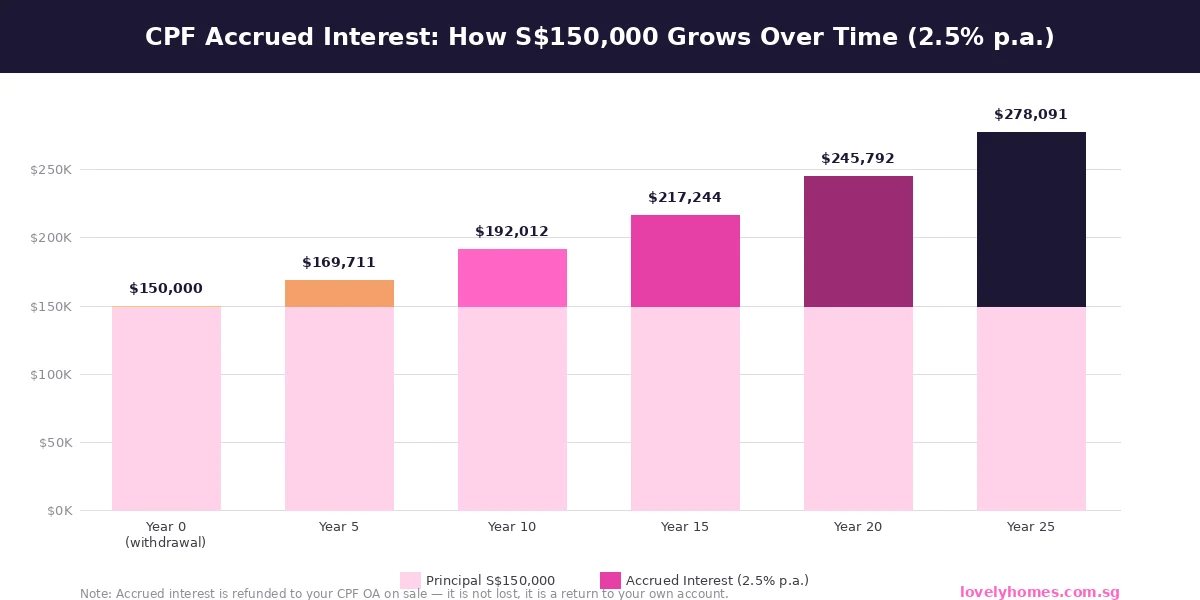
  2. CPF refund — the principal you used from CPF, plus accrued interest, is refunded back into your CPF Ordinary Account. This can be substantial on a flat you have lived in for 10+ years.
  3. Balance — what remains is your cash-in-hand from the sale.

If the flat has appreciated slowly or you used a large CPF component, the CPF refund may consume most of the proceeds, leaving little cash. This is the “negative sale” scenario and a real risk for short-lease resale.

Worked Example: Selling a S$680k 4-Room Flat

You bought the flat 9 years ago for S$420k, paid using S$100k CPF (principal) and a S$300k HDB loan, and have S$150k outstanding on the loan:

Item Amount
Sale price S$680,000
Less: outstanding HDB loan (S$150,000)
Less: CPF refund (principal + 9yr accrued @ 2.5%) (S$125,000)
Less: agent commission (2%) (S$13,600)
Less: legal fees (S$500)
Net cash in hand S$390,900
CPF Ordinary Account now holds S$125,000 more

Common Pitfalls

  • Accepting an offer before verifying buyer HFE status — if the buyer cannot get HFE, the deal collapses.
  • Ethnic quota surprise — HDB rejects the application because the sale would push the block over its EIP cap for the buyer’s ethnic group.
  • Valuation shortfall — the buyer walks away if the valuation is too low and they cannot fund the cash COV.
  • Underestimating CPF accrued interest — many sellers find far less cash in hand than expected.
  • Overestimating the flat — overpricing leads to extended listing periods and ultimately a lower final transacted price.

FAQ — Selling an HDB Flat 2026

Can I sell my flat before MOP is fulfilled?

Only under exceptional circumstances (divorce, death, financial hardship) and with HDB’s explicit approval. Otherwise, sale before MOP is not permitted.

How much cash will I actually get from the sale?

Sale price minus outstanding loan minus CPF refund minus agent commission minus legal fees. For most owners 5–10 years in, cash in hand is 40–60% of sale price.

Do I pay Seller Stamp Duty on an HDB resale?

Only if you have owned the flat for less than 3 years (very rare because of MOP). See our SSD guide.

Can I reject a buyer after accepting their OTP offer?

No. Once the OTP is granted and the buyer has paid the option fee, you are legally bound to sell to them if they exercise within 21 days.

What if the buyer’s HDB loan gets denied?

The buyer can walk away from the OTP, forfeiting the option fee (and exercise fee if already paid). You are then free to re-list and sell to another buyer.

Disclaimer: HDB processes, fees and scheme rules change over time. Verify the current rules with HDB before committing to sale. Consult your conveyancing lawyer for advice on your specific situation.


How to Buy an HDB Resale Flat in Singapore (2026 Step-by-Step)

How to Buy an HDB Resale Flat in Singapore (2026 Step-by-Step)

Buying an HDB resale flat in Singapore in 2026 is a process with clear, legally-defined stages. Miss one, and the deal either stalls or collapses entirely. This guide walks you through every step in the exact order you will actually encounter it — from securing your HDB Flat Eligibility (HFE) letter to collecting the keys.

For the official rules, refer to the HDB Resale Buying page. This article explains what those rules mean in practice and how the numbers add up for a typical 2026 buyer.

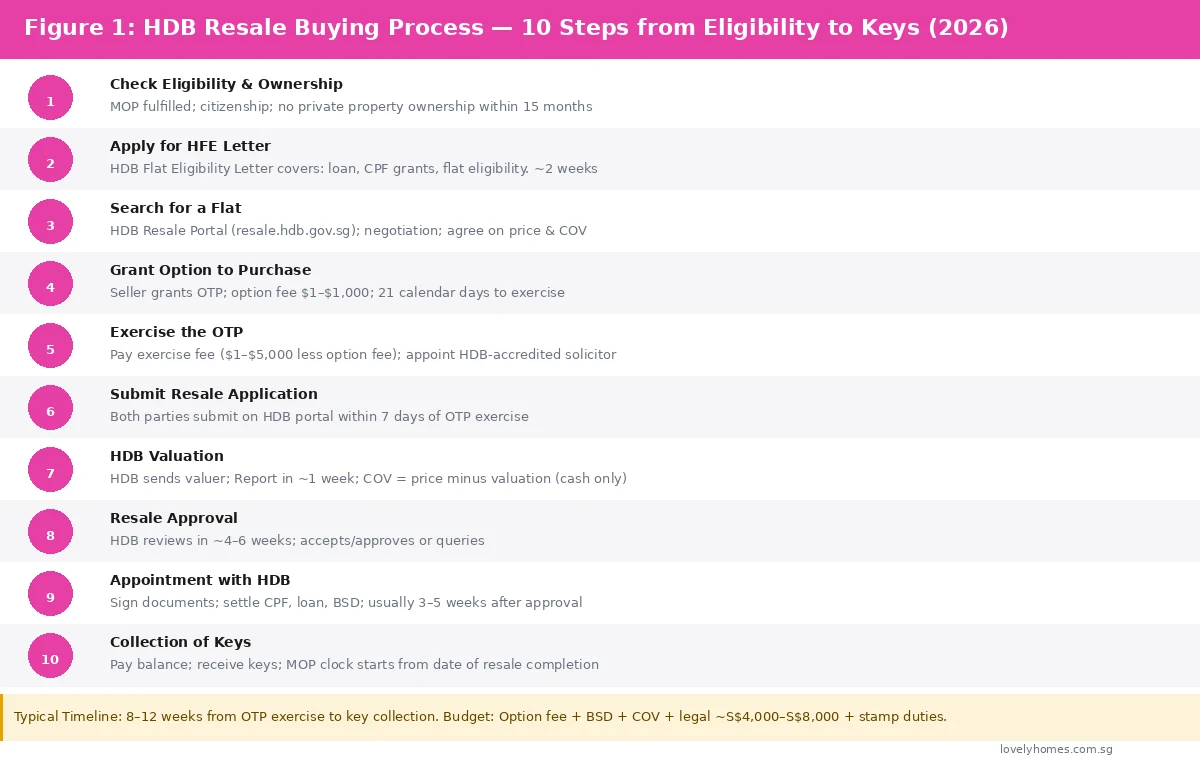
Quick Answer — The HDB Resale Buying Process

  1. Apply for HFE letter on the HDB Flat Portal (~2 weeks processing).
  2. Shortlist and view flats (typically 2–6 weeks).
  3. Negotiate, then receive the OTP from the seller (S$1,000 option fee).
  4. Exercise the OTP within 21 days with the exercise fee (up to S$4,000 more).
  5. Submit the resale application on the HDB Resale Portal.
  6. HDB processes the application (~8 weeks) — appraisal, Resale Checklist, legal, CPF.
  7. Complete the purchase at the HDB Hub appointment and collect keys.

Total elapsed time: typically 12–16 weeks from OTP to keys.

HDB resale buying timeline 5 stages Singapore 2026
The five stages of buying an HDB resale flat, from HFE letter to keys.

Step 1: Apply for Your HFE Letter

The HDB Flat Eligibility (HFE) letter is the gating document for any HDB purchase. It confirms three things in a single statement: whether you are eligible to buy, how much CPF housing grant you qualify for, and the maximum HDB loan you can take.

You apply through the HDB Flat Portal using Singpass. The portal will check your household income, ages, citizenship, and existing property holdings. Processing usually takes around two weeks — but longer if HDB needs clarification on income or existing flat ownership.

The HFE letter is valid for six months, and you cannot exercise any OTP without one. Budget for your HFE to be ready before you start serious viewings — you will see sellers, and agents expect you to have it lined up.

What the HFE letter tells you

  • Whether your household meets the eligibility conditions (at least one SC, under the S$14,000 monthly household income ceiling, no overlapping private-property ownership).
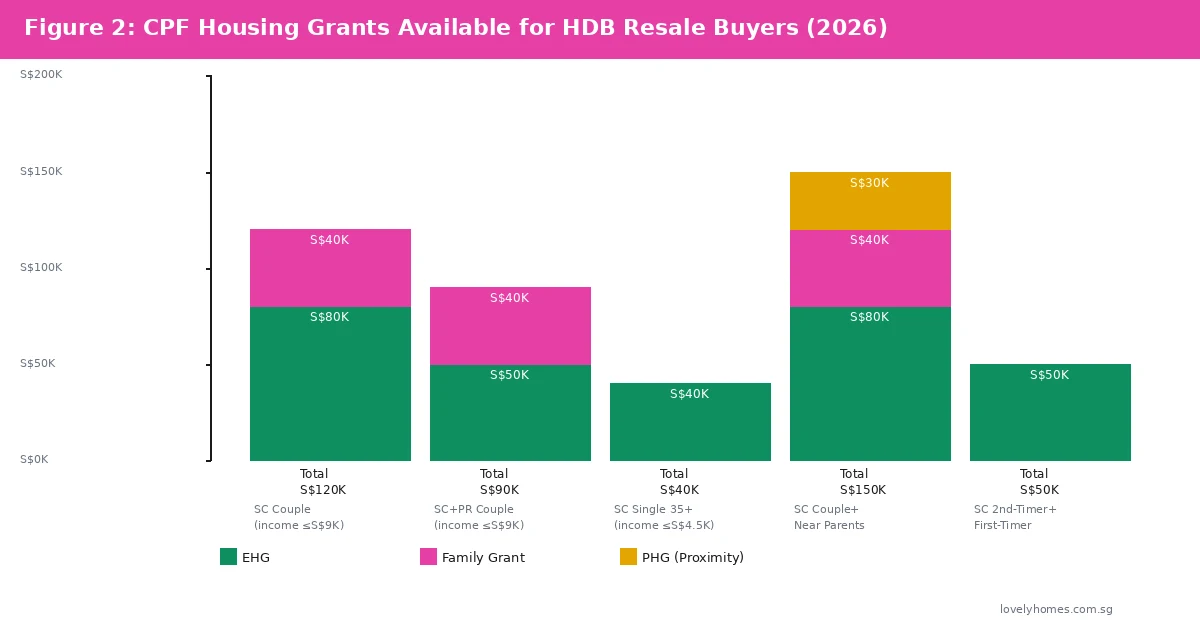
  • The exact CPF Housing Grants you qualify for (CPF Housing Grant, Enhanced CPF Housing Grant, Proximity Housing Grant).
  • The maximum HDB Concessionary Loan you can take, based on TDSR and MSR.
  • The minimum cash required at OTP and exercise stages.

Step 2: Shortlist Flats and Conduct Viewings

Once you have your HFE letter in hand, you can begin serious viewings. The HDB Resale Portal and third-party sites (PropertyGuru, 99.co, ourselves at LovelyHomes) let you filter by town, flat type, remaining lease and recent transacted price.

What to actually evaluate at a viewing

  • Remaining lease: Directly affects your maximum loan tenure and CPF usage. Anything under 60 years of remaining lease starts restricting grants and CPF usage significantly.
  • Condition of the flat: Look past the paint. Check ceilings for water marks (upstairs leaks), windows for water ingress, and door frames for termite damage.
  • Ethnic quota status: Your ethnic group must be under the block-level EIP cap. Ask the agent if the block is “open” for your group.
  • Noise and dust: Traffic, MRT, and construction noise. Visit twice — once at peak hour, once in the evening.
  • Ownership history: The agent should be able to confirm the number of previous owners and whether any structural alterations were made without HDB approval.

Step 3: Negotiate the Price and Receive the OTP

Once you and the seller agree on a price, the seller grants you the Option to Purchase (OTP). The option fee is fixed by HDB at S$1,000, paid on the spot. This buys you the exclusive right to purchase that flat at the agreed price for 21 calendar days.

The OTP is a legally binding document for the seller during those 21 days — they cannot sell to anyone else. But you, the buyer, can walk away by simply not exercising the option. You forfeit the S$1,000 but have no further obligation.

Cash-Over-Valuation (COV) in 2026

If the agreed price exceeds HDB’s official valuation, the gap must be paid in cash — never from CPF or loan. This is Cash-Over-Valuation, and it is firmly back on the table in 2026’s tight resale market. Budget for it if you are bidding on a popular estate or a high-floor unit. See our full COV guide for negotiation tactics.

Step 4: Exercise the OTP

Within the 21-day window, you exercise the OTP by paying the exercise fee. The option fee plus exercise fee cannot exceed S$5,000 combined — typically structured as S$1,000 option + S$4,000 exercise. At this point the sale becomes unconditional.

In the same 21 days, you should:

  • Engage a conveyancing lawyer (HDB’s in-house Legal & Claims Registry is a low-cost option for straightforward cases).
  • If taking a bank loan, finalise your loan offer and submit it for valuation.
  • Prepare the Buyer’s Stamp Duty (BSD) — due within 14 days of OTP exercise.

Step 5: Submit the Resale Application

Once the OTP is exercised, both parties log into the HDB Resale Portal and submit the resale application jointly. The portal walks you through the Resale Checklist, financial plan, and any declarations.

You will pay stamp duty, agree on the completion timeline, and nominate your solicitor. Your CPF refund to the seller, the loan disbursement and the final cash shortfall are all calculated at this point. HDB aims to process the resale application within eight weeks.

Typical fees at application stage

  • Resale application fee: S$80 (1-room / 2-room flats) or S$120 (3-room and above).
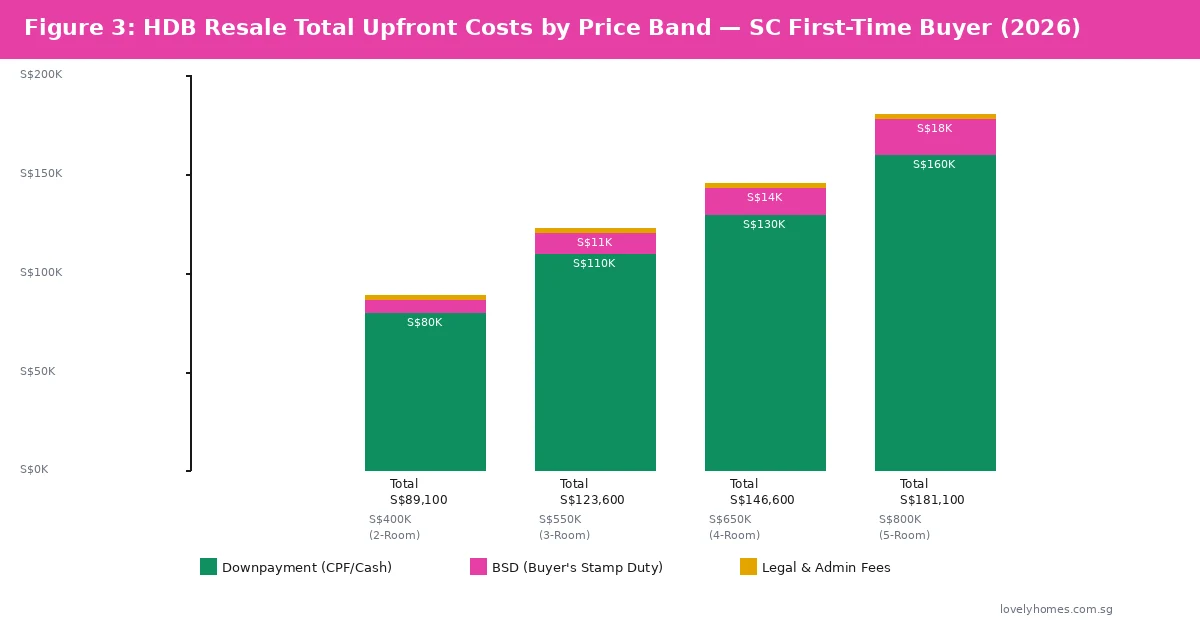
  • Buyer Stamp Duty (BSD): Graduated — 1% on first S$180k, 2% on next S$180k, 3% on next S$640k, 4% thereafter. On a S$600k resale, BSD comes to S$12,600. See our BSD guide for the full maths.
  • Legal fees: S$350–S$600 via HDB Legal, S$1,800–S$3,000 via a private conveyancing firm.

Step 6: Completion and Key Collection

About twelve to sixteen weeks after you first exercised the OTP, you will attend the completion appointment at HDB Hub. Both parties sign the legal transfer documents, CPF disbursements are triggered, your bank or HDB loan is drawn down, and you receive the keys.

From this moment, the flat is legally yours. Your MOP clock starts ticking from this date — see our MOP guide for what that means going forward.

Worked Example: Buying a S$620,000 4-Room Resale Flat

Let’s walk through a realistic 2026 purchase. A young couple, both Singapore Citizens and first-time buyers, buy a 4-room resale flat in Sengkang at S$620,000 — S$30,000 above HDB’s valuation of S$590,000.

Component Amount
Purchase price S$620,000
HDB valuation S$590,000
COV (cash) S$30,000
HDB loan @ 75% of valuation S$442,500
Cash + CPF downpayment (25% of valuation) S$147,500
Buyer Stamp Duty S$13,200
Legal fees (HDB route) ~S$500
Minimum cash needed upfront ~S$60,000

The couple might qualify for an Enhanced CPF Housing Grant of up to S$80,000 depending on their combined income, which offsets a large chunk of the downpayment. See our CPF for property guide for how the grants flow into the purchase.

Common Mistakes That Delay or Kill the Deal

  • No HFE letter in hand: You cannot exercise an OTP without one. Plan at least three weeks of buffer before you start offering.
  • Underestimating COV: It has to come from cash savings, not CPF. Many deals collapse at OTP because buyers find their cash short.
  • Ignoring the ethnic quota: Your offer can be accepted, only to have HDB reject the resale application because the block is full for your group.
  • Not checking structural alterations: Unauthorised renovations (load-bearing wall removal, unpermitted window grilles) are the buyer’s problem after completion.
  • Valuation shock: If the valuation comes in below the purchase price, the cash shortfall must be covered by you — not CPF.

FAQ — HDB Resale Buying 2026

How long does the entire HDB resale process take?

Typically 12–16 weeks from OTP exercise to keys. Add another 2–6 weeks for your flat search, and 2 weeks for the HFE letter.

Can I use CPF to pay the option fee?

No. The S$1,000 option fee and the up-to-S$4,000 exercise fee both come from cash. CPF Ordinary Account funds only flow in at the resale-application stage.

What happens if I cannot exercise the OTP in time?

You forfeit the S$1,000 option fee. The seller is then free to grant the OTP to someone else.

Do I need a property agent to buy HDB resale?

No. HDB’s Resale Portal is designed to let buyers and sellers complete the process without an agent, though you are welcome to use one. Total agent commission on the buyer side is typically 1% of the purchase price.

Can I back out after I exercise the OTP?

Only with the seller’s agreement, and you would likely forfeit both the option and exercise fees (up to S$5,000). HDB does not have a “cooling-off” period for resale buyers once OTP is exercised.

Disclaimer: This is general guidance, not legal advice. Rules, fees and grant amounts change periodically — always verify with HDB directly before committing. Consult a qualified conveyancing lawyer for your specific purchase.


Translate »