HDB BTO vs Resale Singapore 2026: Price, Wait Time, Grants and Which Is Right for You
Quick Answer: HDB BTO vs Resale Singapore 2026
- Price: BTO flats are sold at subsidised prices, typically 30–60% below comparable resale flats. A 4-room BTO in Tampines may be priced around S$380,000, versus S$680,000 or more on the resale market.
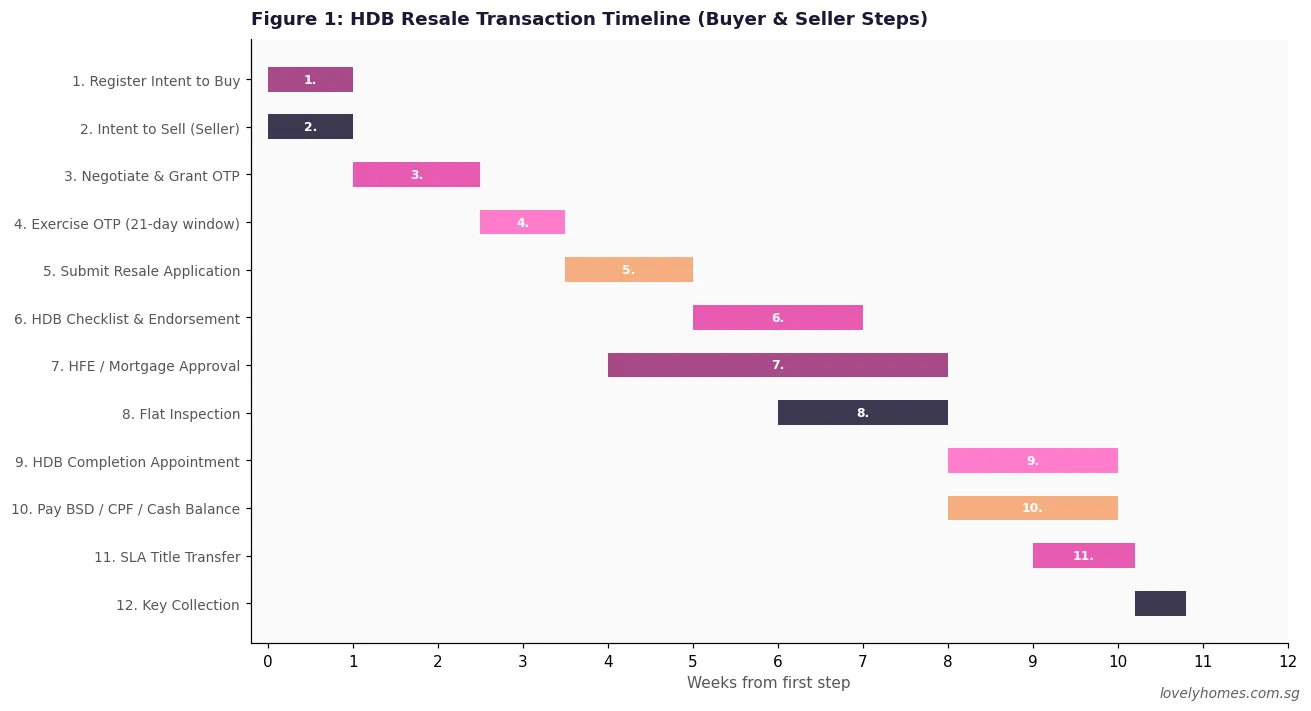
- Wait time: BTO construction takes 4–5 years from selection to key collection for standard flats; 5–6 years for PLH Plus/Prime flats. Resale flats can be occupied within 8–12 weeks of exercising the OTP.
- Grants: Both BTO and resale buyers can access the Enhanced Housing Grant (EHG) of up to S$120,000. Resale buyers additionally qualify for the Family Grant (up to S$50,000) and Proximity Housing Grant (PHG) of up to S$30,000.
- Minimum Occupation Period (MOP): Standard BTO and resale flats have a 5-year MOP. Plus and Prime (PLH) flats carry a 10-year MOP with permanent restrictions on subletting the entire flat.
- Location: BTO projects are often in non-mature estates (Tengah, Woodlands, Punggol, Sembawang), while resale gives access to mature estates (Bishan, Queenstown, Tampines, Toa Payoh) immediately.
- Resale Levy: If you previously received a housing subsidy and buy a second subsidised flat (including BTO), you pay a Resale Levy of S$15,000–S$55,000 depending on the previous flat type.
- CPF Housing Grants are credited directly to your CPF OA and reduce the loan quantum needed — they do not affect your cash outlay directly.
- For most first-timer families earning under S$7,000/month, BTO in a non-mature estate offers the best financial outcome. Above S$7,000/month, resale with grants becomes competitive, especially for families needing immediate occupancy.
I. The Choice Every HDB Buyer Faces
Every year, tens of thousands of Singapore households face the same decision: apply for a new HDB Build-to-Order (BTO) flat, or buy an existing HDB resale flat on the open market? It is not a simple question. The financial stakes are large — the price gap between a subsidised BTO and a comparable resale flat in the same town can run to several hundred thousand dollars — and the practical consequences (particularly the 4-to-5-year wait for BTO keys) can affect life decisions around marriage, children, and career.
This guide compares BTO and resale across five critical dimensions: price, wait time, grants, location options, and MOP rules. It concludes with a worked example showing the total lifetime cost of each option for a typical young couple, and a decision framework for choosing which path suits your situation.
II. BTO Flats: Subsidised Pricing and the Ballot
The HDB Build-to-Order (BTO) programme offers new flats directly from HDB at heavily subsidised prices. As of 2026, HDB launches BTO exercises roughly six times per year, each offering several thousand units across multiple towns. Buyers apply through the HDB Flat Portal during the exercise window, and successful applicants are balloted for a queue number. Higher queue numbers wait longer for flat selection, and lower-demand towns naturally move faster.
BTO eligibility at a glance
To apply for a BTO flat, you must meet HDB’s eligibility criteria. At minimum, at least one applicant must be a Singapore Citizen; co-applicants may be SPR. The household must meet the income ceiling: S$14,000 per month for families; S$7,000 for singles applying under the Single Singapore Citizen scheme (applicable only for 2-room Flexi flats in non-mature estates). You must not own any other residential property at the time of application, and must not have previously received two housing subsidies.
Plus and Prime classification
Since the PLH (Plus/Prime Location Public Housing) model was introduced in late 2021 and subsequently evolved into the Plus/Prime classification under the HDB Redesign in 2024, certain BTO flats in well-connected or central locations carry additional restrictions: a 10-year MOP (versus the standard 5 years), permanent restrictions on subletting the entire flat after the MOP, and eligibility restrictions requiring all owners to be Singapore Citizens at the time of resale. These restrictions are designed to keep Plus/Prime flats within reach of genuine owner-occupiers rather than investors. Buyers of Plus/Prime flats should understand these constraints fully before applying — the restrictions run with the flat permanently.
III. Resale HDB Flats: Market Pricing and Immediate Occupancy
An HDB resale flat is purchased from its existing owner at a price set by negotiation. Unlike BTO, there is no income ceiling for resale (except where grants are being claimed: the EHG income ceiling is S$9,000/month for families). The transaction follows the private-market model: you find a flat, agree a price, sign an Option to Purchase, and complete the sale through the HDB Resale Portal within a few months. There is no ballot, no construction wait, and no uncertainty about which specific flat you will receive — what you inspect is what you buy.
Cash Over Valuation (COV)
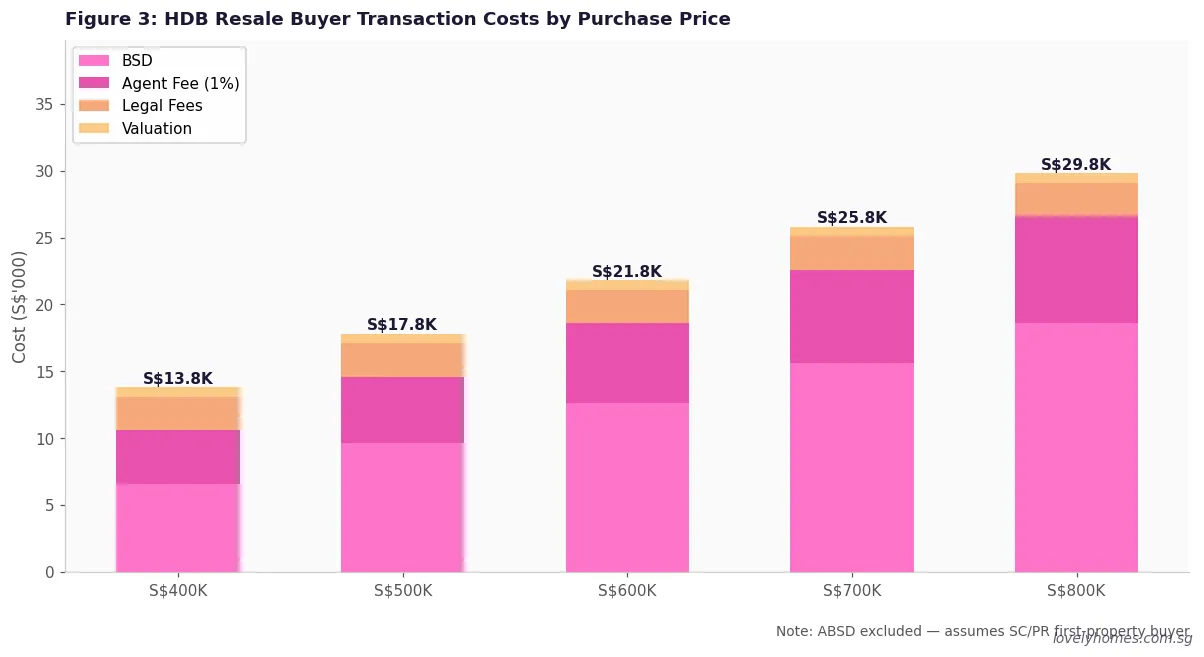
When the agreed purchase price exceeds HDB’s assessed market valuation, the excess is called Cash Over Valuation (COV). COV must be paid in cash — it cannot be financed by an HDB loan, a bank loan, or CPF. COV has been a significant factor in buoyant markets; in H1 2026, median COV for resale 4-room flats in mature estates ran between S$20,000 and S$60,000. Buyers must budget for COV in addition to the standard downpayment. For a flat where the valuation is S$650,000 but the agreed price is S$690,000, the COV of S$40,000 must be in cash — on top of the minimum 5% cash downpayment requirement for bank loans.
HDB Loan vs bank loan for resale
Resale buyers can use either an HDB concessionary loan or a bank loan. The HDB loan offers a rate of 2.6% per annum (pegged at 0.1% above the prevailing CPF OA interest rate), requires no minimum cash downpayment (the entire downpayment can come from CPF OA), and has no income ceiling for the loan itself. Bank loans offer potentially lower rates in favourable interest rate environments, but require a minimum 5% cash downpayment and are subject to the stricter TDSR and LTV limits administered by MAS.
IV. The Price Gap: What You Actually Pay
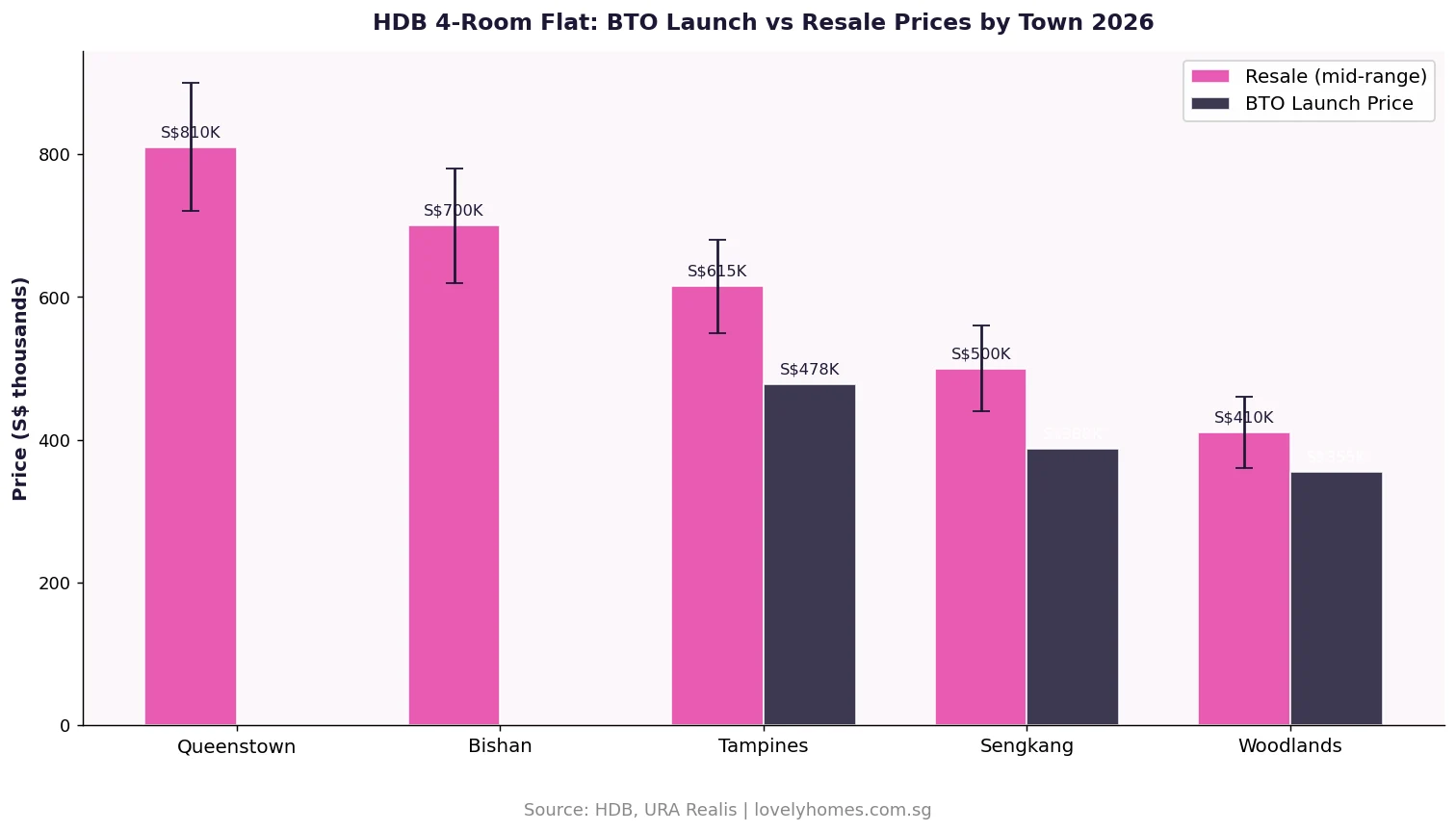
The BTO subsidy is the most powerful financial argument for the BTO route. HDB sets BTO selling prices with reference to market comparable values, then applies a subsidy — meaning a BTO flat is always priced below what an equivalent resale flat in the same estate trades for. The gap is typically widest in mature estates (where BTO supply is limited and resale demand is high) and narrowest in new towns (Tengah, Punggol) where BTO and resale prices are closer because resale supply in those towns is itself thin.
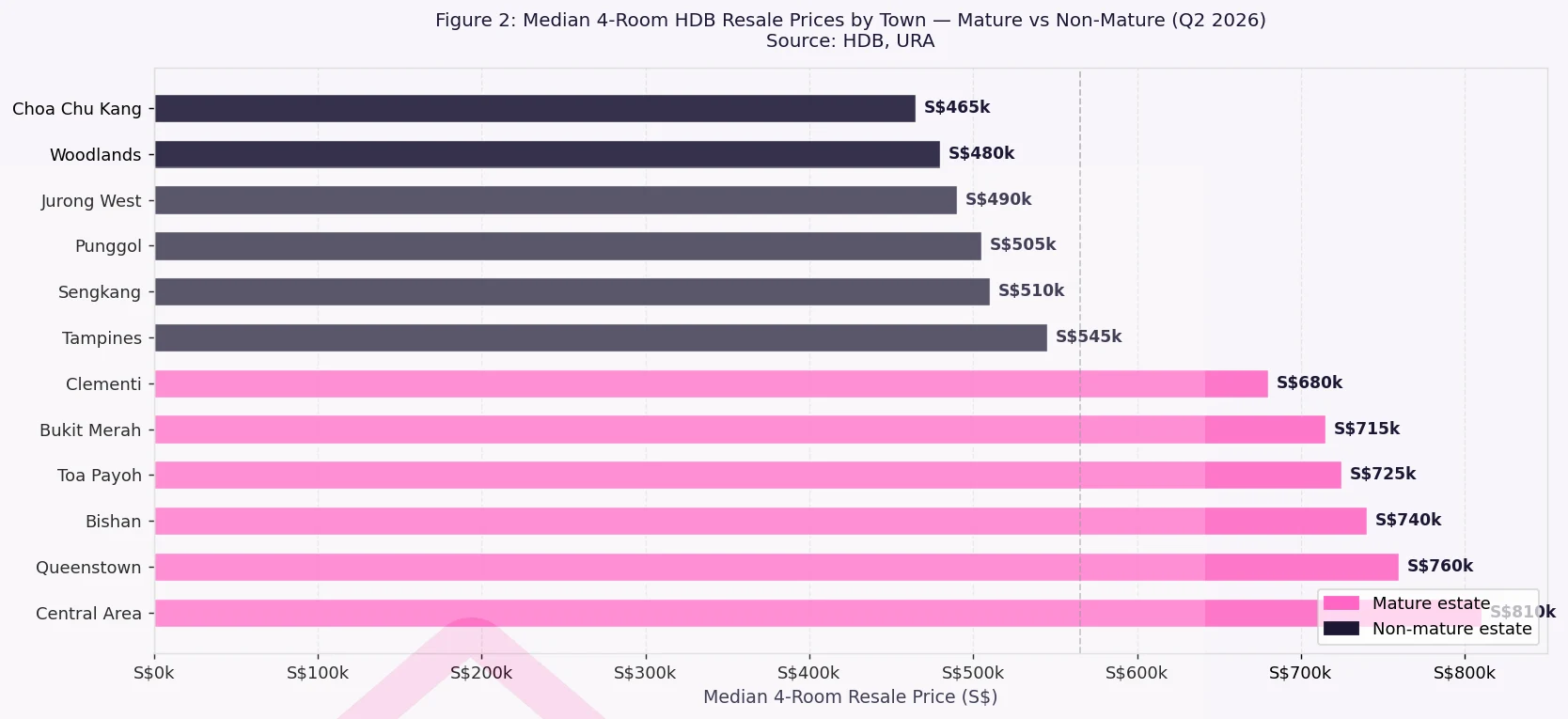
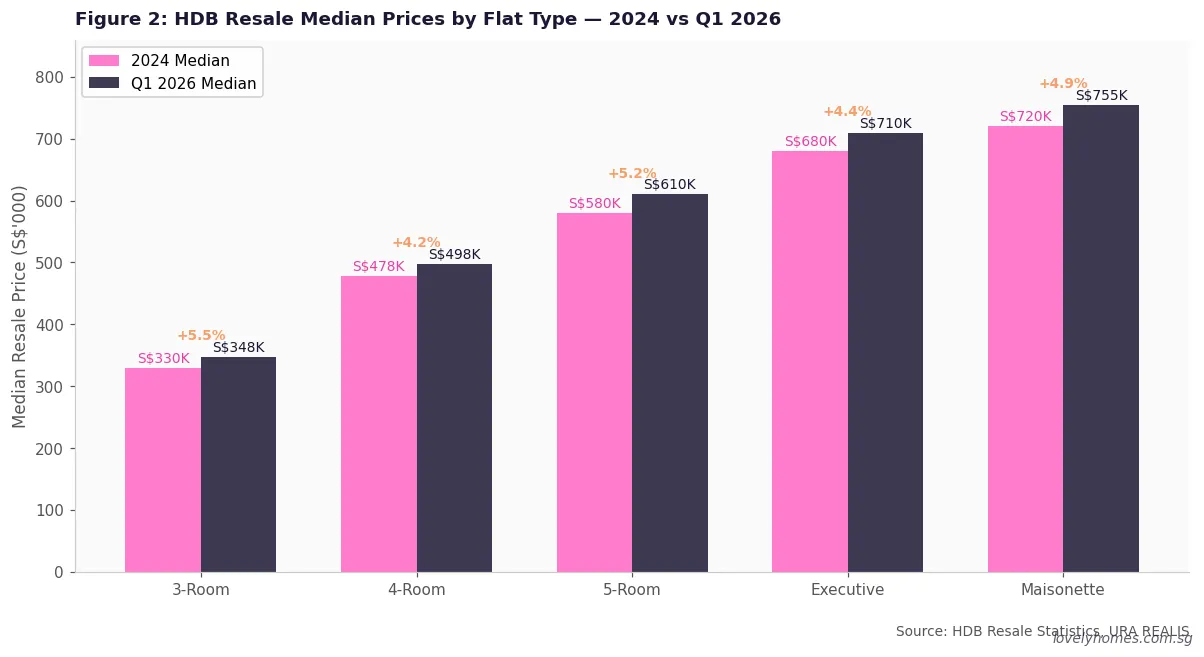
For a 4-room flat in Tampines in 2026, a comparable BTO selling price would be around S$380,000, while resale 4-room transactions in the same town run at S$650,000–S$720,000. The gap of approximately S$300,000 represents the subsidy, though buyers must deduct any grants received (which reduce both the effective BTO price and, for resale, the net resale cost). The counter-argument from resale buyers is that the S$300,000 premium purchases approximately 4–5 years of immediate occupancy — time that has significant economic value if you are currently renting or living with parents.
V. Wait Time: The Most Practical Differentiator
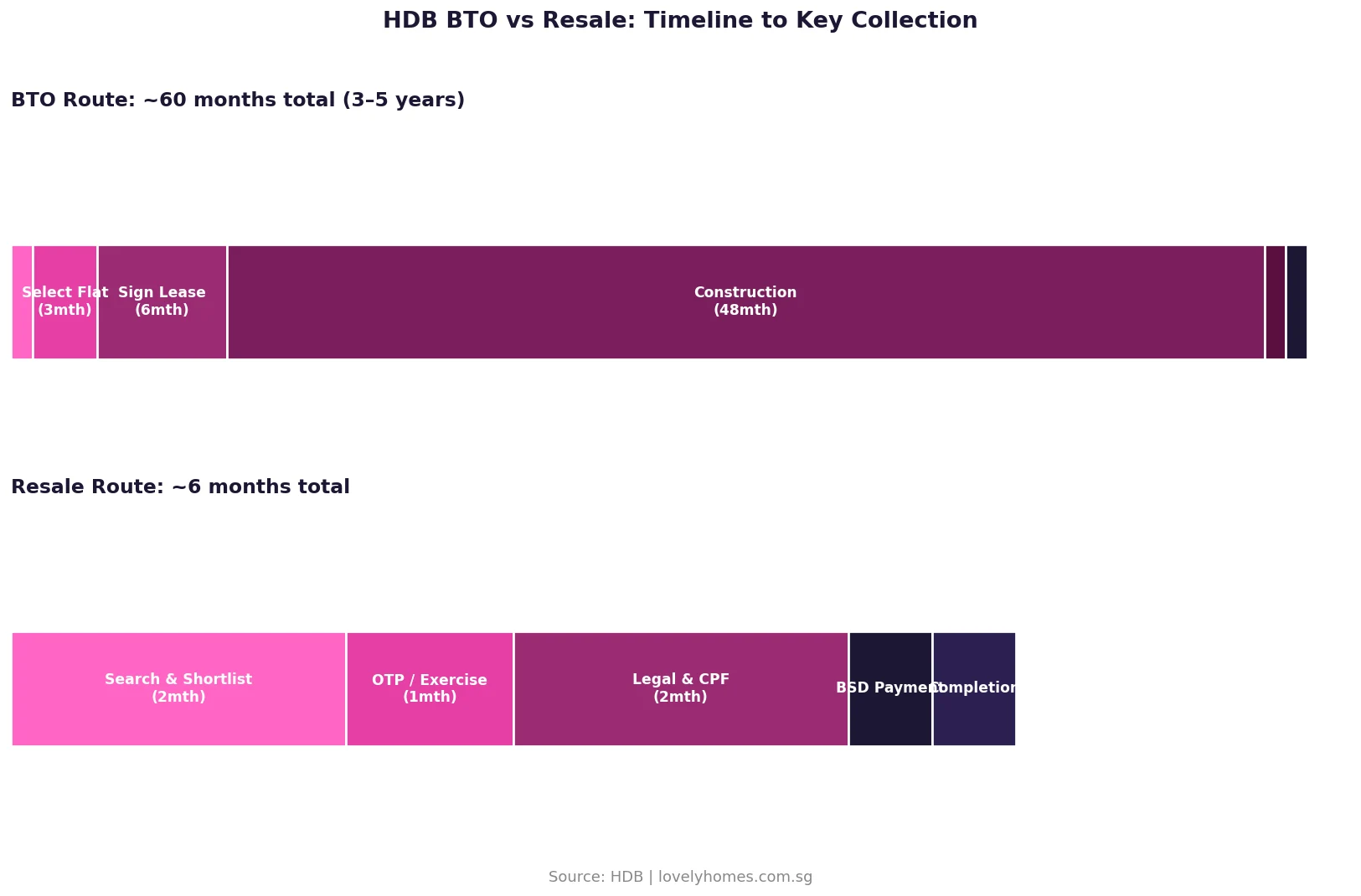
The wait for a BTO flat is the single biggest practical obstacle for many buyers. From the time you submit your HFE Letter application to the time you collect keys for a new BTO flat, the typical elapsed time is 50–60 months for a standard flat and 60–72 months for a Plus or Prime flat. During this period, most buyers continue renting or living with family — at a cost. A young couple renting a 2-bedroom unit at S$2,500/month for 5 years pays S$150,000 in rent, which meaningfully erodes the financial advantage of the BTO subsidy.
Resale, by contrast, can move very quickly. From first viewing to key collection, a motivated buyer can complete a resale transaction in as little as 10 weeks — though 4 to 5 months is more typical when you account for finding the right flat, negotiating, and completing the HDB administrative process. For families with children already enrolled in nearby schools, or who need to accommodate elderly parents immediately, this speed premium is often worth more than the price differential.
VI. Housing Grants: Who Gets What
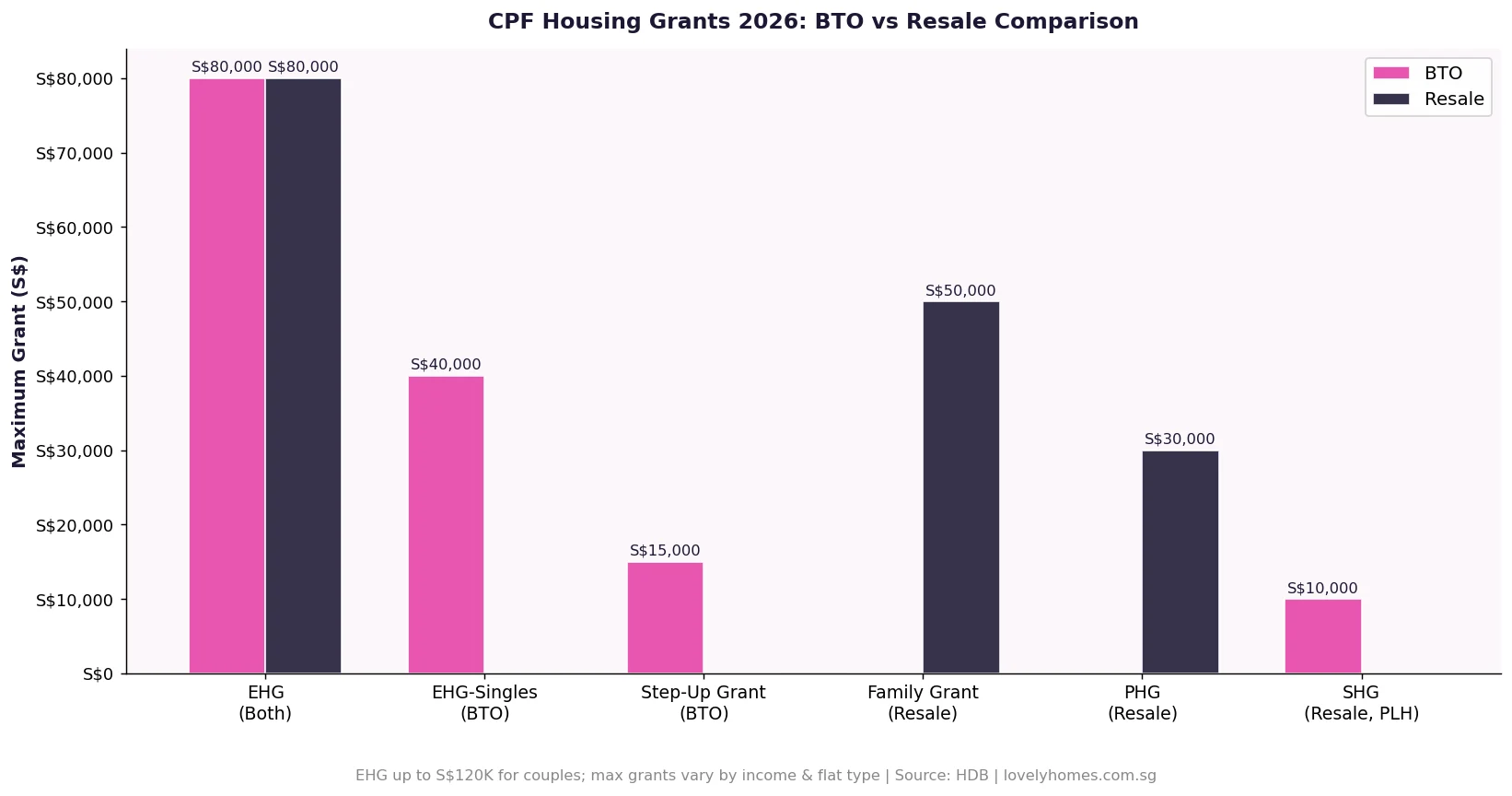
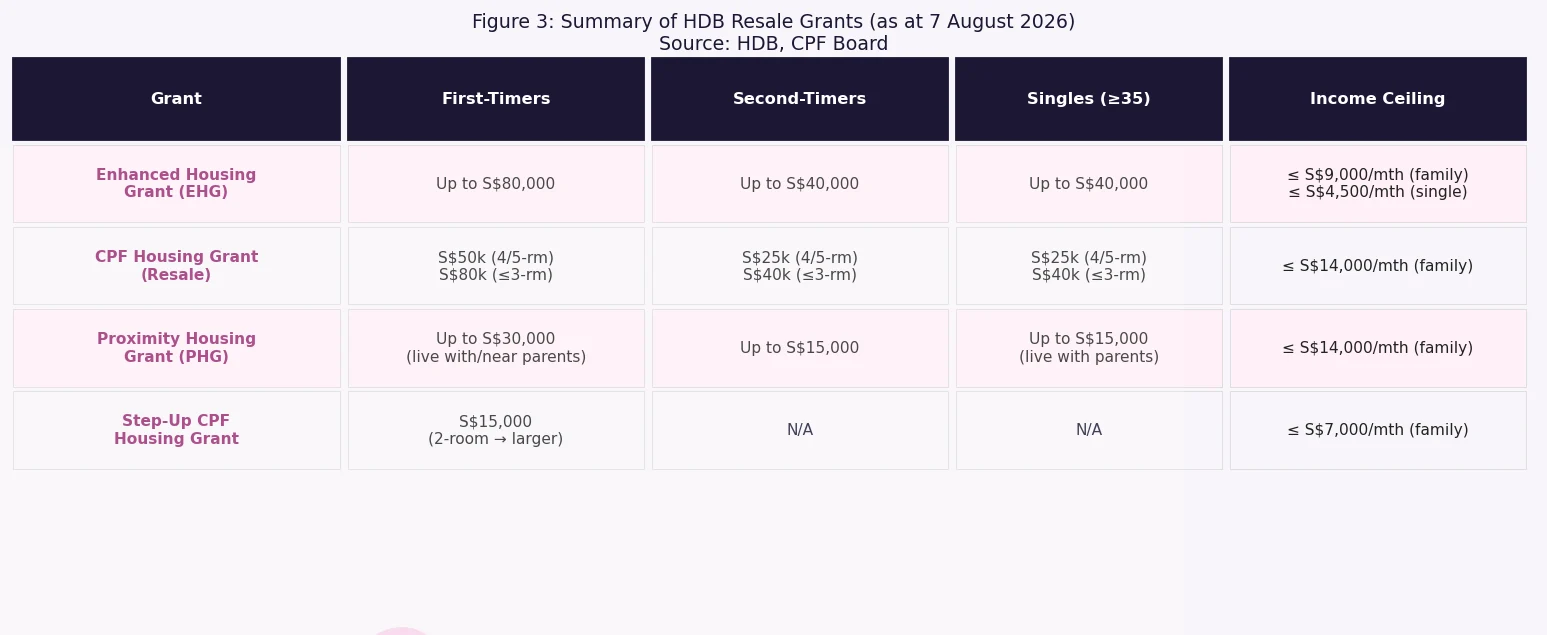
The Enhanced Housing Grant (EHG) is available to first-timer families earning S$9,000/month or less (up to S$4,500 for singles). The maximum EHG is S$120,000, tapering to S$5,000 for households earning S$8,501–S$9,000. It is available for both BTO and resale flats. All grants are credited to the CPF OA of the buyers, reducing the loan and monthly repayments.
Resale buyers have access to two additional grants that BTO buyers cannot claim. The Family Grant (S$50,000 for a family of at least one SC buying their first resale flat) and the Step-Up CPF Housing Grant (S$15,000, for second-timer families moving from a 2-room Flexi to a larger resale flat). The Proximity Housing Grant (PHG) of up to S$30,000 is available to resale buyers living within 4 km of their parents or vice versa. PHG is also available for BTO flats located near parents under the Married Child Priority Scheme but as a grant only for resale.
The combined maximum grant package for a resale buyer (EHG S$120,000 + Family Grant S$50,000 + PHG S$30,000) is S$200,000 — substantially more than the maximum available to a BTO buyer. However, the BTO subsidy embedded in the lower selling price typically exceeds even the largest resale grant package for comparable flats.
VII. BTO vs Resale: Side-by-Side Summary
| Factor | BTO Flat | Resale HDB |
|---|---|---|
| Price level | Subsidised (30–60% below resale) | Open market (higher) |
| Wait time | 4–6 years (incl. construction) | 8–16 weeks |
| Location choice | Limited to launched projects (often non-mature estates) | Any town, any flat |
| Condition | Brand new, with defect warranty | Existing condition (may need renovation) |
| EHG grant | Up to S$120,000 | Up to S$120,000 |
| Family Grant | Not applicable | Up to S$50,000 |
| PHG grant | Not applicable (separate MCPS scheme) | Up to S$30,000 |
| COV | Not applicable | Possible — must be paid in cash |
| MOP | 5 years (standard); 10 years (Plus/Prime) | 5 years (standard); 10 years (PLH resale) |
| CPF usage | From selection and loan disbursement | From key collection |
| Renovation cost | Full renovation needed from scratch | May only need refresh |
| Resale Levy risk | Yes, if previously subsidised flat owned | Yes, if previously subsidised flat owned |
VIII. Worked Example — Mr & Mrs Goh: BTO versus Resale in Tampines
Scenario: SC married couple, combined income S$8,500/month, first HDB purchase, targeting Tampines 4-room
Option A — BTO (standard, non-PLH):
Selling price: S$385,000. EHG: S$30,000 (income S$8,500/month, tapering scale). Net price after EHG: S$355,000. HDB loan at 2.6% 25yr on S$355,000 = S$1,609/month. MSR = 1,609/8,500 = 18.9% — well under 30% cap. Cash outlay: BSD S$5,550, legal ~S$1,500, total cash ~S$7,050. CPF downpayment: nil required for HDB loan (but couple choose to put S$35,500 CPF as 10% voluntary DP to reduce loan). Wait: 4.5 years. Interim: renting a 2BR at S$2,200/month = S$118,800 in rent over 54 months. True total cost at year 5: S$355,000 (loan) + S$118,800 (rent) + S$7,050 (cash) = S$480,850 — noting the flat is worth around S$650,000 at key collection (estimated).
Option B — Resale (mature estate, Tampines):
Purchase price: S$690,000. HDB valuation: S$660,000. COV: S$30,000 cash. EHG: S$30,000. Family Grant: S$50,000. Net loan: S$690,000 – S$30,000 (EHG OA) – S$50,000 (Family Grant OA) = S$610,000. HDB loan 80% on S$660,000 valuation = S$528,000; excess S$82,000 (= S$610,000 – S$528,000) financed by CPF OA. Monthly repayment at 2.6% 25yr on S$528,000 = S$2,391/month. MSR = 2,391/8,500 = 28.1% — just under 30% cap. Cash outlay: COV S$30,000 + BSD S$14,100 + legal S$2,500 = S$46,600. No rent during wait. True total cost at year 5: Loan serviced over 5 years ~S$143,460 (principal + interest); remaining principal ~S$489,000; total cash spent S$46,600 + S$143,460 = S$190,060 — but the flat is already worth S$690,000+ from day 1.
Verdict: For the Goh family, BTO saves approximately S$305,000 in purchase price but requires S$118,800 in rent and 4.5 years of waiting. The net financial advantage of BTO is approximately S$186,000 — significant but not overwhelming when accounting for the lifestyle and timing cost. If Mrs Goh is pregnant, or they need to move out of their current living situation, the calculus shifts toward resale.
IX. The Decision Framework: Which Should You Choose?
Choose BTO if you:
- Can wait 4–5 years (ideally newly married, no children yet)
- Have a lower income (EHG tapering makes BTO far cheaper)
- Are flexible on location and willing to consider non-mature estates
- Want a brand-new flat with developer defect warranty
- Plan to customise the entire interior from scratch
Choose Resale if you:
- Need to move within 6 months (rental expiry, child’s school enrolment)
- Must live near parents (PHG + family proximity requirements)
- Need a specific mature estate (schools, amenities, elderly parents nearby)
- Are a second-timer and need immediate move-up
- Have a higher income and the larger grant package bridges the cost gap
X. What May Change: BTO Supply and Policy Outlook
The government’s ramp-up to approximately 100,000 BTO units delivered between 2022 and 2025 has been maintained, with 2025 and 2026 exercises continuing at a pace of roughly 20,000–22,000 units per year. HDB has been strategic about including more BTO exercises in mature estates to meet demand from couples who might otherwise default to resale. The introduction of the 2022 Ballot Category (first-timer families receive two ballots versus one for others) has improved first-timer success rates. However, mature-estate BTO flat supply remains structurally tight given limited land availability.
Resale prices rose modestly through H1 2026, with the HDB Resale Price Index at 202.7 in Q2 2026 — a slight decline of 0.3% QoQ from Q1 2026 (203.0), suggesting the market is cooling at the margins. The government has no stated plans to remove or significantly loosen BTO eligibility criteria, and the Plus/Prime framework is likely to persist. Buyers who have been in the BTO queue since 2022–2023 are beginning to receive their keys in 2026–2027, which may add a modest wave of secondary market supply as some of them sell or upgrade.
XI. Frequently Asked Questions
Can a Singapore Permanent Resident (SPR) apply for a BTO flat?
SPRs cannot apply for a BTO flat on their own. However, an SPR can co-apply with a Singapore Citizen spouse (or parent, sibling, or child under the Public Scheme), provided at least one applicant is an SC. The SC must be the primary applicant. Under the Fiancé/Fiancée Scheme, an SC engaged to an SPR may apply, but the SPR must obtain SC status within six months of key collection. SPRs buying HDB resale flats on their own (without an SC co-applicant) are permitted, but they do not qualify for CPF Housing Grants and must use the Resale application only.
What is the Resale Levy and does it apply to me?
The Resale Levy applies to second-timer households who have previously received a direct subsidy (i.e., a first subsidised BTO or SBF flat), and who are now buying a second subsidised flat (another BTO or an EC from the developer). If you sold your first subsidised flat, HDB deducts the levy from the proceeds of that sale. If you still own it (e.g., you’re buying a concurrent BTO), the levy is paid in cash. The levy amount depends on your first flat type: S$15,000 for a 2-room Flexi, S$30,000 for a 3-room, S$40,000 for a 4-room, S$45,000 for a 5-room or 3Gen, and S$55,000 for an executive flat. Resale Levy does NOT apply if you are buying a resale flat — it only applies to purchases of new subsidised flats from HDB or a developer (EC).
Can I rent out my BTO or resale HDB flat before the MOP ends?
You cannot sublet the entire flat before the MOP expires. However, you may rent out individual bedrooms (not the entire flat) from the date of key collection, subject to HDB’s approval and prevailing subletting guidelines. HDB requires that you (the owner) continue to occupy the flat as your registered address and that the total number of occupants (including tenants) does not exceed the flat’s approved occupancy limit. For a 4-room flat, HDB generally permits renting out up to 3 bedrooms as long as the owner remains in residence. Overseas income earners who are temporarily overseas may apply to HDB for a subletting waiver under specific conditions. Violation of subletting rules is a serious offence — HDB can compulsorily acquire the flat.
How does the Enhanced Housing Grant (EHG) work for resale versus BTO?
The EHG is income-tested: the full S$120,000 is available to households earning S$1,500/month or less; it tapers down to S$5,000 for households earning S$8,501–S$9,000/month. The EHG quantum is identical whether you are buying a BTO or resale flat. It is credited to your CPF OA, from which it is then used toward the purchase price, reducing the loan amount. For BTO, the grant is applied at the time of booking; for resale, it is released at the completion appointment. Critically, for resale, the EHG cannot be used to pay Cash Over Valuation — only the base price (up to the valuation) can be funded from CPF. The COV above valuation is always cash.
What is the ballot priority system for BTO and how do I improve my chances?
HDB’s ballot priority system gives different numbers of ballot chances to different applicant categories. First-timer families applying under the Public Scheme receive two ballot chances per exercise; second-timers receive one. Married Child Priority Scheme (MCPS) applicants who want to live near parents receive an additional ballot. Applicants who have not been successful in three or more exercises may apply for the Married Child Priority Enhanced Ballot, which provides a higher ballot queue number priority. The Parenthood Priority Scheme (PPS) reserves a portion of units (up to 30%) for first-timer married couples with at least one Singapore Citizen child. To maximise your chances, apply in exercises with lower demand-to-supply ratios (typically non-mature estates), apply early to accumulate ballot count, and use all available priority schemes for which you qualify.
Is it possible to use both an HDB loan and a bank loan for the same purchase?
No. You must choose either an HDB concessionary loan or a bank loan — you cannot combine the two for the same property. The distinction matters because they have different LTV limits (HDB: 80% of valuation; bank: 75% on first property), different minimum cash requirements (HDB: zero; bank: minimum 5% cash), and different stress-test rules. You can switch from an HDB loan to a bank loan at any point during the loan tenure (refinancing), but you cannot revert back to an HDB loan once you have switched. The inability to return to the HDB loan is a significant consideration: bank loans, while potentially cheaper in low-interest environments, expose you fully to rate movements, whereas the HDB rate is effectively pegged to the CPF OA rate, which has historically been more stable.
Can I buy a private property while waiting for my BTO to complete?
Yes, with conditions. During the BTO construction period (before key collection), you may purchase private residential property — the MOP does not begin until keys are collected. However, if you own private property at the time of BTO key collection, HDB requires you to dispose of the private property within six months of collecting the BTO keys. If you fail to do so, you are in breach of HDB’s conditions, which can result in compulsory acquisition of the BTO flat. Note also that buying private property before BTO key collection means you will owe ABSD on the private property (since you are treated as already owning the BTO under the Agreement for Lease). The ABSD is 20% for an SC’s second property. Planning your property ladder while in the BTO queue requires careful sequencing with a property lawyer.
Click anywhere to close